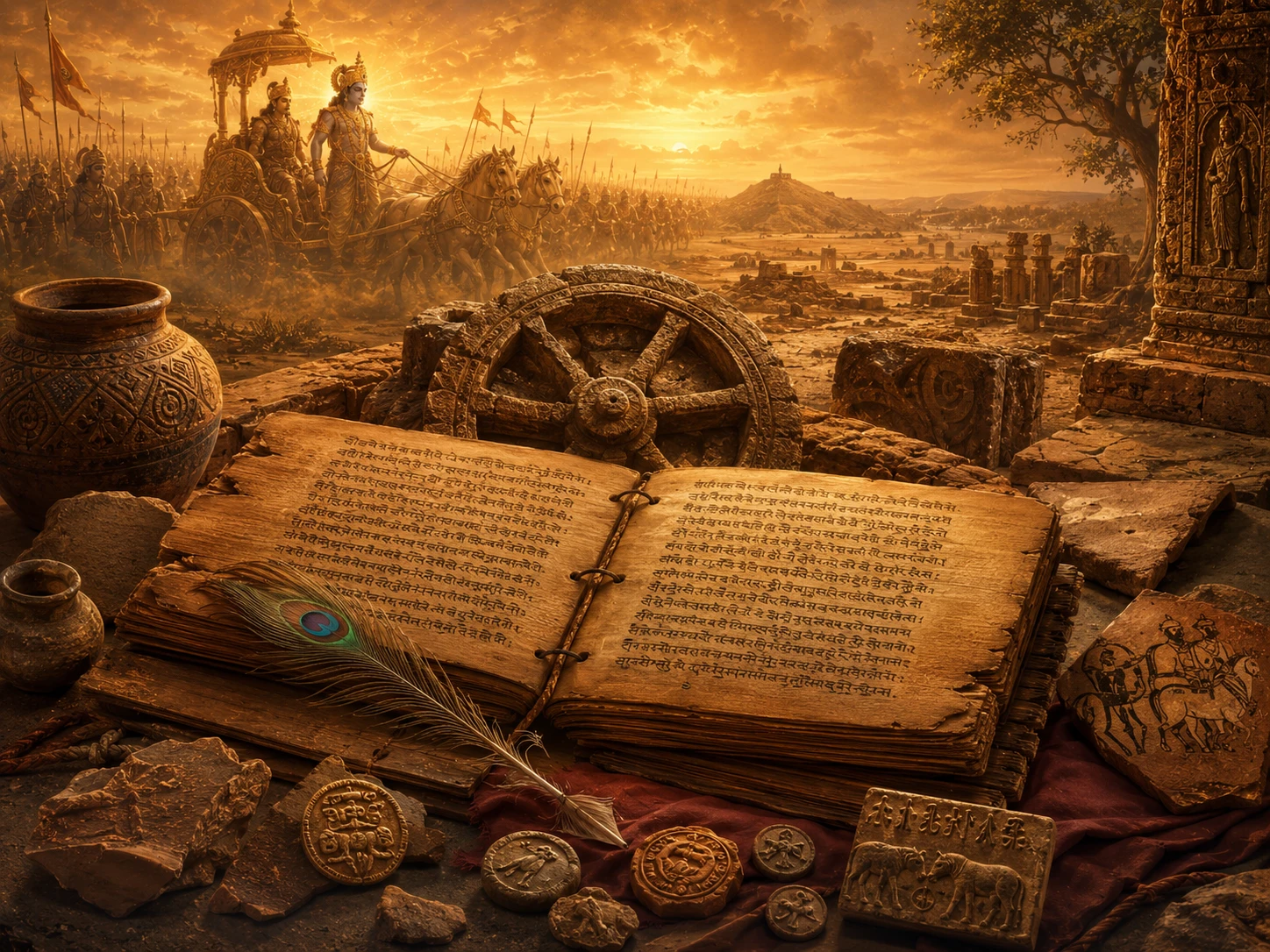
Mahabharata -- History or Myth? What the Evidence Actually Says
महाभारत -- इतिहास या मिथक? साक्ष्य वास्तव में क्या कहते हैं
In 1950, a young archaeologist named B.B. Lal began digging at a mound near Meerut in Uttar Pradesh. The site was called Hastinapur -- the same name as the capital of the Kuru kingdom in the Mahabharata. Lal was not looking for proof of an epic. He was looking for pottery. Specifically, he was trying to fix the chronological position of a distinctive grey pottery with painted black geometric designs -- what archaeologists now call Painted Grey Ware (PGW).
What he found changed the conversation forever.
The excavation revealed five distinct cultural layers spanning over two thousand years. In the PGW layer (Period II, roughly 1100-800 BCE), Lal found copper utensils, iron arrowheads, ivory dice -- remarkably consistent with the material culture described in the Mahabharata. He also found evidence of a catastrophic flood that had destroyed the settlement -- exactly matching the Puranic account that a Ganga flood washed away Hastinapur during the reign of Nichakshu, the fifth king after the Kurukshetra war, forcing the capital's shift to Kaushambi.
One site proves nothing. But then the same PGW pottery turned up at Kurukshetra. At Indraprastha (Purana Qila, Delhi). At Panipat. At Mathura. At Kampilya. At Barnawa. At over 35 sites named in the Mahabharata -- all showing the same cultural pattern, in the same archaeological layer, across the same geographical region the epic describes.
This article does not claim the Mahabharata is proven history. That would be intellectually dishonest. What it does is lay out five categories of evidence -- archaeological, astronomical, oceanographic, geological, and genealogical -- and let you see for yourself why the question 'history or myth?' may be the wrong question entirely. The more honest framing might be: 'How much history is encoded in this myth, and how much myth has been layered onto this history?'
यदिहास्ति तदन्यत्र यन्नेहास्ति न तत् क्वचित्॥
yadihāsti tadanyatra yannehāsti na tat kvacit ||
What is found here (in the Mahabharata) may be found elsewhere; what is not found here is found nowhere.
— Mahabharata, Adi Parva 1.56.33
Evidence 1 -- Archaeology: The Ground Remembers
The strongest category of evidence comes from what lies under the soil at sites the Mahabharata names.
B.B. Lal, who later became Director General of the Archaeological Survey of India, spent decades excavating Mahabharata-associated sites. His key findings form a remarkably consistent pattern. At Hastinapur, Period II (PGW layer, c. 1100-800 BCE) yielded copper objects, iron arrowheads, bone tools, ivory dice (consistent with the Chaupar game central to the epic's plot), and evidence of a catastrophic Ganga flood that matches the Puranic record of the capital's abandonment. At Indraprastha (identified with Purana Qila in Delhi), the same PGW layer was found beneath later Mauryan remains. At Kampilya, the Panchala capital where Draupadi's Swayamvar took place, PGW was excavated in consistent stratigraphy.
The 2018 Sanauli excavation in Baghpat district, Uttar Pradesh, added a dramatic new dimension. The dig was led by S.K. Manjul, Director of ASI's Institute of Archaeology, with Arvin Manjul as co-director. The team unearthed three two-wheeled vehicles with solid disc wheels studded with triangular copper pieces, copper-sheet covering on the body, and a high dashboard -- presented by the excavators as chariots. Warrior burials alongside the vehicles contained copper helmets with embossed decoration, antenna-hilted swords (one 70 cm long with a wooden hilt wrapped in copper strips), daggers, shields, a torch, combs, and ornate copper coffins with floral motifs. Carbon dating confirmed the burials to approximately 1900-2000 BCE. This is significant because the Mahabharata extensively describes chariot warfare, and previously critics argued such vehicles were not indigenous to the subcontinent. The academic debate is real -- some archaeologists note the solid wheels (no spokes) technically make these carts rather than true spoked-wheel chariots, while the excavators argue the copper reinforcements served a spoke-like function. Regardless of terminology, the find demonstrated that wheeled warrior vehicles existed in the Ganga-Yamuna doab by the early second millennium BCE. S.K. Manjul delivered a lecture in July 2018 titled 'Mahabharata and Archaeology: PGW vis-a-vis OCP/Copper Hoard Culture,' arguing that OCP (Ochre Coloured Pottery) culture, not just PGW, might correlate with the Mahabharata period -- pushing the timeline back several centuries from B.B. Lal's original PGW-based estimate of 1100-900 BCE to approximately 2000 BCE. This is the kind of revision that makes history exciting for a JEE aspirant in Kota who is told science is static -- here, the evidence forced the experts to update their own hypothesis.
At Kurukshetra itself -- the 'Dharmakshetra' where the 18-day war is set -- excavations have uncovered iron arrowheads, spearheads, and PGW pottery. These do not prove that Arjuna or Karna fought here, but they confirm that large-scale settlement and warfare occurred in this exact location during a period broadly consistent with the epic's internal timeline.
The critical academic point, made by Lal himself: the Mahabharata describes a specific political geography of Late Vedic North India. Archaeological evidence confirms urban centres existed exactly where described, with material culture matching what the text describes. The geography is not invented.
Evidence 2 -- Astronomy: The Sky Does Not Lie
The Mahabharata, particularly in the Bhishma Parva and Udyoga Parva, contains over 200 specific references to celestial events -- planetary positions, eclipses, comets, nakshatra configurations, and seasonal markers. These are not vague poetic descriptions. They are precise astronomical statements that can be tested against modern planetarium software.
Three astronomical observations are especially significant:
First, the text describes paired eclipses -- a lunar eclipse on Pournima (full moon) followed by a solar eclipse on Amavasya (new moon) within 13-14 days -- just before the war begins. Paired eclipses within this interval are astronomically rare and can be computed for specific years.
Second, the text mentions specific planetary positions: Saturn afflicting Rohini nakshatra, Mars in Jyeshtha, Jupiter in Shravana/Vishakha, and comet-like appearances (Dhumaketu) in the sky. When combined, these create a singular sky-map that can be matched to specific dates using software like Stellarium or Planetarium Gold.
Third, researchers like Nilesh Nilkanth Oak have highlighted the Arundhati-Vashistha observation -- a reference to the star Arundhati (Alcor) appearing to walk ahead of Vashistha (Mizar) in the Saptarishi (Ursa Major) constellation. Due to proper motion of stars, this configuration is dated to approximately 5561 BCE. This dating is contested by many scholars who place the war between 1400-900 BCE based on archaeological evidence, but the astronomical observation itself is verifiable.
The honest assessment: different methods of computing the astronomical data yield different dates -- commonly 5561 BCE (Oak), 3067 BCE (traditional Kali Yuga calculation), or 1400-900 BCE (archaeological correlation). The dates disagree. But the astronomical observations themselves are embedded in the text and are not random -- they describe a real sky that existed at some point in the past. The question is when, not whether.
Evidence 3 -- Oceanography: The City Under the Sea
The Mahabharata's Mausala Parva (7.41-42) explicitly states that the ocean submerged Dwarka immediately after Krishna's death. For centuries, historians treated this as mythological embellishment. Then marine archaeologists went looking.
Dr. S.R. Rao of the National Institute of Oceanography led 12 underwater expeditions between 1983 and 1990 in the Arabian Sea off the Gujarat coast. His team, using SCUBA equipment, side-scan sonar, and underwater cameras, documented submerged stone building blocks -- walls, bastions, and pillars -- in water depths of 3 to 12 metres. They found over 120 stone anchors of various types (three-holed, prismatic, triangular), confirming Dwarka was a major port city. Among the recovered artefacts were a Late Indus-type seal, chert blades, an inscribed votive jar, and Lustrous Red Ware pottery dated to approximately 1600-1500 BCE. The variety of finds indicated not just habitation but active trade -- the stone anchors alone suggest a maritime culture sophisticated enough to build deep-water vessels. Underwater excavation at Dwarka is only possible during November to February, when low tides and calm seas permit diving. Even within this window, the team had only about 40-45 effective diving days per season -- making each artefact recovery a feat of planning as much as archaeology.
At Bet Dwarka, the team recovered a conch-shell seal depicting a three-headed animal -- believed to correspond to the identification seal (mudra) mentioned in the Harivamsa that residents needed to enter the city. This is a specific textual detail matched by a specific archaeological find.
Rao's own assessment was carefully worded: the available evidence confirms the existence of a city-state with satellite towns, submerged in the second millennium BCE, consistent with Mahabharata and Puranic descriptions. He did not claim this was conclusively 'Krishna's Dwarka' -- but he noted the convergence was extraordinary.
The ASI's Underwater Archaeology Wing resumed excavations in 2007 under Alok Tripathi, discovering additional structural fragments and a wooden block from a submerged circular structure that may be thousands of years old. As of 2025, excavations continue with advanced sonar and AI-assisted imaging technology.
The sober conclusion: a significant port city existed where the Mahabharata places Dwarka. It was submerged, as the text says. The material culture is broadly consistent with the epic's period. What we cannot yet confirm is whether this specific city is the Dwarka of Krishna or one of several historical settlements at the same location. The text was right about the place and the submergence. The question of identity remains open.
Evidence 4 -- Geology: The River That Vanished
The Mahabharata and the Rigveda both describe the Saraswati as a mighty river -- 'best of mothers, best of rivers, best of goddesses' (Rigveda 2.41.16). The epic places the Kurukshetra battlefield between the Saraswati and the Drishadvati rivers. By later Puranic times, the texts record the Saraswati as drying up and disappearing underground at a place called Vinashana ('the place of disappearance').
For over a century, Western scholars treated the Saraswati as a mythical river. Then satellite imagery changed everything.
ISRO (Indian Space Research Organisation) and French satellite data from the 1990s and 2000s identified a massive paleochannel -- a dried-up riverbed -- running through Rajasthan and Haryana, tracing almost exactly the path described in ancient texts. The channel, now called the Ghaggar-Hakra paleochannel, is up to 8 km wide in places -- confirming this was once a major Himalayan river system, not a stream.
Geological studies by V.M.K. Puri and B.C. Verma of the Geological Survey of India, along with ISRO's remote sensing data, established that the Saraswati was fed by Himalayan glaciers and dried up due to tectonic shifts that diverted its tributaries to the Yamuna and Sutlej systems -- a process that occurred over centuries, consistent with the gradual drying described in later Vedic and Puranic texts.
The Mahabharata describes Balarama undertaking a pilgrimage along the Saraswati during the 18-day war. The sites he visits can be mapped along the paleochannel with remarkable accuracy. The river was real. It was mighty. It dried up. And the texts recorded its decline with geographical precision that satellite technology has now confirmed.
अम्बितमे नदीतमे देवितमे सरस्वति। अप्रशस्ता इव स्मसि प्रशस्तिमम्ब नस्कृधि॥
ambitame nadītame devitame sarasvati | apraśastā iva smasi praśastim amba nas kṛdhi ||
O best of mothers, best of rivers, best of goddesses, O Saraswati -- we are unhonoured, grant us honour, O Mother.
— Rigveda 2.41.16
Evidence 5 -- Genealogies: The King Lists That Cross-Check
The Harivamsa, Vishnu Purana, Bhagavata Purana, Matsya Purana, and Brahma Purana all independently record genealogies of the Kuru, Yadava, and Panchala dynasties -- the royal lineages central to the Mahabharata. These are not identical copies. They are independent recensions that converge on the same key figures and chronological relationships, suggesting a common historical kernel.
The genealogies link historical kings to the Mahabharata timeframe. For instance, the Puranic king lists provide the succession from Parikshit (Arjuna's grandson, who became king after the war) through to the Nanda dynasty and the Mauryas -- figures that are independently attested by Greek and Buddhist sources. Working backwards from the Mauryas through the Puranic king lists, scholars have attempted to date the Mahabharata war, arriving at estimates ranging from 1400 BCE to 3100 BCE depending on how average reign lengths are calculated.
This evidence is the weakest of the five categories because Puranic genealogies contain mythological elements (divine parentage, impossibly long reigns) mixed with what may be historical records. They cannot be treated as literal timelines. But the convergence of multiple independent Puranas on the same genealogical structure is significant -- it suggests an underlying tradition of historical record-keeping, even if the precise numbers have been mythologized over time.
The UPSC General Studies syllabus includes Puranic genealogies as a legitimate source for reconstructing ancient Indian chronology, alongside archaeological and numismatic evidence. This is not fringe scholarship. It is established historical methodology, applied with appropriate caution.
For context, consider how genealogies function in other ancient cultures. The Hebrew Bible's genealogies connect Abraham to David across approximately 14 generations -- and these genealogies, once dismissed as legendary, gained credibility when the Tel Dan Stele (9th century BCE) confirmed the historical existence of the House of David. The Puranic genealogies perform a similar function: they claim to connect mythological figures to historical dynasties verifiable through Greek, Buddhist, and numismatic evidence. The intellectual tool is the same. The question of reliability is the same. And the honest answer is the same: the genealogies are not literal timelines, but they preserve a structural memory of political succession that deserves careful analysis, not blanket dismissal.
Five Evidence Categories -- Strength Assessment
| Evidence Category | What It Confirms | What It Cannot Confirm | Key Researcher / Source | Strength |
|---|---|---|---|---|
| 1. Archaeology (PGW + Sanauli) | Urban centres at 35+ Mahabharata sites. Matching material culture. Flood at Hastinapur. | Identity of specific characters. Whether the war was 18 days. Supernatural elements. | B.B. Lal (ASI), S.K. Manjul (Sanauli 2018) | Strong |
| 2. Astronomical Dating | 200+ celestial observations in the text are not random -- they describe a real sky. | The exact date. Different methods give 5561 BCE, 3067 BCE, or 1400-900 BCE. | Nilesh Oak (5561 BCE), traditional (3067 BCE), B.B. Lal (1400-900 BCE) | Moderate (contested) |
| 3. Oceanography (Dwarka) | Submerged city exists where the text places Dwarka. Port infrastructure confirmed. | Whether this specific submerged layer is Krishna-era Dwarka or a later settlement. | S.R. Rao (NIO, 1983-1990), Alok Tripathi (ASI, 2007+) | Strong |
| 4. Geology (Saraswati River) | A mighty river existed exactly where Vedic/epic texts describe. Dried up as recorded. | Precise dating of the drying. Whether the Ghaggar-Hakra is definitively the Saraswati. | ISRO satellite data, V.M.K. Puri (GSI), French satellite surveys | Strong |
| 5. Puranic Genealogies | Multiple independent Puranas converge on the same dynastic structure. | Precise reign lengths. Historicity of divine parentage claims. Exact dating. | F.E. Pargiter, Kota Venkatachalam, various Indological scholars | Weak to Moderate |
No single category 'proves' the Mahabharata. But their convergence -- archaeology, astronomy, oceanography, geology, and genealogy all pointing in the same direction -- is what makes dismissal as pure fiction increasingly untenable. Serious scholars now debate the degree of historicity, not its existence.
The Honest Middle Ground
Here is what responsible scholarship looks like on this question: the Mahabharata is neither pure history nor pure fiction. It is what scholars of ancient literature call a 'mytho-historical text' -- a narrative that contains a historical core (real places, real dynasties, possibly real conflicts) that has been amplified, mythologized, and theologized over centuries of oral and written transmission.
This is not unique to India. The Iliad describes the Trojan War with gods fighting alongside humans -- and yet Schliemann found Troy. The Hebrew Bible describes the kingdoms of David and Solomon with miraculous elements -- and yet the Tel Dan inscription confirmed the House of David's existence. No serious historian reads these texts as either literal history or complete invention. They exist in a third category: traditions with historical roots.
The Mahabharata deserves the same treatment. When B.B. Lal finds PGW at 35+ sites matching the epic's geography, when S.R. Rao finds submerged structures off Dwarka, when ISRO confirms the Saraswati's paleochannel, when planetarium software validates celestial references -- we are not looking at coincidence. We are looking at a civilisation that recorded its history inside its stories, its geography inside its mythology, and its astronomy inside its poetry.
The next time someone on Instagram says 'Mahabharata is scientifically proven,' you can say: not quite. But the next time someone at a university says 'it is just a myth,' you can say: that is not quite right either. The truth lives in the space between faith and evidence, where serious inquiry still has much work to do.
B.B. Lal's excavation at Hastinapur found ivory dice in the PGW layer -- the same period where the Mahabharata places the Kuru kingdom. The Mahabharata's central plot trigger is a rigged dice game (Chaupar/Dyuta) where Yudhishthira gambles away his kingdom, his brothers, and Draupadi. Finding dice at Hastinapur does not prove Yudhishthira existed, but it confirms that dice-playing was a real cultural practice at this exact location during the correct archaeological period. The artefact matches the text. Similarly, when archaeologists found a 2,000-year-old chariot at Sanauli with warrior burial goods in 2018, it became the first physical evidence of indigenous chariot warfare in the Indian subcontinent -- the very practice the Mahabharata describes across 18 books and 100,000 verses.
Read the Mahabharata -- Start with the Bhagavad Gita
Whether history, myth or something in between, the Mahabharata's wisdom is timeless. Begin with the Bhagavad Gita on Eternal Raga -- the 700 verses where Krishna answers the question every human asks: what should I do when everything falls apart?
Tags
Eternal Raga · शाश्वत राग
Institutional voice — scholarly articles on Sanatan Dharma
Deepen Your Understanding
अपनी समझ और गहरी करें
scriptural exegesis
100 Kauravas -- The Forgotten Brothers of the Mahabharata
Everyone knows Duryodhana and Dushasana. But what about Vikarna, who stood up for Draupadi when no one else did? Or Yuyutsu, who defected to the Pandavas because his conscience demanded it? The Mahabharata names all 100 sons of Dhritarashtra -- warriors, strategists, and dissenters -- most of whom are killed across 18 days. Their story is not just a casualty list. It is the most devastating portrait of fratricidal war ever composed.
divine arsenal
10 Weapons That Changed the War
Across the Ramayana and Mahabharata, certain weapons did not merely kill -- they altered the course of history. From Rama shattering Shiva's bow to win Sita, to the Shakti that saved the Pandavas by killing the one person it should not have, these ten weapon-moments are the pivot points on which two epics turn.
scriptural exegesis
Karna's Tragedy -- The Sun's Forgotten Son
Born with divine armor, abandoned at birth, raised by a charioteer, humiliated for his caste, cursed by his teacher, and killed while defenseless -- Karna's story is not the Mahabharata's subplot. It is the Mahabharata's conscience. Every system that failed him is a system that still fails people today.
scriptural exegesis
Draupadi in the Sabha -- The Trial That Started the War
A queen was dragged into a court full of kings, warriors, and elders. Not one stood up. She asked a single legal question that nobody could answer. Then she swore an oath that burned a civilization to the ground. Draupadi's Sabha episode is not a story about a helpless woman. It is the most devastating indictment of institutional silence in world literature.
scriptural exegesis
Yaksha Prashna -- Questions at the Lake
Four brothers lie dead beside an enchanted lake. One brother remains. A voice from the water asks 124 questions about dharma, death, happiness, and the self. Yudhishthira's answers in Vana Parva remain the most sophisticated ethical examination in all of Sanskrit literature.
scriptural exegesis
Abhimanyu and the Chakravyuha -- The Boy Who Knew How to Enter but Not How to Leave
On the 13th day of Kurukshetra, a sixteen-year-old boy broke into the deadliest military formation in the ancient world -- alone, because the adults who promised to follow him were blocked at the gate. He fought Drona, Karna, Ashwatthama, Kripa, Duryodhana, and Shalya simultaneously. He killed Duryodhana's son Lakshmana. He made Karna flee. He held an entire army at bay for hours. And then they killed him -- not in fair combat, but by surrounding him, destroying his chariot, breaking his weapons, and attacking from all sides at once. Abhimanyu's death is not a tragedy of weakness. It is a tragedy of incomplete knowledge sent to do a complete job.
vedic sciences
Kaal Ganana -- The Hindu Measure of Time
From a single blink of the eye (Nimesha) to one Day of Brahma (4.32 billion years) -- explore the complete cosmic time hierarchy of Hindu cosmology, anchored in Vishnu Purana 1.3, with its remarkable parallels to modern science.
B.B. Lal's excavation at Hastinapur found ivory dice in the PGW layer -- the same period where the Mahabharata places the Kuru kingdom. The Mahabharata's central plot trigger is a rigged dice game (Chaupar/Dyuta) where Y…
More in Scriptural Exegesis
Abhimanyu and the Chakravyuha -- The Boy Who Knew How to Enter but Not How to Leave
14 min read
Adbhuta Ramayana -- The Ramayana Where Sita Becomes Kali
9 min read
After Kurukshetra -- What Happened Next
14 min readThe same translation error that turned '33 Koti' into '33 crore' in Hinduism also happened in Buddhism. The Chinese translation of Buddhist texts rendered 'Sapta Koti Buddha' (7 Supreme Buddhas) as '7 Crore Buddhas.' The…
Deities AvatarsCommunity Reflections
🕉️
Be the first to share your reflection.