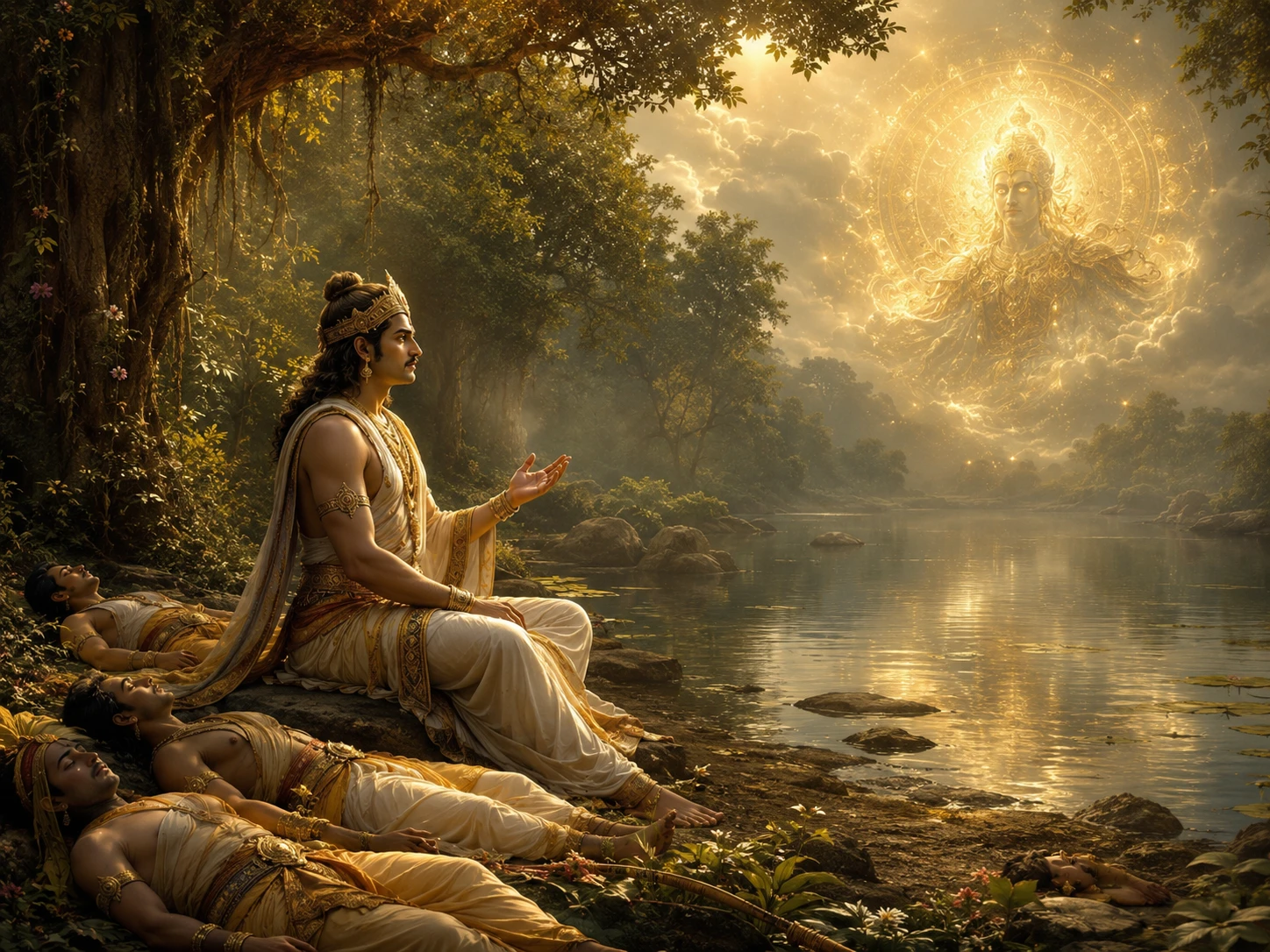
Yaksha Prashna -- Questions at the Lake
यक्ष प्रश्न -- सरोवर पर मृत्यु की पहेली
The Pandavas are in their twelfth year of forest exile. A brahmin's fire-sticks have been carried off by a deer, and Yudhishthira sends his brothers to track it. When the deer vanishes, the brothers are thirsty and exhausted. Nakula climbs a tree, spots a lake surrounded by cranes, and goes to fetch water.
He never returns.
A disembodied voice had warned him: answer my questions first, then drink. Nakula ignored it. He drank. He dropped dead.
Sahadeva went next. Same warning, same arrogance, same result. Then Arjuna -- the greatest warrior alive -- strode to the shore, heard the voice, scanned the treeline for an enemy he could fight, found nothing, drank in defiance, and collapsed. Bhima followed, saw his three brothers lying like broken dolls, assumed poison, and drank anyway because Bhima's solution to every problem was direct action.
Four Pandavas dead. Not by arrows, not by rakshasas, not by Duryodhana's scheming -- by a voice they refused to hear.
Yudhishthira arrived last. He saw the carnage and understood immediately that no ordinary force was at work. When the voice spoke -- 'Do not act rashly. Answer my questions, and then drink' -- he did what none of his brothers could. He stopped. He listened. He answered.
This scene from the Aranya Parva (Book 3, Sections 311-313 in the Ganguli translation, also called the Yaksha Prasna Adhyaya) is not a minor episode. It is the Mahabharata's philosophical centrepiece -- a 124-question examination of what it means to be human, conducted between a disguised god and a king who has lost everything except his capacity to think.
The setting matters. This is not a court debate with spectators and protocols. It is a man standing beside the bodies of his brothers, answering riddles while grief tears at his chest. Every answer carries the weight of life and death. The Yaksha is testing not just knowledge but composure -- can Yudhishthira think clearly when everything he loves lies dead at his feet?
The UPSC Civil Services examination, which selects India's highest administrators, explicitly draws from this tradition. The ethics paper introduced in 2013 by the Second Administrative Reforms Commission asks exactly the kind of questions the Yaksha asks -- not 'what do you know?' but 'what would you do when every option hurts someone?' IAS training academies at Mussoorie's Lal Bahadur Shastri National Academy use Yaksha Prashna as a case study in ethical reasoning under pressure.
Kaun Banega Crorepati, India's most-watched quiz show, unconsciously mirrors the Yaksha format -- escalating questions, one contestant, a lifeline mechanism, the option to walk away. Amitabh Bachchan's signature pause before revealing answers echoes the Yaksha's silence between questions. The difference: the Yaksha's stakes are real.
The Yaksha's 124 questions are not random trivia. They follow a carefully designed architecture that moves from cosmology to psychology to ethics to eschatology. Modern scholars including Wendy Doniger, Alf Hiltebeitel, and Indian philosopher Bimal Krishna Matilal have noted that the questions form concentric circles, spiralling inward from the external world to the interior self.
The first cluster asks about nature and the cosmos. What makes the sun rise? (Brahman.) What is the sun's companion? (Dharma.) What supports the sun? (Truth.) These sound like catechism, but the Yaksha is establishing a baseline -- does this man understand that the physical universe is underpinned by moral order? Yudhishthira does.
The second cluster shifts to definitions. What is heavier than the earth? (One's mother.) What is taller than the sky? (One's father.) What is faster than wind? (The mind.) What is more numerous than blades of grass? (Thoughts.) Here the Yaksha pivots from cosmology to human psychology. The answers are not obvious -- they require Yudhishthira to weigh metaphor against literalism and choose metaphor every time. A warrior-king choosing poetry over precision is itself remarkable.
The third cluster attacks the hardest territory -- ethics without neat answers. What is dharma's highest expression? (Anrishamsya -- non-cruelty, not ahimsa.) What is the greatest wonder in the world? (That every being sees others die yet believes themselves immortal.) What is the path? (The path is what great beings have walked -- tarkah apratishtah, argument alone is groundless; shruti are many, sages disagree; dharmasya tattvam nihitam guhayam -- the essence of dharma is hidden in a cave.)
That last answer is extraordinary. Yudhishthira, a dharma-king, admits that dharma cannot be pinned down by scripture or logic alone. He points to the lived practice of recognized exemplars as the best guide -- a position that anticipates virtue ethics by two millennia before Alasdair MacIntyre.
The 'greatest wonder' answer (pratidinah priyamanah -- 'daily, beings die; the rest desire immortality') has become perhaps the most quoted line from the entire Mahabharata outside of the Bhagavad Gita. It appears in Indian school textbooks across CBSE and ICSE boards, usually in the moral science or Sanskrit syllabus. Every year, UPSC aspirants studying at Rajinder Nagar's coaching institutes encounter this verse in their ethics preparation. Doctors at AIIMS and Tata Memorial Hospital have cited it in palliative care training -- the denial of death is not a Western psychiatric discovery; the Mahabharata named it three thousand years ago.
IIT entrance coaching centres in Kota have an unlikely connection to this episode. Students preparing for JEE Advanced face the same structural challenge Yudhishthira does -- a barrage of questions where the stakes escalate, where mental composure matters more than raw knowledge, where one wrong move (drinking before answering) eliminates you. The parallel is not metaphorical; coaching institutes explicitly use the Yaksha Prashna as a motivational text, printed on hostel common-room walls.
अहन्यहनि भूतानि गच्छन्तीह यमालयम्। शेषाः स्थावरमिच्छन्ति किमाश्चर्यमतः परम्॥
ahany ahani bhūtāni gacchantīha yamālayam | śeṣāḥ sthāvaram icchanti kim āścaryam ataḥ param ||
Day after day, beings go to Yama's abode. Those who remain wish to live forever. What greater wonder can there be than this?
— Mahabharata, Vana Parva (Aranya Parva), Yaksha Prashna Adhyaya (Ganguli translation, Section 313; BORI Critical Edition 3.297.20)
After 124 questions, the Yaksha is satisfied. He offers Yudhishthira a reward: one dead brother will be restored to life. Choose.
The obvious tactical choice is Arjuna -- the supreme warrior, the one who can protect them in battle. Or Bhima -- the physical powerhouse without whom the Pandavas cannot survive the forest. Both are Kunti's sons, Yudhishthira's full brothers by blood.
Yudhishthira chooses Nakula.
The Yaksha is startled. Why Nakula -- the least powerful, the youngest of Kunti's stepsons through Madri?
Yudhishthira's reasoning is precise and devastating. Kunti has one son alive -- me. For justice, Madri must also have one son alive. Dharma requires that I weigh not my tactical advantage but my mother's co-wife's grief. If Nakula dies permanently while all of Kunti's sons survive, the asymmetry is unjust regardless of its military logic.
This is not sentimentality. It is structural fairness applied under extreme duress. Yudhishthira does not choose the brother he loves most (Arjuna) or the one most useful (Bhima). He chooses the one whose death would create the greatest inequity between his two mothers. The calculus is impersonal, principled, and heartbreaking.
The Yaksha, moved, reveals himself as Dharma (or Yama in some recensions) -- Yudhishthira's own divine father. He restores all four brothers to life.
The Nakula choice has generated centuries of commentary. Was it genuine ethics or performative virtue? The Mahabharata itself seems to anticipate this criticism. Yudhishthira does not hesitate, does not calculate aloud, does not frame it as a philosophical position. He just answers. The speed suggests internalized principle, not deliberated strategy -- which is exactly what Aristotelian phronesis (practical wisdom) looks like.
In corporate India, the Nakula choice has become a management teaching moment. IIM Ahmedabad's Professor Rishikesha Krishnan has used it in leadership ethics modules -- when you have limited resources, do you optimize for performance (Arjuna) or equity (Nakula)? Indian startups facing layoffs grapple with exactly this: do you keep the highest performer or the person whose termination would cause disproportionate harm? The Mahabharata offers no easy answer, but it makes clear which choice earns divine approval.
The episode also resonates in India's reservation debates. The question of whether to prioritize merit (Arjuna) or structural fairness (Nakula) maps directly onto arguments about OBC/SC/ST quotas in IIT admissions and government jobs. Yudhishthira's choice suggests that systemic equity is not a concession to weakness but an expression of dharma itself. Whether one agrees with this reading politically, the Mahabharata unmistakably frames it as the correct answer.
Key Yaksha Prashna Questions and Yudhishthira's Answers
| Question (EN) | Answer (EN) | Category | Modern Parallel |
|---|---|---|---|
| What makes the sun rise? | Brahman (the ultimate reality) | Cosmology | First principles thinking in physics |
| What is heavier than the earth? | One's mother | Psychology | Mental health discourse on parental impact |
| What is faster than wind? | The mind (manas) | Psychology | Neuroscience research on processing speed |
| What is the greatest wonder? | That mortals see death daily yet believe themselves immortal | Eschatology | Palliative care / AIIMS death denial studies |
| What is dharma's highest form? | Anrishamsya (non-cruelty) | Ethics | UPSC ethics paper -- 'compassion vs rules' |
| What is the path? | The path walked by great beings; dharma's essence is hidden | Epistemology | Virtue ethics, exemplar-based moral education |
| Which brother should live? | Nakula -- so Madri has a living son too | Justice | Reservation debates, equity vs merit in IITs |
| What must one give up to be rich? | Desire | Renunciation | FIRE movement, startup founders post-exit |
| What is happiness? | The result of good conduct (shila) | Eudaimonia | Positive psychology, character-strength frameworks |
| What is the self's enemy? | Anger (krodha) | Self-knowledge | Anger management, road rage data in Indian metros |
Questions sourced from Mahabharata Vana Parva, Sections 311-313 (Ganguli translation). The Yaksha poses approximately 124 questions; this table highlights the ten most widely discussed.
Sit With the Yaksha's Questions
The Yaksha's deepest question was about the self. Sit for fifteen minutes in silence and ask yourself the questions that matter most when no one else is listening. The Meditate section has practices to settle the mind first.
Tags
Eternal Raga · शाश्वत राग
Institutional voice — scholarly articles on Sanatan Dharma
Deepen Your Understanding
अपनी समझ और गहरी करें
scriptural exegesis
Draupadi in the Sabha -- The Trial That Started the War
A queen was dragged into a court full of kings, warriors, and elders. Not one stood up. She asked a single legal question that nobody could answer. Then she swore an oath that burned a civilization to the ground. Draupadi's Sabha episode is not a story about a helpless woman. It is the most devastating indictment of institutional silence in world literature.
scriptural exegesis
Bhishma's Terrible Vow
A crown prince gave up the throne, love, marriage, and children -- forever -- so his father could marry a fisherwoman. That single vow made Bhishma immortal in name and set the entire Mahabharata into motion. Was it the noblest sacrifice in literature, or the most catastrophic?
scriptural exegesis
Karna's Tragedy -- The Sun's Forgotten Son
Born with divine armor, abandoned at birth, raised by a charioteer, humiliated for his caste, cursed by his teacher, and killed while defenseless -- Karna's story is not the Mahabharata's subplot. It is the Mahabharata's conscience. Every system that failed him is a system that still fails people today.
deities avatars
Rama -- Ideal of Dharmic Living
Why does India still name its sons after a prince who chose exile over a throne? Rama's life is not a fairy tale -- it is a manual for dharmic decision-making under impossible pressure. From boardrooms to battlefields, his choices remain the hardest moral benchmark in civilization.
scriptural exegesis
Pandavas in Hell -- The Shocking Finale of the Mahabharata
The Mahabharata does not end with victory. It ends with the heroes falling dead on a Himalayan climb, the villains seated in heaven, and the one righteous king demanding to be sent to hell. The Swargarohana Parva is the most unsettling, most philosophically radical, and most misunderstood finale in all of world literature.
More in Scriptural Exegesis
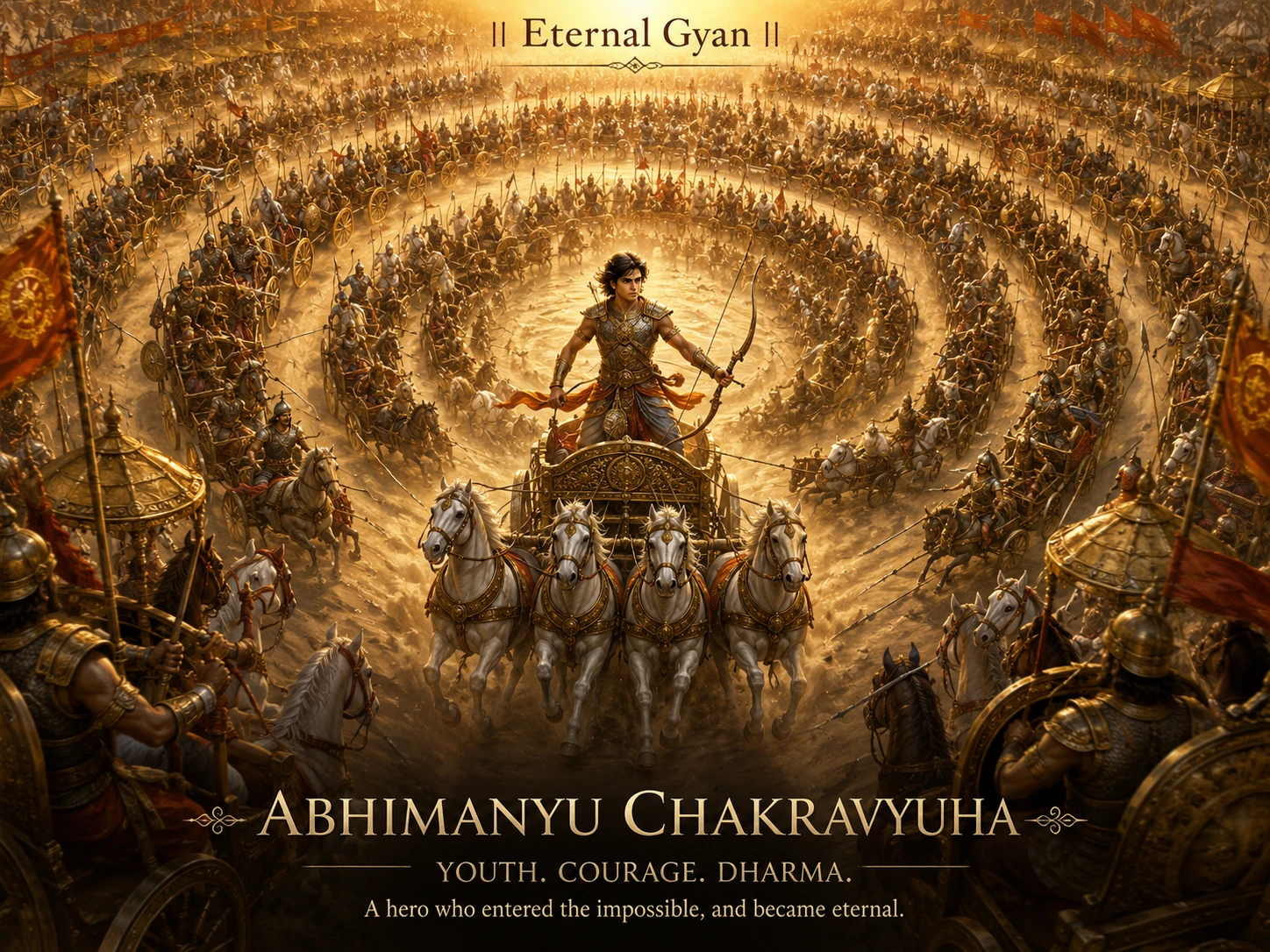
Abhimanyu and the Chakravyuha -- The Boy Who Knew How to Enter but Not How to Leave
14 min read
Adbhuta Ramayana -- The Ramayana Where Sita Becomes Kali
9 min read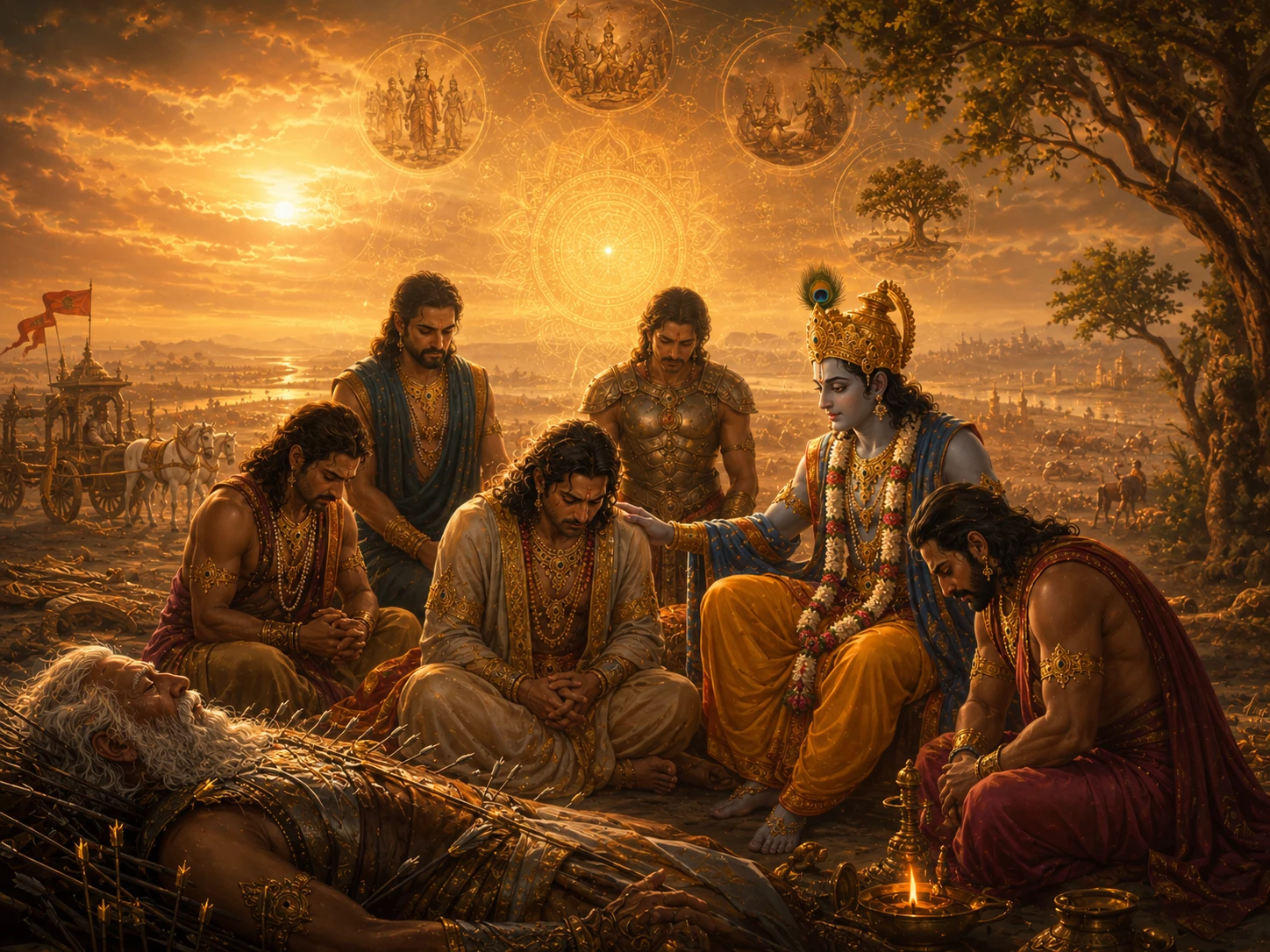
After Kurukshetra -- What Happened Next
14 min readThe same translation error that turned '33 Koti' into '33 crore' in Hinduism also happened in Buddhism. The Chinese translation of Buddhist texts rendered 'Sapta Koti Buddha' (7 Supreme Buddhas) as '7 Crore Buddhas.' The…
Deities AvatarsCommunity Reflections
🕉️
Be the first to share your reflection.