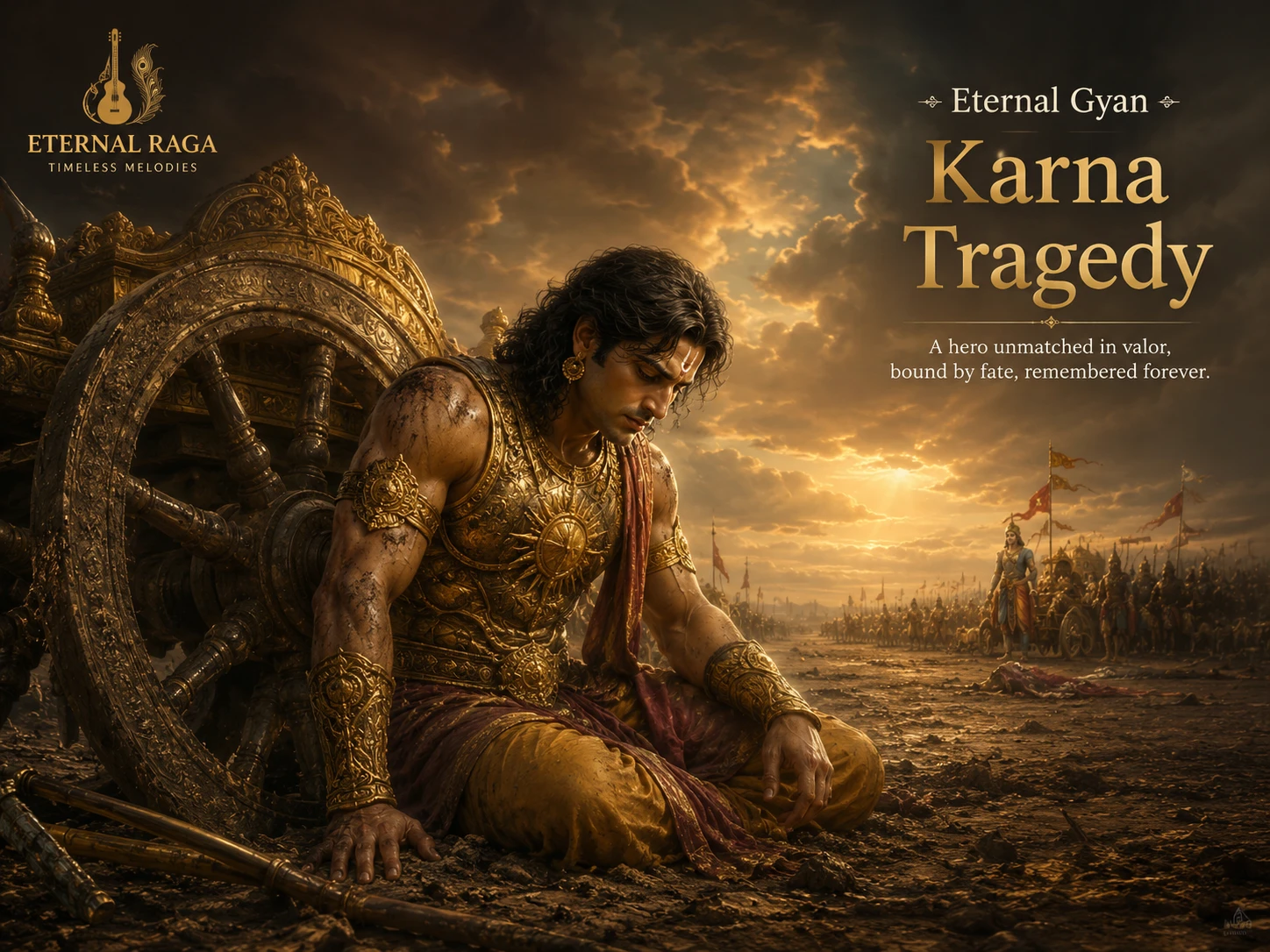
Karna's Tragedy -- The Sun's Forgotten Son
कर्ण की त्रासदी -- सूर्य का वो बेटा जिसे दुनिया ने भुला दिया
Before a single arrow flew at Kurukshetra, Karna had already lost. Not because he lacked skill, strength, or courage -- he had all three in abundance. He lost because the universe had stacked its deck against him with a precision that looks, from the outside, like cruelty.
Consider the sequence. Born to Kunti, a princess, through the invocation of the sun god Surya -- making him biologically the eldest Pandava and rightful heir to the Kuru throne. But Kunti, an unmarried teenager terrified of social scandal, placed the newborn in a basket and floated him down a river. Found and raised by Adhiratha, a charioteer (suta), and his wife Radha. Named Vasusena, later Karna. Grew up as a suta-putra -- a charioteer's son -- in a society where birth determined everything.
Karna's biological truth -- that he was a Kshatriya prince, the son of Surya himself -- was hidden from him for his entire active life. He discovered it only when Kunti came to him on the eve of the Kurukshetra war and begged him to switch sides. By then, his loyalties, friendships, and sense of self were irrevocably committed to Duryodhana and the Kaurava cause. The revelation did not liberate him. It simply added one more layer of tragedy to an already impossible life.
This is the Mahabharata's most brutal thought experiment: what happens when a supremely talented person is born into the wrong social slot? When every institution -- family, education, military, politics -- is designed to exclude them? When they fight their way to the top anyway, only to discover that the game was rigged from before they were born?
For the Dalit student who cracks IIT-JEE only to face caste discrimination in hostel rooms and lab groups. For the woman founder who builds a profitable company only to be asked in investor meetings 'but who is the real CEO?' For the small-town kid at a Bombay law firm who has the skills but not the surname. For the OBC government officer who is brilliant but whispered about as a 'quota hire.' Karna is not ancient history. Karna is Tuesday morning.
The first public humiliation comes at Drona's tournament (Rangbhoomi). The young princes of Hastinapura are displaying their martial skills. Arjuna dazzles with his archery. Then Karna appears -- uninvited, unannounced -- and matches Arjuna shot for shot. The crowd erupts. Who is this? When Karna challenges Arjuna to single combat, Kripacharya intervenes with a procedural objection: only a prince of equal standing may challenge a prince. Karna is asked to declare his lineage. He cannot. He is a suta-putra.
In that moment, Duryodhana seizes the opportunity. He crowns Karna king of Anga on the spot -- giving him a royal title to make the combat legitimate. This is the beginning of Karna-Duryodhana, the most complicated friendship in the Mahabharata. Duryodhana does not befriend Karna out of pure goodness. He sees in Karna a weapon against Arjuna. But Karna sees in Duryodhana the first person who ever looked at him and saw a warrior instead of a charioteer's son.
The friendship binds Karna to the Kaurava side permanently. When Krishna offers Karna the throne of Indraprastha and the kingship of the Pandava alliance (in a last-ditch attempt to prevent war), Karna refuses -- not because he supports Duryodhana's cause, but because he cannot betray the one person who stood by him when the world sat down. 'He gave me respect when I had nothing,' Karna tells Krishna. 'I will not abandon him now that he needs me.'
This is loyalty operating at a level that transcends ethics. It is the loyalty of the squad mate who covers your six in combat even though the war is unjust. It is the loyalty of the best friend who stays after everyone else leaves. It is the loyalty that the Mahabharata simultaneously admires and mourns -- because it leads Karna to fight on the wrong side of history.
The curses that shadow Karna are the mechanism through which the Mahabharata dramatizes systemic injustice. Karna approached Parashurama for weapons training, knowing that Parashurama taught only Brahmins. He disguised himself as a Brahmin student. Parashurama gave him all his knowledge, including the Brahmastra. Then one day, while Parashurama slept on Karna's lap, a beetle bored into Karna's thigh. Karna did not move -- he endured the pain silently so as not to disturb his guru. When Parashurama woke and saw the blood, he recognized that only a Kshatriya could endure such pain without flinching. Enraged at the deception, he cursed Karna: the Brahmastra would fail him when he needed it most.
The curse punishes Karna for lying about his caste. But what choice did he have? The system would not teach him otherwise. He lied because truth would have excluded him from the education he deserved. This is the paradox that makes Karna eternal -- society forces you to deceive it, then punishes you for the deception.
A second curse came from a Brahmin whose cow Karna accidentally killed. The Brahmin cursed him: his chariot wheel would sink into the earth at the critical moment. This curse activates during Karna's final battle with Arjuna in the Karna Parva, immobilizing him at the moment he needs mobility most.
Then there is the kavach-kundal episode. Karna was born with divine armor (kavach) fused to his body and earrings (kundal) that made him invulnerable. Indra, Arjuna's father, approached Karna disguised as a Brahmin and asked for the armor as a charitable donation. Karna knew who Indra was. He knew giving up the armor would likely mean his death. Surya himself appeared and warned him. Karna gave it anyway.
Why? Because generosity -- dana -- was his identity. It was the one thing no curse, no humiliation, no systemic exclusion could touch. Being called a suta-putra? He could not control that. Being cursed by Parashurama? He could not undo that. But giving -- giving until it hurt, giving when it was suicidal, giving the armor off his literal body -- that was his. No one could take his generosity from him because he gave it away first.
This is why Karna is called Danveer -- the hero of giving. And this is why he remains the most beloved tragic figure in Indian culture, more sympathized with than any Pandava. The audience of the Mahabharata -- across two millennia, across every retelling -- has consistently understood something the text's own characters do not: Karna was the best of them. And the system destroyed him anyway.
Karna's death in the Karna Parva is the Mahabharata's darkest passage. His chariot wheel sinks (the Brahmin's curse). He dismounts to free it. Unarmed, struggling, he invokes the rules of dharmic warfare and asks Arjuna to wait. Krishna -- God himself -- tells Arjuna to shoot. Krishna reminds Arjuna that Karna did not invoke dharma when Draupadi was being disrobed. The arrow flies. Karna falls.
The moral calculus is devastating. Krishna is right that Karna was complicit in Draupadi's humiliation. But Krishna is also orchestrating the killing of a defenseless man. The Mahabharata does not let either side off the hook. This is not good vs. evil. This is two flawed moral systems colliding, with the most tragic figure caught in the wreckage.
अयं स कालः सम्प्राप्तो दुर्लभः कुरुनन्दन। प्रयच्छ भूमिदानं मे यदि दातासि भूमिप॥
ayaṃ sa kālaḥ samprāpto durlabhaḥ kurunandana | prayaccha bhūmidānaṃ me yadi dātāsi bhūmipa ||
This rare moment has arrived, O son of the Kurus. Give me the gift of earth, if you are truly a giver, O lord of the land.
— Mahabharata, Udyoga Parva (Indra's request to Karna for his kavach-kundal; Ganguli translation, Section 284)
The Curses and Betrayals That Sealed Karna's Fate
| Event | What Happened | What It Cost Karna | Systemic Parallel |
|---|---|---|---|
| Abandoned at birth | Kunti floated him in a river to avoid scandal | Lost royal identity, raised as suta-putra | Orphan children in India losing caste/family safety net |
| Parashurama's curse | Lied about caste to get education; discovered and cursed | Brahmastra would fail at critical moment | Students who fake credentials because gatekeepers block merit-based access |
| Rangbhoomi humiliation | Refused single combat with Arjuna due to low birth | Public caste shaming before Hastinapura's elite | Caste discrimination in IIT hostels, corporate boardrooms |
| Kavach-Kundal donation | Gave divine armor to Indra knowing it meant death | Lost invulnerability | Generosity weaponized -- giving until self-destruction |
| Brahmin's cow curse | Accidentally killed a cow; cursed that his wheel would sink | Chariot immobilized in final battle | Disproportionate punishment for accidental harm |
| Krishna's battlefield command | Told Arjuna to shoot defenseless Karna | Killed while following dharma of asking for fair combat | Rules applied selectively -- one standard for the powerful, another for the outsider |
The Mahabharata does not present Karna as faultless. His complicity in Draupadi's humiliation is real. But the text ensures the reader understands that his flaws were shaped by a system designed to exclude him.
Karna is the only Mahabharata character who has a major Indian state capital's iconic landmark named after him -- the Karna Lake (Karna Jheel) in Karnal, Haryana, a city whose very name derives from 'Karna-alaya' (Karna's abode). The Archaeological Survey of India recognizes the site. Karnal is also home to the National Dairy Research Institute (NDRI) and the Indian Army's Counter Insurgency and Jungle Warfare School is nearby at Vairengte -- a modern institution of national defense located in a land named after the Mahabharata's most tragic warrior.
Greet the Sun as Karna Did
Karna's father was Surya, and Karna worshipped the sun every morning; no one who asked him for anything during that worship went away empty-handed. Begin your day facing the sun, with twelve rounds of Surya Namaskar or a recitation of the Aditya Hridayam, which is on Eternal Raga with its meaning.
Tags
Eternal Raga · शाश्वत राग
Institutional voice — scholarly articles on Sanatan Dharma
Deepen Your Understanding
अपनी समझ और गहरी करें
scriptural exegesis
Bhishma's Terrible Vow
A crown prince gave up the throne, love, marriage, and children -- forever -- so his father could marry a fisherwoman. That single vow made Bhishma immortal in name and set the entire Mahabharata into motion. Was it the noblest sacrifice in literature, or the most catastrophic?
scriptural exegesis
Draupadi in the Sabha -- The Trial That Started the War
A queen was dragged into a court full of kings, warriors, and elders. Not one stood up. She asked a single legal question that nobody could answer. Then she swore an oath that burned a civilization to the ground. Draupadi's Sabha episode is not a story about a helpless woman. It is the most devastating indictment of institutional silence in world literature.
scriptural exegesis
Mahabharata -- History or Myth? What the Evidence Actually Says
Submerged cities off Gujarat. 35+ archaeological sites matching the epic's geography. 200+ astronomical events verified by planetarium software. A river that vanished exactly as the text describes. Five categories of evidence that do not 'prove' the Mahabharata -- but make dismissing it as pure fiction increasingly difficult.
philosophy darshana
Rama vs Krishna -- Two Faces of Dharma, One Question for Your Life
Rama followed every rule and lost his wife. Krishna broke every rule and won the war. Both are Vishnu. Both upheld Dharma. So who was right? The answer might be the most important thing Hindu philosophy has to say to a world that thinks morality is simple.
scriptural exegesis
Yaksha Prashna -- Questions at the Lake
Four brothers lie dead beside an enchanted lake. One brother remains. A voice from the water asks 124 questions about dharma, death, happiness, and the self. Yudhishthira's answers in Vana Parva remain the most sophisticated ethical examination in all of Sanskrit literature.
scriptural exegesis
Women Power in Ancient India -- Scholars, Warriors, and Queens the Textbooks Erased
Gargi debated the greatest philosopher of her age and he could not defeat her. Maitreyi rejected a fortune for the pursuit of knowledge. Vishpala lost a leg in battle, got an iron prosthetic, and went back to fight. Kaikeyi drove Dasharatha's chariot in war and saved his life. These are not feminist reimaginings. These are the primary texts. And they tell a very different story from the one you were taught.
Karna is the only Mahabharata character who has a major Indian state capital's iconic landmark named after him -- the Karna Lake (Karna Jheel) in Karnal, Haryana, a city whose very name derives from 'Karna-alaya' (Karna'…
More in Scriptural Exegesis
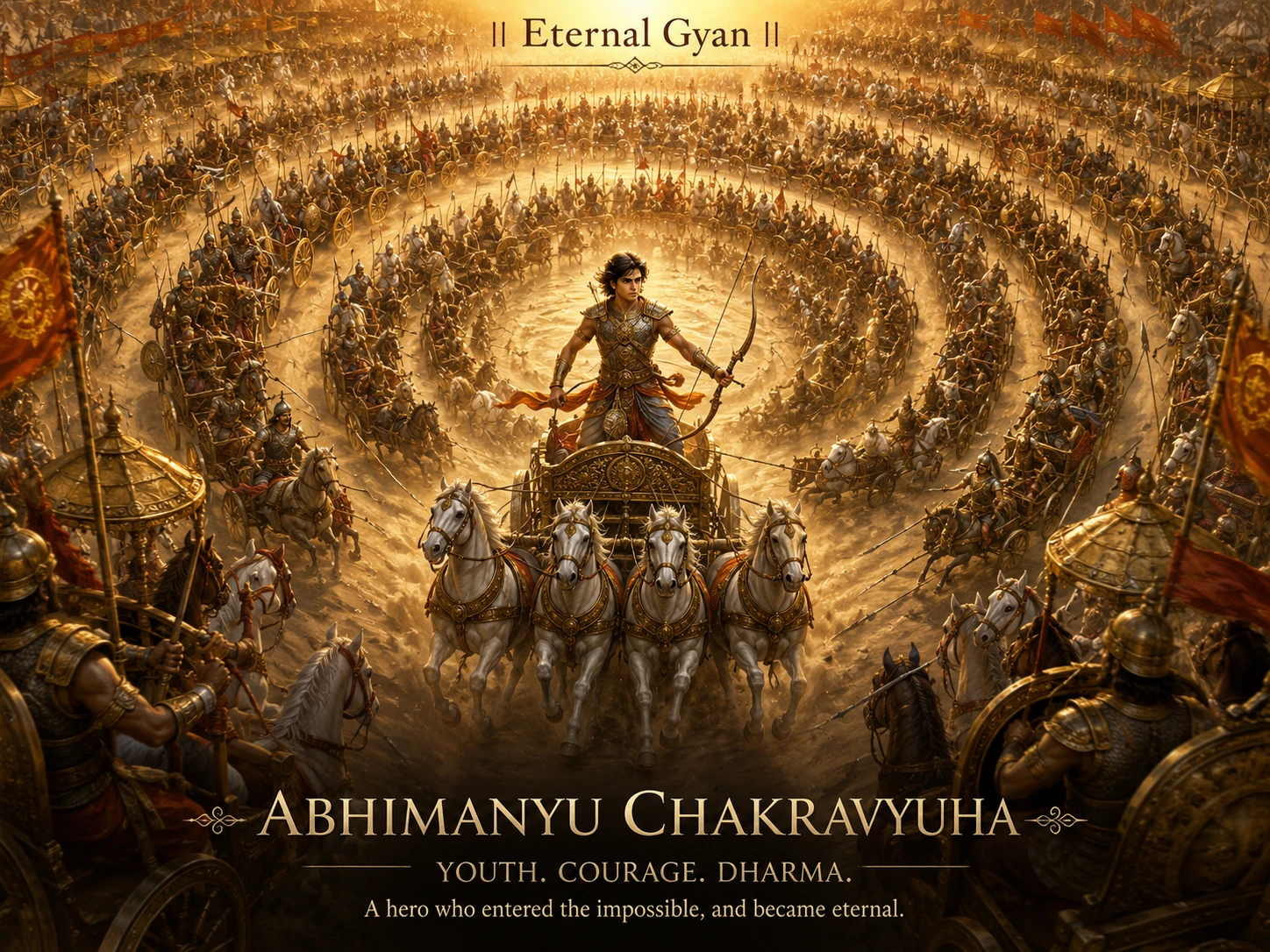
Abhimanyu and the Chakravyuha -- The Boy Who Knew How to Enter but Not How to Leave
14 min read
Adbhuta Ramayana -- The Ramayana Where Sita Becomes Kali
9 min read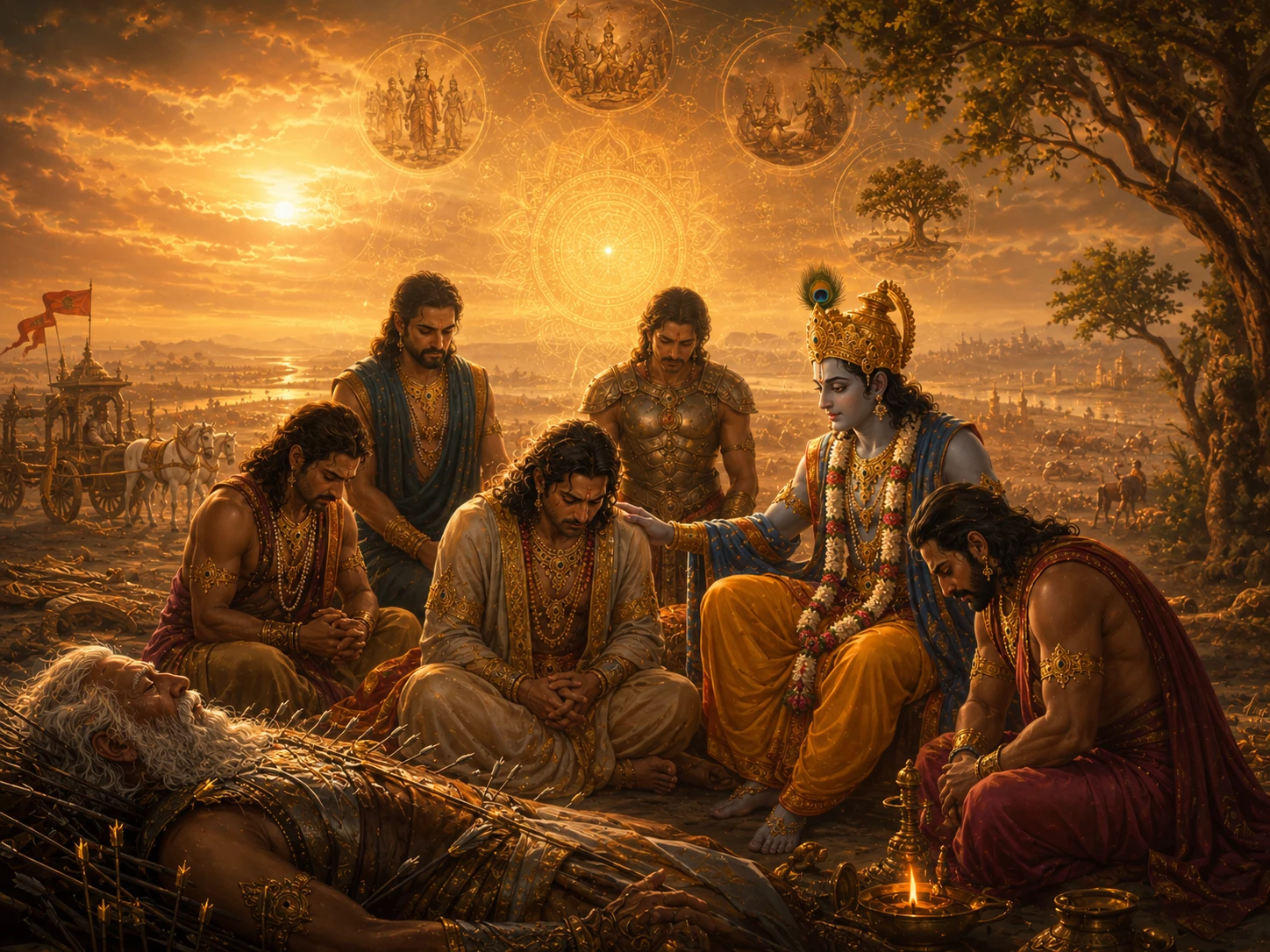
After Kurukshetra -- What Happened Next
14 min readThe same translation error that turned '33 Koti' into '33 crore' in Hinduism also happened in Buddhism. The Chinese translation of Buddhist texts rendered 'Sapta Koti Buddha' (7 Supreme Buddhas) as '7 Crore Buddhas.' The…
Deities AvatarsCommunity Reflections
🕉️
Be the first to share your reflection.