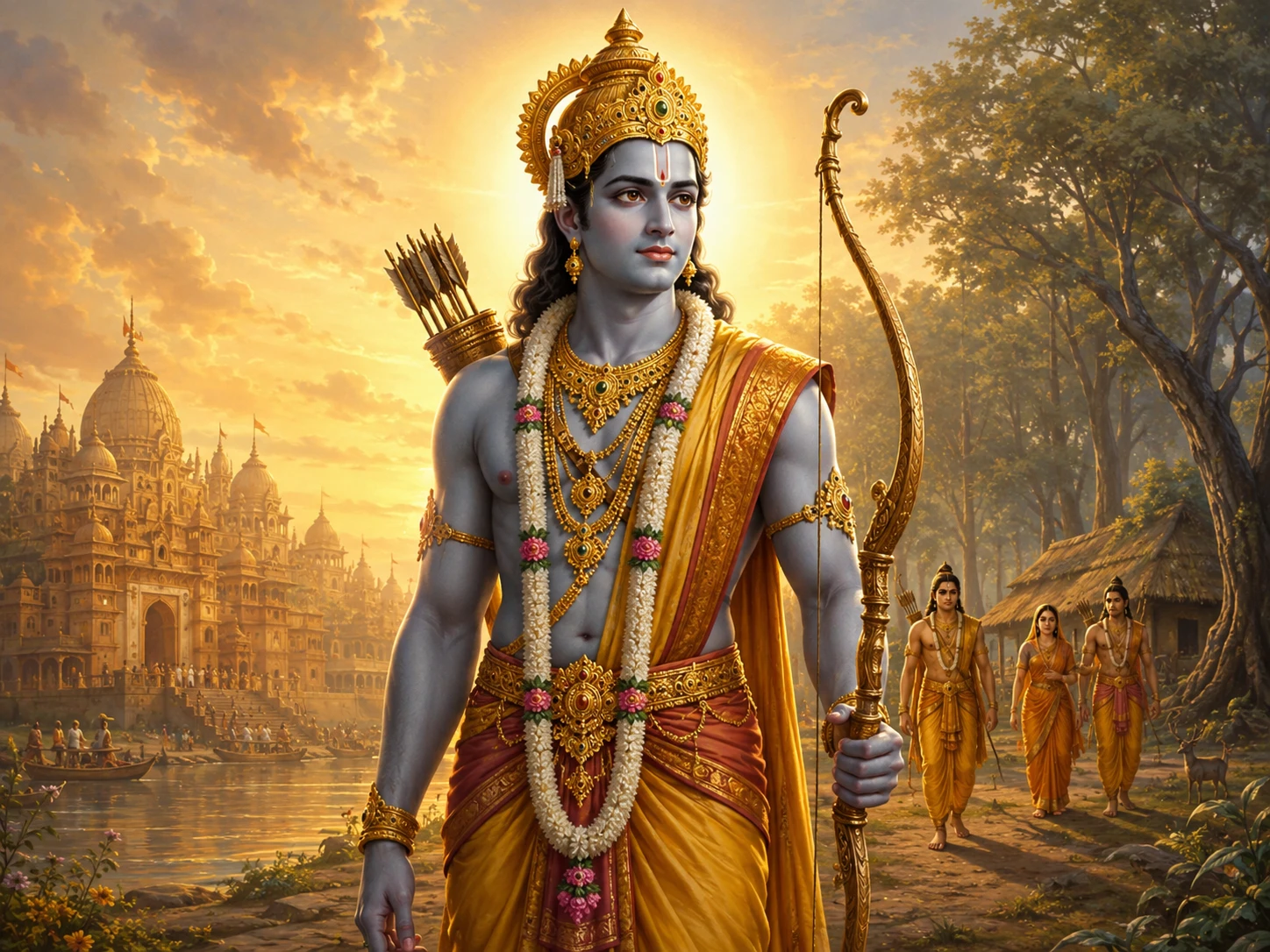
Rama -- Ideal of Dharmic Living
राम -- धर्म की चलती-फिरती परिभाषा
In a country where Ramlila unfolds every autumn across ten thousand stages -- from the ghats of Varanasi to the dusty maidans of small-town Madhya Pradesh -- the question is not whether people know Rama. The question is whether they understand what 'Maryada Purushottam' actually demands.
The title does not mean 'perfect man.' It means the supreme person who operates within boundaries -- maryada. That distinction matters. Rama is not worshipped because he lived a charmed life. He is worshipped because every single boundary life imposed on him, he honored. Son told to leave his kingdom on the eve of his coronation? He left. Husband whose wife was abducted by a demon-king with an aerial chariot and an army of shape-shifters? He built an alliance and fought a war -- but within the rules of righteous combat. King whose subjects whispered about his queen's purity? He let her go, even though his own heart broke.
Think of it this way. A UPSC aspirant in Old Rajinder Nagar knows the syllabus, knows the rules, and knows that cutting corners with leaked papers might work in the short run. Rama is the aspirant who refuses the shortcut every single time, even when the system makes it almost irrational not to cheat. That is maryada -- not perfection, but disciplined adherence to dharma even when it costs everything.
Rama was the eldest of four sons born to King Dasharatha of Ayodhya and his three queens -- Kausalya, Kaikeyi, and Sumitra. Valmiki's Ramayana, the oldest extant telling, composed roughly between the 5th and 3rd centuries BCE, presents Rama not as a god playing at being human but as a human whose dharmic conduct elevates him to divinity. The Bala Kanda traces his birth through the Putrakameshti Yajna, his training under Vishvamitra, his breaking of Shiva's bow (Pinaka) to win Sita's hand, and his early reputation as the prince who could do no wrong.
But Valmiki is no hagiographer. The text sets up Rama's greatness precisely so that the tests to follow have real stakes. If he were simply God, there would be no tension in Ayodhya Kanda when Kaikeyi invokes her two boons, demanding Bharata's coronation and Rama's fourteen-year exile. The power of the scene lies in the fact that Rama could contest it -- Dasharatha himself begs him to -- but chooses not to.
Why? Because his father made a promise. And in Rama's moral architecture, a father's word is not breakable by the son, even when the father himself wishes to break it. This is not blind obedience. It is a conscious decision to uphold the sanctity of a vow -- the foundational unit of dharma in Vedic society. In modern India, think of it as honoring a contract even when the other party would let you walk away. The startup founder who returns investor money when the product fails instead of pivoting into a gray area -- that is Rama's instinct.
रामो विग्रहवान् धर्मः साधुः सत्यपराक्रमः। राजा सर्वस्य लोकस्य देवानामिव वासवः॥
rāmo vigrahavān dharmaḥ sādhuḥ satyaparākramaḥ | rājā sarvasya lokasya devānāmiva vāsavaḥ ||
Rama is dharma embodied in human form, virtuous and of true valor. He is the king of all the world, as Indra is the lord of the gods.
— Valmiki Ramayana, Aranya Kanda, 37.13 (Maricha's testimony to Ravana)
That verse is spoken by Maricha -- not a devotee, but a demon who has twice been humiliated by Rama's arrows. Even Rama's enemies testify that he is dharma incarnate. Valmiki places this statement in the mouth of an adversary precisely to establish that Rama's righteousness is not self-declared propaganda but an observable, verifiable fact recognized even by those who oppose him.
The Aranya Kanda (Forest Book) is where Rama's dharmic choices become most painful and most instructive. Fourteen years in the forest with Sita and Lakshmana is not a camping trip. It is a systematic stripping away of every privilege -- royal comforts, political power, military protection, social standing. What remains when you take away the palace, the army, and the crown? Only character. And Rama's character does not change by a single degree.
He treats forest sages with the same respect he showed courtiers. He fights demons threatening ashrams not for glory but because protecting the vulnerable is a kshatriya's non-negotiable duty. When Shurpanakha approaches him with desire, he does not mock her or attack unprovoked -- he redirects her to Lakshmana (whose own response becomes a separate ethical debate). The escalation to Sita's abduction follows from Shurpanakha's mutilation, which Rama did not order, a detail that matters for anyone reading the text with legal precision.
Sita's abduction in Panchavati is the crucible. A lesser man would rage. A pragmatic king would calculate alliances. Rama does both -- but never at the cost of dharma. His grief at Sita's loss, described in Aranya Kanda sargas 60-63, is raw and human. He weeps. He asks the trees and rivers if they have seen her. Valmiki does not flinch from showing a warrior prince undone by love. This is not weakness in the Ramayana's moral universe -- it is proof of Rama's humanity, the very quality that makes his subsequent discipline meaningful.
The Kishkindha Kanda introduces realpolitik. Rama allies with Sugriva, a dethroned monkey-king, and helps him kill his brother Vali. This is the episode that critics seize upon -- Rama shoots Vali from behind a tree during Vali's combat with Sugriva. Is this dharmic? The text addresses the objection directly. Vali himself, dying, demands an answer. Rama's reply spans multiple sargas and rests on several arguments: Vali took his brother's wife (a grave sin), Vali was classified as an animal (mriga) and thus could be hunted by a king, and Sugriva was under Rama's protection. Modern readers may find these justifications uncomfortable -- and that discomfort is part of the text's design. Dharma in the Ramayana is not a neat formula. It is a set of competing principles that must be weighed in context.
Consider the parallel to a corporate whistleblower in today's India. A mid-level manager at an infrastructure company discovers that a senior partner has been diverting funds meant for a rural bridge project. Reporting it will end the whistleblower's career and possibly invite physical threats. Not reporting it means the bridge never gets built and people die in the next monsoon flood. Rama's Vali decision sits in this territory -- doing the right thing sometimes looks ugly from one angle, and the text is honest enough to let the reader wrestle with it.
The Yuddha Kanda is the payoff. The war with Ravana is not just military -- it is the final exam of every dharmic principle Rama has followed. He gives Ravana a chance to return Sita. He sends Angada as an ambassador. Even in the heat of battle, after Ravana's chariot and weapons are destroyed, Rama tells him to go home and return the next day rather than killing an unarmed opponent. This is the moment that separates Rama from every other warrior-king in world literature. Victory delayed for the sake of honor. Imagine an IPL captain choosing to replay a dubious umpire decision even though it means the other team gets another over -- not because the rules require it, but because winning by a technicality feels like losing.
Rama's return to Ayodhya -- the event Diwali celebrates across India and the diaspora -- is not just a homecoming. It is the vindication of a fourteen-year experiment: can a man live entirely within dharmic boundaries and still win? The answer the Ramayana gives is yes, but at enormous personal cost. Rama gets his kingdom back, but the scars of exile, war, and the later separation from Sita during the Uttara Kanda never fully heal.
The Uttara Kanda, widely believed to be a later addition to Valmiki's text, introduces the most controversial decision of Rama's life -- the banishment of a pregnant Sita based on a washerman's gossip. Scholars from the BORI Critical Edition project in Pune have debated its authenticity. Regardless of textual history, the episode forces a question: can a king's duty to public perception override his duty to his wife? Rama answers yes. Modern India overwhelmingly answers no -- and that generational pushback is itself a form of engaging with dharma, not abandoning it. The IIT Bombay student who argues on a Reddit thread that Rama was wrong about Sita is doing exactly what the Ramayana invites: using the text as a whetstone to sharpen your own ethical thinking.
स्थितः स धर्मे परमे महात्मा सत्यव्रतः सत्यपरः सत्यसन्धः। समस्तलोकस्य हिते निरतः स्मृतिमान् प्रतिज्ञां परिपालयिष्यन्॥
sthitaḥ sa dharme parame mahātmā satyavrataḥ satyaparaḥ satyasandhaḥ | samastolokasya hite nirataḥ smṛtimān pratijñāṃ paripālayiṣyan ||
That great soul was established in the highest dharma, devoted to truth, committed to truth, and pledged to truth. He was dedicated to the welfare of all beings, mindful and ever fulfilling his vows.
— Valmiki Ramayana, Ayodhya Kanda, 1.9-10 (Narada's description of Rama)
The triple repetition of satya (truth) in this verse is not poetic excess. It marks three distinct dimensions: satyavrata means one who has taken truth as a vow, satyapara means one whose highest aim is truth, and satyasandha means one whose resolve is welded to truth. In Indian philosophy, a single virtue repeated thrice becomes an unbreakable identity. This is Rama's DNA.
What does this look like outside the text? Consider the Indian Armed Forces. When a young officer at the IMA in Dehradun takes the oath of commissioning, the structure is remarkably similar -- truth to the nation, truth to the service, truth to one's comrades. Rama's triple-truth framework operates at the same level: personal integrity, cosmic alignment, and social contract. The CRPF jawan guarding a polling booth in Naxal-affected Chhattisgarh, the Navy officer on a destroyer in the Indian Ocean, the Border Roads Organisation engineer building a highway at 14,000 feet in Ladakh -- each of them, knowingly or not, enacts a version of Rama's satyasandha when they hold their post despite personal risk.
Rama's legacy in modern India is impossible to separate from politics, and we will not pretend otherwise. The Ram Janmabhoomi movement, the construction of the Ram Mandir in Ayodhya inaugurated in January 2024, and the use of Rama as a political symbol are all facts of contemporary Indian life. What Eternal Gyan focuses on is the textual Rama -- the character as Valmiki wrote him, supplemented by Tulsidas's Ramcharitmanas (16th century, Awadhi Hindi) which reframed Rama as the supreme deity for millions of Hindi-speaking devotees. Tulsidas's Rama is more explicitly divine, more tender, more bhakti-saturated than Valmiki's. The Ramcharitmanas gave India the Hanuman Chalisa, the Sundara Kanda parayana tradition, and the intimate relationship between Ram and his devotees that defines living Hinduism in the Gangetic belt.
Between Valmiki and Tulsidas, Kamban's Tamil Ramavataram (12th century) presents a Rama who is more passionate, more emotionally expressive, and embedded in Dravidian cultural aesthetics. Ezhuthachan's Adhyatma Ramayanam in Malayalam brings Advaitic philosophy to the narrative. Each regional retelling adjusts the emphasis without altering the core -- a righteous prince tested to the limit who never breaks.
For the UPSC aspirant, Rama provides essay-ready material on governance, ethics, and leadership. For the IIT student, the Vali episode is a systems-design problem -- how do you optimize for justice when two valid ethical frameworks conflict? For the NRI in Dallas or Melbourne lighting a diya on Diwali, Rama is the reason the lamp matters at all.
Rama Across India's Major Retellings
| Text | Language / Era | Rama's Dominant Trait | Key Addition to the Tradition |
|---|---|---|---|
| Valmiki Ramayana | Sanskrit, ~5th-3rd c. BCE | Dharmic discipline (maryada) | Foundational narrative; Rama as ideal human |
| Ramcharitmanas (Tulsidas) | Awadhi, 16th century | Supreme divine tenderness (karuna) | Bhakti framework; Hanuman Chalisa; Sundara Kanda parayana |
| Ramavataram (Kamban) | Tamil, 12th century | Passionate heroism (vira rasa) | Dravidian aesthetics; expanded emotional range |
| Adhyatma Ramayanam (Ezhuthachan) | Malayalam, 16th century | Advaitic wisdom (jnana) | Philosophical Rama; Maya-Sita concept |
| Krittivasi Ramayan (Krittivas) | Bengali, 15th century | Compassionate warrior | Bengali cultural rituals; Durga Puja connection |
| Ranganatha Ramayanam | Telugu, 14th century | Royal majesty (aishwarya) | Andhra courtly traditions; elaborate battle sequences |
Over 300 Ramayana retellings exist across South and Southeast Asia. This table covers the six most influential Indian versions.
India's most advanced ballistic missile series is named Agni -- after the Vedic fire god who appears prominently in the Ramayana's battle sequences. But it is ISRO's Mars orbiter mission (Mangalyaan, 2014) that carries a deeper Rama connection: the mission succeeded on a budget smaller than the film Gravity, and ISRO scientists were photographed celebrating at the Tirumala Tirupati temple -- a Vishnu shrine, Rama's own lineage. The blend of cutting-edge engineering and devotional gratitude is modern India's version of Rama's dual nature: rational precision and unwavering faith.
The Ram Setu (Adam's Bridge), a chain of limestone shoals between India and Sri Lanka, has been studied by geological surveys and satellite imagery (NASA, 2002). While its origin remains debated -- natural formation vs. man-made structure -- the Ramayana's description of Nala and Nila building the bridge with stones that float matches the geological curiosity of pumice-like coral formations in the Palk Strait. The Archaeological Survey of India and the National Institute of Ocean Technology have both investigated the site.
Chant Sri Ram Jai Ram
Chant Sri Ram Jai Ram Jai Jai Ram 108 times on a mala, with a simple intention for the day. It is one of the most widely chanted names of Rama. Its page on Eternal Raga gives the meaning and how to chant it.
Eternal Raga · शाश्वत राग
Institutional voice — scholarly articles on Sanatan Dharma
Deepen Your Understanding
अपनी समझ और गहरी करें
deities avatars
Hanuman -- The Perfect Devotee
He could lift mountains, leap oceans, and burn Lanka to the ground -- yet his greatest power was this: he never forgot whose work he was doing. Hanuman is not just a mythological hero. He is the operating system of selfless devotion that India still runs on.
scriptural exegesis
Why Sundara Kanda is the Most Revered
It is the only book of the Ramayana named after a quality, not a place. It is the only one where Rama is absent from the action. And it is the most recited, most parayana'd, most trusted text in living Hindu practice. Why does Sundara Kanda hold this unmatched position?
rituals traditions
Diwali -- Five Days of Light
Diwali is not one night of firecrackers. It is a five-day arc from Dhanteras to Bhai Dooj, layering wealth, ancestors, Lakshmi, community, and sibling bonds into a single liturgical sequence. Its origins span Rama's return, Krishna's Narakasura victory, Jain Mahavira's nirvana, and Sikh Bandi Chhor Divas -- making it the most theologically layered festival in the Indian calendar.
scriptural exegesis
Ramayana -- History or Myth? What the Evidence Actually Says
A 48-km limestone bridge between India and Sri Lanka that NASA satellites photographed. An exile route spanning 3,000 km that you can walk today -- every river, cave, and mountain matching Valmiki's descriptions. Astronomical events that planetarium software can verify. Five categories of evidence that turn a simple 'myth or fact?' into a far more interesting question.
scriptural exegesis
Sita and Draupadi -- The Two Women Who Triggered Two Great Wars
Every Indian knows that the Ramayana happened because Sita was abducted and the Mahabharata happened because Draupadi was disrobed. But here is the question nobody asks: were these women the cause of war, or the consequence of systems that had already failed? The answer reframes both epics.
scriptural exegesis
Yaksha Prashna -- Questions at the Lake
Four brothers lie dead beside an enchanted lake. One brother remains. A voice from the water asks 124 questions about dharma, death, happiness, and the self. Yudhishthira's answers in Vana Parva remain the most sophisticated ethical examination in all of Sanskrit literature.
philosophy darshana
Rta, Dharma, Karma -- The Three Threads of Cosmic Order
Long before any tradition coined the word 'ethics,' Vedic thought had three distinct words for what holds existence together. Rta is the order itself. Dharma is your part within it. Karma is the receipt every action issues. This is how they fit, and why mixing them up is the most expensive error in Indian thought.
India's most advanced ballistic missile series is named Agni -- after the Vedic fire god who appears prominently in the Ramayana's battle sequences. But it is ISRO's Mars orbiter mission (Mangalyaan, 2014) that carries a…
More in Deities & Avatars
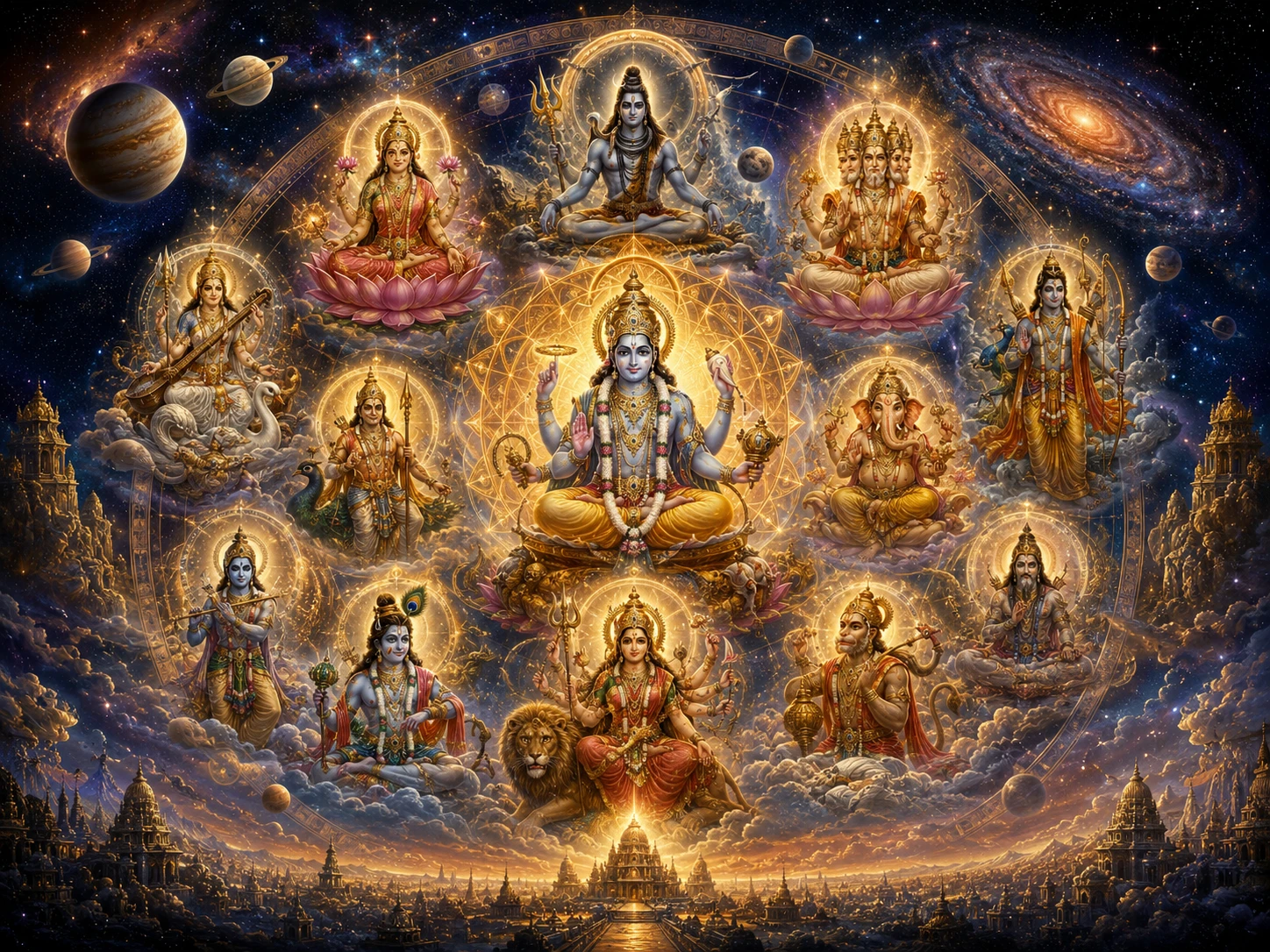
33 Koti Devata -- Why Hinduism Has 33 Types of Gods, Not 33 Crore
13 min read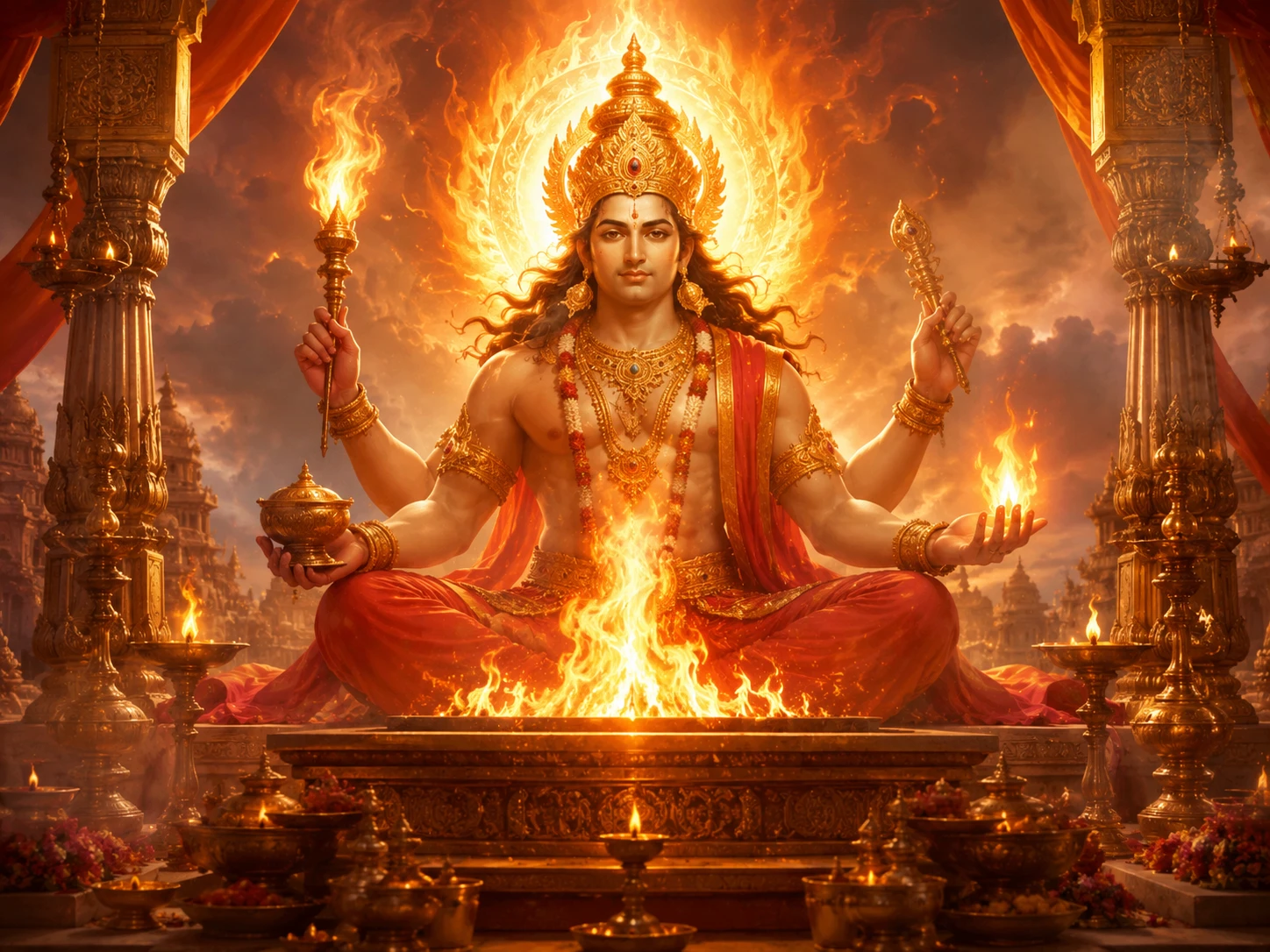
Agni -- The Fire God
19 min read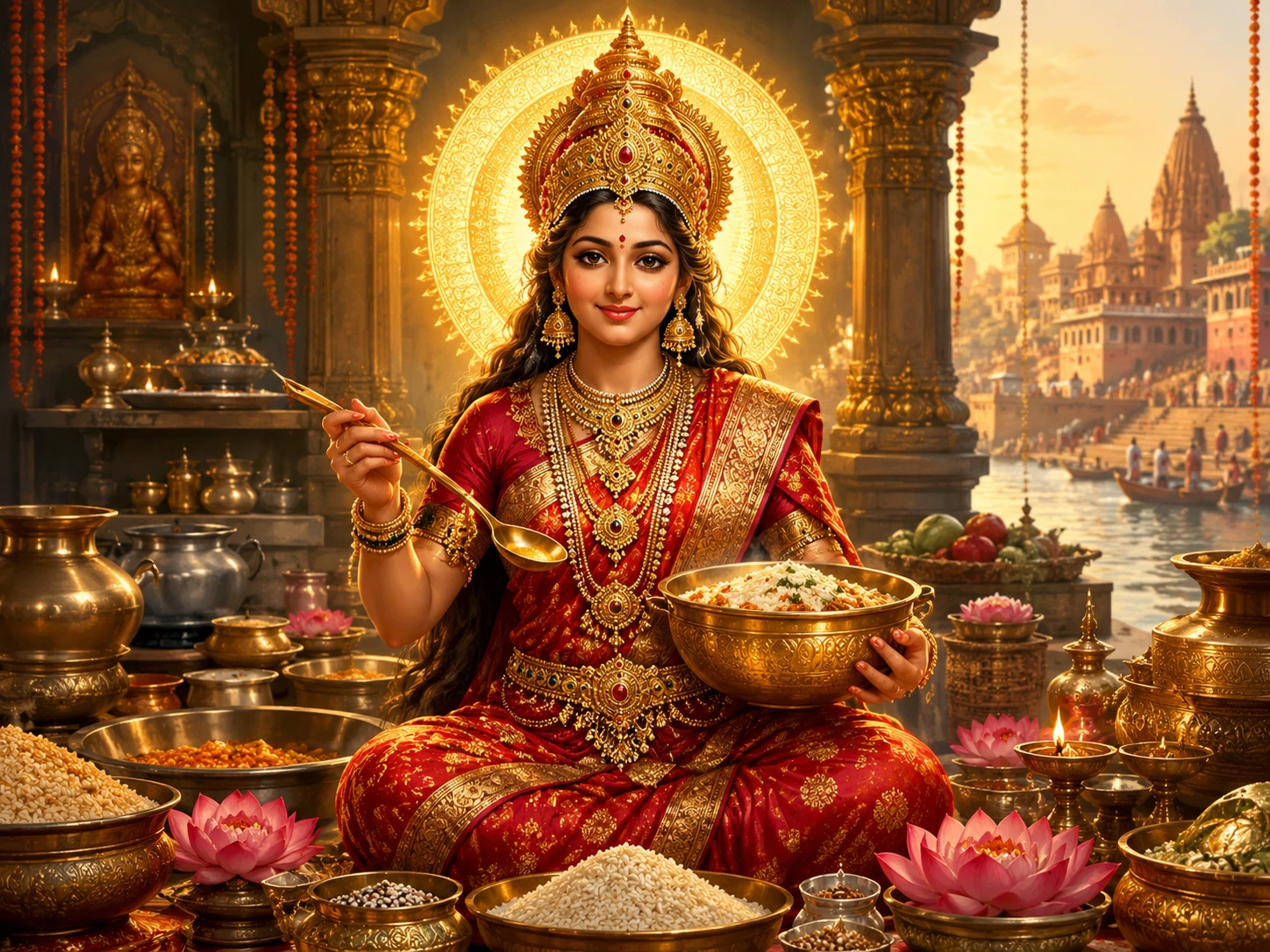
Annapurna -- Goddess of Food
19 min readThe same translation error that turned '33 Koti' into '33 crore' in Hinduism also happened in Buddhism. The Chinese translation of Buddhist texts rendered 'Sapta Koti Buddha' (7 Supreme Buddhas) as '7 Crore Buddhas.' The…
Deities AvatarsCommunity Reflections
🕉️
Be the first to share your reflection.