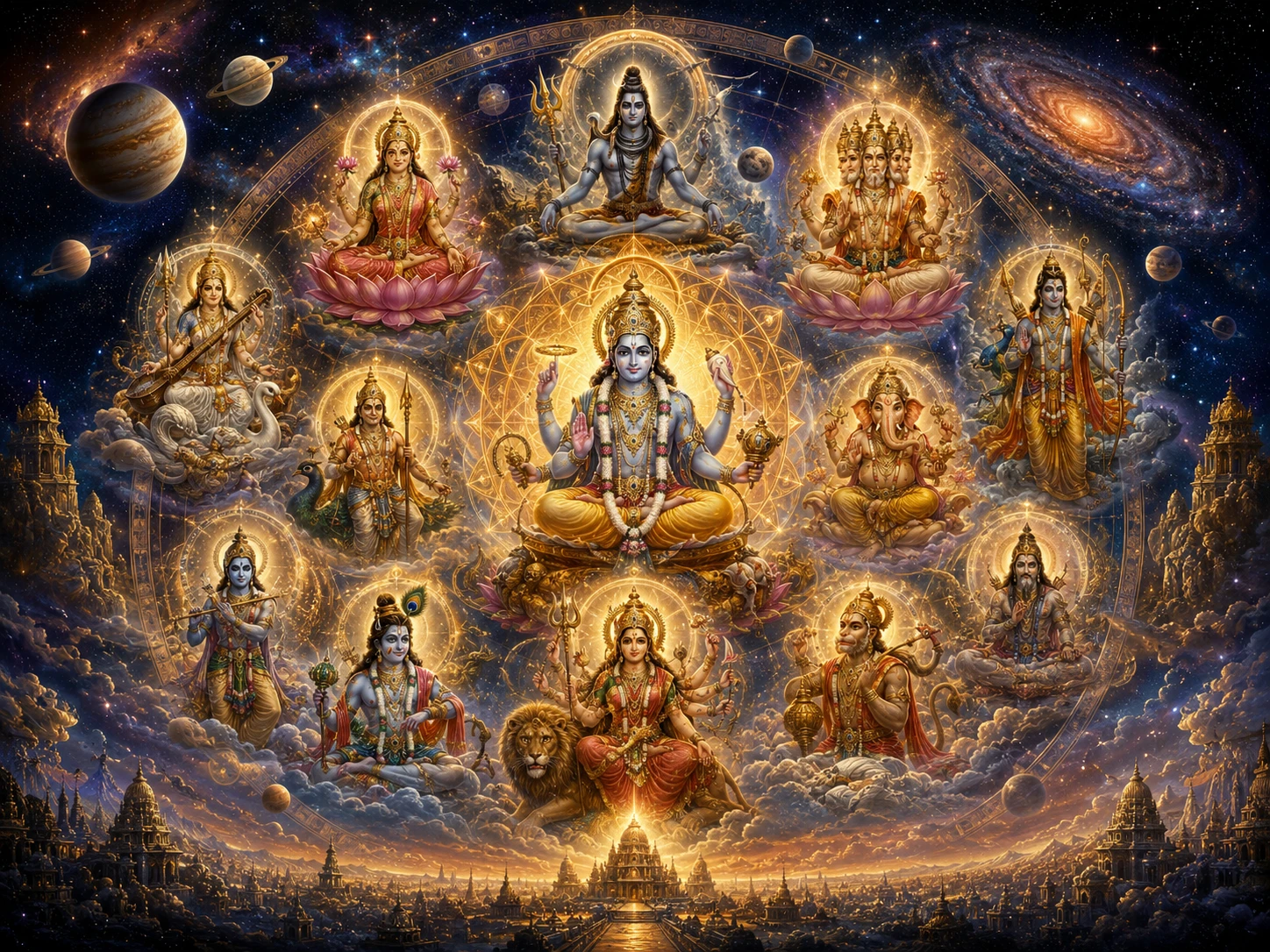
33 Koti Devata -- Why Hinduism Has 33 Types of Gods, Not 33 Crore
33 कोटि देवता -- हिन्दू धर्म में 33 प्रकार के देवता हैं, 33 करोड़ नहीं
Every debate about Hinduism on the internet -- whether it is a Reddit thread, a Twitter war, or a drawing room argument during Diwali -- eventually hits the same question: 'You guys have 33 crore gods, right?' And every Hindu has one of three reactions. Some are embarrassed and mumble something about it being symbolic. Some are proud and say 'Yes! That shows how open-minded we are!' And some say 'Actually, it is 33, not 33 crore.' All three reactions are incomplete. The real story is far more interesting.
The confusion begins with a single Sanskrit word: Koti. In modern Hindi, 'Koti' means 'crore' -- 10 million. So '33 Koti' became '33 crore' became '330 million gods.' But in classical Sanskrit, 'Koti' has multiple meanings. It can mean 'crore' (a large number). It can also mean 'type,' 'category,' 'supreme,' 'pre-eminent,' or 'pinnacle.' The phrase 'Trayastrimsati Koti' in the Atharva Veda and Shatapatha Brahmana means '33 supreme types' -- not '33 crore.' The Tibetan Buddhist tradition, which also inherited this term, correctly translated 'Sapta Koti Buddha' as '7 Supreme Buddhas,' not '7 Crore Buddhas.' The Chinese translation made the same mistake that popular Hinduism made -- reading 'Koti' as a number rather than a category.
But the clinching evidence is not linguistic. It is textual. The Brihadaranyaka Upanishad (3.9) contains one of the most remarkable philosophical dialogues in all of world literature -- a conversation between the sage Yajnavalkya and Vidagdha Shakalya about the exact number of gods. And Yajnavalkya does not just give an answer. He gives a series of answers that progressively reduce the number from 3,306 to 33 to 6 to 3 to 2 to 1.5 to 1. The entire conversation is a philosophical teaching method: start with multiplicity and compress toward unity. The gods are not 33 crore or even 33. They are, ultimately, One.
कति देवाः इति। यावन्तो वैश्वदेवस्य निविदि गृह्यन्ते। त्रयश्च त्री च शता त्रयश्च त्री च सहस्रा इति। ॐ इति। कत्येव देवाः इति। त्रयस्त्रिंशदिति।
kati devāḥ iti | yāvanto vaiśvadevasya nividi gṛhyante | trayaś ca trī ca śatā trayaś ca trī ca sahasrā iti | oṃ iti | katy eva devāḥ iti | trayastriṃśad iti |
'How many gods are there, Yajnavalkya?' 'As many as are mentioned in the hymn to the Vishvedevas -- three hundred and three, and three thousand and three.' 'Yes, but how many gods are there really?' 'Thirty-three.'
— Brihadaranyaka Upanishad 3.9.1, Yajur Veda
Yajnavalkya's Countdown -- From 3,306 to 1
The dialogue in Brihadaranyaka Upanishad 3.9 is a masterclass in philosophical compression. Vidagdha Shakalya keeps asking 'how many gods are there, really?' and Yajnavalkya keeps reducing the number. The sequence is:
3,306 (three hundred and three plus three thousand and three) -- the full manifest pantheon, all the powers and aspects of the divine as experienced in ritual and nature. 33 -- when pressed, these 3,306 are really expressions of just 33 fundamental divine principles. 6 -- when pressed further, the 33 reduce to six: Agni (fire), Prithvi (earth), Vayu (air), Antariksha (space), Aditya (sun), and Dyaus (heaven). 3 -- these six are really three worlds: the earthly (Agni + Prithvi), the atmospheric (Vayu + Antariksha), and the celestial (Aditya + Dyaus). 2 -- the three reduce to two fundamental principles: matter (Anna/food) and breath/life-force (Prana). 1.5 -- the two reduce to one-and-a-half: the one all-pervading air (Vayu) which is called 'one-and-a-half' (Adhyardha) because everything prospers in it. 1 -- finally, there is only One: Prana, the life-breath, which is Brahman.
This countdown is not numerology. It is ontology -- a systematic reduction of apparent multiplicity to underlying unity. The Rishis looked at the universe and saw thousands of divine forces at work. When they looked deeper, they saw 33 categories. When they looked deeper still, they saw 6, then 3, then 2, then 1. The destination of all Hindu theology is this: however many gods you see, they are all faces of one reality.
Think of it like this. A JEE aspirant in Kota sees hundreds of physics formulas. A professor sees perhaps 33 fundamental principles. A physicist at TIFR Mumbai sees them as 6 fundamental forces and fields. A theoretical physicist at IISc Bangalore reduces them further to 3 (electroweak, strong, gravity). A string theorist tries to get them down to 1 (a unified field equation). The Rishis were doing the same thing with the divine -- compressing observed multiplicity into fundamental unity.
Now -- who are the 33?
The 33 Vedic Deities -- Complete Breakdown
| Category | श्रेणी | Count | Members | They Represent |
|---|---|---|---|---|
| Vasus | वसु | 8 | Agni (Fire), Prithvi (Earth), Vayu (Air), Antariksha (Space), Aditya (Sun), Dyaus (Heaven), Chandramas (Moon), Nakshatras (Stars) | The fundamental elements in which all life dwells. 'Vasu' means 'that which dwells' or 'abode.' |
| Rudras | रुद्र | 11 | 10 Pranas (Prana, Apana, Vyana, Samana, Udana, Naga, Kurma, Krikala, Devadatta, Dhananjaya) + the Atman (soul) | The life-forces within the body. Called 'Rudras' because when they leave, the body dies and relatives weep (rud = to weep). |
| Adityas | आदित्य | 12 | The 12 solar months personified: Indra/Shakra, Ansha, Aryaman, Bhaga, Dhatri, Tvashtar, Mitra, Pushan, Savitri, Surya, Varuna, Vishnu | The cosmic timekeepers who cause the passage of time and the cycles of life. Sons of Aditi (boundlessness). |
| Indra | इन्द्र | 1 | Indra (also identified with Vidyut/lightning or the all-pervading electric force) | The supreme among Devas, king of Svarga, lord of storms and cosmic power. |
| Prajapati | प्रजापति | 1 | Prajapati (also identified with Yajna/sacrifice) | The lord of creatures, the cosmic creative principle, identified with the sacrifice that sustains the world. |
Total: 8 + 11 + 12 + 1 + 1 = 33. Some texts replace Indra and Prajapati with the two Ashwini Kumars (celestial physicians). The 33 are not 'gods' in the Western sense -- they are cosmic principles, natural forces, and life-energies personified as divine beings.
Being Intellectually Honest -- What the Puranas Say
Now here is where intellectual honesty matters. The viral WhatsApp forward that says 'There are only 33 gods, not 33 crore -- it is a mistranslation!' is partially right but oversimplified. The Vedic and Upanishadic tradition clearly describes 33 deities. That is not disputed by any scholar.
However, the later Puranic tradition does describe vastly larger numbers of divine beings. The Skanda Purana, for instance, mentions Devas numbering in crores. The Markandeya Purana and Shiva Purana describe cosmic hierarchies with innumerable celestial beings -- Gandharvas, Apsaras, Yakshas, Kinnaras, Nagas -- that far exceed 33.
The resolution is not to dismiss either source but to understand the difference in genre and purpose. The Vedas and Upanishads are philosophical -- they are interested in the fundamental categories of divine reality. The Puranas are narrative -- they are interested in telling stories about the vast divine ecosystem. Both are valid. Both are part of Hindu scripture. They are doing different things.
Think of it this way: a biology textbook might say there are 5 kingdoms of life (Monera, Protista, Fungi, Plantae, Animalia). A field guide to Indian wildlife might catalogue 91,000 species of animals. Both are correct. One gives you categories. The other gives you the full census. The Vedas give you 33 categories. The Puranas give you the census.
The error is not in the Puranas. The error is in taking a Puranic census number and attributing it to a Vedic philosophical statement. When someone says 'The Vedas say there are 33 crore gods,' that is factually wrong. The Vedas say 33. When someone says 'Hinduism recognises only 33 divine beings,' that is also misleading. The tradition recognises vast hierarchies of celestial beings beyond the 33 primary categories.
The truly Hindu answer to 'How many gods are there?' is Yajnavalkya's final answer: One. However many forms, names, and stories you encounter, they are all expressions of one ultimate reality -- Brahman. The 33 are its primary modes. The thousands are its infinite expressions. The one is its truth.
Modern India and the 33 Koti Question
The '33 crore gods' claim has become a meme -- weaponised by critics of Hinduism and awkwardly defended by Hindus who have not read the source texts. Both sides are operating from ignorance.
The Hindutva wing of Indian politics sometimes uses '33 crore gods' as a cultural pride point. The secular-liberal wing uses it as evidence that Hinduism is 'chaotic polytheism.' Western commentators use it to contrast Hinduism unfavourably with 'organised' monotheistic religions. None of these readings survive contact with the Brihadaranyaka Upanishad.
What the Upanishad actually demonstrates is the most sophisticated theology in the ancient world. It acknowledges the full spectrum of religious experience -- from nature worship (Vasus as elements) through cosmic timekeeping (Adityas as months) through life-force mysticism (Rudras as Pranas) -- and then systematically reduces all of it to One. This is not polytheism. It is not monotheism. It is a uniquely Hindu synthesis that Western religious categories cannot contain.
For the UPSC aspirant: this topic appears in both GS-1 (Indian Heritage) and Ethics (pluralism, tolerance). Know the Brihadaranyaka Upanishad reference, the 33 breakdown, and the philosophical method of progressive reduction. For the NRI parent at a school multicultural day: when your child's classmate says 'Hindus have millions of gods,' your child can say: 'The Upanishads describe 33 categories of divine forces, and they all point to one ultimate reality. A Hindu monk named Yajnavalkya explained this 3,000 years ago in one of the world's first philosophical dialogues.' That is a much better answer than either embarrassment or bluster.
For the Instagram reels creator who wants to go viral with accurate content instead of myths: the Yajnavalkya countdown (3,306 to 33 to 6 to 3 to 2 to 1.5 to 1) is inherently dramatic and perfect for a short-form video. Each number reduction reveals a deeper layer of reality. That is not just philosophy. That is great storytelling.
The same translation error that turned '33 Koti' into '33 crore' in Hinduism also happened in Buddhism. The Chinese translation of Buddhist texts rendered 'Sapta Koti Buddha' (7 Supreme Buddhas) as '7 Crore Buddhas.' The Tibetan translation got it right: 7 types, not 7 crore. One Sanskrit word, misread across two major world religions, generated two identical misconceptions independently.
Yajnavalkya's progressive reduction from 3,306 gods to 1 mirrors what modern physics attempts with its Grand Unified Theory. Physicists started with hundreds of 'fundamental' particles, reduced them to the Standard Model's 17, and are now trying to reduce everything to one unified field equation. The Brihadaranyaka Upanishad did this 3,000 years ago -- not with particles, but with the divine forces of nature. Yajnavalkya was history's first 'Theory of Everything' physicist.
Explore the 108 Names Collections
The 33 Vedic deities -- 8 Vasus, 11 Rudras, 12 Adityas, Indra and Prajapati -- are remembered today mostly through their names. Eternal Raga's 108 Names collections gather the names of the great deities with their meanings, a good place to begin a practice of naming.
Eternal Raga · शाश्वत राग
Institutional voice — scholarly articles on Sanatan Dharma
Deepen Your Understanding
अपनी समझ और गहरी करें
deities avatars
Dashavatara -- Why Vishnu Comes Back Ten Times
Fish, tortoise, boar, half-lion, dwarf, axe-warrior, prince, cowherd, enlightened teacher, future horseman. The ten avatars of Vishnu are not random folklore. Read them in sequence and you get something startling -- a narrative that mirrors evolutionary biology, tracks the rise and fall of political systems, and argues that God does not sit above history but enters it, gets dirty, and does the work. The Dashavatara is Hinduism's answer to the question every civilisation asks: why does the world keep breaking, and who fixes it?
philosophy darshana
Atman and Brahman -- The Self and the Absolute
The Upanishads make a claim so radical that 3,000 years have not dulled its edge: the individual self (Atman) and the ultimate reality of the universe (Brahman) are not two different things. They are one. Every school of Hindu philosophy is essentially an argument about what this identity means.
philosophy darshana
Advaita Vedanta Explained -- Shankara's Radical Philosophy of Non-Duality
You are not your job title. You are not your Instagram bio. According to Adi Shankaracharya, you are not even your body or mind -- you are Brahman itself, the infinite consciousness wearing a temporary costume. Advaita Vedanta is the most radical philosophical claim in Indian history: that the entire universe is one undivided reality, and separation is the grandest illusion.
philosophy darshana
The Six Darshanas -- India's Original Intellectual Operating Systems
Long before Greek philosophy had its first argument, India had six complete philosophical systems -- each with its own logic, metaphysics, epistemology, and liberation path. Nyaya built formal logic. Vaisheshika invented atomic theory. Samkhya mapped consciousness. Yoga engineered the mind. Mimamsa decoded ritual. Vedanta asked the final question. Together, they are the most comprehensive intellectual framework any civilisation has produced.
philosophy darshana
The Four Mahavakyas -- Upanishadic Sentences That Changed Civilisation
Four sentences. Twelve words of Sanskrit. Three thousand years of commentary. The Mahavakyas are the most compressed, most powerful, and most debated statements in all of Indian philosophy. Each one claims that the individual self and the ultimate reality of the universe are not two different things. And each one has been interpreted to mean something completely different by every major school of Vedanta.
scriptural exegesis
Samudra Manthan -- When Gods and Demons Ran a Joint Venture and the Universe Almost Died
A cosmic ocean. A mountain for a churning rod. A serpent king for a rope. Gods on one end, demons on the other. And out came 14 treasures -- including wealth, beauty, medicine, immortality, and one poison so lethal it could end creation itself. The Samudra Manthan is not mythology. It is the original playbook for collaboration, crisis management, and how to handle it when your joint venture partner tries to cheat you.
vedic sciences
Kaal Ganana -- The Hindu Measure of Time
From a single blink of the eye (Nimesha) to one Day of Brahma (4.32 billion years) -- explore the complete cosmic time hierarchy of Hindu cosmology, anchored in Vishnu Purana 1.3, with its remarkable parallels to modern science.
The same translation error that turned '33 Koti' into '33 crore' in Hinduism also happened in Buddhism. The Chinese translation of Buddhist texts rendered 'Sapta Koti Buddha' (7 Supreme Buddhas) as '7 Crore Buddhas.' The…
More in Deities & Avatars
Agni -- The Fire God
19 min read
Annapurna -- Goddess of Food
19 min read
Apah -- The Waters of the Rig Veda
9 min readThe same translation error that turned '33 Koti' into '33 crore' in Hinduism also happened in Buddhism. The Chinese translation of Buddhist texts rendered 'Sapta Koti Buddha' (7 Supreme Buddhas) as '7 Crore Buddhas.' The…
Deities AvatarsCommunity Reflections
🕉️
Be the first to share your reflection.
Frequently Asked Questions
Does Hinduism have 33 crore (330 million) gods?
What does the word koti actually mean: crore or category?
Who are the 33 devatas of the Vedas?
Where does the number 33 come from, and is it the final answer?
Related across Eternal Raga