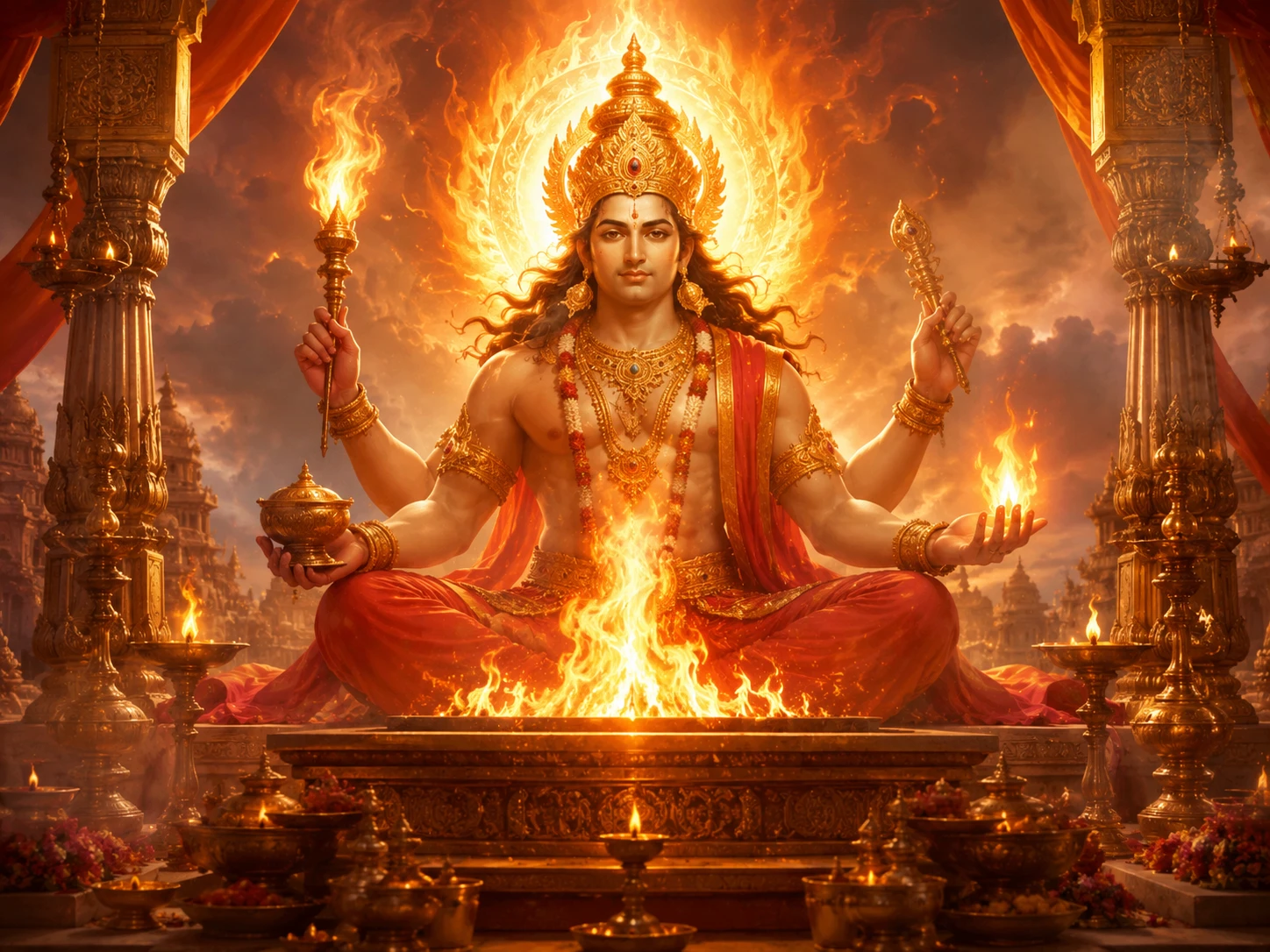
Agni -- The Fire God
अग्नि -- यज्ञ-देव
The Rig Veda, the oldest surviving scripture of the Hindu tradition, begins with the name Agni. Its very first verse, recited by every traditionally trained Sanskrit student before any other mantra, opens: agnim ile purohitam yajnasya devam ritvijam. 'I praise Agni, the household-priest of the sacrifice, the divine minister.' Before any other deity is named in the Rig Veda, Agni is named. About 200 of the text's 1,028 hymns are dedicated to him, second only to Indra. He is the central ritual presence of Vedic religion. Every yajna, every homa, every havan, every sandhyavandana, every wedding fire, every cremation pyre: Agni is there, literally as the flame, theologically as the deity who inhabits the flame and carries whatever is offered to the other gods. He is the divine postman of the Vedic religious economy. Without Agni, the yajna has no destination; the offerings sit uneaten on the altar. Because of this structural centrality, Agni survived the decline of Vedic sacrificial religion far better than other Vedic deities. You may not pray to Indra today, but if you attend an Indian wedding in 2026, Agni will be there in the havan kund around which the bride and groom circle seven times.
The Vedic understanding of Agni is layered, and each layer adds to the next. Agni is threefold: the fire of the altar (ahavaniya agni) in the east, the fire of the household (garhapatya agni) in the west, and the fire of the ancestors (dakshinagni) in the south. Each of these has its own function, its own kindling, its own offering, and its own presiding priest. A traditional Brahmin grihastha was expected to maintain these three fires continuously in a structured fire-altar arrangement; the complexity of the shrauta ritual system is built on this three-fire foundation. Agni is also threefold at a cosmological level: the fire on earth (terrestrial Agni), the fire of lightning in the atmosphere (atmospheric Agni), and the fire of the sun in the heavens (celestial Agni). All three are the same deity manifesting at different levels. The Atharva Veda extends this further, identifying Agni with the jatharagni, the digestive fire in the human stomach, and with the kundalini agni, the subtle fire at the base of the spine in later yogic theology. The fire is not a symbol. It is the same deity wherever combustion occurs. A Brahmin priest offering ghee into a yajna in Varanasi, a grandmother lighting the kitchen stove in Madurai, and a cremation priest lighting the pyre at Manikarnika Ghat are all engaging with Agni in his different forms.
अग्निमीळे पुरोहितं यज्ञस्य देवमृत्विजम् । होतारं रत्नधातमम् ॥१॥
agnim īḷe purohitaṃ yajñasya devam ṛtvijam | hotāraṃ ratnadhātamam ||1||
I praise Agni, the household-priest of the sacrifice, the divine minister who performs the rituals at their proper times, the invoker, the most skilled bestower of treasure.
— Rig Veda 1.1.1 (Madhucchandas Vaishvamitra)
The iconography of Agni is extraordinarily detailed in the Puranas and Agamic texts. He has two faces, one looking forward and one backward, representing the fire that consumes and the fire that purifies. Seven tongues of flame emerge from his mouth; each has a specific name in the Mundaka Upanishad (Kali, Karali, Manojava, Sulohita, Sudhumravarna, Sphulingini, and Vishvaruchi) and each accepts a different kind of offering. His body is shown in red or orange; he has three legs, seven arms (sometimes four), a long black beard, and wears a deer skin and a sacred thread. His vehicle is the mesha, the ram, whose wool is used in soma filtration and whose sacrifice was central to the old Vedic rites. He is accompanied by seven horses or sometimes by a pair of horses named Rohita and Ruchita. His consort is Svaha, whose name is the mantra recited at the moment an oblation is placed in the fire. Without the word svaha, the offering does not reach its destination. Svaha is therefore not decorative. She is the functional completion of every Agni ritual. Every Hindu wedding, every havan, every puja ends with the word svaha. Svaha is active in the moment the fire receives.
The Agnihotra is the simplest and most continuous Agni ritual in Hindu tradition. Performed at sunrise and sunset every day by orthodox Brahmin householders, it requires only a small fire kund, some cow-dung cakes, a few grains of rice, ghee, and a specific set of mantras. The ritual takes about ten minutes morning and evening. Its structure: kindle the fire with cow-dung, recite the sankalpa, offer the first spoonful of rice mixed with ghee at the exact moment of sunrise or sunset saying agnaye svaha idam agnaye idam na mama ('to Agni, svaha; this is for Agni, not for me'), offer a second spoonful to Prajapati saying prajapataye svaha, sit in silence for two minutes, recite a short closing mantra, and extinguish the fire appropriately. The practice is minimal but theologically complete: the householder is affirming, twice a day, that everything received is to be given back, that food is a debt to be acknowledged, and that the rhythm of the cosmos is maintained through small regular offerings. The Agnihotra is still performed by roughly tens of thousands of families across India, concentrated in Maharashtra, Gujarat, Karnataka, and among Arya Samaj communities globally. It is also practiced by some modern spiritual movements as an environmental purification ritual, though the traditional purpose is strictly religious.
The Three Vedic Fires
| Fire | Direction | Purpose |
|---|---|---|
| Garhapatya / गार्हपत्य | West / पश्चिम | The household fire; used for daily cooking and domestic rituals. Kindled first and kept permanently alight. / गृह-अग्नि; दैनिक भोजन और घरेलू अनुष्ठानों के लिए। सबसे पहले जलाई जाती है और स्थायी रूप से जलती रहती है। |
| Ahavaniya / आहवनीय | East / पूर्व | The oblation fire into which offerings to the devas are made. The ritual centre of the yajna. / हवि-अग्नि जिसमें देवताओं को अर्पण किया जाता है। यज्ञ का अनुष्ठान-केंद्र। |
| Dakshinagni / दक्षिणाग्नि | South / दक्षिण | The ancestor fire; used in pitri-yajna and shraddha rituals for departed souls. / पितृ-अग्नि; दिवंगत आत्माओं के लिए पितृ-यज्ञ और श्राद्ध में प्रयुक्त। |
The full shrauta ritualist maintains all three fires simultaneously in a structured agnyadhana (fire-establishment) arrangement that takes years to set up correctly and must be tended daily thereafter. Most contemporary Hindus encounter Agni only through the simplified single-fire havan of modern puja.
The Hindu wedding ceremony is organized entirely around Agni. The sacred fire, kindled in a havan kund in the centre of the mandap, is the witness to the exchange of vows. The priest begins by establishing Agni through the agni-sthapana mantras. The bride and groom perform the saptapadi, the seven steps around the fire, each step accompanied by a specific vow: to nourish each other, to share strength, to acquire wealth ethically, to maintain love and respect, to raise children with dharma, to live long together, and to remain friends through every season of life. The fire is the witness. Agni is, in Hindu theological understanding, the only legally competent witness of a marriage. This is why Hindu weddings are called agni-sakshin vivaha, 'marriage witnessed by Agni.' Even in modern Hindu weddings streamlined for busy urban schedules, the saptapadi around Agni is non-negotiable. A Chennai techie's destination wedding in Goa, a Marwari business family's grand Udaipur affair, a Punjabi NRI's reception in Toronto: all will include this ritual. The couple is not married when a document is signed. The couple is married when they have walked seven steps around Agni and Agni has received their vows.
The Indian Space Research Organisation (ISRO) named its medium-range ballistic missile series Agni, with the first Agni-I tested in 1989, and has subsequently developed Agni-II, III, IV, V, and the intercontinental Agni-V variants. The naming is deliberate. Indian strategic culture has frequently drawn on Vedic deity names for missile systems: Prithvi (earth), Akash (sky), Trishul (Shiva's trident), Nag (the serpent), and Agni (fire) all appear as named missile systems. The specific choice of Agni for long-range systems reflects both the god's Vedic prestige and the symbolic association of fire with propulsion. A DRDO scientist working on solid-fuel rocket motors in Hyderabad in 2026 is in a lineage that stretches, at a symbolic level, back to the priests who offered ghee into the first agnihotra four thousand years ago. The irony is not lost on some Indian cultural commentators: the oldest Vedic deity survives most visibly in the most modern of India's strategic arsenals.
Agni's role in cremation is theologically specific. The Hindu funeral rite, antyeshti, is considered the final yajna of a human life. The dead body is carried to the shmashana, the cremation ground, arranged on a pyre of wood, anointed with ghee and sandalwood oil, and given to Agni. The chief mourner, usually the eldest son, lights the pyre with a specific flame brought from home. The pyre burns. The body dissolves into the five elements of which it was composed: the flesh and bone returning to earth through ash, the water through evaporation, the heat through fire, the air through smoke, and the space through the rising soul. The Garuda Purana describes this as the completion of the soul's release. Without cremation by Agni, the soul is understood to remain partially attached to the body. At Manikarnika Ghat in Varanasi, the most sacred cremation ground in the Hindu tradition, the flame is said to have been continuously alight for at least several centuries; every cremation is lit from the same sacred flame, which is understood to be Agni himself. The operation of the ghat, now managed by the Dom community who have maintained this ritual role for generations, continues 24 hours a day without pause. The fire does not stop. The deity remains present.
The theological equation of Agni with the digestive fire in the human stomach is ancient and structurally important. The Upanishads, particularly the Chhandogya (5.24) and the Bhagavad Gita (15.14), state that the Lord resides as vaishvanara agni in the stomach of all living beings and digests the food they consume. Every meal is therefore, in this reading, an offering to the inner Agni. Ayurveda takes this theology seriously as medical principle. Its central concept of agni as digestive capacity (along with vata, pitta, and kapha as bodily humors) structures its diagnosis and treatment protocols. A physician trained at the Banaras Hindu University's Ayurveda faculty or at Jamnagar's Institute of Teaching and Research in Ayurveda evaluates a patient's jatharagni as the first step in any consultation. Weak digestion indicates weak agni, which indicates weak ojas, which indicates weak immunity. This framework does not contradict modern medical physiology but provides a parallel conceptual language for thinking about metabolism and constitutional health. A Hindu who chants the prayer om pranaya svaha, apanaya svaha before a meal is formally offering the food to the inner agni; this pre-meal ritual survives in many orthodox households and is taught in Ayurveda colleges as a practice that improves digestion regardless of metaphysical beliefs.
Agni's dikpala role -- guardian of the south-east direction -- is part of the classical eight-directional cosmological scheme of Hindu architecture and Vastu Shastra. The eight directions are each assigned to a specific deity: Indra in the east, Agni in the south-east, Yama in the south, Nirriti in the south-west, Varuna in the west, Vayu in the north-west, Kubera in the north, and Ishana in the north-east. In Vastu-compliant home construction, the south-east corner of a building -- known as the Agni-kona -- is designated for the kitchen. This is not arbitrary; it reflects the principle that the household's cooking fire should align with the cosmic direction ruled by Agni. A middle-class family in Bengaluru commissioning a new apartment from a Vastu-consulting interior designer will receive specific advice about placing the cooking stove in the south-east corner of the kitchen, with the cook facing east while preparing food. The tradition has survived the transition from traditional Indian homes with open hearths to modern apartments with gas stoves and induction cooktops; the consultant will simply recommend reorienting the appliance rather than redesigning the entire home. Whether the family follows the advice is a personal decision. Whether Agni is being invoked through the geometry of the kitchen is not up for debate within the tradition.
The Arya Samaj movement, founded by Swami Dayananda Saraswati in 1875, brought Agni back to the centre of organized Hindu devotional life in a way no other modern movement attempted. Dayananda argued that the original Vedic religion was non-idolatrous and was centered on the havan ritual offered to Agni as the sole appropriate form of worship. Every Arya Samaj mandir therefore contains a havan kund rather than murtis of gods. Every Arya Samaj satsang begins with the lighting of the fire and the recitation of Vedic mantras accompanying the offering of ghee, rice, and samagri (a specific herbal mixture). The 'Swastivachana,' 'Shanti Karana,' and 'Gayatri Mantra' are chanted in a specific order, and the congregation recites 'svaha' at the moment of each offering. An Arya Samaj mandir in Lahore before 1947, in Delhi through the twentieth century, or in Los Angeles in 2026 runs the same basic ritual every week. The movement counts several million adherents globally, with particularly strong presence in Punjab, Haryana, western Uttar Pradesh, and the Hindu diaspora in Fiji, Mauritius, Trinidad, Guyana, Suriname, and South Africa, where it has played a significant role in preserving Hindu practice among communities descended from nineteenth-century indentured labour. For an Arya Samaji, Agni is not one deity among many. Agni is the central one and the only one who receives formal ritual.
For contemporary practitioners who do not come from an Arya Samaj background or a traditional shrauta lineage, a modest Agni practice is still accessible. The simplest form is to conduct a monthly havan at home on the Purnima (full moon) night. Materials needed: a small metal havan kund, some dry mango wood sticks, cow-dung cakes, a small jar of ghee, a quarter cup of white rice, and samagri purchased from any puja-samagri shop. On the full moon evening, light the fire, recite the Gayatri mantra 11 times while offering small spoonfuls of rice mixed with ghee, ending each offering with 'svaha.' Follow this with 11 recitations of the Maha Mrityunjaya mantra, again with offerings. Close with three recitations of the Shanti mantra and let the fire burn out naturally. The practice takes about 25 minutes and purifies the home atmosphere while maintaining a monthly connection to the Vedic ritual tradition. The practice is explicitly not a substitute for temple worship or for deity-specific devotion. It is an addition to whatever else the practitioner does spiritually, and it keeps alive the oldest form of Hindu religious expression. Many young Indian professionals in Bengaluru, Pune, and Hyderabad have taken up this monthly havan since 2020, often conducting it together with their partners or families as a quiet ritual anchor in otherwise unstructured urban lives.
The fifteen-day shraaddha period, called Pitru Paksha, falls in the lunar fortnight of Krishna Paksha in the month of Bhadrapada (usually September-October). During these fifteen days, every Hindu household with living elders performs tarpan, a ritual offering of water mixed with black sesame seeds, to departed ancestors. The most common site for this is the banks of a sacred river: the Ganga at Varanasi, the Godavari at Nashik, the Narmada at Omkareshwar, or the Kaveri at Srirangam. At the riverbank, a family's senior male carries out the pitru-tarpan while a purohita recites the appropriate mantras. The ritual always involves a sacred fire kindled in a small kund, into which black sesame seeds, rice balls (pindas), and ghee are offered. This pitru-fire is a specific form of Agni, the dakshinagni mentioned earlier, and its function is to carry the offering directly to the ancestors' world, called pitruloka. The belief is that ancestors who have not yet moved beyond pitruloka into higher worlds need these annual offerings for their ongoing spiritual sustenance. A Delhi-based IT professional who flies his ageing father to Gaya once in their lives for the Gaya shraaddha is participating in the same ritual system his ancestors practised two thousand years ago. The fire mediates between worlds; Agni carries the food.
The chief priest of the Vedic yajna is called the hotri, and the hotri is defined by his relationship to Agni. The word hotri itself comes from the same root as 'to pour' and 'to offer'; a hotri is the one who pours offerings into the fire. The Rig Veda itself is understood as the book of the hotri, with each hymn being what the hotri chants while offering. Four specific priestly functions are assigned in the classical Srauta ritual: the hotri who chants from the Rig Veda while offering, the adhvaryu who physically performs the ritual acts and chants from the Yajur Veda, the udgatri who sings melodies from the Sama Veda, and the brahman who silently oversees all three and chants from the Atharva Veda to correct errors. All four specialise in Agni. The hotri stands closest to the fire. The adhvaryu handles the physical offerings into the fire. The udgatri sings while the fire burns. The brahman watches the fire for signs of irregularity. Contemporary Hinduism has collapsed these four functions into one purohita in most ritual contexts, but the traditional four-fold distinction is still maintained at large public yajnas. A yajna at Kumbh Mela or during a major temple consecration may still feature four specialists. The whole architecture of Vedic priesthood is Agni-centred.
Agni's presence in every major Hindu transition point -- birth, upanayana (sacred thread ceremony), marriage, and death -- is what makes him structurally irreplaceable in Hindu life, even for families who are otherwise minimally observant. The birth rite of jatakarma, performed traditionally within ten days of a child's birth, includes an offering to Agni. The upanayana ceremony at age seven or nine for Brahmin boys, still performed in many Tamil Brahmin, Iyer, Iyengar, Chitpavan, and Gaud Saraswat Brahmin families, has Agni at its centre: the boy approaches the fire, is given the sacred thread, and is taught the Gayatri mantra while seated before the fire. The marriage rite is built around Agni, as discussed. The cremation rite gives the body back to Agni. A Hindu therefore enters and exits life through Agni, is bound to a spouse through Agni, and is initiated into spiritual adulthood through Agni. No other deity in the Hindu pantheon has this four-fold structural ritual presence. Vishnu, Shiva, and the Devi receive far more daily puja and temple devotion, but Agni receives the most ontologically important ritual attention: he is present at every genuinely life-changing moment. This is why, even as other Vedic deities faded, Agni did not. Structural embeddedness is more durable than popular affection.
Recite the Agni Suktam on Purnima
The Agni Suktam (Rig Veda 1.1) is on Eternal Raga with its meaning. Recite its nine verses aloud on Purnima night while lighting a small oil lamp, as a minimal substitute for a formal havan.
Eternal Raga · शाश्वत राग
Institutional voice — scholarly articles on Sanatan Dharma
Deepen Your Understanding
अपनी समझ और गहरी करें
tantra mantra yantra
Mahamrityunjaya Mantra -- Conquering Death
A 16-year-old boy clings to a Shiva Linga as the god of death throws a noose around his neck. Shiva emerges from the Linga, kicks Yama in the chest, and declares the boy immortal. That boy is Markandeya. That mantra is the Mahamrityunjaya. It appears in the Rig Veda, the Yajur Veda, and the Atharva Veda -- the only healing mantra attested in three of the four Vedas. It is chanted in ICU corridors, before surgeries, at bedsides, and in cremation grounds. This is not a mantra about avoiding death. It is a mantra about not being afraid of it.
rituals traditions
Vrata -- What a Hindu Vow Really Means (It Is Not Just Fasting)
Your mother kept Karva Chauth without water for sixteen hours. Your grandmother observed Ekadashi every fortnight without fail. Your colleague skips lunch on Tuesdays 'for Hanuman.' The world sees Hindu fasting as dietary restriction. The tradition sees it as something far more radical: Vrata is a voluntary, time-bound act of self-imposed discipline that rewires the relationship between desire and willpower. Fasting is the most visible expression. But the real Vrata happens inside.
deities avatars
Dashavatara -- Why Vishnu Comes Back Ten Times
Fish, tortoise, boar, half-lion, dwarf, axe-warrior, prince, cowherd, enlightened teacher, future horseman. The ten avatars of Vishnu are not random folklore. Read them in sequence and you get something startling -- a narrative that mirrors evolutionary biology, tracks the rise and fall of political systems, and argues that God does not sit above history but enters it, gets dirty, and does the work. The Dashavatara is Hinduism's answer to the question every civilisation asks: why does the world keep breaking, and who fixes it?
scriptural exegesis
Samudra Manthan -- When Gods and Demons Ran a Joint Venture and the Universe Almost Died
A cosmic ocean. A mountain for a churning rod. A serpent king for a rope. Gods on one end, demons on the other. And out came 14 treasures -- including wealth, beauty, medicine, immortality, and one poison so lethal it could end creation itself. The Samudra Manthan is not mythology. It is the original playbook for collaboration, crisis management, and how to handle it when your joint venture partner tries to cheat you.
deities avatars
Who is Shiva?
He is the ash-smeared ascetic who is also the ideal husband. The destroyer of the universe who is called 'The Auspicious One.' The god of death who drank poison to save all life. He sits in meditation on a Himalayan peak, and simultaneously dances the cosmos into existence and annihilation. No deity in Hinduism contains more contradictions -- and no deity resolves them more completely. This is not a mythology explainer. This is an attempt to stand at the foot of the mountain and look up.
deities avatars
Nine Forms of Shiva -- The Many Faces of Mahadeva
He is the silent teacher under a banyan tree and the screaming destroyer on a battlefield. He is half-woman and half-man. He drank the poison that would have ended the universe and his throat turned blue. Nine scripturally-attested forms of Shiva -- from Nataraja to Rudra -- and why each one exists.
rituals traditions
Tirtha Yatra -- Why Hindus Travel to Get Closer to God
The word 'Tirtha' does not mean 'holy place.' It means 'crossing point' -- a ford where the river of worldly existence can be crossed to reach the far shore of liberation. Hindu pilgrimage is not tourism with a spiritual label. It is the deliberate journey to locations where the boundary between the material and the divine is believed to be thinnest -- where the crossing is easiest. From Kashi to Kailash, from Char Dham to Kumbh Mela, the tradition maps a sacred geography onto the physical landscape of the subcontinent, turning the act of travel itself into a spiritual practice.
The Indian Space Research Organisation (ISRO) named its medium-range ballistic missile series Agni, with the first Agni-I tested in 1989, and has subsequently developed Agni-II, III, IV, V, and the intercontinental Agni-…
More in Deities & Avatars
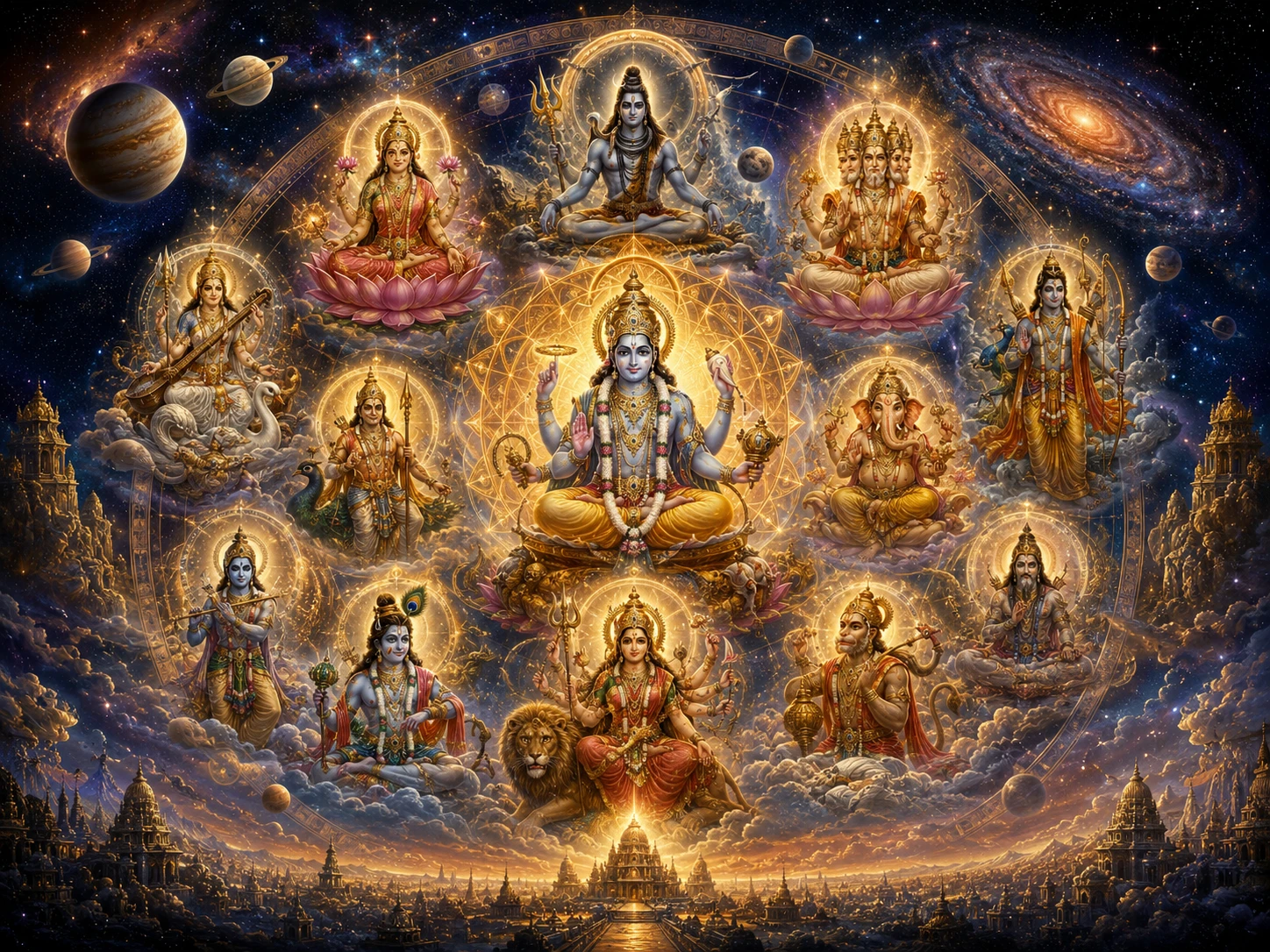
33 Koti Devata -- Why Hinduism Has 33 Types of Gods, Not 33 Crore
13 min read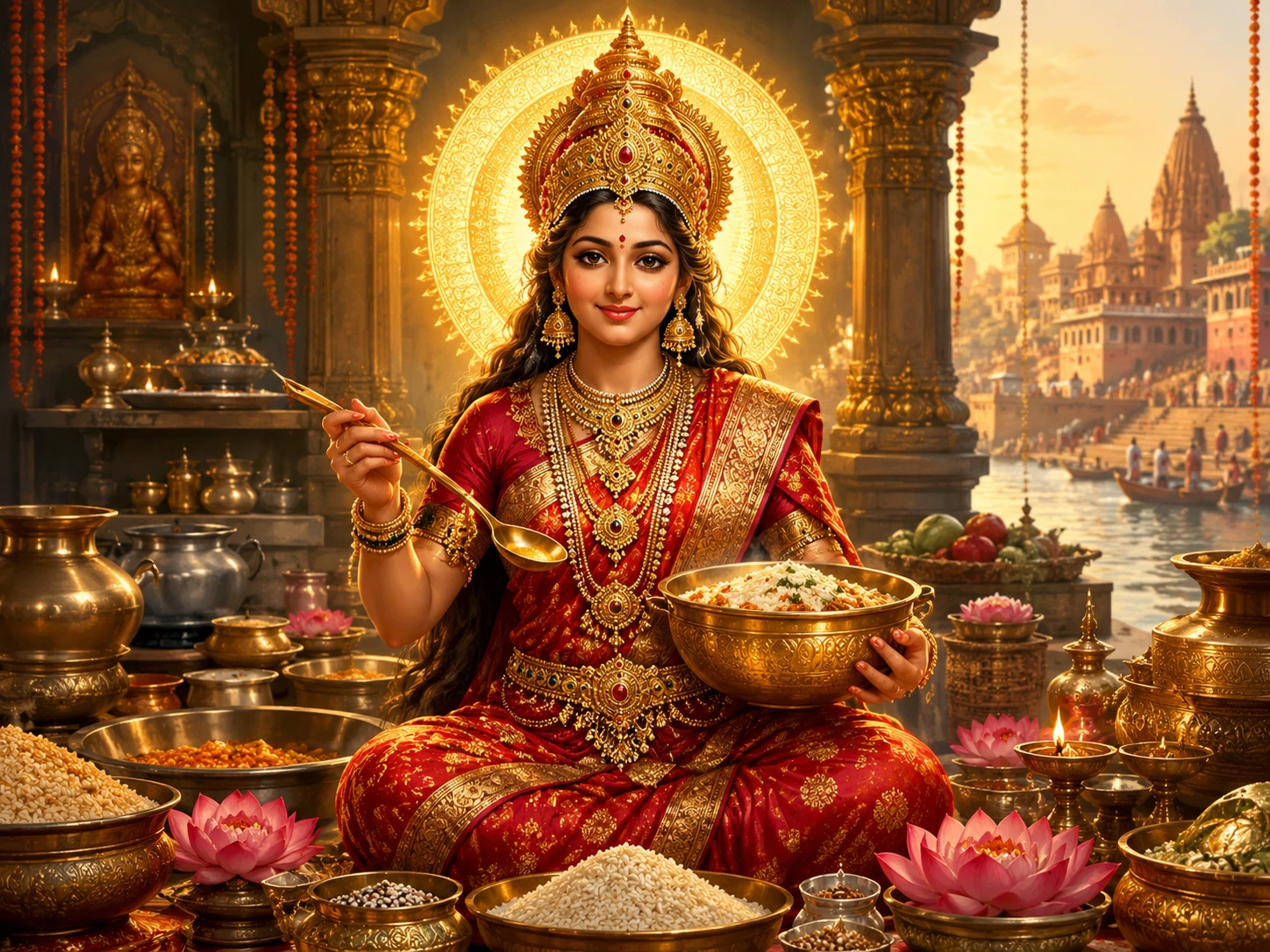
Annapurna -- Goddess of Food
19 min read
Apah -- The Waters of the Rig Veda
9 min readThe same translation error that turned '33 Koti' into '33 crore' in Hinduism also happened in Buddhism. The Chinese translation of Buddhist texts rendered 'Sapta Koti Buddha' (7 Supreme Buddhas) as '7 Crore Buddhas.' The…
Deities AvatarsCommunity Reflections
🕉️
Be the first to share your reflection.