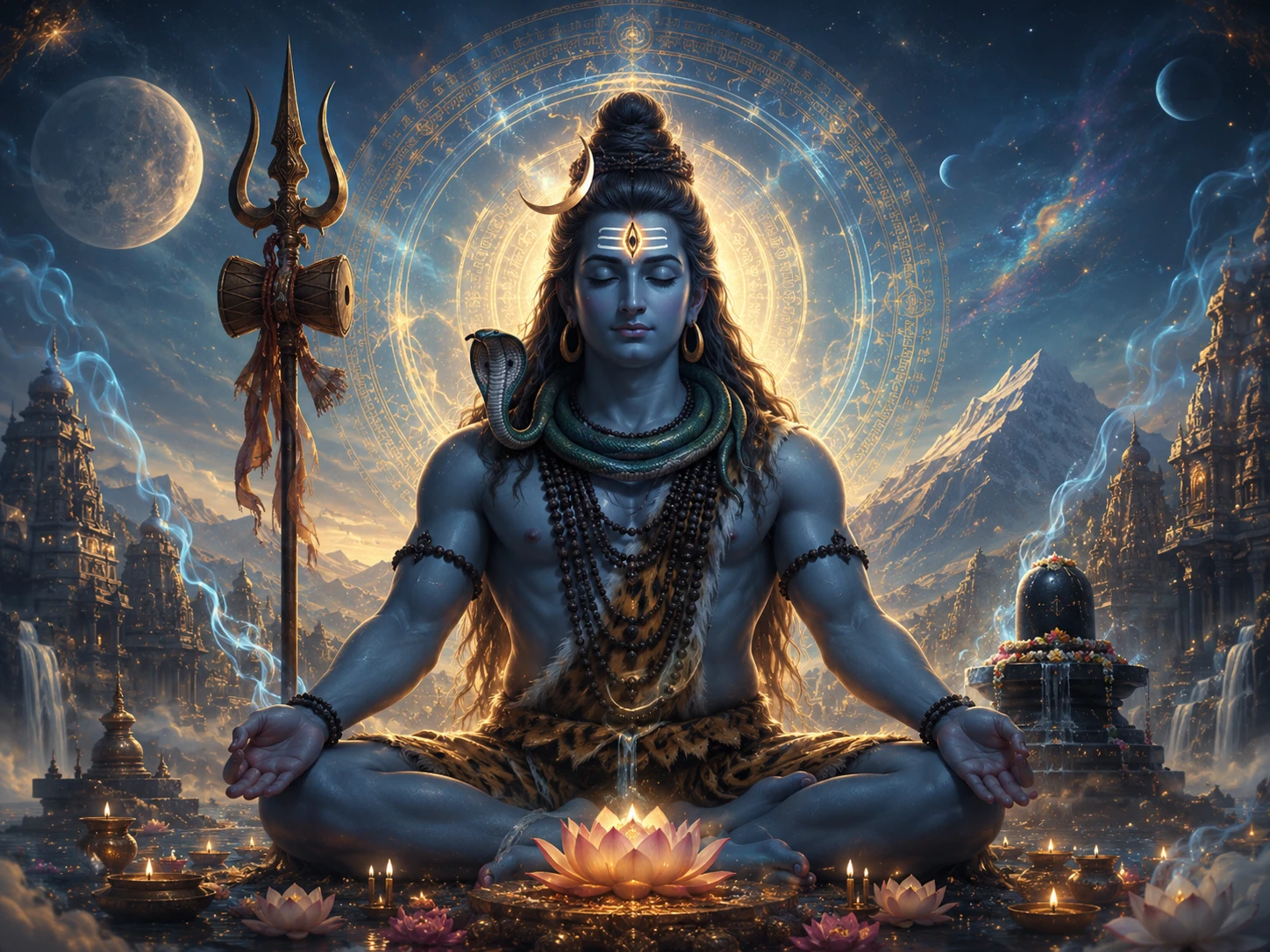
Mahamrityunjaya Mantra -- Conquering Death
महामृत्युंजय मन्त्र -- मृत्यु पर विजय
There are two mantras that Hindu tradition places above all others. The Gayatri Mantra is for illumination -- it lights the mind. The Mahamrityunjaya Mantra is for healing -- it shields the life. Together, they are called the two eyes of the Vedas. If the Gayatri is the right eye (solar, intellectual, clarifying), the Mahamrityunjaya is the left eye (lunar, protective, nurturing).
The mantra's full name -- Maha-Mrityu-Jaya -- means 'Great Victory Over Death.' It is also called the Tryambakam Mantra (addressed to the three-eyed Shiva), the Rudra Mantra (invoking Shiva's fierce protective aspect), and the Mrita-Sanjivini Mantra (the 'life-restoring' formula). This last name connects it to Sage Shukracharya, who received it from Shiva as the knowledge of reviving the dead -- the same Sanjivini Vidya that Hanuman later sought on the mountain to save Lakshmana.
The mantra appears in three of the four Vedas: Rig Veda (7.59.12), Yajur Veda (Taittiriya Samhita 1.8.6 and Vajasaneyi Samhita 3.60), and Atharva Veda (14.1.17). This triple attestation is extremely rare. Most Vedic verses appear in one, sometimes two Vedas. The Mahamrityunjaya's presence in three signals that it was considered universally essential across Vedic traditions -- not restricted to any one school, region, or ritual context.
In the Rig Veda, the verse appears in Sukta 59 of Mandala VII, a hymn attributed to Rishi Vasishtha Maitravaruni. The hymn begins with eleven stanzas praising the Maruts (storm deities, sons of Rudra). The Mahamrityunjaya verse is in the final section, which relates to the Sakamedha ritual -- the concluding rite of the Chaturmasya (four-monthly) sacrifices. Its liturgical context is a ritual oblation to Rudra Tryambaka at a moment of seasonal transition -- when the old season 'dies' and the new one begins. Death and renewal are built into the mantra's original ceremonial function.
ॐ त्र्यम्बकं यजामहे सुगन्धिं पुष्टिवर्धनम्। उर्वारुकमिव बन्धनान् मृत्योर्मुक्षीय मामृतात्॥
om tryambakaM yajaamahe sugandhiM puShTivardhanam | urvaarukamiva bandhanaan mR^ityormukShiiya maamR^itaat ||
Om. We worship the three-eyed one (Shiva), who is fragrant and who nourishes all beings. As the ripe cucumber is freed from its bondage to the vine, may he liberate us from death -- but not from immortality.
— Rig Veda, Mandala VII, Sukta 59, Verse 12 (also: Yajurveda TS 1.8.6, VS 3.60; Atharva Veda 14.1.17). Rishi: Vasishtha Maitravaruni. Devata: Rudra Tryambaka.
The Cucumber Metaphor -- The Most Misunderstood Line
The phrase 'urvarukamiva bandhanan' -- 'like a ripe cucumber from its bondage' -- is the most distinctive image in the mantra and the one people find strangest. Why a cucumber? What does agriculture have to do with conquering death?
The answer is in how a cucumber (or gourd -- urvaruka) separates from its vine. When unripe, it clings tightly. The gardener cannot pull it off without damaging both fruit and vine. But when fully ripe, the cucumber detaches on its own -- effortlessly, naturally, without violence. The separation is not traumatic. It is the completion of a process. The fruit is ready.
The mantra is asking Shiva: let my death be like that. Not a tearing away. Not a violent extraction. Not a premature end. But a natural, painless release at the right time -- when I am ripe, when I have lived fully, when the process of my life is complete. And even as you release me from death, do not release me from the immortal truth -- 'maamritaat' means 'do not deprive me of the nectar of immortality.' The prayer is not for endless physical life. It is for liberation that includes awareness of the eternal.
This is why the mantra is chanted at bedsides of the dying and in ICUs across India. It is not a desperate plea to avoid death. It is a prayer for a good death -- a conscious, peaceful, ripe release. For anyone who has sat beside a grandparent in their final hours, this metaphor needs no explanation. You want them to go gently. You want the vine to let go without pain.
For a medical student doing a rotation at AIIMS or JIPMER, for a palliative care worker in Kerala, for a family gathered in a hospital corridor anywhere in India -- the Mahamrityunjaya is not an abstract Vedic verse. It is the sound of hope when medicine has done what it can and something beyond medicine is needed.
The Markandeya Legend -- Why This Mantra Exists
The most beloved origin story comes from the Shiva Purana and Markandeya Purana. Sage Mrikandu and his wife Marudvati desperately wanted a child. After intense austerities, Shiva appeared and offered a choice: a virtuous son who would live only 16 years, or a long-lived but ordinary son. They chose virtue over longevity.
The child, Markandeya, was brilliant and devoted to Shiva from birth. When his parents eventually told him about the 16-year limit, he was not afraid. He chose to spend his remaining time in worship, not in grief. On the day he turned 16, Yama -- the god of death -- arrived with his noose (pasha) to claim Markandeya's life. The boy was performing Abhishekam on a Shiva Linga.
Markandeya clung to the Linga. Yama's noose fell around both the boy and the Linga. This was Yama's fatal error. The noose touched Shiva. And Shiva emerged from the Linga in his Kalari (fierce) form, kicked Yama in the chest, and killed the god of death himself. Only after the Devas pleaded did Shiva restore Yama to life -- but with a condition: Markandeya would be eternally 16 years old. The conqueror of death became Mrityunjaya, and the mantra Markandeya chanted became the Mahamrityunjaya.
This story is not just mythology. It is a teaching about the relationship between devotion and mortality. Markandeya did not pray for a longer life. He prayed for a devoted life. The extension of life was a consequence, not the goal. The mantra carries this teaching in its DNA: it does not ask to avoid death. It asks that death, when it comes, be a liberation rather than an annihilation.
The Markandeya temple at Amarkantak (where the Narmada river originates, Madhya Pradesh) and the Markandeshwar temple at Chaur Kheda (Kurukshetra, Haryana) are pilgrimage sites connected to this legend. During Shravana month, these temples see thousands of devotees chanting the Mahamrityunjaya for the health of family members.
Word-by-Word Decode of the Mahamrityunjaya
| Sanskrit Word | Transliteration | Literal Meaning | Deeper Significance |
|---|---|---|---|
| ॐ | Om | The primordial sound | Invocation of the absolute reality before the prayer begins |
| त्र्यम्बकम् | Tryambakam | The three-eyed one | Shiva who sees past, present, future; or creation, preservation, dissolution |
| यजामहे | Yajamahe | We worship / we meditate upon | First person plural -- this is a collective prayer, not individual |
| सुगन्धिम् | Sugandhim | The fragrant one / the sweet-smelling | Divine grace that permeates invisibly -- like fragrance, you know it is there but cannot see it |
| पुष्टिवर्धनम् | Pushti-vardhanam | Nourisher / increaser of fullness | Not just physical health but complete flourishing -- body, mind, spirit, relationships |
| उर्वारुकम् इव | Urvarukam iva | Like a ripe cucumber/gourd | Natural, painless, timely release -- not premature, not forced |
| बन्धनात् | Bandhanan | From bondage / from the stem | The attachment that holds the fruit to the vine -- karma, fear, ego, ignorance |
| मृत्योः | Mrityoh | From death | Not just physical death but all forms of dying -- failure, loss, endings, fear |
| मुक्षीय | Mukshiya | May he liberate / free | Liberation (mukti) -- the root is the same as moksha |
| मा अमृतात् | Maa Amritat | Not from immortality / do not deprive of nectar | Even in releasing me from death, do not cut me off from the eternal truth |
The structure of the mantra moves from invocation (Om) to identification (Tryambakam) to worship (Yajamahe) to praise (Sugandhim, Pushti-vardhanam) to the prayer itself (Urvarukam... Mukshiya... Maamritat). It is a complete devotional arc in a single verse -- the shortest complete prayer in the Vedas.
How to Practice: From 11 to 1,25,000
The mantra can be chanted at three scales. Daily practice: 11 or 108 repetitions with a Rudraksha mala, ideally during Brahma Muhurta (4-5:30 AM) or at Sandhya (twilight). This is maintenance-level practice -- like a daily vitamin for the pranic body. Intensive practice: for specific intentions (illness of a family member, upcoming surgery, overcoming fear), 1,008 repetitions in a single sitting, or a Purascharana of 1,25,000 repetitions spread over 40 days. This is prescribed in Shiva Purana's Vidyeshvara Samhita as the threshold for the mantra's 'full activation.' Homa practice: the mantra is chanted while making offerings into a sacred fire (Havan/Homa). This is the most powerful form and is traditionally performed by a trained priest, often at Rudra Abhisheka ceremonies at Shiva temples.
The mantra is synchronised with breath: 'Om Tryambakam Yajamahe Sugandhim Pushti-vardhanam' on the exhalation, 'Urvarukamiva Bandhanan Mrityor Mukshiya Maamritat' on the inhalation. This creates a 'breathing the mantra' pattern that naturally slows respiration and induces meditative calm. Focus is typically held at the Ajna Chakra (brow centre/third eye) or Anahata Chakra (heart centre).
Mondays are considered the most auspicious day for Mahamrityunjaya practice. Pradosha evenings (the 13th lunar day evenings) amplify the effect. Mahashivaratri is the apex -- many devotees chant the mantra continuously through the night, completing thousands of repetitions. The Kashi Vishwanath temple in Varanasi and the Mahakaleshwar temple in Ujjain hold special Mahamrityunjaya Homas on Shivaratri that draw lakhs of participants.
There is no caste or gender restriction on chanting this mantra. The Shiva Purana is explicit. If you can breathe, you can chant it.
The Mahamrityunjaya Mantra is increasingly being studied in complementary medicine contexts. A 2019 study at NIMHANS (National Institute of Mental Health and Neuro-Sciences, Bangalore) investigated the effects of mantra chanting on stress biomarkers. While not specific to the Mahamrityunjaya, the study found that Vedic mantra recitation significantly reduced salivary cortisol (stress hormone) and improved heart rate variability -- biomarkers associated with parasympathetic nervous system activation. Multiple hospitals across India, including AIIMS Delhi and CMC Vellore, now allow family members to play recorded mantras (including the Mahamrityunjaya) in ICU settings, recognising the psychological comfort and potential physiological benefits of familiar sacred sounds for critically ill patients. This is not alternative medicine replacing science. This is the ancient and the modern sitting in the same ICU room, each doing what it does best.
The 'Sugandhim' (fragrant one) in the mantra has an Ayurvedic resonance that most commentators miss. In Ayurveda, fragrance (gandha) is the tanmatra (subtle element) of the Earth element (Prithvi). A healthy body has a natural pleasant scent; illness produces foul odours. The mantra's praise of Shiva as 'fragrant' is simultaneously a prayer for health -- asking that the body remain balanced, nourished, and free of disease. The word 'Pushti-vardhanam' (increaser of fullness/nourishment) reinforces this: it is not just spiritual nourishment but physical thriving. The Mahamrityunjaya is, at the Ayurvedic level, a prayer for complete health -- a sonic prescription that preceded the written pharmacopoeia.
Chant the Mahamrityunjaya on Eternal Raga
Chant it 108 times on a rudraksha mala, slowly enough that every syllable is whole. Its page on Eternal Raga gives the meaning and how to chant it. The mantra Markandeya chanted to conquer death is a click away. Use it.
Tags
Eternal Raga · शाश्वत राग
Institutional voice — scholarly articles on Sanatan Dharma
Deepen Your Understanding
अपनी समझ और गहरी करें
deities avatars
Who is Shiva?
He is the ash-smeared ascetic who is also the ideal husband. The destroyer of the universe who is called 'The Auspicious One.' The god of death who drank poison to save all life. He sits in meditation on a Himalayan peak, and simultaneously dances the cosmos into existence and annihilation. No deity in Hinduism contains more contradictions -- and no deity resolves them more completely. This is not a mythology explainer. This is an attempt to stand at the foot of the mountain and look up.
tantra mantra yantra
Om Namah Shivaya -- The Panchakshari Mantra
Five syllables. Three thousand years of continuous chanting. The most spoken mantra in Shaivism, extracted from the heart of the Vedas -- the eighth Anuvaka of the Sri Rudram in the Krishna Yajurveda. Na is earth. Ma is water. Shi is fire. Va is air. Ya is space. When you chant Om Namah Shivaya, you are not simply praying to a deity. You are vibrating the five elements that constitute your body, the universe, and the consciousness that witnesses both. This is how a mantra becomes a technology.
scriptural exegesis
Markandeya -- The Sage Who Conquered Death
A boy given sixteen years to live, who clung to a Shiva linga when Death came for him; a sage who survived the end of the world and saw a child floating on a banyan leaf. The two great stories of Markandeya, the deathless rishi of the Puranas.
tantra mantra yantra
The Science of Mantra -- How Sacred Sound Rewires Consciousness
A mantra is not a prayer. It is not a wish. It is a precision instrument of consciousness -- a vibrational key engineered in Sanskrit thousands of years ago to unlock specific states of mind. Modern neuroscience is only now catching up.
tantra mantra yantra
The Gayatri Mantra -- 24 Syllables That Illuminate the Mind
The most chanted verse in human history is not a prayer for wealth, power, or protection. It is a prayer for light -- for the divine radiance to illuminate the intellect. 24 syllables from Rig Veda 3.62.10, attributed to Rishi Vishwamitra, have shaped Indian civilisation for over three thousand years.
deities avatars
Nine Forms of Shiva -- The Many Faces of Mahadeva
He is the silent teacher under a banyan tree and the screaming destroyer on a battlefield. He is half-woman and half-man. He drank the poison that would have ended the universe and his throat turned blue. Nine scripturally-attested forms of Shiva -- from Nataraja to Rudra -- and why each one exists.
sacred symbols
Rudraksha -- Shiva's Tears and the Science Inside the Bead
Rudra's tears (Rudra + Aksha) fell to earth and became seeds. That is the mythology. The science: Rudraksha is the dried seed of Elaeocarpus ganitrus, a tree native to the Himalayan foothills, Nepal, and Indonesia. Impedance spectroscopy at IIT Banaras confirmed that the beads possess measurable electromagnetic, capacitive, and paramagnetic properties -- properties that vary by the number of Mukhis (natural grooves on the surface). A 3,000-year-old prayer bead turns out to be a natural biomaterial with dielectric characteristics. Tradition and physics, sitting in the same seed.
The Mahamrityunjaya Mantra is increasingly being studied in complementary medicine contexts. A 2019 study at NIMHANS (National Institute of Mental Health and Neuro-Sciences, Bangalore) investigated the effects of mantra …
More in Tantra, Mantra & Yantra
Agama vs Tantra vs Veda -- Three Streams of Hindu Practice
14 min read
Agni Dhyana -- What Meditation on Fire Is Actually Grounded In
8 min read
Ashta Siddhi -- The Eight Yogic Powers and How Hanuman Embodies Them
13 min readThe same translation error that turned '33 Koti' into '33 crore' in Hinduism also happened in Buddhism. The Chinese translation of Buddhist texts rendered 'Sapta Koti Buddha' (7 Supreme Buddhas) as '7 Crore Buddhas.' The…
Deities AvatarsCommunity Reflections
🕉️
Be the first to share your reflection.