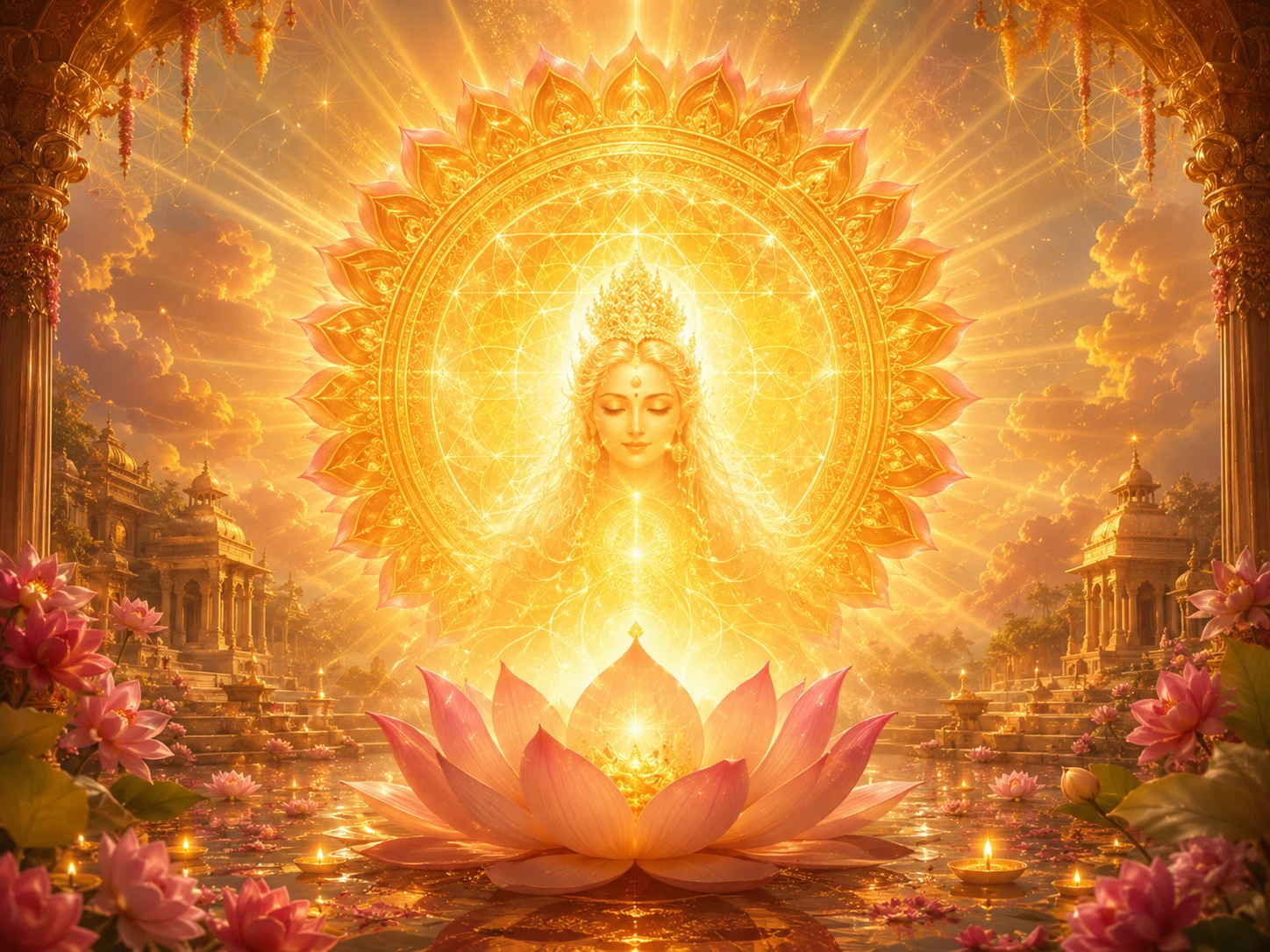
The Gayatri Mantra -- 24 Syllables That Illuminate the Mind
गायत्री मंत्र -- 24 अक्षर जो बुद्धि को प्रदीप्त करते हैं
Every morning, somewhere in India right now, a grandmother in Madurai is whispering it while lighting a brass lamp. A software engineer in Bengaluru is murmuring it in a shared auto on the way to Manyata Tech Park. A first-year student at IIT Bombay is chanting it before opening Irodov for the first time. A retired colonel in Dehradun is reciting it at his puja shelf at 0530 hours, just as he has done for forty years. A twelve-year-old boy in Varanasi is hearing it for the first time from his grandfather during his thread ceremony, the words entering his ears like a key entering a lock he did not know he carried.
The Gayatri Mantra is the most universal verse in the Sanatan tradition. Krishna declares in the Bhagavad Gita (10.35): 'Among metres, I am Gayatri' -- gāyatrī chhandasām aham. Not the most powerful. Not the most esoteric. But the one He chooses to identify Himself with. That alone tells you its position in the hierarchy of sacred sound.
Yet for all its universality, the Gayatri Mantra is profoundly misunderstood. It is not a prayer for material blessings. It is not a protection spell. It is not a loyalty oath to any deity. It is, at its irreducible core, a request for one thing: illumination of the intellect. In a civilisation that valued buddhi (discriminating intelligence) above all other human faculties, this mantra sits at the apex -- the daily request to the cosmic source of light to sharpen the one instrument that makes liberation possible.
This article unpacks the Gayatri syllable by syllable, traces its journey from Rishi Vishwamitra's revelation to its modern practice across continents, examines the science behind its specific structure, and offers a practical framework for integrating it into daily life -- whether you are a college student in Pune, a working parent in Gurgaon, or a seeker anywhere in the world.
ॐ भूर्भुवः स्वः तत्सवितुर्वरेण्यं भर्गो देवस्य धीमहि धियो यो नः प्रचोदयात्॥
oṃ bhūr bhuvaḥ svaḥ tat savitur vareṇyaṃ bhargo devasya dhīmahi dhiyo yo naḥ pracodayāt
Om. Through the three worlds -- earthly, atmospheric, and celestial. We meditate upon the most adorable radiance of the divine Sun (Savitr). May that luminous light illuminate and inspire our intellects.
— Rig Veda, Mandala 3, Sukta 62, Mantra 10 (attributed to Rishi Vishwamitra)
Word by Word -- The Architecture of 24 Syllables
The mantra has three structural layers, and understanding each is essential.
The first layer is the Pranava -- Om. This is the universal seed syllable, the primordial vibration from which all sound emerges. Om is not part of the 24-syllable Gayatri metre; it precedes and encompasses it. It is the ground on which the mantra stands.
The second layer is the Mahavyahriti -- Bhur Bhuvah Svah. These three sacred utterances represent the three planes of existence: Bhur (the physical world, earth), Bhuvah (the intermediate realm, atmosphere, the world of vital breath), and Svah (the celestial realm, heaven, the world of mind). By uttering these three, the practitioner locates themselves within the totality of creation before beginning the invocation. Think of it as setting the coordinate system before plotting the point.
The third layer is the mantra proper -- the 24 syllables in three lines (padas) of eight syllables each:
Tat -- 'That.' The demonstrative pronoun pointing to the ultimate reality. Not 'this' (close, familiar) but 'that' (transcendent, beyond). One syllable containing the entire gesture of reaching toward the infinite.
Savitur -- 'Of Savitr.' Savitr is not merely the physical sun. The word derives from the root 'su' meaning 'to impel, to generate, to give birth.' Savitr is the creative impulse behind all manifestation -- the sun as symbol of the cosmic creative force that generates, sustains, and illuminates all existence.
Varenyam -- 'Most worthy of worship/adoration.' From 'vr' -- to choose, to prefer. This is the supreme reality that, once known, one would choose above all else.
Bhargo -- 'Radiance, luminous effulgence.' From 'bhrj' -- to shine. Not ordinary light but the self-luminous brilliance that dispels the darkness of ignorance (avidya). This is the light that the Mundaka Upanishad describes: 'By His light, all this is illuminated.'
Devasya -- 'Of the divine.' The word 'deva' derives from 'div' -- to shine, to play, to illuminate. Devasya connects the abstract 'bhargo' to a living, conscious divine source.
Dhimahi -- 'We meditate upon.' The verb is in the first person plural -- not 'I meditate' but 'we meditate.' The Gayatri Mantra is not an individual petition. It is a collective invocation. Every person who chants it joins a chain of meditators stretching back over three millennia.
Dhiyo -- 'Intellects.' Not 'minds' in the general sense, but 'dhee' -- the discriminating, wisdom-seeking faculty of consciousness. The buddhi that distinguishes real from unreal, permanent from impermanent, self from not-self.
Yo -- 'Who/which.' The relative pronoun linking the divine light to its function.
Nah -- 'Our.' Again plural, again collective.
Prachodayat -- 'May it inspire, impel, illuminate.' From 'pra + chud' -- to set in motion forward. Not passive illumination but active inspiration -- the light that does not merely show the path but propels you along it.
The complete architecture, then, is: We meditate upon THAT transcendent creative radiance of the divine Savitr -- may IT actively illuminate and propel our discriminating intellects forward.
Notice what is absent. No request for wealth. No mention of enemies. No condition of exclusivity. No threat of consequences. Just: illuminate us. A civilisation that placed this as its central daily prayer was a civilisation that valued clarity of thought above all else.
Vishwamitra -- The Warrior Who Became a Seer
The Gayatri Mantra is attributed to Rishi Vishwamitra, and his story is inseparable from the mantra's meaning. Vishwamitra was not born a sage. He was born Kaushika, a Kshatriya king -- powerful, ambitious, accustomed to commanding armies and conquering territories. His transformation into a Brahmarishi is one of the most dramatic arcs in Vedic literature.
The turning point came during an encounter with Rishi Vasishtha. Kaushika, with his entire army, could not match the spiritual power of Vasishtha's single cow, Nandini (Kamadhenu's daughter). Humiliated, the king realised that material power -- however vast -- was subordinate to spiritual power. He renounced his kingdom and undertook the most gruelling tapas (austerities) recorded in tradition.
His journey was not smooth. The Puranas record multiple failures. He was seduced by the apsara Menaka, losing decades of accumulated merit. He cursed in anger, destroying his own progress. Each failure taught him the very lesson the Gayatri Mantra encodes: that without illuminated buddhi, even the most powerful being operates in darkness.
When Vishwamitra finally achieved Brahmarishi status -- the same rank as Vasishtha, who had been born into it -- the verse that emerged from his realisation was not a victory chant. It was a prayer for light. The warrior who had spent lifetimes accumulating power asked, in the end, for one thing only: clarity. That is the Gayatri.
For every IAS officer who failed the prelims three times before clearing, for every startup founder whose first two ventures collapsed before the third succeeded, for every student who dropped a year to restart from scratch -- Vishwamitra is the archetype. The Gayatri is the mantra born from failure, forged in persistence, and offered to the world as proof that transformation is always possible.
Krishna identifies Himself with the Gayatri metre in Bhagavad Gita 10.35: 'gayatri chhandasam aham' -- 'Among poetic metres, I am Gayatri.' This is remarkable because Krishna does not say He is the most powerful mantra or the most secret one. He says He is the metre itself -- the underlying rhythmic structure that carries the power. The container, not just the content.
The Science of 24 -- Why This Number Matters
The Gayatri metre contains exactly 24 syllables, and this number is not arbitrary. It maps onto multiple systems simultaneously.
In Samkhya philosophy, the material universe is constituted of 24 tattvas (fundamental principles): Prakriti, Mahat (Buddhi), Ahankara, Manas, 5 Tanmatras (subtle elements), 5 Mahabhutas (gross elements), 5 Jnanendriyas (sense organs), and 5 Karmendriyas (organs of action). The 24 syllables of Gayatri are traditionally correlated one-to-one with these 24 tattvas. Chanting the complete mantra is thus understood as activating and harmonising the entire spectrum of one's material constitution.
The three padas of eight syllables map to the three gunas: Sattva (purity, first pada), Rajas (activity, second pada), and Tamas (inertia, third pada). They also map to the three sandhyas (juncture times): dawn, noon, and dusk -- the three daily windows when the Gayatri is traditionally chanted.
The Chandogya Upanishad (3.12.1-6) provides an extended meditation on Gayatri as the measure of all existence. It states that Gayatri is all this -- whatever exists. It is four-footed (chatushpada): one foot is the three worlds, one foot is the three Vedas, one foot is the three pranas, and the fourth foot shines beyond the sun -- the transcendent turiya.
For the mathematically inclined: 24 is the factorial of 4 (4! = 24). It is the number of permutations of four distinct objects. The Gayatri, with its 24 syllables, contains within itself every possible arrangement of the four states of consciousness (waking, dreaming, deep sleep, and turiya). Whether the rishis intended this mathematical resonance or whether the structure reflects a deeper pattern they intuited, the symmetry is striking.
The Gayatri Across Traditions and Forms
| Gayatri Form | Deity Invoked | Source Text | Traditional Use | Who Can Chant |
|---|---|---|---|---|
| Savitri Gayatri (original) | Savitr (Solar Creative Force) | Rig Veda 3.62.10 | Sandhya Vandana, Upanayana, daily japa | Traditionally dvija after upanayana; modern reform movements opened to all |
| Ganesh Gayatri | Ganesha | Ganapati Atharvasirsha-derived | Before new ventures, exam preparation | All devotees |
| Narayana Gayatri | Vishnu/Narayana | Narayana Upanishad | Vaishnava daily practice | All devotees |
| Shiva Gayatri | Shiva/Rudra | Taittiriya Aranyaka 10.1 | Shaiva sandhya, Monday worship | All devotees |
| Devi Gayatri | Shakti/Durga | Devi Bhagavata Purana | Navaratri, Shakti sadhana | All devotees |
| Saraswati Gayatri | Saraswati | Yajurveda-derived | Before study, vidyarambha | Students, scholars, all devotees |
The original Vedic Gayatri (Savitri) remains the most universal, addressing not a personal deity but the cosmic principle of creative light itself. Other deity-specific Gayatris follow the same 24-syllable metre and invocatory structure.
Sandhya Vandana -- The Daily Framework
The Gayatri Mantra was never meant to be chanted in isolation. Its natural home is the Sandhya Vandana -- the 'worship at the juncture points' performed at dawn, noon, and dusk. These three sandhyas correspond to the three transitions in natural light: the shift from darkness to light (dawn), the peak of light (noon), and the shift from light to darkness (dusk). The Gayatri, as a solar invocation, is calibrated to these moments of transition.
The full Sandhya Vandana is a structured ritual that includes achamana (sipping water for purification), pranayama (breath regulation), Gayatri japa (typically 108 or 1,008 repetitions), and arghya (offering water to the sun). It takes approximately 15-20 minutes when performed with moderate deliberation. Across India, the specifics vary by Veda shakha (branch), community, and regional tradition, but the Gayatri japa is the common thread in every version.
The Dharmashastra texts prescribe Sandhya as the first duty of the day -- before eating, before work, before any other worship. The Manusmriti states that the twice-born who does not perform Sandhya is unfit for any other ritual. While modern practitioners may find the full Sandhya difficult to maintain daily, the Gayatri japa component remains accessible even in the busiest schedules.
Consider the morning routine of a working professional in Gurgaon. The Metro ride from Rajiv Chowk to Cyber City takes approximately 25 minutes. 108 repetitions of the Gayatri Mantra at a moderate pace take approximately 12 minutes. The morning commute, instead of being dead time scrolling through Instagram reels, becomes a daily Gayatri sadhana. No special setup required. No mat, no incense, no separate time allocation. The sandhya can be adapted to the rhythms of modern Indian life without losing its essence.
The Democratisation Debate -- Who Can Chant?
This must be addressed honestly. The Gayatri Mantra's history carries the weight of restriction. For centuries, the Savitri Gayatri was transmitted exclusively through the upanayana (sacred thread) ceremony, which was traditionally restricted to dvija males of the three upper varnas. Women and Shudras were explicitly excluded from Vedic recitation in many Dharmashastra texts.
But the tradition itself contains counter-currents. The Chandogya Upanishad's meditation on Gayatri (3.12) makes no mention of varna restriction. The Gayatri is presented as the measure of all existence -- not the possession of a caste. The Bhagavad Gita (9.32) declares that women, Vaishyas, and even those of lower birth can attain the supreme state through devotion. Swami Vivekananda actively initiated non-Brahmins into Gayatri in the 1890s. Swami Dayananda Saraswati's Arya Samaj movement threw the doors wide open in the 19th century, declaring that the Gayatri belongs to all of humanity.
The All World Gayatri Pariwar, founded by Pandit Shriram Sharma Acharya in the mid-20th century, conducted mass Gayatri yajnas across India with participants of all castes, genders, and backgrounds. Today, the Gayatri is chanted in corporate offices in Hyderabad, in yoga studios in Bali, in Vedic study groups in Texas, and in school morning assemblies across India. The democratisation is not a modern dilution -- it is a return to the mantra's own stated purpose: the illumination of all intellects. 'Nah' -- our. Not 'mama' -- mine.
Eternal Raga takes the position that the Gayatri Mantra belongs to all seekers. This is not a political stance; it is the mantra's own grammar.
The Gayatri Mantra has been broadcast from space. In 1991, the sound of Gayatri chanting was included in a cultural payload on an Indian satellite. More recently, the Indian Navy includes Gayatri recitation in the morning routine aboard several warships. The mantra that asks for illumination of intellect is considered operational protocol by those who navigate by the stars.
Neuroscience of Gayatri -- What Research Shows
Multiple studies have examined the specific effects of Gayatri Mantra chanting on the brain and body.
A study conducted at the Defence Institute of Physiology and Allied Sciences (DIPAS), a DRDO laboratory in Delhi, measured the effects of Gayatri Mantra chanting on attention and cognitive flexibility in military personnel. The results showed significant improvements in sustained attention tasks and a measurable decrease in reaction time after a 12-week chanting protocol.
Researchers at NIMHANS Bengaluru have studied the effects of Vedic chanting (including Gayatri) on cortisol levels and emotional regulation. Their findings indicate reduced salivary cortisol (a biomarker of stress) and improved scores on emotional intelligence scales after regular practice.
The specific phonetic structure of the Gayatri contributes to its neurological effects. The three prolonged nasal resonances (the 'm' in Om, the nasal continuation in Bhuvah, and the anusvara in Varenyam) create sustained vibrations in the sinuses and skull that stimulate the trigeminal nerve -- the largest cranial nerve, with branches reaching the forehead, cheeks, and jaw. Trigeminal stimulation is associated with increased alertness and reduced perception of pain.
The rhythmic structure of the three padas creates a breathing pattern that naturally synchronises with the body's rest-and-digest cycle (parasympathetic activation). Each pada takes approximately one full exhalation at a comfortable pace. Three padas, three breaths, one complete nervous system reset. Repeated 108 times, this amounts to approximately 324 regulated breaths -- a pranayama session disguised as a prayer.
The claim is not that the Gayatri is a substitute for medical treatment. The claim is that its effects are measurable, reproducible, and explicable through known physiological mechanisms. The rishis may not have had fMRI machines, but they had something better: thousands of practitioners over thousands of years, reporting consistent results.
बृहत्साम तथा साम्नां गायत्री छन्दसामहम्। मासानां मार्गशीर्षोऽहमृतूनां कुसुमाकरः॥
bṛhat-sāma tathā sāmnāṃ gāyatrī chandasām aham māsānāṃ mārgaśīrṣo 'ham ṛtūnāṃ kusumākaraḥ
Among the hymns of the Sama Veda, I am the Brihatsama; among poetic metres, I am Gayatri. Among months I am Margashirsha, and among seasons I am flower-bearing spring.
— Bhagavad Gita, Chapter 10, Verse 35
How to Practice -- A Complete Guide for Today
You do not need to wait for an upanayana ceremony. You do not need a pandit's permission. You need only sincerity, correct pronunciation, and regularity.
Pronunciation matters. The syllable 'varenyam' (or its metrical variant 'vareniyam') must not be slurred into 'varanium' or 'waraniyam.' The retroflex 'dh' in 'dhimahi' is not the same as the dental 'dh' in English 'the.' The nasal anusvara in 'varenyam' should resonate in the nasal cavity, not stop at the lips. If pronunciation is uncertain, the Eternal Raga app provides audio recordings by trained Vedic chanters -- listen and repeat until the sounds are internalised.
Timing: The ideal times are the three sandhyas -- Brahma Muhurta (approximately 4:30-5:30 AM), noon, and sunset. If only one is possible, choose the morning. Face east at dawn, north at noon, west at sunset. If facing a specific direction is impractical (you are on the Metro, in a meeting room, or walking), the intention matters more than the compass.
Posture: Sit with a straight spine. Cross-legged on the floor, on a cushion, or on a chair -- all are acceptable. The spine must be erect because the mantra's vibrational path runs along the sushumna nadi (central energy channel) which parallels the spinal column.
Method: Begin with three rounds of deep breathing (pranayama). Then chant Om once, followed by the Mahavyahriti (Bhur Bhuvah Svah), then the mantra proper. One complete round: Om Bhur Bhuvah Svah, Tat Savitur Varenyam, Bhargo Devasya Dhimahi, Dhiyo Yo Nah Prachodayat. Repeat 108 times using a mala or the Eternal Raga Japa counter.
Progression: Begin with 21 repetitions if 108 feels daunting. Build to 54, then 108 over four weeks. Advanced practitioners undertake Gayatri Purascharana -- chanting 24,000 repetitions (1,000 per syllable) over a prescribed period, usually 24 or 40 days.
The most important rule: do not skip days. Regularity builds the vibrational field; irregular practice dissipates it. A single mala (108) every morning without fail is infinitely more powerful than sporadic sessions of 1,008. Consistency is the real sadhana.
The Gayatri Mantra's 24 syllables map onto the 24 vertebrae of the human spinal column (7 cervical + 12 thoracic + 5 lumbar). When chanted with awareness of each syllable resonating at successive vertebral levels from base to crown, the mantra becomes a sonic scan of the entire spinal energy system. Yoga practitioners call this 'Gayatri Nyasa' -- placing the mantra in the body.
Chant Gayatri -- 108 Repetitions at Sandhya
Chant the Gayatri 108 times on a mala at sunrise or sunset, the two sandhyas, and keep the same time each day. The Gayatri's page on Eternal Raga gives its meaning and how to chant it. Begin your daily practice today.
Tags
Eternal Raga · शाश्वत राग
Institutional voice — scholarly articles on Sanatan Dharma
Deepen Your Understanding
अपनी समझ और गहरी करें
tantra mantra yantra
The Science of Mantra -- How Sacred Sound Rewires Consciousness
A mantra is not a prayer. It is not a wish. It is a precision instrument of consciousness -- a vibrational key engineered in Sanskrit thousands of years ago to unlock specific states of mind. Modern neuroscience is only now catching up.
tantra mantra yantra
Tantra, Mantra and Yantra -- The Three Pillars of Spiritual Practice
Tantra is the loom, Mantra is the thread, Yantra is the pattern. Together they form the complete technology of spiritual transformation that India gifted to the world -- and they are far more profound than popular culture imagines.
tantra mantra yantra
What Makes a Mantra -- The Anatomy of Sacred Sound
Not every Sanskrit word is a mantra. Not every chant carries power. A mantra is an engineered formula with six mandatory components -- rishi, devata, chhanda, beej, shakti, and viniyoga. Miss any one and the circuit is incomplete. Here is the blueprint.
sacred symbols
108 -- The Sacred Number That Links Your Mala to the Solar System
Why does a japa mala have exactly 108 beads? Why do temples list 108 names for every deity? The answer involves astronomy, anatomy, music, and mathematics -- and a coincidence so precise it still stuns astrophysicists: the distance from Earth to the Sun is approximately 108 times the Sun's diameter.
rituals traditions
Sandhyavandana -- The Daily Vedic Practice That Even Rama and Krishna Never Skipped
Three times a day, at the junction of night and day, morning and afternoon, afternoon and night, the twice-born Hindu is commanded to stop everything and perform Sandhyavandana. It combines pranayama, the Gayatri Mantra, water offerings, and meditation into a single twenty-minute ritual. The Ramayana shows Rama doing it in the forest. The Mahabharata shows Krishna doing it before battle. And somewhere in India right now, an IIT student is doing it in his hostel room.
sacred symbols
Om -- The Primordial Sound That Contains the Universe
Every temple bell, every mantra, every meditation session begins and ends with Om. But what exactly IS Om? The Mandukya Upanishad claims this single syllable contains all of reality -- past, present, future, and whatever lies beyond time itself. Twelve verses. One sound. The entire map of consciousness.
scriptural exegesis
Vishvamitra -- The King Who Became a Brahmarshi
A warrior-king humbled by a sage's cow, he gave up his throne and spent thousands of years in austerity until even his rival Vasishtha called him brahmarshi. The seer of the Gayatri mantra and the teacher who led Rama to Sita -- the story of Vishvamitra.
Krishna identifies Himself with the Gayatri metre in Bhagavad Gita 10.35: 'gayatri chhandasam aham' -- 'Among poetic metres, I am Gayatri.' This is remarkable because Krishna does not say He is the most powerful mantra o…
More in Tantra, Mantra & Yantra
Agama vs Tantra vs Veda -- Three Streams of Hindu Practice
14 min read
Agni Dhyana -- What Meditation on Fire Is Actually Grounded In
8 min read
Ashta Siddhi -- The Eight Yogic Powers and How Hanuman Embodies Them
13 min readThe same translation error that turned '33 Koti' into '33 crore' in Hinduism also happened in Buddhism. The Chinese translation of Buddhist texts rendered 'Sapta Koti Buddha' (7 Supreme Buddhas) as '7 Crore Buddhas.' The…
Deities AvatarsCommunity Reflections
🕉️
Be the first to share your reflection.