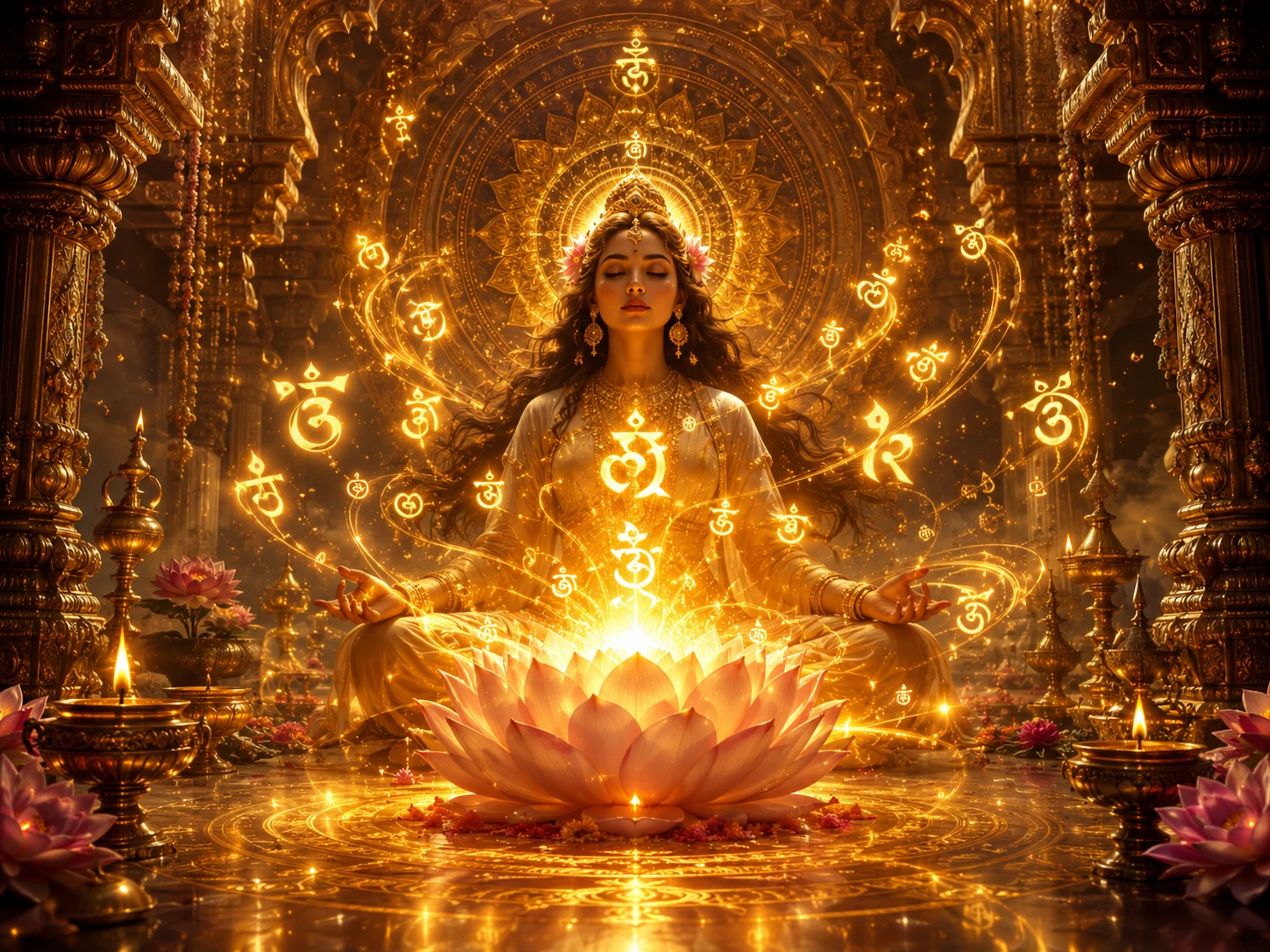
Beeja Mantras of Major Deities -- The Seed Syllables That Contain Universes
प्रमुख देवताओं के बीज मन्त्र -- ब्रह्माण्ड समाहित बीजाक्षर
In computer science, data compression takes a large file and reduces it to a fraction of its size while retaining all the essential information. When you unzip the file, the complete original data is restored.
The Tantric tradition invented data compression thousands of years before Claude Shannon. They called it Beej Mantra -- the seed syllable.
A Beej Mantra is a single Sanskrit syllable that contains the entire energy signature of a deity, a cosmic principle, or a dimension of reality. It is not an abbreviation or a shorthand. It is a holographic compression -- every part contains the whole. When you chant 'Shreem,' you are not invoking a fraction of Lakshmi. You are invoking all of Lakshmi -- her abundance, her grace, her beauty, her creative power, her cosmic function as the sustaining energy of Vishnu -- compressed into a single vibrational frequency.
The word Beej means seed. Just as an acacia seed contains the complete genetic blueprint for a tree that will grow fifty feet tall and live three hundred years, a Beej Mantra contains the complete vibrational blueprint for a deity's energy that can expand into an entire universe of experience when properly planted (through Diksha), watered (through Japa), and tended (through sustained Sadhana).
The Beej Mantra tradition is Tantra's most powerful innovation and its most closely guarded secret. While longer mantras like the Gayatri (24 syllables) or the Mahamrityunjaya (33 syllables) can be chanted by anyone, many Beej Mantras -- particularly the Shakta ones like Hreem, Kleem, and the compound Beejs used in Sri Vidya -- traditionally require Diksha (initiation by a guru) for full activation. This is not gatekeeping. It is safety engineering. A Beej Mantra is concentrated cosmic energy. Chanting it without proper guidance is like connecting a 100-watt bulb to a 10,000-volt line -- the energy is real, but the circuitry may not be ready.
That said, several Beej Mantras are universally open: Om (the Pranava), Gam (Ganesha), and the planetary Beej Mantras. These can be chanted by anyone, at any time, without initiation. And they are powerful enough to transform a daily practice from routine to revelation.
ॐ इत्येकाक्षरं ब्रह्म व्याहरन्मामनुस्मरन्। यः प्रयाति त्यजन्देहं स याति परमां गतिम्॥
oṃ ity ekākṣaraṃ brahma vyāharan mām anusmaran | yaḥ prayāti tyajan dehaṃ sa yāti paramāṃ gatim ||
He who departs this body while uttering the single syllable Om -- which is Brahman -- and remembering Me, attains the supreme goal.
— Bhagavad Gita 8.13
The Major Beej Mantras and Their Deities
| Beej Mantra | Devanagari | Primary Deity | Energy / Function | Open or Diksha Required |
|---|---|---|---|---|
| Om | ॐ | Brahman / Universal | The Pranava -- primordial vibration; source of all; contains A-U-M (creation-preservation-dissolution) | Open to all -- the most universal mantra |
| Shreem | श्रीं | Mahalakshmi | Abundance, beauty, grace, prosperity; sustaining Shakti of Vishnu | Open for general chanting; Diksha recommended for Tantric Sadhana |
| Hreem | ह्रीं | Mahamaya / Bhuvaneshwari | Creative power, illusion-piercing, divine feminine energy; Shakti Beej | Diksha strongly recommended; core of Sri Vidya |
| Kleem | क्लीं | Krishna / Kamadeva | Attraction, desire, magnetic pull, love; Kama Beej | Diksha recommended; used in Tantric attraction practices |
| Aim | ऐं | Saraswati | Wisdom, learning, speech, creative arts; Vani Beej | Open for students and seekers of knowledge |
| Gam | गं | Ganesha | Obstacle removal, grounding, Muladhara activation; Ganapati Beej | Open to all -- safe and universally beneficial |
| Haum | हौं | Shiva | Dissolution, transcendence, Rudra energy; Shiva Beej | Diksha recommended for serious Shaiva Sadhana |
| Dum | दूं | Durga | Fierce protection, destruction of evil, warrior Shakti; Durga Beej | Diksha recommended; used in Durga Sadhana |
| Kreem | क्रीं | Kali | Transformation, time, death and rebirth, Kali Shakti | Diksha essential; not for casual use |
Beej Mantras marked 'Open' can be chanted by anyone without initiation. Those marked 'Diksha recommended' or 'essential' should ideally be received from a qualified Guru for full activation and safe practice. When in doubt, chant Om -- it contains all other Beejs.
Om -- The Supreme Beej That Contains All Others
Om deserves extended attention because it is the foundation from which all other Beej Mantras emerge.
The Mandukya Upanishad -- the shortest of the major Upanishads, just 12 verses -- is devoted entirely to the analysis of Om. It identifies Om with Brahman itself: 'Sarvam hyetad Brahma, ayam Atma Brahma' -- all this is Brahman, this Self is Brahman. Then it proceeds to demonstrate that Om contains four states of consciousness: A (the waking state, where consciousness is turned outward and engages the material world), U (the dream state, where consciousness turns inward and creates its own reality), M (the deep sleep state, where consciousness rests in undifferentiated awareness), and the silence after M (Turiya, the fourth state, which is pure consciousness itself -- neither inward nor outward, neither knowing nor unknowing, but the witness of all three states).
This analysis makes Om the most information-dense sound in all of human culture. In three phonemes and a silence, it maps the entire spectrum of consciousness. No other sacred syllable -- not Amen, not Shalom, not Aum in its Tibetan Buddhist form -- has been subjected to such rigorous philosophical analysis.
The Ganapati Upanishad reveals that Om visually encodes Ganesha's form. The Taittiriya Upanishad calls Om the 'sound of Brahman.' The Bhagavad Gita (8.13) says that one who departs the body chanting Om attains the supreme goal. The Yoga Sutras of Patanjali (1.27-28) identify Om as the name of Ishvara and prescribe its repetition (Japa) and contemplation as a direct path to samadhi.
For the JEE Physics student: Om is the Hindu equivalent of the Planck constant -- a fundamental unit that relates to everything else in the system. For the music student: Om is the Sa (Shadja), the base note of the cosmic scale from which all other notes derive their identity. For the startup founder: Om is the seed round -- the initial investment of consciousness from which everything else is built.
Practically, Om should be chanted at the beginning and end of every spiritual practice, every meal, every journey, and every significant undertaking. The tradition is emphatic: no mantra, no ritual, and no yantra activation is complete without Om. It is the universal prefix and the universal suffix -- the alpha and omega of Sanskrit sacred sound.
How Beej Mantras Work -- The Mechanics of Sacred Sound
Every Beej Mantra has a specific anatomy. Understanding it reveals why these single syllables are considered more powerful than elaborate prayers.
A Beej Mantra typically consists of three components: a consonant (the body), a vowel (the energy), and the anusvara or visarga (the direction). Take 'Shreem' (श्रीं): 'Shr' is the consonantal body -- the structural framework. 'ee' (ई) is the vowel energy -- the elongated vowel creates a sustained vibrational field. The anusvara 'm' (ं) is the nasal resonance that directs the vibration upward through the nasal passages into the cranial cavity, activating higher chakras.
The Tantric texts explain that each consonant in Sanskrit corresponds to a specific Shakti, and each vowel to a specific state of consciousness. The consonant 'Shr' carries the frequency of Lakshmi's creative abundance. The vowel 'ee' extends this frequency in time, sustaining the connection. The anusvara seals the circuit, preventing energy dissipation. The complete syllable is a self-contained energy unit -- a mantra that needs nothing added to it.
This is why the tradition says a Beej Mantra chanted 10,000 times has more transformative power than a longer mantra chanted the same number of times. The Beej is concentrated. There is no linguistic padding, no grammatical structure, no narrative content to dilute the vibrational core. It is pure signal, zero noise.
The Matrika Shakti doctrine teaches that the 50 letters of the Sanskrit alphabet are themselves 50 Shaktis -- 50 divine energies that combine to create all mantras, all language, and all manifest reality. A Beej Mantra selects specific Matrikas and combines them in a precise sequence that resonates with a particular deity's frequency. Knowing which Matrikas compose a Beej is like knowing the chemical formula of a compound -- it tells you exactly what elements are present and how they interact.
For the IIT student studying signal processing or the NEET student studying acoustics: a Beej Mantra is functionally a carrier wave modulated with a specific information signal. The carrier (the base vibrational frequency of the syllable) carries the signal (the deity's energy pattern) to the receiver (the practitioner's chakra system). The Japa count (108, 1008) is the repetition rate that ensures the signal is received with sufficient strength to produce the desired effect.
Practical Beej Mantra Sadhana -- What You Can Start Today
Three Beej Mantras are universally safe and extraordinarily powerful for daily practice without initiation.
Om (ॐ): The Pranava. The mother of all Beej Mantras. Chant it before any other practice. 21 repetitions at the start of meditation create a sonic foundation for everything that follows. The Mandukya Upanishad analyses Om into A (waking state, Vaishvanara), U (dream state, Taijasa), M (deep sleep, Prajna), and the silence after M (Turiya, the fourth state beyond the three). Every time you chant Om, you traverse all four states of consciousness in a single breath.
Gam (गं): Ganesha's Beej. The safest deity-specific Beej available. Chant Om Gam Ganapataye Namah 108 times daily for obstacle removal, exam success, and mental clarity. It activates Muladhara Chakra, providing the grounding that all higher practices require. For the JEE or NEET aspirant: this is your foundation mantra.
Aim (ऐं): Saraswati's Beej. Chant Om Aim Saraswatyai Namah 108 times before study sessions, creative work, music practice, or writing. Aim activates Vishuddha (throat) and Ajna (third eye) chakras, enhancing both verbal expression and intuitive insight. Students across India have traditionally chanted Aim before exams -- the practice is so widespread that it hardly needs a recommendation.
For those who have received Diksha: Shreem (for Lakshmi/abundance), Hreem (for Devi/creative power), and Haum (for Shiva/transcendence) should be chanted according to the guru's specific instructions regarding count, time, direction, and accompanying practices.
The simplest daily practice: 5 minutes of Om (21 times), then 10 minutes of your chosen deity Beej (108 times on mala), then 5 minutes of silence. Twenty minutes total. This single practice, done consistently, builds a vibrational foundation that the tradition says transforms the practitioner's entire energy architecture over time -- like a daily SIP that compounds into spiritual wealth.
The Shakta Beej Mantras -- Hreem, Shreem, Kleem and the Goddess Tradition
The three Shakta Beej Mantras -- Hreem, Shreem, and Kleem -- form a trinity of feminine power that is arguably the most influential cluster of seed syllables in the entire Tantric tradition.
Hreem (ह्रीं) is the Maya Beej -- the seed of creative illusion, the power by which the formless Brahman manifests as the formed universe. In the Sri Vidya tradition, Hreem is Bhuvaneshvari's Beej -- the Goddess who is the space within which all worlds exist. When the Tantric texts say 'Hreem is Shakti herself,' they mean that this single syllable encodes the entire mechanism of manifestation: how the unmanifest becomes manifest, how the infinite becomes the finite, how consciousness becomes matter. The 'H' in Hreem is Shiva (consciousness), the 'R' is Agni (transformative fire), the 'ee' is Mahamaya (the great creative power), and the final 'M' seals the combination. For the physics student: Hreem is the Big Bang compressed into a syllable -- the moment potential becomes actual.
Shreem (श्रीं) is the Lakshmi Beej -- the seed of abundance, beauty, and auspiciousness. 'Shri' itself is one of the oldest words in Sanskrit for prosperity and sacred beauty. Shreem is not merely about material wealth; in the deeper Tantric understanding, it represents the principle that the divine is inherently generous, that creation is an act of overflowing abundance rather than scarcity. Every Friday evening when a family lights a diya before the Lakshmi image and chants 'Om Shreem Mahalakshmyai Namah,' they are activating the oldest prosperity protocol in human civilisation. The practice is so embedded in Indian culture that it no longer registers as Tantra -- it has become domestic devotion. But the structure is pure Tantric technology: Beej Mantra + deity visualisation + specific day and time = systematic invocation of a particular cosmic energy.
Kleem (क्लीं) is the Kama Beej -- the seed of attraction and desire. It is associated with both Krishna (in Vaishnava Tantra) and Kamadeva (in Shakta Tantra). The word 'Kama' in Hindu philosophy does not carry the Western connotation of sinful desire. Kama is one of the four Purusharthas (aims of human life), listed alongside Dharma, Artha, and Moksha. Kleem activates Anahata Chakra (the heart centre), which governs attraction, connection, and the magnetic pull between beings. The Saradatilaka Tantra identifies Kleem as the binding force of the universe -- the energy that makes atoms cohere, that makes planets orbit stars, that makes human beings fall in love. Without Kama, the universe would fly apart. Kleem is the syllable that holds it together.
The supreme expression of these three Beej Mantras working together is the Panchadashi Mantra of the Sri Vidya tradition -- a fifteen-syllable mantra composed of three groups (kuttas), each built around one of these three seeds. Ka-E-I-La-Hreem (Vagbhava Kutta, governing speech and knowledge), Ha-Sa-Ka-Ha-La-Hreem (Kamaraja Kutta, governing desire and will), and Sa-Ka-La-Hreem (Shakti Kutta, governing action and power). The three kuttas together form a complete map of consciousness: knowledge, desire, and action -- the three pillars of all human experience. The Panchadashi is considered so powerful that it is never written in full in any publicly available text; it is transmitted only through Guru-Diksha. Its components, however, are the Beej Mantras described in this article -- which is why understanding Beej Mantras is the prerequisite for understanding Sri Vidya.
Beej Mantras in Everyday Indian Life -- What You Already Chant
The remarkable thing about Beej Mantras is how completely they have saturated Indian devotional culture -- to the point where millions of people chant them daily without recognising them as Tantric technology.
Every time a temple bell rings, the sustained metallic tone produces a vibration that traditional temple architects deliberately calibrated to approximate the acoustic profile of Om. The bell (Ghanta) is not decoration -- it is a bronze Om generator. The Agama Shastra texts that govern temple construction specify the bell's dimensions, alloy composition, and hanging height to achieve this precise tonal quality.
Every Ganesh Chaturthi, when a city like Mumbai erupts with 'Ganpati Bappa Morya,' the underlying mantric structure of Ganesha worship is activated across millions of voices simultaneously. The Atharvashirsha -- the most popular Ganesha stotra -- begins with 'Om Namaste Ganapataye' and contains the Beej 'Gam' woven through its 10 sections. The text explicitly states: 'Ganapatim pranamami' (I bow to Ganapati) -- but the acoustic foundation is the Beej Gam running beneath every syllable like a bass note beneath a melody.
Bollywood itself unconsciously carries Beej Mantra influence. The repeated syllabic patterns in devotional film songs (the 'Jai Ho' rhythm, the sustained 'Om' that opens every morning raga sequence in films) follow the same principle of repetitive sacred sound that makes Japa effective. AR Rahman's 'Jai Ho' from Slumdog Millionaire -- the most globally recognised Indian musical phrase of the 21st century -- is structurally a Beej-style invocation: a compressed syllable of victory (Jai) bound to a carrier syllable (Ho), repeated with increasing intensity.
In South India, Carnatic music is saturated with Beej Mantras. Muthuswami Dikshitar's compositions explicitly encode Beej Mantras for specific deities in their sahitya (lyrics). His kriti 'Shri Ganapathini' contains embedded Gam repetitions. His Navagraha kritis contain the planetary Beejas (Surya: Hram, Chandra: Shram, Mangala: Kram, and so on). The tradition treats music as audible Yantra and Beej Mantras as the frequencies that lock the geometric pattern into place.
Even the ubiquitous 'Shreem' finds its way into everyday commercial life. The gold loan company Manappuram, the jewellery brand Tanishq during Dhanteras, the mutual fund SIP advertisements that air during Diwali -- all tap into Shreem energy without explicitly naming it. When your mother or grandmother says 'Lakshmi aa rahi hai' while cleaning the house on Dhanteras evening, she is performing an intuitive Shreem activation. The Beej Mantra tradition's greatest achievement is not that scholars study it. It is that grandmothers practice it -- without textbooks, without initiation certificates, without even knowing the Sanskrit name for what they are doing.
The Beej Mantra 'Kleem' (क्लीं) -- the seed syllable of attraction associated with Krishna and Kamadeva -- has become one of the most searched mantras on YouTube and Spotify, with multiple videos claiming it can attract love, wealth, and success. While the tradition acknowledges Kleem's power of attraction (Akarshana Shakti), serious Tantric texts like the Saradatilaka and Prapanchasara warn that Kleem should ideally be received through Diksha, as its indiscriminate use can amplify desire (Kama) without the discernment (Viveka) needed to channel it constructively. The popularity of Kleem on social media is a case study in how Tantric technologies migrate from guarded lineage practice to viral content -- with both benefits (wider access) and risks (decontextualised use). Meanwhile, researchers at IIT Kharagpur's Centre for Cognitive Science have studied the acoustic properties of Sanskrit seed syllables, finding that the precise phonemic structure of Beej Mantras creates measurable resonance patterns in the vocal tract that differ significantly from ordinary speech sounds.
Plant Your Seed -- Begin with Om and Gam
Begin a daily practice: 21 repetitions of Om, then 108 of Om Gam Ganapataye Namah on a mala -- twelve to fifteen minutes in all. After forty days of steady practice (one mandala), add Aim (Saraswati, wisdom) or Shreem (Lakshmi, abundance) according to your main focus in life. Om Gam Ganapataye Namah and each beej syllable have their own pages on Eternal Raga. The seed is planted; now water it daily.
Eternal Raga · शाश्वत राग
Institutional voice — scholarly articles on Sanatan Dharma
Deepen Your Understanding
अपनी समझ और गहरी करें
tantra mantra yantra
The Science of Mantra -- How Sacred Sound Rewires Consciousness
A mantra is not a prayer. It is not a wish. It is a precision instrument of consciousness -- a vibrational key engineered in Sanskrit thousands of years ago to unlock specific states of mind. Modern neuroscience is only now catching up.
tantra mantra yantra
What Makes a Mantra -- The Anatomy of Sacred Sound
Not every Sanskrit word is a mantra. Not every chant carries power. A mantra is an engineered formula with six mandatory components -- rishi, devata, chhanda, beej, shakti, and viniyoga. Miss any one and the circuit is incomplete. Here is the blueprint.
sacred symbols
Om -- The Primordial Sound That Contains the Universe
Every temple bell, every mantra, every meditation session begins and ends with Om. But what exactly IS Om? The Mandukya Upanishad claims this single syllable contains all of reality -- past, present, future, and whatever lies beyond time itself. Twelve verses. One sound. The entire map of consciousness.
tantra mantra yantra
The Gayatri Mantra -- 24 Syllables That Illuminate the Mind
The most chanted verse in human history is not a prayer for wealth, power, or protection. It is a prayer for light -- for the divine radiance to illuminate the intellect. 24 syllables from Rig Veda 3.62.10, attributed to Rishi Vishwamitra, have shaped Indian civilisation for over three thousand years.
tantra mantra yantra
Diksha -- Why Initiation Matters and What It Actually Means
The Kularnava Tantra is unambiguous: there is no liberation without Diksha, no Diksha without a Guru, and no Guru without a Parampara. In an age where mantras are available on YouTube and spiritual apps offer 'instant enlightenment,' understanding why initiation is non-negotiable separates the seeker from the tourist.
tantra mantra yantra
Ganesh Yantra -- The Obstacle Remover's Sacred Geometry
Every Hindu ritual begins with Ganesha. Every mantra starts with Om -- and the shape of Om itself encodes Ganesha's form. His yantra is the geometric blueprint of this primacy: a sacred diagram that clears obstacles before you even name them. From JEE aspirants to startup founders, the Ganesh Yantra is India's oldest project-launch protocol.
tantra mantra yantra
Tantra, Mantra and Yantra -- The Three Pillars of Spiritual Practice
Tantra is the loom, Mantra is the thread, Yantra is the pattern. Together they form the complete technology of spiritual transformation that India gifted to the world -- and they are far more profound than popular culture imagines.
The Beej Mantra 'Kleem' (क्लीं) -- the seed syllable of attraction associated with Krishna and Kamadeva -- has become one of the most searched mantras on YouTube and Spotify, with multiple videos claiming it can attract …
More in Tantra, Mantra & Yantra
Agama vs Tantra vs Veda -- Three Streams of Hindu Practice
14 min read
Agni Dhyana -- What Meditation on Fire Is Actually Grounded In
8 min read
Ashta Siddhi -- The Eight Yogic Powers and How Hanuman Embodies Them
13 min readThe same translation error that turned '33 Koti' into '33 crore' in Hinduism also happened in Buddhism. The Chinese translation of Buddhist texts rendered 'Sapta Koti Buddha' (7 Supreme Buddhas) as '7 Crore Buddhas.' The…
Deities AvatarsCommunity Reflections
🕉️
Be the first to share your reflection.