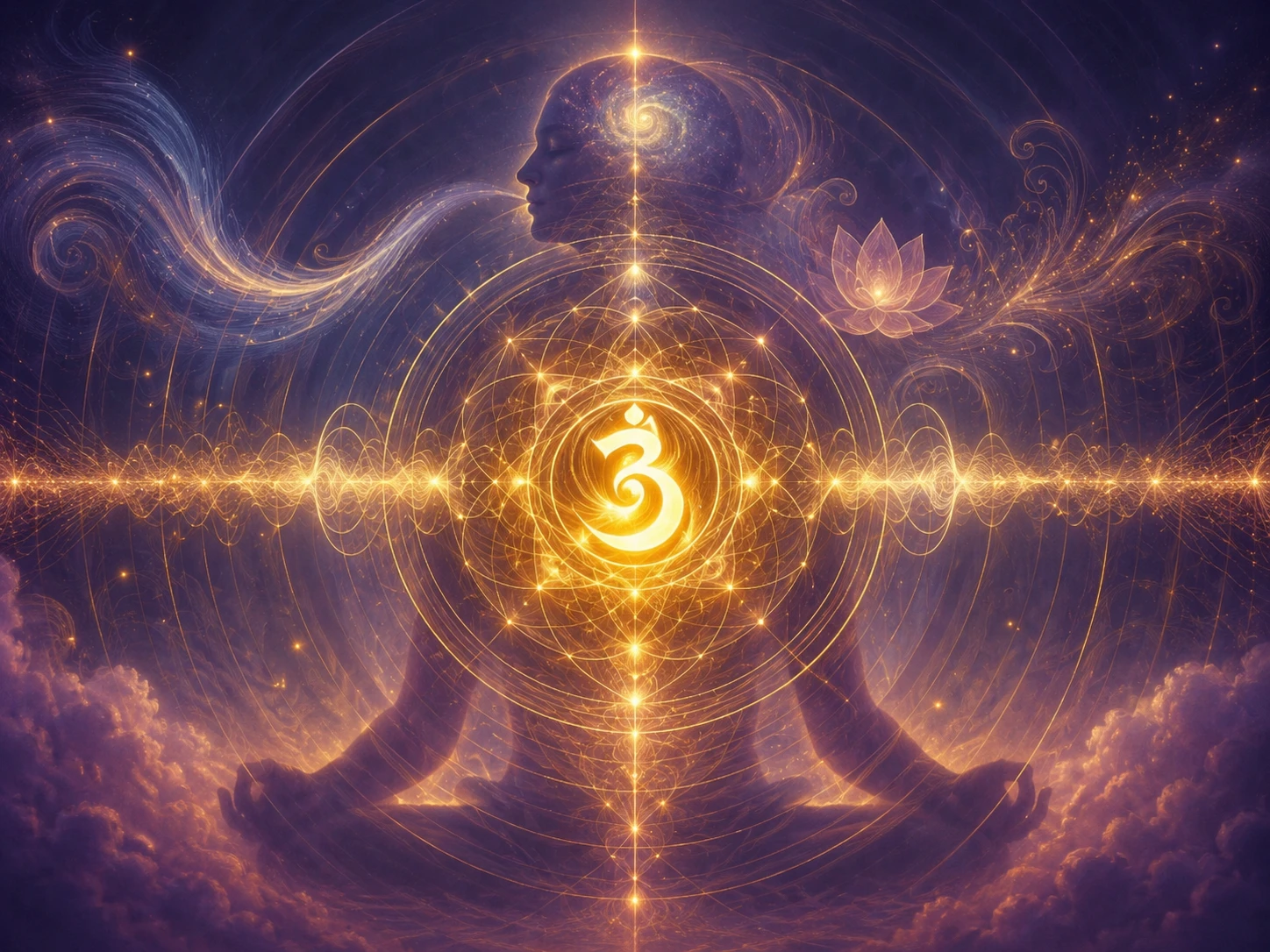
What Makes a Mantra -- The Anatomy of Sacred Sound
मंत्र को मंत्र क्या बनाता है -- पवित्र ध्वनि की शरीर-रचना
Open Instagram today and you will find a carousel post promising that repeating 'I am abundance' 108 times will manifest wealth. Open YouTube and a self-styled guru will tell you that any word spoken with feeling becomes a mantra. Open Amazon and you will find a book titled 'Create Your Own Mantra in 30 Days.'
All of this is well-intentioned. None of it is mantra.
The Vedic and Tantric traditions draw a line sharper than a surgeon's blade between ordinary speech and mantric sound. That line is not mystical gatekeeping -- it is engineering specification. A mantra is not any sound that makes you feel good. It is a specific formula with specific components, received through a specific lineage, and activated through a specific process. Remove any single component and you have words, perhaps powerful words, perhaps soothing words, but not a mantra in the technical sense that the tradition defines.
This article lays out the blueprint. What are the six mandatory components (shadanga) that constitute an authentic mantra? Why does each matter? What happens when one is missing? And how does this framework explain why a Gayatri chanted by a practitioner after years of diksha carries a different charge than the same syllables read off a website by a curious first-timer?
The distinction matters because in a world drowning in spiritual content, precision is the difference between transformation and decoration. A startup founder in HSR Layout, Bengaluru, knows that code that compiles is not the same as code that works. Similarly, a mantra that sounds correct is not the same as a mantra that is complete.
ऋषिश्छन्दो देवता च कीलकं च प्रकीर्तितम्। बीजं शक्तिस्तथा न्यासो विनियोगश्च कीर्तितः॥
ṛṣiś chando devatā ca kīlakaṃ ca prakīrtitam bījaṃ śaktis tathā nyāso viniyogaś ca kīrtitaḥ
The rishi, the metre, the deity, the pin (kilaka), the seed syllable, the power, the placement (nyasa), and the application (viniyoga) -- these are declared as the essential components of a mantra.
— Traditional Mantra Shastra formulation (cited in Sharada Tilaka Tantra and various Agamic texts)
Component 1: Rishi -- The Seer Who Received the Sound
A mantra is not composed. It is received. This is the foundational distinction. The Vedic tradition holds that mantras are apaurusheya -- not of human origin. They exist as vibrational patterns in the fabric of consciousness itself. The rishi did not invent the mantra; the rishi perceived it. The Sanskrit term is 'drashta' -- seer, not creator.
Why does this matter? Because it establishes the mantra's authority outside the ego of any individual. The Gayatri Mantra does not belong to Vishwamitra. Vishwamitra is the conduit through which it entered human awareness. The Mahamrityunjaya Mantra does not belong to Rishi Markandeya. Markandeya is the antenna that received the signal.
When you declare the rishi before chanting -- 'Asya shri [mantra name] mantrasya [rishi name] rishih' -- you are doing something precise. You are acknowledging the lineage of transmission. You are connecting your practice to an unbroken chain (parampara) that stretches from the original perception to your guru to you. This is not ceremonial decoration. In electrical engineering terms, you are grounding the circuit. Without grounding, energy has no reference point and dissipates.
The rishi component also functions as a quality certificate. If a mantra has a named rishi in the Vedic or Agamic literature, it means the mantra has been verified through generations of practice by qualified practitioners. It has a track record. Compare this to an affirmation invented last Tuesday by a life coach in California -- it may be pleasant, but it has no rishi, no parampara, no verification through generations of sadhana.
For the UPSC aspirant: think of the rishi as the original researcher who published the paper. The mantra is the finding. The parampara is the chain of peer-reviewed citations. Without the original researcher, the finding has no provenance.
Component 2: Devata -- The Deity Encoded in Sound
Every mantra has a presiding deity (devata). This is the conscious intelligence that the mantra's vibrational pattern accesses. The devata is not a separate being sitting somewhere waiting to be called -- in Tantric metaphysics, the devata IS the mantra. The sound and the deity are identical. The Tantric axiom states: 'Mantrah devatah, devatah mantrah' -- the mantra is the deity, the deity is the mantra.
This is not figurative language. It is an ontological claim. When you chant Om Namah Shivaya, you are not sending a message to Shiva. You are generating the vibrational field that IS Shiva-consciousness. The mantra does not invoke the deity from outside; it activates the deity-pattern within your own consciousness.
Different devatas correspond to different aspects of cosmic intelligence. Saraswati mantras activate the faculty of knowledge and creative expression. Lakshmi mantras activate the faculty of abundance and harmony. Rudra mantras activate the faculty of dissolution and transformation. The choice of devata determines the direction in which the mantra's energy will flow.
This is why random mantra selection does not work. A student preparing for JEE does not need a Lakshmi mantra for wealth -- they need a Saraswati or Gayatri mantra for intellectual clarity. A person healing from grief does not need a Durga mantra for battle -- they may need a Tara mantra for compassion and crossing. The devata must match the purpose. In Ayurveda, the right herb for the wrong disease is still the wrong prescription. The same principle applies to mantra.
Component 3: Chhanda -- The Metrical Carrier Wave
Chhanda is the metrical structure -- the rhythmic container that shapes how the mantra's syllables are delivered. The Vedic tradition recognises multiple chandas, each with distinct syllable counts and rhythmic patterns: Gayatri (24 syllables), Anushtubh (32), Trishtubh (44), Jagati (48), Brihati (36), and others.
The chhanda is not an aesthetic choice. It is a functional specification. Just as a radio signal requires a carrier frequency to travel, the mantra's content requires a metrical carrier wave to reach its target. Different chandas carry energy at different 'frequencies' -- each suited to a different purpose.
Gayatri chhanda, with its three padas of eight syllables, creates a tripartite breathing rhythm that naturally maps to inhalation-retention-exhalation. This makes it ideal for mantras of contemplation and illumination. Anushtubh chhanda, with four padas of eight syllables, creates a steadier, marching rhythm suited to protective and healing mantras like the Mahamrityunjaya. Trishtubh, with its longer eleven-syllable padas, creates an expansive wave suited to hymns of praise and cosmic invocation.
When you declare the chhanda before chanting -- 'Gayatri chhandah' or 'Anushtubh chhandah' -- you are setting the carrier frequency. You are telling your consciousness: this is the rhythmic pattern through which this energy will be transmitted. Skip this step and the energy has no waveform -- it is raw signal with no modulation.
For the engineering-minded: varna (syllable) is the data. Chhanda (metre) is the protocol. Devata (deity) is the server. Rishi (seer) is the original developer. Without the protocol, data does not transmit.
Component 4: Beej -- The Seed That Contains the Tree
The beej (seed syllable) is the compressed essence of the mantra's entire energy. Just as a banyan seed contains the genetic information for a tree that can cover acres, a beej mantra contains the complete vibrational blueprint of the deity it represents.
The major beej mantras and their correspondences are fundamental knowledge in mantra shastra. Om is the universal beej, the seed of all creation. Hreem is the Maya beej, the seed of creative illusion and Shakti. Shreem is the Lakshmi beej, the seed of abundance and beauty. Kleem is the Kama beej, the seed of attraction and desire. Aim is the Saraswati beej, the seed of knowledge and speech. Kreem is the Kali beej, the seed of transformation and time. Gam is the Ganesha beej, the seed of obstacle removal and beginnings. Haum is the Shiva beej, the seed of pure consciousness.
Each beej is a phonetic microchip. Its power comes not from semantic meaning (most beej mantras have no translatable meaning) but from the specific combination of consonant, vowel, and nasal resonance that creates a precise vibrational signature. The 'ee' vowel (as in Hreem, Shreem, Kleem) activates the upper energy centres and pulls consciousness upward. The 'a' vowel (as in Gam, Ram) grounds energy in the lower centres. The anusvara ('m') at the end of every beej seals the vibration in the cranial cavity, creating a sustained resonance.
Beej mantras are the most concentrated form of mantric energy and traditionally require diksha (initiation) from a qualified guru for full activation. This is not elitism -- it is safety. A concentrated medicine requires a doctor's prescription, not because the doctor owns the medicine, but because dosage, timing, and patient compatibility matter. The guru assesses the sadhaka's readiness and prescribes the appropriate beej accordingly.
The Six Components (Shadanga) of a Complete Mantra
| Component | Sanskrit Term | Function | Analogy | Without It |
|---|---|---|---|---|
| Seer | Rishi | Establishes lineage and provenance of the mantra | Original researcher who published the paper | No verified source; energy has no grounding |
| Deity | Devata | The conscious intelligence the mantra accesses | The server that processes the request | Sound without a destination; energy with no direction |
| Metre | Chhanda | Rhythmic carrier wave that shapes delivery | The communication protocol (TCP/IP) | Data without transmission format; garbled signal |
| Seed syllable | Beej | Compressed vibrational essence of the mantra | The encryption key that unlocks the payload | Formula without its catalyst; inert compound |
| Power | Shakti | The active energy that the mantra generates | The current flowing through the circuit | Wiring without electricity; structure without force |
| Application | Viniyoga | Specific purpose and context of the practice | The use-case that defines how the code runs | Tool without a task; prescription without diagnosis |
The Nyasa (placement) and Kilaka (pin or lock) are sometimes listed as additional components, bringing the total to eight (Ashtanga). The core six remain universal across all Agamic and Tantric traditions.
Component 5: Shakti -- The Power That Flows
Shakti in the context of mantra anatomy refers to the specific energy or power that the mantra is designed to generate. This is not a vague 'spiritual energy' -- it is a named, directional force with a specific function.
The Gayatri Mantra's shakti is 'medha' -- the power of illuminated intellect. The Mahamrityunjaya Mantra's shakti is 'amrita' -- the nectar of immortality, the power that overcomes death-fear and disease. The Panchadashi Mantra's shakti is 'tripura sundari' -- the power of beauty in all three planes of existence. Each mantra has exactly one primary shakti, and that shakti determines its therapeutic application.
Declaring the shakti before practice -- '[shakti name] shaktih' -- programs the intention of the practice. It is the difference between switching on a device and switching on a device for a specific task. The computer that is powered on without any application running is consuming energy without producing output. The mantra chanted without shakti awareness generates vibration without directing it.
In modern wellness language, shakti would be called the 'therapeutic modality' of the mantra. Just as different yoga asanas target different muscle groups and physiological systems, different mantra shaktis target different dimensions of consciousness. The precision matters. A Kali mantra's shakti (transformation through destruction of ignorance) applied to a situation requiring Lakshmi shakti (nourishment and abundance) is a category mismatch -- powerful but misdirected.
Component 6: Viniyoga -- The Specific Application
Viniyoga is the component that answers: what is this mantra being used for, right now, by this practitioner? It is the most contextual component -- the one that changes with each practitioner and each occasion.
The traditional viniyoga declaration includes: the mantra's name, the rishi, the chhanda, the devata, the beej, the shakti, and finally the specific purpose -- 'shri [deity] prityarthe jape viniyogah' (for the purpose of pleasing [deity], this mantra is applied in japa). This declaration functions as a contract between the practitioner and the practice. It specifies the scope of work.
Viniyoga also governs the practical parameters: how many repetitions (sankhya), at what time (kala), in what posture (asana), facing which direction (dik), using which mala material (rudraksha for Shiva mantras, tulsi for Vishnu mantras, crystal for Devi mantras), and for how many days (the purascharana period).
This level of specification is what separates authentic mantra sadhana from casual chanting. It is the difference between a doctor writing a prescription -- drug name, dosage, frequency, duration, with-food-or-without -- and someone saying 'take some medicine.' Both involve pills. Only one involves viniyoga.
The Kularnava Tantra warns explicitly against mantra practice without proper viniyoga. It compares such practice to 'pouring ghee into ashes instead of fire' -- the substance is correct, the effort is real, but the result is nil because the application framework is absent.
For working professionals managing demanding schedules -- a software architect in Whitefield, a CA firm partner in Connaught Place, a surgeon at AIIMS -- viniyoga offers a crucial freedom. You do not need to do everything. You need to do the right thing, with the right specification, at the right time. 108 repetitions of the correctly specified mantra at Brahma Muhurta will outperform 10,000 repetitions of an unspecified mantra chanted absentmindedly on the commute. Viniyoga is the quality control of sadhana.
The Indian military's missile naming convention follows a precise viniyoga logic. DRDO's Agni missile series uses numerical suffixes (Agni-I through Agni-V) to denote range and payload -- exactly as mantra traditions use numerical specifications (sankhya) within viniyoga to denote intensity of practice. Agni-V, with its 5,000 km range, parallels how a purascharana of 1,25,000 repetitions intensifies a mantra's range of effect beyond the standard 108.
Mantra Dosha -- What Goes Wrong and Why
The Tantric texts catalogue specific defects (dosha) that can afflict a mantra practice. Understanding these is as important as understanding the components themselves.
The most common dosha is uccharan dosha -- pronunciation error. Sanskrit is a precision instrument. A single misplaced accent or incorrect articulation can change the meaning and vibrational signature of a syllable. The classical example is the word 'Indrashatru' -- with one accent it means 'slayer of Indra,' with another it means 'one whose slayer is Indra.' The demon Vritra's father, performing a yagna to produce a son who would slay Indra, made an accent error -- and the son born was destined to be slain by Indra instead. This story from the Taittiriya Samhita is not mythology -- it is a cautionary tale about pronunciation precision.
Other doshas include: sampradaya dosha (receiving a mantra outside proper lineage transmission), kala dosha (chanting at inappropriate times), desha dosha (chanting in inappropriate places), sankhya dosha (incorrect count -- stopping at 107 instead of 108 breaks the energetic cycle), and niyama dosha (breaking the vows associated with the practice, such as dietary restrictions during a purascharana).
The most dangerous dosha, according to the Kularnava Tantra, is guru-apachara -- disrespect toward the guru who transmitted the mantra. This is not about personality worship. It is about maintaining the integrity of the transmission chain. If you break the chain of transmission, the energy circuit is broken. The mantra may still sound the same, but it no longer carries the accumulated shakti of the lineage.
None of this should intimidate beginners. Universal mantras like Om, the Gayatri, and the Maha Mrityunjaya have built-in tolerance for imperfect practice. The tradition says that even imperfect chanting of a true mantra generates merit, just as even imperfect fire generates heat. The doshas matter most for advanced tantric mantras where the energies involved are more concentrated and the margin for error is correspondingly smaller.
दीक्षा बिना न मोक्षः स्यान्न दीक्षा गुरुमन्तरा।
dīkṣā binā na mokṣaḥ syān na dīkṣā guru-mantarā
Without diksha (initiation) there is no liberation; and there is no diksha without a guru.
— Kularnava Tantra, Ullasa 14
Practical Takeaway -- What You Can Do Today
Understanding the six components does not mean you cannot chant until you find a guru in the Himalayas. It means you should be informed about what you are doing and honest about the level at which you are practising.
Tier 1 -- Open to all, no diksha required: Om, Gayatri Mantra, Maha Mrityunjaya Mantra, Hanuman Chalisa, Vishnu Sahasranama, Lalita Sahasranama, any stotra or chalisa. These are public-domain mantras, if you will. Their power is established, their lineage unbroken, and the tradition explicitly makes them available to sincere seekers regardless of caste, gender, or sect. Start here.
Tier 2 -- Recommended with guidance: Deity-specific mantras like Om Namah Shivaya, Om Namo Narayanaya, Om Namo Bhagavate Vasudevaya. These carry specific devata and shakti configurations. While they can be chanted by anyone, a teacher's guidance on proper pronunciation, sankhya (count), and viniyoga amplifies the practice significantly.
Tier 3 -- Diksha required: Beej mantras (Hreem, Shreem, Kleem as standalone practice), Tantric mantra combinations (like Panchadashi, Shodashi), and specific sadhana-grade mantras prescribed for intense spiritual practice. These are concentrated formulations that require the full shadanga framework to be activated by an initiated guru.
The Eternal Raga app supports all three tiers. The Japa counter works for any mantra. The guided audio provides correct pronunciation for Tier 1 and Tier 2 mantras. For Tier 3, the app provides a framework for tracking your purascharana -- but the diksha itself must come from a living guru, not an app. Technology serves the tradition; it does not replace it.
Start Your Japa -- Choose the Right Mantra for You
Choose a mantra that suits you. Open mantras such as Om Namah Shivaya or the Gayatri need no initiation; others are traditionally received from a guru. Set a daily number, take up a mala, and begin. The mantra meditation library on Eternal Raga gives each mantra's deity, meaning and a guide to chanting it.
Tags
Eternal Raga · शाश्वत राग
Institutional voice — scholarly articles on Sanatan Dharma
Deepen Your Understanding
अपनी समझ और गहरी करें
tantra mantra yantra
The Science of Mantra -- How Sacred Sound Rewires Consciousness
A mantra is not a prayer. It is not a wish. It is a precision instrument of consciousness -- a vibrational key engineered in Sanskrit thousands of years ago to unlock specific states of mind. Modern neuroscience is only now catching up.
tantra mantra yantra
The Gayatri Mantra -- 24 Syllables That Illuminate the Mind
The most chanted verse in human history is not a prayer for wealth, power, or protection. It is a prayer for light -- for the divine radiance to illuminate the intellect. 24 syllables from Rig Veda 3.62.10, attributed to Rishi Vishwamitra, have shaped Indian civilisation for over three thousand years.
tantra mantra yantra
Tantra, Mantra and Yantra -- The Three Pillars of Spiritual Practice
Tantra is the loom, Mantra is the thread, Yantra is the pattern. Together they form the complete technology of spiritual transformation that India gifted to the world -- and they are far more profound than popular culture imagines.
sacred symbols
108 -- The Sacred Number That Links Your Mala to the Solar System
Why does a japa mala have exactly 108 beads? Why do temples list 108 names for every deity? The answer involves astronomy, anatomy, music, and mathematics -- and a coincidence so precise it still stuns astrophysicists: the distance from Earth to the Sun is approximately 108 times the Sun's diameter.
sacred symbols
Om -- The Primordial Sound That Contains the Universe
Every temple bell, every mantra, every meditation session begins and ends with Om. But what exactly IS Om? The Mandukya Upanishad claims this single syllable contains all of reality -- past, present, future, and whatever lies beyond time itself. Twelve verses. One sound. The entire map of consciousness.
tantra mantra yantra
Guru-Shishya Parampara -- How Knowledge Passes from Teacher to Student
For three thousand years, the most important knowledge in India -- the Vedas, philosophy, yoga, music and dance -- has been passed on not through books alone but from one living teacher to one living student. What the guru-shishya parampara is, what it asks of each side, and why it still matters.
tantra mantra yantra
Yantra Meditation Guide -- How to Meditate with Sacred Geometry
A yantra is not a decoration. It is an optical mantra -- a geometric diagram engineered to restructure visual perception and, through it, consciousness itself. This guide teaches you how to meditate with yantras, from beginner trataka to advanced Sri Yantra navigation.
The Indian military's missile naming convention follows a precise viniyoga logic. DRDO's Agni missile series uses numerical suffixes (Agni-I through Agni-V) to denote range and payload -- exactly as mantra traditions use…
More in Tantra, Mantra & Yantra
Agama vs Tantra vs Veda -- Three Streams of Hindu Practice
14 min read
Agni Dhyana -- What Meditation on Fire Is Actually Grounded In
8 min read
Ashta Siddhi -- The Eight Yogic Powers and How Hanuman Embodies Them
13 min readThe same translation error that turned '33 Koti' into '33 crore' in Hinduism also happened in Buddhism. The Chinese translation of Buddhist texts rendered 'Sapta Koti Buddha' (7 Supreme Buddhas) as '7 Crore Buddhas.' The…
Deities AvatarsCommunity Reflections
🕉️
Be the first to share your reflection.