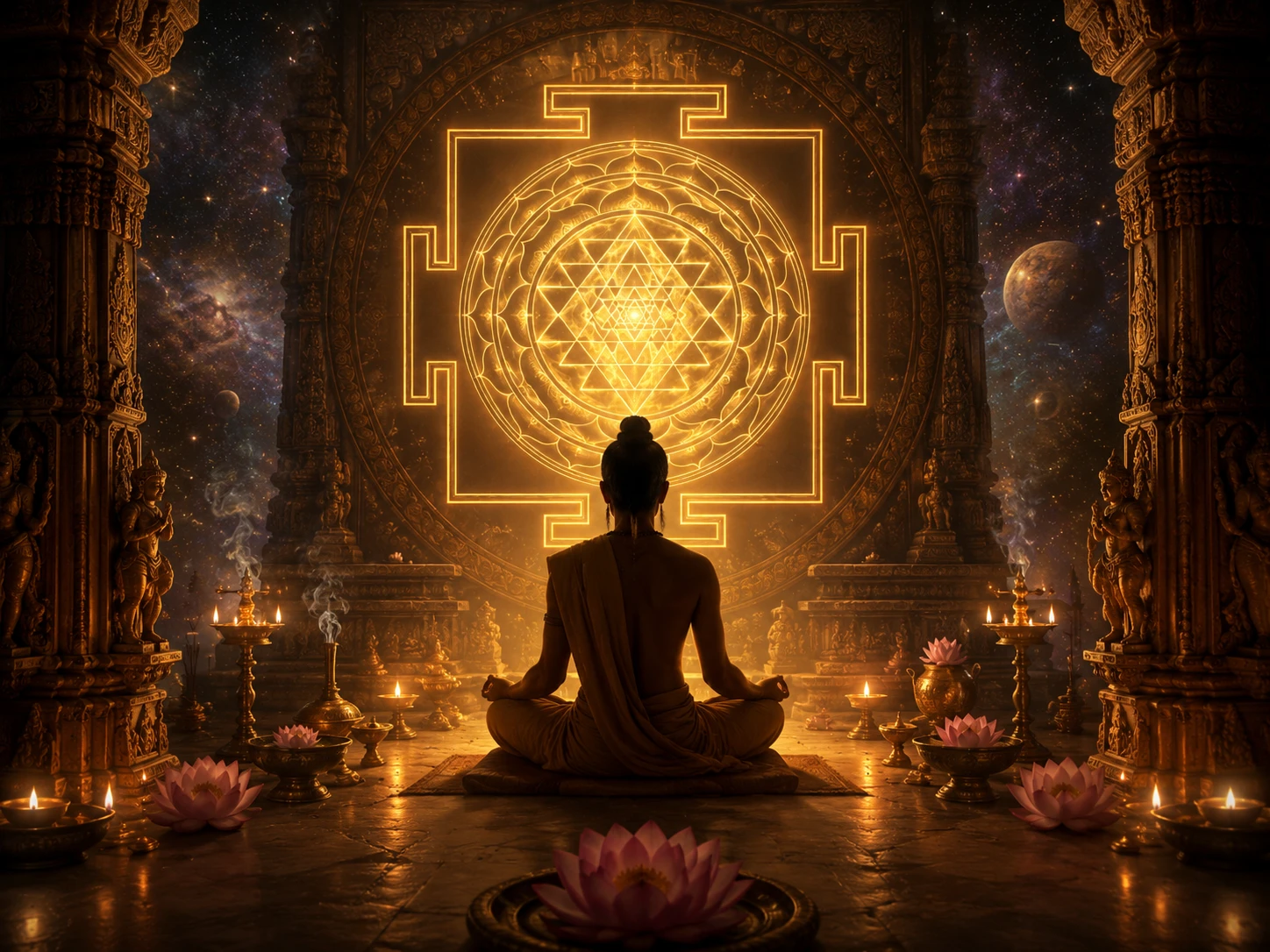
Yantra Meditation Guide -- How to Meditate with Sacred Geometry
यन्त्र ध्यान मार्गदर्शिका -- पवित्र ज्यामिति से कैसे ध्यान करें
You have seen yantras without knowing it. The rangoli your mother draws at the threshold every morning is a yantra. The kolam in rice flour that your Tamil neighbour creates before dawn is a yantra. The geometric pattern on the copper plate that the pandit places under the deity's idol in the temple is a yantra. The mandala that your colleague uses as a phone wallpaper after downloading a meditation app is a simplified yantra.
But seeing a yantra and meditating with a yantra are two entirely different things. A yantra hung on the wall is a picture. A yantra gazed upon with focused awareness, paired with its corresponding mantra, activated through prescribed ritual -- that is a precision instrument of consciousness transformation. The difference is the same as between looking at a circuit board and powering it on.
This guide bridges the gap. Whether you are a complete beginner who has never sat for meditation or an experienced practitioner looking to integrate yantra into your existing sadhana, this article provides the complete method -- from selecting the right yantra to the step-by-step seated practice to understanding what is happening inside your visual cortex when you gaze at these ancient geometric patterns.
The IIT Kanpur Department of Mathematics has studied the geometric properties of the Sri Yantra and found that its nine interlocking triangles create 43 smaller triangles with mathematical precision that satisfies multiple geometric constraints simultaneously -- a feat that modern computational geometry finds non-trivial to replicate. You are not gazing at decorative art. You are gazing at one of the most sophisticated mathematical objects ever created by human civilisation, and its purpose is to reorganise your mind.
यं त्रायते इति यन्त्रम्।
yaṃ trāyate iti yantram
That which controls and protects (trayate) the forces represented by 'yam' (the seed of control) -- that is called a Yantra.
— Traditional etymological definition from Yantra Shastra
What a Yantra Is -- The Visual Mantra
If mantra is the sound-body of a deity, yantra is the form-body. They are two expressions of the same reality -- one accessed through hearing, the other through sight. The Tantric axiom is direct: 'Yantra is the body of the deity. Mantra is the breath. Tantra is the mind.' Remove any one and the deity is incomplete.
A yantra is a geometric diagram composed of specific elements, each carrying precise meaning. The bindu (central point) represents the source -- the unmanifest origin from which all creation emerges. Triangles represent Shakti (pointing downward, feminine creative energy) and Shiva (pointing upward, masculine transcendent consciousness). Circles represent cycles -- of creation, of time, of breath. Lotus petals represent unfolding stages of consciousness. The bhupura (square outer frame) represents the earth, the physical plane, the boundary where the cosmic meets the material.
Every yantra follows a centripetal logic: from the outer boundary (the world of matter and multiplicity) toward the inner bindu (the point of unity and source). Meditating on a yantra is therefore a visual journey from the many to the one, from complexity to simplicity, from the phenomenal world to the transcendent core. This journey mirrors the journey of consciousness itself -- from distraction to focus, from separation to unity.
The Sri Yantra is the most celebrated and complex of all yantras. Its nine interlocking triangles (four pointing upward for Shiva, five pointing downward for Shakti) create a pattern of 43 smaller triangles arranged in concentric layers, surrounded by lotus petals and enclosed in the bhupura. It is the complete map of creation -- from the bindu (Brahman) through the unfolding of the universe (the triangles) to the material world (the bhupura). Gazing at the Sri Yantra is, in the tradition's own terms, gazing at the face of the cosmos.
Step 1 -- Choosing Your Yantra
Your first yantra should match your primary spiritual intention. Here is a practical guide.
For intellectual clarity and academic success -- Saraswati Yantra or Gayatri Yantra. These pair with the Saraswati Gayatri or the Savitri Gayatri Mantra. Ideal for students preparing for competitive exams, researchers, writers, and anyone whose work depends on mental clarity. If you are in Kota preparing for JEE or in Mukherjee Nagar preparing for UPSC, this is your yantra.
For prosperity and career growth -- Sri Yantra or Lakshmi Yantra. The Sri Yantra is the most universal and powerful prosperity yantra, but it is also the most complex for beginners. The Lakshmi Yantra is a simpler entry point. These pair with the Sri Suktam or the Lakshmi Gayatri. For working professionals, entrepreneurs, and anyone navigating career transitions.
For protection and obstacle removal -- Ganesha Yantra or Sudarshana Yantra. The Ganesha Yantra pairs with 'Om Gam Ganapataye Namaha.' The Sudarshana Yantra pairs with the Sudarshana Ashtakam. For those facing persistent obstacles, litigation, health challenges, or major life transitions.
For healing and peace -- Mahamrityunjaya Yantra or Dhanvantari Yantra. The Mahamrityunjaya pairs with the Mahamrityunjaya Mantra. For those dealing with illness (self or family), grief, anxiety, or fear.
For spiritual advancement -- Sri Yantra (advanced) or Shiva Yantra. These are for practitioners with an established meditation practice who seek deeper contemplative states.
Material: Copper is the preferred material for yantras because of its conductivity -- the same property that makes copper the material of choice for electrical wiring. Copper yantras are available from traditional suppliers in Varanasi, Haridwar, and online. Paper or printed yantras work for beginners but carry less energetic charge. Avoid purely decorative yantras without proper geometric accuracy -- a yantra with incorrect proportions is like a circuit with wrong connections.
Yantra-Mantra Pairs for Common Life Situations
| Life Situation | Recommended Yantra | Paired Mantra | Ideal Meditation Time | Minimum Daily Practice |
|---|---|---|---|---|
| Exam preparation, academic focus | Saraswati Yantra | Om Aim Saraswatyai Namah | Brahma Muhurta (4:30-5:30 AM) | 11 minutes trataka + 108 japa |
| Career growth, new business | Sri Yantra | Om Shreem Hreem Shreem Kamalavaasinyai Svaha | Friday sunrise or Lakshmi hora | 15 minutes trataka + 108 japa |
| Health recovery, fear of death | Mahamrityunjaya Yantra | Om Tryambakam Yajamahe... | Monday sunrise | 11 minutes trataka + 108 japa |
| Obstacle removal, new ventures | Ganesha Yantra | Om Gam Ganapataye Namah | Tuesday or Wednesday sunrise | 11 minutes trataka + 108 japa |
| Relationship harmony, inner peace | Shiva-Parvati Yantra | Om Namah Shivaya | Monday sandhya | 11 minutes trataka + 54 japa |
| Deep spiritual practice, kundalini | Sri Yantra (advanced) | Panchadashi Mantra (diksha required) | Brahma Muhurta | 30-45 minutes (guru-directed) |
Trataka (fixed gazing) durations are minimums. Advanced practitioners may extend to 30 or 45 minutes. The Panchadashi Mantra paired with Sri Yantra is the pinnacle of Sri Vidya sadhana and requires proper diksha from a qualified guru in the Dakshinamurti or Hayagriva lineage.
Step 2 -- Setting Up Your Practice Space
The yantra should be placed at eye level when you are seated. If you sit on the floor, place it on a low table or wall mount at approximately 60-90 cm height. If you sit on a chair, mount it slightly higher. The distance from your eyes to the yantra should be approximately 45-60 cm -- roughly arm's length. Too close and your eyes cannot take in the full geometry; too far and the details blur.
Lighting matters. The ideal is soft, natural light or a single ghee lamp placed below the yantra so the light falls upward onto the geometric surface. Avoid harsh overhead fluorescent lighting -- it creates glare on copper yantras and flattens the visual depth of the geometry. The interplay of light and shadow on a copper yantra's raised lines is itself a meditation tool -- the geometry appears to shift and breathe as the lamp flickers.
The yantra sits on a clean cloth -- traditionally red for Shakti yantras, white for Saraswati, yellow for Ganesha or Vishnu. A small offering of flowers, kumkum (vermillion dot at the bindu), and incense creates the ritual container. This is not superstition -- it is environmental design. The flowers engage smell. The kumkum draws the eye to the bindu. The incense smoke creates a soft visual atmosphere. Every sense is oriented toward the practice.
For those in compact urban apartments -- a one-bedroom flat in Andheri or a PG in Koramangala -- the setup can be minimal. A printed yantra on the wall above your study desk, a small diya, and a five-minute preparation ritual is sufficient. The tradition scales to your life, not the other way around.
Step 3 -- The Trataka Method (Beginner to Intermediate)
Trataka is the yogic technique of fixed gazing. It is classified as one of the six shatkarmas (purification practices) in the Hatha Yoga Pradipika. When applied to a yantra, trataka becomes a powerful meditation method that uses the visual pathway to alter brain state.
Phase 1 -- External Trataka (Bahir Trataka). Duration: 3-5 minutes initially, building to 11 minutes over 2-3 weeks.
Sit in a comfortable posture with spine erect. Close your eyes and take five deep breaths. Open your eyes and fix your gaze on the bindu -- the central point of the yantra. Do not scan the geometry. Do not follow the lines. Simply rest your gaze on the bindu with soft, relaxed eyes. Blink naturally; this is not a staring contest.
Within 2-3 minutes, you will notice the geometry beginning to shift. The triangles may appear to pulse or rotate. The lines may seem to glow. Colours may appear that are not physically present. This is not hallucination -- it is your visual cortex responding to the sustained geometric stimulus. The yantra's precise symmetry creates a phenomenon called neural adaptation, where the brain's pattern-recognition circuits begin to oscillate between competing geometric interpretations. This oscillation destabilises ordinary visual processing and opens a window to altered perceptual states.
Phase 2 -- Internal Trataka (Antar Trataka). After 5-11 minutes of external gazing, close your eyes. You will see the afterimage of the yantra imprinted on your visual field -- often in complementary colours (a copper yantra may appear as a blue-green ghost image). Hold this afterimage in your mind's eye. Let it float at the centre of your internal visual field. When it fades, gently recall it. This internal image is the yantra transferred from the physical plane to the mental plane -- from Vaikhari (external) to Madhyama (internal) in the language of Vak Tattva.
Phase 3 -- Integration. While holding the internal image, begin mentally chanting the paired mantra. The yantra provides the visual anchor; the mantra provides the auditory anchor. Two senses are now synchronised on a single object. This dual-channel focus is exponentially more powerful than either alone, because it engages both the visual cortex and the auditory processing centres simultaneously, creating a unified field of attention.
This three-phase practice takes 11-15 minutes. It can be done by anyone, requires no initiation, and produces measurable results (improved concentration, reduced anxiety, enhanced creative thinking) within 2-3 weeks of daily practice.
The rangoli and kolam patterns drawn at Indian doorsteps every morning are functional yantras. Research at IIT Madras has studied the mathematical properties of kolam patterns and found they follow specific graph-theory rules similar to Euler paths. These patterns are not just decorative -- they are among the oldest continuously practised geometric meditation traditions on earth, maintained overwhelmingly by women who may never use the word 'yantra' but practise its essence daily.
Advanced Practice -- Navigating the Sri Yantra
For practitioners who have established a stable 11-minute trataka practice over at least three months, the Sri Yantra offers a deeper journey. The Sri Yantra is not gazed at passively -- it is navigated. The nine enclosures (avaranas) of the Sri Yantra form a progressive meditation map, each with its own presiding deities, mantras, and psychological correspondences.
The journey begins at the outermost enclosure (the bhupura, the square earth-gate) and moves progressively inward. In the Sri Vidya tradition, this inward journey through the nine avaranas mirrors the practitioner's journey through successively subtler layers of consciousness.
The first avarana is the Trailokya Mohana Chakra (the enchantment of the three worlds) -- the outer square with its four gates. This represents the beginning of the inward turn, where the practitioner chooses to look beyond the ordinary world.
The second is the Sarva Asha Paripuraka Chakra (fulfilment of all desires) -- the sixteen-petal lotus. Here, the practitioner confronts and transcends the sixteen desires that bind consciousness to the material.
The third through eighth avaranas progress through increasingly subtle layers: the eight-petal lotus (Sarva Sankshobhana, the agitation of all), the fourteen-triangle enclosure (Sarva Saubhagya Dayaka, bestower of all fortune), the outer ten triangles, the inner ten triangles, the eight triangles, and finally the innermost triangle (Sarva Siddhi Prada, bestower of all attainments).
The ninth avarana is the bindu itself -- the dimensionless point at the centre. This is the destination: the point of unity where Shiva and Shakti merge, where subject and object dissolve, where the meditator and the meditated-upon become one. In the language of the tradition, this is the state of 'para samvit' -- supreme awareness.
This nine-stage navigation is not done in a single sitting. Traditional practice takes months or years, with the practitioner dwelling in each avarana until its lessons are absorbed. The Sri Yantra is not a sprint -- it is a pilgrimage. And like all pilgrimages, the destination matters less than the transformation that occurs along the way.
The nine interlocking triangles of the Sri Yantra create exactly 43 smaller triangles. Getting all nine triangles to interlock with mathematical precision -- so that all triple-intersection points (called marma points) align correctly -- is an extraordinarily difficult geometric problem. A 2017 paper in the Journal of Mathematics and the Arts confirmed that constructing a 'correct' Sri Yantra requires solving a system of simultaneous non-linear equations. Ancient Indian mathematicians solved this without algebra or computers.
The Neuroscience of Geometric Gazing
What happens in the brain when you gaze at a yantra? Modern research on visual meditation and mandala gazing offers some answers.
First, sustained gazing at a single geometric point (trataka on the bindu) activates the superior colliculus -- a midbrain structure involved in directing visual attention. This suppresses saccadic eye movements (the rapid, unconscious scanning that the eyes normally perform 3-4 times per second). When saccades are suppressed, the brain's visual processing shifts from 'search mode' to 'absorption mode.' This is measurable in EEG as a shift from beta waves (13-30 Hz, associated with active scanning) to alpha waves (8-13 Hz, associated with relaxed alertness).
Second, the geometric symmetry of the yantra engages the brain's pattern-recognition circuits in a unique way. The visual cortex responds strongly to bilateral symmetry, concentric patterns, and recursive self-similarity -- all of which yantras contain in abundance. Research on fractal geometry viewing has shown that images with fractal dimensions between 1.3 and 1.5 produce the strongest relaxation response. The Sri Yantra's geometry falls within this fractal range.
Third, the phenomenon of 'visual entrainment' -- when a sustained visual stimulus begins to synchronise brain rhythms -- has been documented in studies on mandala meditation. The geometric regularity of the yantra creates a periodic visual signal that, over minutes of sustained gazing, begins to entrain neural oscillations in the visual cortex toward lower-frequency, more coherent states.
NIMHANS Bengaluru has conducted studies on trataka's effects on cognitive function, finding improvements in spatial memory and sustained attention after eight weeks of practice. The All India Institute of Medical Sciences (AIIMS) Delhi has investigated the effects of visual meditation practices on anxiety disorders, with promising preliminary results.
The convergence between traditional claims and modern findings is not coincidental. The rishis did not have fMRI machines. But they had millennia of systematic observation, and their conclusions -- that fixed gazing on precise geometric forms produces measurable shifts in mental state -- hold up under controlled laboratory conditions.
यन्त्रं मन्त्रमयं प्रोक्तं मन्त्रात्मा देवतैव हि। देहात्मनोर्यथा भेदो यन्त्रदेवतयोस्तथा॥
yantraṃ mantramayaṃ proktaṃ mantrātmā devataiva hi dehātmanor yathā bhedo yantra-devatayor tathā
The yantra is declared to be the form of the mantra. The soul of the mantra is the deity itself. Just as the body and the soul are related, so too are the yantra and the deity.
— Kularnava Tantra, Ullasa 6
Common Mistakes and How to Avoid Them
Mistake 1: Straining the eyes. Trataka should never cause pain or excessive tearing. If the eyes strain, you are trying too hard. Soften the gaze. Let the yantra come to you rather than reaching for it. Blink naturally. If discomfort persists, reduce the duration and build gradually.
Mistake 2: Scanning the geometry. The temptation is to trace the lines, follow the triangles, count the petals. Resist this. The mind wants to analyse; meditation requires absorption. Fix on the bindu and let the peripheral geometry enter your awareness without pursuing it. The yantra's power lies in its totality, not in its parts.
Mistake 3: Treating the yantra as decoration. A yantra placed casually on a shelf between books and photo frames has been domesticated. It will not generate the same field as a yantra given a dedicated space, regular puja, and daily practice attention. You would not store a musical instrument face-down under a pile of clothes and expect it to stay in tune.
Mistake 4: Using geometrically incorrect yantras. Many commercially produced yantras are aesthetically pleasing but geometrically wrong -- the marma points do not align, the proportions are off, the triangles are not properly interlocked. A geometrically incorrect yantra is worse than no yantra, because it trains the visual system on false symmetry. Source your yantra from a reputable traditional supplier -- Giri Trading in Chennai, Kashi Vishwanath temple shops in Varanasi, or verified online sellers who provide geometric certification.
Mistake 5: Skipping the mantra. Yantra without mantra is a body without breath. The visual and auditory channels must work together. Even if the mantra is simply Om, it must accompany the gazing practice. Without the sound anchor, the mind will wander even while the eyes are fixed.
The Sriharikota launch pad of ISRO has a small temple where a Sri Yantra is installed. Before every major launch, a brief puja is conducted. The engineers who design rockets and the priests who venerate the yantra share a common understanding: precision matters. Whether the geometry is a trajectory calculation or a sacred diagram, getting the lines right is everything.
Begin Yantra Trataka
Phase 1: gaze at a printed yantra -- start with the Ganesha yantra -- for two to five minutes, blinking only when you need to. Phase 2: close your eyes and hold its after-image as long as it lasts. Keep a simple timer beside you. The Steady Gaze dharana on Eternal Raga teaches the same two phases with a lamp flame.
Tags
Eternal Raga · शाश्वत राग
Institutional voice — scholarly articles on Sanatan Dharma
Deepen Your Understanding
अपनी समझ और गहरी करें
tantra mantra yantra
Tantra, Mantra and Yantra -- The Three Pillars of Spiritual Practice
Tantra is the loom, Mantra is the thread, Yantra is the pattern. Together they form the complete technology of spiritual transformation that India gifted to the world -- and they are far more profound than popular culture imagines.
tantra mantra yantra
Sri Yantra -- The Supreme Geometry of Creation
Nine interlocking triangles. 43 smaller triangles. A single point from which the entire universe unfolds. The Sri Yantra is the most complex and revered sacred diagram in Hinduism -- and modern mathematicians have found that constructing it requires solving simultaneous equations that Western mathematics did not formalise until the 18th century. This is not decoration. This is the visual body of the Goddess.
tantra mantra yantra
The Science of Mantra -- How Sacred Sound Rewires Consciousness
A mantra is not a prayer. It is not a wish. It is a precision instrument of consciousness -- a vibrational key engineered in Sanskrit thousands of years ago to unlock specific states of mind. Modern neuroscience is only now catching up.
tantra mantra yantra
What Makes a Mantra -- The Anatomy of Sacred Sound
Not every Sanskrit word is a mantra. Not every chant carries power. A mantra is an engineered formula with six mandatory components -- rishi, devata, chhanda, beej, shakti, and viniyoga. Miss any one and the circuit is incomplete. Here is the blueprint.
tantra mantra yantra
The Seven Chakras -- Energy Centres That Map Your Inner Universe
You have seven power stations running along your spine. Each governs a specific domain of human experience -- from survival instinct to sexual energy to willpower to love to expression to intuition to cosmic consciousness. The chakra system is not mystical poetry. It is the most detailed map of human psychology ever embedded in a spiritual framework -- and modern neuroscience is only now catching up to what Tantric yogis described 1,500 years ago.
tantra mantra yantra
The Gayatri Mantra -- 24 Syllables That Illuminate the Mind
The most chanted verse in human history is not a prayer for wealth, power, or protection. It is a prayer for light -- for the divine radiance to illuminate the intellect. 24 syllables from Rig Veda 3.62.10, attributed to Rishi Vishwamitra, have shaped Indian civilisation for over three thousand years.
sacred symbols
108 -- The Sacred Number That Links Your Mala to the Solar System
Why does a japa mala have exactly 108 beads? Why do temples list 108 names for every deity? The answer involves astronomy, anatomy, music, and mathematics -- and a coincidence so precise it still stuns astrophysicists: the distance from Earth to the Sun is approximately 108 times the Sun's diameter.
The rangoli and kolam patterns drawn at Indian doorsteps every morning are functional yantras. Research at IIT Madras has studied the mathematical properties of kolam patterns and found they follow specific graph-theory …
More in Tantra, Mantra & Yantra
Agama vs Tantra vs Veda -- Three Streams of Hindu Practice
14 min read
Agni Dhyana -- What Meditation on Fire Is Actually Grounded In
8 min read
Ashta Siddhi -- The Eight Yogic Powers and How Hanuman Embodies Them
13 min readThe same translation error that turned '33 Koti' into '33 crore' in Hinduism also happened in Buddhism. The Chinese translation of Buddhist texts rendered 'Sapta Koti Buddha' (7 Supreme Buddhas) as '7 Crore Buddhas.' The…
Deities AvatarsCommunity Reflections
🕉️
Be the first to share your reflection.