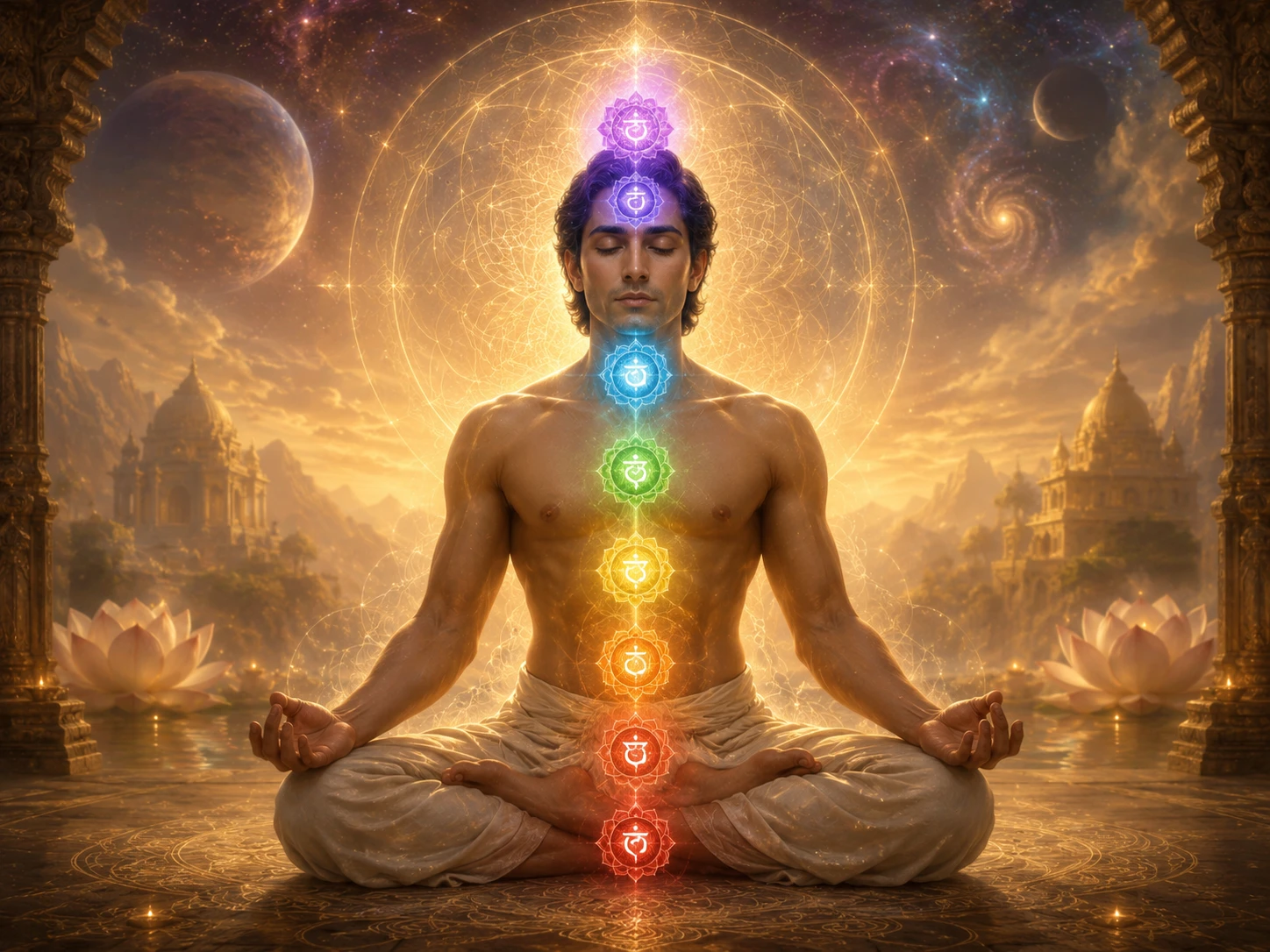
The Seven Chakras -- Energy Centres That Map Your Inner Universe
सात चक्र -- तुम्हारे भीतरी ब्रह्माण्ड का मानचित्र
Open any wellness app in 2026 and you will find chakra content -- colour-coded wheels, crystal prescriptions, affirmation cards. Search 'chakra balancing' on YouTube and you will get millions of results, most featuring ambient music and someone speaking in a soothing voice about 'unblocking your throat chakra.' The chakra system has been adopted by global wellness culture with such enthusiasm that its original context -- rigorous Tantric yogic science rooted in Sanskrit texts -- has been almost entirely buried under layers of commercial simplification.
The actual chakra system, as described in the Shat-Chakra-Nirupana (16th century) and earlier Tantric texts, is not a self-help tool. It is a detailed psycho-spiritual map of the human subtle body -- the energetic architecture that underlies and interpenetrates the physical form. Each chakra is described with extraordinary precision: its exact location, its number of petals (each petal carrying a specific Sanskrit letter), its presiding deity and consort, its associated element, its beej (seed) mantra, its colour, its animal vehicle, and the specific psychological domain it governs.
The seven chakras are not metaphorical 'energy vibes.' They are described as actual vortices of prana (life-force) located at specific points along the Sushumna Nadi (the central energy channel running through the spine). When Kundalini Shakti rises through these centres, each one activates, transforming the practitioner's consciousness at that level.
What makes the chakra system genuinely remarkable is how accurately it maps onto modern understanding of human psychology and neuroscience. The progression from survival (Muladhara) through sexuality (Svadhisthana), power (Manipura), love (Anahata), communication (Vishuddha), insight (Ajna), to transcendence (Sahasrara) mirrors Abraham Maslow's hierarchy of needs -- proposed in 1943, roughly 1,400 years after the Tantric texts. The nerve plexuses along the spine (sacral, lumbar, solar, cardiac, cervical) correspond remarkably to the chakra positions. This does not prove identity between chakras and nerve plexuses, but the correspondence is too precise to dismiss.
आधारं प्रथमं चक्रं स्वाधिष्ठानं द्वितीयकम्। नाभेर्मणिपूरं च हृदये चानाहतम्॥ कण्ठे विशुद्धिनामानमाज्ञाख्यं भ्रूमध्यगम्। सहस्रारं महत्पद्मं ब्रह्मरन्ध्रे प्रतिष्ठितम्॥
ādhāraṁ prathamaṁ cakraṁ svādhiṣṭhānaṁ dvitīyakam | nābher maṇipūraṁ ca hṛdaye cānāhatam || kaṇṭhe viśuddhi-nāmānam ājñākhyaṁ bhrūmadhyagam | sahasrāraṁ mahat-padmaṁ brahmarandhre pratiṣṭhitam ||
The first chakra is the Adhara (base support), the second is Svadhisthana. At the navel is Manipura, at the heart Anahata. At the throat is the one called Vishuddhi, between the brows is Ajna. The great lotus Sahasrara is established at the Brahmarandhra (crown aperture).
— Shat-Chakra-Nirupana (traditional summary verse, Purnananda Swami)
The Seven Centres -- From Earth to Ether
1. MULADHARA (Root Support) -- Base of spine, perineum. Element: Earth. Petals: 4 (carrying letters va, sha, sha, sa). Beej Mantra: LAM. Deity: Brahma and Dakini. Colour: Red. Animal: Elephant (Airavata). Domain: Survival, security, grounding, physical identity. This is where Kundalini sleeps, coiled three and a half times around the Shiva Linga (representing latent consciousness). When balanced: stability, confidence, physical health. When blocked: anxiety, fear, insecurity, hoarding behaviour. The JEE aspirant in Kota who cannot sleep because the fear of failure has become physical -- tightness in the legs, inability to sit still -- is experiencing Muladhara disturbance.
2. SVADHISTHANA (One's Own Abode) -- Below the navel, sacral region. Element: Water. Petals: 6 (ba, bha, ma, ya, ra, la). Beej: VAM. Deity: Vishnu and Rakini. Colour: Orange. Animal: Makara (crocodile). Domain: Sexuality, creativity, pleasure, emotional fluidity. This chakra governs the ability to feel, to flow, to create, to enjoy. When balanced: healthy sexuality, creative expression, emotional intelligence. When blocked: guilt about pleasure, creative paralysis, emotional numbness or volatility. The startup founder who has been working 18-hour days for months and has forgotten what joy feels like -- Svadhisthana has dried up.
3. MANIPURA (City of Gems) -- Solar plexus, navel region. Element: Fire. Petals: 10 (da, dha, na, ta, tha, da, dha, na, pa, pha). Beej: RAM. Deity: Rudra and Lakini. Colour: Yellow. Animal: Ram (male sheep). Domain: Willpower, self-esteem, personal power, digestion (both physical and psychological). This is the fire centre -- the engine of ambition, confidence, and decisive action. When balanced: strong will, healthy ego, good digestion. When blocked: helplessness, indecision, digestive problems, rage. The middle manager at a Gurugram MNC who cannot speak up in meetings despite having the best ideas -- Manipura is smothered.
4. ANAHATA (Unstruck Sound) -- Heart centre, cardiac plexus. Element: Air. Petals: 12 (ka, kha, ga, gha, nga, cha, chha, ja, jha, nya, ta, tha). Beej: YAM. Deity: Isha (Shiva) and Kakini. Colour: Green. Animal: Antelope (symbolising the heart's swift, graceful movement). Domain: Love, compassion, forgiveness, connection, breath. Anahata means 'unstruck' -- the sound that arises without two things striking together. This is the vibration of love itself, which exists without cause or condition. When balanced: unconditional love, empathy, healthy relationships. When blocked: grief, jealousy, inability to forgive, loneliness. The Vishnu Granthi (knot of emotional attachment) sits here -- Kundalini must pierce through emotional dependency to continue rising.
5. VISHUDDHA (Purification) -- Throat centre, cervical plexus. Element: Ether (Akasha). Petals: 16 (all vowels of Sanskrit). Beej: HAM. Deity: Sadashiva and Shakini. Colour: Blue. Animal: White elephant. Domain: Communication, self-expression, truth, listening. This is the purification centre -- where the practitioner's expression is purified of falsehood, manipulation, and ego. When balanced: clear communication, authentic expression, ability to listen deeply. When blocked: fear of speaking, dishonesty, inability to express feelings, thyroid issues. The content creator who has 50,000 followers but cannot say what she actually thinks -- Vishuddha is locked.
6. AJNA (Command) -- Between the eyebrows, pineal region. Element: Mind (beyond physical elements). Petals: 2 (Ha and Ksha -- representing Shiva and Shakti, the final duality). Beej: OM. Deity: Paramashiva (Ardhanarishvara) and Hakini. Colour: Indigo. Domain: Intuition, wisdom, insight, inner vision, command over the mind. This is the 'third eye' -- not a magical organ but the point where duality collapses into unity. The two petals represent the last remaining duality (subject/object), which dissolves here. The Rudra Granthi (knot of intellectual attachment) sits here -- Kundalini must pierce through the certainty that 'I know' to recognise that all knowing is the Goddess knowing through you.
7. SAHASRARA (Thousand-Petalled Lotus) -- Crown of the head, cerebral cortex. Element: Beyond elements. Petals: 1,000 (representing infinity). Beej: Silence (or Visarga -- the silent exhalation). Deity: Paramashiva and Adi Shakti in union. Colour: Violet/White/All colours. Domain: Cosmic consciousness, non-duality, liberation, union of Shiva and Shakti. Sahasrara is not technically a chakra in the same sense as the other six -- it is the destination. When Kundalini reaches here, the individual self dissolves into universal consciousness. This is moksha. This is samadhi. This is the goal of all Tantric practice. The thousand petals represent the infinite expressions of consciousness, all emanating from and returning to the one Bindu.
Seven Chakras -- Complete Reference Map
| # | Chakra | चक्र | Location | Element | Beej Mantra | Petals | Domain |
|---|---|---|---|---|---|---|---|
| 1 | Muladhara | मूलाधार | Base of spine | Earth | LAM | 4 | Survival, security, grounding |
| 2 | Svadhisthana | स्वाधिष्ठान | Below navel | Water | VAM | 6 | Sexuality, creativity, pleasure |
| 3 | Manipura | मणिपूर | Solar plexus | Fire | RAM | 10 | Willpower, self-esteem, digestion |
| 4 | Anahata | अनाहत | Heart | Air | YAM | 12 | Love, compassion, forgiveness |
| 5 | Vishuddha | विशुद्ध | Throat | Ether | HAM | 16 | Communication, truth, expression |
| 6 | Ajna | आज्ञा | Between brows | Mind | OM | 2 | Intuition, insight, inner vision |
| 7 | Sahasrara | सहस्रार | Crown | Beyond | Silence | 1000 | Cosmic consciousness, liberation |
The total number of petals across the six lower chakras (4+6+10+12+16+2 = 50) corresponds exactly to the 50 letters of the Sanskrit alphabet. Each petal carries one letter. This means the entire Sanskrit alphabet is mapped onto the subtle body -- and chanting any Sanskrit sound activates its corresponding point in the chakra system. This is one reason why Sanskrit is considered a 'vibrational' language in Tantric tradition.
The 50 petals of the six lower chakras correspond to the 50 letters of the Sanskrit alphabet -- meaning the entire language is literally mapped onto the human subtle body. But here is something even more striking: the nerve plexuses that modern anatomy identifies along the spine (coccygeal, sacral, lumbar/solar, cardiac, cervical/pharyngeal, cavernous/optic) correspond almost exactly to the positions of the six chakras. Dr. Hiroshi Motoyama, a Japanese scientist who devoted decades to studying chakras with bioelectric measurements, found measurable electromagnetic differences at chakra locations in advanced meditators. AIIMS Delhi and NIMHANS Bangalore have both hosted research symposia on the correspondence between chakra anatomy and the autonomic nervous system. The ancient yogis may not have used the language of neuroscience, but they mapped the same territory.
Activate Your Chakras -- Beej Mantra Meditation
The simplest and safest chakra practice: sit quietly, bring attention to each chakra from Muladhara upward, and chant its beej mantra seven times at each centre -- LAM, VAM, RAM, YAM, HAM, OM, then silence at the crown. About fifteen minutes in all. Eternal Raga's chakra pages, beginning with Muladhara, describe each centre in turn.
Tags
Eternal Raga · शाश्वत राग
Institutional voice — scholarly articles on Sanatan Dharma
Deepen Your Understanding
अपनी समझ और गहरी करें
tantra mantra yantra
Kundalini -- The Serpent Power That Sleeps at Your Spine's Base
A coiled serpent sleeps at the base of your spine. When awakened through yoga, mantra, or guru's grace, she rises through seven energy centres, dissolving every limitation of body and mind, until she merges with pure consciousness at the crown of your head. This is not New Age fantasy. This is the central psycho-spiritual technology of Tantric Hinduism -- mapped in Sanskrit texts over 1,500 years ago and now studied by neuroscientists at institutions from Harvard to NIMHANS Bangalore.
tantra mantra yantra
Tantra, Mantra and Yantra -- The Three Pillars of Spiritual Practice
Tantra is the loom, Mantra is the thread, Yantra is the pattern. Together they form the complete technology of spiritual transformation that India gifted to the world -- and they are far more profound than popular culture imagines.
tantra mantra yantra
Sri Yantra -- The Supreme Geometry of Creation
Nine interlocking triangles. 43 smaller triangles. A single point from which the entire universe unfolds. The Sri Yantra is the most complex and revered sacred diagram in Hinduism -- and modern mathematicians have found that constructing it requires solving simultaneous equations that Western mathematics did not formalise until the 18th century. This is not decoration. This is the visual body of the Goddess.
tantra mantra yantra
Nadis and the Subtle Body
Your body has 72,000 nadis. You will not find them in a surgical dissection. They are channels of prana, the subtle life energy, running through the subtle body that underlies the physical. Three are principal -- Ida running down the left, Pingala down the right, and Sushumna running through the centre of the spine. Every pranayama, every mudra, every mantra practice is shaping the flow of these invisible highways.
philosophy darshana
Shakta Philosophy -- Devi as Ultimate Reality
What if God is not He but She? Not an abstract principle but a living, breathing, dancing power? Shakta philosophy does not merely add a feminine dimension to Hindu theology. It inverts the entire structure: Shakti is the primary reality, and consciousness without her is inert. Shiva without Shakti is shava -- a corpse. This is not metaphor. This is metaphysics.
sacred symbols
Om -- The Primordial Sound That Contains the Universe
Every temple bell, every mantra, every meditation session begins and ends with Om. But what exactly IS Om? The Mandukya Upanishad claims this single syllable contains all of reality -- past, present, future, and whatever lies beyond time itself. Twelve verses. One sound. The entire map of consciousness.
deities avatars
Devi Swaroopa -- Forms of the Goddess
She is Durga on the battlefield and Annapurna in the kitchen. She is Kali at the cremation ground and Lakshmi in the boardroom. She is Saraswati at the university and Parvati in the family. The Hindu Goddess is not one deity with accessories -- she is the entire spectrum of feminine power, from terrifying to tender, from cosmic to domestic. Understanding her forms is understanding the universe itself.
The 50 petals of the six lower chakras correspond to the 50 letters of the Sanskrit alphabet -- meaning the entire language is literally mapped onto the human subtle body. But here is something even more striking: the ne…
More in Tantra, Mantra & Yantra
Agama vs Tantra vs Veda -- Three Streams of Hindu Practice
14 min read
Agni Dhyana -- What Meditation on Fire Is Actually Grounded In
8 min read
Ashta Siddhi -- The Eight Yogic Powers and How Hanuman Embodies Them
13 min readThe same translation error that turned '33 Koti' into '33 crore' in Hinduism also happened in Buddhism. The Chinese translation of Buddhist texts rendered 'Sapta Koti Buddha' (7 Supreme Buddhas) as '7 Crore Buddhas.' The…
Deities AvatarsCommunity Reflections
🕉️
Be the first to share your reflection.