Nadis and the Subtle Body
नाड़ी और सूक्ष्म शरीर
A first-year MBBS student in AIIMS Delhi dissecting a cadaver for her anatomy practical will find blood vessels, lymph channels, nerves, tendons, muscles, and bones. She will not find nadis. This is not because yoga is mistaken about the body. It is because nadis are not physical structures. They are channels of prana, the subtle life energy that the classical Hindu yoga and tantra tradition describes as running through a subtle body that underlies the gross physical body. The same student, if she later takes up a serious pranayama practice for ten years, may begin to perceive these channels directly as energetic pathways with specific locations, directions of flow, and effects on mood, concentration and breath. Her teacher will not be surprised. The yoga tradition has known about these channels for at least two and a half thousand years. It has mapped them, counted them, named the most important ones, and developed specific techniques to work with them. The fact that Western anatomical science did not need to account for them does not mean they are not there. It means they are a different kind of thing, visible to a different kind of investigation.
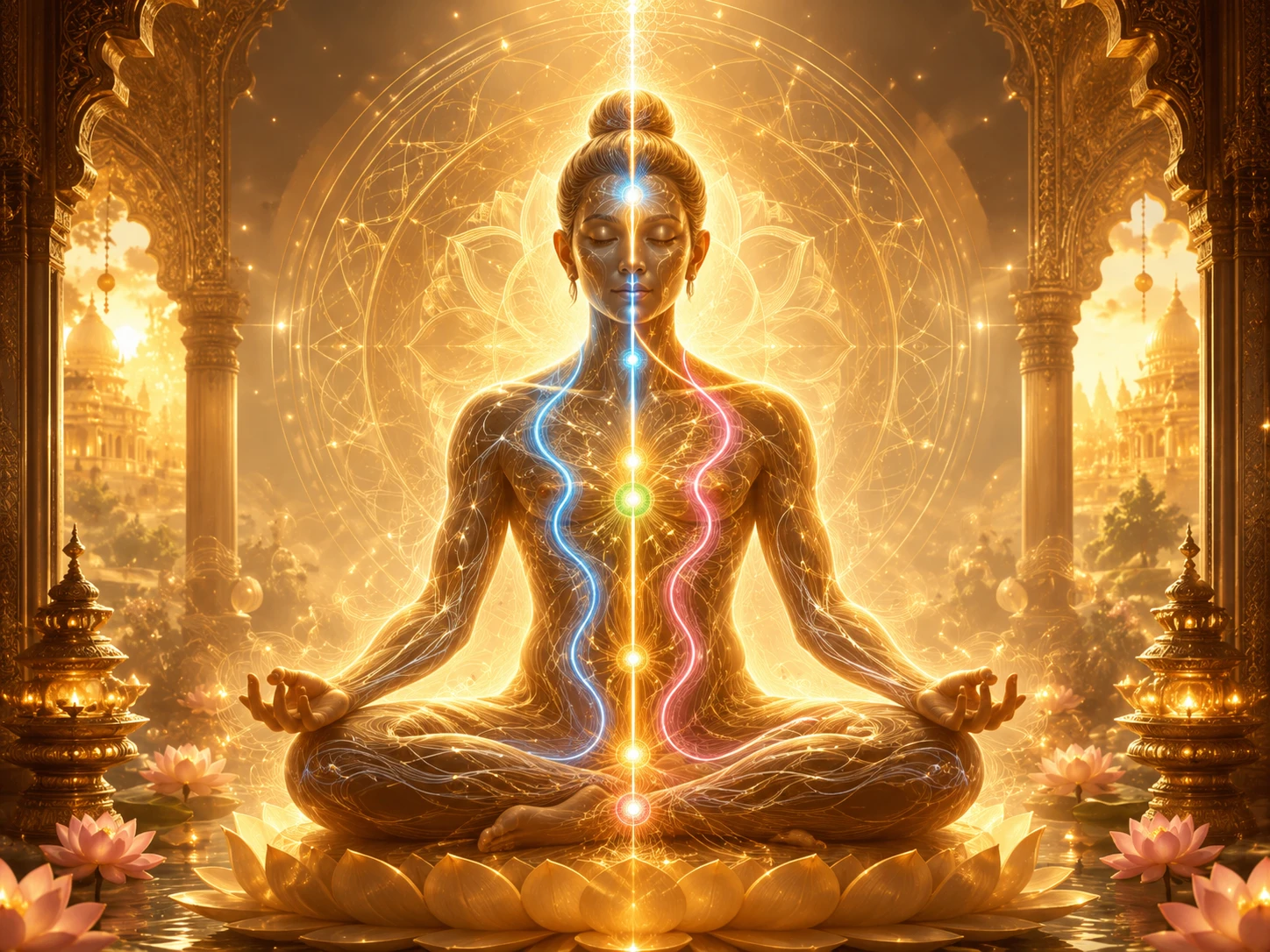
The classical number is 72,000 nadis in the human subtle body. This number appears in the Shiva Samhita, the Hatha Yoga Pradipika, the Gheranda Samhita, and multiple earlier Upanishadic and tantric sources. The exact figure is probably not to be taken as literal count in the modern statistical sense. It is a traditional enumeration that conveys the scale of the system -- tens of thousands of channels, branching into ever-finer sub-channels, reaching every part of the body that contains prana. Of these 72,000, the tradition identifies 14 as principal. Of these 14, three are named as the most important by essentially every classical text. These three are Ida, running on the left side of the spinal column, associated with lunar energy, cooling quality, and the feminine principle. Pingala, running on the right side of the spinal column, associated with solar energy, warming quality, and the masculine principle. And Sushumna, the central channel running through the vertical axis of the subtle body, treated as the path of liberation itself. A yogi whose prana has not yet entered Sushumna is still working within the dualistic flow of Ida and Pingala, alternating between lunar and solar states without ever reaching the neutral central awareness.
तेषु नाडीसहस्रेषु द्विसप्ततिरुदाहृताः। प्राधान्यात्प्राणवाहिन्यो भूयस्तत्र दश स्मृताः॥ इडा च पिङ्गला चैव सुषुम्ना च तृतीयका। गान्धारी हस्तिजिह्वा च पूषा चैव यशस्विनी॥
teṣu nāḍīsahasreṣu dvisaptatirudāhṛtāḥ | prādhānyātprāṇavāhinyo bhūyastatra daśa smṛtāḥ || iḍā ca piṅgalā caiva suṣumnā ca tṛtīyakā | gāndhārī hastijihvā ca pūṣā caiva yaśasvinī ||
Among these thousands of nadis, seventy-two are prominent. Among those carriers of prana, ten are especially remembered: Ida and Pingala, with Sushumna as third, along with Gandhari, Hastijihva, Pusha and Yashasvini.
— Shiva Samhita 2.17-19, medieval Hatha yoga scripture; parallel listings in Hatha Yoga Pradipika 3.1-4 and Goraksha Shataka
Ida is called the lunar or chandra nadi for specific reasons. Its flow is described as cool, feminine, introspective, and tending toward stillness and nourishment. When Ida is dominant, the left nostril is the primary breath channel, the mind is quieter, digestive activity increases, and the practitioner is suited to rest, meditation, reflective study, and receptive work. Traditional yogic texts recommend reading and meditation when Ida is running, because the faculties that support these activities are then active. In the classical schema, Ida originates at the base of the spine on the left side, ascends along the spinal column in a gentle spiral, and terminates at the left nostril. Every classical text describes its colour as pale, its quality as moonlike, and its deity as Chandra or Varuna depending on the tradition. A practitioner who learns to close her right nostril and breathe only through the left for twenty minutes is deliberately activating Ida, with characteristic effects on state of mind and body. This is the basis of one of the oldest pranayama techniques, called Chandra Bhedana, the moon-piercing breath, which has specific therapeutic applications for heat conditions, anxiety, and insomnia in classical Ayurveda-Yoga integration.
Pingala is the mirror image. Called the solar or surya nadi, it flows from the base of the spine on the right side, ascends in an opposite spiral to Ida, and terminates at the right nostril. Its qualities are warming, masculine, externally directed, assertive, and active. When Pingala is dominant, the right nostril breath is primary, the mind becomes outward-focused and task-oriented, digestion of food is faster, metabolic heat increases, and the practitioner is suited to physical exercise, work requiring output, social engagement, and decision-making. Traditional texts recommend eating and physical activity when Pingala is running. Its deity is Surya in most traditions. Pranayama that activates Pingala is called Surya Bhedana, the sun-piercing breath, in which one closes the left nostril and breathes only through the right for a prescribed duration. The effect is stimulating rather than calming. Surya Bhedana is contraindicated for people with heat conditions, high blood pressure, or inflammatory illness, because it amplifies exactly the qualities that these conditions already carry in excess. A 2026 yoga teacher prescribing pranayama for a student with hyperthyroidism should know this basic contraindication. The teacher who does not know this has not been trained in traditional yoga. She has been trained in a stripped-down modern variant that omits the functional anatomy underneath.
Ida, Pingala and Sushumna Compared
| Attribute | Ida | Pingala | Sushumna |
|---|---|---|---|
| Side / Location | Left of spine | Right of spine | Central axis of spine |
| Polarity | Chandra (lunar) | Surya (solar) | Neutral, beyond polarity |
| Quality | Cooling, receptive, feminine | Warming, active, masculine | Silent, beyond qualities |
| Associated deity | Chandra / Varuna | Surya / Agni | Shiva-Shakti non-dual |
| Nostril | Left | Right | Both, or breath suspended |
| Best for | Meditation, study, rest, reflection | Exercise, work, eating, engagement | Only the advanced yogi's work |
| Pranayama to activate | Chandra Bhedana | Surya Bhedana | Kumbhaka, Bhastrika, deep japa |
| Contraindications of excess | Lethargy, heaviness, cold disorders | Irritability, heat disorders, insomnia | None if actually achieved; many if forced prematurely |
These are classical correspondences recorded in Shiva Samhita, Hatha Yoga Pradipika, and Goraksha Shataka. Contemporary yoga therapy texts like those of Swami Satyananda Saraswati and the Bihar School of Yoga preserve this correspondence framework accurately.
Sushumna is the third and most important channel, and the one that practically defines yoga as a soteriological discipline. While Ida and Pingala can be activated by relatively simple pranayama techniques available to any motivated student, Sushumna does not open casually. Classical texts treat its opening as the actual work of yoga, with everything else being preparation. When prana enters Sushumna, specifically through the lower entry point called Brahma Dvara at the base, the yogi's state changes in ways that every classical text describes in similar language. The sense of self becomes centrally located along the vertical axis rather than scattered laterally. The breath may suspend spontaneously without effort. The distinction between internal and external observation collapses. The yogi, while remaining aware, no longer experiences the ordinary dualistic separation between observer and observed. Most classical texts say that full Sushumna activation is associated with the first stages of what the tradition calls samadhi, specifically savikalpa samadhi (with thought) and eventually nirvikalpa samadhi (without thought). The tradition is serious about this being a specific experiential outcome, not a metaphor. Yogis who have reached these states are expected to provide detailed phenomenological reports consistent with the texts, and these reports become part of the verification tradition.
The seven principal chakras sit along the Sushumna channel and represent the meeting points of the three principal nadis at specific vertical stations. Muladhara, at the base of the spine, is where Ida, Pingala and Sushumna first emerge and where Kundalini Shakti traditionally sleeps coiled three and a half times. Svadhisthana sits just above, at the level of the sacral region. Manipura is at the solar plexus. Anahata at the heart. Vishuddha at the throat. Ajna between the eyebrows. And Sahasrara at the crown. The chakras are often described as lotuses with varying petal counts -- Muladhara has four petals, Svadhisthana six, Manipura ten, Anahata twelve, Vishuddha sixteen, Ajna two, and Sahasrara the famous thousand. Each petal carries a Sanskrit syllable, and the complete Matrika, the fifty letters of the Sanskrit alphabet, is distributed across the petals of the lower six chakras. When a mantric letter is activated, the corresponding petal and therefore the corresponding region of the subtle body is energised. This is the technical basis of mantra yoga. The chakra theory presented in the Shatchakra Nirupana of Purnananda Swami, the Kathopanishad, the Yoga Kundalini Upanishad, and numerous tantric texts is remarkably consistent across centuries, suggesting that the tradition is describing stable observable features of the subtle body rather than varying cultural conventions.
Swar Yoga, the yoga of breath awareness, is a specific classical discipline that works entirely with the alternation between Ida and Pingala and their meeting in Sushumna. The term Swar literally means tone, note, or breath flow, and Swar Yoga teaches that by observing which nostril is currently dominant and adjusting activities accordingly, a practitioner aligns her actions with her subtle body's actual state in each moment. Traditional Swar Yoga texts, particularly the Shiva Swarodaya (also spelled Swarodaya), provide detailed prescriptions. Start important work when the matching nostril is active. Eat food when Pingala is running, because digestive heat is then active. Initiate projects aligned with increase, money, or acquisition when the breath is in Pingala. Initiate projects aligned with receiving, healing, or reflection when the breath is in Ida. A battle-related decision should ideally be made when Pingala is dominant, a diplomatic decision when Ida is. Even the ancient Kshatriya kings, according to tradition, were trained to check their breath before making major strategic decisions. Whether this produced better outcomes than simple deliberation is a matter for historians to debate, but the Swar Yoga framework itself is internally coherent and remains actively practised by serious yogis in 2026. A sincere Swar Yoga practitioner will check her own nostril flow before meetings, meals, exercise sessions, and significant conversations, and will adjust her behaviour to match. The traditional framework explicitly acknowledges that not every piece of advice applies equally in every era -- a modern urban professional who must eat at fixed office hours cannot always align meals with Pingala dominance -- but the practitioner who checks her breath before important actions, even when she cannot adjust timing, still benefits from the awareness that her internal state has a recognisable pattern. Awareness alone produces benefit. Alignment where possible produces more. This is the pragmatic shape of applied Swar Yoga in contemporary life.
The entry of prana into Sushumna is the central goal of Hatha Yoga, and classical texts describe the specific obstacles that keep prana out of the central channel. Three granthis, or knots, block the flow at three levels along Sushumna. Brahma granthi sits at Muladhara and holds the practitioner's identification with the physical body and survival concerns. Vishnu granthi sits at Anahata and holds emotional attachments and relational identifications. Rudra granthi sits at Ajna and holds intellectual identity and cognitive self-image. Kundalini Shakti rising through Sushumna must pierce all three granthis sequentially. Each piercing produces a specific shift in the practitioner's self-understanding. Brahma granthi piercing shifts identity away from the body-as-self. Vishnu granthi piercing shifts it away from emotional-attachments-as-self. Rudra granthi piercing shifts it away from thoughts-and-opinions-as-self. After all three granthis are pierced, Kundalini reaches Sahasrara and the practitioner experiences the state classical texts call samadhi. The three granthis are why Kundalini work is not a matter of pushing energy upward casually. Each granthi requires the resolution of a specific psychological identification, and an unqualified attempt to force energy through a granthi before the identification has actually softened produces what the tradition calls vikshipta kundalini, agitated or destabilised awakening, with specific pathological presentations that serious teachers know and avoid.
Modern attempts to correlate the nadi system with specific anatomical structures have produced interesting but inconclusive results. Some researchers have proposed that Ida and Pingala map onto the parasympathetic and sympathetic divisions of the autonomic nervous system, because the functional correspondence is striking. The parasympathetic, like Ida, tends toward rest, digestion, receptive function, and is dominant during sleep and quiet states. The sympathetic, like Pingala, tends toward activation, heat, external engagement, and is dominant during exertion and stress. Other researchers have proposed that Sushumna corresponds to the central nervous system itself, specifically the spinal cord. None of these proposed mappings captures the full traditional description. The classical texts treat nadis as prana channels rather than nerve pathways, and prana is a distinct concept not reducible to nerve signalling. Yet the functional parallels are real enough that certain medical researchers at institutions like the National Institute of Mental Health and Neurosciences in Bangalore have treated Ida-Pingala dominance as a useful proxy for autonomic state, with pranayama as an intervention that demonstrably shifts the balance. The research is preliminary, the claims are modest, and the framing is careful. But the yogic framework and the autonomic framework are conversing productively rather than dismissing each other, which is a welcome development compared to the 20th-century pattern of either/or opposition.
A practical implication of the nadi framework for a 2026 yoga student is the specific care required in choosing pranayama techniques. Not every pranayama suits every practitioner, and the nadi framework explains why. A person whose baseline disposition is already Pingala-dominant -- energetic, competitive, heat-prone, perhaps running a startup in Koramangala with irregular sleep -- should not be prescribed Surya Bhedana or other Pingala-amplifying techniques without specific clinical reason. Her baseline state already has too much of that quality. She benefits from Chandra Bhedana, left-nostril breathing, and other Ida-activating practices that rebalance her toward cooling and receptivity. Conversely, a person whose baseline is already Ida-dominant -- lethargic, reflective, prone to sleep excessively, perhaps a PhD student in Jadavpur who cannot finish her dissertation -- benefits from carefully prescribed Pingala-activating techniques that bring assertiveness and metabolic heat back online. The generic pranayama instruction that many yoga studios dispense, teaching the same techniques to every student regardless of their baseline, misses the fundamental traditional wisdom. A teacher trained at Bihar School of Yoga or Kaivalyadhama or any lineage Guru will assess each student's dosha constitution and nadi tendency before prescribing practice. The assessment takes perhaps twenty minutes. The prescription lasts a lifetime.
Nadi Shodhana, the most widely taught pranayama in modern yoga, deserves specific attention because it is named after the nadi system itself. Shodhana means purification. Nadi Shodhana is the practice of purifying and balancing the nadis by alternating the breath between left and right nostrils in a specific rhythm. A typical 2026 yoga class will introduce Nadi Shodhana as a simple calming practice, have students do five rounds, and move on. Traditional Nadi Shodhana is far more than that. The classical technique involves specific ratios of inhalation, retention, and exhalation, usually starting at 1:1:1 for beginners, moving to 1:2:2, then 1:4:2 as the practitioner's capacity grows. The aim is not simply to calm the mind but to purify the nadis of all obstructions, balance Ida and Pingala so perfectly that neither dominates, and eventually create the conditions under which prana can spontaneously enter Sushumna. Traditional texts prescribe years of daily practice before the advanced ratios become safe. The Bihar School of Yoga curriculum, for example, takes at least eighteen months of daily Nadi Shodhana before a student is cleared to attempt Kumbhaka, the retention-centred pranayama that is the actual gateway to Sushumna activation. A student who is taught 1:4:2 ratios in her third yoga class is being set up for physical distress and should change teachers.
A final point concerns the relationship between nadis and mantras. The Matrika, the fifty Sanskrit letters, sits on the petals of the lower six chakras, with the letters distributed in a specific order that every major tantric text records consistently. When a mantra is chanted, the letters that constitute it activate the corresponding petals. This is why specific mantras are said to work on specific chakras. Lam activates Muladhara. Vam activates Svadhisthana. Ram activates Manipura. Yam activates Anahata. Ham activates Vishuddha. Om activates Ajna. Silence or the nada beyond silence activates Sahasrara. A seasoned mantra yogi who has internalised the Matrika layout can compose or select mantras with precise targeting. If a student presents with Anahata-level blockage -- grief, emotional constriction, difficulty trusting -- the appropriate mantra work involves the Yam beeja and the twelve Anahata petal syllables. If the issue is Manipura-level -- lack of agency, procrastination, weak digestion -- Ram beeja and the ten Manipura petal syllables become appropriate. This is the technical precision that gets lost when mantra is taught as generic positive affirmation. Mantra in the classical tradition is nadi-aligned surgical work. It requires a teacher who knows the Matrika, understands the student's subtle body state, and can prescribe sound with the same care a physician prescribes pharmacology. A 2026 seeker should ask her Guru which beeja suits her current state before taking up any mantra. The answer will tell her something about her own subtle body that she probably has not noticed.
A 2018 study by the Swami Vivekananda Yoga Anusandhana Samsthana in Bangalore used continuous nostril flow monitoring on 47 advanced pranayama practitioners and 52 matched controls to test whether the traditional Swar Yoga claim about nostril dominance switching every 90 to 120 minutes has measurable basis. The study found that untrained controls showed switching at irregular intervals ranging from 45 minutes to several hours, with no clear pattern. The 47 practitioners with at least five years of daily pranayama showed a significantly more regular rhythm, with switches clustering around 90-minute and 180-minute intervals in most individuals. The researchers did not claim that pranayama causes the rhythm. They documented that the rhythm is detectable, it is more regular in trained practitioners, and the intervals match what the Shiva Swarodaya text had specified some four hundred years earlier. The study was published in the International Journal of Yoga and received modest but serious academic engagement. It is one of a growing body of studies in which traditional yogic claims about subtle body phenomena receive external validation through measurement tools that simply did not exist when the claims were first made.
Start with Nostril Awareness
Before attempting any pranayama, spend two weeks simply observing which nostril is dominant at different times of day: right after waking, before eating, during work, in the evening, before sleep. Note which nostril dominates and what state of mind comes with it, in a small notebook kept for the purpose. After two weeks you will have a personal baseline. Only then consider nadi shodhana or any nostril-specific pranayama, under qualified guidance. The observation phase is not preparation for the real practice. It is the real practice. The Meditate section has the pranayama pages for when you are ready.
Tags
Eternal Raga · शाश्वत राग
Institutional voice — scholarly articles on Sanatan Dharma
Deepen Your Understanding
अपनी समझ और गहरी करें
tantra mantra yantra
Kundalini -- The Serpent Power That Sleeps at Your Spine's Base
A coiled serpent sleeps at the base of your spine. When awakened through yoga, mantra, or guru's grace, she rises through seven energy centres, dissolving every limitation of body and mind, until she merges with pure consciousness at the crown of your head. This is not New Age fantasy. This is the central psycho-spiritual technology of Tantric Hinduism -- mapped in Sanskrit texts over 1,500 years ago and now studied by neuroscientists at institutions from Harvard to NIMHANS Bangalore.
tantra mantra yantra
The Seven Chakras -- Energy Centres That Map Your Inner Universe
You have seven power stations running along your spine. Each governs a specific domain of human experience -- from survival instinct to sexual energy to willpower to love to expression to intuition to cosmic consciousness. The chakra system is not mystical poetry. It is the most detailed map of human psychology ever embedded in a spiritual framework -- and modern neuroscience is only now catching up to what Tantric yogis described 1,500 years ago.
tantra mantra yantra
Shiva Samhita
An anonymous author in 14th or 15th century Varanasi compiled a yoga text that is unusual among the classical manuals -- it was written explicitly for householders, not renunciates. The Shiva Samhita has five chapters, teaches only four asanas, emphasises meditation and Kundalini over athletic posture, and opens with a philosophical claim straight out of Advaita Vedanta. It is also the only major hatha yoga text that frames itself as tantra throughout.
tantra mantra yantra
Hatha Yoga Pradipika
The 15th century yogi Svatmarama compiled 389 verses into the Hatha Yoga Pradipika, the single most influential manual of physical yoga ever written. Four chapters walk the practitioner from asana to pranayama to mudra to samadhi in a specific graduated sequence. Every modern yoga studio from Rishikesh to Los Angeles, even those that have forgotten the text's name, traces its practice back to what Svatmarama wrote.
tantra mantra yantra
Matrika Shakti -- The Sacred Alphabet as Cosmic Blueprint
The Sanskrit alphabet is not a human invention. It is a cosmological map -- each letter a compressed Shakti, each vowel a tattva, the whole Varnamala a sonic replica of the universe unfolding from pure consciousness to gross matter. When Shiva's damaru sounded fourteen times, it did not produce grammar. It produced reality.
tantra mantra yantra
Bindu, Nada, Kala -- Manifestation
Three Sanskrit terms carry the entire Shakta cosmology of how Brahman becomes universe. Bindu is the condensed point before all creation. Nada is the first vibration, the primordial sound that is not yet sound. Kala is the first differentiation, the division that makes many from one. Every Sri Yantra, every mantra, every breath a trained upasaka takes passes through these three stages in reverse, collapsing back from kala through nada to bindu.
tantra mantra yantra
The Science of Mantra -- How Sacred Sound Rewires Consciousness
A mantra is not a prayer. It is not a wish. It is a precision instrument of consciousness -- a vibrational key engineered in Sanskrit thousands of years ago to unlock specific states of mind. Modern neuroscience is only now catching up.
A 2018 study by the Swami Vivekananda Yoga Anusandhana Samsthana in Bangalore used continuous nostril flow monitoring on 47 advanced pranayama practitioners and 52 matched controls to test whether the traditional Swar Yo…
More in Tantra, Mantra & Yantra

Agama vs Tantra vs Veda -- Three Streams of Hindu Practice
14 min read
Agni Dhyana -- What Meditation on Fire Is Actually Grounded In
8 min read
Ashta Siddhi -- The Eight Yogic Powers and How Hanuman Embodies Them
13 min readThe same translation error that turned '33 Koti' into '33 crore' in Hinduism also happened in Buddhism. The Chinese translation of Buddhist texts rendered 'Sapta Koti Buddha' (7 Supreme Buddhas) as '7 Crore Buddhas.' The…
Deities AvatarsCommunity Reflections
🕉️
Be the first to share your reflection.