Hatha Yoga Pradipika
हठ योग प्रदीपिका
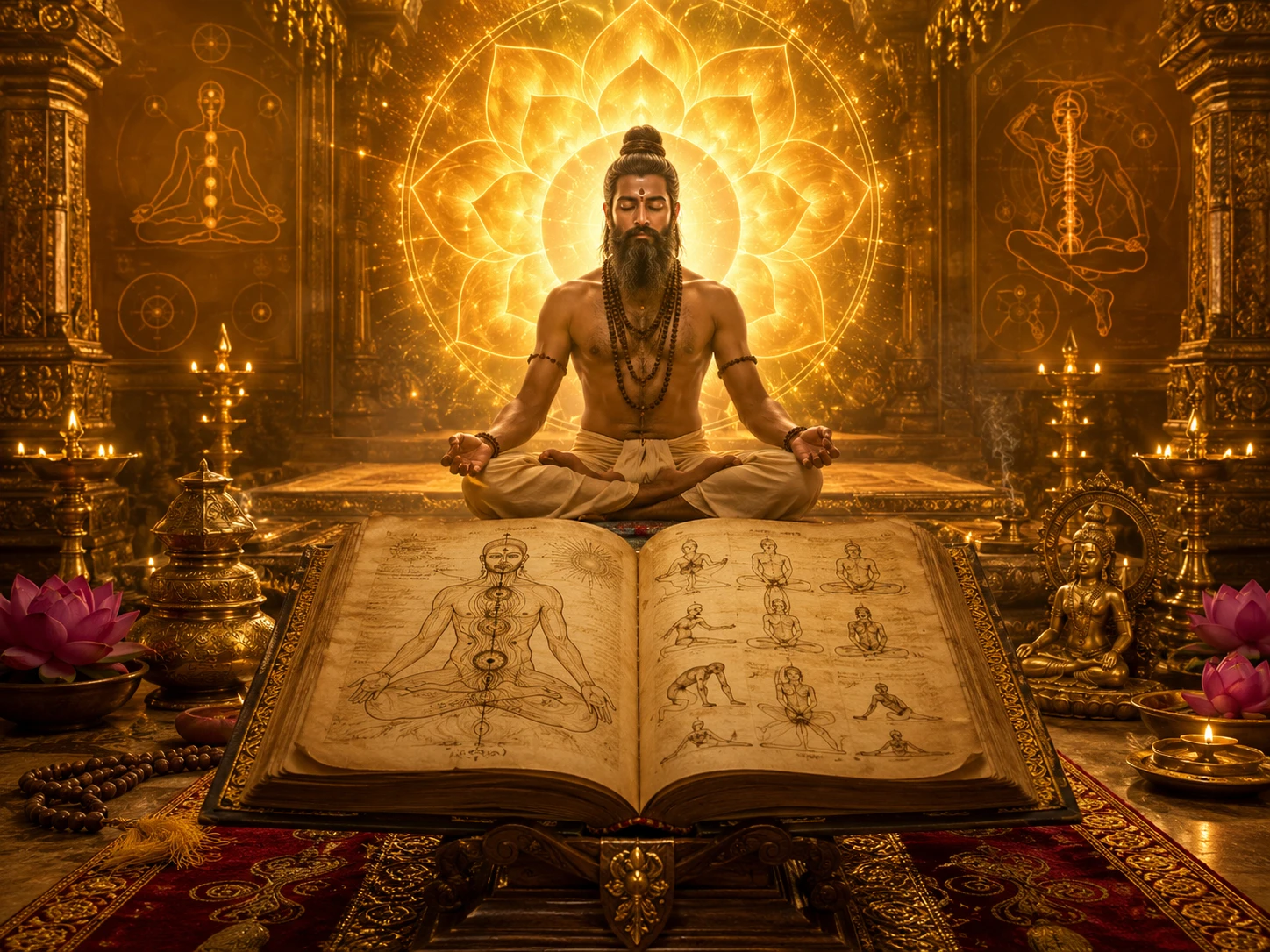
Somewhere in 15th century India, probably in the region that is now Maharashtra or northern Karnataka, a yogi named Svatmarama compiled 389 verses into a single Sanskrit text and gave it a specific name -- Hatha Pradipika, the Lamp of Hatha Yoga, later known widely as the Hatha Yoga Pradipika. Before Svatmarama, the yoga tradition had produced many scriptures on specific practices -- the Goraksha Shataka on asana and subtle body, the Shiva Samhita on tantric kundalini work, the Patanjala Yoga Sutras on the philosophical framework of Ashtanga Yoga. But no single text had brought the practical physical technology of yoga into one organised, graduated sequence that a committed practitioner could actually follow step by step without a living Guru at every turn. Svatmarama did that. His 389 verses cover everything from how to build a hut for practice and what to eat, to the specific asanas to learn first, the pranayama sequences to master next, the mudras that prepare the subtle body, and finally the samadhi states that complete the path. For six centuries now, the Hatha Yoga Pradipika has been the single most-consulted manual on physical yoga in the Hindu tradition. No serious practitioner, regardless of lineage, can afford to be unfamiliar with it.
Svatmarama himself left very little biographical information. What we know comes mainly from his own verses, where he identifies his place in a specific lineage that he treats as essential to understanding his work. The Nath tradition, from which Svatmarama descends, traces its origins back to the mythological sage Adinatha, who is Shiva himself considered as the first Guru. The tradition then descends through Matsyendranatha and Gorakshanatha, two 9th to 11th century figures whose historical existence is supported by manuscript evidence and who are venerated as Mahasiddhas, perfected masters. After Gorakshanatha, the Nath lineage branched into many sub-traditions across North India, with Svatmarama belonging to one of them. The Hatha Yoga Pradipika opens with a salutation to Adinatha and then names a list of 35 earlier Nath Mahasiddhas -- Matsyendra, Goraksha, Chauranga, Charpati, Virupaksha, Nityanatha, Kapila, Bindunatha, Jalandharanatha, and others. Svatmarama is clear that he is not inventing yoga but compiling the accumulated wisdom of his lineage into a usable form. This lineage grounding is important, because it means that the techniques described in the Hatha Yoga Pradipika are not Svatmarama's personal inventions but tested practices transmitted through generations of practitioners, each of whom had personally confirmed them in their own sadhana before passing them on.
श्रीआदिनाथाय नमोऽस्तु तस्मै येनोपदिष्टा हठयोगविद्या। विभ्राजते प्रोन्नतराजयोग- मारोढुमिच्छोरधिरोहिणीव॥
śrī-ādināthāya namo'stu tasmai yenopadiṣṭā haṭhayogavidyā | vibhrājate pronnatarājayogam- āroḍhumicchoradhirohiṇīva ||
Salutation to the venerable Adinatha, the Primordial Lord, by whom the science of Hatha Yoga has been taught, which shines forth as a stairway for the one who wishes to climb up to the exalted Raja Yoga.
— Hatha Yoga Pradipika 1.1, mangalashloka by Svatmarama, 15th century CE; verified against Centre for Yoga Studies critical edition and AshtangaYoga.info reference
The opening verse makes Svatmarama's philosophical position explicit in just four lines. Hatha Yoga is a stairway. It is not the destination. The destination is Raja Yoga, the royal yoga, which is the classical eight-limbed path codified by Patanjali in the Yoga Sutras, culminating in samadhi and kaivalya (liberation). Raja Yoga requires a stable, purified, energetically aligned body-mind as a precondition. Hatha Yoga is the discipline that produces this precondition. Without a body that has been carefully prepared through asana and pranayama, without nadis that have been purified through specific techniques, without a prana that has been concentrated rather than dissipated, the aspirant attempting Raja Yoga directly will fail. Her body will not sit still. Her breath will not stabilise. Her nervous system will not support the extended concentration that samadhi requires. She will experience what Svatmarama elsewhere calls vighnas -- obstacles -- which are not moral failings but mechanical inadequacies. Hatha Yoga addresses the mechanical level so that Raja Yoga can address the contemplative level. This is the same logic by which a violinist learns bow-hold and finger position before attempting a concerto. The preparatory work is not lesser work. It is what makes the higher work possible.
The first chapter of the Hatha Yoga Pradipika, called Prathama Upadesha, covers preliminaries and asana. Svatmarama begins with the outer conditions for practice. The hatha yogi should settle in a well-ruled, righteous region where food is abundant and disturbances are few. The practice hut should be simple, away from people, and within easy reach of water. Food should be sattvic -- milk, ghee, wheat, green vegetables, mung dal -- and the yogi should avoid sour, overly salty, or heating foods. Sexual activity, travel, over-talking, over-eating, and strenuous physical work that is not part of the yoga practice itself should be minimised. After these preliminaries, Svatmarama describes 15 specific asanas. This count is striking to 2026 readers familiar with modern yoga studios teaching hundreds of postures. Svatmarama's list is short by design. It includes Siddhasana (the adept's pose), Padmasana (the lotus pose), Simhasana (the lion pose), Bhadrasana (the auspicious pose), and a dozen others, with particular emphasis on seated postures that enable prolonged motionless sitting. There are no standing asanas in the Hatha Yoga Pradipika. The hundreds of modern standing poses are 20th century additions, largely through the work of T. Krishnamacharya and his students B. K. S. Iyengar and K. Pattabhi Jois, who built on Svatmarama's foundation but added substantially. The additions are not wrong. They are extensions of the tradition, and Svatmarama would probably have approved of more asanas that produced the same preparatory stability in body and breath.
The Four Chapters of the Hatha Yoga Pradipika
| Chapter | Sanskrit Name | Topic | Verse Count (approx) | Key Practices |
|---|---|---|---|---|
| First | Prathama Upadesha | Preparation, diet, asana | 67 verses | Siddhasana, Padmasana, 13 other seated postures; sattvic diet; conduct |
| Second | Dvitiya Upadesha | Pranayama and shat karma | 78 verses | Six cleansing actions; eight kumbhakas; Nadi Shodhana; Bhastrika; Ujjayi |
| Third | Tritiya Upadesha | Mudra and bandha | 130 verses | Ten mudras; Maha Bandha; Jalandhara; Uddiyana; Mula Bandha; Khechari |
| Fourth | Chaturtha Upadesha | Samadhi and laya | 114 verses | Nadanusandhana; the four stages of yoga; absorption in the unstruck sound |
Verse counts vary slightly between manuscripts. The critical edition by the Kaivalyadhama Research Department stabilises the count at 389 verses total across the four chapters, following the most widely accepted manuscript tradition.
The second chapter, Dvitiya Upadesha, covers pranayama and is where the Hatha Yoga Pradipika establishes its most technical contribution. Svatmarama describes the six shat karmas -- the six cleansing practices that prepare the body for pranayama. These include Dhauti (cleansing of the digestive tract), Basti (cleansing of the lower intestine), Neti (nasal cleansing), Trataka (focused gazing), Nauli (abdominal massage), and Kapalabhati (forced exhalation). Each has specific prescribed techniques and specific physical effects. Then he describes the eight kumbhakas, the eight retention-centred pranayama sequences that are the main engine of Hatha Yoga practice. These include Ujjayi (the victorious breath), Suryabhedana (the sun-piercing breath), Sitali (the cooling breath), Sitkari (the hissing breath), Bhastrika (the bellows breath), Bhramari (the bee breath), Murchha (the fainting breath), and Plavini (the floating breath). Each kumbhaka has its own internal structure -- specific inhalation technique, specific retention duration, specific exhalation, and specific mudras or bandhas applied during retention. The instructions are detailed enough that a serious student, working with qualified guidance, can actually learn each technique from the text and verify its effects in her own practice.
The third chapter, Tritiya Upadesha, covers mudras and bandhas, and is in some ways the most esoterically significant. Svatmarama describes ten mudras -- Mahamudra, Mahabandha, Mahavedha, Khechari, Uddiyana, Mula Bandha, Jalandhara Bandha, Viparita Karani, Vajroli, and Shakti Chalana. Three of these are the major bandhas, the energetic locks -- Mula Bandha (root lock at the perineum), Uddiyana Bandha (upward abdominal lock), and Jalandhara Bandha (throat lock). Together these three form the Maha Bandha, the great lock, which is performed during specific kumbhaka retention to seal prana in place and direct it upward through Sushumna. Khechari mudra, the tongue-lock where the tongue is tucked back against the soft palate, is described with unusual technical detail, including the preparatory cutting of the lingual frenum that allows the tongue to reach further back. The Vajroli mudra, which involves urinary sphincter control and specific sexual retention techniques, is described more cryptically and reserved for advanced practitioners. The Shakti Chalana mudra directly addresses Kundalini awakening, giving specific instructions for arousing the dormant serpent energy at Muladhara. These mudras are not decorative. They are specific energetic interventions with specific effects, and the Hatha Yoga Pradipika treats them as essential rather than optional steps in the sequence toward samadhi.
The fourth chapter, Chaturtha Upadesha, is the shortest in practical prescription but the most philosophically elevated. Svatmarama turns to samadhi, the completion of the yoga path. He describes four progressive stages -- Arambha (the beginning, marked by internal sounds arising in the practitioner's awareness), Ghata (the vessel, marked by steadiness of breath and body in deeper states), Parichaya (familiarity, marked by entry of prana into Sushumna), and Nishpatti (fulfilment, marked by complete absorption in the source). Each stage has its own specific markers, and Svatmarama cautions that the practitioner must not confuse one stage for the next. A beginning practitioner who hears some internal ringing sounds during Bhramari pranayama should not conclude she has reached Ghata stage. The markers are specific, and experienced teachers verify progress against them with care. Svatmarama also describes Nadanusandhana in detail -- the inquiry into the unstruck inner sound, the anahata nada. He argues that this direct attention to inner sound is a particularly effective route to samadhi because it requires no complex technique, no special equipment, no unusual circumstances, only a quiet room and a sincere practitioner willing to sit long enough for the sound to become audible. In chapter four, the Hatha Yoga Pradipika moves from physical and energetic technique into the interior contemplative territory that Raja Yoga covers, and Svatmarama hands the practitioner off to the Patanjala Yoga Sutras and other Raja Yoga texts for completion.
The relationship between the Hatha Yoga Pradipika and modern yoga deserves careful treatment. When a 2026 practitioner walks into a vinyasa class in Bandra or a power yoga studio in Gurgaon, she is doing something that Svatmarama would partially recognise and partially not. The asana component is recognisable in kind, though the specific postures are mostly later additions. The pranayama component, if taught at all, is typically in a drastically simplified form that omits the six shat karmas, the kumbhaka sequences, the bandhas, and the specific mudras. The samadhi component is almost entirely absent from modern studio yoga, replaced by a brief Savasana relaxation at the end of class. This is not a condemnation of modern yoga. Modern yoga serves millions of people who benefit from what they are getting. It is a clarification about what modern yoga is and is not. Modern yoga is primarily a physical fitness and stress-management system drawn from the first chapter of the Hatha Yoga Pradipika, with significant 20th century elaboration. Traditional Hatha Yoga, the full four-chapter sequence, is a much smaller, more specialised spiritual technology that leads to samadhi if fully completed. A student who wants the full traditional path must seek it out deliberately, typically in an ashram setting with a qualified teacher, and plan for years of immersion rather than weeks of studio classes.
Contemporary scholarly work on the Hatha Yoga Pradipika has been extensive. The Kaivalyadhama Yoga Institute at Lonavla, founded by Swami Kuvalayananda in 1924, has produced perhaps the most authoritative critical edition, with detailed commentary and extensive cross-referencing to older Nath texts. Swami Muktibodhananda's translation with commentary, published by the Bihar School of Yoga, is widely used in practitioner training programmes and is accessible in English while preserving most technical detail. Dr Pancham Singh's 1915 translation is older but still respected and is in the public domain. Jason Birch and Jacqueline Hargreaves of the Haṭha Yoga Project at SOAS London have produced philological work on the manuscript tradition that has refined scholarly understanding of which verses are original and which were added by later commentators. The Brahmananda commentary, called Jyotsna, is a 19th century Sanskrit commentary that is still the standard insider reference, and its English translation by Srinivasa Iyangar and Tookaram Tatya in 1893 is a classic in the field. A 2026 student who wants to study the Hatha Yoga Pradipika seriously has access to more scholarly apparatus than any previous generation. The challenge is not finding good translations. The challenge is finding qualified teachers who can guide the actual practice that the text describes.
A specific point worth making concerns the Hatha Yoga Pradipika's relationship to tantric tradition. The text is unambiguously tantric in its philosophical framework, its lineage attribution to Adinatha-Matsyendra-Goraksha, its central place for Kundalini, its chakras-and-nadis anatomy, and its technical use of mudras, mantras, and bandhas. Modern Western-influenced yoga teaching sometimes presents Hatha Yoga as a secular health practice distinct from tantric or Hindu religious practice, as if the tantric framework were a later overlay. This is historically incorrect. Hatha Yoga emerged from within tantric tradition, specifically from Shaiva tantric lineages that the Nath Gurus carried. The asanas, the pranayamas, the mudras all have tantric cosmology as their foundational justification. Stripping away the tantric framework while retaining the techniques produces modern physical-fitness yoga, which works at its level but is not what Svatmarama wrote. This matters practically because the higher stages of Hatha Yoga -- the Kundalini work, the samadhi stages -- cannot be accessed without the tantric framework. You cannot reach Parichaya stage where prana enters Sushumna without treating Sushumna as a real feature of the subtle body, which requires taking tantric anatomy seriously. A 2026 student who wants the full benefits of Hatha Yoga must engage with its tantric dimension rather than treating it as an optional ornament.
For a 2026 student approaching the Hatha Yoga Pradipika, the practical path is clear. Do not begin by reading the text. Begin by establishing a steady daily asana and pranayama practice under qualified guidance for at least two years. A basic practice of Sukhasana or Padmasana sitting for twenty minutes, followed by ten minutes of Nadi Shodhana pranayama, done every day without skipping, is sufficient foundation. After two years of this basic work, read the first chapter of the Hatha Yoga Pradipika in a good translation with commentary. Work slowly, verse by verse, and attempt only the practices that match your current capacity. Add the shat karmas gradually, under teacher supervision, because several of them can produce adverse effects if done incorrectly. Approach the bandhas and mudras only after five or more years of steady practice. Vajroli and Khechari should be reserved for those in active ashram residence with qualified Gurus, because both involve physical preparations that cannot safely be self-administered. Kundalini work through Shakti Chalana mudra should not be attempted without specific permission from a teacher who has themselves worked through the same stage. The classical timeline for completing all four chapters of the Hatha Yoga Pradipika is twelve to twenty-five years of daily committed practice. Modern workshop formats that promise to cover the whole text in a week are not taking the tradition seriously. The serious student should not take them seriously either.
A closing reflection on the Hatha Yoga Pradipika's place in global yoga culture. The 20th century saw yoga exported from India to the world, largely through the work of T. Krishnamacharya at the Mysore Palace and his three most influential students -- B. K. S. Iyengar, K. Pattabhi Jois, and T. K. V. Desikachar. Each of these teachers worked from a foundation that included the Hatha Yoga Pradipika, though each emphasised different aspects. Iyengar emphasised precise asana alignment and the use of props, developing what is now called Iyengar yoga. Pattabhi Jois emphasised the vinyasa flow sequences that became Ashtanga yoga. Desikachar emphasised breath-centred adaptive practice. From these three streams, and through later offshoots like Bikram yoga and the various power yoga systems, the modern global yoga industry emerged. Every one of these descendants traces back through Krishnamacharya to a foundation that includes Svatmarama. The text that Svatmarama compiled in a cave or monastery six hundred years ago is now the distant philosophical source of a global practice with perhaps half a billion participants. Whether Svatmarama would have recognised or approved of what yoga has become is an interesting question. What is not in question is that the lamp he lit still illuminates, however indirectly, every modern yoga practice that has inherited even a fraction of his careful work. Every sincere yoga practitioner, even one who has never opened the text, stands in debt to Svatmarama's patient synthesis.
The Kaivalyadhama Yoga Research Centre at Lonavla, in a series of physiological studies beginning in the 1970s and continuing into the 2010s, tested specific Hatha Yoga Pradipika claims against modern medical measurements. One particularly notable study in 2009 examined the effects of Bhastrika pranayama on pulmonary function and cardiovascular parameters in 50 trained practitioners and 50 controls. After a six-month protocol matching the classical Svatmarama instructions, the practitioner group showed statistically significant improvements in vital capacity, peak expiratory flow, and heart rate variability -- with changes that exceeded what standard aerobic exercise produced in the control group. The researchers concluded that Svatmarama's specific pranayama prescriptions produce physiological effects that modern exercise physiology cannot fully replicate through generic breathing drills. A similar study on Nadi Shodhana showed measurable rebalancing of heart rate variability between sympathetic and parasympathetic dominance over weeks of daily practice, directly paralleling the traditional Ida-Pingala balance claim. These studies do not prove the metaphysical framework of Hatha Yoga. They do establish that at the physiological level, the specific techniques Svatmarama described produce specific measurable effects, and that the classical instructions are not arbitrary cultural artefacts but the result of careful empirical observation by practitioners over many generations.
Start with Siddhasana and Nadi Shodhana
Before approaching the Hatha Yoga Pradipika as a text, give yourself a foundation in its most basic practices. Learn Siddhasana or Padmasana, whichever your body can hold steadily for twenty minutes without pain. Learn nadi shodhana pranayama in its simple 1:1:1 form, which is safe for any healthy adult. Practise this pairing daily, at roughly the same time, for six months at least. Only then approach the text itself, in a careful translation with commentary by a trained teacher, not as a do-it-yourself manual. The nadi shodhana page on Eternal Raga explains the pranayama step by step.
Tags
Eternal Raga · शाश्वत राग
Institutional voice — scholarly articles on Sanatan Dharma
Deepen Your Understanding
अपनी समझ और गहरी करें
tantra mantra yantra
Nadis and the Subtle Body
Your body has 72,000 nadis. You will not find them in a surgical dissection. They are channels of prana, the subtle life energy, running through the subtle body that underlies the physical. Three are principal -- Ida running down the left, Pingala down the right, and Sushumna running through the centre of the spine. Every pranayama, every mudra, every mantra practice is shaping the flow of these invisible highways.
tantra mantra yantra
Shiva Samhita
An anonymous author in 14th or 15th century Varanasi compiled a yoga text that is unusual among the classical manuals -- it was written explicitly for householders, not renunciates. The Shiva Samhita has five chapters, teaches only four asanas, emphasises meditation and Kundalini over athletic posture, and opens with a philosophical claim straight out of Advaita Vedanta. It is also the only major hatha yoga text that frames itself as tantra throughout.
tantra mantra yantra
Kundalini -- The Serpent Power That Sleeps at Your Spine's Base
A coiled serpent sleeps at the base of your spine. When awakened through yoga, mantra, or guru's grace, she rises through seven energy centres, dissolving every limitation of body and mind, until she merges with pure consciousness at the crown of your head. This is not New Age fantasy. This is the central psycho-spiritual technology of Tantric Hinduism -- mapped in Sanskrit texts over 1,500 years ago and now studied by neuroscientists at institutions from Harvard to NIMHANS Bangalore.
tantra mantra yantra
The Seven Chakras -- Energy Centres That Map Your Inner Universe
You have seven power stations running along your spine. Each governs a specific domain of human experience -- from survival instinct to sexual energy to willpower to love to expression to intuition to cosmic consciousness. The chakra system is not mystical poetry. It is the most detailed map of human psychology ever embedded in a spiritual framework -- and modern neuroscience is only now catching up to what Tantric yogis described 1,500 years ago.
philosophy darshana
Yoga Darshana -- Patanjali's Science of the Mind
Before yoga became a global fitness trend worth $80 billion, it was India's most rigorous system of psychology. Patanjali's 196 sutras are not about touching your toes -- they are about rewiring your mind. Here is the philosophy the world forgot when it turned yoga into exercise.
tantra mantra yantra
The Nath Tradition -- Gorakhnath, Matsyendranath and the Birth of Hatha Yoga
Yogis with split ears and great earrings, who trace their lineage to Shiva himself and gave India the discipline of hatha yoga. Who the Naths are, the legends of Matsyendranath and Gorakhnath, and how the tradition shaped yoga, poetry and devotion from Nepal to Maharashtra.
vedic sciences
Pranayama -- The Yogic Science of the Breath
The fourth limb of Patanjali's yoga, and the bridge between the body and the mind. What pranayama is in the classical texts, the main practices from the Hatha Yoga Pradipika, how to begin safely, and why the old teachers warned against rushing it.
The Kaivalyadhama Yoga Research Centre at Lonavla, in a series of physiological studies beginning in the 1970s and continuing into the 2010s, tested specific Hatha Yoga Pradipika claims against modern medical measurement…
More in Tantra, Mantra & Yantra
Agama vs Tantra vs Veda -- Three Streams of Hindu Practice
14 min read
Agni Dhyana -- What Meditation on Fire Is Actually Grounded In
8 min read
Ashta Siddhi -- The Eight Yogic Powers and How Hanuman Embodies Them
13 min readThe same translation error that turned '33 Koti' into '33 crore' in Hinduism also happened in Buddhism. The Chinese translation of Buddhist texts rendered 'Sapta Koti Buddha' (7 Supreme Buddhas) as '7 Crore Buddhas.' The…
Deities AvatarsCommunity Reflections
🕉️
Be the first to share your reflection.