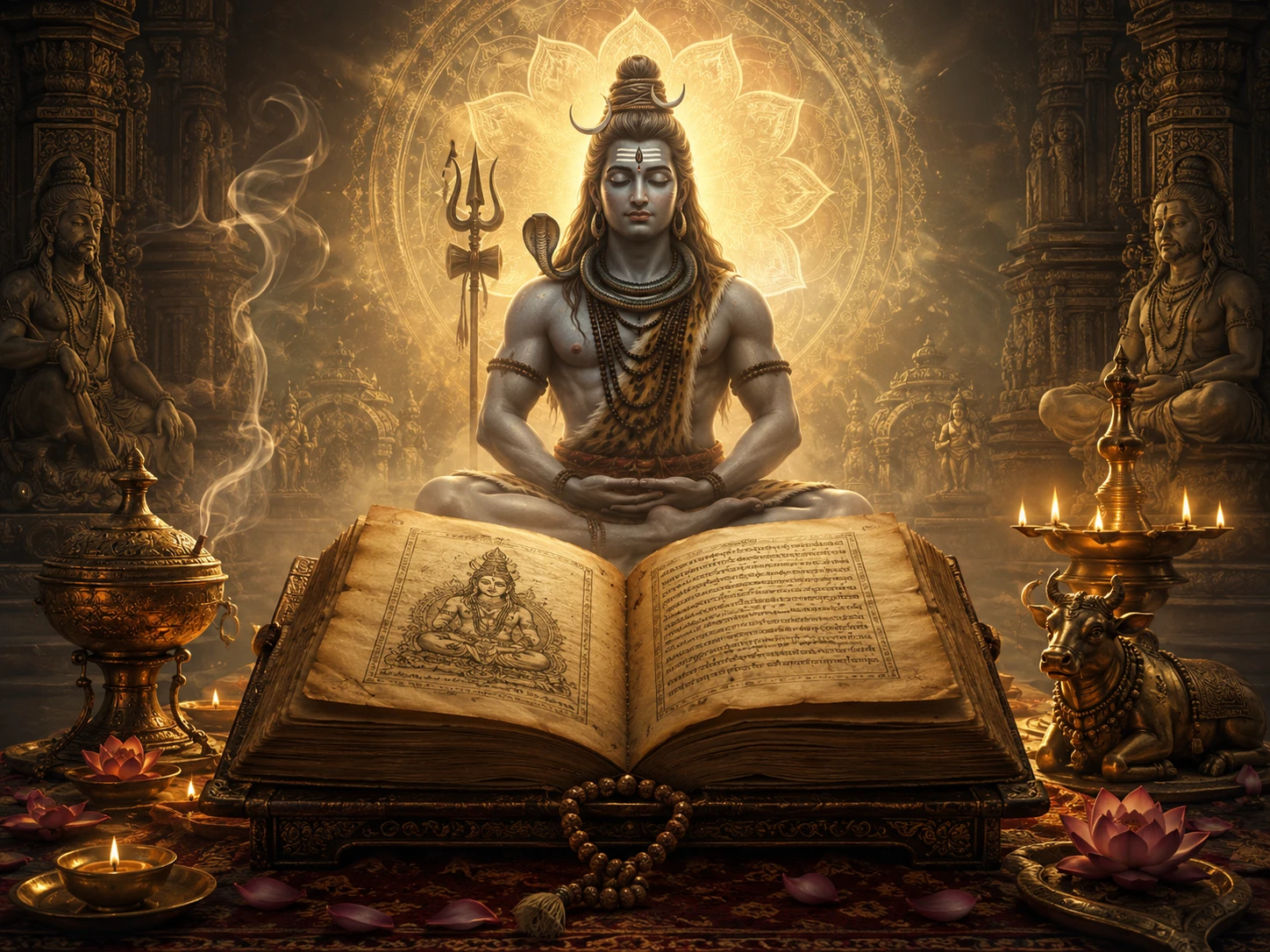
Shiva Samhita
शिव संहिता
The three canonical manuals of classical Hatha Yoga are the Hatha Yoga Pradipika of Svatmarama, the Gheranda Samhita attributed to Sage Gheranda, and the Shiva Samhita by an anonymous author. Of these three, the Shiva Samhita is the one that most modern practitioners have heard of least, yet it is arguably the most philosophically developed of the three and the only one that explicitly addresses householders rather than reclusive yogis. The text was probably composed in or near Varanasi between 1300 and 1500 CE, according to the most careful recent scholarship by James Mallinson at SOAS London. Its author did not sign the work, following a common convention by which the teaching was given as a direct discourse from Shiva to Parvati, suggesting that the human compiler saw himself as a transmitter rather than an originator. The text we call Shiva Samhita today is essentially a compilation of teachings from older Shakta Sri Vidya tantric lineages, systematised into a practical guide that a serious but worldly practitioner could actually follow while still running a household, a business, or a civic life. This householder orientation sets the Shiva Samhita apart from most classical yoga texts, which assume a monastic or forest-hermit setting.
The text opens with a philosophical move that would surprise anyone expecting a dry manual of techniques. The first chapter is essentially a short treatise on Advaita Vedanta, presented in the vocabulary of Sri Vidya tantra. The author declares that there is one eternal true knowledge, without beginning or end, and that every other apparent doctrine is ultimately a partial view of this one reality. He describes the world as a manifestation of Maya, the power of the supreme Atman to project diversity without losing its own unity. Yoga is then introduced as the discipline that strips away Maya and reveals the underlying one reality. This opening is important for understanding what follows. The techniques that the Shiva Samhita will teach in subsequent chapters are not presented as health practices or self-improvement methods. They are presented as methods for recognising the one reality that the first chapter has already identified philosophically. A practitioner who skips the first chapter and dives into the asana and pranayama of the later chapters misses the frame. The techniques work only because they are aligned with the philosophical understanding that the first chapter establishes. Without that frame, they become gymnastics.
देवाश्च सर्वे त्रिभुवनमिदं सर्वं च परमात्मना। एकम् एव हि सत्यं च ज्ञानं चैव चिदात्मकम्॥ अद्वैतं परिपूर्णं तत्तदेव ब्रह्म वर्तते। एतत् ज्ञात्वा विमुच्येत योगिनो ब्रह्मसंज्ञया॥
devāśca sarve tribhuvanamidaṃ sarvaṃ ca paramātmanā | ekam eva hi satyaṃ ca jñānaṃ caiva cidātmakam || advaitaṃ paripūrṇaṃ tat tadeva brahma vartate | etat jñātvā vimucyeta yogino brahmasaṃjñayā ||
The gods and the entire three-worlds universe are all pervaded by the Supreme Atman. It is one only, it is truth, and it is knowledge whose nature is pure consciousness. It is non-dual and entirely complete, and that same one is Brahman itself. Knowing this, the yogi is liberated through the realisation of Brahman.
— Shiva Samhita 1.53, critical edition and translation by James Mallinson (2007), YogaVidya.com; composite Sanskrit reconstructed from Vasu 1914 and Mallinson 2007 editions
The structural division of the Shiva Samhita into five chapters is worth examining. Chapter one, as described, is the philosophical foundation in Vedanta-Sri-Vidya register. Chapter two moves to yogic anatomy, describing the nadis, the chakras, the five pranas, the microcosmic correspondence between the human body and the cosmos. This chapter introduces the famous teaching that the mount Meru is the vertebral column, the seven continents are the plexuses of the body, the rivers are the nadis, and the sun and moon are Pingala and Ida. The yogi who has understood this microcosmic map has a precise framework for her own subsequent practice. Chapter three covers the importance of the Guru, the prerequisites for yogic practice including moral conduct and diet, the five elements that compose the body, and the four stages of yogic progress. Chapter four describes specific techniques -- asanas, mudras, and pranayamas -- and includes the famous claim that the text teaches only four asanas (Siddhasana, Padmasana, Paschimottanasana, and Svastikasana), because these four are sufficient when combined with the internal practices. Chapter five, the longest, describes eleven yogic siddhis or attainments, the detailed practice of Kundalini awakening, the meditative stages leading to samadhi, and a set of specific meditations on different chakras and internal sounds.
The Shiva Samhita's decision to teach only four asanas deserves attention because it pushes back against a common misconception about classical yoga. A modern practitioner might assume that older yoga texts taught hundreds of postures, and that the reduction to 84 or 15 in later texts represents truncation. The Shiva Samhita shows the opposite pattern. It teaches only four, and it treats even this as sufficient for the full yogic path. The reasoning is specific. These four seated postures are all that is needed to support extended pranayama, mudra, and meditation practice. Additional postures, which the Shiva Samhita acknowledges exist in other traditions, are treated as optional rather than essential. What cannot be skipped is the internal work -- the pranayama sequences, the bandhas, the mudras, the meditations, the Kundalini practice. This is an important corrective for 2026 yoga culture where posture-heavy vinyasa classes are often presented as complete practice. The Shiva Samhita would say that 200 postures done well without pranayama are worth less than one posture held steady while the full pranayama-mudra-meditation sequence is executed within it. The posture is the platform. The platform is not the practice.
The Three Classical Hatha Yoga Texts Compared
| Text | Approximate Date | Chapter Count | Asana Count | Distinctive Feature |
|---|---|---|---|---|
| Shiva Samhita | 1300-1500 CE | 5 chapters | Only 4 | Householder-oriented; opens with Vedantic philosophy; unusually technical Kundalini detail |
| Hatha Yoga Pradipika | c. 1450 CE | 4 chapters | 15 | Most widely studied; systematic progression from asana to samadhi; Nath lineage grounding |
| Gheranda Samhita | c. 1650-1700 CE | 7 chapters | 32 | Most comprehensive asana list; emphasises cleansing practices; explicitly devotional tone |
All three texts share the same theoretical framework of nadis, chakras, prana, and Kundalini. They differ in emphasis, target audience, and breadth of practice coverage. Serious practitioners traditionally study all three, often in the order Hatha Yoga Pradipika first, then Shiva Samhita, then Gheranda Samhita.
The Shiva Samhita's householder orientation is its single most distinctive feature. Where the Hatha Yoga Pradipika assumes a yogi who can retreat to a mountain hermitage or a forest matha for years of uninterrupted sadhana, the Shiva Samhita explicitly anticipates practitioners who have jobs, spouses, children, property, and civic obligations. The text directly addresses how to reconcile these obligations with serious yoga practice rather than treating them as obstacles to be renounced. In chapter five, the Shiva Samhita argues that the siddhis -- yogic attainments including liberation -- are fully available to the householder who practises diligently. This was a radical claim in the late medieval Indian context, where the dominant assumption held that renunciation was a prerequisite for deep spiritual attainment. The Shiva Samhita's author is pushing back against that assumption and democratising access to serious yoga. A 2026 practitioner who works in a Bangalore tech company, raises two children in Whitefield, commutes to Electronic City, and practises an hour of yoga each morning before the family wakes is working within exactly the demographic the Shiva Samhita addresses. The text was written for her. The techniques it prescribes are scaled to fit into the structure of a functioning household life.
A specific technical contribution of the Shiva Samhita is its detailed treatment of the four types of yogic practitioners. Chapter five categorises aspirants into four levels based on their capacity, preparation, and temperament. The first is Mridu (mild), suited to Mantra Yoga -- simple japa of deity mantras without demanding physical practice. The second is Madhya (middle), suited to Laya Yoga -- the yoga of dissolution, working with visualisation and internal absorption. The third is Adhimatra (above-average), suited to Hatha Yoga with its full physical, energetic, and subtle-body technology. The fourth is Adhimatratama (highest), suited to Raja Yoga -- the direct path of consciousness working on itself without needing the preparatory scaffolding of the lower paths. This classification is practically useful because it warns against mismatch. A Mridu aspirant pushed into Hatha Yoga will injure herself or quit. An Adhimatratama aspirant confined to Mantra Yoga will stagnate. The Guru's task in the Shiva Samhita framework is to recognise which category the disciple belongs to and prescribe accordingly. This is a more differentiated approach than many texts offer, and it reflects the Shiva Samhita's careful awareness that not every technique suits every practitioner.
The treatment of Kundalini in the Shiva Samhita is particularly detailed and technical, exceeding what the Hatha Yoga Pradipika offers. Chapter five describes the dormant Kundalini Shakti as a coiled serpent resting at the base of Sushumna in the Muladhara chakra. The chapter prescribes specific techniques for arousing her -- pranayama sequences, bandhas applied during kumbhaka retention, visualisation practices, and the Shakti Chalana mudra. It describes the markers by which a practitioner knows that Kundalini has begun to move -- specific sensations in the body, specific shifts in consciousness, specific phenomena during meditation. It then describes what happens as Kundalini moves upward through each chakra, including the temptation at each stage to be seduced by the siddhis that become available rather than continuing to the goal. The text is frank about the dangers of mishandled Kundalini, including specific symptoms of prematurely forced practice that modern practitioners would recognise as psychiatric emergencies -- agitation, insomnia, rage, unfocused fear, somatic symptoms without medical cause. The Shiva Samhita's clinical clarity on these issues is striking and is one reason the text is still read by serious Kundalini practitioners centuries after its composition. It knows what can go wrong and why, and it prescribes preventive caution in specific, actionable terms.
Manuscript history of the Shiva Samhita is complex. Over a dozen variant manuscripts are known, with significant textual differences between them. The text appears to have been used and copied across a wide geographic range, from Kashmir through the Gangetic plains to Bengal and possibly as far south as Tamil Nadu. Different manuscript families emphasise slightly different techniques, and scholarly debates about the original text versus later accretions remain active. James Mallinson's 2007 critical edition, published by YogaVidya.com under the title The Shiva Samhita, is the most carefully prepared modern version. Mallinson worked from multiple manuscript sources, produced a conservatively edited Sanskrit text with facing English translation, and provided detailed scholarly apparatus. The 1999 critical edition from the Kaivalyadhama Yoga Research Institute, based on 13 manuscripts and 3 printed editions, is the other authoritative modern reference, favouring textual conservation and preserving variant readings that Mallinson sometimes discards. Srisa Chandra Vasu's 1914 translation, published by the Panini Office in Allahabad and reprinted many times, remains widely read and is in the public domain. Each of these editions emphasises slightly different aspects of the text, and a serious student benefits from consulting at least two of them rather than relying on any single version.
A specific technical teaching from the Shiva Samhita that has become particularly important in modern yoga is Paschimottanasana, the seated forward fold. Mallinson notes that the Shiva Samhita is the first known text to describe this specific posture, which later became one of the foundational asanas of modern practice. The description is simple. The yogi sits with legs extended straight, grasps the feet with the hands, and folds the torso forward toward the legs while keeping the spine extended. The effect is described as moving prana through Sushumna, stretching the nadis, and preparing the body for the kumbhaka retentions that follow. Every contemporary yoga student who folds forward into this posture in a modern studio is performing an asana whose written record begins with the Shiva Samhita. That is not the same as saying that Svatmarama or the Shiva Samhita author invented it. The asana was surely practised before being textually recorded. But the Shiva Samhita is where it enters the documentary tradition, and all subsequent yoga texts that include it are drawing, directly or indirectly, on this source. The small detail is a useful reminder that textual history and practical history are not identical, but they inform each other in specific ways that matter for understanding the tradition.
The Shiva Samhita's relationship with tantra is explicit rather than hidden. The text repeatedly calls itself a tantra within its own verses, places itself within the Sri Vidya lineage through specific doctrinal references, and uses tantric technical vocabulary throughout. This explicit tantric identification makes the Shiva Samhita somewhat unusual among classical hatha yoga texts. The Hatha Yoga Pradipika, while clearly drawing on tantric sources, presents itself primarily as a manual of yoga rather than tantra. The Gheranda Samhita positions itself in a more devotional Vaishnavite register. The Shiva Samhita places itself squarely within the Shakta tantric universe, with the Goddess Shakti treated as the operating principle of the yogic path and specific Sri Vidya teachings like the Sri Chakra and the Lalita Sahasranama implicitly referenced. For a 2026 student approaching the Shiva Samhita, this tantric positioning is important because it means that the text cannot be cleanly separated from its tantric religious framework. A secular reading of the Shiva Samhita as generic yoga manual misses most of what the text is actually saying. The techniques it prescribes are not arbitrary movements but specific acts within a tantric cosmology, and their effects depend on being performed within that understanding.
For a 2026 householder practitioner in India, the practical utility of the Shiva Samhita is unusually high precisely because of its householder orientation. A Pune IT professional who wants to build a serious yoga practice around her job, family, and commute cannot easily follow the Hatha Yoga Pradipika's recommendations for a forest hermitage. She can, however, adopt the Shiva Samhita's framework nearly directly. The text's four asanas fit a practical daily schedule. Its pranayama sequences can be done in thirty to sixty minutes before the household wakes. Its meditation practices work within the rhythms of city life rather than against them. The key adaptation is to take the text seriously as a tantric framework rather than secularising it. The pranayama is not just breath control; it is Shakti operating in the body. The asanas are not just physical exercise; they are alignments that allow prana to move correctly. The meditations are not just stress relief; they are stages of Kundalini work. A householder practitioner who holds the full tantric framework while living a contemporary urban life can actually progress through the Shiva Samhita's recommendations over the course of a decade or two, which is what the text assumes in any case. The text was never for quick fixes. It was for lifetime practice, which householder life naturally provides.
A closing observation concerns the Shiva Samhita's implicit position on the yoga-spirituality-religion question that modern yoga culture often debates. Western secular yoga studios sometimes present yoga as a universal physical technology separable from Hindu religious content. The Shiva Samhita would reject this cleanly. For the Shiva Samhita, the yogic techniques work because they align with a specific cosmology in which Shiva and Shakti are the ground of reality, Kundalini is the operating power within the body, the chakras are the real interface between consciousness and matter, and liberation from cycles of rebirth is the actual goal. Remove any of these assumptions and the techniques no longer have the same footing. They may still produce physical benefits as exercise, but the specific transformative effects the Shiva Samhita describes depend on the practitioner working within the cosmology the text assumes. A 2026 practitioner is free to disagree with the cosmology. What she cannot do is claim the Shiva Samhita's results while denying its framework. The integrity of the tradition depends on acknowledging what it actually is rather than reshaping it to fit contemporary preferences. The Shiva Samhita is a Hindu tantric yoga text. Householders who practise within its framework can access its full teachings. Those who strip the framework get whatever fragmentary residual benefit survives the stripping.
A specific textual puzzle worth noting concerns the Shiva Samhita's relationship with the Dattatreya Yoga Shastra, a slightly earlier compilation from roughly the same Varanasi region. Mallinson has shown through detailed philological work that the Shiva Samhita borrows several passages verbatim from the Dattatreya Yoga Shastra, including specific descriptions of mudras and pranayama sequences. This is not plagiarism in the modern sense. It is the standard medieval practice of textual compilation, in which a new work incorporates material from recognised earlier sources as a sign of authority and continuity with tradition. The pattern is similar to how Puranas incorporate verses from older Puranas, or how Shankaracharya's commentaries cite earlier Vedantic texts with implicit approval. Identifying these borrowings lets scholars reconstruct the textual history of hatha yoga in a more precise way than was previously possible. It turns out that by the 14th century there was already a substantial body of written hatha yoga material circulating in the Varanasi region, and the Shiva Samhita is one of the more organised attempts to synthesise this material into a manual aimed at householders. The text is therefore less a single author's creation and more a carefully edited anthology, which helps explain why its voice is measured and authoritative rather than idiosyncratic.
A 2014 textual study by Professor Mark Singleton and collaborators at SOAS London traced the influence of the Shiva Samhita on the 20th century modernisation of yoga by T. Krishnamacharya at the Mysore Palace. The researchers showed that several of the asanas and pranayama sequences that Krishnamacharya taught his students -- including B. K. S. Iyengar and K. Pattabhi Jois -- can be traced through intermediate sources back to specific passages in the Shiva Samhita. Paschimottanasana in particular, which became a centrepiece of Ashtanga and Iyengar yoga, descends through Krishnamacharya's Yoga Makaranda (1934) from the Shiva Samhita's Chapter Four description. The study also documented that Krishnamacharya himself owned a copy of the Vasu 1914 translation of the Shiva Samhita in his personal library, which is preserved in the Krishnamacharya Yoga Mandiram archive in Chennai and can be viewed by qualified researchers. This quiet lineage connection means that every contemporary yoga practice descending from Krishnamacharya -- which is most of modern global yoga -- carries the Shiva Samhita's influence embedded in its foundation, even when the practitioners have never heard the text's name.
Household Practice the Shiva Samhita Way
The Shiva Samhita is the text to follow if you are a householder wanting serious yoga without renunciation. Begin with its four asanas -- Siddhasana, Padmasana, Paschimottanasana and Svastikasana -- learning each thoroughly over a month. Add thirty minutes of nadi shodhana daily. Read the text in James Mallinson's translation alongside Srisa Chandra Vasu's 1914 edition, noting where they differ. Practise this for a year before exploring chapters three to five, which hold more advanced material. The nadi shodhana page on Eternal Raga explains the pranayama step by step.
Tags
Eternal Raga · शाश्वत राग
Institutional voice — scholarly articles on Sanatan Dharma
Deepen Your Understanding
अपनी समझ और गहरी करें
tantra mantra yantra
Hatha Yoga Pradipika
The 15th century yogi Svatmarama compiled 389 verses into the Hatha Yoga Pradipika, the single most influential manual of physical yoga ever written. Four chapters walk the practitioner from asana to pranayama to mudra to samadhi in a specific graduated sequence. Every modern yoga studio from Rishikesh to Los Angeles, even those that have forgotten the text's name, traces its practice back to what Svatmarama wrote.
tantra mantra yantra
Nadis and the Subtle Body
Your body has 72,000 nadis. You will not find them in a surgical dissection. They are channels of prana, the subtle life energy, running through the subtle body that underlies the physical. Three are principal -- Ida running down the left, Pingala down the right, and Sushumna running through the centre of the spine. Every pranayama, every mudra, every mantra practice is shaping the flow of these invisible highways.
tantra mantra yantra
Kundalini -- The Serpent Power That Sleeps at Your Spine's Base
A coiled serpent sleeps at the base of your spine. When awakened through yoga, mantra, or guru's grace, she rises through seven energy centres, dissolving every limitation of body and mind, until she merges with pure consciousness at the crown of your head. This is not New Age fantasy. This is the central psycho-spiritual technology of Tantric Hinduism -- mapped in Sanskrit texts over 1,500 years ago and now studied by neuroscientists at institutions from Harvard to NIMHANS Bangalore.
tantra mantra yantra
The Seven Chakras -- Energy Centres That Map Your Inner Universe
You have seven power stations running along your spine. Each governs a specific domain of human experience -- from survival instinct to sexual energy to willpower to love to expression to intuition to cosmic consciousness. The chakra system is not mystical poetry. It is the most detailed map of human psychology ever embedded in a spiritual framework -- and modern neuroscience is only now catching up to what Tantric yogis described 1,500 years ago.
tantra mantra yantra
Sri Vidya -- The Supreme Worship System
Sri Vidya is the most guarded, most intricate worship system inside Hinduism. It worships the Divine Mother Lalita Tripura Sundari through a fifteen-syllable mantra, the Sri Chakra yantra, and an initiation line that reaches back through Adi Shankaracharya to the Rig Veda. Miss the diksha and nothing works. Receive it, and the entire cosmos reorganizes itself inside you.
tantra mantra yantra
Tantraloka of Abhinavagupta
Around 1000 CE in Kashmir, a polymath named Abhinavagupta composed the most ambitious tantric text in Hindu history. The Tantraloka is 5800 verses across 37 chapters, synthesising every Shaiva tantric tradition available to the 10th century into a single non-dual philosophy. It remains the definitive statement of Kashmir Shaivism and one of the most challenging texts in all of Indian thought. Understanding it requires learning how to read Kashmir at all.
philosophy darshana
Yoga Darshana -- Patanjali's Science of the Mind
Before yoga became a global fitness trend worth $80 billion, it was India's most rigorous system of psychology. Patanjali's 196 sutras are not about touching your toes -- they are about rewiring your mind. Here is the philosophy the world forgot when it turned yoga into exercise.
A 2014 textual study by Professor Mark Singleton and collaborators at SOAS London traced the influence of the Shiva Samhita on the 20th century modernisation of yoga by T. Krishnamacharya at the Mysore Palace. The resear…
More in Tantra, Mantra & Yantra
Agama vs Tantra vs Veda -- Three Streams of Hindu Practice
14 min read
Agni Dhyana -- What Meditation on Fire Is Actually Grounded In
8 min read
Ashta Siddhi -- The Eight Yogic Powers and How Hanuman Embodies Them
13 min readThe same translation error that turned '33 Koti' into '33 crore' in Hinduism also happened in Buddhism. The Chinese translation of Buddhist texts rendered 'Sapta Koti Buddha' (7 Supreme Buddhas) as '7 Crore Buddhas.' The…
Deities AvatarsCommunity Reflections
🕉️
Be the first to share your reflection.