Sri Vidya -- The Supreme Worship System
श्री विद्या -- सर्वोच्च उपासना पद्धति
There is a worship system in Hinduism that you cannot download. You cannot buy it on Amazon. No YouTube playlist, however sincere, will unlock it. Even if you memorise every syllable of its mantra from a book, the mantra remains inert until a living teacher whispers it into your right ear at an auspicious hour, touches the crown of your head, and accepts responsibility for your further progress. This system is called Sri Vidya, and for roughly fifteen hundred years it has been the innermost circle of Hindu tantric practice. Adi Shankaracharya composed hymns to its goddess. The Kanchi and Sringeri Shankaracharyas practise it as their personal sadhana. The 18th century polymath Bhaskararaya wrote four thousand pages of commentary on its core texts. A Chennai techie in Adyar who receives Sri Vidya diksha from a Guru in 2026 is stepping onto the same track that Gaudapada walked around 700 CE. The continuity is not symbolic. It is operational. Every initiate can name every teacher in the line that brought the mantra to them.
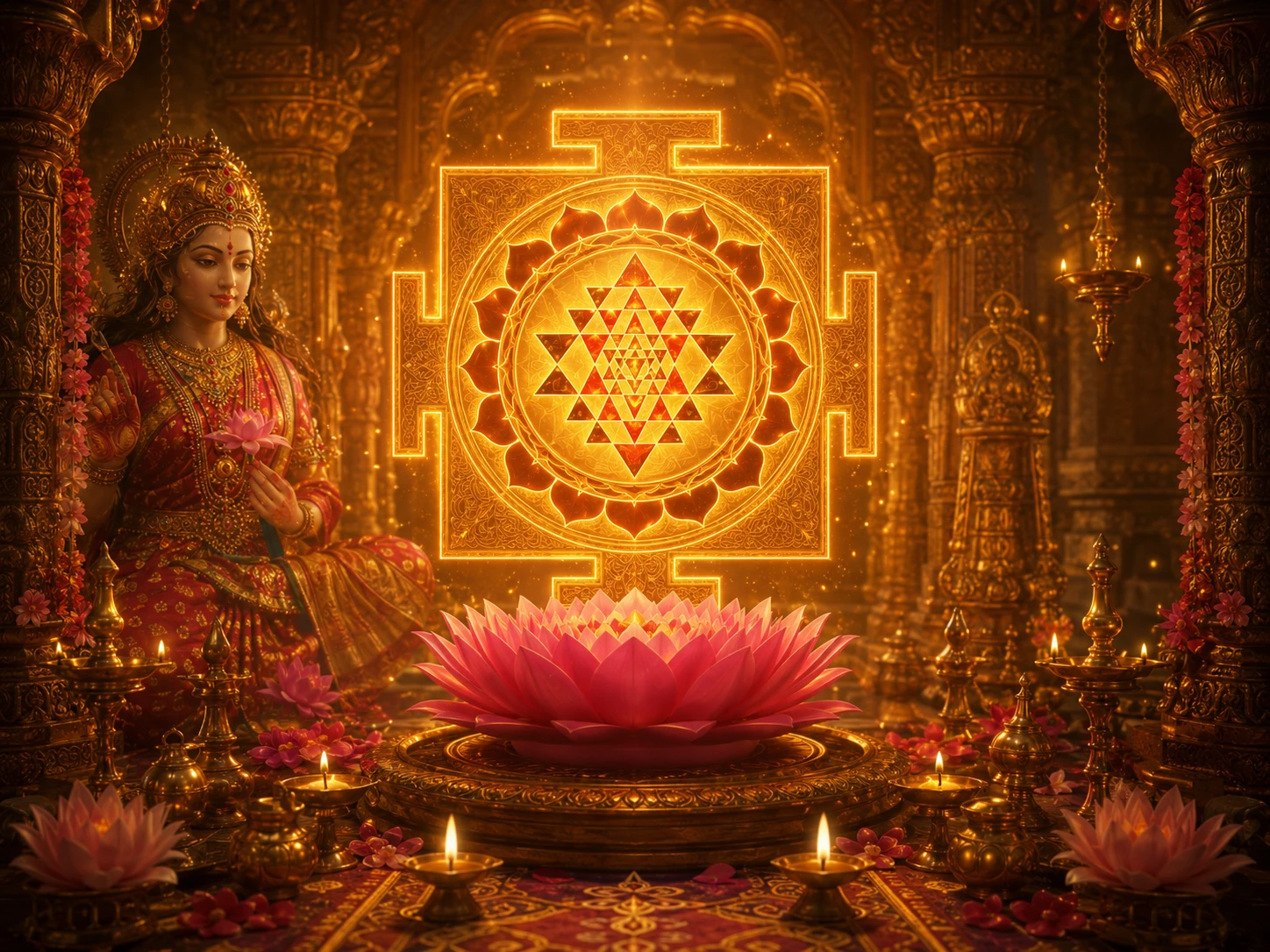
Sri Vidya translates, crudely, as the knowledge pertaining to Sri. Sri here is not wealth in the Lakshmi sense alone. It is the compound auspiciousness that contains wealth, beauty, sovereignty, and the direct apprehension of non-dual reality. The deity worshipped is Lalita Tripura Sundari, the playful one who is the beautiful lady of the three cities. The three cities are waking, dream and deep sleep; She is that fourth state which contains all three without being any of them. The mantra used is the Panchadasi, fifteen Sanskrit syllables arranged in three clusters of five, four and six. The yantra used is the Sri Chakra, the interlocking pattern of nine triangles arranged around a central bindu that produces forty-three smaller triangles, three circumscribing lotuses of eight and sixteen petals, and an outer square gateway. Mantra, yantra and deity are not three things. They are the same reality approached through sound, form and personality respectively. The tradition insists on all three together. A Sri Vidya upasaka who knows only the mantra and ignores the Sri Chakra is doing half the practice. One who meditates on the Sri Chakra without mantra initiation is drawing a beautiful geometry and nothing more.
शिवः शक्त्या युक्तो यदि भवति शक्तः प्रभवितुं न चेदेवं देवो न खलु कुशलः स्पन्दितुमपि। अतस्त्वामाराध्यां हरिहरविरिञ्चादिभिरपि प्रणन्तुं स्तोतुं वा कथमकृतपुण्यः प्रभवति॥
śivaḥ śaktyā yukto yadi bhavati śaktaḥ prabhavituṃ na cedevaṃ devo na khalu kuśalaḥ spanditumapi | atastvāmārādhyāṃ hariharaviriñcādibhirapi praṇantuṃ stotuṃ vā kathamakṛtapuṇyaḥ prabhavati ||
Only when united with Shakti does Shiva become capable of creation; without Her He cannot even stir. You are therefore worshipped by Hari, Hara and Brahma themselves. How then can one without acquired merit so much as bow to You, let alone sing Your praise?
— Saundarya Lahari, Verse 1, attributed to Adi Shankaracharya (Ananda Lahari section)
The opening verse of the Saundarya Lahari is the theological spine of Sri Vidya. It settles, in four lines, the entire philosophical question that divides Advaita from Shakta tantra. Brahman without Shakti is inert. Shakti is not a consort standing beside a husband. She is the activity, the pulsing, the spanda of Brahman itself. Without Her, even the capacity to move is absent. This is why Sri Vidya is not a separate religion inside Hinduism. It is the operational face of Advaita Vedanta, the way of actually doing what the Upanishads describe. Shankaracharya, who demolished rival philosophies with pure logic in his Brahma Sutra Bhashya, is the same Shankaracharya who composed ecstatic verses to the Mother and worshipped Her through the Sri Chakra. Sri Vidya upasakas take this as proof that jnana marga and upasana marga are not in conflict. The mantra is the sound of the reality that logic can only point towards.
The Panchadasi mantra itself cannot be printed in a public article in full. That is not mystical drama. It is protocol. The rule is that the mantra is given by the Guru at the moment of initiation, after preparation that may have taken years, and never before. What can be discussed publicly is its structure. It arranges itself in three kutas, or peaks. The first kuta is Vagbhava Kuta, the peak of speech, associated with the face and the region above the neck, with Brahma as presiding deity and earth as the element. The second kuta is Kamaraja Kuta, the peak of desire, associated with the region from neck to hips, with Vishnu as presiding deity and fire as the element. The third kuta is Shakti Kuta, associated with everything below the hips, with Rudra as presiding deity and the triple knot of Brahma, Vishnu and Rudra together. Each kuta ends with the syllable Hrim, the pranava of the Goddess, which functions like a hinge turning one peak into the next. A sixteenth syllable, added only for those who receive further Shodashi initiation, seals the whole into non-duality. This is why the tradition calls the basic mantra Panchadasi and the complete one Shodashi, the fifteenth and the sixteenth respectively.
Sri Vidya is not a single monolith. Over the centuries the tradition split into recognisable lineages, each with small variations in the mantra and in the ritual framework. The two major streams are Kadi and Hadi, named after the syllable that begins their respective versions of the Panchadasi. Kadi begins with Ka and is associated with the seer-sage Kamaraja, transmitted through Manmatha the god of love. Hadi begins with Ha and is associated with Lopamudra, the wife of the sage Agastya, who according to the Rigveda composed hymns herself. A smaller third stream is Sadi, beginning with Sa, also called Saubhagya Vidya, considered the rarest. Each lineage claims its own chain of initiation back to a primordial transmission. Kanchi Kamakoti Peetham traditionally preserves the Kadi line, while certain Kerala families of Sri Vidya upasakas preserve the Hadi line. In 2026 a young Sri Vidya aspirant who approaches a Guru in Kanchipuram will most likely be initiated into Kadi. One who finds a teacher in Kerala around Guruvayur might receive Hadi. The metaphysical goal is identical. The inner architecture of practice differs, and initiates respect both streams as complete paths.
Kadi, Hadi and Sadi -- The Three Streams of Sri Vidya
| Aspect | Kadi | Hadi | Sadi |
|---|---|---|---|
| Opening syllable | Ka (क) | Ha (ह) | Sa (स) |
| Rishi (seer) | Kamaraja / Manmatha | Lopamudra (wife of Agastya) | Kala / Durvasa (debated) |
| Primary lineage seat | Kanchi Kamakoti Peetham, Sringeri | Certain Kerala families; Haridwar line | Rare; scattered across Karnataka and Maharashtra |
| Temperament of practice | Solar, outward, ritual-rich | Lunar, inward, contemplative | Balanced, often fused with Bhuvaneshwari practice |
| Best-known upasaka | Adi Shankaracharya (by tradition) | Bhaskararaya Makhin (18th century) | Certain Nath tradition masters |
| Temple association | Kamakshi Temple, Kanchipuram | Mookambika Temple, Kollur area | Bhramaramba Temple, Srisailam |
| Accessibility today | Widely available through Sringeri and Kanchi networks | Narrow, often family-transmitted | Very narrow, usually received alongside other vidyas |
These are traditional attributions recorded in commentaries like those of Bhaskararaya and in the oral teaching of modern peethams. Variations exist across regional lines.
The philosophy that actually carries a Sri Vidya sadhaka through years of practice is not the public theology. It is the teaching that the human body, with its nine openings, is already a Sri Chakra. This is the core claim of the Bhavana Upanishad, a short text of thirty-odd sutras that is probably the single most practical document in the tradition. Muladhara corresponds to the outer Bhupura. The petalled lotuses correspond to specific chakras. The inner triangles correspond to the region near the heart. The central bindu is in the crown. The upasaka learns to worship the Goddess not in a copper plate placed on an altar, but in her own spine. External puja trains the body; internal bhavana completes the training. An engineer from IIT Madras who takes Sri Vidya initiation is not leaving her engineering mind at the door. She is learning that the same precision she brings to circuit design applies to her own subtle body. The same triangles, the same nested enclosures, the same relationship between central axis and outer boundary. Only the material changes -- from silicon to prana.
Bhaskararaya Makhin, who lived in Tiruvalangadu on the Cauvery in the early 18th century, is the figure who made Sri Vidya textually visible to later readers. Before him the tradition relied heavily on oral transmission with scattered commentaries. Bhaskararaya wrote three giant works that together became the canon for modern study. Saubhagya Bhaskara is his commentary on the Lalita Sahasranama, still the most cited explanation of the thousand names. Setubandha is his commentary on the Nityashodashikarnava section of the Vamakeshwara Tantra, the text that describes the mantra and yantra in technical detail. Varivasya Rahasya is his explanation of the Panchadasi mantra for advanced upasakas. A UPSC optional paper on Indian philosophy will not test you on Bhaskararaya. A Mylapore Sanskrit college will spend three years on him. His prose style is dense, argumentative, and occasionally brutal towards rival schools. But he is also the reason why a 2026 Sri Vidya student can open a printed book and find every technical detail laid out. He converted a guru-dependent oral system into a written scholarly corpus, without betraying the oral requirement for initiation. The text tells you what is happening. It cannot make it happen inside you.
Modern India carries Sri Vidya in visible and invisible forms. The Kanchi Kamakoti Peetham at Kanchipuram runs a continuous Sri Chakra worship in its sanctum, a practice maintained unbroken since at least the medieval period. Sringeri Sharada Peetham, founded by Shankaracharya himself according to tradition, performs daily Navavarana Puja before the Sri Chakra installed by its first Acharya. The Mookambika temple at Kollur in Karnataka, the Kamakhya temple in Guwahati, the Meenakshi temple at Madurai, and the Lalita temple at Naimisharanya all carry Sri Vidya elements in their agama. Outside the temple network, thousands of upasakas practise privately, often in career families far from the stereotype of the renunciate. A chartered accountant in Chennai, a consultant in Bangalore's Koramangala, a professor at JNU, a Bollywood music director in Juhu, an NRI gastroenterologist in New Jersey -- any of them, if an insider ever introduced you, might turn out to hold Panchadasi diksha from a teacher in Sringeri or Kanchi. The tradition survives precisely because it does not advertise. The initiates keep their daily puja quiet, and the quiet is protective rather than elitist.
The fair question a curious 2026 reader eventually asks is why one should bother. Most practices reward you publicly. Sri Vidya demands years of preparation and then hides even its results inside the practitioner. The traditional answer is that the practice is aimed at a different kind of reward, one that cannot be inherited, gifted, stolen or faked. The sadhaka gradually stops being a sadhaka, because the one who sought and the one sought turn out to be the same presence. The daily ritual which begins as a scheduled activity eventually becomes the background condition of every other activity. The engineer remains an engineer, the mother remains a mother, the portfolio still gets managed, the lecture still gets delivered. But the axis around which all of that turns has moved from the surface self to the central bindu. That relocation is the point. Everything before it is preparation. This is why the tradition insists on a Guru. The claim is too large to test through books. Someone who has already reached the bindu has to extend a hand to someone who has not, and both have to trust the hand.
The historical transmission of Sri Vidya to the current era is a chain that tradition reconstructs in precise detail. Before the codified lineage that Shankaracharya enters, the tradition names mythic rishis -- Manu, Chandra, Kubera, Manmatha -- as early recipients. Moving into historical ground, Gaudapada, the grand-teacher of Shankaracharya, is credited with composing the Subhagodaya Stuti, one of the earliest surviving Sri Vidya hymns. Shankaracharya, in the late 8th or early 9th century, established the four cardinal mathas at Sringeri, Dwaraka, Puri and Jyotirmath, and tradition holds that he installed a Sri Chakra in each, charging the presiding Acharyas with continuing worship. Whether or not all four mathas equally emphasise Sri Vidya today, at least Sringeri and its Kanchi offshoot have preserved intensive practice without obvious interruption. Later anchors in the chain include Vidyaranya in 14th century Vijayanagar, Appayya Dikshita in the 16th century, Bhaskararaya Makhin in the early 18th century, and the modern Chandrashekhara Bharati and Chandrashekharendra Saraswati of the 20th century. Each name in this list can be followed into hundreds of pages of primary sources. The point is that Sri Vidya is not a reconstruction from 19th century scholarship. It is a living transmission that academic study later tried to map.
To grasp why this tradition calls itself a Vidya rather than merely a mantra or a sampradaya, the grammatical distinction matters. In Sanskrit, mantra is a specific acoustic formula. Sampradaya is a line of transmission. Vidya is knowledge that transforms the knower. The Panchadasi is called a Vidya because its intended result is not a blessing bestowed from outside. It is a structural rearrangement of the upasaka's cognition. Once the mantra is installed through nyasa, repeated until it becomes the spine of ordinary awareness, and matched with meditation on the Sri Chakra, the practitioner begins to perceive the three kutas in her own body, the nine avaranas in her own fields of attention, the bindu as the point from which her own sense of I arises. This is why advanced upasakas, when asked what they do every day, sometimes smile and say they are no longer the one doing it. A Vidya eventually consumes the practitioner into itself. A mantra without the framework of Vidya treatment remains a useful chant. The same syllables, embedded in the full Sri Vidya apparatus, become a technology of self-dissolution.
The practical scaffolding of Sri Vidya sadhana unfolds in predictable stages once diksha has been received. Stage one is mantra purascharana -- a prescribed number of japa recitations completed under fasting and behavioural discipline, typically 1,25,000 for the Panchadasi, to charge the mantra fully in the upasaka's system. Stage two introduces nyasa, the touching of specific syllables to specific body points, so that the mantra is no longer only heard but located. Stage three adds the Sri Chakra, first as an external plate for daily puja, then as an interiorised diagram visualised along the central axis of one's own body. Stage four is the full Navavarana Puja, the worship of the nine enclosures one by one, either from outer towards centre (samhara krama, the dissolution order) or from centre outward (srishti krama, the creation order). Stage five is the deepening into bhavana -- where the external ritual becomes optional because the whole architecture now runs inside the awareness of the practitioner. A sincere householder with two hours a day of protected sadhana usually takes five to seven years to move cleanly through stages one through four. Stage five is open-ended and defines the rest of the upasaka's life.
A word of caution is owed to readers encountering Sri Vidya through internet searches. Two patterns show up repeatedly in 2026 online spaces, and both are misleading. First, a wave of Instagram accounts and YouTube channels that market the Panchadasi mantra for money, promising wealth, love partners, or promotions, skipping the entire framework of diksha, preparation and Guru. This is a pure commercial operation with no relationship to the actual tradition, and senior upasakas at Sringeri and Kanchi have publicly warned against it. The mantra in such a context is inert decoration. Second, an older pattern where Sri Vidya is conflated with the more sensational aspects of left-hand tantra, complete with wine, meat and ritual intercourse. Mainstream Sri Vidya as carried by the matha system is predominantly samayachara, the right-hand internal path that works entirely through meditation, nyasa and pure offerings. Left-hand lineages exist and have their own respected teachers, but they are not the default face of the tradition. A prospective aspirant in 2026 is best served by approaching an established matha, requesting the preparatory sadhanas of Bala or Ganapati first, and letting a Guru decide when the Panchadasi is appropriate. Patience here is not weakness. It is the actual path.
A common misconception treats Sri Vidya as a purely South Indian phenomenon. In practice the tradition has significant presence wherever Shakta worship has flourished. The Bengal Kalikula lineages, while primarily focused on Kali and the Das Mahavidyas, include Sri Vidya upasakas who carry mantras in the Kadi stream with Bengali pronunciations. The Kashmir Shaivism stream that flowered around Abhinavagupta in the 10th century treats Tripura Sundari as a named Goddess within the trika framework and exchanged ideas with Sri Vidya through the medieval period. Maharashtra retains Sri Vidya practice across Nasik, Pune and the Konkan coast, often linked to Renuka and Ekvira temples. The Himalayan region, particularly around Haridwar and Uttarkashi, preserves older Hadi lineages that predate the southern codification. A reader in 2026 encountering Sri Vidya for the first time sometimes assumes Tamil Nadu is the centre. That is partly a modern visibility effect. Bhaskararaya happened to live in the Tamil region, the Kanchi Peetham happens to broadcast its activities internationally, and modern publishing in English has concentrated on South Indian authorities. The tradition itself has always been pan-Indian, often pan-subcontinental, and in the last thirty years has extended through the diaspora to the United States, United Kingdom, Singapore and Australia. Every major Sri Vidya matha in India now fields requests for initiation from NRIs with a regularity that would have seemed impossible in 1995.
Researchers at IIT Madras and subsequently at IIT Bombay have studied the geometric properties of the Sri Chakra for nearly two decades. A 2008 paper in the Indian Journal of History of Science showed that the nine-triangle interlocking pattern produces 43 smaller triangles only when the dimensions are drawn according to a specific mathematical relationship. Drawn freehand or using approximate proportions, the triangles do not close cleanly and the 43 count is not reached. The precision required matches proportions later studied in non-Euclidean geometry. A well-drawn Sri Chakra is not a symbolic diagram that happens to look good. It is a computational object that only exists when a specific set of nested equations is satisfied. Temple agamic manuals from the 12th century already specify these proportions. The geometry is older than the equations that describe it.
Sit with Lalita Tripura Sundari
You cannot practise Panchadashi japa without diksha. You can, however, sit daily with Lalita's names, recite part of the Lalita Sahasranama, or meditate on an image of the Sri Chakra. Many upasakas start here and approach a guru for initiation only after a year or two of this preparatory devotion. The Lalita Sahasranama is on Eternal Raga with each name's meaning.
Tags
Eternal Raga · शाश्वत राग
Institutional voice — scholarly articles on Sanatan Dharma
Deepen Your Understanding
अपनी समझ और गहरी करें
tantra mantra yantra
Sri Yantra -- The Supreme Geometry of Creation
Nine interlocking triangles. 43 smaller triangles. A single point from which the entire universe unfolds. The Sri Yantra is the most complex and revered sacred diagram in Hinduism -- and modern mathematicians have found that constructing it requires solving simultaneous equations that Western mathematics did not formalise until the 18th century. This is not decoration. This is the visual body of the Goddess.
tantra mantra yantra
Dasha Mahavidya -- Ten Wisdom Goddesses Who Map the Entire Universe
One holds her own severed head. Another is an ugly old widow. A third paralyses enemies by seizing their tongues. The Dasha Mahavidya are not comfortable goddesses. They are the ten dimensions of reality that most religions are too afraid to acknowledge -- from transcendent beauty to terrifying destruction, from cosmic abundance to abject poverty. Together, they form the most complete map of feminine divinity ever conceived.
tantra mantra yantra
Navavarana Puja -- Sri Chakra Worship
Navavarana Puja is the crown ritual of Sri Vidya. Nine concentric enclosures of the Sri Chakra, each housing a circle of yoginis, each offering a distinct siddhi, are worshipped one by one. The full ritual moves either from outside inward, dissolving the world into the Goddess, or from the centre outward, bringing Her out to fill the world. A seasoned upasaka finishes in three hours. The structure itself holds a full cosmology.
tantra mantra yantra
Matrika Shakti -- The Sacred Alphabet as Cosmic Blueprint
The Sanskrit alphabet is not a human invention. It is a cosmological map -- each letter a compressed Shakti, each vowel a tattva, the whole Varnamala a sonic replica of the universe unfolding from pure consciousness to gross matter. When Shiva's damaru sounded fourteen times, it did not produce grammar. It produced reality.
tantra mantra yantra
Beeja Mantras of Major Deities -- The Seed Syllables That Contain Universes
Om is not just a sound. It is the compression of the entire Vedic cosmology into a single syllable. Shreem contains Lakshmi's abundance. Hreem holds Devi's creative power. Kleem carries Krishna's attraction. Aim encodes Saraswati's wisdom. Each Beej Mantra is a cosmic zip file -- one syllable containing the complete energy signature of a deity.
tantra mantra yantra
The Sahasranama Tradition -- Why God Needs a Thousand Names
On a bed of arrows, dying but not yet dead, Bhishma reveals to Yudhishthira the thousand names of Vishnu -- and changes Hindu devotional practice forever. The Sahasranama is not a list. It is a map of infinity compressed into 107 Sanskrit verses, chanted by millions every morning from Srirangam to Silicon Valley.
tantra mantra yantra
Diksha -- Why Initiation Matters and What It Actually Means
The Kularnava Tantra is unambiguous: there is no liberation without Diksha, no Diksha without a Guru, and no Guru without a Parampara. In an age where mantras are available on YouTube and spiritual apps offer 'instant enlightenment,' understanding why initiation is non-negotiable separates the seeker from the tourist.
Researchers at IIT Madras and subsequently at IIT Bombay have studied the geometric properties of the Sri Chakra for nearly two decades. A 2008 paper in the Indian Journal of History of Science showed that the nine-trian…
More in Tantra, Mantra & Yantra
Agama vs Tantra vs Veda -- Three Streams of Hindu Practice
14 min read
Agni Dhyana -- What Meditation on Fire Is Actually Grounded In
8 min read
Ashta Siddhi -- The Eight Yogic Powers and How Hanuman Embodies Them
13 min readThe same translation error that turned '33 Koti' into '33 crore' in Hinduism also happened in Buddhism. The Chinese translation of Buddhist texts rendered 'Sapta Koti Buddha' (7 Supreme Buddhas) as '7 Crore Buddhas.' The…
Deities AvatarsCommunity Reflections
🕉️
Be the first to share your reflection.