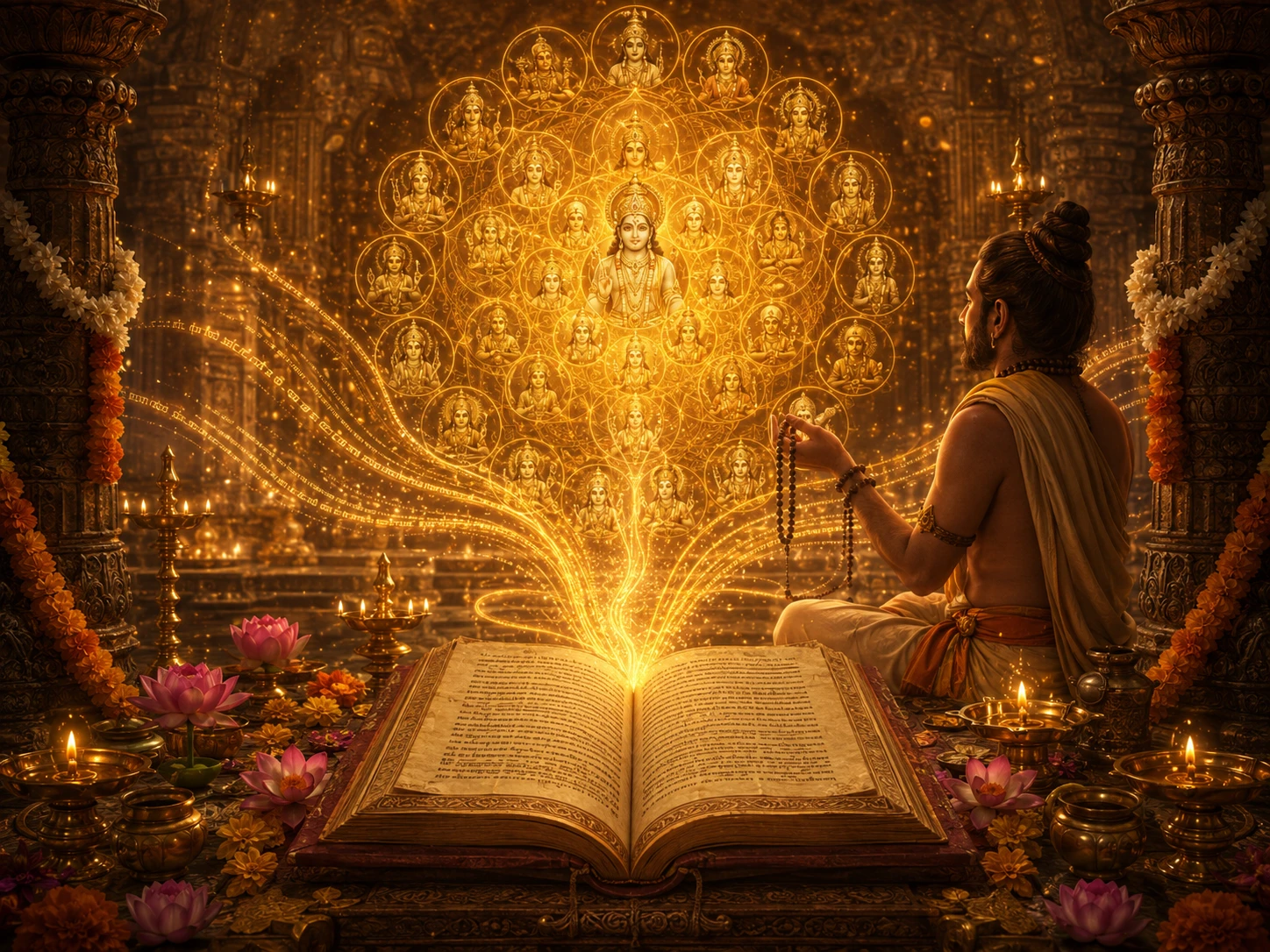
The Sahasranama Tradition -- Why God Needs a Thousand Names
सहस्रनाम परम्परा -- भगवान को हज़ार नाम क्यों चाहिए
The war is over. Eighteen days of slaughter on the plains of Kurukshetra have ended. The Pandavas have won, but the victory tastes of ash. Yudhishthira, the eldest, the one who was supposed to embody Dharma, is consumed by grief and guilt. He has survived a war that killed millions -- including his own teachers, uncles, and cousins.
He goes to the one man who might have answers. Bhishma Pitamaha lies on a bed of arrows (sharashayya) on the battlefield, his body pierced by hundreds of shafts fired by Arjuna. Bhishma has chosen to die only when the sun turns northward (Uttarayana), and so he waits -- conscious, coherent, and speaking -- for weeks, the greatest repository of wisdom in the Kuru dynasty slowly releasing his knowledge before departing.
Yudhishthira asks six questions. The most consequential: 'Who is the one Supreme Deity? By praising whom, by worshipping whom, can a person attain the good? What is the highest Dharma?'
Bhishma's answer is the Vishnu Sahasranama -- one thousand names of Vishnu, composed in 107 verses of Anushtubh metre, delivered from a dying man's lips to a grieving king's ears. This is not a theological lecture. It is a deathbed transmission of the most concentrated devotional technology in the Hindu tradition.
The Sahasranama -- literally 'thousand names' -- is a genre unique to Hinduism. No other world religion has anything quite like it: a systematic catalogue of a deity's attributes, powers, and cosmic functions compressed into a chantable hymn of precisely one thousand names. The tradition produced Sahasranamas for Vishnu, Shiva, Lalita (Devi), Ganesha, Hanuman, and many others. Each is simultaneously a philosophical treatise, a meditation manual, and a devotional offering -- the entire theology of a deity encoded in names that can be recited in 20 to 45 minutes.
Today, the Vishnu Sahasranama is chanted every morning in virtually every Vaishnava temple in India. The Lalita Sahasranama is the daily practice of millions in South India, particularly in Kerala, Tamil Nadu, and Andhra Pradesh. The Shiva Sahasranama anchors Shaivite worship from Kashi to Kathmandu. And in NRI households from New Jersey to Newcastle, the morning Sahasranama recitation -- often played as an audio track during the commute -- connects the diaspora to a practice that Bhishma initiated on a battlefield five thousand years ago.
किमेकं दैवतं लोके किं वाप्येकं परायणम्। स्तुवन्तः कं कमर्चन्तः प्राप्नुयुर्मानवाः शुभम्॥
kim ekaṃ daivataṃ loke kiṃ vāpy ekaṃ parāyaṇam | stuvantaḥ kaṃ kam arcantaḥ prāpnuyur mānavāḥ śubham ||
Who is the one Supreme Deity in the world? What is the one supreme goal? By praising whom, by worshipping whom, can human beings attain the good?
— Mahabharata, Anushasana Parva 135 (Yudhishthira's question to Bhishma)
The Big Three -- Vishnu, Lalita, and Shiva Sahasranamas
Three Sahasranamas dominate the living tradition, each reflecting a distinct theological perspective and regional emphasis.
The Vishnu Sahasranama (Anushasana Parva, Mahabharata) is the most widely recited. Its 1,000 names are drawn from 107 verses in Anushtubh metre. Though called 'thousand names,' a careful analysis reveals 901 distinct names -- 815 appearing once, 75 appearing twice, 9 thrice, and 2 four times. The great Acharyas gave different meanings to repeated names in different contexts, creating layers of theological commentary. Shankaracharya's Advaitic commentary, Parasara Bhattar's Vishishtadvaitic commentary, and Madhvacharya's Dvaitic commentary all interpret the same 1,000 names through their respective philosophical lenses -- making the Vishnu Sahasranama a unique text where three rival schools find their own truth in the same words.
The Lalita Sahasranama (Brahmanda Purana) is the Shakta counterpart. It lists 1,000 names of Lalita Tripurasundari, the supreme goddess of the Sri Vidya tradition. Unlike the Vishnu Sahasranama which emerges from a battlefield conversation, the Lalita Sahasranama is presented as a conversation among the gods after Lalita Devi destroys the demon Bhandasura. The names encode the entire Sri Vidya philosophy -- the 15-syllable Panchadashi mantra, the Sri Yantra's geometry, the Kundalini's ascent through the chakras, and the nature of consciousness itself. Bhaskararaya's 18th-century commentary (Saubhagya Bhaskara) is considered the definitive interpretation. The Lalita Sahasranama is especially prominent in Kerala, where it is recited daily in homes and temples with extraordinary devotion.
The Shiva Sahasranama exists in at least eight versions, the most popular from the same Anushasana Parva of the Mahabharata (Chapter 17). It catalogues Shiva's attributes from the fierce (Rudra, Bhairava, Mahakala) to the benevolent (Shankara, Shambhu, Sadashiva), reflecting the paradoxical nature of a deity who is simultaneously the destroyer and the meditator, the ascetic and the householder, the cremation-ground dweller and the cosmic dancer.
A remarkable feature shared by all three: each Sahasranama includes names that belong to other deities. The Vishnu Sahasranama includes names like Rudra and Shiva. The Shiva Sahasranama includes names like Vishnu and Narayana. The Lalita Sahasranama includes names of both Vishnu and Shiva. This is not confusion -- it is deliberate theological statement. At the highest level, the tradition affirms, all divine names point to one reality. The Sahasranama genre embodies the Hindu principle that the paths are many but the destination is one.
How Sahasranama Works -- The Technology of 1,000 Names
A Sahasranama is not merely a list to be memorised. It is a multi-layered technology operating on at least four levels simultaneously.
Level 1: Japa (Repetition). The most basic function is the repetitive chanting of divine names, which produces the same neurological and spiritual benefits as mantra japa. Each name is a micro-mantra. Chanting 1,000 of them in sequence produces a cumulative vibrational effect far greater than repeating a single name 1,000 times -- because each name activates a different aspect of the deity's energy, like striking 1,000 different keys on a cosmic piano.
Level 2: Dhyana (Meditation). Each name is a meditation seed. When you chant 'Vishvam' (the first name of the Vishnu Sahasranama, meaning 'the Universe'), you are invited to contemplate Vishnu as the entirety of existence. When you chant 'Sthavishthah' (meaning 'the most massive'), you contemplate his cosmic scale. A single recitation contains 1,000 meditation prompts -- more than enough to occupy a lifetime of contemplative practice.
Level 3: Jnana (Knowledge). The Sahasranama is a compressed encyclopedia of theology. By studying the meaning of each name with the help of commentaries, the devotee absorbs the entire philosophical system of their tradition. A student who thoroughly understands the Vishnu Sahasranama has effectively mastered Vaishnava theology. A student who understands the Lalita Sahasranama has mastered Sri Vidya philosophy.
Level 4: Archana (Ritual offering). In temple worship, the Sahasranama is used for Archana -- offering a flower or a bilva leaf with each name. This transforms the recitation into a physical act of worship. At Tirupati, priests perform Vishnu Sahasranama Archana with 1,000 tulsi leaves. At Meenakshi temple, Lalita Sahasranama Archana uses 1,000 kumkum-tipped flowers. The combination of sound (name), material offering (flower), and devotional intention (bhakti) creates a triple-channel worship that engages body, speech, and mind simultaneously.
For the law student preparing for the judiciary exam: the Sahasranama is the Hindu tradition's equivalent of a legal code -- a comprehensive, precisely worded, sequentially organised text that covers every relevant aspect of its subject. For the data science student: it is a feature vector -- 1,000 attributes that collectively define a complex entity with maximum informational density.
The Major Sahasranamas -- A Comparative Overview
| Sahasranama | Source Text | Deity | Context of Revelation | Regional Strength | Chanting Duration |
|---|---|---|---|---|---|
| Vishnu Sahasranama | Mahabharata, Anushasana Parva Ch.135 | Vishnu / Narayana | Bhishma on sharashayya to Yudhishthira after the Kurukshetra war | Pan-Indian; dominant in Vaishnava temples (Tirupati, Srirangam) | ~20-25 minutes |
| Lalita Sahasranama | Brahmanda Purana (Lalitopakhyana) | Lalita Tripurasundari (Devi) | Gods narrate after Lalita destroys Bhandasura | South India -- Kerala, Tamil Nadu, AP; Sri Vidya practitioners globally | ~30-35 minutes |
| Shiva Sahasranama | Mahabharata, Anushasana Parva Ch.17 (8 versions exist) | Shiva / Maheshwara | Varied; MBh version from Anushasana Parva | Shaivite regions -- Kashi, Nepal, Kashmir, Tamil Nadu | ~25-30 minutes |
| Ganesha Sahasranama | Ganesha Purana (I.46) | Ganesha / Ganapati | Within Ganesha Purana; also an alliterative 'G' version | Maharashtra, Ganapatya communities | ~25-30 minutes |
| Kali Sahasranama | Mahanirvana Tantra and other Shakta texts | Kali / Dakshina Kali | Tantric revelation | Bengal, Assam; Tantric practitioners | ~30-35 minutes |
The Varahi Tantra states that in Kali Yuga, three texts are free from all doshas and grant immediate results: the Bhagavad Gita, the Vishnu Sahasranama, and the Devi Mahatmyam (Chandi Saptashati). This elevates the Vishnu Sahasranama to the status of a Kali Yuga essential -- accessible, effective, and universally beneficial.
The Parvati-Shiva Exchange -- One Name Equal to a Thousand
In the Uttara Khanda that concludes the Vishnu Sahasranama, a fascinating exchange occurs between Parvati and Shiva.
Parvati asks Shiva: 'This Sahasranama is long and difficult. Is there an easier way for the common devotee to obtain the same merit?'
Shiva replies: 'Sri Rama Rama Rameti, Rame Raame Manorame; Sahasranama Tattulyam, Rama Nama Varanane.' -- 'O beautiful-faced one, chanting the name of Rama three times is equal to the entire thousand names.'
This verse is one of the most quoted in all of Hindu devotional literature. It is simultaneously a validation of the Sahasranama's power (it takes a thousand names to capture Vishnu's totality) and a democratisation of that power (but if a thousand is too many, one name -- Rama -- contains them all).
The Gaudiya Vaishnava tradition extends this further. The Padma Purana states that one name of Rama equals a thousand names of Vishnu, and one name of Krishna equals three names of Rama. This creates a beautiful compression hierarchy: 1,000 names of Vishnu = 1 name of Rama = 1/3 name of Krishna. The mathematical absurdity is the theological point: the Divine cannot be quantified, and any attempt to do so reveals that infinity is present in every fragment.
For the busy professional in Gurugram or the student cramming for prelims who genuinely cannot dedicate 25 minutes to the full Sahasranama: this verse is the tradition's explicit permission to chant 'Sri Rama Rama Rama' three times and receive the full benefit. The tradition is not rigid. It is infinitely adaptive -- meeting every devotee at their capacity level and assuring them that even the smallest sincere effort reaches the Divine.
Sahasranama in Modern Life -- From Temple to Tech Park
The Sahasranama has adapted to modern Indian life with remarkable fluidity.
In South Indian households, particularly in Tamil Nadu, Karnataka, and Andhra Pradesh, the morning routine of millions includes playing the Vishnu Sahasranama audio while preparing for work. The recitation -- typically by M.S. Subbulakshmi in the most popular recording -- fills the kitchen while coffee is brewed, children are readied for school, and the day's tiffin is packed. The family may not be sitting in formal meditation. They may not understand every Sanskrit word. But the 25-minute sonic field of divine names creates a perceptible shift in household atmosphere that any family member can describe: 'The house feels different when paati's VS is playing.'
This ambient Sahasranama practice is the tradition at its most adaptive. It does not demand a dedicated hour. It does not require Sanskrit proficiency. It layers itself onto the existing rhythm of daily life -- exactly as a tradition designed for householders (grihastha), not monks, should.
In temples, the Sahasranama remains central to formal worship. At Srirangam, the Vishnu Sahasranama is recited during the morning service. At Tirupati, special Sahasranama Archana is offered for devotees. At the Kolhapur Mahalakshmi temple, the Lalita Sahasranama Archana during Navaratri draws thousands. At Varanasi's Kashi Vishwanath, the Shiva Sahasranama punctuates the Maha Shivaratri worship.
The NRI experience has created its own Sahasranama culture. WhatsApp groups in the United States, UK, Singapore, and Australia organise weekly Sahasranama reading circles where families across time zones join a video call and recite together. Spotify and YouTube have made professional recordings by artists like Bombay Sisters, Priya Sisters, and contemporary chanters available on demand. The Apple Watch of a software engineer in Cupertino may ping at 6 AM with a reminder to play the Vishnu Sahasranama -- a 21st-century alarm set by a tradition from the 4th century BCE.
For the UPSC aspirant: Sahasranama texts appear in questions about Indian literary traditions, Mahabharata structure, and Sanskrit stotric literature. Understanding the genre -- its source texts, its commentarial tradition (Shankara vs Parasara Bhattar vs Madhva on the Vishnu Sahasranama), and its cultural significance -- is valuable for both GS-1 Art and Culture and the Essay paper.
The Commentarial Wars -- Three Philosophers, One Text, Three Universes
The Vishnu Sahasranama is perhaps the only text in world literature that has definitive commentaries from three competing philosophical traditions -- each interpreting the same thousand names through radically different metaphysical frameworks. Understanding these three readings transforms the Sahasranama from a devotional chant into an intellectual event of the highest order.
Adi Shankaracharya's commentary (Advaita Vedanta) interprets every name as a description of Nirguna Brahman -- the formless, attributeless Absolute. When the text says 'Vishvam' (the All), Shankara reads it as: Vishnu IS the universe, not that Vishnu rules the universe. The thousand names are a thousand ways of saying that there is only one reality, and that reality is you. The individual soul (Atman) and the cosmic Brahman are identical. The Sahasranama, for Shankara, is a progressive demolition of the illusion of separateness -- each name dismantling one more layer of Maya until the devotee stands face to face with the truth that there is no devotee and no God, only Brahman.
Parasara Bhattar's commentary (Vishishtadvaita, following Ramanuja's school) reads the same names as descriptions of Saguna Brahman -- a personal God with infinite auspicious qualities. When the text says 'Vishvam,' Bhattar reads it as: Vishnu pervades and sustains the universe while remaining distinct from it, as a soul pervades and sustains a body. The thousand names describe a thousand real attributes of a real Supreme Person (Purushottama). Devotion (Bhakti) is not an illusion to be transcended but the highest mode of relating to a God who genuinely loves you back. The Sahasranama, for Bhattar, is a love letter from the finite to the infinite -- each name a point of contact between the devotee's longing and God's grace.
Madhvacharya's commentary (Dvaita) reads the names as descriptions of an utterly transcendent God who is fundamentally different from the individual soul. When the text says 'Vishvam,' Madhva reads it as: Vishnu is the independent reality on whom all dependent realities rely. The thousand names describe a thousand aspects of a God who is infinitely superior to every soul and can never be equated with them. The Sahasranama, for Madhva, is an act of surrender -- each name an acknowledgement of the unbridgeable gap between the human and the divine, and the devotee's absolute dependence on God's will.
Three commentaries. The same text. Three completely different visions of reality: non-dual identity (Shankara), qualified non-duality (Bhattar/Ramanuja), and irreconcilable duality (Madhva). The fact that a single set of Sanskrit names can support all three readings without distortion is a testament to the extraordinary precision and openness of the original composition. The Sahasranama does not take philosophical sides. It provides the raw material for philosophy to occur.
For the IIM student studying strategy or the law student at NLSIU arguing moot court: this is the supreme case study in how the same data can support fundamentally different conclusions depending on your framework of interpretation. The text is the same. The reading changes everything.
The Vishnu Sahasranama contains 901 distinct names, but the tradition counts it as 1,000 because some names are repeated with different meanings in different contexts. Shankaracharya, Parasara Bhattar (Vishishtadvaita), and Madhvacharya (Dvaita) each wrote commentaries on the same text, interpreting the same names through radically different philosophical frameworks -- making it perhaps the only text in world literature with authoritative commentaries from three competing philosophical schools. Meanwhile, neuroscience research at NIMHANS Bengaluru has studied the cognitive effects of Sahasranama recitation, finding that the rhythmic chanting of Sanskrit verses in Anushtubh metre produces measurable increases in alpha-wave brain activity and reductions in self-reported anxiety -- suggesting that the Sahasranama functions as a precisely engineered 25-minute neurological intervention.
Begin the Sahasranama Journey -- Choose Your Path
Start with the Vishnu Sahasranama if you are drawn to preservation and stability, the Lalita Sahasranama if drawn to Shakti and creative energy, the Shiva Sahasranama if drawn to transformation and transcendence. All three are on Eternal Raga with the meaning of each name; recite along, a section at a time. Even listening without chanting confers benefit -- the Vishnu Sahasranama's own phalashruti promises it to the one who hears.
Tags
Eternal Raga · शाश्वत राग
Institutional voice — scholarly articles on Sanatan Dharma
Deepen Your Understanding
अपनी समझ और गहरी करें
deities avatars
Lalita Tripurasundari -- The Supreme Goddess Who Is Beautiful in All Three Worlds
She holds a sugarcane bow and flower arrows -- weapons made not of metal but of desire, beauty, and attraction. Lalita Tripurasundari is Hinduism's most philosophically sophisticated goddess, the Supreme Reality in feminine form, worshipped through the Sri Vidya tradition that has been called the PhD of Hindu spiritual practice.
deities avatars
Who is Shiva?
He is the ash-smeared ascetic who is also the ideal husband. The destroyer of the universe who is called 'The Auspicious One.' The god of death who drank poison to save all life. He sits in meditation on a Himalayan peak, and simultaneously dances the cosmos into existence and annihilation. No deity in Hinduism contains more contradictions -- and no deity resolves them more completely. This is not a mythology explainer. This is an attempt to stand at the foot of the mountain and look up.
tantra mantra yantra
Tantra, Mantra and Yantra -- The Three Pillars of Spiritual Practice
Tantra is the loom, Mantra is the thread, Yantra is the pattern. Together they form the complete technology of spiritual transformation that India gifted to the world -- and they are far more profound than popular culture imagines.
tantra mantra yantra
Japa -- Vachika, Upamshu, Manasika and the Art of Sacred Repetition
Krishna declares in the Gita: 'Among sacrifices, I am Japa.' Not the fire ritual, not the horse sacrifice, not the Soma offering -- but the silent repetition of a sacred name. Three levels of chanting, one mala of 108 beads, and a practice you can do on the Delhi Metro without anyone knowing.
tantra mantra yantra
Kavacha Literature -- The Armour of Mantras
Karna wore physical armour fused to his body. But the Hindu tradition developed something more powerful -- armour woven from Sanskrit syllables that protects not the body but the soul. Narayana Kavacham, Devi Kavacham, Narasimha Kavacham: these are not prayers. They are force-fields activated by sound, assigning a specific deity to guard every inch of your being.
tantra mantra yantra
The Science of Mantra -- How Sacred Sound Rewires Consciousness
A mantra is not a prayer. It is not a wish. It is a precision instrument of consciousness -- a vibrational key engineered in Sanskrit thousands of years ago to unlock specific states of mind. Modern neuroscience is only now catching up.
The Vishnu Sahasranama contains 901 distinct names, but the tradition counts it as 1,000 because some names are repeated with different meanings in different contexts. Shankaracharya, Parasara Bhattar (Vishishtadvaita), …
More in Tantra, Mantra & Yantra
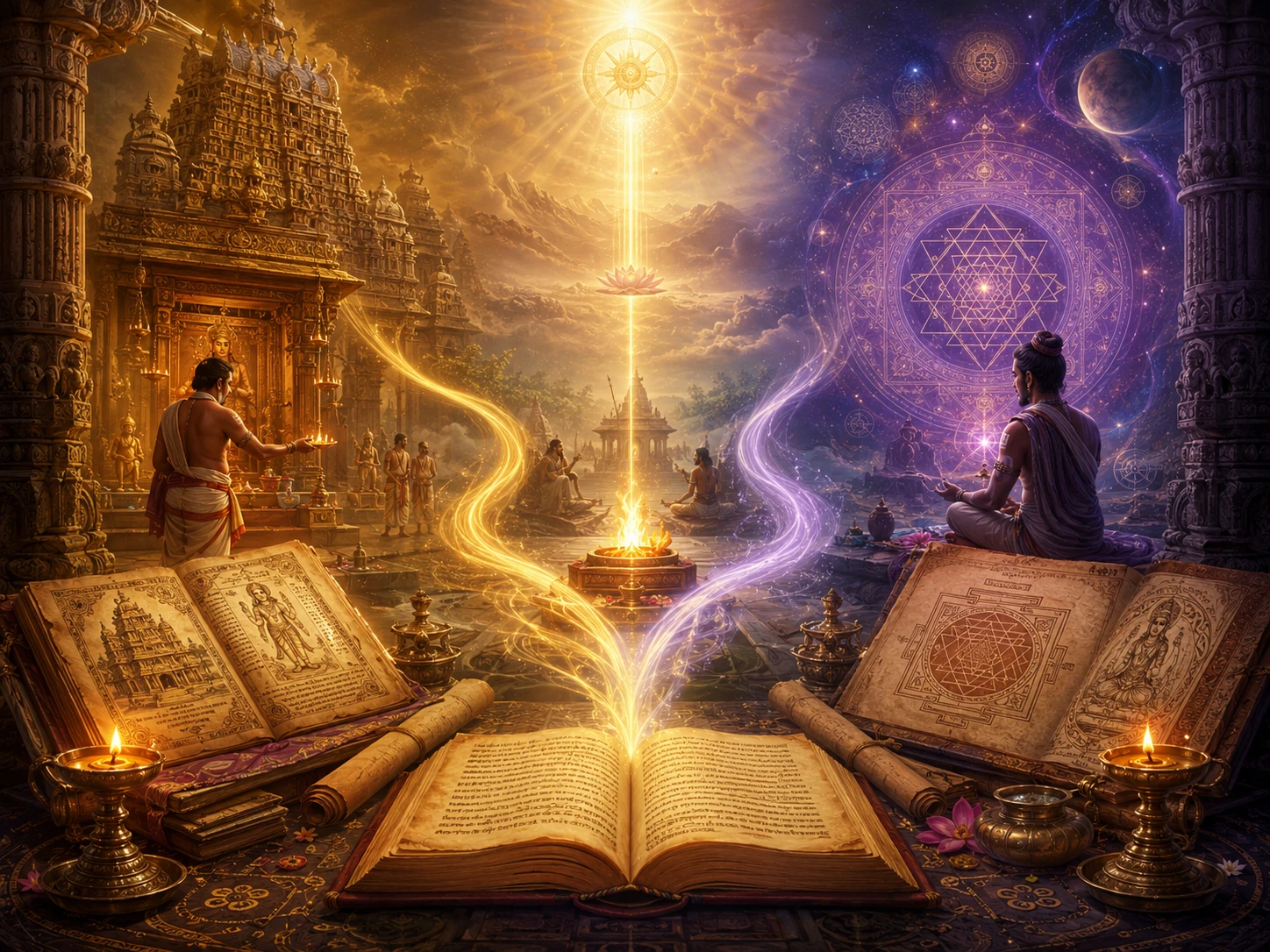
Agama vs Tantra vs Veda -- Three Streams of Hindu Practice
14 min read
Agni Dhyana -- What Meditation on Fire Is Actually Grounded In
8 min read
Ashta Siddhi -- The Eight Yogic Powers and How Hanuman Embodies Them
13 min readThe same translation error that turned '33 Koti' into '33 crore' in Hinduism also happened in Buddhism. The Chinese translation of Buddhist texts rendered 'Sapta Koti Buddha' (7 Supreme Buddhas) as '7 Crore Buddhas.' The…
Deities AvatarsCommunity Reflections
🕉️
Be the first to share your reflection.