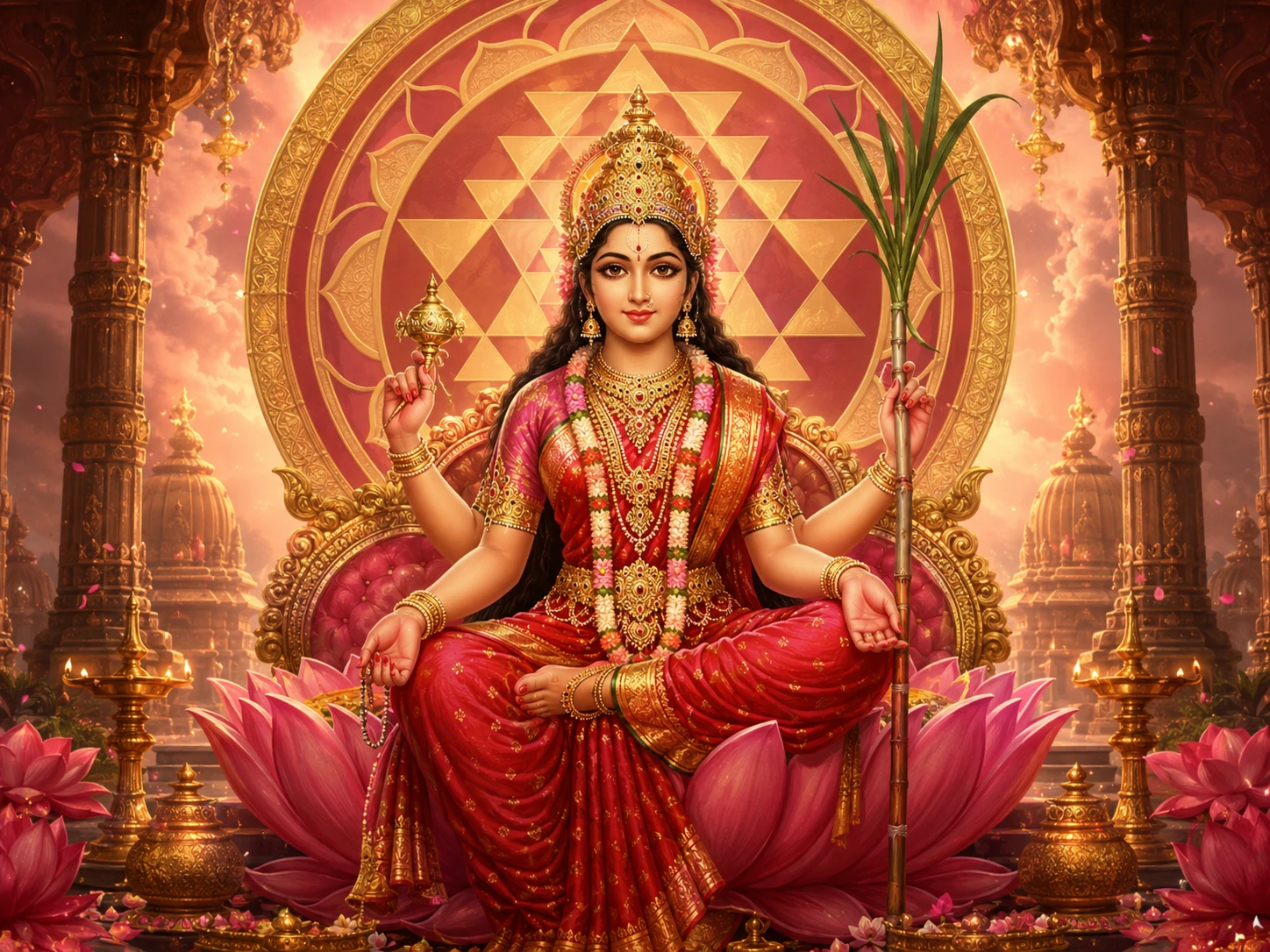
Lalita Tripurasundari -- The Supreme Goddess Who Is Beautiful in All Three Worlds
ललिता त्रिपुरसुन्दरी -- तीनों लोकों में सुन्दर परम देवी
If Saraswati is the goddess you pray to before an exam and Lakshmi is the goddess you pray to for Diwali and Durga is the goddess who gets the biggest pandals in Kolkata, then Lalita Tripurasundari is the goddess most people have never heard of -- and who, according to the Shakta philosophical tradition, encompasses all three of them and everything else in the universe.
Lalita (literally 'the Playful One') Tripurasundari (literally 'She who is Beautiful in the Three Worlds' -- the physical, the astral, and the causal) is the Supreme Goddess of the Sri Vidya tradition, the most intellectually demanding and philosophically rigorous system of goddess worship in Hinduism. Sri Vidya is not casual devotion. It is a structured, initiated, guru-transmitted practice that involves specific mantras (most importantly the Panchadashi and Shodashi mantras), specific yantras (the Sri Chakra or Sri Yantra), and specific rituals that can take years to learn properly. If Bhakti Yoga is the undergraduate programme of Hindu devotion, Sri Vidya is the doctoral research.
The Lalita Sahasranama -- the Thousand Names of Lalita -- is the central text of her worship. It appears in the Uttarakhanda of the Brahmanda Purana, in a dialogue between Hayagriva (Vishnu's horse-headed form, the god of knowledge) and the sage Agastya. The names were not composed by a human author; they were composed by the eight Vag Devis (Vasini, Kameshvari, Aruna, Vimala, Jayani, Modini, Sarveshvari, and Kaulini) -- goddesses of speech -- at the command of Lalita herself. Each of the 1,000 names is a philosophical statement, a meditation seed, and a description of a cosmic function. Chanting the full Lalita Sahasranama takes approximately 30-40 minutes and is performed daily by millions of devotees, particularly in South India.
For the computer science student at IIT Bombay who sees beauty in an elegant algorithm. For the architect in Ahmedabad who understands that beauty is not decoration but structure. For anyone who has ever looked at a mathematical proof and felt something that can only be called aesthetic pleasure. Lalita Tripurasundari is the theological explanation: beauty and truth are not separate categories. They are the same thing, experienced from different angles. And the source of both is feminine.
सिन्दूरारुणविग्रहां त्रिनयनां माणिक्यमौलिस्फुरत्- तारानायकशेकरां स्मितमुखीमापीनवक्षोरुहाम्। पाणिभ्यामलिपूर्णरत्नचषकं रक्तोत्पलं बिभ्रतीं सौम्यां रत्नघटस्थरक्तचरणां ध्यायेत्परामम्बिकाम्॥
sindūrāruṇavigrahāṃ triṇayanāṃ māṇikyamaulisphurat- tārānāyakaśekharāṃ smitamukhīmāpīnavakṣoruhām | pāṇibhyāmalipūrṇaratnacaṣakaṃ raktotpalaṃ bibhratīṃ saumyāṃ ratnaghaṭastharaktacaraṇāṃ dhyāyetparāmambikām ||
Meditate upon the Supreme Mother (Para Ambika) -- whose form is crimson like vermilion at dawn, who has three eyes, whose ruby-studded crown is adorned by the Moon (the lord of stars), who has a smiling face and full breasts; who holds in her two hands a jewelled cup filled with honey (or wine) and a red lotus; who is gentle and serene (saumya), and whose reddened feet rest upon a pedestal of gems.
— Lalita Sahasranama, Dhyana Shloka 1 -- Brahmanda Purana, Uttarakhanda (composed by the eight Vag Devis)
The narrative of Lalita Tripurasundari -- her origin, her cosmic war, and her establishment as the Supreme Being -- is told primarily in the Lalitopakhyana, a section of the Brahmanda Purana, and it is one of the most philosophically rich narratives in all of Hindu scripture.
The story begins with the demon Bhandasura, who was created from the ashes of Kamadeva (the god of desire) after Shiva burned him. Taraka, one of Shiva's ganas, collected the ashes and performed rituals that brought forth Bhandasura -- a being of pure desire divorced from wisdom, pure attraction without discernment. Bhandasura conquered the three worlds and established a city called Shunyaka ('the Void') -- a place where all creative energy, all desire, all beauty, all art, all music ceased to exist. The universe became a wasteland of spiritual emptiness.
This is not a standard demon-conquers-heaven narrative. Bhandasura's rule is specifically about the death of aesthetics, the death of desire, the death of the creative principle. Without Kama (desire), there is no creation, no art, no music, no love, no drive to build or achieve. The universe under Bhandasura is functional but dead -- a corporate office where everyone does their job but no one creates anything beautiful.
To defeat Bhandasura, the gods perform a great fire ritual (Maha Yajna), and from the fire pit (Chidagni Kunda, the 'Fire Pit of Consciousness'), Lalita emerges. She does not come from the combined tejas of the gods (as Durga does); she manifests directly from the fire of consciousness itself. She is not a collective creation of male gods; she is a self-manifest emergence of the Supreme Reality.
Lalita is accompanied by her own complete divine court: her minister Mantranayika (also called Shyamala or Matangi); her general Dandanayika (also called Varahi); her army of Shakti warriors; and her divine chariot, the Sri Chakra Ratha. Her weapons are not conventional: she carries a sugarcane bow (representing the mind -- sweet but bendable), five flower arrows (representing the five sense faculties -- sight, sound, touch, taste, smell), a noose (pasha -- representing attachment), and a goad (ankusha -- representing aversion). These are not weapons of destruction; they are instruments of consciousness. Lalita does not kill through violence; she kills through knowledge.
The battle with Bhandasura involves cosmic forces on a scale that dwarfs even the Mahishasura narrative. Lalita's armies, commanded by deities like Varahi (the boar-faced goddess) and Matangi (the elephant-faced goddess), systematically destroy Bhandasura's sons, generals, and magical defences. When Bhandasura deploys his ultimate weapon -- the Sarvashuranga Astra, which strips the universe of all desire and beauty -- Lalita counters with Kameshwara Astra, which restores desire to the cosmos. The final kill is performed with the Maha Kameshwara Astra (the Great Arrow of the Lord of Desire) -- she destroys the absence of desire with the fullness of desire. Bhandasura's city of Void is annihilated, and the three worlds are restored.
The philosophical implication is staggering: the universe's greatest enemy is not violence or evil in the conventional sense. It is the absence of beauty, desire, and creative energy. And the force that defeats this enemy is not a warrior's rage but a goddess's aesthetic fullness -- the radiance of one who is Beautiful in All Three Worlds.
The Sri Chakra (also called Sri Yantra) is the geometric representation of Lalita Tripurasundari and the central diagram of the Sri Vidya tradition. It is, by any measure, the most complex and mathematically precise sacred geometry in any world religion.
The Sri Chakra consists of nine interlocking triangles -- four pointing upward (representing Shiva/consciousness) and five pointing downward (representing Shakti/energy) -- arranged around a central point (bindu). These triangles intersect to create 43 smaller triangles, arranged in five concentric levels. The whole figure is enclosed by two circles of lotus petals (8 and 16 petals respectively) and a square outer boundary with four gates (called Bhupura).
The Sri Chakra is not decorative. It is a precise cosmological map. Each triangle, each intersection, each petal corresponds to a specific deity, a specific mantra, a specific cosmic function, and a specific level of consciousness. The nine enclosures (avaranas) of the Sri Chakra correspond to the nine levels of spiritual evolution. The bindu at the centre represents the union of Shiva and Shakti -- the point at which all duality collapses and only the undifferentiated Supreme Reality remains.
IIT researchers have studied the Sri Chakra's geometry and confirmed that the nine interlocking triangles, if drawn with mathematical precision, produce exactly 43 intersecting triangles -- a feat of geometric design that is extraordinarily difficult to achieve freehand. The angles, proportions, and intersections are not arbitrary; they follow specific mathematical relationships that modern geometers have found fascinating. This is not to make a 'Vedic science proves modern mathematics' claim (which would violate our editorial honesty standards), but to note that the designers of the Sri Chakra possessed geometric knowledge of a high order, applied to a spiritual rather than secular purpose.
The Sri Chakra is inscribed in gold at the Kamakshi Amman Temple in Kanchipuram (established by Adi Shankaracharya), at the Sringeri Sharada Peetham in Karnataka (one of the four mathas founded by Shankaracharya), and in the inner sanctum of the Tirumala Venkateswara Temple. The latter is significant: even in a Vaishnavite temple dedicated to Vishnu, the Sri Chakra of Lalita is present, suggesting a historical layer of Shakta worship at what is now the world's richest Hindu temple.
Lalita's four weapons -- sugarcane bow, flower arrows, noose, and goad -- deserve deeper examination because they represent a completely different theology of power from anything else in the Hindu divine arsenal.
The Sugarcane Bow (Ikshu Dhanus) represents the mind (manas). Sugarcane is sweet but flexible -- it bends without breaking. The mind, Lalita's theology says, is not a weapon of destruction but an instrument of creation. It can be aimed, it can project, and its nature is sweetness -- consciousness at its root is blissful (ananda). The bow is also called Mano-rupa ('mind-form'), making explicit what other traditions leave implicit: the mind itself is the most powerful weapon in the universe.
The Five Flower Arrows (Pancha Pushpa Bana) represent the five tanmatras (subtle sense faculties): shabda (sound), sparsha (touch), rupa (form/sight), rasa (taste), and gandha (smell). These are the arrows Lalita fires from her mind-bow. The implications are radical: the sense faculties are not obstacles to spiritual progress (as many ascetic traditions teach) but divine weapons. Lalita does not conquer through renunciation; she conquers through engagement with the fullness of sensory experience. The person who deeply sees, truly hears, fully tastes, genuinely touches, and completely smells -- that person is firing Lalita's arrows.
The Noose (Pasha) represents raga (attachment/attraction). The Goad (Ankusha) represents dvesha (aversion/repulsion). These two -- attraction and aversion -- are the fundamental forces that drive all human behaviour according to Hindu psychology. Lalita holds them both, meaning she is the master of both attachment and aversion. She does not eliminate them; she wields them. This is a crucial distinction from Buddhist psychology, which seeks to eliminate attachment entirely. Lalita's theology says: attachment and aversion are not problems to be solved. They are forces to be mastered and wielded with wisdom.
This weapon set makes Lalita unique among Hindu deities. While Vishnu's discus destroys demons and Shiva's trident destroys delusion, Lalita's weapons operate on the level of consciousness itself. She does not fight external enemies; she transforms the internal landscape of the mind. Her war is not against beings but against states of consciousness. This is why the Sri Vidya tradition is considered the most 'internal' (antarmukha) of all Hindu worship systems -- the entire battle takes place within.
For the mindfulness practitioner, the cognitive behavioural therapist, the neuroscientist studying the relationship between attention and consciousness -- Lalita's four weapons constitute a remarkably precise phenomenological map of how the mind engages with reality. The mind as bow (instrument of intentional projection), the senses as arrows (directed experience), attachment as noose (what we cannot let go of), and aversion as goad (what drives us away from) -- this is not ancient mysticism dressed in metaphor. This is a technical vocabulary for mental architecture that predates modern psychology by at least a thousand years.
Lalita's Weapons vs Durga's Weapons -- Two Theologies of Power
| Attribute | Durga (Mahishasuramardini) | Lalita Tripurasundari |
|---|---|---|
| Source of Power | Combined tejas of all male gods | Self-manifested from Chidagni Kunda (Fire of Consciousness) |
| Primary Weapon | Trident (Trishula) -- piercing, destroying | Sugarcane Bow (Ikshu Dhanus) -- the mind, sweet and flexible |
| Secondary Weapons | Discus, sword, thunderbolt, spear -- all metal, all lethal | Five flower arrows (Pancha Pushpa Bana) -- five sense faculties |
| Auxiliary Weapons | Conch, staff, axe -- instruments of war | Noose (Pasha -- attachment) and Goad (Ankusha -- aversion) -- instruments of consciousness |
| Mount | Lion (Simha) -- ferocious courage, predatory power | Sri Chakra Ratha -- a chariot made of cosmic geometry |
| Enemy Defeated | Mahishasura -- brute force, tamas, shapeshifting ego | Bhandasura -- absence of beauty, the void of desire, creative death |
| Method of Victory | Physical combat across multiple chapters | Restoration of desire and beauty to the cosmos via Kameshwara Astra |
| Theological Register | Dharmic warrior -- evil must be physically destroyed | Aesthetic philosopher -- the universe dies when beauty dies |
| Primary Text | Devi Mahatmya (Markandeya Purana) | Lalitopakhyana (Brahmanda Purana) |
| Festival Association | Navaratri, Durga Puja (mass public celebration) | Lalita Jayanti, Sri Vidya initiatory rituals (intimate, esoteric) |
Durga and Lalita are not competing goddesses; they are two faces of the same Shakti. Durga is the emergency response -- the warrior who appears when evil requires immediate physical destruction. Lalita is the fundamental principle -- the cosmic beauty that sustains creation at the deepest level. You need Durga when the house is on fire. You need Lalita to understand why the house matters.
The Lalita Sahasranama itself is a philosophical masterpiece disguised as a devotional text. Each of its 1,000 names is a compressed theological statement.
The very first name is Sri Mata -- 'the Divine Mother.' This establishes the primary relationship: Lalita is not a distant cosmic principle; she is your mother. The last name is Lalitambika -- 'Lalita, the Mother.' The text begins and ends with motherhood, enclosing 998 names that describe every aspect of the cosmos within the frame of maternal love.
Some names describe her form: Sinduraruna-vigraha (body crimson like vermilion), Panchami (the fifth -- she is the fifth element, space), Maha-lavanya-sevadhih (the ocean of all beauty). Some describe her cosmic functions: Srshti-kartri (the creator), Goptri (the sustainer), Samharini (the destroyer) -- claiming for the goddess the functions that the Trimurti (Brahma, Vishnu, Shiva) normally hold. Some describe her philosophical nature: Nirguna (without attributes -- the same term used for Brahman in Advaita Vedanta), Nirupama (beyond comparison), Nirvikalpa (beyond all mental constructs).
Name 250 is Pancha-pretasanasina -- 'she who sits on the five corpses.' The five corpses are Brahma, Vishnu, Shiva, Ishvara, and Sadashiva -- the five aspects of Shiva. Without Lalita's Shakti, all five are inert. She sits on them because she is the power that animates them. This is not feminist theology grafted onto a patriarchal tradition; this is the tradition itself, in its most authoritative text, stating explicitly that the masculine divine is inert without the feminine.
Name 870 is Sarva-vedanta-samvedya -- 'she who is knowable through all Vedanta.' This claims that the ultimate reality described by Shankaracharya's Advaita Vedanta, by Ramanuja's Vishishtadvaita, by Madhva's Dvaita -- all of them -- is Lalita. Every Vedantic path, regardless of its philosophical school, leads to her. This is a breathtaking claim: the Lalita Sahasranama is asserting that all Hindu philosophy, without exception, describes the same reality, and that reality is the Goddess.
The daily practice of chanting the Lalita Sahasranama is widespread in South India, particularly in Tamil Nadu, Karnataka, Andhra Pradesh, and Telangana. In many Brahmin households, the grandmother chants it every morning and evening. In urban India, apps and YouTube channels offering guided recitations have made it accessible to a new generation of devotees -- the software engineer in Whitefield, Bengaluru, who chants the Sahasranama on her commute to work is participating in a tradition that has been unbroken for at least a thousand years.
The Sri Chakra at the Sringeri Sharada Peetham in Karnataka was installed by Adi Shankaracharya himself in the 8th century and is one of the most sacred objects in Hinduism. The Sri Vidya tradition counts among its historical practitioners some of the most important figures in Indian intellectual history: Adi Shankaracharya (who wrote the Saundarya Lahari, a 100-verse hymn to Lalita), Bhaskararaya (the 18th-century scholar who wrote the definitive commentary on the Lalita Sahasranama), and Muthuswami Dikshitar (one of the 'trinity' of Carnatic music, who encoded Sri Vidya mantras and chakra descriptions in his compositions -- his kriti 'Kamalambika Navavarna' is essentially a musical map of the nine enclosures of the Sri Chakra). Meanwhile, the Kamakshi Amman Temple in Kanchipuram, one of the 51 Shakti Peethas, houses a Sri Chakra that is worshipped with the full Sri Vidya ritual sequence daily. And in Silicon Valley, Sri Vidya study groups meet regularly in Cupertino and Fremont -- making the worship of a goddess whose weapons are flowers and sugarcane a weekend practice for engineers who build the world's most powerful technology.
The Sri Vidya tradition -- the esoteric worship system centred on Lalita Tripurasundari -- is the most intellectually demanding devotional practice in Hinduism, and its influence extends far beyond the circle of initiated practitioners.
Sri Vidya is structured around three core elements: mantra, yantra, and tantra (ritual procedure). The central mantra is the Panchadashi (fifteen-syllable mantra) or the Shodashi (sixteen-syllable mantra, considered the most secret and powerful). These mantras are not publicly chanted; they are transmitted from guru to disciple through formal initiation (diksha) and are considered so powerful that incorrect recitation can cause harm. The secrecy is not mere mystification -- it is a safety protocol, analogous to how certain laboratory procedures require training before access.
The yantra is the Sri Chakra, described above. The tantra (ritual procedure) involves elaborate internal and external worship (antaryaga and bahiryaga) that maps the Sri Chakra onto the human body, identifying each of its 43 triangles and nine enclosures with specific chakras, nadis, and states of consciousness. A complete Sri Chakra puja can take 3-4 hours and involves the systematic worship of 108 deities arranged within the nine enclosures.
Adi Shankaracharya's connection to Sri Vidya is often overlooked in popular accounts of his philosophy. While he is primarily known as the proponent of Advaita Vedanta (non-dualist philosophy), Shankaracharya was also an accomplished Sri Vidya practitioner. His Saundarya Lahari ('Wave of Beauty') -- a 100-verse poem that is simultaneously a devotional hymn to Lalita, a technical manual of Sri Vidya practice, and one of the greatest works of Sanskrit poetry -- demonstrates that for Shankaracharya, Advaita philosophy and Shakta devotion were not contradictory but complementary. The impersonal Brahman of Advaita and the personal Goddess of Sri Vidya are the same reality experienced at different levels.
The influence of Sri Vidya on South Indian culture is pervasive. The Carnatic music tradition is deeply interwoven with Sri Vidya symbolism -- Muthuswami Dikshitar's Kamalamba Navavarna Kritis are essentially a musical walk through the nine enclosures of the Sri Chakra. Bharatanatyam dance, particularly in the Tanjore tradition, incorporates Sri Vidya concepts in its abhinaya (expressive storytelling). Temple architecture in Tamil Nadu and Karnataka often follows Sri Chakra geometry in the placement of subsidiary shrines around the central garbhagriha.
In modern India, Sri Vidya has experienced a revival, partly driven by the publication of previously secret texts and commentaries, and partly by the accessibility of online resources. Organisations like the Srividya Foundation, the Devipuram temple in Andhra Pradesh (built in the form of the Sri Chakra by Sri Amritananda Natha Saraswati), and various guru lineages have made Sri Vidya accessible to a wider audience, including NRIs in the United States and Europe.
The philosophical sophistication of the Lalita tradition offers something that many modern seekers find missing in other forms of Hindu practice: intellectual rigour combined with devotional warmth. Lalita is not merely a deity to be worshipped; she is a cosmological principle to be understood. The Sri Chakra is not merely a sacred diagram to be venerated; it is a map of consciousness to be explored. The Lalita Sahasranama is not merely a list of names to be chanted; it is a philosophical encyclopedia to be studied. For the IIT graduate who finds standard temple Hinduism intellectually unsatisfying but feels drawn to the tradition, for the yoga practitioner who wants to go beyond asana into the philosophical depths, for the seeker who wants both rigour and devotion -- Lalita Tripurasundari offers a path that satisfies both the mind and the heart.
Chant the Lalita Sahasranama
Begin your journey into the thousand names of the Supreme Goddess -- the most comprehensive philosophical text of the Shakta tradition, chanted daily by millions. The Lalita Sahasranama is on Eternal Raga with the meaning of each name; begin with a hundred names a day.
Tags
Eternal Raga · शाश्वत राग
Institutional voice — scholarly articles on Sanatan Dharma
Deepen Your Understanding
अपनी समझ और गहरी करें
deities avatars
Durga -- The Warrior Goddess Who Cannot Be Defeated
When every male god in the Hindu pantheon failed to defeat the buffalo demon Mahishasura, they pooled their tejas -- their divine radiance and rage -- into a single being. What emerged was not another god. It was a goddess. And she succeeded where they could not. That is the origin story of Durga, and it rewrites every assumption about power.
deities avatars
Parvati -- Shakti, Wife, Mother, and the Woman Who Moved a Mountain God
She is the daughter of the Himalayas who performed tapas so intense that even Shiva -- the god who burned Kamadeva to ash for daring to disturb his meditation -- was compelled to open his eyes. Parvati is Hinduism's most complete feminine archetype: lover, mother, warrior, philosopher, and the literal other half of god.
tantra mantra yantra
Dasha Mahavidya -- Ten Wisdom Goddesses Who Map the Entire Universe
One holds her own severed head. Another is an ugly old widow. A third paralyses enemies by seizing their tongues. The Dasha Mahavidya are not comfortable goddesses. They are the ten dimensions of reality that most religions are too afraid to acknowledge -- from transcendent beauty to terrifying destruction, from cosmic abundance to abject poverty. Together, they form the most complete map of feminine divinity ever conceived.
deities avatars
Devi Swaroopa -- Forms of the Goddess
She is Durga on the battlefield and Annapurna in the kitchen. She is Kali at the cremation ground and Lakshmi in the boardroom. She is Saraswati at the university and Parvati in the family. The Hindu Goddess is not one deity with accessories -- she is the entire spectrum of feminine power, from terrifying to tender, from cosmic to domestic. Understanding her forms is understanding the universe itself.
tantra mantra yantra
Sri Vidya -- The Supreme Worship System
Sri Vidya is the most guarded, most intricate worship system inside Hinduism. It worships the Divine Mother Lalita Tripura Sundari through a fifteen-syllable mantra, the Sri Chakra yantra, and an initiation line that reaches back through Adi Shankaracharya to the Rig Veda. Miss the diksha and nothing works. Receive it, and the entire cosmos reorganizes itself inside you.
philosophy darshana
Shakta Philosophy -- Devi as Ultimate Reality
What if God is not He but She? Not an abstract principle but a living, breathing, dancing power? Shakta philosophy does not merely add a feminine dimension to Hindu theology. It inverts the entire structure: Shakti is the primary reality, and consciousness without her is inert. Shiva without Shakti is shava -- a corpse. This is not metaphor. This is metaphysics.
deities avatars
Saraswati -- Goddess of Knowledge, Music, and the Flowing Stream of Consciousness
She is the only Hindu deity worshipped with a musical instrument in her hands -- not a weapon, not a boon-granting gesture, but a veena. Saraswati is the goddess who makes knowledge possible, and the fact that India has a national holiday dedicated to placing books at her feet tells you everything about a civilisation's priorities.
The Sri Chakra at the Sringeri Sharada Peetham in Karnataka was installed by Adi Shankaracharya himself in the 8th century and is one of the most sacred objects in Hinduism. The Sri Vidya tradition counts among its histo…
More in Deities & Avatars
33 Koti Devata -- Why Hinduism Has 33 Types of Gods, Not 33 Crore
13 min read
Agni -- The Fire God
19 min read
Annapurna -- Goddess of Food
19 min readThe same translation error that turned '33 Koti' into '33 crore' in Hinduism also happened in Buddhism. The Chinese translation of Buddhist texts rendered 'Sapta Koti Buddha' (7 Supreme Buddhas) as '7 Crore Buddhas.' The…
Deities AvatarsCommunity Reflections
🕉️
Be the first to share your reflection.