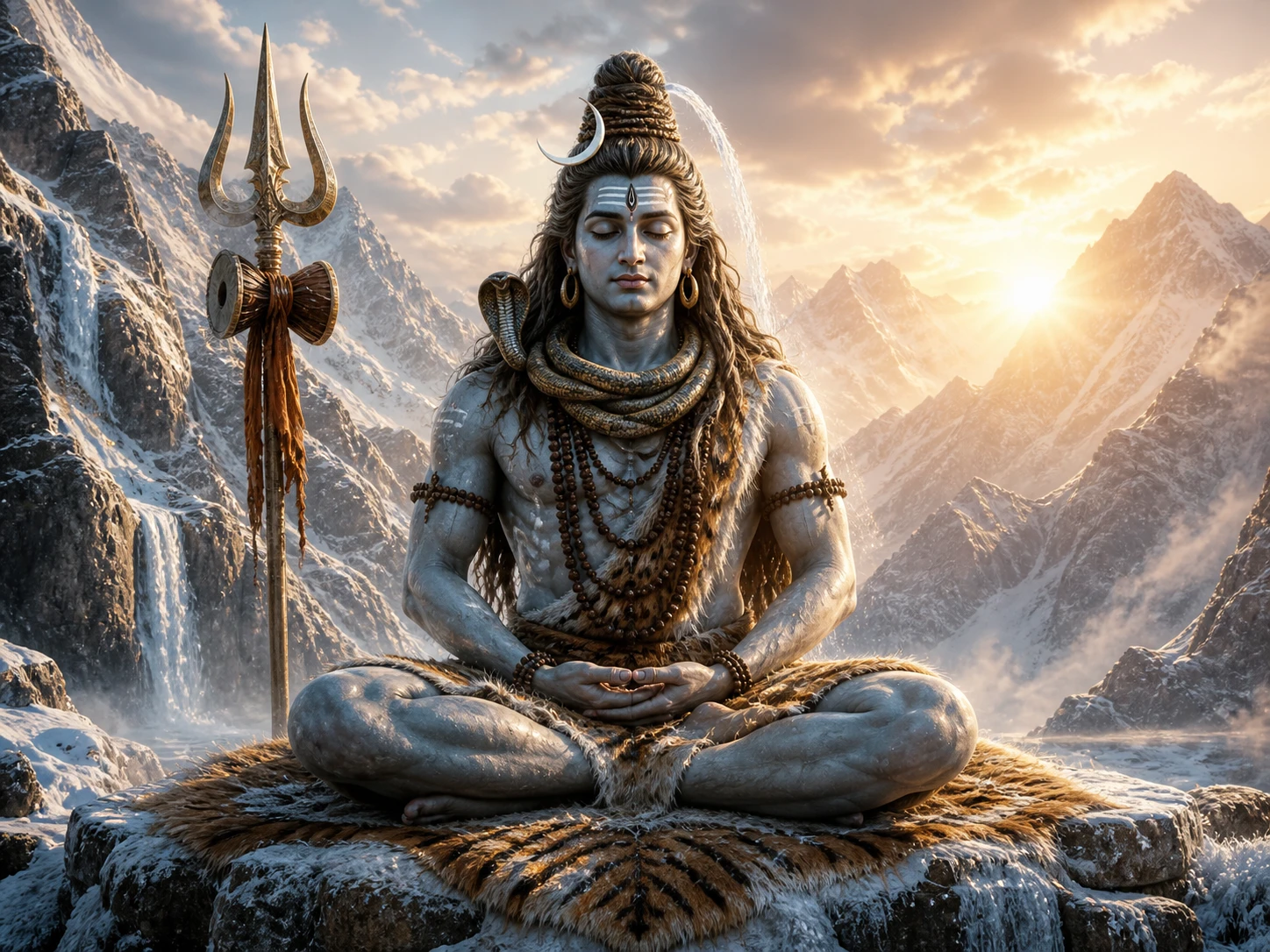
Who is Shiva?
शिव कौन हैं?
'Who is Shiva?' is the most searched Hindu deity query on the internet. It is also, according to the tradition itself, the wrong question. The Shvetashvatara Upanishad -- the foundational text of Shaiva theology, composed between 400-200 BCE -- does not answer 'Who is Shiva?' It says 'Eko hi Rudro na dvitiyaya tasthuh' -- 'Rudra is truly one; there is no place for a second.' The answer is not a biography. The answer is a negation of everything you think separates you from him.
But we are going to start from the beginning anyway, because understanding requires a path, even if the destination abolishes it.
The word 'Shiva' means 'The Auspicious One.' This is already a paradox. In the Vedas, the deity who later becomes Shiva is called Rudra -- 'The Howler,' 'The Terrible One,' the god of storms, disease, and death. The Rig Veda (1.114) simultaneously fears and praises Rudra, begging him for mercy and medicine. He is the physician who causes the illness. He is the destroyer who grants immortality. From the earliest layers of Hindu scripture, this deity refuses to be only one thing.
The transformation from Rudra to Shiva -- from 'terrible' to 'auspicious' -- is one of the most significant theological developments in Indian civilisation. The Shvetashvatara Upanishad is the bridge. In its third chapter, Rudra is identified with Brahman, the ultimate reality. The adjective 'shiva' (kind, benign, blessed) is used seven times -- gradually crystallising from a description into a proper name. By the time the Puranas are composed, Shiva is no longer an epithet. He is Mahadeva -- the Great God.
एको हि रुद्रो न द्वितीयाय तस्थुर् य इमाँल्लोकानीशत ईशनीभिः। प्रत्यङ् जनांस्तिष्ठति सञ्चुकोचान्तकाले संसृज्य विश्वा भुवनानि गोपाः॥
eko hi rudro na dvitiiyaaya tasthur ya imaa.Nllokaaniishata iishaniibhiH | pratya~N janaaMstishhThati sa~nchukocaantakaale saMsR^ijya vishvaa bhuvanani gopaaH ||
Rudra is truly one; there is no place for a second. He rules these worlds with His sovereign powers. He stands facing all beings. Having created all the worlds, He -- the Protector -- withdraws them all at the end of time.
— Shvetashvatara Upanishad, Adhyaya 3, Shloka 2
The Paradox Engine: Why Shiva Contains Opposites
Every symbol on Shiva's body is a resolved contradiction. The crescent moon (Chandrashekhara) -- time itself resting on the head of the timeless. The Ganga flowing from his matted locks -- the destructive flood tamed by stillness. The serpent around his neck (Nagabhushana) -- death worn as an ornament by the deathless. The tiger skin he sits on -- the wild, the predatory, the untameable, subdued and used as a seat of meditation. Ash (vibhuti) smeared on his body -- the final residue of everything that has been burned away; he wears the end of all things.
The third eye (Trinetra) is not merely a weapon. It is the eye of jnana -- knowledge that sees beyond duality. When Kamadeva (the god of desire) shot his arrow at Shiva to disturb his meditation, Shiva's third eye opened and reduced Kama to ash. This is not an anger story. This is a statement: desire cannot survive in the presence of undivided awareness. The third eye does not kill -- it sees, and what it sees cannot maintain illusion.
The Damaru (drum) in his hand is the origin of sound. According to tradition, the 14 Maheshwara Sutras -- the foundational phonemes of Sanskrit grammar -- emerged from the beats of Shiva's Damaru at the end of his cosmic dance. Panini built the entire Ashtadhyayi (the world's first formal grammar) on these 14 sutras. The god of destruction is literally the source of language. The Trishula (trident) represents the three Gunas (Sattva, Rajas, Tamas), the three states (waking, dreaming, deep sleep), the three times (past, present, future) -- and Shiva as the one who transcends all three.
The blue throat (Neelakantha) is perhaps the most beloved of Shiva's attributes. During the Samudra Manthan, when the Halahala poison emerged and threatened to destroy all creation, Shiva drank it. Parvati pressed his throat to prevent it from entering his body, and the poison turned his throat blue forever. The god of destruction saved all life -- not through power but through voluntary suffering. Every time you see a Shiva image with a blue throat, you are looking at a portrait of someone who chose to hold pain in his body so others would not have to.
If that does not resonate with every healthcare worker who worked double shifts during COVID, every parent who swallowed their own anxiety to keep their children calm, every teacher in a government school who shows up despite everything -- then the symbol is not being read closely enough.
The Five Faces: Shiva's Complete Architecture
Shiva's Panchavaktra (five-faced) form, described in the Mahanarayana Upanishad and elaborated in the Pancha-Brahma Mantras of the Taittiriya Aranyaka, maps the five cosmic functions onto five directional faces. Each face corresponds to one syllable of the Panchakshari Mantra (Na-Ma-Shi-Va-Ya), one element, one cosmic function, and one Shakti.
Sadyojata faces West. It governs creation (Srishti). Its element is Earth. Its Shakti is Kriya Shakti (the power of action). When you plant a seed, start a business, write the first line of code, or begin a new relationship -- Sadyojata is the face of Shiva active in that moment.
Vamadeva faces North. It governs preservation (Sthiti). Its element is Water. Its Shakti is Jnana Shakti (the power of knowledge). The sustaining, nurturing, patient aspect -- the Shiva who holds the world steady while everything around it changes.
Aghora faces South. It governs dissolution (Samhara). Its element is Fire. Its expression is fierce, transformative, uncompromising. This is the Shiva of the cremation ground -- not cruel, but honest. Aghora does not destroy for sport. It removes what is no longer alive.
Tatpurusha faces East. It governs concealment (Tirodhana). Its element is Air. This is the face of Maya -- the cosmic veil that hides ultimate reality so that the game of creation can proceed. Without concealment, there is no discovery. Without forgetting, there is no remembering.
Ishana faces upward. It governs grace (Anugraha). Its element is Akasha (space/ether). This is the supreme face -- the one that bestows liberation. All other functions serve this one. Creation, preservation, dissolution, and concealment exist so that, eventually, grace can reveal what was always there.
The 12 Jyotirlingas -- Shiva's Self-Manifest Light Across India
| Jyotirlinga | Location | State | Significance |
|---|---|---|---|
| Somnath | Veraval, Saurashtra | Gujarat | First Jyotirlinga. Destroyed and rebuilt 17 times. Symbol of civilisational resilience. |
| Mallikarjuna | Srisailam, Nallamala Hills | Andhra Pradesh | On Krishna river. Shakti Peetha too. Adi Shankaracharya composed Shivananda Lahari here. |
| Mahakaleshwar | Ujjain | Madhya Pradesh | Only south-facing (dakshinamukhi) Jyotirlinga. Bhasma Aarti at 4 AM is iconic. |
| Omkareshwar | Mandhata island, Narmada river | Madhya Pradesh | Island shaped like Om. Two temples -- Omkareshwar and Amareshwar. |
| Kedarnath | 3,583m altitude, Garhwal Himalayas | Uttarakhand | Highest Jyotirlinga. One of Char Dham. Survived 2013 floods. Adi Shankaracharya's samadhi nearby. |
| Bhimashankar | Sahyadri Hills, near Pune | Maharashtra | Origin of Bhima river. Dense forest. Shiva as protector of the innocent. |
| Kashi Vishwanath | Varanasi, on Ganga | Uttar Pradesh | Most visited. Moksha-dayaka -- liberation granter. New Kashi Vishwanath Corridor (2021). |
| Trimbakeshwar | Near Nashik, Brahmagiri hills | Maharashtra | Origin of Godavari. Three-faced Linga (Brahma, Vishnu, Shiva). Kumbh Mela site. |
| Vaidyanath | Deoghar | Jharkhand | Shiva as the Divine Physician. Ravana's devotion to Shiva linked here. |
| Nageshwar | Near Dwarka | Gujarat | Shiva as protector from poison. Near Krishna's Dwarka -- Shaiva-Vaishnava geography. |
| Rameshwaram | Pamban Island | Tamil Nadu | Rama worshipped Shiva here before Lanka war. Rama Setu. Southernmost Jyotirlinga. |
| Grishneshwar | Near Ellora Caves, Daulatabad | Maharashtra | Smallest Jyotirlinga. Near Ajanta-Ellora UNESCO site. Often the last pilgrims visit. |
The 12 Jyotirlingas span the entire Indian subcontinent -- from Somnath on the Arabian Sea coast to Kedarnath in the high Himalayas, from Rameshwaram at India's southern tip to Vaidyanath in eastern India. This is not accidental. The Jyotirlinga network is a civilisational mapping of sacred geography, ensuring that Shiva's presence is accessible from every region. It is, in effect, an ancient spiritual infrastructure project.
The Family: Shiva as Householder
The same Shiva who sits alone in the cremation ground is also the ideal Grihastha -- householder. His marriage to Parvati (Sati reborn after self-immolation at Daksha's yajna) is the mythological model of partnership between equals. Parvati is not Shiva's subordinate. She is his Shakti -- his power, his energy, his other half. Without her, he is Shava (corpse). The Ardhanarishvara form -- half-Shiva, half-Parvati -- is the most radical statement of gender unity in any world mythology.
Their sons are Ganesha (remover of obstacles, god of beginnings, patron of arts and learning) and Kartikeya/Murugan (commander of the divine armies, god of war and youth). Each son inherits different aspects of the parents. Ganesha has Parvati's resourcefulness and Shiva's transcendence. Kartikeya has Shiva's warrior intensity and Shakti's creative fire.
Nandi -- the sacred bull -- is Shiva's vahana, gatekeeper, and foremost devotee. In every Shiva temple across India, Nandi sits facing the Garbhagriha, eternally gazing at his Lord. The tradition of whispering your wish into Nandi's ear (believing he will carry it to Shiva) is practised by millions of devotees daily. Nandi represents Dharma itself -- standing on four legs (truth, purity, compassion, charity), waiting patiently, serving without condition.
For every IIT student away from home who feels the pull of family during placement season, for every startup founder whose spouse holds everything together while they chase a dream, for every grandmother who is simultaneously the foundation and the shelter of three generations -- Shiva's household is recognisable. The divine family is not perfect because it avoids conflict. It is perfect because it contains conflict and love in the same space.
Major Shaiva Traditions -- A Map
| Tradition | Region | Philosophy | Key Text / Teacher | Core Practice |
|---|---|---|---|---|
| Shaiva Siddhanta | Tamil Nadu, South India | Dualistic (Pati-Pashu-Pasha). Shiva and soul are distinct. | Tirumurai (12 volumes), 63 Nayanars | Temple worship, Panchakshara japa, Bhakti |
| Kashmir Shaivism (Trika) | Kashmir | Non-dualistic. Everything is Shiva. Recognition (Pratyabhijna) of Self as Shiva. | Abhinavagupta (Tantraloka), Vasugupta (Shiva Sutras) | Meditation, Spanda (vibration awareness), Kundalini |
| Lingayat / Veerashaiva | Karnataka | Qualified monism. Ishtalinga worn on body. Anti-caste, anti-ritual orthodoxy. | Basavanna (12th century), Vachana literature | Ishtalinga worship, social equality, Kayaka (dignity of labour) |
| Nath Sampradaya | Pan-India (Rajasthan, Maharashtra, Nepal) | Yoga-oriented. Shiva as Adinath (first guru). Hatha Yoga lineage. | Matsyendranath, Gorakshanath | Hatha Yoga, Pranayama, Nada Yoga, ascetic practice |
| Pashupata | Gujarat, earliest Shaiva sect | Oldest surviving Shaiva school (2nd century BCE). Theistic. | Lakulisha (28th avatar of Shiva per tradition) | Ash-smearing, ecstatic practice, mantra repetition |
| Smarta / Panchayatana | Pan-India | Non-sectarian. Shiva is one of five equal deities (with Vishnu, Devi, Surya, Ganesha). | Adi Shankaracharya | Five-deity worship, Advaita Vedanta |
These six traditions demonstrate that 'Shaivism' is not one religion but a family of related philosophical and devotional paths. A Shaiva Siddhanta devotee in Madurai and a Kashmir Shaiva practitioner in Srinagar worship the same Shiva but understand the relationship between self and God in fundamentally different ways. This theological pluralism within a single deity tradition is uniquely Hindu.
A 2-metre bronze statue of Nataraja -- Shiva as the Cosmic Dancer -- stands at CERN, the European Organisation for Nuclear Research in Geneva, home of the Large Hadron Collider. It was gifted by the Government of India in 2004. The plaque quotes physicist Fritjof Capra: 'Hundreds of years ago, Indian artists created visual images of dancing Shivas in a beautiful series of bronzes. In our time, physicists have used the most advanced technology to portray the patterns of the cosmic dance. The metaphor of the cosmic dance thus unifies ancient mythology, religious art and modern physics.' The dance of Nataraja represents the cycle of creation and destruction at the subatomic level -- particles appearing and disappearing, energy transforming endlessly. The physicists at CERN chose Nataraja not as a religious symbol but as the most accurate mythological representation of what their particle accelerator actually does.
The Sri Rudram (also called Rudra Prashna or Shatarudriya), found in the Krishna Yajurveda's Taittiriya Samhita, is the oldest known litany dedicated to Shiva-Rudra. Its first section, the Namakam, contains the word 'namah' (salutations) approximately 300 times. The second section, the Chamakam, lists over 300 specific blessings. Together, they form the most comprehensive Vedic hymn to any single deity. The Panchakshari Mantra 'Om Namah Shivaya' is extracted from the central verse of the Namakam. When millions chant this mantra daily, they are chanting a distillation of a Vedic hymn that is at least 3,000 years old -- one of the longest unbroken chains of continuous liturgical use in human civilisation.
Chant the 108 Names of Shiva
Each of Shiva's 108 names is an aspect of the infinite -- from Rudra (the fierce) to Shankara (the benevolent) to Mrityunjaya (the conqueror of death). Start your Shiva sadhana with the Ashtottara; the 108 names are on Eternal Raga with the meaning of each.
Tags
Eternal Raga · शाश्वत राग
Institutional voice — scholarly articles on Sanatan Dharma
Deepen Your Understanding
अपनी समझ और गहरी करें
deities avatars
Nine Forms of Shiva -- The Many Faces of Mahadeva
He is the silent teacher under a banyan tree and the screaming destroyer on a battlefield. He is half-woman and half-man. He drank the poison that would have ended the universe and his throat turned blue. Nine scripturally-attested forms of Shiva -- from Nataraja to Rudra -- and why each one exists.
deities avatars
Ardhanarishvara -- The Half-Male, Half-Female Form of Shiva
Split exactly down the centre. Right half: matted hair, serpent, drum, trident, ash-smeared skin. Left half: silk, flowers, kohl-lined eye, curved breast, jewelled anklet. One body. Two genders. Zero contradiction. Ardhanarishvara is the most radical statement on gender in any world mythology -- 5,000 years before the modern conversation began. This is not inclusion as a concession. This is divine completeness as a first principle.
deities avatars
Nataraja -- The Cosmic Dancer
One foot crushes a dwarf. The other is raised in liberation. A ring of fire frames the dance. A drum beats creation into existence. An open palm says 'do not fear.' This is Nataraja -- Shiva as the Lord of Dance -- and it is the single most replicated Indian bronze in the history of art. The physicists at CERN chose it to stand outside the world's largest particle accelerator. The Chola bronzesmiths of Tamil Nadu perfected it a thousand years ago. And every time a subatomic particle appears and disappears, the cosmic dance continues.
sacred symbols
Shiva Linga -- Symbol, Form, and Misunderstanding
The most searched, most misunderstood, and most deliberately distorted symbol in Hinduism. The word 'Linga' means 'sign' or 'mark' in Sanskrit -- the same word Panini uses in grammar for 'gender marker' and the Nyaya school uses for 'evidence in logical inference.' The Shvetashvatara Upanishad says Shiva has no linga -- meaning He is beyond all characteristics, including gender. The Linga Purana says the Linga is the formless Brahman made graspable. Colonial-era mistranslation turned this into something else entirely. Here is what the texts actually say.
tantra mantra yantra
Om Namah Shivaya -- The Panchakshari Mantra
Five syllables. Three thousand years of continuous chanting. The most spoken mantra in Shaivism, extracted from the heart of the Vedas -- the eighth Anuvaka of the Sri Rudram in the Krishna Yajurveda. Na is earth. Ma is water. Shi is fire. Va is air. Ya is space. When you chant Om Namah Shivaya, you are not simply praying to a deity. You are vibrating the five elements that constitute your body, the universe, and the consciousness that witnesses both. This is how a mantra becomes a technology.
scriptural exegesis
Mohini and Shiva -- Why the Bhagavatam Tells This Story
Social media loves verse 8.12.32 -- Shiva loses control chasing Mohini. It never shows verse 8.12.36 -- where Shiva recovers instantly and is not at all surprised. It never shows 8.12.37 -- where Vishnu is very pleased to see Shiva unagitated and unashamed. And it never shows 8.12.38 -- where Vishnu Himself declares that Shiva is 'established in his position' despite everything. This is not a story about Shiva's weakness. It is the Bhagavatam's most powerful teaching on Maya, surrender, and why even the greatest ascetic needs divine grace.
sacred symbols
Rudraksha -- Shiva's Tears and the Science Inside the Bead
Rudra's tears (Rudra + Aksha) fell to earth and became seeds. That is the mythology. The science: Rudraksha is the dried seed of Elaeocarpus ganitrus, a tree native to the Himalayan foothills, Nepal, and Indonesia. Impedance spectroscopy at IIT Banaras confirmed that the beads possess measurable electromagnetic, capacitive, and paramagnetic properties -- properties that vary by the number of Mukhis (natural grooves on the surface). A 3,000-year-old prayer bead turns out to be a natural biomaterial with dielectric characteristics. Tradition and physics, sitting in the same seed.
A 2-metre bronze statue of Nataraja -- Shiva as the Cosmic Dancer -- stands at CERN, the European Organisation for Nuclear Research in Geneva, home of the Large Hadron Collider. It was gifted by the Government of India i…
More in Deities & Avatars
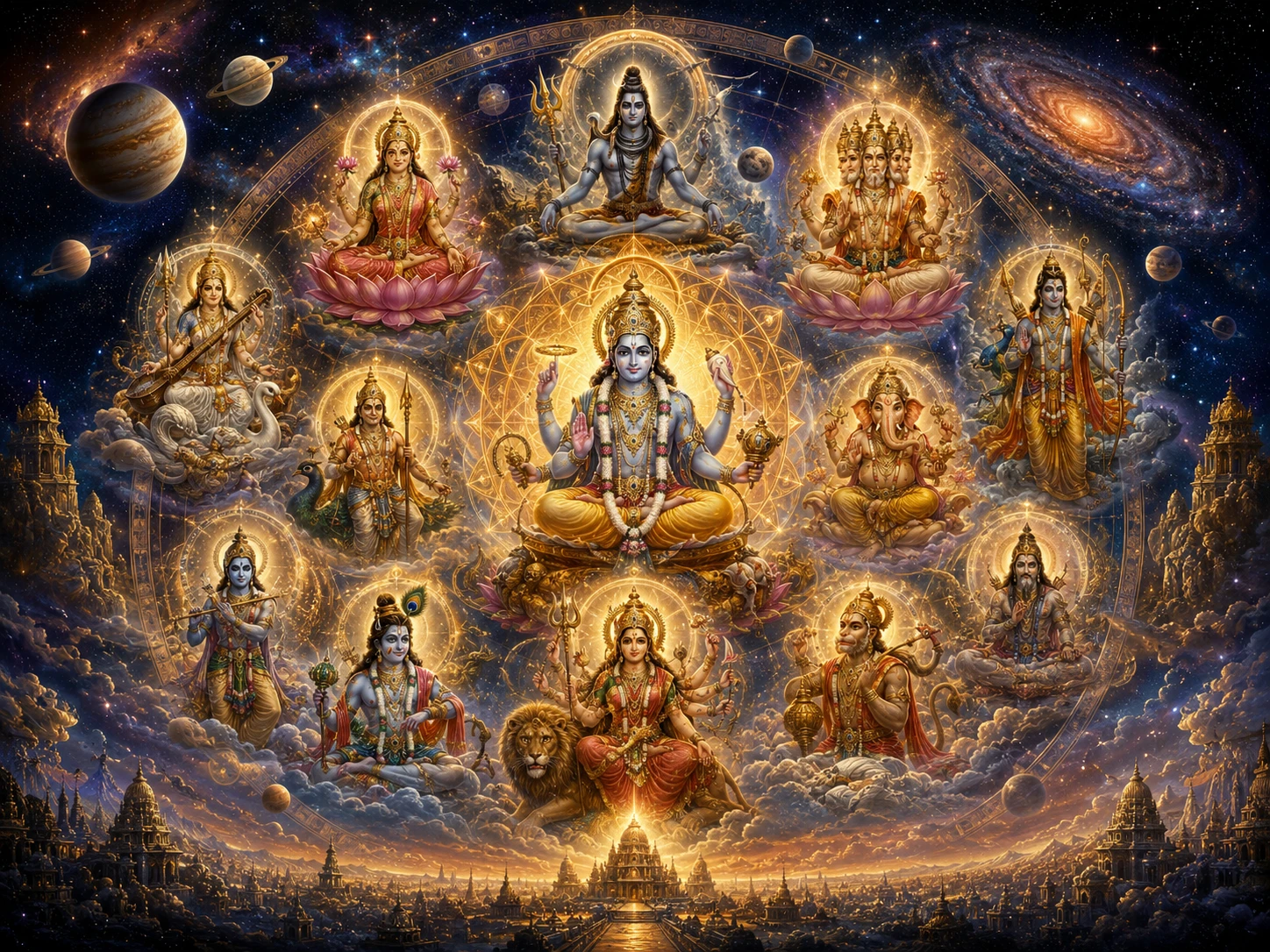
33 Koti Devata -- Why Hinduism Has 33 Types of Gods, Not 33 Crore
13 min read
Agni -- The Fire God
19 min read
Annapurna -- Goddess of Food
19 min readThe same translation error that turned '33 Koti' into '33 crore' in Hinduism also happened in Buddhism. The Chinese translation of Buddhist texts rendered 'Sapta Koti Buddha' (7 Supreme Buddhas) as '7 Crore Buddhas.' The…
Deities AvatarsCommunity Reflections
🕉️
Be the first to share your reflection.
Related across Eternal Raga