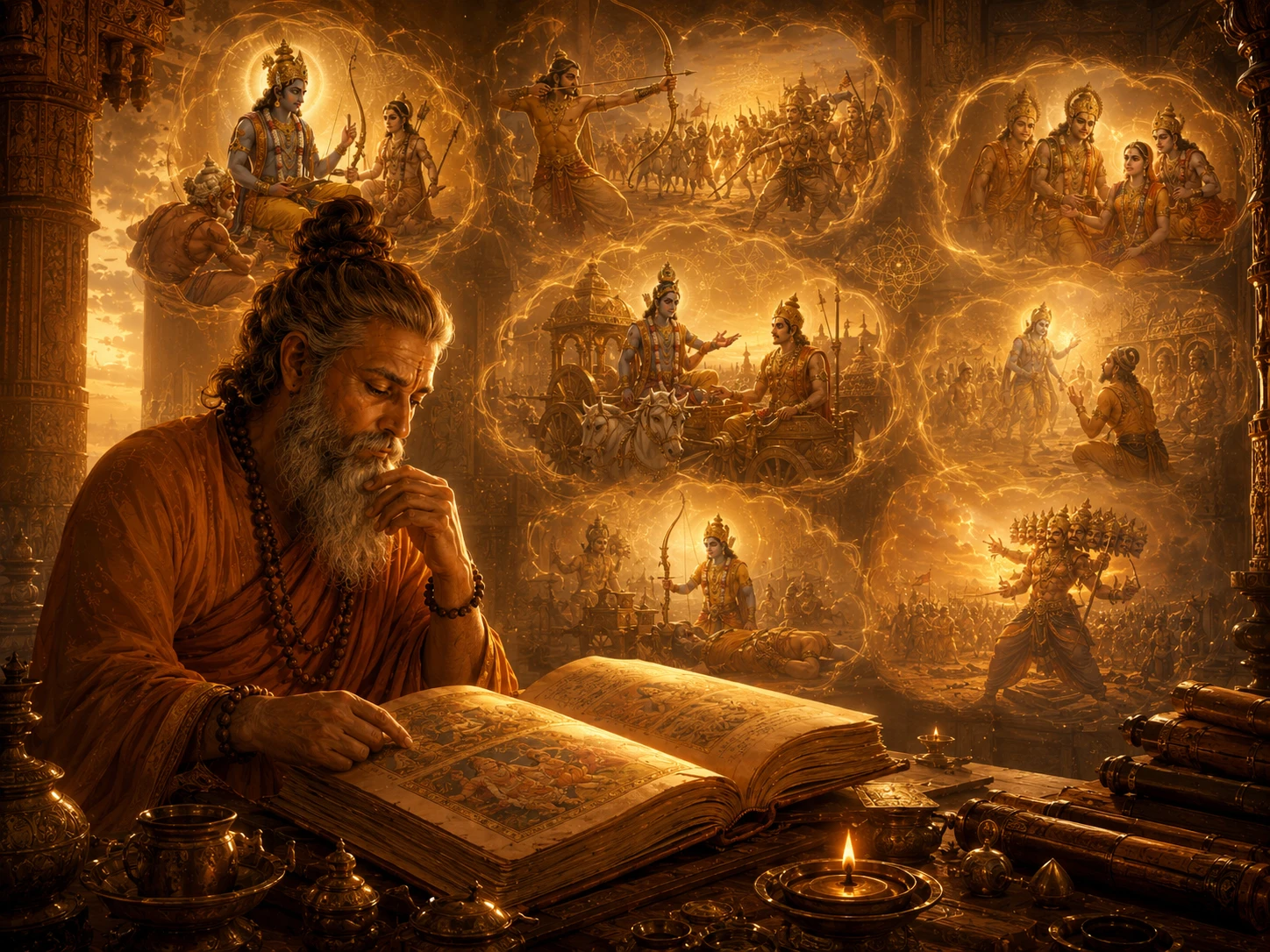
Mohini and Shiva -- Why the Bhagavatam Tells This Story
मोहिनी और शिव -- भागवत यह कथा क्यों सुनाता है
If you want to understand how social media butchers Hindu scripture, Srimad Bhagavatam 8.12 is the case study. The episode circulates online in a three-sentence summary: 'Vishnu turned into a woman. Shiva chased her. He lost control.' Presented this way, the passage sounds like a mockery of Shiva. Anti-Hindu polemicists use it to claim that Hindu gods are morally degenerate. Shaiva-Vaishnava sectarian trolls use it as ammunition against each other. And ordinary Hindus, encountering it for the first time in a comment section, feel a mix of confusion and shame.
All three reactions are the product of not reading the text. Bhagavatam 8.12 is 44 verses long. The 'scandal' occupies approximately 5 of them. The remaining 39 verses contain: Shiva's majestic prayer to Vishnu (8.12.4-12), Vishnu's warning that His Maya is irresistible (8.12.15), Shiva's instant and complete recovery (8.12.35-36), Vishnu's praise of Shiva as uniquely great for recovering so quickly (8.12.37-38), and Shiva's own teaching to Parvati about why the experience proved Vishnu's supremacy (8.12.42-43).
This is not a story of humiliation. It is a story of testing, failing, recovering, and being honoured for the recovery. Every spiritual tradition has such narratives. Job in the Hebrew Bible. Arjuna's despair on the battlefield. The Buddha's temptation by Mara. The test is not the point. The response is.
Act 1: The Setup -- Shiva Asks, Vishnu Warns (Verses 1-15)
The chapter follows directly from the Samudra Manthan (churning of the ocean). Vishnu had already assumed the Mohini form once to deceive the Asuras and distribute the Amrita (nectar of immortality) exclusively to the Devas. Shiva, hearing about this form, is curious. He arrives at Vishnu's abode with his wife Parvati (Uma) and his attendants.
Verses 4-12 contain Shiva's prayer to Vishnu -- one of the most exalted theological stutis in the entire Bhagavatam. Shiva addresses Vishnu as 'deva-deva' (chief of all devas), 'jagat-vyapin' (all-pervading), 'jagat-isha' (master of the universe), and declares that Vishnu is the root cause, the Supersoul, and the supreme controller. He acknowledges that even he and Brahma are bewildered by Vishnu's illusory energy. This is not a casual visitor. This is the greatest yogi in the cosmos paying the highest possible theological tribute.
Verse 14: Shiva explicitly requests to see the Mohini form: 'We have come here desiring to see that form of Yours which captivated the demons completely.'
Verse 15: And here is the verse that makes the entire episode intelligible. Vishnu's response is described with the words 'prahasya bhava-gambhiram' -- 'laughing with serious gravity.' This is not playful laughter. Vishnu laughs because He knows what will happen. He then shows the Mohini form -- but not before the text signals to the reader that what follows is a demonstration, not an accident.
Act 2: The Fall -- What Actually Happened (Verses 16-34)
Mohini appears, described as extraordinarily beautiful, playing with a ball in a forest. The text uses vivid sensory imagery: her sari slipping, her anklets jingling, her eyes darting. Verses 26-28 describe Shiva, overcome by desire, chasing Mohini as she runs through forests, riverbanks, mountains, and gardens.
Verse 32 -- the verse critics weaponise -- states that Shiva discharged his seed while pursuing Mohini, 'just as a maddened bull elephant follows a female elephant.' But the same verse contains the crucial qualifier: 'amogha-retasah' -- 'his discharge of semen never goes in vain.' This is not a throwaway phrase. It is doing cosmological work.
Verse 33 explains: wherever Shiva's seed fell upon the earth, mines of gold and silver appeared. This transforms what looks like a moment of weakness into an act of involuntary cosmic creation. In Shaiva cosmology, Shiva's retas (seed) is the generative principle of the universe. From his seed were born Kartikeya, veins of precious metals, and sacred sites. The Bhagavatam is invoking this framework: even in apparent loss of control, Shiva's creative power generates something sacred.
Visvanatha Cakravarti Thakura's commentary adds an important layer: Mohini deliberately led Shiva to places where great sages lived. The purpose was not humiliation but instruction -- if even Mahadeva, the destroyer of Kamadeva, can be overwhelmed by desire, then no sage should consider himself immune. This is a teaching aimed at the listener, not a degradation of Shiva.
Act 3: The Recovery -- The Part Nobody Quotes (Verses 35-44)
Verse 35: 'When Lord Shiva had fully discharged semen, he could see how he himself had been victimised by the illusion created by the Supreme Personality of Godhead. Thus he restrained himself from any further maya.'
Verse 36 -- the verse that changes everything: 'Thus Lord Shiva could understand his position and that of the Supreme Personality of Godhead, who has unlimited potencies. Having reached this understanding, he was not at all surprised by the wonderful way Lord Vishnu had acted upon him.' Read that again. Shiva was not surprised. Not ashamed. Not devastated. He understood. The greatest yogi in the cosmos processed an encounter with absolute Maya, regained composure, and arrived at a deeper understanding of divine potency. This is not the response of a defeated being. This is the response of a being so spiritually advanced that even total temporary overwhelm becomes a source of insight.
Verse 37 -- Vishnu's response to Shiva's recovery: 'Seeing Lord Shiva unagitated and unashamed, Lord Vishnu [Madhusudana] was very pleased. Thus He resumed His original form and spoke as follows.' Vishnu is pleased. Not smug, not victorious -- pleased. The word is 'priti' -- genuine affection and satisfaction. The test was the point. The recovery proved Shiva's greatness.
Verse 38: 'O best of the demigods, although you have been amply harassed because of My potency in assuming the form of a woman, you are established in your position.' Vishnu Himself certifies that Shiva's fundamental position is unshaken. This is not a consolation prize. It is a formal declaration that the greatest possible test of the greatest possible being has been conducted, and the subject has passed.
Verses 42-43: Back on Kailasa, Shiva tells Parvati: 'O Goddess, you have now seen the illusory energy of the Supreme Personality of Godhead. Although I am one of the principal expansions of His Lordship, even I was illusioned by His energy. What then is to be said of others, who are fully dependent on Maya?' Shiva turns his own experience into a teaching. This is the hallmark of a guru: using personal vulnerability as pedagogical material.
अथावगतमाहात्म्यमात्मनो जगदात्मनः। अपारिक्षीत्महाराज विस्मितो विष्णुमायया॥
athaavagatamaahaatmyam aatmano jagad-aatmanaH | apaariikShiit mahaaraaja vismito viShNumaayayaa ||
Thus Lord Shiva could understand his own position and that of the Supreme Soul of the universe, who has unlimited potencies. Having reached this understanding, he was not at all surprised by the wonderful way Lord Vishnu's Maya had acted upon him.
— Srimad Bhagavatam, Skandha 8, Adhyaya 12, Shloka 36 (Shiva's recovery -- the verse social media never shows)
तमव्यक्तगतिं दृष्ट्वा अनुत्तप्तमवस्मितम्। प्रीतो मधुसूदनो विष्णुः स्वरूपं प्राह शूलिनम्॥
tam avyakta-gatim dR^iShTvaa anuttaptam avasmitam | priito madhusudano viShNuH svaruupam praaha shuulinam ||
Seeing Lord Shiva unagitated and unashamed, Lord Vishnu (Madhusudana) was very pleased. Thus He resumed His original form and spoke to the wielder of the trident.
— Srimad Bhagavatam, Skandha 8, Adhyaya 12, Shloka 37 (Vishnu praising Shiva's recovery)
Five Readings of the Mohini-Shiva Episode
| Reading | Core Interpretation | Key Textual Evidence | What Social Media Misses |
|---|---|---|---|
| Bhakti-Tattva (Vaishnava) | Demonstrates that Vishnu's Yoga-Maya operates even on cosmic-level beings. Shiva's temporary overwhelm proves the absolute supremacy of divine Maya. His recovery proves his unique greatness. | 8.12.38 -- Vishnu certifies Shiva is 'established in his position.' 8.12.37 -- Vishnu 'very pleased' by the recovery. | The entire recovery arc (verses 35-44). Without it, the episode is a prank. With it, it is a theology of grace. |
| Shaiva-Shakta (Purusha-Prakriti) | Consciousness (Shiva) eternally moves toward Energy (Shakti/Mohini). Their interaction is never sterile -- it always produces manifestation. The 'chase' is the cosmic dance of awareness and creative power. | 8.12.32 -- 'amogha-retasah' (seed never in vain). 8.12.33 -- Gold and silver mines appear where seed falls. | The cosmological significance of verse 33. Shiva's retas is not waste but cosmic creation. |
| Samkhya-Vedantic | Purusha engages with Prakriti not through weakness but through the inherent dynamic of consciousness and manifestation. The 'discharge' represents the moment awareness fertilises creative potential. | Shiva's own Samkhya-inflected prayer in 8.12.4-12 sets the philosophical framework before the event. | Shiva's prayer, which establishes the metaphysical context that makes the episode intelligible. |
| Tantric (Bindu) | The bindu (seed-point) of Shiva is the originating pulse of creation in Sri Vidya and Kashmir Shaiva traditions. This episode describes the spanda -- the primordial creative throb when Shiva-consciousness engages Shakti-dynamism. | The gold/silver emergence (8.12.33) parallels Tantric creation cosmology where bindu manifests as matter. | That 'semen' in Puranic context is virya (creative potency), not merely biological fluid. |
| Pedagogical (Teaching Text) | The Bhagavatam is structured as instruction to Parikshit. This episode teaches: (1) even the greatest ascetic needs divine grace, (2) willpower alone is insufficient against Maya, (3) the quality of recovery defines greatness. | Canto 8 theme: surrender vs self-reliance. Samudra Manthan shows Devas needing Vishnu. Mohini shows even Shiva needing to acknowledge Maya. | The structural position of this chapter in Canto 8's larger arc about the insufficiency of self-effort. |
All five readings have coexisted within Hindu commentary for centuries. The Vaishnava reading emphasises Vishnu's supremacy. The Shaiva reading emphasises Shiva's cosmic generativity. The Tantric reading transcends the sectarian frame entirely. The pedagogical reading focuses on the listener (you). None of these readings reduces the episode to 'Shiva was humiliated' -- that reading exists only on social media.
Why the Bhagavatam Tells This Story: The Canto 8 Architecture
The Mohini-Shiva episode is not a random scandal inserted for shock value. It occupies a precise structural position in Canto 8, which is systematically about one theme: the insufficiency of self-reliance and the necessity of divine grace.
Chapter 7: The Devas cannot handle the Halahala poison. They need Shiva. (Even gods need help.) Chapter 8-9: The Devas cannot distribute the Amrita fairly. They need Vishnu as Mohini. (Even after receiving the solution, you need divine guidance to implement it.) Chapter 12: Even Shiva, who saved everyone by drinking the poison, cannot resist Vishnu's Maya when directly confronted by it. (Even the saviour needs the saved-by.)
This is a cascading structure. Each chapter raises the threshold. If the Devas needed help, that is understandable -- they are limited beings. If Shiva needed to be shown the power of Maya, that hits harder -- he is the supreme ascetic. The Bhagavatam is building an argument: at every level of the cosmic hierarchy, self-effort reaches a ceiling. Beyond that ceiling, only surrender works.
For anyone who has ever burnt out at work, maxed out their willpower on a diet, or studied 18 hours a day for JEE only to blank out in the exam hall -- this is the spiritual equivalent. There is a limit to what discipline can achieve. Beyond that limit, you need something you did not earn: grace. Kripaa. The Bhagavatam's word for what Vishnu extends to Shiva at the end of this episode.
Shiva's greatness is not diminished by this episode. It is proven by it. He is the only being in the Bhagavatam who encounters absolute Maya head-on and recovers completely. Nobody else does. Not the Asuras (they were permanently deceived). Not ordinary sages (they would have been destroyed). Only Mahadeva walks through the fire of Maya and comes out the other side with his understanding intact. That is why Vishnu is 'very pleased.' That is why the text honours Shiva even in his moment of apparent weakness.
And that is why the final verse of the chapter says: anyone who hears this lila with faith will become free from the influence of desire. The episode is framed as medicine. The discomfort you feel reading it is the medicine working.
Mohini is the only female avatar of Vishnu in the Dashavatara tradition. The Mohini form appears twice in the Bhagavatam: first during the Samudra Manthan to distribute Amrita (Canto 8, Chapter 9), and then in Canto 8, Chapter 12 when Shiva requests to see the form. In Kerala, the deity at the Malanada temple in Kollam district is worshipped as Mohini -- one of the very few temples in India dedicated to this avatar. The Vishnu Purana and Brahmanda Purana also reference the Mohini form, confirming it is not a late or minor tradition but part of the core Puranic framework.
The phrase 'amogha-retasah' (whose seed never goes in vain) is not unique to this passage. It appears as an epithet of Shiva across multiple Puranas. In Shaiva tradition, Shiva's retas is the source of Kartikeya (Skanda), born when Shiva's seed was carried by Agni, received by Ganga, and nurtured by the Krittikas (Pleiades star cluster). This is the origin story of both a warrior-god and the Krittika Nakshatra. In South India, Kartikeya (as Murugan) is one of the most widely worshipped deities. The theological principle is that Shiva's creative energy, even when discharged involuntarily, produces divinity -- never waste. This directly parallels the gold-and-silver verse (8.12.33) in the Mohini episode.
Chant the Shiva Panchakshari
Om Namah Shivaya -- the five-syllable mantra of Mahadeva, the being who encountered absolute Maya and recovered. If he needed grace, so do you. Start with 108 repetitions on a mala; the mantra's page on Eternal Raga gives its meaning.
Tags
Eternal Raga · शाश्वत राग
Institutional voice — scholarly articles on Sanatan Dharma
Deepen Your Understanding
अपनी समझ और गहरी करें
scriptural exegesis
Samudra Manthan -- When Gods and Demons Ran a Joint Venture and the Universe Almost Died
A cosmic ocean. A mountain for a churning rod. A serpent king for a rope. Gods on one end, demons on the other. And out came 14 treasures -- including wealth, beauty, medicine, immortality, and one poison so lethal it could end creation itself. The Samudra Manthan is not mythology. It is the original playbook for collaboration, crisis management, and how to handle it when your joint venture partner tries to cheat you.
scriptural exegesis
The Gopis and Krishna at the Yamuna -- What the Bhagavatam Actually Says
Social media shows you verses 9-11 of Srimad Bhagavatam 10.22 -- Krishna stealing clothes, laughing from a tree. It never shows you verses 25-27 -- where he returns the clothes, blesses the gopis, calls them 'saintly,' and declares their desire purified. The algorithm loves outrage. The text is telling a story about surrender, purified desire, and the difference between lust and love. This article presents all 38 verses of the chapter, every major Acharya commentary, and exposes the anatomy of a misquotation industry.
deities avatars
Who is Shiva?
He is the ash-smeared ascetic who is also the ideal husband. The destroyer of the universe who is called 'The Auspicious One.' The god of death who drank poison to save all life. He sits in meditation on a Himalayan peak, and simultaneously dances the cosmos into existence and annihilation. No deity in Hinduism contains more contradictions -- and no deity resolves them more completely. This is not a mythology explainer. This is an attempt to stand at the foot of the mountain and look up.
deities avatars
Dashavatara -- Why Vishnu Comes Back Ten Times
Fish, tortoise, boar, half-lion, dwarf, axe-warrior, prince, cowherd, enlightened teacher, future horseman. The ten avatars of Vishnu are not random folklore. Read them in sequence and you get something startling -- a narrative that mirrors evolutionary biology, tracks the rise and fall of political systems, and argues that God does not sit above history but enters it, gets dirty, and does the work. The Dashavatara is Hinduism's answer to the question every civilisation asks: why does the world keep breaking, and who fixes it?
philosophy darshana
Maya -- The Cosmic Illusion That Runs the Universe
You walk down a dark path and see a snake. Your heart pounds, your body freezes. Then someone brings a lamp. It was a rope. The snake was never there. Hindu philosophy says the entire universe works exactly like this -- and the lamp is called knowledge. Welcome to Maya, the most counterintuitive and most liberating idea in Indian thought.
scriptural exegesis
Ram and Sita -- The Complete Life Chronology
How old was Sita when Ram went into exile? Were they married for 12 years or just one? What does Valmiki Ramayana actually say -- and why do different manuscripts say different things? Social media is full of numbers thrown out of context. This article does what most don't: it lays out every verse, every manuscript variant, every scholarly reading, and lets you see the complete picture. From Chaitra Navami to the banks of Sarayu, this is the life chronology of Ram and Sita as the primary texts present it -- contradictions, critical editions, and all.
scriptural exegesis
Agni Pariksha -- Sita's Fire Ordeal and the Interpretations That Divided India
A woman walks into fire to prove she is 'pure.' The man who asked her to do it is called God. For two thousand years, India has argued about what this scene means -- and the argument is far from over. Devotional reading, feminist critique, textual scholarship, and political appropriation all collide in the most contested episode of the Ramayana.
Mohini is the only female avatar of Vishnu in the Dashavatara tradition. The Mohini form appears twice in the Bhagavatam: first during the Samudra Manthan to distribute Amrita (Canto 8, Chapter 9), and then in Canto 8, C…
More in Scriptural Exegesis
Abhimanyu and the Chakravyuha -- The Boy Who Knew How to Enter but Not How to Leave
14 min read
Adbhuta Ramayana -- The Ramayana Where Sita Becomes Kali
9 min read
After Kurukshetra -- What Happened Next
14 min readThe same translation error that turned '33 Koti' into '33 crore' in Hinduism also happened in Buddhism. The Chinese translation of Buddhist texts rendered 'Sapta Koti Buddha' (7 Supreme Buddhas) as '7 Crore Buddhas.' The…
Deities AvatarsCommunity Reflections
🕉️
Be the first to share your reflection.