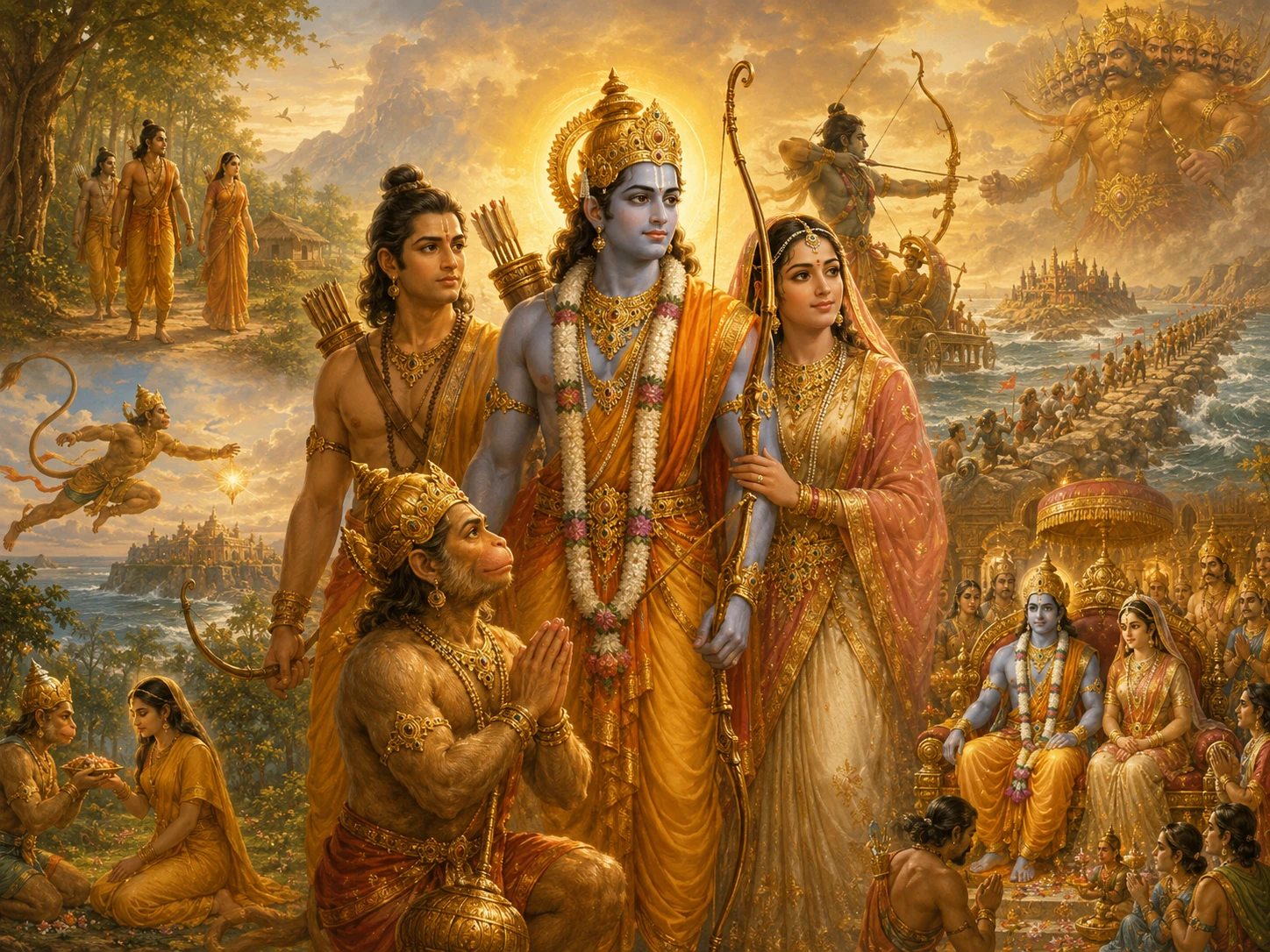
Ram and Sita -- The Complete Life Chronology
राम और सीता -- सम्पूर्ण जीवन कालक्रम
If you have ever searched 'How old was Sita when she married Ram?' you have probably walked away more confused than before. One article says she was 6. Another says 18. A third says 'it is symbolic.' Instagram reels cherry-pick a single verse and build an outrage industry around it. Anti-Hindu polemicists weaponise the '6-year-old bride' claim. Defenders either dismiss the question or offer unconvincing metaphors. Both sides fail the same test: neither actually reads the full text.
The truth is more interesting than either claim. Valmiki Ramayana contains at least two internally contradictory chronological frameworks -- one in Bala Kanda and another in Aranya Kanda -- and the Baroda Critical Edition (the gold standard of Ramayana scholarship, compiled between 1960 and 1975 by a team of scholars at the Oriental Institute) deliberately removed certain verses it considered interpolations. This is not a scandal. This is how ancient epics work. The Mahabharata has the same issue. So does the Iliad. When a text is transmitted orally for centuries before being written down, and then copied by hundreds of scribes across the subcontinent for two millennia, variant readings are inevitable.
What follows is the most honest reconstruction possible: every key verse cited, every manuscript conflict noted, every scholarly interpretation laid out. No cherry-picking. No apologetics. Just the text, its variants, and what they tell us.
Phase 1: Birth
Rama's birth is described in Bala Kanda, Sarga 18 (verses 8-11). He is born on the ninth day of Chaitra month (Chaitra Shukla Navami), when five planets -- Sun, Mars, Jupiter, Saturn, and Venus -- are exalted, Jupiter and Moon are in Cancer, and the ruling Nakshatra is Punarvasu. This astronomical configuration has been studied by multiple researchers (Nilesh Nilkanth Oak, Pushkar Bhatnagar, and others) to attempt dating Rama's birth, though their proposed dates range from 5114 BCE to 12222 BCE -- a range that tells you more about the limitations of archaeo-astronomical dating than about Rama's birthday.
Rama is the eldest of four brothers. Bharata is born to Kaikeyi, and twins Lakshmana and Shatrughna to Sumitra. All four complete their education under Sage Vasishtha's gurukul.
Sita's birth is described differently. She is found by King Janaka while ploughing a field for a yajna -- hence her name Sita ('furrow'). The Ramopakhyana section of the Mahabharata and the Jain version by Vimala Suri describe her as Janaka's biological daughter. Her birth date is celebrated as Sita Navami (Vaishakha Shukla Navami), approximately one month after Rama Navami -- a coincidence the tradition treats as significant.
Neither Bala Kanda nor any other primary Ramayana text gives Sita's birth year relative to Rama's. The '7-year age gap' frequently cited online is derived backwards from a single disputed passage in Aranya Kanda -- it is not a directly stated fact.
Phase 2: Vishvamitra's Visit and Marriage
The first age-related verse appears in Bala Kanda, Sarga 20. When Sage Vishvamitra arrives at Dasharatha's court requesting Rama to protect his yajna from Rakshasas, Dasharatha protests.
Dasharatha uses the phrase 'una shodasha varshah' -- literally 'less than sixteen years of age' -- for Rama and says he lacks the combat experience to fight demons. This places Rama at approximately 15-16 years old at the time of Vishvamitra's visit.
However, a contradictory reference appears later. In Aranya Kanda, Maricha tells Ravana that when Rama defeated him at Vishvamitra's yajna, Rama was 'una dvadasha varshah' ('less than twelve years'). This places Rama at approximately 11-12 at the same event.
Scholar Nilesh Oak and others have attempted to reconcile these by proposing that Dasharatha's 'sixteen' refers to biological age while Maricha's 'twelve' refers to post-Upanayana age (counting from the Kshatriya sacred thread ceremony at 11). This 'Dwija' interpretation is thoughtful but remains a scholarly hypothesis, not a textual certainty.
After training under Vishvamitra, Rama breaks Shiva's bow (Pinaka) at King Janaka's court in Mithila and wins Sita's hand. All four brothers are married simultaneously -- Rama to Sita, Lakshmana to Urmila, Bharata to Mandavi, and Shatrughna to Shrutakirti. The quadruple wedding is described in detail in Bala Kanda, Sargas 72-73.
ऊनषोडशवर्षो मे रामो राजीवलोचनः। न युद्धयोग्यतामस्य पश्यामि सह राक्षसैः॥
uunaSoDashavarsho me raamo raajiivalochanaH | na yuddhayogyataamasya pashyaami saha raakshasaiH ||
My lotus-eyed Rama is less than sixteen years of age. I do not see in him the aptitude for battle against the demons.
— Valmiki Ramayana, Bala Kanda, Sarga 20, Verse 2 (Dasharatha speaking to Vishvamitra)
Phase 3: Married Life in Ayodhya -- The Great 12-vs-1 Debate
This is where the textual conflict becomes most consequential. In Aranya Kanda, when Ravana approaches Sita in disguise at Panchavati, she narrates her own story. Different manuscript families preserve her statement differently.
The Southern manuscripts (plus several Devanagari and one Nepali manuscript) read: 'ushitvaa dvaadasha samaah' -- 'having lived for twelve years' in the Ikshvaku household after marriage. The Northern, Maithili, and Bengali manuscripts read: 'samvatsaram chaadhyushitaa' -- 'having lived for one year.'
The Baroda Critical Edition chose 'one year' as the reading, with editor P.C. Diwanji stating it 'very well suits the context.' But the 'twelve years' reading appears in the Gorresio edition, the Calcutta edition, and is the more widely circulated version in traditional recitation.
This is not a minor difference. If Sita lived 12 years in Ayodhya, and she was 18 at exile (as the Aranya Kanda passage states in the non-CE manuscripts), then she was approximately 6 at marriage -- a number that seems irreconcilable with other Ramayana passages describing her as a 'grown woman of marriageable age' (the word used is 'vardhamaanaam' meaning 'growing/grown'). If she lived only 1 year, she was approximately 17 at marriage -- consistent with the other textual evidence of both Rama and Sita being young adults at the time of the Swayamvara.
The Dwija interpretation resolves this mathematically: if 'eighteen' means 18 years after Upanayana (at age 11 for Kshatriyas), then Sita's biological age at exile would be approximately 29. Similarly, Rama's '25' would mean 36. Under this reading, both were adults at marriage (approximately 17 and 24) and spent 12 years in Ayodhya before exile. This is the interpretation favoured by scholars like Vidwan N. Ranganatha Sharma, who translated Valmiki Ramayana into Kannada.
मम भर्ता महातेजा वयसा पञ्चविंशकः। अष्टादश हि वर्षाणि मम जन्मनि गण्यते॥
mama bhartaa mahaatejaa vayasaa panchavimshakaH | aShTaadasha hi varShaaNi mama janmani gaNyate ||
My husband, that great resplendent one, is twenty-five years of age. Eighteen years are counted since my birth.
— Valmiki Ramayana, Aranya Kanda, Sarga 47, Verse 10-11 (Sita speaking to Ravana in disguise). NOTE: This verse is present in the Vulgate (popular) editions but removed from the Baroda Critical Edition.
The Age Debate -- Three Scholarly Readings
| Parameter | Reading 1: Vulgate (Popular) Text -- 12 Years in Ayodhya | Reading 2: Baroda Critical Edition -- 1 Year in Ayodhya | Reading 3: Dwija (Dual-Birth) Interpretation |
|---|---|---|---|
| Rama's age at Vishvamitra's visit | 15-16 (Bala Kanda 20.2) | Under 16 (same verse retained in CE) | Biological 15-16 (pre-Upanayana age) |
| Rama's age at marriage | ~13 (25 minus 12 years in Ayodhya) | ~24 (25 minus 1 year in Ayodhya) | Biological ~24 (post-Upanayana 13 + 11) |
| Sita's age at marriage | ~6 (18 minus 12 years in Ayodhya) | ~17 (CE removed the '18' verse entirely) | Biological ~17 (post-Upanayana 6 + 11) |
| Years lived in Ayodhya after marriage | 12 years (Southern manuscripts) | 1 year (Northern/Maithili/Bengali manuscripts) | 12 years (accepts Southern reading) |
| Rama's age at exile | 25 (Aranya Kanda) | 25 (retained in CE) | Biological 36 (25 + 11) |
| Sita's age at exile | 18 (Aranya Kanda) | Not stated (verse removed from CE) | Biological 29 (18 + 11) |
| Key problem with this reading | 6-year-old bride contradicts Swayamvara descriptions of grown woman | CE removes data rather than resolving it; 1 year contradicts 12 year traditions | Hypothesis -- no direct textual confirmation that ages use post-Upanayana counting |
| Scholars who support this reading | Traditional pandit lineages; most popular editions | Baroda Oriental Institute team; Bibek Debroy translation | Vidwan N. Ranganatha Sharma; Narayanadhwari |
No reading is without problems. The honest position is to acknowledge that Valmiki Ramayana's chronological data is internally inconsistent across Kandas, likely due to centuries of oral transmission and scribal interpolation. The most defensible reconstruction (based on the weight of textual evidence across ALL passages, not just one) points to Rama and Sita being young adults at marriage.
Phase 4: The 14-Year Exile -- Where They Went and How Long
The exile itself is 14 years -- this is consistent across all manuscripts and all Kandas. Kaikeyi's boon specifies 'chaturdasha varshani' (fourteen years) unambiguously.
The journey can be traced geographically. From Ayodhya, they cross the Tamsa river, then the Ganga at Shringverpur (where the Nishada chief Guha helps them), then cross the Yamuna, reach Sage Bharadwaja's ashram at Prayag, and settle at Chitrakut in the Vindhya foothills. Bharata arrives, pleads for Rama's return, receives his sandals (paduka), and returns to govern Ayodhya as regent.
From Chitrakut, the trio moves south through the Dandaka forest (covering present-day Chhattisgarh and Maharashtra), visits Sage Atri and his wife Anusuya, then Sage Agastya south of the Vindhyas, who advises them to settle at Panchavati on the banks of the Godavari (near present-day Nashik, Maharashtra). They spend the majority of their exile years in the Dandaka-Panchavati region.
It is at Panchavati, approximately 13 years into the exile, that Shurpanakha encounters Rama, Lakshmana disfigures her, and the chain of events leading to Sita's abduction by Ravana begins.
Just think about that UPSC Geography optional paper where you trace Rama's route: Ayodhya (UP) to Shringverpur to Chitrakut (UP-MP border) to Dandaka (Chhattisgarh) to Nashik (Maharashtra) to Hampi (Karnataka) to Rameshwaram (Tamil Nadu) to Lanka. That is a 3,000+ km journey through the Indian peninsula. This is not a local story. The Ramayana is a pan-Indian civilisational narrative that passes through nearly every major region of the subcontinent.
Ram-Sita Life Chronology -- Key Events
Phase 5: The War and Return
Sita's captivity in Lanka's Ashoka Vatika lasted approximately 10 months. During this time, Ravana repeatedly proposes to her and she repeatedly refuses -- her agency in the captivity narrative is significant and often underplayed. She chooses to remain faithful not out of passivity but out of conviction, and explicitly tells Hanuman she will not ride on his back to escape because she wants Rama to come and defeat Ravana publicly -- she will not be rescued like a stolen object but liberated through a demonstration of dharmic justice.
The war at Lanka involves multiple days of fighting (traditional sources suggest 13 to 87 days depending on the recension; the Padma Purana mentions 72 days of actual combat). Key events include the death of Kumbhakarna, the killing of Indrajit (Meghanada) by Lakshmana, and the final battle between Rama and Ravana. Ravana's death is followed by Vibhishana's coronation as king of Lanka.
The Agni Pariksha (fire ordeal) of Sita occurs immediately after the war. This is one of the most contested episodes in all of Hindu literature and deserves its own article. For now, note that in the Valmiki Ramayana, Agni himself testifies to Sita's purity and returns her to Rama. In the Ramcharitmanas, a parallel tradition holds that Maya Sita (an illusion created by Agni before the abduction) was the one held captive, and the Agni Pariksha was actually the reunion of the real Sita with Rama.
Rama, Sita, and Lakshmana return to Ayodhya on the Pushpaka Vimana. The return traditionally falls on Kartik Amavasya -- the darkest night of the year, illuminated by the diyas lit to welcome them home. This is the origin of Diwali as celebrated in most of North India. Rama is crowned king and the era of Ram Rajya begins.
Phase 6: Uttara Kanda -- The Controversial Aftermath
This is the portion that generates the most anguish among modern readers: pregnant Sita is sent to the forest based on a washerman's gossip about her chastity. She takes refuge in Sage Valmiki's ashram, gives birth to twins Lava and Kusha, and raises them as warrior-poets. Years later, during Rama's Ashvamedha yajna, the twins sing the Ramayana (composed by Valmiki) before Rama himself -- not knowing he is their father.
When Rama asks Sita to prove her purity again before the assembled court, Sita calls upon her mother -- the Earth -- and the ground opens to receive her. She descends into the earth and does not return.
Before you react emotionally, here is what the scholarship says: Uttara Kanda is widely considered a later addition to Valmiki Ramayana. Books 2 through 6 (Ayodhya Kanda through Yuddha Kanda) are the oldest core. Both Bala Kanda and Uttara Kanda show linguistic and thematic differences from the core text. Scholar M.R. Parameswaran has noted that the depiction of women and Shudras in Uttara Kanda contradicts the dharmic framework of the main epic. The Critical Edition includes Uttara Kanda but notes its problematic status.
This does not mean Uttara Kanda is worthless. It means it should be read as what it likely is: a later theological meditation on the costs of kingship, the tension between personal love and public duty, and the impossible standards placed on women in patriarchal societies. Sita's descent into the earth is not a validation of Rama's decision -- it is the epic's tragic acknowledgement that even the ideal king can fail the ideal wife.
For any JEE or UPSC aspirant who has ever been told 'your marks don't define you' but still felt crushed by a result -- the Uttara Kanda understands that gap between the ideal and the real. Ram Rajya was supposed to be perfect. It was not. That is the point.
The route Rama took during exile is being developed as a tourism and heritage circuit by the Government of India. The 'Ram Van Gaman Parikrama Path' in Chhattisgarh connects 75 sites across the state associated with Rama's 14-year exile, complete with interpretation centres, pilgrim facilities, and archaeological conservation. Similar projects exist in Uttar Pradesh (Ayodhya-Chitrakut corridor), Maharashtra (Nashik-Panchavati region), and Karnataka (Hampi-Kishkindha). The fact that physical sites across this 3,000+ km route have continuous local traditions, temple structures, and place-names connected to the Ramayana is itself a form of evidence -- not of historicity in the modern scientific sense, but of civilisational memory preserved in landscape.
Rama's birth chart (janma kundali) as described in Bala Kanda 18.8-11 is one of the most computationally studied passages in ancient literature. Multiple researchers have used planetarium software to find dates when the five specified planets were simultaneously exalted in the described configuration. The resulting date proposals range across thousands of years -- which tells us that such configurations recur cyclically, making astronomical dating of ancient events inherently ambiguous. It is an interesting exercise in the intersection of data science and scripture, but it is not proof of a calendar date. If you are doing a data science project in your BTech and need an interesting historical dataset, Ramayana astronomical references are genuinely fascinating computational material.
Read the Ramayana on Eternal Raga
The verses cited in this article are fragments. Read the Ramayana in sequence on Eternal Raga -- from the Bala Kanda onward -- and see the narrative arc for yourself. Context changes everything.
Tags
Eternal Raga · शाश्वत राग
Institutional voice — scholarly articles on Sanatan Dharma
Deepen Your Understanding
अपनी समझ और गहरी करें
scriptural exegesis
Ramayana -- History or Myth? What the Evidence Actually Says
A 48-km limestone bridge between India and Sri Lanka that NASA satellites photographed. An exile route spanning 3,000 km that you can walk today -- every river, cave, and mountain matching Valmiki's descriptions. Astronomical events that planetarium software can verify. Five categories of evidence that turn a simple 'myth or fact?' into a far more interesting question.
deities avatars
Rama -- Ideal of Dharmic Living
Why does India still name its sons after a prince who chose exile over a throne? Rama's life is not a fairy tale -- it is a manual for dharmic decision-making under impossible pressure. From boardrooms to battlefields, his choices remain the hardest moral benchmark in civilization.
scriptural exegesis
Agni Pariksha -- Sita's Fire Ordeal and the Interpretations That Divided India
A woman walks into fire to prove she is 'pure.' The man who asked her to do it is called God. For two thousand years, India has argued about what this scene means -- and the argument is far from over. Devotional reading, feminist critique, textual scholarship, and political appropriation all collide in the most contested episode of the Ramayana.
scriptural exegesis
Sita and Draupadi -- The Two Women Who Triggered Two Great Wars
Every Indian knows that the Ramayana happened because Sita was abducted and the Mahabharata happened because Draupadi was disrobed. But here is the question nobody asks: were these women the cause of war, or the consequence of systems that had already failed? The answer reframes both epics.
scriptural exegesis
Hanuman's Leap Across the Ocean
100 yojanas of open ocean. Three supernatural obstacles. Zero backup. Hanuman's leap to Lanka is not just mythology's greatest action sequence -- it is a masterclass in overcoming self-doubt, navigating temptation, and executing under impossible pressure.
scriptural exegesis
Why Sundara Kanda is the Most Revered
It is the only book of the Ramayana named after a quality, not a place. It is the only one where Rama is absent from the action. And it is the most recited, most parayana'd, most trusted text in living Hindu practice. Why does Sundara Kanda hold this unmatched position?
scriptural exegesis
The Gopis and Krishna at the Yamuna -- What the Bhagavatam Actually Says
Social media shows you verses 9-11 of Srimad Bhagavatam 10.22 -- Krishna stealing clothes, laughing from a tree. It never shows you verses 25-27 -- where he returns the clothes, blesses the gopis, calls them 'saintly,' and declares their desire purified. The algorithm loves outrage. The text is telling a story about surrender, purified desire, and the difference between lust and love. This article presents all 38 verses of the chapter, every major Acharya commentary, and exposes the anatomy of a misquotation industry.
The route Rama took during exile is being developed as a tourism and heritage circuit by the Government of India. The 'Ram Van Gaman Parikrama Path' in Chhattisgarh connects 75 sites across the state associated with Rama…
More in Scriptural Exegesis
Abhimanyu and the Chakravyuha -- The Boy Who Knew How to Enter but Not How to Leave
14 min read
Adbhuta Ramayana -- The Ramayana Where Sita Becomes Kali
9 min read
After Kurukshetra -- What Happened Next
14 min readThe same translation error that turned '33 Koti' into '33 crore' in Hinduism also happened in Buddhism. The Chinese translation of Buddhist texts rendered 'Sapta Koti Buddha' (7 Supreme Buddhas) as '7 Crore Buddhas.' The…
Deities AvatarsCommunity Reflections
🕉️
Be the first to share your reflection.