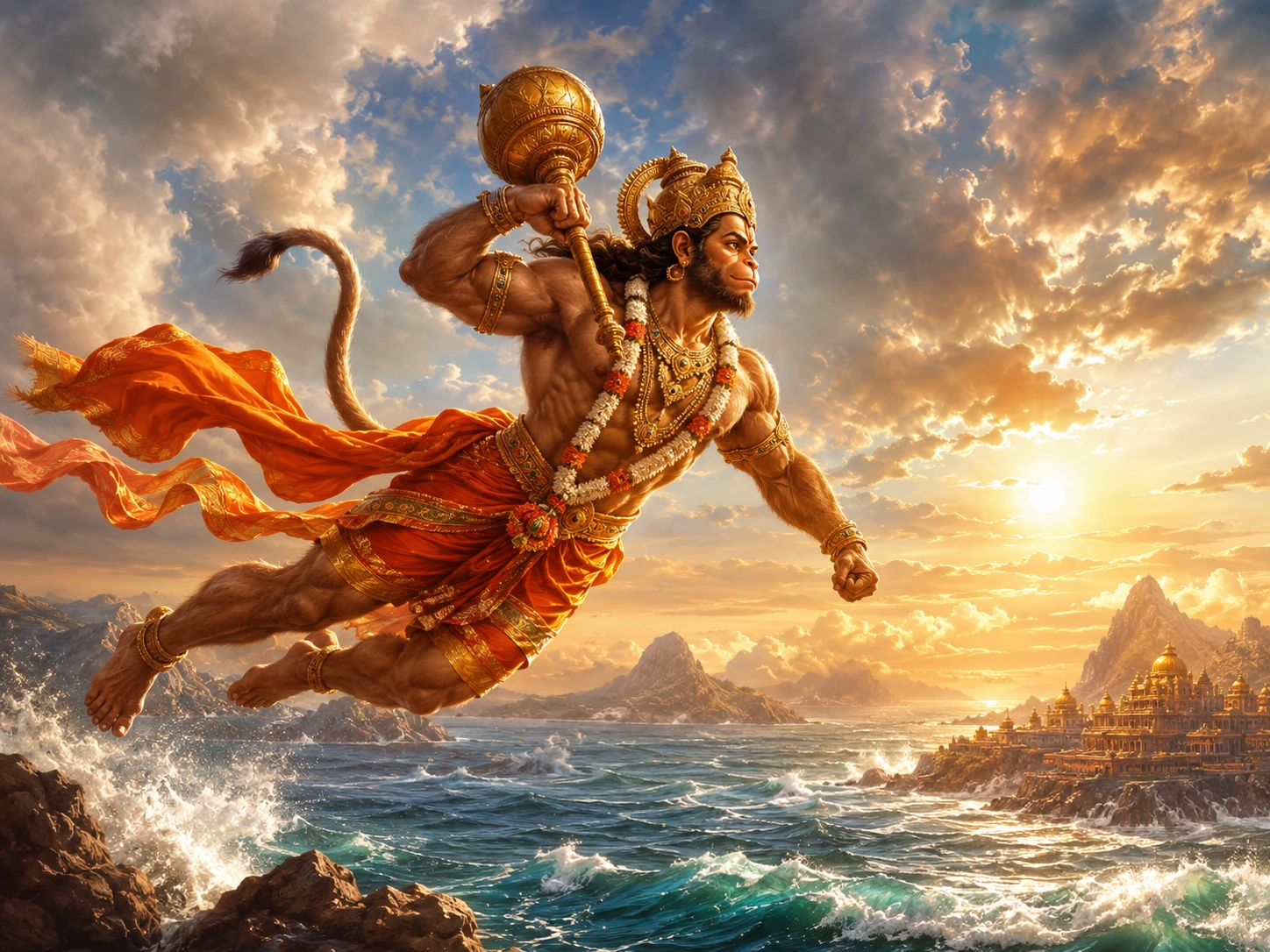
Hanuman's Leap Across the Ocean
हनुमान की समुद्र-लंघन गाथा
The scene begins at the southern tip of India. The Vanara army has tracked Sita to Lanka, an island fortress across a vast ocean. Now they need someone to cross it. Not the entire army -- just one scout, fast enough to fly, smart enough to search an enemy city, and loyal enough to bring back accurate intelligence. The task is volunteer-only because it is functionally suicidal.
Angada, the crown prince, can make it but might not come back. Jambavan is too old. The other Vanaras can manage 30, 50, 80 yojanas -- but not 100. One by one they state their limits. Then Jambavan turns to Hanuman, who has been sitting quietly in a corner, and delivers the most important pep talk in Indian literature: 'You are the son of Vayu. You leapt for the sun as a child. You can do this. You have simply forgotten.'
This is Valmiki Ramayana, Kishkindha Kanda, Sargas 66-67 transitioning into Sundara Kanda, Sarga 1. The leap across the ocean is the bridge between the two kandas -- literally the hinge of the entire epic. Everything before this is setup. Everything after is payoff.
Hanuman stands on Mount Mahendra (identified with the Mahendragiri hills in modern Odisha-Andhra border region). He presses the mountain with his feet, and it trembles. Trees shed flowers. Animals scatter. He grows in size -- Valmiki describes him expanding like an ocean during high tide. Then he launches.
The physics, naturally, are mythological. But the emotional architecture is surgical. Valmiki spends more verses on Hanuman's doubt and Jambavan's encouragement than on the actual flight. The takeaway is clear: the hardest part of any impossible journey is not the distance. It is believing you can begin.
For the IIT-JEE aspirant staring at a syllabus that feels like 100 yojanas -- organic chemistry, calculus, electromagnetic theory stretching to the horizon -- the lesson is structural. You do not need someone to carry you across. You need a Jambavan to remind you that you already have the capacity. The difference between the student who cracks JEE and the one who does not is often not talent but the moment someone says: you can do this.
The leap itself covers roughly 800 miles if we use the traditional yojana-to-mile conversion (1 yojana is approximately 8 miles, though scholars debate this). Hanuman crosses at enormous speed, his shadow racing across the water below, sea creatures leaping in awe. Valmiki's imagery is cinematic -- he compares Hanuman to a comet, to Garuda, to a mountain with wings. The ocean itself, personified as Sagara, watches in respect.
But the journey is not a straight line. Three obstacles rise to test Hanuman, and each one represents a different category of challenge that anyone on a difficult mission will face.
स सागरमनाधृष्यमभ्येत्य वरुणालयम्। जगामाकाशमाविश्य वेगेन गरुडोपमः॥
sa sāgaramanādhṛṣyamabhyetya varuṇālayam | jagāmākāśamāviśya vegena garuḍopamaḥ ||
Approaching that impassable ocean -- the abode of Varuna -- he soared into the sky with the speed of Garuda himself.
— Valmiki Ramayana, Sundara Kanda, 1.40
The first obstacle is Mainaka, a golden mountain that rises from the ocean floor. Mainaka is not hostile -- quite the opposite. He offers Hanuman a place to rest. The ocean (Sagara), indebted to Rama's ancestor King Sagara, has asked Mainaka to surface and provide a resting spot. Mainaka's offer is genuine, comfortable, and well-intentioned.
This is the most dangerous kind of obstacle: the temptation of legitimate rest. Hanuman has been flying hard. A break makes tactical sense. But he declines -- graciously, with a touch to Mainaka's summit, but without stopping. He explains that he cannot rest until the mission is complete.
Every professional who has ever been offered a comfortable lateral transfer instead of pursuing a risky promotion understands Mainaka. The NRI software engineer in the Bay Area whose current job pays well, whose H-1B is stable, whose children are settled in good schools -- and who is thinking about leaving it all to start a company back in India. Mainaka is the golden cage of comfort. It is not wrong. It is just not the mission.
The second obstacle is Surasa, mother of the Nagas, who appears as a massive she-demon and opens her mouth wide enough to swallow Hanuman whole. The gods have sent her as a test. She says: 'No one passes me without entering my mouth -- it is Brahma's boon.' Hanuman faces a divine paradox -- he cannot fight a being sanctioned by the gods, but he cannot enter her mouth and continue his journey.
His solution is pure genius. He shrinks to the size of a thumb, darts into Surasa's mouth and out again in an instant, then resumes his normal size. 'I have entered your mouth and exited,' he says. 'Your boon is fulfilled.'
This is creative problem-solving at its finest. When the rules seem to create an impossible bind, redefine the scale of engagement. Do not fight the constraint -- satisfy it on your own terms. The IAS officer who faces a politically mandated transfer and turns it into a chance to reform a neglected district is using Hanuman's Surasa strategy. The startup that pivots from hardware to SaaS because the market changed is entering the mouth and coming out the other side.
The third obstacle is Simhika, a genuine threat. She is a rakshasi who catches prey by grabbing their shadow -- she seizes Hanuman's shadow on the water, dragging him downward. Unlike Mainaka (comfort) and Surasa (divine constraint), Simhika represents raw, unexpected violence -- the obstacle that cannot be reasoned with or cleverly navigated. Hanuman must fight. He enters her gaping mouth, expands inside her, and tears her apart from within.
Simhika is the market crash that wipes out your portfolio, the layoff email on a Monday morning, the medical diagnosis that stops your world. There is no clever workaround for a Simhika -- you go through it, you survive it, and you keep moving. The CRPF jawan who walks into an ambush in Bastar and fights out of the kill zone is facing a Simhika. The single mother in a Dharavi chawl who loses her factory job during Covid and stitches masks at home to feed her children is tearing the demon apart from the inside.
After these three tests, Hanuman sights Lanka atop Mount Trikuta. He shrinks to a small form, lands on a hilltop, and observes the city's fortifications at sunset. Sundara Kanda, Sarga 2 describes Lanka as a city of gold, fortified by Vishwakarma himself, patrolled by Rakshasa guards -- beautiful and terrifying in equal measure.
The structural brilliance of the three obstacles is that they escalate in severity while testing different capabilities:
Mainaka tests discipline -- the ability to refuse comfort. Surasa tests intelligence -- the ability to solve unsolvable problems. Simhika tests courage -- the ability to fight when there is no alternative.
Together they form a complete examination of the qualities needed for any truly important mission. The UPSC General Studies paper practically writes itself from this framework.
What Valmiki achieves in these sargas is more than narrative excitement. He establishes that Hanuman's greatness is not raw power. It is judgment. At every stage, Hanuman could have used brute force -- smashed Mainaka aside, fought Surasa head-on, simply outrun Simhika. Instead, he matches his response to the nature of each challenge. Proportional, precise, appropriate. This is the difference between a soldier and a strategist, between a coder who writes functioning code and an architect who designs elegant systems.
The ocean crossing takes a single night. By dawn, Hanuman is perched on the hills outside Lanka, planning his next move. Behind him: the impossible ocean, three conquered obstacles, and the awakening of powers he had forgotten he possessed. Ahead: the Sundara Kanda -- the most recited, most beloved, most parayana-worthy book of the Ramayana.
For the student facing boards next month, the professional launching a new venture, the patient beginning a difficult treatment -- Hanuman's leap says one thing with absolute clarity: the obstacle is not the ocean. The obstacle is the moment before you jump.
Three Obstacles of the Ocean Crossing
| Obstacle | Nature | Hanuman's Response | What It Tests | Modern Equivalent |
|---|---|---|---|---|
| Mainaka (Golden Mountain) | Benevolent comfort -- rest offered mid-mission | Gracious decline with a respectful touch | Discipline -- refusing valid temptation | Stable corporate job vs. risky entrepreneurship |
| Surasa (Naga Mother) | Divine constraint -- must enter her mouth to pass | Shrinks to thumb-size, enters and exits instantly | Intelligence -- creative problem-solving within rules | Regulatory compliance that seems to block innovation |
| Simhika (Shadow-Grabber) | Raw violence -- seizes shadow, drags downward | Enters her body, expands, destroys from within | Courage -- surviving what cannot be negotiated | Market crash, layoff, medical emergency |
The three obstacles form an escalating difficulty curve -- from soft temptation to hard violence -- mirroring real-world challenge progression.
NASA's 2002 satellite imagery of the Palk Strait between India and Sri Lanka shows a 30-mile chain of limestone shoals -- the Ram Setu (Adam's Bridge). The Ramayana describes Nala and Nila building the bridge for the army crossing, but Hanuman's solo aerial crossing happened before the bridge was built. Geologists at the National Institute of Oceanography, Goa, have dated the formation to roughly 7,000 years ago -- though the man-made vs. natural debate continues. Either way, the strait Hanuman crossed is real geography, and fishermen in Rameswaram still point to the shoals as 'Hanuman's runway.'
Begin Your Own Leap -- Sundara Kanda Parayana
Read the Sundara Kanda sarga by sarga on Eternal Raga, with Sanskrit, transliteration and meaning, and complete your own hundred-yojana journey.
Eternal Raga · शाश्वत राग
Institutional voice — scholarly articles on Sanatan Dharma
Deepen Your Understanding
अपनी समझ और गहरी करें
deities avatars
Hanuman -- The Perfect Devotee
He could lift mountains, leap oceans, and burn Lanka to the ground -- yet his greatest power was this: he never forgot whose work he was doing. Hanuman is not just a mythological hero. He is the operating system of selfless devotion that India still runs on.
scriptural exegesis
Why Sundara Kanda is the Most Revered
It is the only book of the Ramayana named after a quality, not a place. It is the only one where Rama is absent from the action. And it is the most recited, most parayana'd, most trusted text in living Hindu practice. Why does Sundara Kanda hold this unmatched position?
deities avatars
Rama -- Ideal of Dharmic Living
Why does India still name its sons after a prince who chose exile over a throne? Rama's life is not a fairy tale -- it is a manual for dharmic decision-making under impossible pressure. From boardrooms to battlefields, his choices remain the hardest moral benchmark in civilization.
scriptural exegesis
Sugriva's Search for Sita -- The Intelligence Network Hidden in the Ramayana
No phones, no satellites, no maps. Yet Sugriva found Sita across an entire continent. He did not send a random army -- he built a four-directional intelligence network with designated leaders, precise geographical routes, and a strict one-month deadline. Kishkindha Kanda, Sargas 40-43, reads less like an ancient epic and more like a military operations manual. The Ramayana was not just telling a story. It was teaching strategy.
scriptural exegesis
7 Chiranjeevis -- The Immortals of Hindu Tradition
Seven beings who will not die until the end of this cosmic age. One is cursed to wander in agony. One rules the underworld. One compiled every scripture you have ever read. One is the most worshipped deity in India. The Chiranjeevis are not a mythology trivia list -- they are a map of how immortality works in Hindu thought, and why it is not always a blessing.
scriptural exegesis
Non-Human Races of the Epics -- Vanaras, Nagas, Yakshas & Beyond
Hindu mythology is not a two-player game between gods and humans. The epics describe at least eight distinct non-human civilisations -- forest-dwelling Vanaras with their own kingdoms and politics, serpentine Nagas with underground empires, shape-shifting Rakshasas with advanced technology, celestial Gandharvas who controlled music, and wealth-guarding Yakshas. This is the Mahabharata's multiverse -- and it was written millennia before Marvel.
NASA's 2002 satellite imagery of the Palk Strait between India and Sri Lanka shows a 30-mile chain of limestone shoals -- the Ram Setu (Adam's Bridge). The Ramayana describes Nala and Nila building the bridge for the arm…
More in Scriptural Exegesis
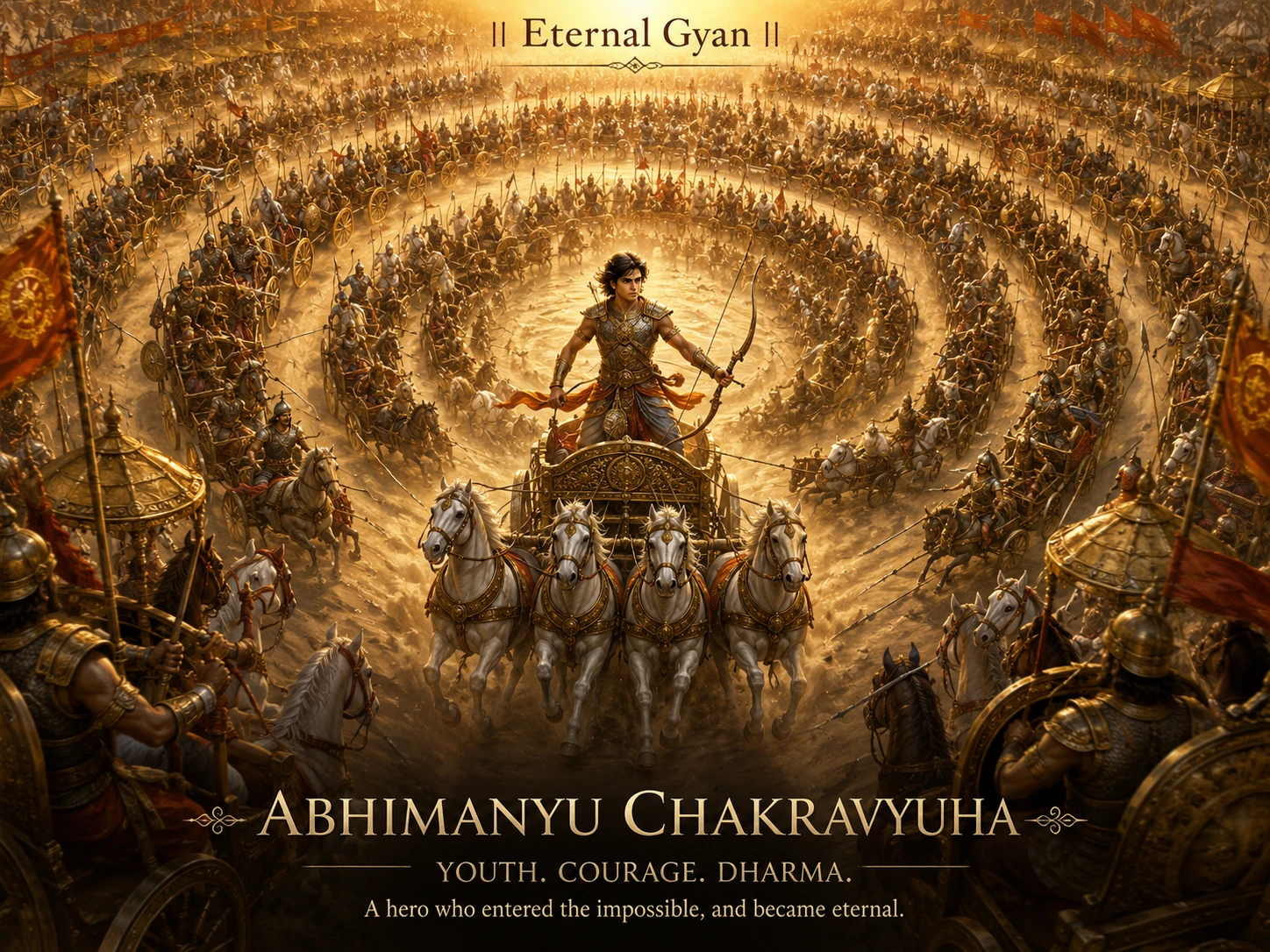
Abhimanyu and the Chakravyuha -- The Boy Who Knew How to Enter but Not How to Leave
14 min read
Adbhuta Ramayana -- The Ramayana Where Sita Becomes Kali
9 min read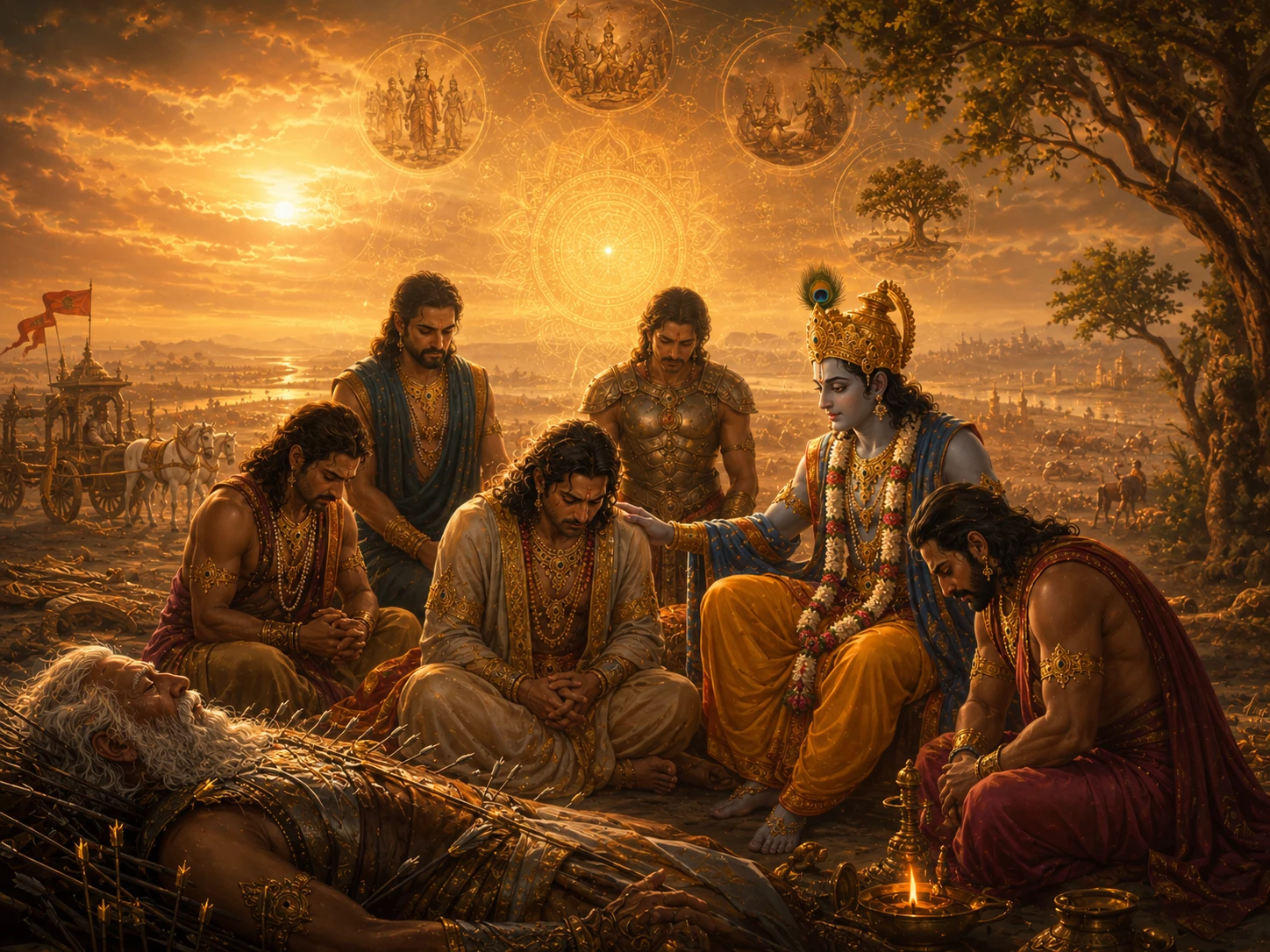
After Kurukshetra -- What Happened Next
14 min readThe same translation error that turned '33 Koti' into '33 crore' in Hinduism also happened in Buddhism. The Chinese translation of Buddhist texts rendered 'Sapta Koti Buddha' (7 Supreme Buddhas) as '7 Crore Buddhas.' The…
Deities AvatarsCommunity Reflections
🕉️
Be the first to share your reflection.