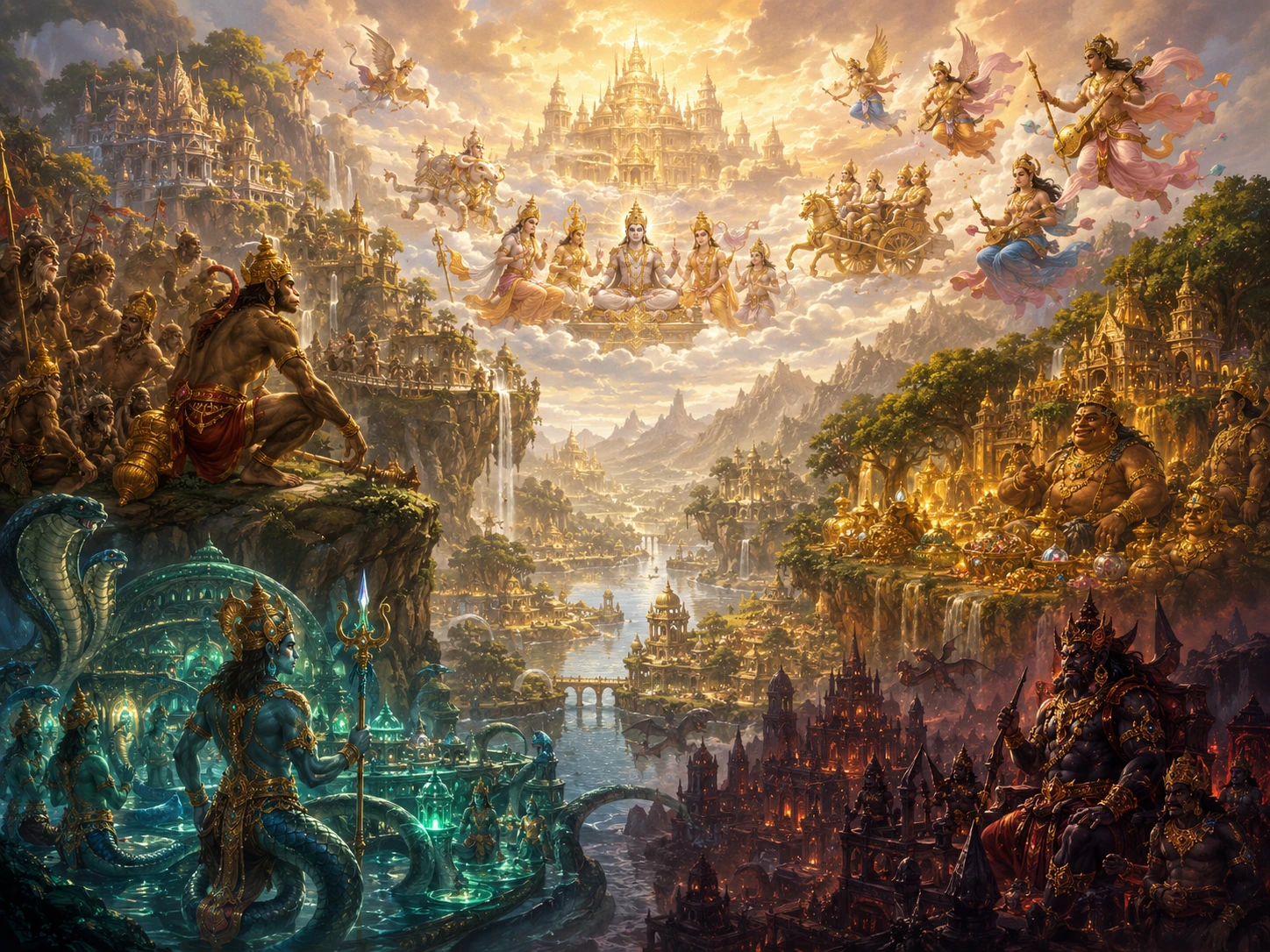
Non-Human Races of the Epics -- Vanaras, Nagas, Yakshas & Beyond
महाकाव्यों की अमानव जातियाँ -- वानर, नाग, यक्ष और अन्य
Open the Ramayana and the Mahabharata with fresh eyes and you notice something that children's retellings consistently flatten: these epics are not stories about humans and gods. They are stories about an entire ecosystem of sentient species -- multiple civilisations with distinct biologies, territories, governance structures, technologies, and cultural practices -- all interacting, intermarrying, forming alliances, waging wars, and shaping the course of cosmic history.
The Vanaras of Kishkindha are not 'monkeys'. They are a forest-dwelling civilisation with a king (Sugriva), a deposed emperor (Vali), a military commander (Hanuman), a council of ministers, a spy network that spans the subcontinent, and the engineering capability to build a bridge across the ocean. The Nagas are not 'snakes'. They are a subterranean civilisation with their own capital (Bhogavati in Patala Loka), a king (Vasuki, later Takshaka), marriage alliances with human royal families (Arjuna married the Naga princess Ulupi), and enough political power to provoke Janamejaya's apocalyptic Sarpa Satra. The Rakshasas are not simply 'demons'. Lanka under Ravana was described as a golden city with advanced vimana technology, sophisticated urban planning, and a king who was a Brahmin scholar and Shiva devotee.
What we have in the Hindu epics is not fantasy. It is worldbuilding on a scale that modern fiction is only now approaching -- a multi-species, multi-dimensional civilisational framework where humans are not the centre of the story but one species among many.
This article maps the major non-human races of the epics, their territories, their key figures, their relationships with humans, and the philosophical implications of a cosmos where sentience is not limited to Homo sapiens.
देवदानवगन्धर्वा यक्षराक्षसपन्नगाः। न शक्नुवन्ति तं द्रष्टुं मर्त्यः किमु सत्त्वजः॥
devadānavagandharva yakṣarākṣasapannagāḥ | na śaknuvanti taṃ draṣṭuṃ martyaḥ kimu sattvjaḥ ||
Devas, Danavas, Gandharvas, Yakshas, Rakshasas, and Pannagas (Nagas) -- even they cannot behold That. What then of mortals born of matter?
— Mahabharata, Anushasana Parva (taxonomy of sentient beings referenced in discussions of Brahman)
The Major Non-Human Races of Hindu Mythology
| Race | Sanskrit | Realm | Key Figures | Role in Epics | Modern Resonance |
|---|---|---|---|---|---|
| Vanaras | वानर | Kishkindha (Southern forests) | Hanuman, Sugriva, Vali, Angada, Jambavan | Rama's allies; built Rama Setu; Sundara Kanda espionage | Special forces; guerrilla intelligence; distributed teamwork |
| Nagas | नाग | Patala Loka / Bhogavati | Vasuki, Takshaka, Shesha, Ulupi, Astika | Samudra Manthan; Arjuna's marriage to Ulupi; Parikshit's death; Sarpa Satra | Underground networks; diplomatic marriages; geopolitical alliances |
| Rakshasas | राक्षस | Lanka; various forest kingdoms | Ravana, Kumbhakarna, Vibhishana, Ghatotkacha, Hidimba | Primary antagonists of Ramayana; Bhima's wife Hidimbi; Ghatotkacha in Kurukshetra | Technological power without dharma; surveillance states; misused innovation |
| Yakshas | यक्ष | Alaka (Kubera's city); forests and lakes | Kubera, the Yaksha of the Lake (Yaksha Prashna) | Wealth guardians; Kubera's flying Pushpaka Vimana (stolen by Ravana); Yudhishthira's test | Central bankers; wealth custodians; institutional governance |
| Gandharvas | गन्धर्व | Celestial realms | Chitrasena, Tumburu, Vishvavasu | Celestial musicians; trained Arjuna in music/dance during exile; Gandharva Vivaha marriage form | Musicians; cultural ambassadors; soft power diplomacy |
| Kinnaras | किन्नर | Mountain regions near Kailasa | Kinnara-Kinnari pairs | Horse-headed celestial musicians; associated with devotion and romantic fidelity | Trans and non-binary identity in Indian tradition; third gender recognition |
| Apsaras | अप्सरा | Indra's court (Amaravati) | Urvashi, Menaka, Rambha, Tilottama | Celestial dancers; sent to disrupt tapasya; Urvashi cursed Arjuna; Menaka seduced Vishwamitra | Beauty industry; distraction as geopolitical weapon; honey traps |
| Danavas / Asuras | दानव / असुर | Various subterranean realms | Hiranyakashipu, Mahabali, Vritra, Narakasura | Cosmic adversaries of Devas; not 'evil' but driven by ambition and ego | Disruptors; anti-establishment forces; innovators who challenge the status quo |
These are not 'monsters'. Each race has its own dharma, its own virtues, and its own civilisational achievements. The epics treat them as sovereign peoples, not as props for human heroism.
The Vanara Question -- Were They Really Monkeys?
The most debated non-human race is the Vanaras. The word 'vanara' is often translated as 'monkey', but the Sanskrit etymology is revealing: 'vana' means forest, and 'nara' means man. A vanara is literally a 'forest-man' -- a being that lives in the forest and has human-like qualities. The Ramayana describes Vanaras as capable of speech, political organisation, strategic thinking, emotional complexity, architectural construction (the Rama Setu), and deep devotion. Hanuman quotes Vedic scripture. Sugriva holds a court. Angada conducts diplomacy. These are not behaviours associated with primates.
Some scholars interpret the Vanaras as a tribal forest-dwelling human community that the Aryan-centric narrative of the Ramayana coded as 'monkey-like'. Others suggest they represent an actual hominid species -- perhaps a memory of contact between Homo sapiens and another species like Homo erectus or Denisovans, preserved in oral tradition over millennia. The Mahabharata tradition, where Bhima marries Hidimbi (a Rakshasi) and has a son Ghatotkacha who fights at Kurukshetra, similarly suggests routine interaction and intermarriage between human and non-human communities.
The Nagas are equally complex. They are described as shape-shifters who can appear human or serpentine. They have an entire subterranean civilisation. Arjuna lived among them during his exile. The Naga princess Ulupi saved Arjuna's life using a magical gem. Takshaka, a Naga king, killed Parikshit -- Arjuna's grandson -- which triggered Janamejaya's Sarpa Satra (serpent sacrifice), the framing narrative of the entire Mahabharata.
In modern India, Naga worship is alive. Nag Panchami is a major festival. Naga stones (naga-kal) are found outside thousands of temples in Karnataka, Kerala, and Tamil Nadu. The Naga tradition appears to be one of the oldest pre-Vedic religious strata in the subcontinent, later absorbed into the Puranic framework.
The philosophical takeaway is significant. The Hindu epics present a cosmos where sentience is distributed across multiple species and realms. Dharma is not a human monopoly. Nagas have dharma. Vanaras have dharma. Even Rakshasas like Vibhishana choose dharma over kinship. This is a worldview of radical inclusivity -- one where the moral universe extends far beyond the boundaries of a single species.
The Mahabharata's framing narrative itself is a cross-species event. The entire epic is narrated by Vaishampayana to King Janamejaya during his Sarpa Satra -- a massive fire ritual intended to exterminate all Nagas (serpents) from the earth. The reason? A Naga king, Takshaka, killed Janamejaya's father Parikshit. The ritual is eventually stopped by a young Brahmin boy named Astika, who is himself half-Naga (his mother Manasa is a Naga princess). So the Mahabharata is literally a story told to prevent a genocide -- and the person who prevents it is a mixed-species child. That framing is not incidental. It is the Mahabharata's final commentary on coexistence.
Chant Hanuman Chalisa -- The Vanara's Devotion
Hanuman is the supreme example of a being whose devotion transcended species. Chant the Hanuman Chalisa, which is on Eternal Raga with its meaning.
Tags
Eternal Raga · शाश्वत राग
Institutional voice — scholarly articles on Sanatan Dharma
Deepen Your Understanding
अपनी समझ और गहरी करें
scriptural exegesis
Pandavas in Hell -- The Shocking Finale of the Mahabharata
The Mahabharata does not end with victory. It ends with the heroes falling dead on a Himalayan climb, the villains seated in heaven, and the one righteous king demanding to be sent to hell. The Swargarohana Parva is the most unsettling, most philosophically radical, and most misunderstood finale in all of world literature.
scriptural exegesis
After Kurukshetra -- What Happened Next
The war ended. The Pandavas won. And then everything fell apart. Krishna's clan destroyed itself in a drunken brawl. Dwaraka sank into the sea. Arjuna's divine powers vanished. And the five brothers who fought the greatest war in history walked into the Himalayas to die. The Mahabharata's post-war chapters are darker, stranger, and more relevant than the war itself.
scriptural exegesis
Sugriva's Search for Sita -- The Intelligence Network Hidden in the Ramayana
No phones, no satellites, no maps. Yet Sugriva found Sita across an entire continent. He did not send a random army -- he built a four-directional intelligence network with designated leaders, precise geographical routes, and a strict one-month deadline. Kishkindha Kanda, Sargas 40-43, reads less like an ancient epic and more like a military operations manual. The Ramayana was not just telling a story. It was teaching strategy.
scriptural exegesis
Hanuman's Leap Across the Ocean
100 yojanas of open ocean. Three supernatural obstacles. Zero backup. Hanuman's leap to Lanka is not just mythology's greatest action sequence -- it is a masterclass in overcoming self-doubt, navigating temptation, and executing under impossible pressure.
scriptural exegesis
Samudra Manthan -- When Gods and Demons Ran a Joint Venture and the Universe Almost Died
A cosmic ocean. A mountain for a churning rod. A serpent king for a rope. Gods on one end, demons on the other. And out came 14 treasures -- including wealth, beauty, medicine, immortality, and one poison so lethal it could end creation itself. The Samudra Manthan is not mythology. It is the original playbook for collaboration, crisis management, and how to handle it when your joint venture partner tries to cheat you.
deities avatars
Dashavatara -- Why Vishnu Comes Back Ten Times
Fish, tortoise, boar, half-lion, dwarf, axe-warrior, prince, cowherd, enlightened teacher, future horseman. The ten avatars of Vishnu are not random folklore. Read them in sequence and you get something startling -- a narrative that mirrors evolutionary biology, tracks the rise and fall of political systems, and argues that God does not sit above history but enters it, gets dirty, and does the work. The Dashavatara is Hinduism's answer to the question every civilisation asks: why does the world keep breaking, and who fixes it?
The Mahabharata's framing narrative itself is a cross-species event. The entire epic is narrated by Vaishampayana to King Janamejaya during his Sarpa Satra -- a massive fire ritual intended to exterminate all Nagas (serp…
More in Scriptural Exegesis
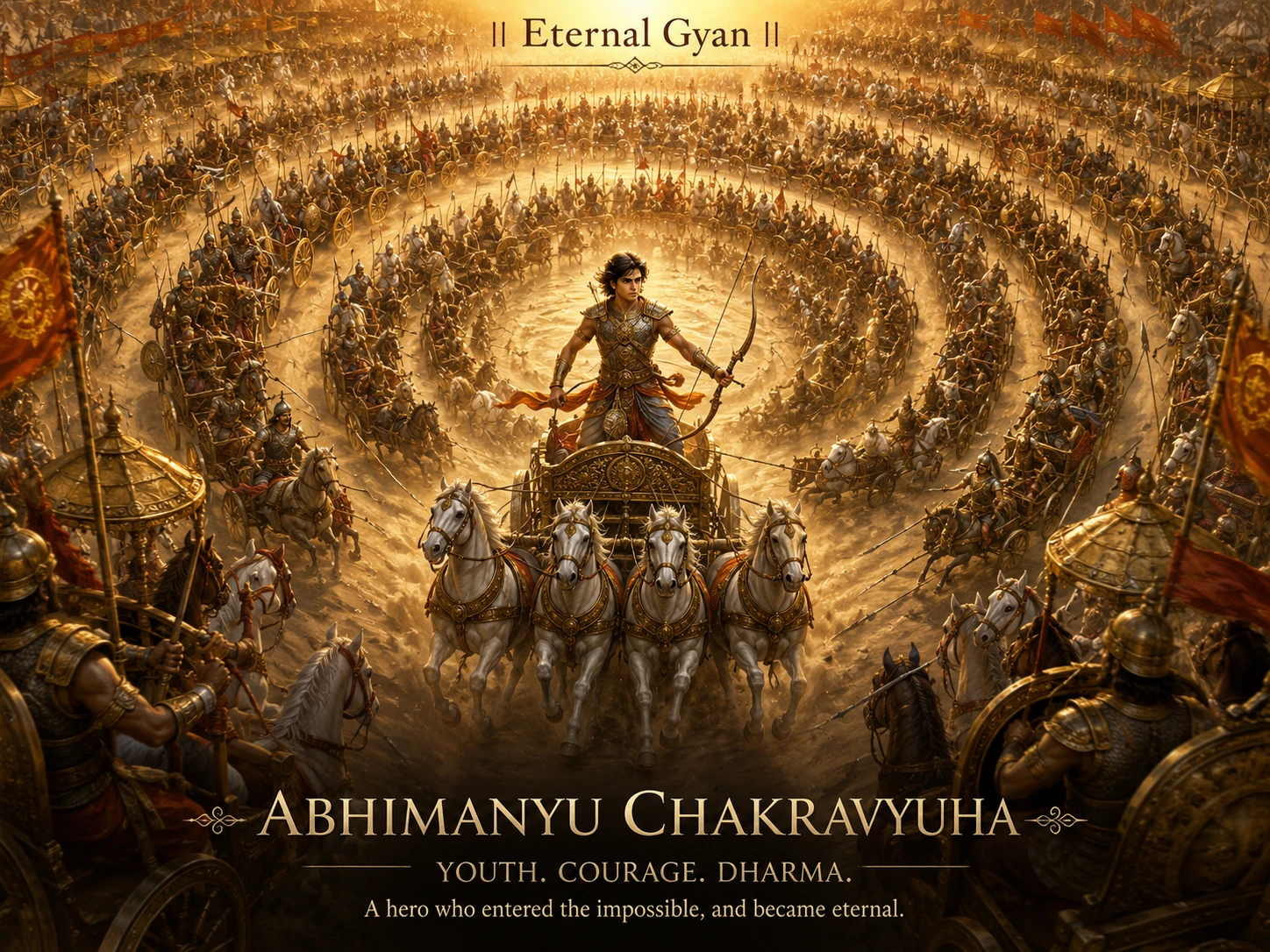
Abhimanyu and the Chakravyuha -- The Boy Who Knew How to Enter but Not How to Leave
14 min read
Adbhuta Ramayana -- The Ramayana Where Sita Becomes Kali
9 min read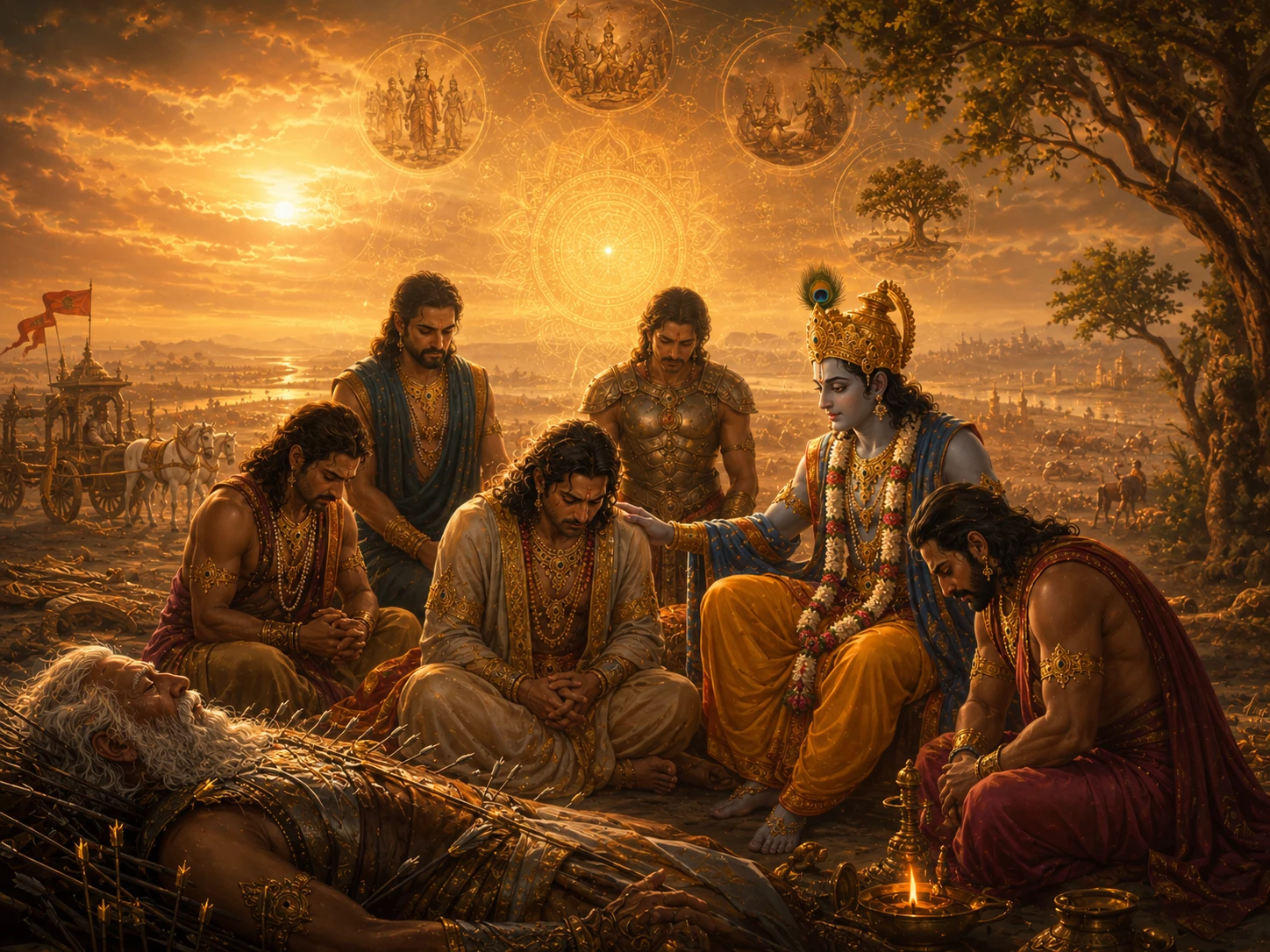
After Kurukshetra -- What Happened Next
14 min readThe same translation error that turned '33 Koti' into '33 crore' in Hinduism also happened in Buddhism. The Chinese translation of Buddhist texts rendered 'Sapta Koti Buddha' (7 Supreme Buddhas) as '7 Crore Buddhas.' The…
Deities AvatarsCommunity Reflections
🕉️
Be the first to share your reflection.