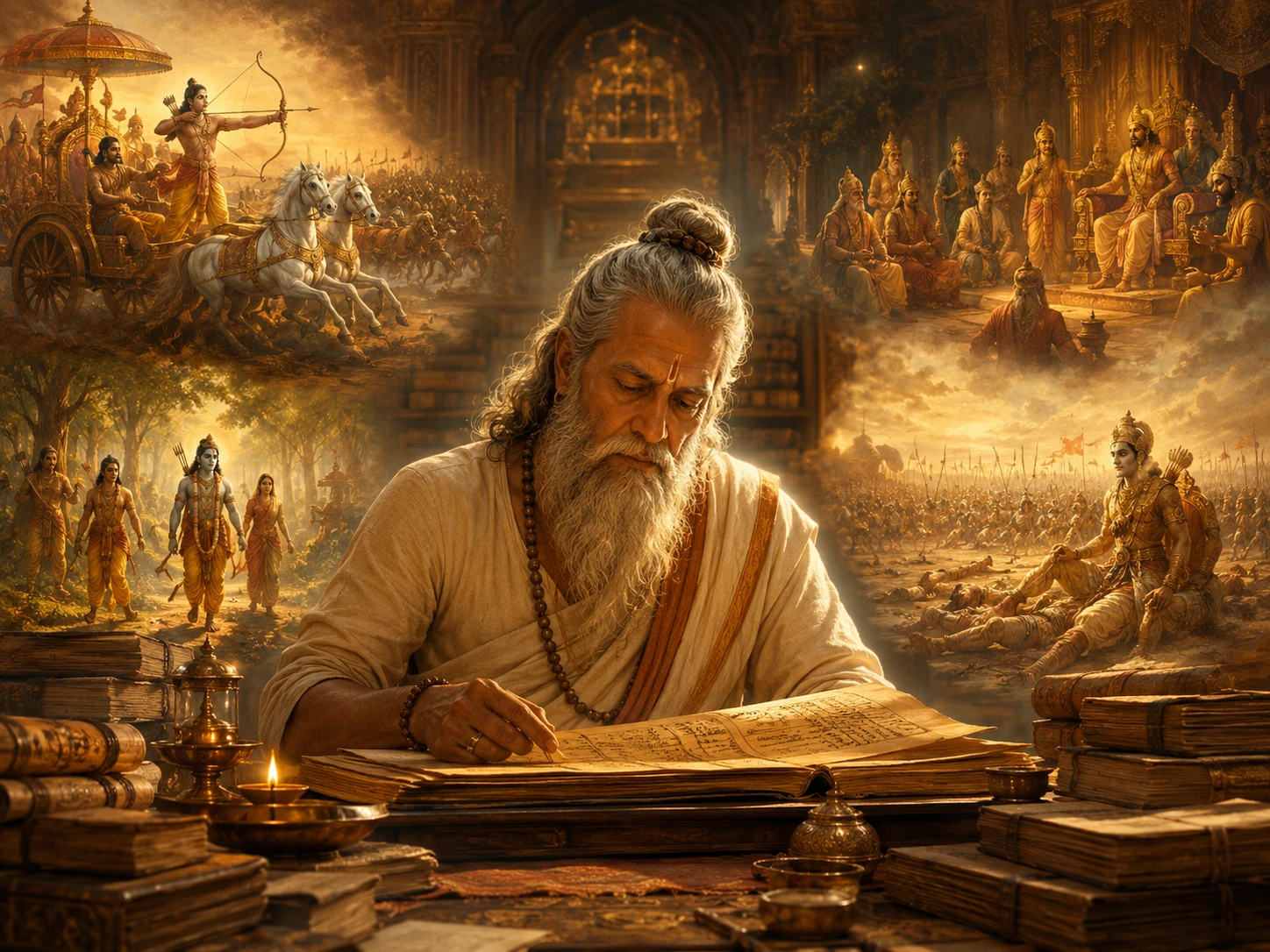
Sugriva's Search for Sita -- The Intelligence Network Hidden in the Ramayana
सुग्रीव की सीता-खोज -- रामायण में छिपा गुप्तचर तन्त्र
The Search That Changed Everything
Imagine this scenario. A hostile force has abducted a high-value individual. The abductor is powerful, his exact location uncertain, and he could be hiding anywhere across an area stretching from the Himalayas to the southern ocean. You have no communication technology, no aerial surveillance, no GPS. All you have is a large but disorganized force of warriors, a king who has just regained his throne, and a desperate husband with a bow.
This is the situation Rama and Sugriva face in Kishkindha Kanda, the fourth book of the Valmiki Ramayana. And what Sugriva does next is not the action of a primitive forest king improvising under pressure. It is a masterclass in strategic planning that would not look out of place in a modern military command centre.
Sugriva does not send his entire army in one direction and hope for the best. He does not rely on a single hero. Instead, he divides the known world into four operational sectors, assigns a dedicated commander to each, provides detailed geographical briefings about every terrain they will cross, specifies landmarks to guide navigation, and sets a hard deadline of one month. This is Sargas 40 through 43 of Kishkindha Kanda -- and if you read them carefully, you are reading the oldest documented distributed search operation in world literature.
एष सर्वो हरिगणो मत्प्रतिज्ञामनुस्मरन्। आज्ञाप्यतां महाबाहो किं करोमीति राघव॥
eṣa sarvo harigaṇo matpratijñāmanusmaran | ājñāpyatāṃ mahābāho kiṃ karomīti rāghava ||
This entire host of vanaras stands assembled, remembering my pledge. Command them, O mighty-armed Raghava -- tell us what must be done.
— Valmiki Ramayana, Kishkindha Kanda, Sarga 39
The Assembly -- How Sugriva Mobilized the Force
Before the search could begin, Sugriva needed to assemble his forces. Kishkindha Kanda, Sargas 37-39 describe how Hanuman was dispatched to summon vanaras from mountains across the subcontinent -- Mahendra, Himalaya, Vindhya, Kailash, Mandara, Anjana, and Meru. The scale of mobilization was staggering. Chiefs arrived with their individual armies: Shatabali, Sushena (father of Queen Tara), Kesari (father of Hanuman), Gavaksha, Dhumra, Panasa, Nila, Jambavan, Angada, Gandhamadana, Mainda, Dwivida, Nala, and dozens more.
What is remarkable here is the chain of command. Sugriva did not simply issue a general order. He personally briefed each directional team with geographical intelligence so detailed that scholars have spent centuries trying to map it onto real-world geography. This was not a king saying 'go find her.' This was a commander-in-chief issuing operational orders with sector-specific intelligence packets.
In a modern UPSC General Studies paper on Indian administrative systems, Sugriva's mobilization would qualify as a case study in rapid force assembly, decentralized command structure, and intelligence-driven deployment. The man who was mocked by Lakshmana for wasting the monsoon season in pleasure turned out to be one of the most methodical military planners in ancient literature.
Four Directions, Four Commanders, One Deadline
The genius of Sugriva's plan lay in its architecture. He did not scatter forces randomly. He divided the entire known world into four operational zones and assigned each to a commander whose strengths matched the terrain.
The Eastern sector (Sarga 40) went to Vinata, with approximately one lakh vanara warriors. Sugriva briefed them on the geography stretching from the Brahmamalaya mountains through the rivers Bhagirathi and Sarayu to the far eastern islands -- essentially the entire eastward expanse of Jambudvipa including what we now call Southeast Asia. He described specific landmarks: the golden Shalmali Island, the mansion of Garuda, and Mount Udaya where the sun rises. This was not vague hand-waving. This was terrain intelligence.
The Southern sector (Sarga 41) received the elite team -- Angada as field commander, with Hanuman, Jambavan, and Nila as his principal operatives. Sugriva knew the south held the highest probability of success, and he stacked his best people there. The briefing covered the Vindhya mountains, rivers Narmada, Godavari, Krishnaveni, Mahanadi, and Kaveri, the provinces of Andhra, Chola, Pandya, and Kerala, and critically -- the island of Lanka across the southern ocean. Sugriva described Ravana's fortress and the golden walls of Lanka with a specificity that scholars like P.V. Vartak have argued reflects actual geographical knowledge.
The Western sector (Sarga 42) went to Sushena, father of Tara and son of the sage Mareecha, with two lakh warriors. The route covered Saurashtra, Bahlika, the Sindhu river, and a chain of oceanic mountains including Hemagiri, Pariyatra, Vajra, and Chakravana.
The Northern sector (Sarga 43) was commanded by Shatabali. The briefing described the Mleccha and Pulinda provinces, the Kuru and Madraka kingdoms, the Himalayas, Mount Kailash, Lake Manasarovar, Mount Krauncha, and the mysterious Uttara Kuru beyond the northern ocean.
Every team received the same instruction: search for Sita and for the residency of Ravana. And every team received the same hard deadline -- one month. After that, failure to return meant death.
Sugriva's Four-Directional Search Architecture
| Direction | दिशा | Commander | Sarga | Force Size | Key Terrain | Outcome |
|---|---|---|---|---|---|---|
| East | पूर्व | Vinata | 40 | ~1 lakh vanaras | Brahmamalaya, Bhagirathi, Sarayu, Shalmali Island, Mt. Udaya | Returned empty-handed |
| South | दक्षिण | Angada (with Hanuman, Jambavan, Nila) | 41 | Elite strike team | Vindhya, Godavari, Kaveri, Dandaka, Andhra, Chola, Pandya, Lanka | SUCCESS -- Sita located via Sampati |
| West | पश्चिम | Sushena (son of Sage Mareecha) | 42 | ~2 lakh vanaras | Saurashtra, Bahlika, Sindhu, Hemagiri, Mt. Meru | Returned empty-handed |
| North | उत्तर | Shatabali | 43 | Large contingent | Kuru, Madraka, Himalayas, Kailash, Manasa, Uttara Kuru | Returned empty-handed |
Each team received a one-month deadline. Only the southern party under Angada succeeded, and that too through HUMINT -- human intelligence from the vulture Sampati, brother of Jatayu, who had witnessed Ravana carrying Sita toward Lanka. Source: Valmiki Ramayana, Kishkindha Kanda, Sargas 40-43.
The Intelligence Doctrine Behind the Search
When a cybersecurity analyst at an IIT Bombay lab or a RAW training officer at the Intelligence Bureau Academy in Rajpura looks at Sugriva's operational design, they would recognize at least five principles that modern intelligence doctrine considers foundational.
First, Distributed Search. Instead of concentrating all resources in one direction, Sugriva ran four parallel operations. This is the same principle behind modern search-and-rescue operations run by the NDRF or the Indian Coast Guard -- when the search area is too vast, you divide it into sectors and assign dedicated teams to each.
Second, Decentralized Command. Each commander -- Vinata, Angada, Sushena, Shatabali -- had full operational autonomy within their sector. Sugriva did not micromanage. He set the objective (find Sita, find Ravana's location), set the deadline, provided intelligence, and let his commanders execute. This is Mission Command, the doctrine that the Indian Army's recent transformation under the Integrated Theatre Command is built upon.
Third, Intelligence-Driven Deployment. Sugriva did not distribute forces equally. He sent the elite team south because his own intelligence (which commentators debate he partly obtained through Queen Tara, who had knowledge of Ravana's establishment) suggested the highest probability target was in that direction. In modern terms, he applied Bayesian probability to resource allocation.
Fourth, Redundancy. If the southern team failed, the eastern, western, and northern teams might still have found Sita. No single point of failure could collapse the entire operation. This is the same redundancy principle that ISRO builds into mission-critical systems.
Fifth, Hard Deadline with Consequences. One month, and the penalty for exceeding it was death. In project management terms, this is a hard milestone with non-negotiable consequences -- the kind of deadline that separates a JEE aspirant's final revision week from casual studying.
तत्र सीतां च वैदेहीं निलयं रावणस्य च। मार्गध्वं गिरिदुर्गेषु वनेषु च नदीषु च॥
tatra sītāṃ ca vaidehīṃ nilayaṃ rāvaṇasya ca | mārgadhvaṃ giridurgeṣu vaneṣu ca nadīṣu ca ||
Search for Sita, the princess of Videha, and also for the abode of Ravana -- in mountain fortresses, in forests, and along the rivers.
— Valmiki Ramayana, Kishkindha Kanda, Sarga 40, Verse 19-20
The Southern Party -- Why the Best Team Got the Hardest Sector
Sugriva's most brilliant move was personnel selection for the southern sector. He did not assign it to a random chief. He sent Angada, the crown prince and son of Vali -- a young leader with something to prove, burning with the fire of a youth whose father had just been killed. With him went Hanuman, the most intelligent and resourceful of all vanaras, and Jambavan, the elder statesman with the longest memory and deepest strategic instincts.
This team composition reveals Sugriva's understanding of group dynamics. Angada provided the authority and the hunger. Hanuman provided the capability and the leap-of-faith courage. Jambavan provided the wisdom and the institutional memory. It was the perfect triangle: ambition, ability, and experience.
The southern team's journey itself reads like a startup founder's war story. They searched exhaustively through Vindhya, crossed rivers, combed through forests, and hit dead end after dead end. Morale collapsed. Angada considered mass suicide on the seashore rather than return to face Sugriva's death sentence for failure. It was at this lowest point that the intelligence breakthrough came -- not from their own searching, but from Sampati, the elderly vulture brother of Jatayu, who had witnessed Ravana carrying Sita southward toward Lanka.
In intelligence terminology, Sampati was a HUMINT (human intelligence) source who provided actionable intelligence that redirected the entire operation. Every search mission -- from the 26/11 Mumbai operations to disaster relief after the Uttarakhand floods -- has that one critical intelligence break that comes from an unexpected source. The Ramayana documented this pattern three millennia before modern intelligence agencies formalized it.
The geographical descriptions Sugriva gives in Kishkindha Kanda Sargas 40-43 are so detailed that they constitute the oldest recorded geographical survey in Indian literature. He names specific rivers (Narmada, Godavari, Kaveri, Sindhu), provinces (Andhra, Chola, Pandya, Kerala, Saurashtra, Kuru, Madraka), mountain ranges (Vindhya, Himalaya, Kailash), and even distant lands beyond the oceans. Scholars have used these descriptions to trace ancient Indian knowledge of Southeast Asia. In his briefing for the eastern party alone, Sugriva references terrain features that span from modern-day Bihar to Myanmar and beyond. DRDO's Project Pralay (a tactical ballistic missile) shares its name with the Sanskrit word for cosmic dissolution -- but the real Pralay in the Ramayana may be the information deluge Sugriva processed to plan this operation.
Modern Parallels -- From Sugriva's War Room to Your WhatsApp Group
The principles Sugriva used are not relics of a mythological past. They are alive in every modern system that handles complexity at scale.
When Google's search engine processes a query, it does not send one server to search the entire internet. It distributes the query across thousands of servers, each searching a defined sector of indexed data, all operating in parallel with a hard time limit. This is distributed computing -- and it is exactly what Sugriva did with his vanara forces.
When the Indian Navy conducts a search-and-rescue operation after a cyclone in the Bay of Bengal, it divides the search area into grids, assigns ships and aircraft to each grid, sets time windows, and maintains a central coordination point. The southern party's discovery of Sita through Sampati is the ancient equivalent of a maritime patrol aircraft picking up a distress signal from an unexpected quadrant.
When a startup CEO at WeWork Koramangala in Bengaluru divides her product team into squads -- one squad for payments, another for user experience, a third for backend infrastructure -- she is applying the same principle Sugriva applied: autonomous teams, clear objectives, defined territories, and a deadline.
Even the failure pattern matches. Three out of four teams returned empty-handed. In modern R&D, this is not waste -- it is the expected cost of covering all possibilities. Every pharmaceutical company that runs parallel drug trials, every venture capital firm that funds ten startups knowing eight will fail -- they are all operating on Sugriva's logic. You do not bet everything on one direction. You cover the map.
The Scholarly Controversy -- Did Sugriva Already Know?
No discussion of this episode is complete without addressing the elephant -- or rather, the vanara -- in the room. The Valmiki Ramayana itself contains a contradiction that commentators have debated for centuries.
In Sarga 7 of Kishkindha Kanda, Sugriva tells Rama that he knows nothing about Ravana -- neither his domain, nor his capabilities, nor his lineage. Yet in Sarga 41, when briefing the southern party, he describes Lanka with remarkable specificity, including its golden fortress walls and its location on an island across the southern ocean.
Sanskrit commentators have offered several explanations. Some argue Sugriva acquired this intelligence through Queen Tara, who had knowledge of Ravana's establishment from Vali's reign. Others suggest Sugriva deliberately withheld this information early on -- an 'official secret' to ensure Rama would first help him eliminate Vali before receiving the intelligence he needed. If Sugriva had told Rama where Ravana was from the start, Rama might have gone straight to Lanka and Sugriva's political goal of reclaiming Kishkindha would never have been fulfilled.
This interpretation makes Sugriva an even more fascinating figure. He is not just a military strategist but a political operator who understood the art of information leverage -- releasing intelligence at the moment when it served the broader strategic objective. In today's world, this is exactly what intelligence agencies do: withhold and release information based on strategic timing, not raw availability.
Yet there is a third possibility that the text itself acknowledges. Even if Sugriva suspected Ravana was in Lanka, he could not be certain Sita was still there. A kidnapper does not necessarily keep his captive in his own home. This is why Sugriva ordered the search in all four directions, repeating the instruction to search for both Sita and for the residency of Ravana -- hedging against the possibility that Ravana had moved Sita to a secondary location.
The southern search party's structure mirrors what modern organizational psychologists call a 'High-Performance Team' -- a small, diverse group with complementary skills and a shared high-stakes mission. Angada (authority and emotional drive), Hanuman (capability and initiative), Jambavan (wisdom and institutional memory), and Nila (tactical execution) together formed the optimal team composition. The Harvard Business Review could not have designed a better task force. And it worked -- out of four parties covering four continents, this was the one that found Sita.
Sugriva as Strategist -- Reclaiming a Forgotten Legacy
In popular retellings of the Ramayana, Sugriva is a secondary character -- the vanara king who fulfils his alliance with Rama. Hanuman gets the glory. Rama gets the reverence. Even Angada gets remembered for his embassy to Ravana's court. Sugriva is often reduced to the king who nearly forgot his promise and had to be reminded by an angry Lakshmana.
But this is a shallow reading. Sargas 40-43 reveal Sugriva as the architect of the entire intelligence operation that made the Lanka campaign possible. Without his four-directional search, there would be no Sundara Kanda. Without his geographical briefings, Hanuman would not have known where to leap. Without his selection of the southern team, the right people would not have been in the right place to receive Sampati's intelligence.
Sugriva deserves to be studied alongside Chanakya and Vidura as one of ancient India's great strategic minds. His contribution is not military force -- it is information architecture. He understood that in a search for a single person across an entire continent, the problem is not strength but information. And the solution to an information problem is not a bigger army -- it is a smarter network.
The next time someone dismisses the Ramayana as 'just mythology,' ask them to read Kishkindha Kanda, Sargas 40-43. Then ask them to explain how a text composed over two millennia ago documents the principles of distributed search, decentralized command, intelligence-driven resource allocation, operational redundancy, and deadline-driven mission control -- principles that the world's most advanced organizations are still trying to master.
Read the Source -- Kishkindha Kanda on Eternal Raga
Read Sugriva's strategic briefings in the original: Kishkindha Kanda, sargas 40 to 43, where he sends the search parties east, south, west and north and describes each region. They are on Eternal Raga in Sanskrit with English and Hindi translations. Then chant 'Sri Ram Jai Ram Jai Jai Ram' 108 times on a mala to honour the alliance that made the search possible.
Tags
Eternal Raga · शाश्वत राग
Institutional voice — scholarly articles on Sanatan Dharma
Deepen Your Understanding
अपनी समझ और गहरी करें
scriptural exegesis
Hanuman's Leap Across the Ocean
100 yojanas of open ocean. Three supernatural obstacles. Zero backup. Hanuman's leap to Lanka is not just mythology's greatest action sequence -- it is a masterclass in overcoming self-doubt, navigating temptation, and executing under impossible pressure.
scriptural exegesis
Why Sundara Kanda is the Most Revered
It is the only book of the Ramayana named after a quality, not a place. It is the only one where Rama is absent from the action. And it is the most recited, most parayana'd, most trusted text in living Hindu practice. Why does Sundara Kanda hold this unmatched position?
deities avatars
Rama -- Ideal of Dharmic Living
Why does India still name its sons after a prince who chose exile over a throne? Rama's life is not a fairy tale -- it is a manual for dharmic decision-making under impossible pressure. From boardrooms to battlefields, his choices remain the hardest moral benchmark in civilization.
scriptural exegesis
Abhimanyu and the Chakravyuha -- The Boy Who Knew How to Enter but Not How to Leave
On the 13th day of Kurukshetra, a sixteen-year-old boy broke into the deadliest military formation in the ancient world -- alone, because the adults who promised to follow him were blocked at the gate. He fought Drona, Karna, Ashwatthama, Kripa, Duryodhana, and Shalya simultaneously. He killed Duryodhana's son Lakshmana. He made Karna flee. He held an entire army at bay for hours. And then they killed him -- not in fair combat, but by surrounding him, destroying his chariot, breaking his weapons, and attacking from all sides at once. Abhimanyu's death is not a tragedy of weakness. It is a tragedy of incomplete knowledge sent to do a complete job.
scriptural exegesis
10 Life Lessons from the Ramayana That Still Work in 2026
The Ramayana is not a bedtime story. It is a 24,000-verse operating manual for life -- written by a reformed highway robber who became India's first poet. Every character, from Rama to Ravana, from Kaikeyi to Vibhishana, carries a lesson that lands harder in a world of Instagram comparisons, campus placements, and family WhatsApp drama than it ever did in the forests of Dandaka. Here are 10 lessons -- not the sanitised textbook kind, but the ones that actually matter when your life gets complicated.
scriptural exegesis
Yaksha Prashna -- Questions at the Lake
Four brothers lie dead beside an enchanted lake. One brother remains. A voice from the water asks 124 questions about dharma, death, happiness, and the self. Yudhishthira's answers in Vana Parva remain the most sophisticated ethical examination in all of Sanskrit literature.
scriptural exegesis
Vidura Niti -- The Wisest Counsel That the King Heard and Still Ignored
The night before the Pandavas' exile ended, when war was one decision away, a sleepless king called his wisest adviser. For eight chapters of the Udyoga Parva, Vidura -- the bastard son who could never be king, the only man in Hastinapura who always told the truth -- delivered 593 verses of raw, unfiltered counsel on leadership, ethics, self-mastery, and statecraft. Dhritarashtra listened to every word. Agreed with every point. And then did the opposite. Vidura Niti is not just political philosophy. It is the anatomy of a man who knew the right thing, had the right adviser, and chose wrong anyway.
The geographical descriptions Sugriva gives in Kishkindha Kanda Sargas 40-43 are so detailed that they constitute the oldest recorded geographical survey in Indian literature. He names specific rivers (Narmada, Godavari,…
More in Scriptural Exegesis
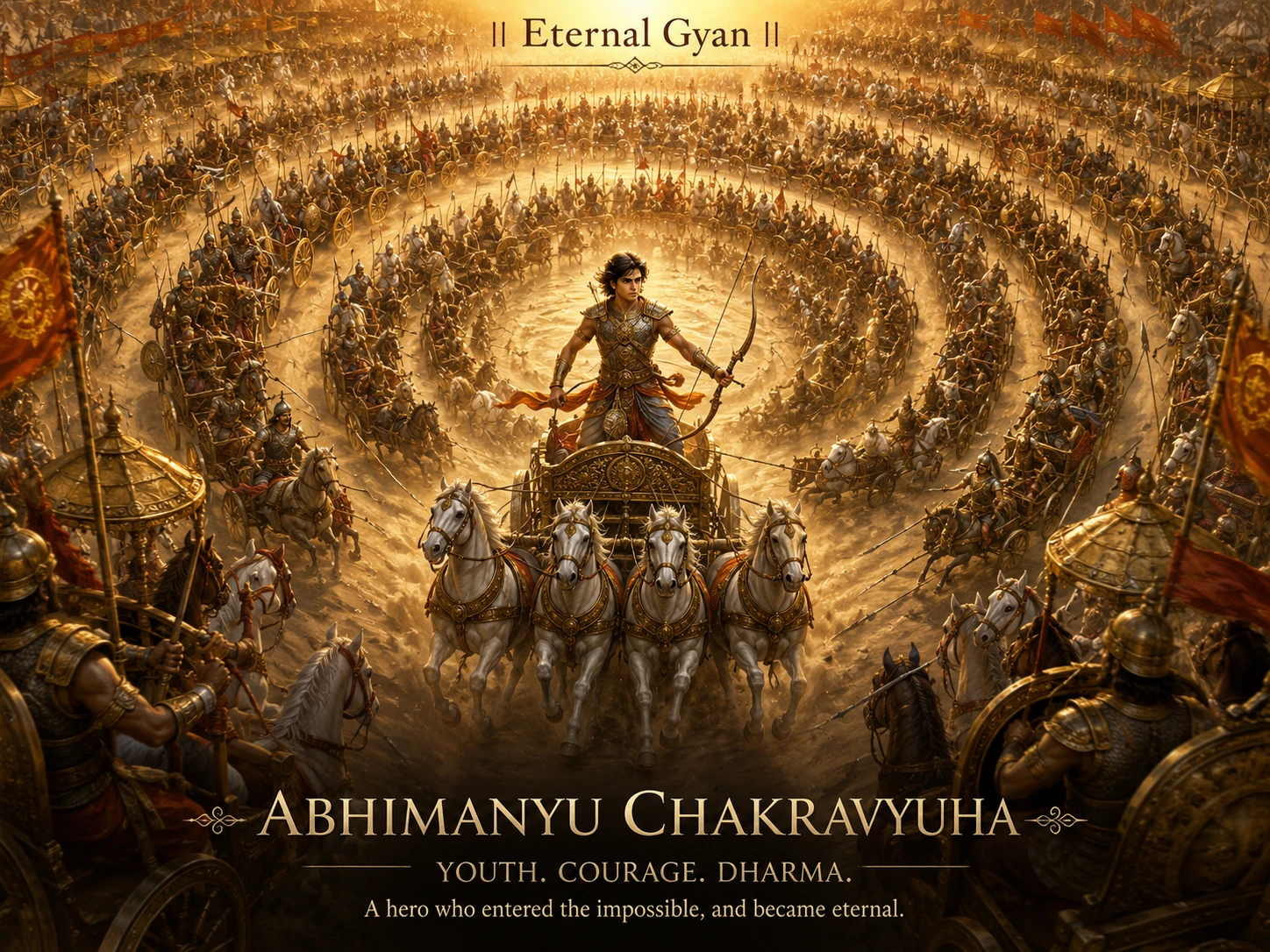
Abhimanyu and the Chakravyuha -- The Boy Who Knew How to Enter but Not How to Leave
14 min read
Adbhuta Ramayana -- The Ramayana Where Sita Becomes Kali
9 min read
After Kurukshetra -- What Happened Next
14 min readThe same translation error that turned '33 Koti' into '33 crore' in Hinduism also happened in Buddhism. The Chinese translation of Buddhist texts rendered 'Sapta Koti Buddha' (7 Supreme Buddhas) as '7 Crore Buddhas.' The…
Deities AvatarsCommunity Reflections
🕉️
Be the first to share your reflection.