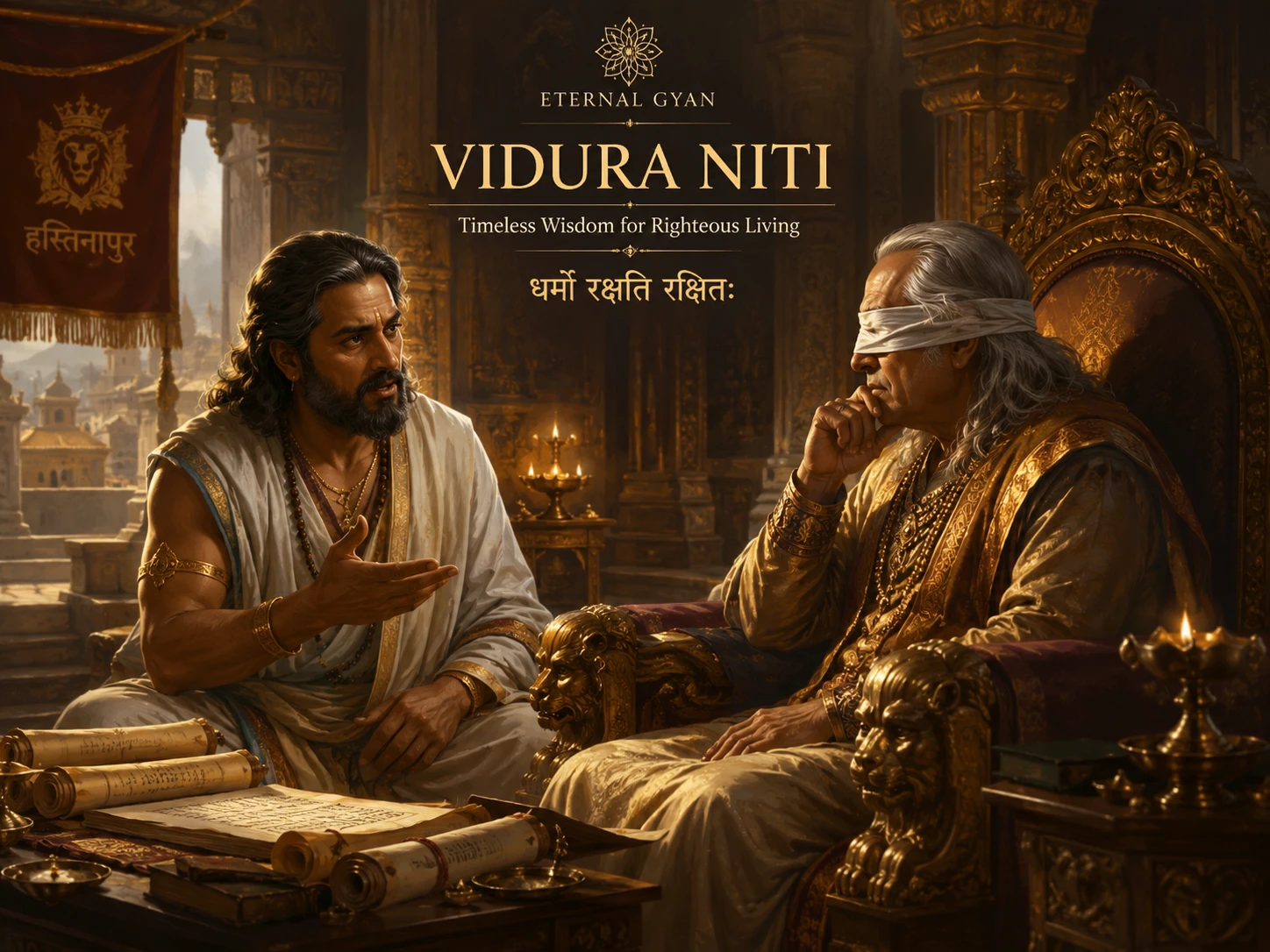
Vidura Niti -- The Wisest Counsel That the King Heard and Still Ignored
विदुर नीति -- वह सर्वोत्तम मन्त्रणा जो राजा ने सुनी और फिर भी अनसुनी की
Vidura Niti is the Mahabharata's answer to Chanakya's Arthashastra -- except it predates Chanakya by centuries and, unlike the Arthashastra's cold pragmatism, it insists that wisdom without ethics is worthless. Found in chapters 33 through 40 of the Udyoga Parva (Book 5), this eight-chapter discourse contains 593 verses delivered by Vidura to the sleepless King Dhritarashtra on the eve of the war. The setting is crucial: Sanjaya has just returned from the Pandava camp with an unfavourable report. Dhritarashtra, tormented by guilt and fear, cannot sleep. He summons Vidura at midnight.
Vidura is the most unusual figure in the Kuru court. He is the son of Vyasa and the maidservant Parishrami -- born through the same niyoga process that produced Dhritarashtra (blind because Ambika closed her eyes) and Pandu (pale because Ambalika turned white with fear). Because his mother was a servant, Vidura can never inherit the throne despite being physically and intellectually superior to both half-brothers. The Mahabharata identifies him as an incarnation of Dharma (Yama, the god of justice and death) -- born into a servant's body because of a curse from sage Mandavya. This dual identity -- the god of justice trapped in the body of a man with no power -- makes everything Vidura says in the Niti section carry a particular weight.
The Vidura Niti is not a lecture. It is a conversation between a man who can see and a man who is blind -- literally and morally. Vidura knows exactly what Dhritarashtra should do: restrain Duryodhana, return the Pandavas' kingdom, avert war. He says so repeatedly, in every possible register -- philosophical, practical, emotional, prophetic. Dhritarashtra agrees with everything and then confesses: 'I know what you say is right. But I cannot act against my son.' This confession is the Niti section's most devastating line. The king's moral failure is not ignorance. It is attachment.
क्रोधो हर्षश्च दर्पश्च ह्रीस्तम्भो मान्यमानिता। यमर्थान्नापकर्षन्ति स वै पण्डित उच्यते॥
krodho harṣaśca darpaśca hrīstambho mānyamānitā | yam arthān nāpakarṣanti sa vai paṇḍita ucyate ||
One whom neither anger, nor joy, nor pride, nor false modesty, nor arrogance, nor vanity can drag away from the four goals of life -- he alone is called a pandit (truly wise).
— Mahabharata, Udyoga Parva 33.19 (Vidura Niti)
The Vidura Niti covers an extraordinary range of topics. It is simultaneously a treatise on personal development, a manual for statecraft, a guide to identifying true friends, a warning system for recognising fools, and a philosophical meditation on the nature of wisdom itself. The major thematic clusters can be organised as follows.
On wisdom and the wise person: Vidura defines the pandit not by learning but by behaviour. A wise person is one who acts after thinking, thinks after deciding, and does not grieve over what is lost. He does not speak ill of others or praise himself. He understands quickly, listens patiently, acts purposefully, and learns from everything. This is not abstract philosophy -- it is a behavioural checklist that any HR manager at Infosys or TCS could use for leadership assessment.
On leadership and governance: A king should wish for the prosperity of all and never set his heart on inflicting misery. He should pay attention to those in distress. He should collect wisdom from multiple sources -- 'one cannot succeed in the world with one-sided morality.' He should be truthful, because 'there is nothing that creates as much confidence in a king as truth.' This section reads like a pre-modern version of the principles taught at IIM Ahmedabad's governance courses.
On self-mastery: 'Sleeplessness affects five types of people: the thief, the lustful, the bankrupt, the failed, and the weak who has been attacked by the strong. I hope, O King, none of these calamities has overtaken you.' This is Vidura at his most surgically sarcastic -- because every one of these conditions applies to Dhritarashtra. The king is morally bankrupt, his kingdom has been stolen from the Pandavas through the dice game, and he is too weak to stand up to his own son.
On crisis management: Vidura advises that a king should foresee trouble before it arrives, should not reveal state secrets, should suppress the wicked and protect the virtuous, and should never fall weak or support wicked people during adversity. A subdued enemy who deserves punishment should not be spared -- if one lacks sufficient strength, it is better to wait, but when power arrives, the threat must be neutralised.
Vidura Niti -- Key Themes and Their Modern Parallels
| Theme | Vidura's Teaching (Udyoga Parva 33-40) | Modern Parallel | Chapter |
|---|---|---|---|
| Defining Wisdom | A pandit is one whom anger, joy, pride, and vanity cannot drag from the four goals of life | Emotional intelligence frameworks (Goleman); Stoic philosophy | 33.19 |
| Sleep and Anxiety | Five types suffer sleeplessness: the thief, the lustful, the bankrupt, the failed, the weak attacked by the strong | Modern insomnia research links sleep loss to guilt, financial stress, and powerlessness | 33.1-5 |
| Leadership | A king should collect wisdom from multiple sources; one-sided morality fails | Diversity of thought in boardrooms; multi-stakeholder governance models | 34.8-15 |
| Self-Reliance | The body is a chariot, the soul the driver, the senses the horses -- if well-trained, the journey is peaceful | Parallels Katha Upanishad's chariot metaphor; modern CBT on cognitive self-regulation | 33.51-56 |
| Diplomacy | Eight qualities of an ideal diplomat: ego-free, courageous, efficient, compassionate, pure, independent-minded, healthy, eloquent | IFS (Indian Foreign Service) training; Kautilya's Arthashastra on envoys | 37.27 |
| Trust and Truth | Nothing creates confidence in a king as much as truth | Corporate governance codes; Tata Group's emphasis on integrity; SEBI disclosure norms | 56.17-18 |
| Crisis Ethics | When life is at stake, even dharma can flex -- but the core principle of protecting life must hold | Apaddharma (crisis ethics); parallels trolley problem in modern ethics | 34.30 |
| Recognising Fools | Six marks of a fool: anger without cause, speech without benefit, giving to the undeserving, trusting the untrustworthy, aimless wandering, failure to distinguish friend from foe | Red flag checklists in behavioural economics; due diligence in venture capital | 33.69-74 |
Vidura Niti is studied as a standalone text in many Indian philosophy curricula. It has appeared in UPSC Civil Services philosophy papers and is referenced in multiple IIM case studies on ethical leadership.
The most powerful dimension of the Vidura Niti is not what Vidura says but what happens after he says it. Dhritarashtra agrees with every word. He is genuinely moved. He says: 'O Vidura, all that you have said is true. I know it well. But my heart is drawn to my son, and I cannot control it.' This moment -- the gap between knowing and doing -- is the central tragedy of the entire Mahabharata. It is the same gap that Arjuna will face on the battlefield (and overcome, with Krishna's help). Dhritarashtra faces it in his palace -- and fails.
Vidura Niti thus becomes a document about the limits of advice. The wisest counsel in the world is useless if the listener's attachment overrides their judgment. Every corporate consultant who has watched a CEO ignore a strategic review because of ego. Every SEBI official who has seen a promoter violate governance norms despite knowing the rules. Every parent who has watched their adult child make a destructive choice despite years of guidance. Dhritarashtra's failure is not rare. It is the default human condition.
For young professionals in India today -- navigating toxic workplaces, political office dynamics, startup culture, and the relentless pressure of competitive exams -- Vidura Niti offers something most self-help books cannot: a 2,500-year-old text that says the wise person is not the one who has all the answers but the one who acts on them. Wisdom without action is just intelligence watching itself fail. And the person who gives good advice but has no power to enforce it -- that is Vidura himself. The smartest person in the room, ignored by the one person who matters.
Vidura Niti is considered a precursor to Chanakya's Arthashastra and is studied in comparative political science courses at JNU, Delhi University, and Hyderabad Central University. The text contains the earliest known articulation of the 'Golden Rule' in Indian literature: 'One should not do to others what one does not wish done to oneself' (Udyoga Parva 39.57) -- predating the commonly cited Biblical and Confucian formulations. Vidura's eight qualities of an ideal diplomat (Chapter 37) are used as a reference framework in India's Lal Bahadur Shastri National Academy of Administration training for IFS officers. The Theosophical Society identified Vidura as one of the 'Mahachohans' -- a transcendent being operating through a mortal form -- which aligns with the Mahabharata's own claim that Vidura was Dharma (Yama) incarnate.
Find the Vidura Niti in the Mahabharata
The Vidura Niti spans eight chapters (33 to 40) of the Udyoga Parva -- some of the most practical wisdom in the Mahabharata. It is not yet on Eternal Raga; the overview article maps the parvas, and translations of the Vidura Niti are widely published on their own.
Tags
Eternal Raga · शाश्वत राग
Institutional voice — scholarly articles on Sanatan Dharma
Deepen Your Understanding
अपनी समझ और गहरी करें
scriptural exegesis
The Dice Game -- The Darkest Hour of the Mahabharata
A king who cannot say no to a challenge. An uncle whose dice are loaded with the bones of the dead. A court full of elders who watch injustice and say nothing. And a woman who asks one question that nobody in the room can answer: 'Did my husband lose himself first, or me?' The dice game in the Sabha Parva is not a plot device. It is the moral black hole at the centre of the Mahabharata. Everything before it is prologue. Everything after it is consequence. And the central horror is not what happens -- it is who lets it happen.
scriptural exegesis
Bhishma's Terrible Vow
A crown prince gave up the throne, love, marriage, and children -- forever -- so his father could marry a fisherwoman. That single vow made Bhishma immortal in name and set the entire Mahabharata into motion. Was it the noblest sacrifice in literature, or the most catastrophic?
scriptural exegesis
Shanti Parva -- What the Dying Man on the Bed of Arrows Taught a King Who Did Not Want to Rule
The war is over. A million men are dead. Yudhishthira, the victorious king, wants to renounce everything and walk into the forest. He says: 'I am a sinner. I caused this slaughter. I have no right to rule.' And then the dying Bhishma -- pierced by hundreds of arrows, lying on a bed of shafts, waiting for the winter solstice to die -- delivers the longest, most comprehensive discourse on governance, ethics, crisis management, and spiritual liberation in all of world literature. 365 chapters. 13,716 verses. Three massive sections: how to rule, how to survive crisis, and how to be free. The Shanti Parva is the Mahabharata's final exam -- and the answer key.
scriptural exegesis
100 Kauravas -- The Forgotten Brothers of the Mahabharata
Everyone knows Duryodhana and Dushasana. But what about Vikarna, who stood up for Draupadi when no one else did? Or Yuyutsu, who defected to the Pandavas because his conscience demanded it? The Mahabharata names all 100 sons of Dhritarashtra -- warriors, strategists, and dissenters -- most of whom are killed across 18 days. Their story is not just a casualty list. It is the most devastating portrait of fratricidal war ever composed.
scriptural exegesis
Draupadi in the Sabha -- The Trial That Started the War
A queen was dragged into a court full of kings, warriors, and elders. Not one stood up. She asked a single legal question that nobody could answer. Then she swore an oath that burned a civilization to the ground. Draupadi's Sabha episode is not a story about a helpless woman. It is the most devastating indictment of institutional silence in world literature.
scriptural exegesis
Karna's Tragedy -- The Sun's Forgotten Son
Born with divine armor, abandoned at birth, raised by a charioteer, humiliated for his caste, cursed by his teacher, and killed while defenseless -- Karna's story is not the Mahabharata's subplot. It is the Mahabharata's conscience. Every system that failed him is a system that still fails people today.
scriptural exegesis
Yaksha Prashna -- Questions at the Lake
Four brothers lie dead beside an enchanted lake. One brother remains. A voice from the water asks 124 questions about dharma, death, happiness, and the self. Yudhishthira's answers in Vana Parva remain the most sophisticated ethical examination in all of Sanskrit literature.
Vidura Niti is considered a precursor to Chanakya's Arthashastra and is studied in comparative political science courses at JNU, Delhi University, and Hyderabad Central University. The text contains the earliest known ar…
More in Scriptural Exegesis
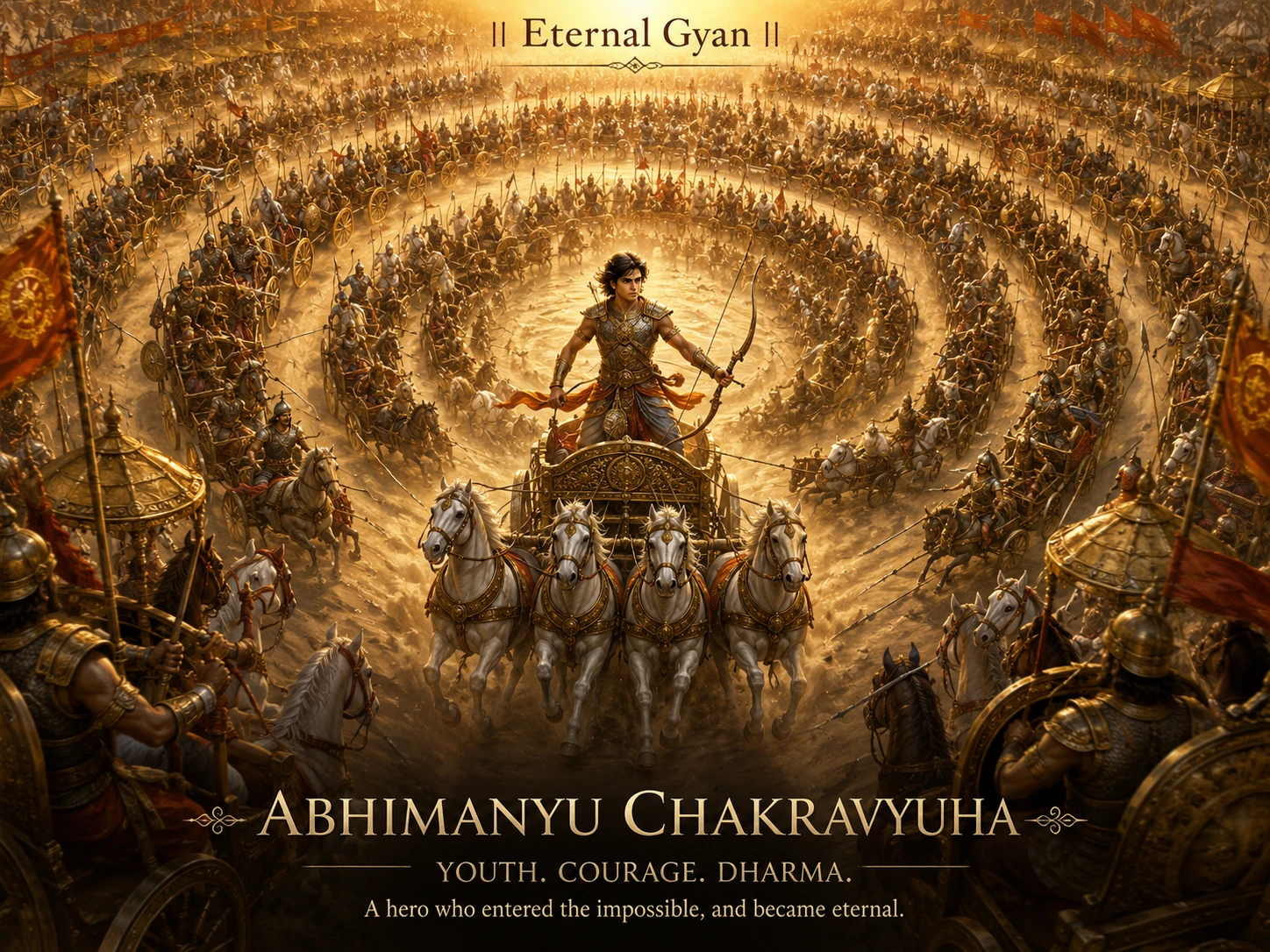
Abhimanyu and the Chakravyuha -- The Boy Who Knew How to Enter but Not How to Leave
14 min read
Adbhuta Ramayana -- The Ramayana Where Sita Becomes Kali
9 min read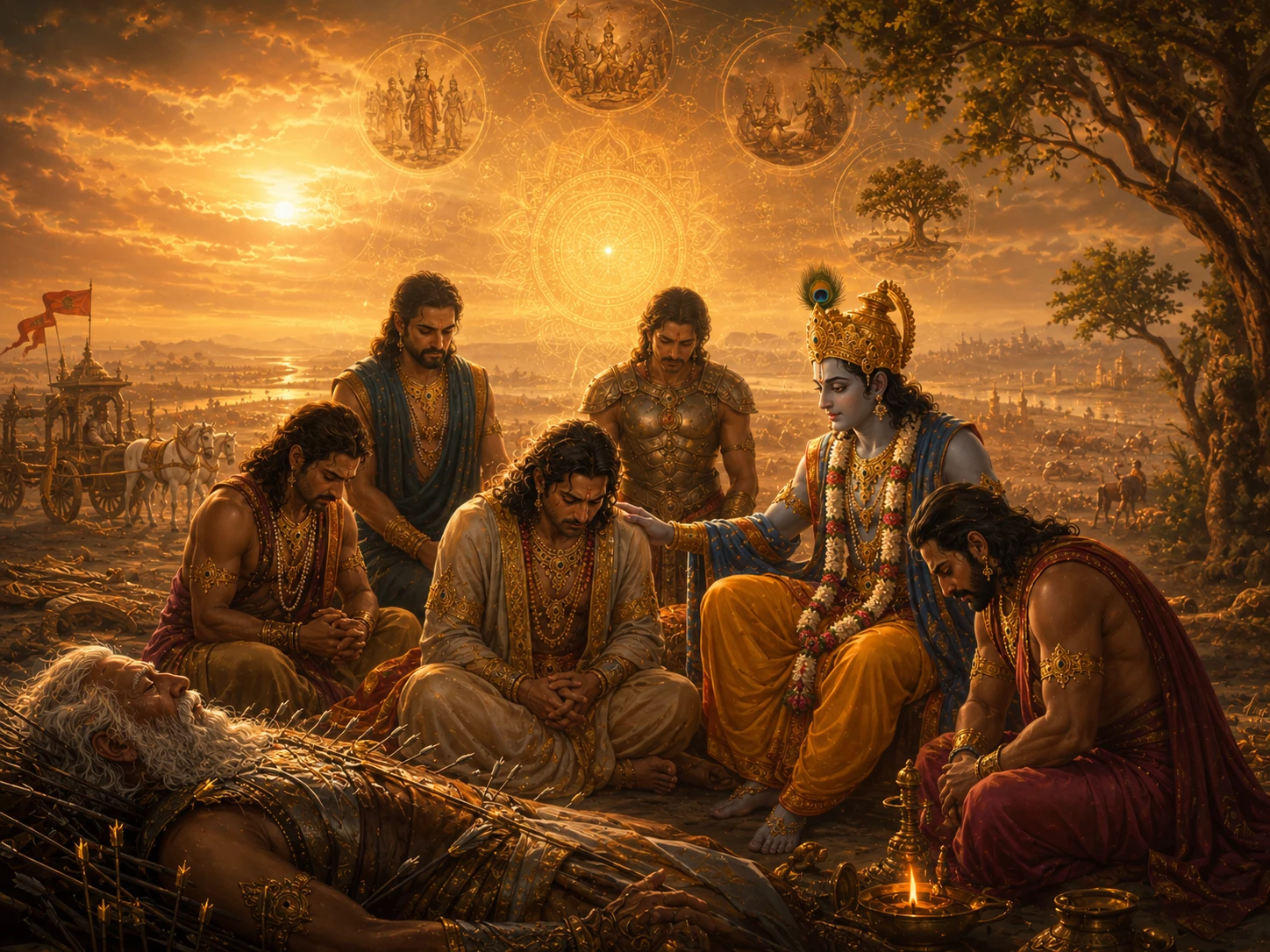
After Kurukshetra -- What Happened Next
14 min readThe same translation error that turned '33 Koti' into '33 crore' in Hinduism also happened in Buddhism. The Chinese translation of Buddhist texts rendered 'Sapta Koti Buddha' (7 Supreme Buddhas) as '7 Crore Buddhas.' The…
Deities AvatarsCommunity Reflections
🕉️
Be the first to share your reflection.