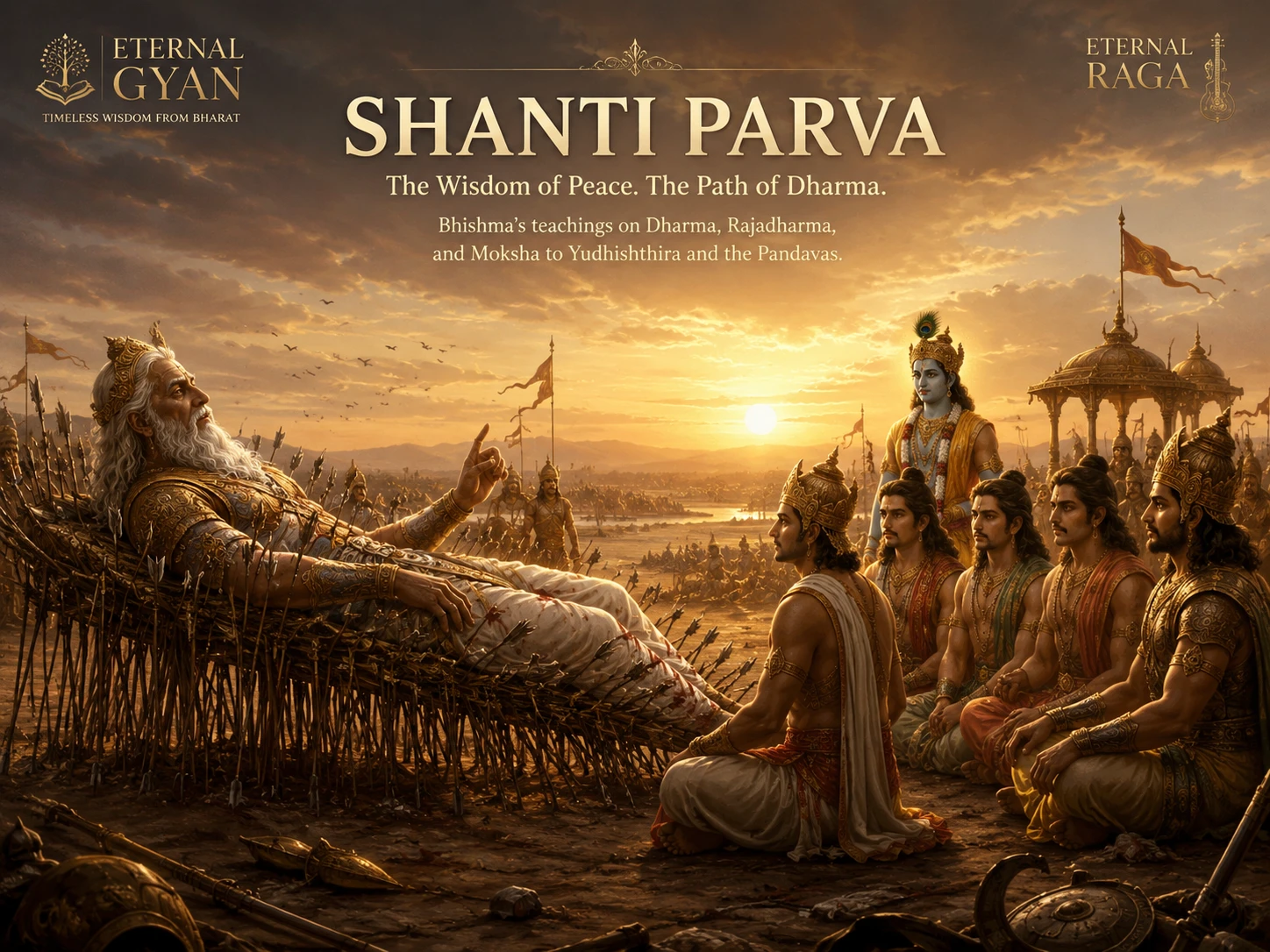
Shanti Parva -- What the Dying Man on the Bed of Arrows Taught a King Who Did Not Want to Rule
शान्ति पर्व -- शरशय्या पर मरते व्यक्ति ने उस राजा को क्या सिखाया जो राज्य नहीं करना चाहता था
The Shanti Parva (Book of Peace) is the twelfth and longest book of the Mahabharata -- 365 chapters, over 13,716 verses, nearly a quarter of the entire epic. If the first eleven books of the Mahabharata are the story, the Shanti Parva is the meaning. It takes place after Kurukshetra is over, after the dead are cremated, after Yudhishthira has been crowned king of Hastinapura. And the first thing the new king does is have a breakdown.
Yudhishthira does not want the throne. He is consumed by guilt. He caused the death of his teacher (Drona, through a lie), his grandfather (Bhishma, through Shikhandin), his half-brother (Karna, whom he discovered too late was Kunti's firstborn). He walked through a battlefield strewn with the bodies of cousins, uncles, friends, and students. He tells Vyasa, Narada, and Krishna: 'I will go to the forest. I will live as an ascetic. I am not fit to rule.' It takes the combined persuasion of five rishis, one god, and his own brothers to convince him that renouncing the kingdom now -- after a million men died to win it for him -- would be a greater sin than the war itself.
And then begins the education. Krishna leads Yudhishthira and his brothers to Kurukshetra, where Bhishma lies on his bed of arrows -- the shara-shayyā -- waiting for the auspicious moment of Uttarayana (the winter solstice, when the sun turns northward) to die. By Krishna's grace, Bhishma's pain is removed so he can speak. What follows is the single longest didactic discourse in all of world literature -- three sub-parvas spanning every conceivable topic from taxation to meditation, from spy networks to the nature of the soul.
न हि सत्यात्परो धर्मो नानृतात्पातकं परम्। सत्यं हि परमं श्रेय आस्तिक्यं सत्यमाश्रितम्॥
na hi satyāt paro dharmo nānṛtāt pātakaṁ param | satyaṁ hi paramaṁ śreya āstikyaṁ satyam āśritam ||
There is no dharma higher than truth, and no sin greater than falsehood. Truth is the highest good, and faith itself rests upon truth.
— Mahabharata, Shanti Parva 12.162 (Bhishma to Yudhishthira)
The Shanti Parva is divided into three sub-parvas, each progressively deeper in scope.
Rajadharma Anushasana Parva (Chapters 1-130, approximately 4,716 verses) covers the duties of kings and leaders. This is the Mahabharata's governance manual. Bhishma covers: how a king should behave, how to select ministers, how to organise an army, how to administer justice, how to collect taxes without oppressing the people, how to use spies, how to treat enemy prisoners, how to conduct diplomacy, how to build infrastructure, how to manage famines. He includes the famous statement: 'Kings should collect wisdom from various sources. One cannot succeed in the world with one-sided morality. Duty must originate from understanding.'
Apaddharma Anushasana Parva (Chapters 131-173, approximately 1,649 verses) addresses ethics during crisis -- what happens when normal rules cannot apply. This is the most controversial section. Bhishma tells the story of the sage Vishvamitra who, during a famine, stole meat from a Chandala's house to feed his starving family. The philosophical point: in extreme circumstances, the hierarchy of dharma shifts. Preserving life overrides ritual purity. A king facing invasion may use deception. A Brahmin facing starvation may eat forbidden food. The word 'apaddharma' literally means 'dharma in danger' -- the rules for when the rules break down.
Mokshadharma Parva (Chapters 174-365, approximately 7,351 verses) is the philosophical and spiritual summit -- the longest of the three sections and one of the most important philosophical texts in all of Hinduism. Here, Bhishma covers: the nature of the Atman, the cycle of birth and death, the paths of Jnana, Karma, and Bhakti Yoga, Sankhya philosophy, the Vishnu Sahasranama (Thousand Names of Vishnu), cosmology, the nature of Brahman, and the means to moksha. This section alone is longer than most complete philosophical texts.
The Three Pillars of the Shanti Parva
| Sub-Parva | Chapters (Vulgate) | Verses | Core Question | Key Teachings |
|---|---|---|---|---|
| Rajadharma Anushasana | 1-130 | ~4,716 | How should a king rule? | Duties of rulers; justice; taxation; spies; diplomacy; military; infrastructure; truth as the highest governance principle |
| Apaddharma Anushasana | 131-173 | ~1,649 | What happens when the rules break down? | Crisis ethics; Vishvamitra's stolen meat; preserving life over ritual purity; flexibility of dharma under extreme stress |
| Mokshadharma | 174-365 | ~7,351 | How does one become free? | Nature of Atman; Sankhya philosophy; Jnana/Karma/Bhakti Yoga; Vishnu Sahasranama; cosmology; Brahman; moksha |
The Shanti Parva's three-part structure mirrors the three Purusharthas discussed: Dharma (Rajadharma section), Artha (Apaddharma as pragmatic survival), and Moksha (Mokshadharma). Kama -- the fourth Purushartha -- is conspicuously absent, perhaps because desire is what caused the war in the first place.
The Shanti Parva also contains the Vishnu Sahasranama -- the Thousand Names of Vishnu -- recited by Bhishma at Yudhishthira's request. This is not a casual inclusion. It is the Mahabharata's way of saying that all the governance wisdom, crisis ethics, and philosophical knowledge in the world eventually points to one destination: surrender to the divine. The Vishnu Sahasranama is recited daily by millions of Hindus worldwide and is considered one of the most powerful devotional texts in existence. That it emerges from the Shanti Parva -- from a dying warrior's lips, on a battlefield, after the worst war in human memory -- gives it a weight that no temple recitation can replicate.
For the contemporary reader, the Shanti Parva presents a paradox. It is simultaneously the most practical and the most transcendent book of the Mahabharata. The Rajadharma section could be a module at the National Defence College or an IAS training academy. The Apaddharma section could be a case study at Harvard Business School on crisis leadership. The Mokshadharma could be the syllabus for an advanced philosophy seminar. And all three are delivered by a man who is dying -- slowly, painfully, publicly -- because of the choices made by the very people he is now teaching.
Bhishma's final teaching position -- lying on arrows, unable to move, surrounded by the survivors of a catastrophe he helped create -- is the Mahabharata's most powerful image of the cost of wisdom. Knowledge is not free. It is paid for in suffering. And the person best qualified to teach governance is not the one sitting on the throne but the one pinned beneath the battlefield, looking up at a sky he will never fly through again.
The Shanti Parva's Rajadharma section contains India's earliest known articulation of the social contract theory -- the idea that the state exists because people consent to be governed in exchange for protection. Bhishma describes an original state of anarchy (matsya-nyaya -- 'the law of the fishes,' where the big eat the small), followed by the people approaching Brahma and requesting a king. This predates Hobbes' Leviathan (1651) by over a millennium. The Vishnu Sahasranama from the Mokshadharma section is chanted at the Tirumala Tirupati temple every morning before the shrine opens, making Bhishma's deathbed recitation the source text for the world's richest Hindu temple's daily liturgy. The Shanti Parva has been cited in at least seven Indian Supreme Court judgments on governance, justice, and the duties of the state toward its citizens.
Recite the Vishnu Sahasranama
The Vishnu Sahasranama -- the thousand names Bhishma recites from his bed of arrows, in the Anushasana Parva that follows the Shanti Parva -- is on Eternal Raga with the meaning of each name. Start your morning the way Bhishma ended his life.
Tags
Eternal Raga · शाश्वत राग
Institutional voice — scholarly articles on Sanatan Dharma
Deepen Your Understanding
अपनी समझ और गहरी करें
scriptural exegesis
Vidura Niti -- The Wisest Counsel That the King Heard and Still Ignored
The night before the Pandavas' exile ended, when war was one decision away, a sleepless king called his wisest adviser. For eight chapters of the Udyoga Parva, Vidura -- the bastard son who could never be king, the only man in Hastinapura who always told the truth -- delivered 593 verses of raw, unfiltered counsel on leadership, ethics, self-mastery, and statecraft. Dhritarashtra listened to every word. Agreed with every point. And then did the opposite. Vidura Niti is not just political philosophy. It is the anatomy of a man who knew the right thing, had the right adviser, and chose wrong anyway.
scriptural exegesis
Bhishma's Terrible Vow
A crown prince gave up the throne, love, marriage, and children -- forever -- so his father could marry a fisherwoman. That single vow made Bhishma immortal in name and set the entire Mahabharata into motion. Was it the noblest sacrifice in literature, or the most catastrophic?
scriptural exegesis
Gita Chapter 18 -- Moksha Sannyasa Yoga: The Final Exam Where Krishna Says 'Do As You Wish'
78 verses. The longest chapter in the Gita. Krishna classifies everything -- knowledge, action, doer, intellect, happiness -- into three gunas, then drops the most radical verse in Indian scripture: abandon all dharmas and just surrender to Me. And then, in a move no dictator would ever make, he tells Arjuna: now do as you wish.
scriptural exegesis
The Dice Game -- The Darkest Hour of the Mahabharata
A king who cannot say no to a challenge. An uncle whose dice are loaded with the bones of the dead. A court full of elders who watch injustice and say nothing. And a woman who asks one question that nobody in the room can answer: 'Did my husband lose himself first, or me?' The dice game in the Sabha Parva is not a plot device. It is the moral black hole at the centre of the Mahabharata. Everything before it is prologue. Everything after it is consequence. And the central horror is not what happens -- it is who lets it happen.
scriptural exegesis
Yaksha Prashna -- Questions at the Lake
Four brothers lie dead beside an enchanted lake. One brother remains. A voice from the water asks 124 questions about dharma, death, happiness, and the self. Yudhishthira's answers in Vana Parva remain the most sophisticated ethical examination in all of Sanskrit literature.
scriptural exegesis
After Kurukshetra -- What Happened Next
The war ended. The Pandavas won. And then everything fell apart. Krishna's clan destroyed itself in a drunken brawl. Dwaraka sank into the sea. Arjuna's divine powers vanished. And the five brothers who fought the greatest war in history walked into the Himalayas to die. The Mahabharata's post-war chapters are darker, stranger, and more relevant than the war itself.
scriptural exegesis
Gita Chapter 2 -- Sankhya Yoga: The Chapter That Changed Indian Philosophy Forever
Arjuna drops his bow. His hands shake. He tells Krishna he would rather beg for food than kill his teachers and cousins. Krishna's response in Chapter 2 is the philosophical backbone of the entire Gita -- covering the immortality of the soul, the ethics of action without attachment, and the portrait of the Sthitaprajna (the person of steady wisdom). This single chapter contains more quotable verses than most entire scriptures. 'Karmanye vadhikaraste' lives on WhatsApp statuses for a reason.
The Shanti Parva's Rajadharma section contains India's earliest known articulation of the social contract theory -- the idea that the state exists because people consent to be governed in exchange for protection. Bhishma…
More in Scriptural Exegesis
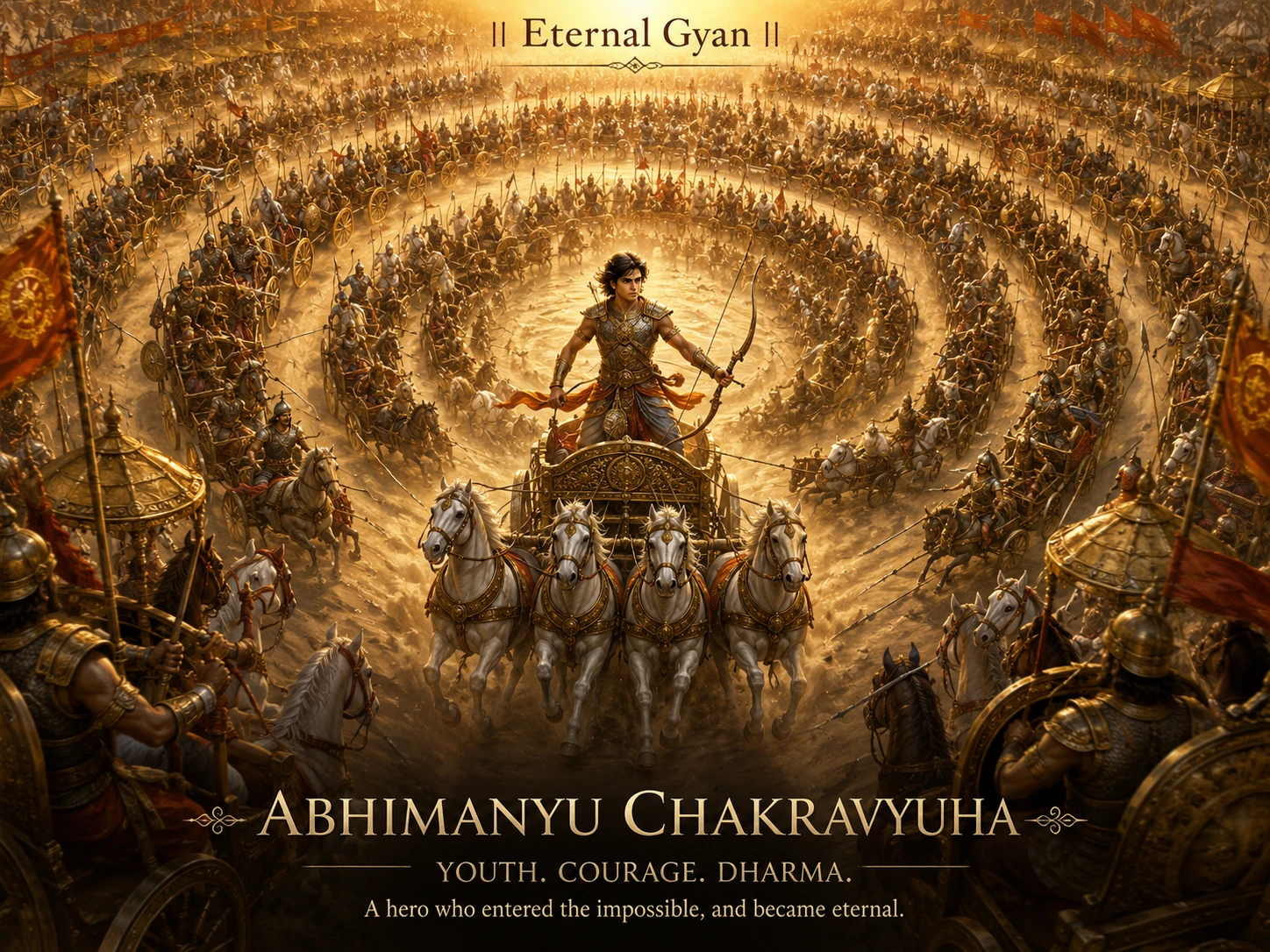
Abhimanyu and the Chakravyuha -- The Boy Who Knew How to Enter but Not How to Leave
14 min read
Adbhuta Ramayana -- The Ramayana Where Sita Becomes Kali
9 min read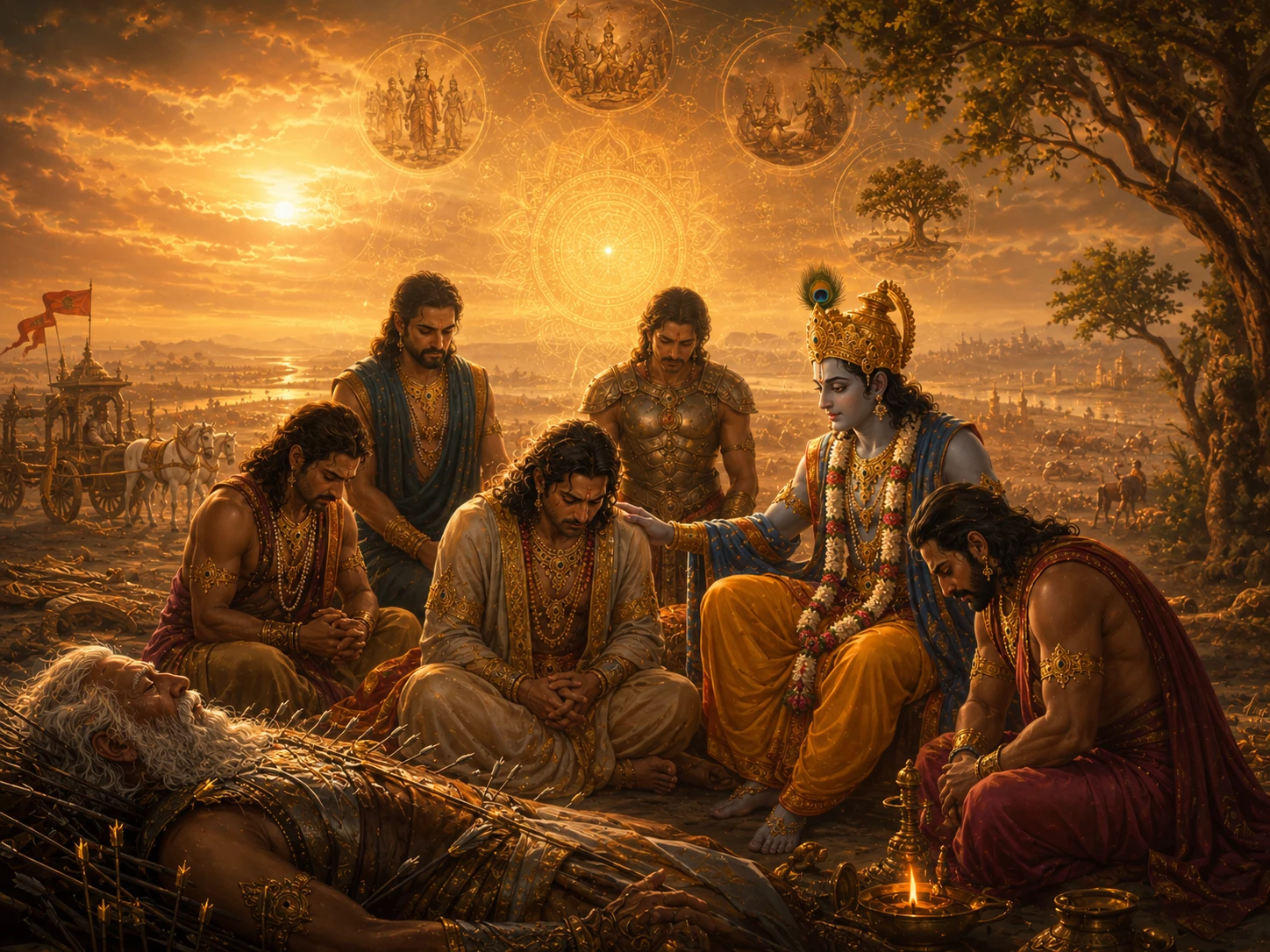
After Kurukshetra -- What Happened Next
14 min readThe same translation error that turned '33 Koti' into '33 crore' in Hinduism also happened in Buddhism. The Chinese translation of Buddhist texts rendered 'Sapta Koti Buddha' (7 Supreme Buddhas) as '7 Crore Buddhas.' The…
Deities AvatarsCommunity Reflections
🕉️
Be the first to share your reflection.