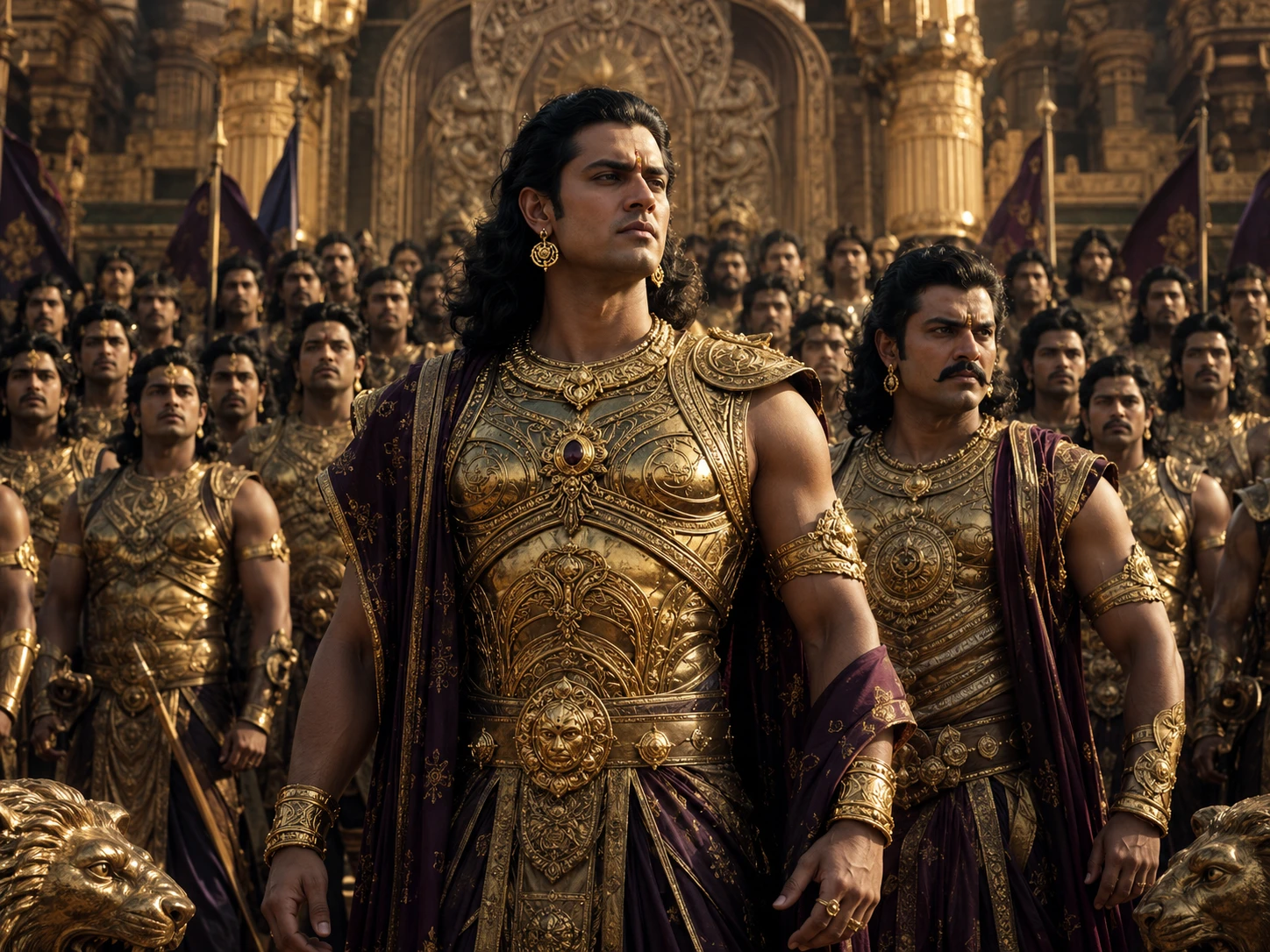
100 Kauravas -- The Forgotten Brothers of the Mahabharata
100 कौरव -- महाभारत के भुलाए गए भाई
The Mahabharata is a war between cousins, and the popular version reduces one side to a blur. Five Pandavas, each with a distinct personality, distinct weapons, distinct stories. And then -- '100 Kauravas,' treated as a faceless mob of villains behind Duryodhana. This is a profound disservice to the text.
Vyasa names every single son of Dhritarashtra. The Adi Parva (Adhyaya 117 in the Ganguli translation; Adhyaya 108 in the BORI Critical Edition) provides the complete list. These are not placeholder names. Many of these brothers appear in specific battle sequences with named opponents, specific weapons, and recorded days of death. Several have moral arcs that complicate the simple 'Pandavas good, Kauravas bad' framework that popular culture has imposed on the epic.
Vikarna publicly objects to Draupadi's disrobing in the sabha. Yuyutsu defects to the Pandava side before the war begins. Chitrasena is a skilled musician. Some brothers are described as reluctant warriors who fight not out of hatred for the Pandavas but out of loyalty to their eldest brother. The Mahabharata does not let you reduce 100 men to a number. It forces you to see them as individuals -- and then it kills them, one by one, across 18 days, while their blind father and grieving mother listen to reports from the battlefield.
Gandhari carried these hundred sons for two years in a single iron-hard mass of flesh. When the mass was divided into 101 pots of ghee (100 sons plus one daughter, Duhsala), each child gestated separately. She endured a pregnancy that lasted longer than any in mythology. And then she watched every single one of her sons die in a war that lasted less than three weeks. The Mahabharata's tragedy is not that the Pandavas won. It is that Gandhari lost everything.
दुर्योधनो युयुत्सुश्च राजन् दुःशासनस्तथा। दुःसहो दुःशलश्चैव जलसन्धः समः सहः॥ विन्दानुविन्दौ दुर्धर्षः सुबाहुर्दुष्प्रधर्षणः। दुर्मर्षणो दुर्मुखश्च दुष्कर्णः कर्ण एव च॥
duryodhano yuyutsushca raajan duhshaasanastathaa | duhsaho duhshalashcaiva jalasandhah samah sahah || vinddaanuvinddau durdharshah subaahurdushpradharshanah | durmarshano durmukhashca dushkarnah karna eva ca ||
Duryodhana, Yuyutsu, Dushasana, Duhsaha, Duhsala, Jalasandha, Sama, Saha, Vinda and Anuvinda, Durdharsha, Suvahu, Dushpradharshana, Durmarshana, Durmukha, Dushkarna, and Karna -- the first among the sons of Dhritarashtra, in order of birth.
— Mahabharata, Adi Parva, Adhyaya 108 (BORI Critical Edition) / Adhyaya 117 (Ganguli translation)
The birth of the Kauravas is among the strangest episodes in the Mahabharata. Gandhari, wife of the blind king Dhritarashtra, received a boon from Sage Vyasa that she would have 100 sons. Her pregnancy lasted two full years. When she heard that Kunti had already given birth to Yudhishthira, she struck her own womb in frustration and anger. What emerged was not a child but a hard mass of grey flesh.
Vyasa intervened. He divided the mass into 101 equal pieces and placed each in a pot of ghee, sealed and stored in a protected chamber. Over time, each pot produced a child. Duryodhana was born first, and at the moment of his birth, jackals howled, donkeys brayed, and ill winds blew -- omens that Vidura interpreted as warnings that this child would destroy the Kuru dynasty. Vidura advised Dhritarashtra to abandon the newborn. Dhritarashtra, blinded by love as much as by sight, refused.
The 101st pot produced Duhsala, the sole daughter, who was later married to Jayadratha, king of Sindhu. Jayadratha's role in trapping Abhimanyu in the Chakravyuha on Day 13 ties Duhsala directly to the war's most heartbreaking episode. After Jayadratha's death, Duhsala is left a widow with a young son -- another woman destroyed by a war she never chose.
Yuyutsu, often counted among the Kauravas, was actually born to Dhritarashtra by a Vaishya maid-servant, making him a half-brother. This matters enormously because Yuyutsu is the only 'Kaurava' to survive the war -- he defects to the Pandava side before the battle, citing dharma. After the war, he serves as regent of Hastinapura when the Pandavas leave for their final journey. The half-brother becomes the heir.
Notable Kauravas -- Beyond Duryodhana and Dushasana
| Name | Birth Order | Distinguishing Role | Day of Death | Killed By | Why They Matter |
|---|---|---|---|---|---|
| Duryodhana (दुर्योधन) | 1st | Crown prince. Instigator of the war. Gandiva-class mace fighter. | Day 18 | Bhima (mace duel, struck below waist) | The antagonist. But also: trained under Balarama, legitimate grievance about throne. |
| Dushasana (दुःशासन) | 2nd | Dragged Draupadi by her hair. Attempted disrobing. | Day 16 | Bhima (tore open his chest, drank blood per vow) | Bhima's vow fulfilled. Most visceral death in the epic. |
| Vikarna (विकर्ण) | 3rd in stature (~19th in Ganguli birth-order list) | ONLY Kaurava who stood up for Draupadi in the sabha. Called the dice game adharma. | Day 14 | Bhima (reluctantly) | The moral conscience of the Kaurava side. Bhima wept after killing him. |
| Chitrasena (चित्रसेन) | ~10th | Skilled in music and arts. Named after the Gandharva king. | Day 14-15 | Multiple Pandava warriors | Shows Kauravas were not all warriors -- some had artistic temperament. |
| Vivimshati (विविंशति) | ~20th | Capable commander. Led akshauhini division. | Day 15 | Arjuna's forces | Proof that mid-ranked Kauravas held real military command. |
| Duhsala (दुःशला) | 101st (daughter) | Only sister. Married to Jayadratha. Widowed on Day 14. | Survived the war | -- | The forgotten woman. Lost husband, brothers, father's dynasty. |
| Yuyutsu (युयुत्सु) | Half-brother (Vaishya mother) | Defected to Pandava side before war. Cited dharma. | Survived the war | -- | Only Kaurava survivor. Became regent of Hastinapura. Conscience over blood. |
| Durmukha (दुर्मुख) | ~6th | Aggressive warrior. Personally challenged Bhima multiple times. | Day 16 | Bhima | Represents the hot-headed loyalist -- fighting because his brother asked. |
| Durjaya (दुर्जय) | ~15th | Charioteering specialist. Fought alongside Karna. | Day 17 | Satyaki's forces | The quiet professional soldier. No grudge, just duty. |
| Jalasandha (जलसन्ध) | ~50th | Naval and riverine warfare specialist. | Day 14 | Satyaki | Suggests Kauravas had specialists beyond conventional land warfare. |
Of the 100 brothers, 98 died in the 18-day war. Only Yuyutsu (defector) survived. Duhsala survived as the sole sister. Gandhari lost every son she carried for two years -- in less than three weeks.
The deaths of the Kauravas follow a pattern of escalating destruction across the 18 days. The first few days see relatively few Kaurava prince deaths -- the brothers are protected by the formations commanded by Bhishma, who deliberately fights a restrained war. After Bhishma falls on Day 10, the Kaurava brothers become increasingly exposed.
The bloodiest days for the Kauravas are Days 14 through 16. After Abhimanyu's death on Day 13 enrages Arjuna, the Pandava side fights with a fury that shatters all remaining restraint. Arjuna's vow to kill Jayadratha by sunset on Day 14 triggers a cascade of battles in which dozens of Kaurava warriors, including many brothers, fall trying to protect Jayadratha.
Bhima is the executioner of the Kaurava royal family. He personally kills Duryodhana, Dushasana, and by various textual accounts, between 10 and 30 of the brothers directly. His vows -- made during the dice game, when he swore to drink Dushasana's blood and break Duryodhana's thigh -- are fulfilled with a literalness that horrifies even his own allies. After killing Vikarna, who had defended Draupadi, Bhima pauses on the battlefield and cries. The text does not let the audience forget that these men were family.
For a student in Kota preparing for JEE, grinding through 18-hour study days, the Kaurava story offers a stark metaphor: 100 brothers with every advantage -- wealth, numbers, the support of Bhishma, Drona, Karna, and Shalya -- destroyed by poor leadership, unchecked pride, and a single catastrophic decision (the dice game). Resources without wisdom lead to ruin. It is not the side with more soldiers that wins. It is the side with more dharma.
The name 'Duryodhana' means 'hard to fight' or 'unconquerable in battle.' But his birth name, according to some later Puranic traditions and regional retellings, was 'Suyodhana' -- meaning 'good warrior' or 'one who fights well.' The prefix shift from 'Su' (good) to 'Dur' (bad/difficult) is itself a commentary: the same man who could have been a noble warrior became, through choices and circumstances, the destroyer of his own dynasty. In South Indian folk traditions, particularly in parts of Karnataka and Andhra Pradesh, Duryodhana is worshipped as a deity in a few local temples -- seen not as a villain but as a tragic king who held his ground until the end. The Mahabharata refuses to make anyone entirely evil. Even the antagonist has temples.
Gandhari's curse on Krishna after the war is one of the most consequential moments in the entire epic. Standing amid the corpses of her 100 sons, she tells Krishna: 'Since you had the power to prevent this war and chose not to, your own clan -- the Yadavas -- will destroy themselves in fratricide, exactly as the Kurus have, 36 years from today. And you will die alone, in the forest, killed by a hunter's arrow.' Every element of this curse is fulfilled in the Mausala Parva: the Yadavas fight among themselves at Prabhasa, Krishna's brother Balarama dies, and Krishna is shot by the hunter Jara while resting alone. A mother's grief, weaponised, becomes the prophecy that closes the epic.
Read the Bhagavad Gita
The Gita is spoken on the first day of Kurukshetra, moments before the war that will kill all hundred Kauravas. Arjuna's grief at fighting his own family is the question; Krishna's answer is the Gita. Read it on Eternal Raga, chapter by chapter.
Tags
Eternal Raga · शाश्वत राग
Institutional voice — scholarly articles on Sanatan Dharma
Deepen Your Understanding
अपनी समझ और गहरी करें
divine arsenal
10 Weapons That Changed the War
Across the Ramayana and Mahabharata, certain weapons did not merely kill -- they altered the course of history. From Rama shattering Shiva's bow to win Sita, to the Shakti that saved the Pandavas by killing the one person it should not have, these ten weapon-moments are the pivot points on which two epics turn.
divine arsenal
Rules of War -- Dharmayuddha and the Geneva Conventions
Three thousand years before the Geneva Conventions, Indian warriors debated whether you could strike a man who had dropped his weapon. The Mahabharata's rules of engagement cover night fighting bans, non-combatant immunity, treatment of prisoners, proportional force, and the use of weapons of mass destruction -- and then shows what happens when every single rule is broken.
scriptural exegesis
Wives of Arjuna -- Four Women Who Shaped the War
Arjuna did not marry for romance. Each of his four marriages -- to Draupadi, Subhadra, Ulupi, and Chitrangada -- was a strategic alliance that brought the Pandavas military power, divine protection, or political legitimacy they could not have won on the battlefield. A Panchala princess, a Yadava sister, a Naga queen, and a Manipuri warrior-princess: four women from four different civilisations, each changing the course of the Mahabharata.
scriptural exegesis
Krishna's 16,108 Queens -- The Story Behind the Number
The number sounds absurd until you understand what it means. Krishna did not 'collect' 16,108 wives. He rescued 16,100 women from a demon's prison, and when no one in society would accept them back -- because they were 'tainted' -- he married every single one to restore their honour. Add 8 named queens (the Ashtabharya) married through love, valour, or diplomacy, and you get the most misunderstood number in Hindu mythology. This is not a harem story. It is the largest social rehabilitation programme in ancient literature.
scriptural exegesis
The Dice Game -- The Darkest Hour of the Mahabharata
A king who cannot say no to a challenge. An uncle whose dice are loaded with the bones of the dead. A court full of elders who watch injustice and say nothing. And a woman who asks one question that nobody in the room can answer: 'Did my husband lose himself first, or me?' The dice game in the Sabha Parva is not a plot device. It is the moral black hole at the centre of the Mahabharata. Everything before it is prologue. Everything after it is consequence. And the central horror is not what happens -- it is who lets it happen.
scriptural exegesis
Gita Chapter 2 -- Sankhya Yoga: The Chapter That Changed Indian Philosophy Forever
Arjuna drops his bow. His hands shake. He tells Krishna he would rather beg for food than kill his teachers and cousins. Krishna's response in Chapter 2 is the philosophical backbone of the entire Gita -- covering the immortality of the soul, the ethics of action without attachment, and the portrait of the Sthitaprajna (the person of steady wisdom). This single chapter contains more quotable verses than most entire scriptures. 'Karmanye vadhikaraste' lives on WhatsApp statuses for a reason.
philosophy darshana
Karma Explained -- Not Punishment, Not Reward, but the Physics of Action
Karma is not cosmic revenge. It is not 'what goes around comes around.' It is India's most sophisticated theory of causation -- a framework that explains why your choices matter, why consequences are inescapable, and why freedom is still possible. The Gita's karma teaching changed Oppenheimer's life. It might change yours.
The name 'Duryodhana' means 'hard to fight' or 'unconquerable in battle.' But his birth name, according to some later Puranic traditions and regional retellings, was 'Suyodhana' -- meaning 'good warrior' or 'one who figh…
More in Scriptural Exegesis
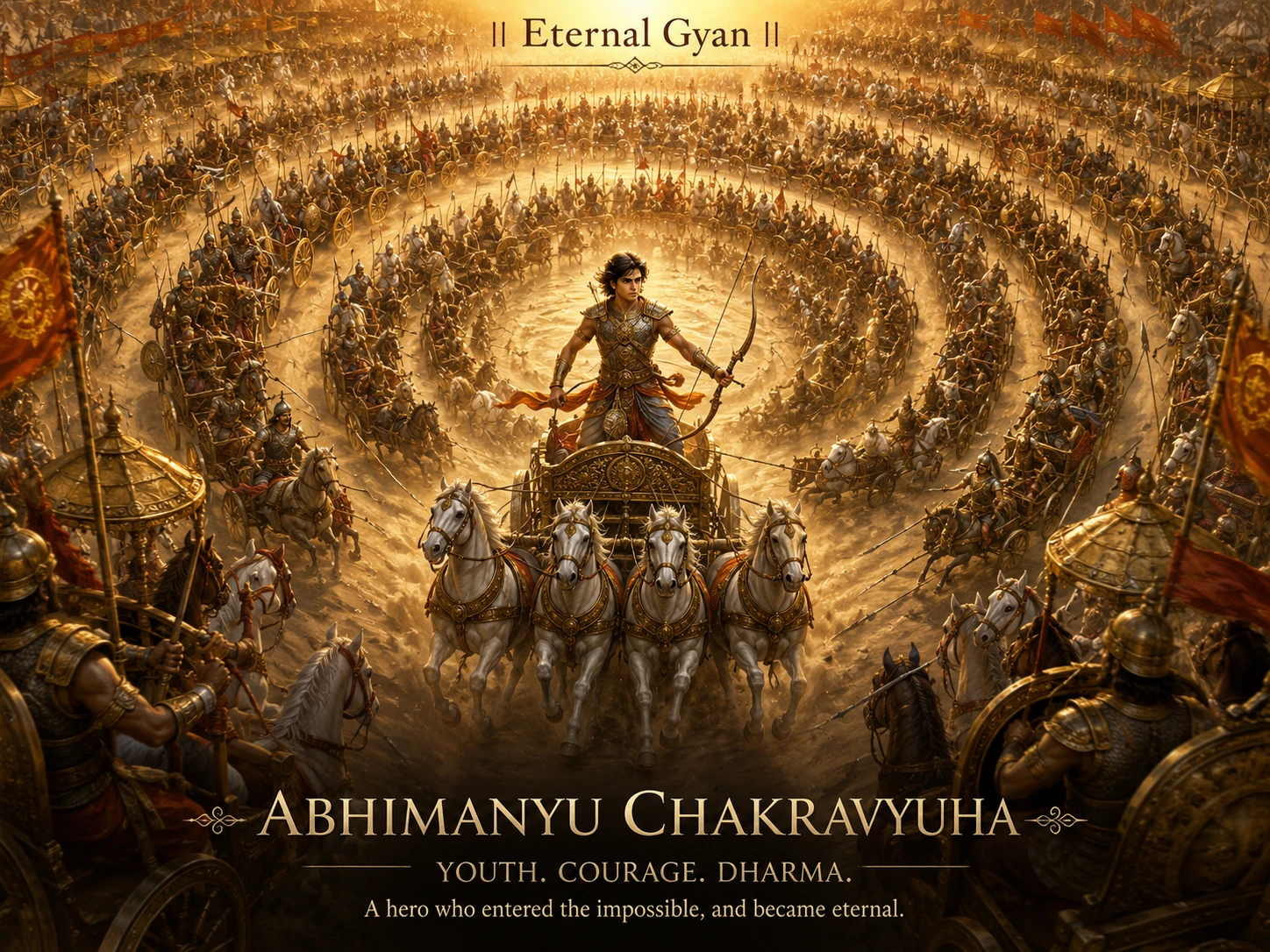
Abhimanyu and the Chakravyuha -- The Boy Who Knew How to Enter but Not How to Leave
14 min read
Adbhuta Ramayana -- The Ramayana Where Sita Becomes Kali
9 min read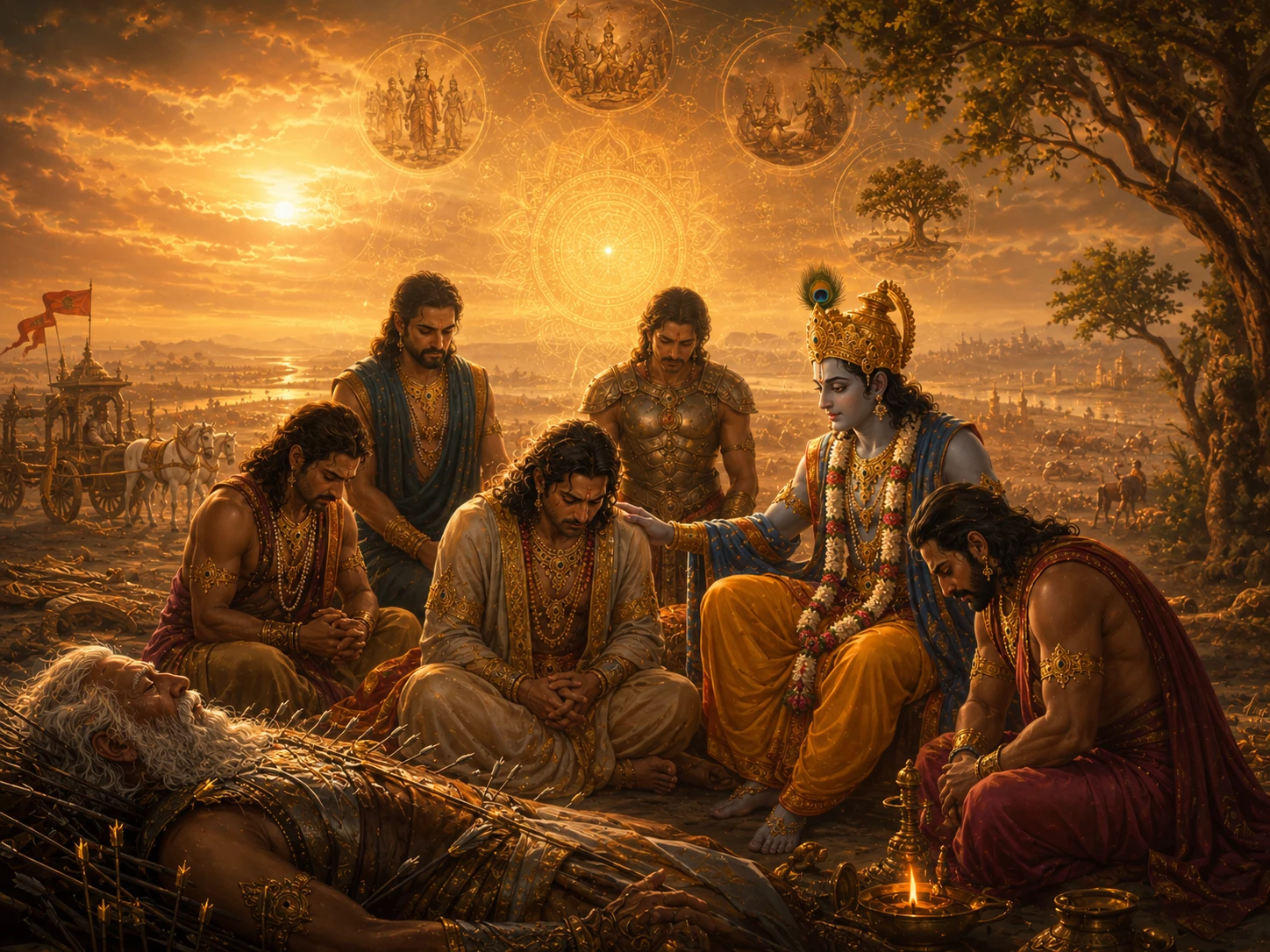
After Kurukshetra -- What Happened Next
14 min readThe same translation error that turned '33 Koti' into '33 crore' in Hinduism also happened in Buddhism. The Chinese translation of Buddhist texts rendered 'Sapta Koti Buddha' (7 Supreme Buddhas) as '7 Crore Buddhas.' The…
Deities AvatarsCommunity Reflections
🕉️
Be the first to share your reflection.