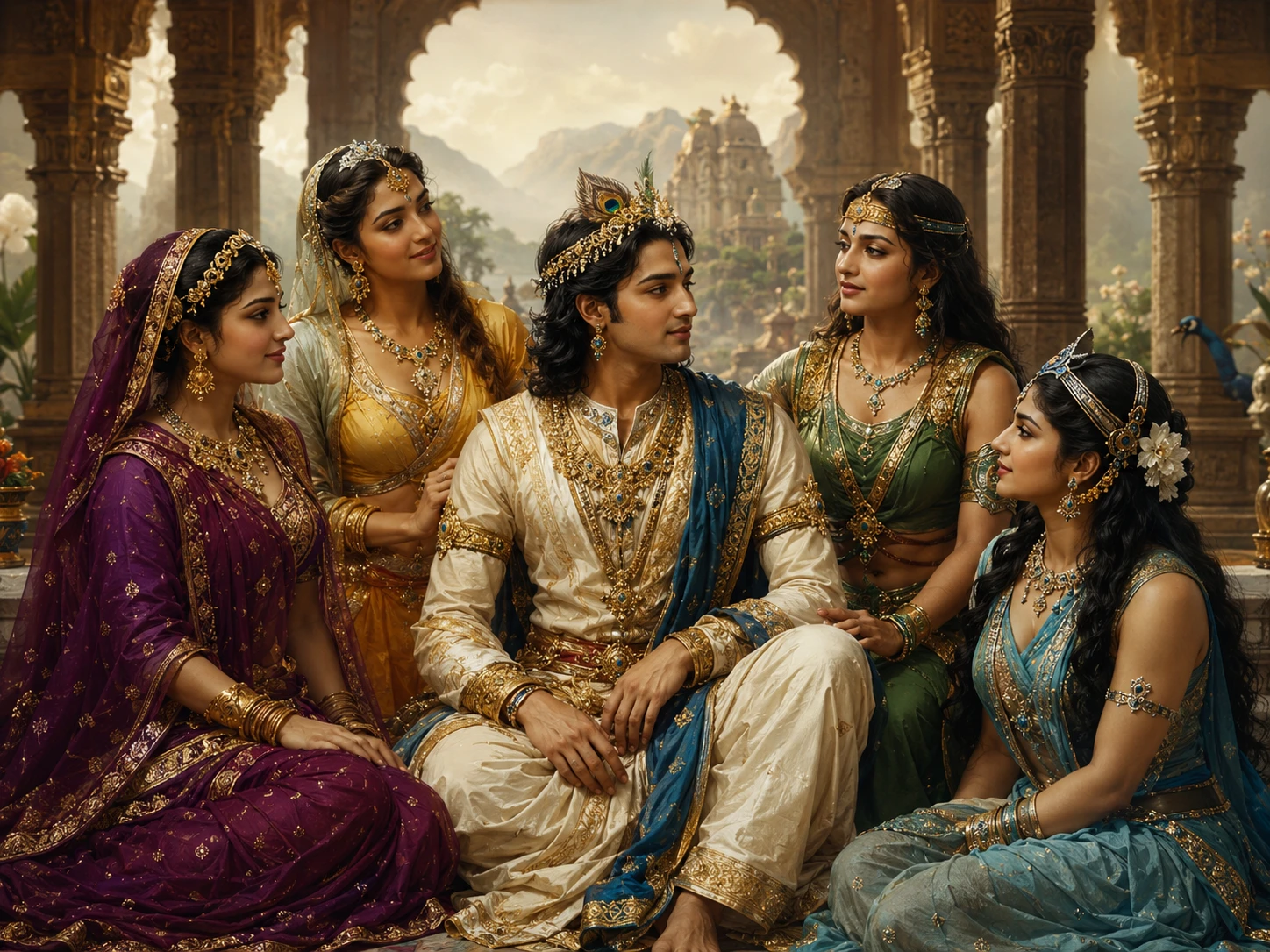
Wives of Arjuna -- Four Women Who Shaped the War
अर्जुन की पत्नियाँ -- चार नारियाँ जिन्होंने युद्ध को आकार दिया
In the modern imagination, Arjuna's love life is a soap opera. Four wives! How scandalous, how complicated, how very ancient-Indian-king. But strip away the romantic projection and look at what each marriage actually accomplished, and a different picture emerges: Arjuna's marriages were the Pandavas' most effective foreign policy.
Each wife came from a distinct civilisation. Each brought an alliance that the Pandavas desperately needed. Each produced a son who played a specific role in the Kurukshetra war or its aftermath. And each woman, in the Mahabharata's telling, was a fully realised character with her own agency, her own demands, and her own story that did not revolve entirely around Arjuna.
Draupadi brought the Panchala army -- the largest single allied force on the Pandava side. Subhadra brought the Yadava alliance and the protection of Krishna. Ulupi brought the Naga kingdom's mystical powers and the boon that saved Arjuna from Bhishma's curse. Chitrangada brought the northeastern frontier alliance and a son who would test Arjuna himself. Together, these four women transformed the Pandavas from five exiled brothers into the centre of a pan-Indian coalition.
For a young professional in Koramangala building cross-functional alliances at work, or a startup founder in HSR Layout assembling an advisory board from different industries, the underlying logic is the same: you do not build power by marrying your own kind. You build power by connecting to every civilisation that can strengthen what you lack.
पत्युः प्रियहिते युक्ता तेजसा प्रज्वलन्त्यपि। प्रतपन्त्यरिसैन्यानि द्रौपदी सत्यवादिनी॥
patyuh priyahite yuktaa tejasaa prajvalantyapi | pratapantyarisainyaani draupadii satyavaadinii ||
Draupadi, the truth-speaker, devoted to the welfare of her husbands, blazing with her own radiance, scorched the enemy armies with her very being.
— Mahabharata, Vana Parva
Draupadi -- born from the sacrificial fire of King Drupada's yagna, dark-skinned, extraordinarily beautiful, and fiercely intelligent -- is not merely Arjuna's wife. She is the wife of all five Pandavas, a polyandrous arrangement that is unique in Indian epic literature and was controversial even within the text itself. Kunti's accidental instruction ('Share whatever you have brought equally among yourselves') and Vyasa's theological justification (she was five deities reborn) establish the marriage, but it is Draupadi's own agency that makes it work.
Her strategic value was immense. Draupadi was the daughter of Drupada, king of Panchala -- one of the most powerful kingdoms in the Gangetic plain. The marriage cemented the Panchala-Pandava alliance. Drupada's son Dhrishtadyumna would serve as the Pandava commander-in-chief at Kurukshetra. Drupada's army formed the core of the Pandava military force. Without the Swayamvara at Panchala, the Pandavas had nothing -- five brothers living in disguise as Brahmins. After it, they had an army.
Draupadi bore five sons, one from each Pandava husband: Prativindhya (from Yudhishthira), Sutasoma (from Bhima), Shrutakarma (from Arjuna), Shatanika (from Nakula), and Shrutasena (from Sahadeva). These five boys, known collectively as the Upapandavas, were killed by Ashwatthama in his midnight raid on Day 18 -- one of the most devastating war crimes in the epic. Draupadi's sons were murdered in their sleep, in a camp that believed the war was already won.
Arjuna's Four Wives -- The Complete Alliance Map
| Wife | Origin / Race | How They Met | What She Brought | Son(s) | Son's Fate |
|---|---|---|---|---|---|
| Draupadi (द्रौपदी) | Panchala kingdom. Born from yagna fire. Kshatriya. | Arjuna won her at Swayamvara by stringing the bow and hitting the fish-eye target. | Panchala army (largest allied force). Dhrishtadyumna as commander. Political legitimacy. | Shrutakarma (from Arjuna). 4 more sons from other Pandavas (Upapandavas). | All 5 Upapandavas killed by Ashwatthama in midnight raid, Day 18. |
| Subhadra (सुभद्रा) | Yadava/Vrishni clan. Krishna's half-sister (some texts: sister). Dwarka. | Arjuna eloped with her on Krishna's advice. She drove the chariot herself during the escape. | Yadava military alliance. Krishna's personal commitment to Pandava cause. Dwarka's navy and resources. | Abhimanyu -- greatest young warrior of the war. | Abhimanyu killed in Chakravyuha, Day 13. His posthumous son Parikshit becomes king. |
| Ulupi (उलूपी) | Naga (serpent) kingdom. Underwater realm. Daughter of Naga king Kauravya. | Met Arjuna during his 12-year exile when he bathed in the Ganga. She pulled him underwater. | Boon of invincibility in water. Neutralised Bhishma's curse. Mystical Naga alliance. | Iravan (also called Aravan). | Iravan killed on Day 8 (in canonical text, by Rakshasa Alambusha in battle; in Tamil tradition, through self-sacrifice to Goddess Kali). Worshipped as Koothandavar deity in Tamil Nadu. Transgender devotee tradition. |
| Chitrangada (चित्रांगदा) | Manipura kingdom (northeast India). Warrior-princess. Daughter of King Chitravahana. | Met during Arjuna's exile. She proposed. Her condition: their son stays in Manipura as heir. | Northeastern frontier alliance. Manipuri military support. | Babruvahana -- who later defeated Arjuna in single combat. | Babruvahana killed Arjuna in Ashvamedha encounter. Ulupi revived Arjuna using Naga gem. |
Each marriage expanded the Pandava alliance network into a new geography: Draupadi = Gangetic plain, Subhadra = Western India (Gujarat), Ulupi = Subterranean/mystical realms, Chitrangada = Northeast India. Together: a pan-Indian coalition.
Subhadra's story is the most strategically consequential. She was Krishna's sister (or half-sister, depending on the textual tradition), and her marriage to Arjuna sealed the most important alliance of the entire epic: the Pandava-Yadava axis. Without this marriage, Krishna has no personal familial obligation to the Pandavas. With it, he is Arjuna's brother-in-law, and the entire Yadava military-diplomatic apparatus becomes available.
The elopement itself is a brilliant set piece. Krishna, who officially cannot take sides in the Yadava council's debate about whom Subhadra should marry (Duryodhana is also a suitor, backed by Balarama), privately advises Arjuna to simply take her. Arjuna disguises himself as a sannyasi, Subhadra falls in love during his stay in Dwarka, and when the moment comes, she drives the chariot herself as they flee. She is not a passive bride being carried away. She is an active participant in her own elopement.
Their son Abhimanyu is the emotional centre of the Mahabharata war. Trained by Krishna and Arjuna, he enters the Chakravyuha on Day 13 knowing how to break in but not how to break out -- his education was left incomplete -- in popular retellings, because Subhadra fell asleep during Arjuna's explanation; in the original text, because the narration was simply interrupted before the exit strategy was covered. This is simultaneously a narrative masterstroke and a theological lesson: incomplete knowledge, combined with courage, leads to glory and death in the same breath. Abhimanyu's son Parikshit, born posthumously, becomes the king to whom the Mahabharata is eventually narrated. The entire epic exists because of this marriage.
Ulupi's contribution is the most mystical. She is a Naga princess who pulls Arjuna into her underwater kingdom during his exile. Their marriage produces Iravan, who dies on Day 8 of the Kurukshetra war. In the canonical Mahabharata, Iravan is killed fighting the Rakshasa Alambusha. In the Tamil Mahabharata tradition, he volunteers for self-sacrifice to Goddess Kali to ensure Pandava victory. In Tamil Nadu, Iravan is worshipped as Koothandavar, and the annual Koovagam festival near Villupuram (now Kallakurichi district) features a unique tradition where transgender individuals (Aravanis, named after Aravan) marry Iravan's deity and then mourn his death. A 3,000-year-old epic directly sustains a living queer devotional tradition in 21st-century Tamil Nadu.
Chitrangada completes the quadrilateral. A warrior-princess of Manipura who proposed to Arjuna herself, she negotiated her terms before marriage: their son would remain in Manipura as heir, not leave for Hastinapura. This is one of the few matrilineal custody agreements in ancient literature. Their son Babruvahana later fights and kills Arjuna during the Ashvamedha horse sacrifice -- not from enmity but from dharmic duty as a king defending his territory. Ulupi revives Arjuna using a mystical Naga gem, connecting all four marriages in a single narrative loop.
The Koovagam festival in Villupuram district, Tamil Nadu -- where thousands of transgender women (Aravanis/Thirunangais) gather annually to marry the deity Koothandavar (Iravan, son of Arjuna and Ulupi) -- is one of the largest transgender gatherings in Asia. According to the Tamil Mahabharata tradition, Iravan agreed to be sacrificed to Goddess Kali to ensure Pandava victory, but requested to be married first so he would not die unmarried. No woman would marry a man doomed to die the next day. Krishna took the form of Mohini and married Iravan. After his death, Mohini/Krishna mourned as a widow. The Aravani community traces its identity to this moment -- they are the symbolic widows of Iravan. The festival draws tens of thousands of participants annually from across India.
Manipur's connection to the Mahabharata through Chitrangada and Babruvahana is not just textual -- it is a living cultural identity. The Meitei people of Manipur trace their Kshatriya heritage to this marriage. The Kangla Fort in Imphal, the ancient seat of Manipuri kings, is linked in local tradition to the kingdom that Chitrangada's son Babruvahana ruled. Manipuri classical dance (Raas Leela) and the martial art Thang-Ta both draw on epic traditions that connect directly to this Mahabharata lineage. When Manipuri dancers perform the Raas Leela at the Sangai Festival, they are enacting a cultural identity that traces back to Arjuna's marriage to their ancestral princess.
Sing to Krishna
Krishna arranged Arjuna's marriage to Subhadra, served as his charioteer, and spoke the Gita to prepare him for war. Sing a Krishna aarti or stotra today; Krishna's hymns are gathered on Eternal Raga with their words and meaning.
Tags
Eternal Raga · शाश्वत राग
Institutional voice — scholarly articles on Sanatan Dharma
Deepen Your Understanding
अपनी समझ और गहरी करें
scriptural exegesis
100 Kauravas -- The Forgotten Brothers of the Mahabharata
Everyone knows Duryodhana and Dushasana. But what about Vikarna, who stood up for Draupadi when no one else did? Or Yuyutsu, who defected to the Pandavas because his conscience demanded it? The Mahabharata names all 100 sons of Dhritarashtra -- warriors, strategists, and dissenters -- most of whom are killed across 18 days. Their story is not just a casualty list. It is the most devastating portrait of fratricidal war ever composed.
scriptural exegesis
Krishna's 16,108 Queens -- The Story Behind the Number
The number sounds absurd until you understand what it means. Krishna did not 'collect' 16,108 wives. He rescued 16,100 women from a demon's prison, and when no one in society would accept them back -- because they were 'tainted' -- he married every single one to restore their honour. Add 8 named queens (the Ashtabharya) married through love, valour, or diplomacy, and you get the most misunderstood number in Hindu mythology. This is not a harem story. It is the largest social rehabilitation programme in ancient literature.
divine arsenal
10 Weapons That Changed the War
Across the Ramayana and Mahabharata, certain weapons did not merely kill -- they altered the course of history. From Rama shattering Shiva's bow to win Sita, to the Shakti that saved the Pandavas by killing the one person it should not have, these ten weapon-moments are the pivot points on which two epics turn.
divine arsenal
Rules of War -- Dharmayuddha and the Geneva Conventions
Three thousand years before the Geneva Conventions, Indian warriors debated whether you could strike a man who had dropped his weapon. The Mahabharata's rules of engagement cover night fighting bans, non-combatant immunity, treatment of prisoners, proportional force, and the use of weapons of mass destruction -- and then shows what happens when every single rule is broken.
divine arsenal
Ancient Indian Martial Arts -- Kalaripayattu to Malla-Yuddha
India may have invented the concept of systematic combat training. Kalaripayattu is arguably the oldest martial art on earth. Malla-Yuddha produced wrestlers who fought Alexander's soldiers. Gatka armed the Sikh Khalsa. Silambam inspired Filipino Eskrima. From Parashurama's legendary training grounds in Kerala to Akharas still operating in Varanasi -- Indian martial arts are the unacknowledged root of half the world's fighting systems.
deities avatars
Krishna Leela -- Why God Chose to Play
He stole butter, broke pots, lied to his mother's face, danced with married women under the full moon, and lifted an entire mountain on his little finger. The Bhagavata Purana's Tenth Skandha -- the most popular 4,000 verses in all of Hindu literature -- is not a biography. It is a theological argument that the Supreme Being's highest expression is not creation, destruction, or cosmic governance. It is play. Krishna Leela is the radical idea that God's truest nature is joy.
deities avatars
Dashavatara -- Why Vishnu Comes Back Ten Times
Fish, tortoise, boar, half-lion, dwarf, axe-warrior, prince, cowherd, enlightened teacher, future horseman. The ten avatars of Vishnu are not random folklore. Read them in sequence and you get something startling -- a narrative that mirrors evolutionary biology, tracks the rise and fall of political systems, and argues that God does not sit above history but enters it, gets dirty, and does the work. The Dashavatara is Hinduism's answer to the question every civilisation asks: why does the world keep breaking, and who fixes it?
The Koovagam festival in Villupuram district, Tamil Nadu -- where thousands of transgender women (Aravanis/Thirunangais) gather annually to marry the deity Koothandavar (Iravan, son of Arjuna and Ulupi) -- is one of the …
More in Scriptural Exegesis
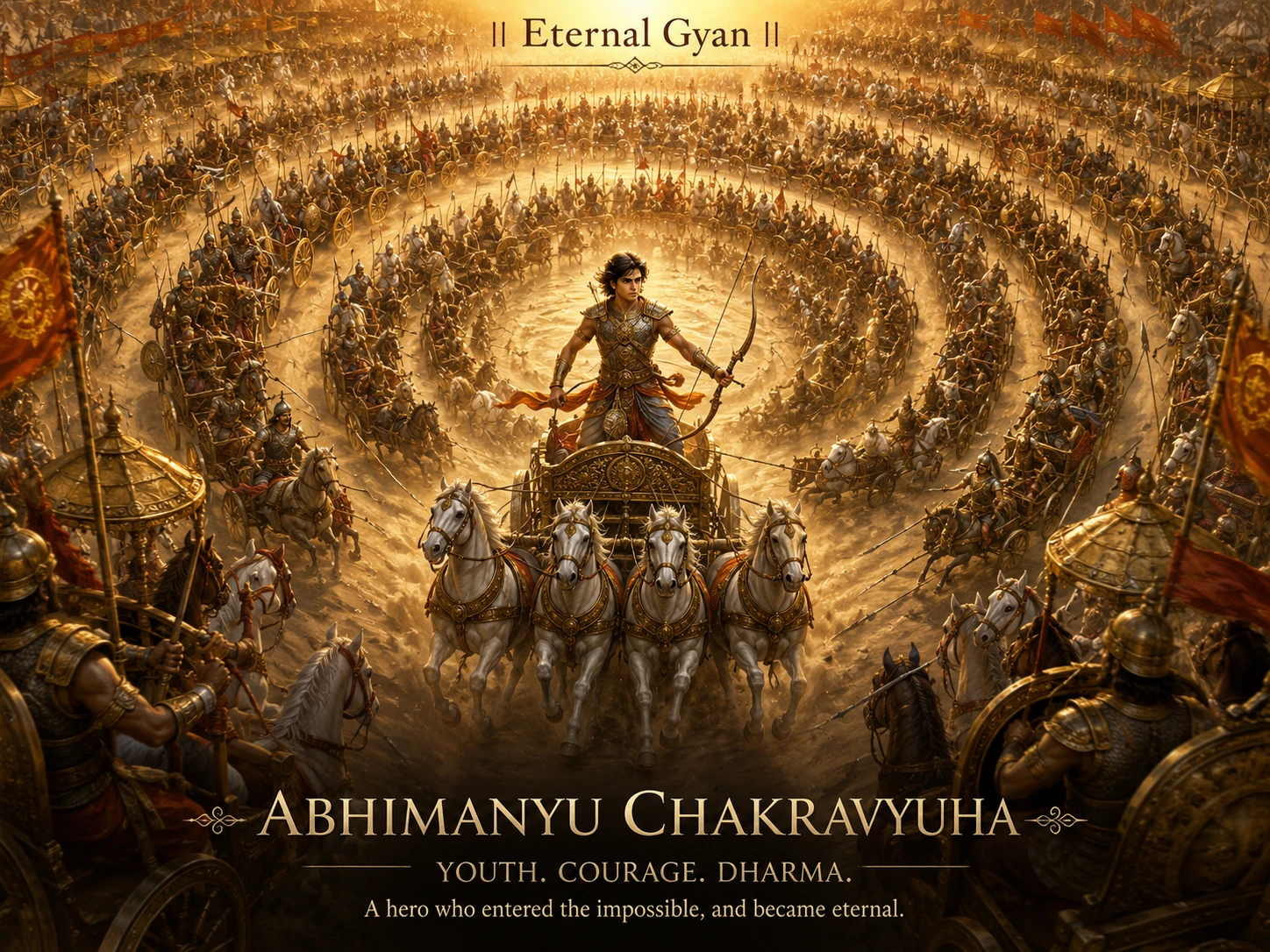
Abhimanyu and the Chakravyuha -- The Boy Who Knew How to Enter but Not How to Leave
14 min read
Adbhuta Ramayana -- The Ramayana Where Sita Becomes Kali
9 min read
After Kurukshetra -- What Happened Next
14 min readThe same translation error that turned '33 Koti' into '33 crore' in Hinduism also happened in Buddhism. The Chinese translation of Buddhist texts rendered 'Sapta Koti Buddha' (7 Supreme Buddhas) as '7 Crore Buddhas.' The…
Deities AvatarsCommunity Reflections
🕉️
Be the first to share your reflection.