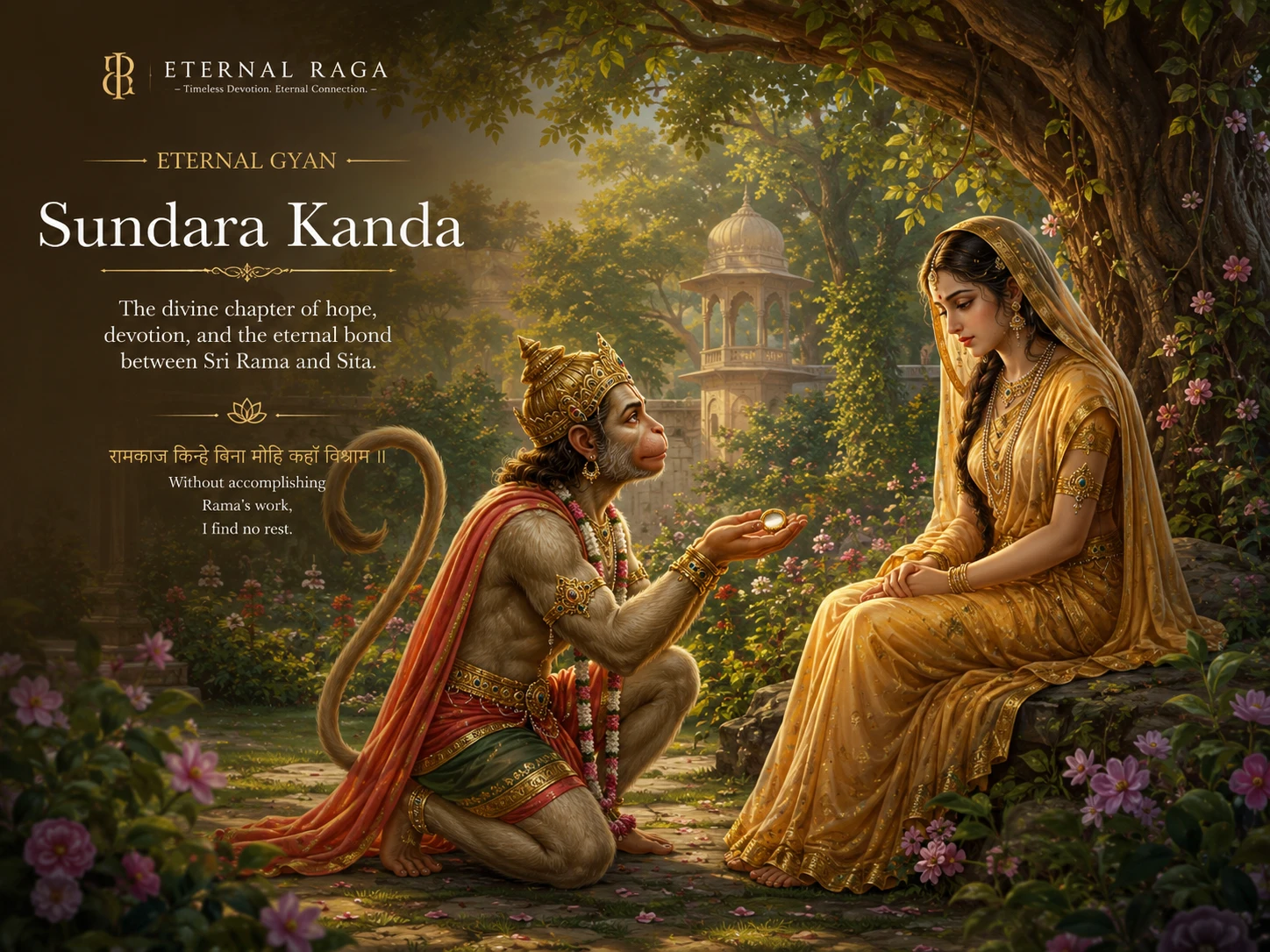
Why Sundara Kanda is the Most Revered
सुन्दरकाण्ड -- रामायण का सबसे पवित्र काण्ड क्यों?
In homes across the Hindi belt -- from Allahabad to Indore, Varanasi to Jaipur -- Saturday evenings carry a specific soundtrack. Families gather around a Ramcharitmanas, and the eldest literate member begins reading aloud. Not from the beginning. Not the war. Not the coronation. They read the Sundara Kanda. Every week. For years. Sometimes for decades.
Sundara Kanda Parayana -- the ritual recitation of this specific book -- is the single most widespread personal devotional practice in North Indian Hinduism. More than Vishnu Sahasranama. More than Bhagavad Gita recitation. More than any single mantra. Temples schedule weekly Sundara Kanda paths; WhatsApp groups coordinate group readings on Tuesdays; NRI communities in New Jersey, Houston, and London organize monthly Sundara Kanda sessions followed by prasad distribution.
The practice cuts across economic lines. The Marwari business family in their Juhu apartment reads it on the same evening as the auto-repair mechanic in his Meerut tenement. The reason given by practitioners is almost always the same: 'Sundara Kanda removes obstacles. It solves problems. It works.'
But why this kanda? The Ramayana has seven books. Each contains drama, dharma, and devotion. What makes the fifth book -- 68 sargas in Valmiki's version, a fraction of the whole -- the undisputed champion of Hindu liturgical life?
The answer operates on three levels: literary architecture, theological function, and lived psychology.
Literary architecture first. Sundara Kanda is the only book of the Ramayana where Rama is not physically present in the action. Rama is in Kishkindha, waiting. Sita is in Lanka, captive. The entire narrative is carried by Hanuman -- alone, in enemy territory, making decisions without his lord's guidance. This creates a unique narrative tension. In every other kanda, Rama's presence provides a moral anchor. In Sundara Kanda, that anchor must be internalized. Hanuman acts as Rama would act, without Rama being there to direct him.
For the reader, this shifts the devotional relationship from passive reception (watching Rama do heroic things) to active emulation (seeing what it looks like when a devotee carries their lord's values into hostile territory alone). This is why Sundara Kanda resonates so powerfully with people facing their own battles -- job interviews, medical procedures, court cases, business crises. You are alone. Your god is not physically present. But if you have internalized the values deeply enough, you can navigate the darkness.
The name itself is the first clue to its special status. Bala Kanda is named after Rama's childhood. Ayodhya Kanda after the city. Aranya Kanda after the forest. Kishkindha Kanda after Sugriva's kingdom. Yuddha Kanda after the war. Uttara Kanda after the aftermath. But Sundara Kanda is named after sundara -- beauty. Which beauty? Commentators across centuries have proposed multiple answers: the beauty of Hanuman's devotion, the beauty of Sita's fortitude, the beauty of the language itself (Valmiki's Sanskrit reaches its peak here), or the beauty of faith that persists in the darkest circumstances.
The most compelling reading is that all four are true simultaneously. Sundara Kanda is the point where form and content achieve unity -- the most beautiful devotion is expressed in the most beautiful language about the most beautiful quality (unwavering faith under siege).
न हि मे परदारेषु दृष्टिर्गच्छति पापिका। परदाराभिमर्शेषु नैवास्तीह तथाविधा॥
na hi me paradāreṣu dṛṣṭirgacchati pāpikā | paradārābhimarśeṣu naivāstīha tathāvidhā ||
My sinful gaze does not fall upon the wives of others. There is no desire in me for touching another's wife.
— Valmiki Ramayana, Sundara Kanda, 11.40 (Hanuman's self-reflection while searching Ravana's inner chambers)
This verse appears during one of the most ethically subtle moments in the Ramayana. Hanuman, searching Lanka palace by palace for Sita, enters Ravana's inner apartments. He sees sleeping women -- Ravana's wives and consorts -- in various states of undress. For a moment, doubt strikes: is it ethical for him to look at other men's wives in such intimate circumstances? He then reasons that he has no lustful intent; his eyes are searching for Sita, not lingering with desire. Furthermore, he could not search for a woman without looking at women.
Valmiki gives this episode twelve verses (Sundara Kanda, Sarga 11) -- a remarkable narrative pause for ethical self-examination in the middle of a covert military operation. The message is layered: even in enemy territory, even under mission pressure, moral awareness does not take a holiday. Hanuman could have justified any amount of looking -- he was literally behind enemy lines. Instead, he stops to examine his own conscience.
This ethical granularity is part of why Sundara Kanda holds such authority in Hindu thought. It does not deal in simple good-vs-evil binaries. It explores the moral gray zones that arise when a good person operates in a bad situation. For the corporate whistleblower, the undercover police officer, the journalist working a corruption story -- Sundara Kanda offers a framework: do what the mission requires, but never lose consciousness of the ethical boundaries you are crossing.
The theological function of Sundara Kanda operates at a different register. In the Ramcharitmanas tradition, Sundara Kanda is understood as the kanda of miraculous intercession. Tulsidas frames Hanuman's journey as the divine agent cutting through impossibility on behalf of the devotee. When families read Sundara Kanda during illness, financial trouble, or legal crisis, they are symbolically asking for a Hanuman -- a powerful, selfless agent who will cross whatever ocean separates them from resolution.
The psychological layer is perhaps the most powerful. Sundara Kanda's narrative arc is: departure from the known, survival in hostile territory, completion of the objective, and triumphant return. This is also the universal arc of every significant human challenge. The student who leaves home for IIT coaching in Kota is living her own Sundara Kanda. The Indian Army officer posted to a forward position in Arunachal Pradesh is in his Lanka. The startup founder burning through runway while building a product no one has validated yet is in Ravana's palace, searching room by room for a Sita who might not even be there.
The Sita chapters within Sundara Kanda (Sargas 15-38 in Valmiki) are themselves a masterclass in resilience literature. Sita, imprisoned in the Ashoka Vatika, is surrounded by rakshasis who alternately threaten and cajole her. Ravana visits periodically to demand she accept him. She refuses, every single time, clinging to a blade of grass between herself and Ravana as a symbolic barrier. Her resistance is not martial -- she has no weapon, no army, no escape route. It is purely moral. She simply will not consent.
For women in India today, Sita in the Ashoka Vatika is a complex figure. Feminist readings range from admiration for her refusal to submit to critique of the captivity narrative itself. What is undeniable is that Sita's agency in Sundara Kanda is active, not passive. She makes choices -- she rejects Ravana's offer of queenship over Lanka (an upgrade from princess of Mithila by any material measure), she considers suicide but decides against it after an omen, she questions Hanuman's credentials before trusting him. These are decisions made under extreme duress, and they are all hers.
The reunion between Hanuman and Sita is the emotional climax of Sundara Kanda. Hanuman descends from a shimshapa tree where he has been hiding, presents Rama's signet ring, and delivers Rama's message. Sita's response -- tears, hope, the first unclenching of months of tension -- is among the most moving passages in world literature. She gives Hanuman her chudamani (head-jewel) as proof of meeting.
Then comes the burning of Lanka. Hanuman allows himself to be captured (deliberately, to assess Ravana's court), his tail is set on fire, and he uses the flames to ignite the city. The burning is both practical intelligence-gathering and psychological warfare -- Hanuman returns to Rama not just with news of Sita but with a detailed assessment of Lanka's defenses, morale, and vulnerabilities.
The arc from doubt to triumph is what makes Sundara Kanda ideal for parayana. The reader begins the reading in a state of need (some personal crisis). The narrative takes them through Hanuman's self-doubt, his obstacles (Mainaka, Surasa, Simhika), his lonely search, his ethical struggles, his meeting with Sita, his victory over Ravana's court, and his triumphant return. By the end of the reading, the psychological journey mirrors the narrative one -- the reader has symbolically crossed their own ocean.
This is not superstition. It is structured narrative therapy, embedded in a devotional framework, practiced for centuries before anyone coined the term 'bibliotherapy.' The WHO recognizes narrative engagement as a valid complement to mental health support. Sundara Kanda parayana is India's oldest continuously practiced version of this principle.
The Seven Kandas of Valmiki Ramayana -- A Structural Overview
| Kanda | Named After | Central Figure | Core Theme | Parayana Popularity |
|---|---|---|---|---|
| 1. Bala Kanda | Childhood (Bala) | Young Rama | Origin, training, Sita's swayamvar | Low -- rarely recited standalone |
| 2. Ayodhya Kanda | City of Ayodhya | Rama and Dasharatha | Exile, duty vs. desire, Bharata's grief | Moderate -- popular for dharma teachings |
| 3. Aranya Kanda | Forest (Aranya) | Rama, Sita, Lakshmana | Exile life, Shurpanakha, Sita's abduction | Low to moderate |
| 4. Kishkindha Kanda | Sugriva's kingdom | Rama and Sugriva | Alliance-building, Vali episode, search teams | Low |
| 5. Sundara Kanda | Beauty (Sundara) | Hanuman alone | Solo mission, devotion under fire, Sita's resilience | Highest -- weekly parayana tradition across India |
| 6. Yuddha Kanda | War (Yuddha) | Rama vs. Ravana | Battle, dharmic warfare, Lanka's fall | Moderate -- read during Navaratri |
| 7. Uttara Kanda | Aftermath (Uttara) | Rama as king | Sita's banishment, Rama's rule, controversies | Low -- considered later addition |
Sundara Kanda's unmatched parayana status stems from its unique combination: a solo protagonist, obstacle-triumph arc, and the emotional climax of Hanuman-Sita meeting.
India's National Defence Academy (NDA) in Khadakwasla, Pune, includes a temple where cadets recite Sundara Kanda before major field exercises. The practice is unofficial but decades old. The rationale -- entering hostile territory alone, completing the mission, returning safely -- maps directly onto military operations. Several retired Indian Army generals have publicly credited Sundara Kanda parayana as part of their personal discipline during active deployment.
Start Your Sundara Kanda Parayana Today
Read the complete Sundara Kanda sarga by sarga on Eternal Raga, in Sanskrit with Hindi and English translation. Set a weekly schedule -- many complete a parayana in seven days -- and mark your progress in a notebook.
Eternal Raga · शाश्वत राग
Institutional voice — scholarly articles on Sanatan Dharma
Deepen Your Understanding
अपनी समझ और गहरी करें
scriptural exegesis
Hanuman's Leap Across the Ocean
100 yojanas of open ocean. Three supernatural obstacles. Zero backup. Hanuman's leap to Lanka is not just mythology's greatest action sequence -- it is a masterclass in overcoming self-doubt, navigating temptation, and executing under impossible pressure.
deities avatars
Hanuman -- The Perfect Devotee
He could lift mountains, leap oceans, and burn Lanka to the ground -- yet his greatest power was this: he never forgot whose work he was doing. Hanuman is not just a mythological hero. He is the operating system of selfless devotion that India still runs on.
deities avatars
Rama -- Ideal of Dharmic Living
Why does India still name its sons after a prince who chose exile over a throne? Rama's life is not a fairy tale -- it is a manual for dharmic decision-making under impossible pressure. From boardrooms to battlefields, his choices remain the hardest moral benchmark in civilization.
scriptural exegesis
Sita and Draupadi -- The Two Women Who Triggered Two Great Wars
Every Indian knows that the Ramayana happened because Sita was abducted and the Mahabharata happened because Draupadi was disrobed. But here is the question nobody asks: were these women the cause of war, or the consequence of systems that had already failed? The answer reframes both epics.
scriptural exegesis
Ramayana -- History or Myth? What the Evidence Actually Says
A 48-km limestone bridge between India and Sri Lanka that NASA satellites photographed. An exile route spanning 3,000 km that you can walk today -- every river, cave, and mountain matching Valmiki's descriptions. Astronomical events that planetarium software can verify. Five categories of evidence that turn a simple 'myth or fact?' into a far more interesting question.
scriptural exegesis
Sugriva's Search for Sita -- The Intelligence Network Hidden in the Ramayana
No phones, no satellites, no maps. Yet Sugriva found Sita across an entire continent. He did not send a random army -- he built a four-directional intelligence network with designated leaders, precise geographical routes, and a strict one-month deadline. Kishkindha Kanda, Sargas 40-43, reads less like an ancient epic and more like a military operations manual. The Ramayana was not just telling a story. It was teaching strategy.
India's National Defence Academy (NDA) in Khadakwasla, Pune, includes a temple where cadets recite Sundara Kanda before major field exercises. The practice is unofficial but decades old. The rationale -- entering hostile…
More in Scriptural Exegesis
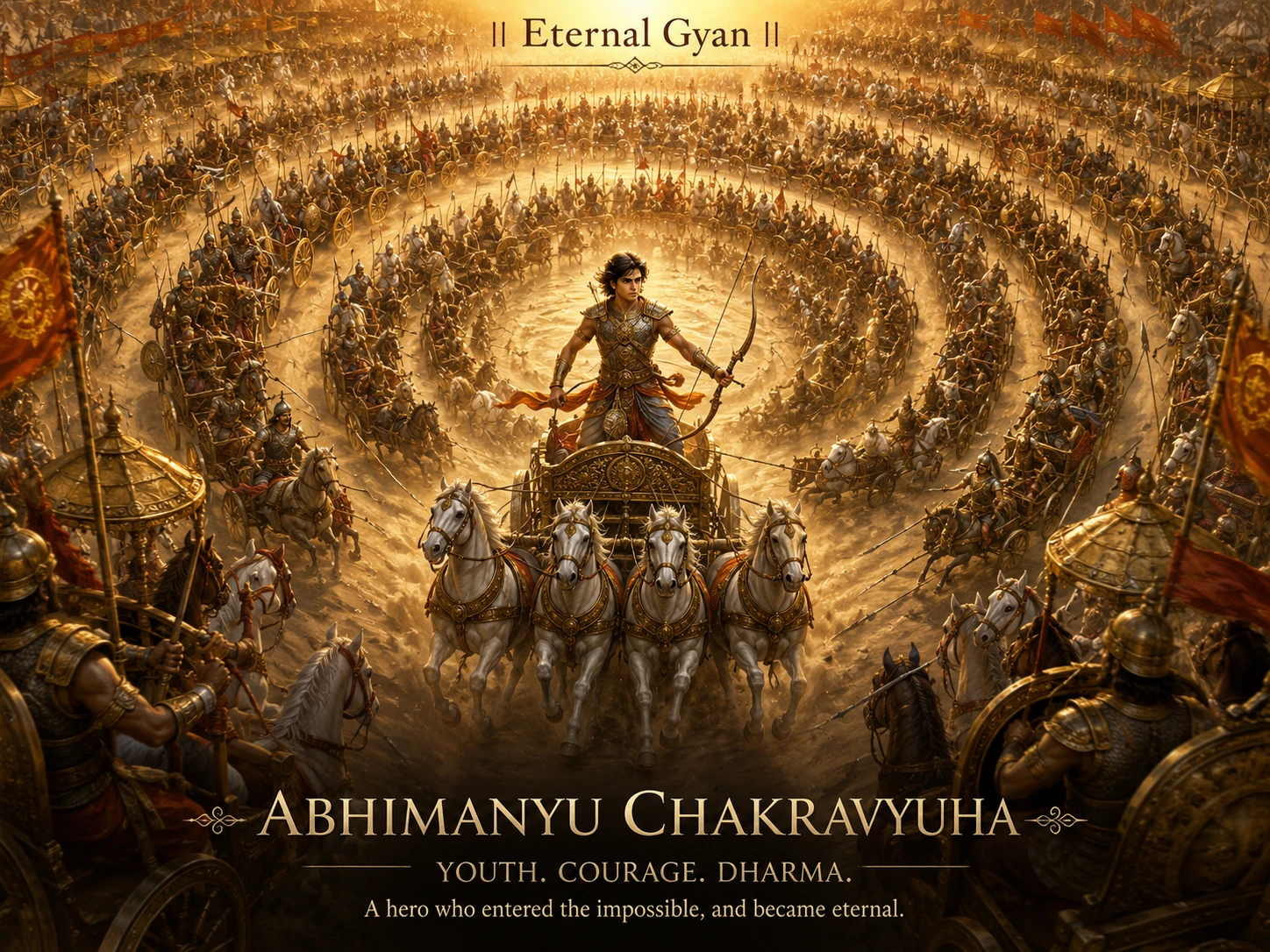
Abhimanyu and the Chakravyuha -- The Boy Who Knew How to Enter but Not How to Leave
14 min read
Adbhuta Ramayana -- The Ramayana Where Sita Becomes Kali
9 min read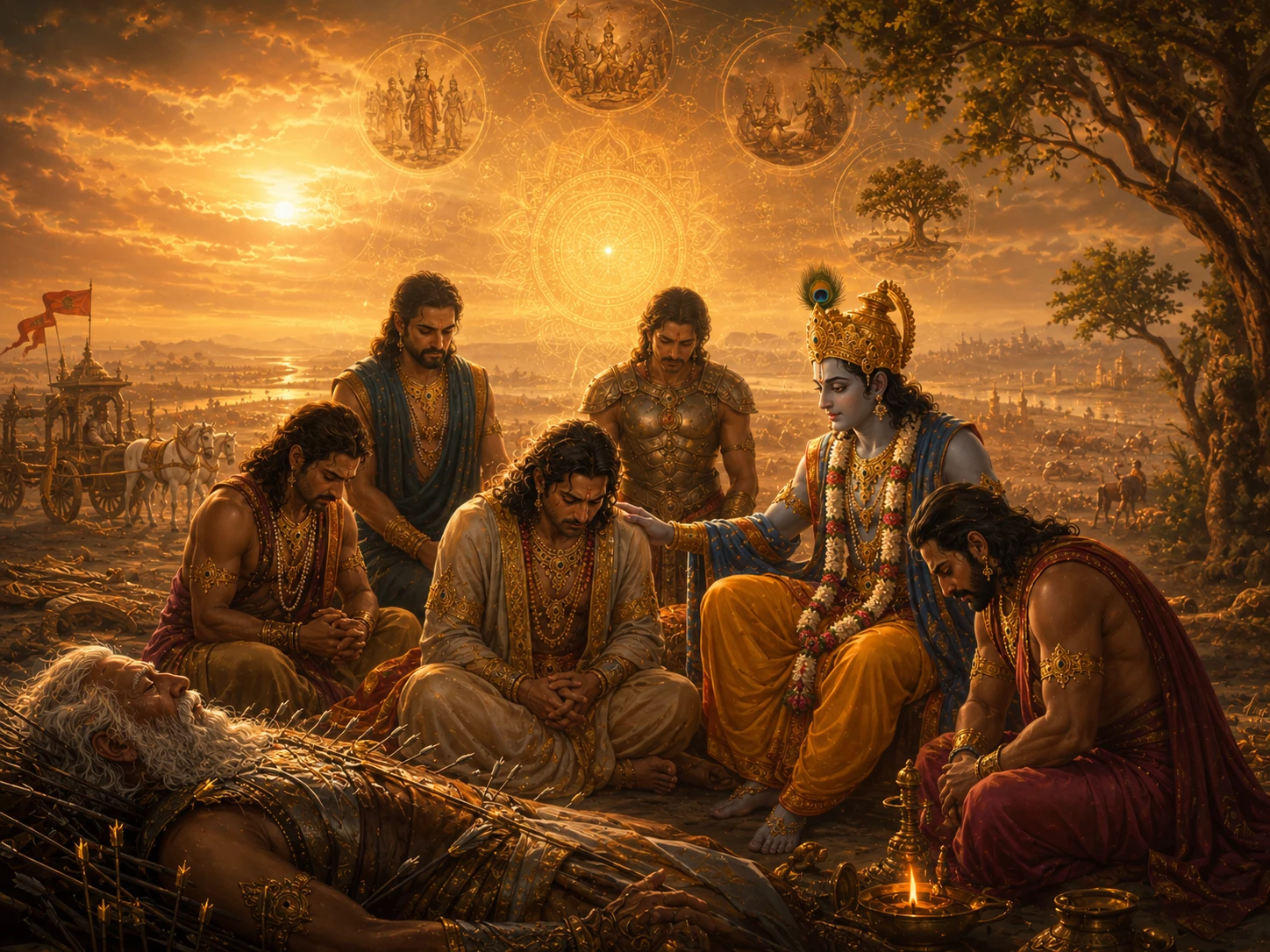
After Kurukshetra -- What Happened Next
14 min readThe same translation error that turned '33 Koti' into '33 crore' in Hinduism also happened in Buddhism. The Chinese translation of Buddhist texts rendered 'Sapta Koti Buddha' (7 Supreme Buddhas) as '7 Crore Buddhas.' The…
Deities AvatarsCommunity Reflections
🕉️
Be the first to share your reflection.