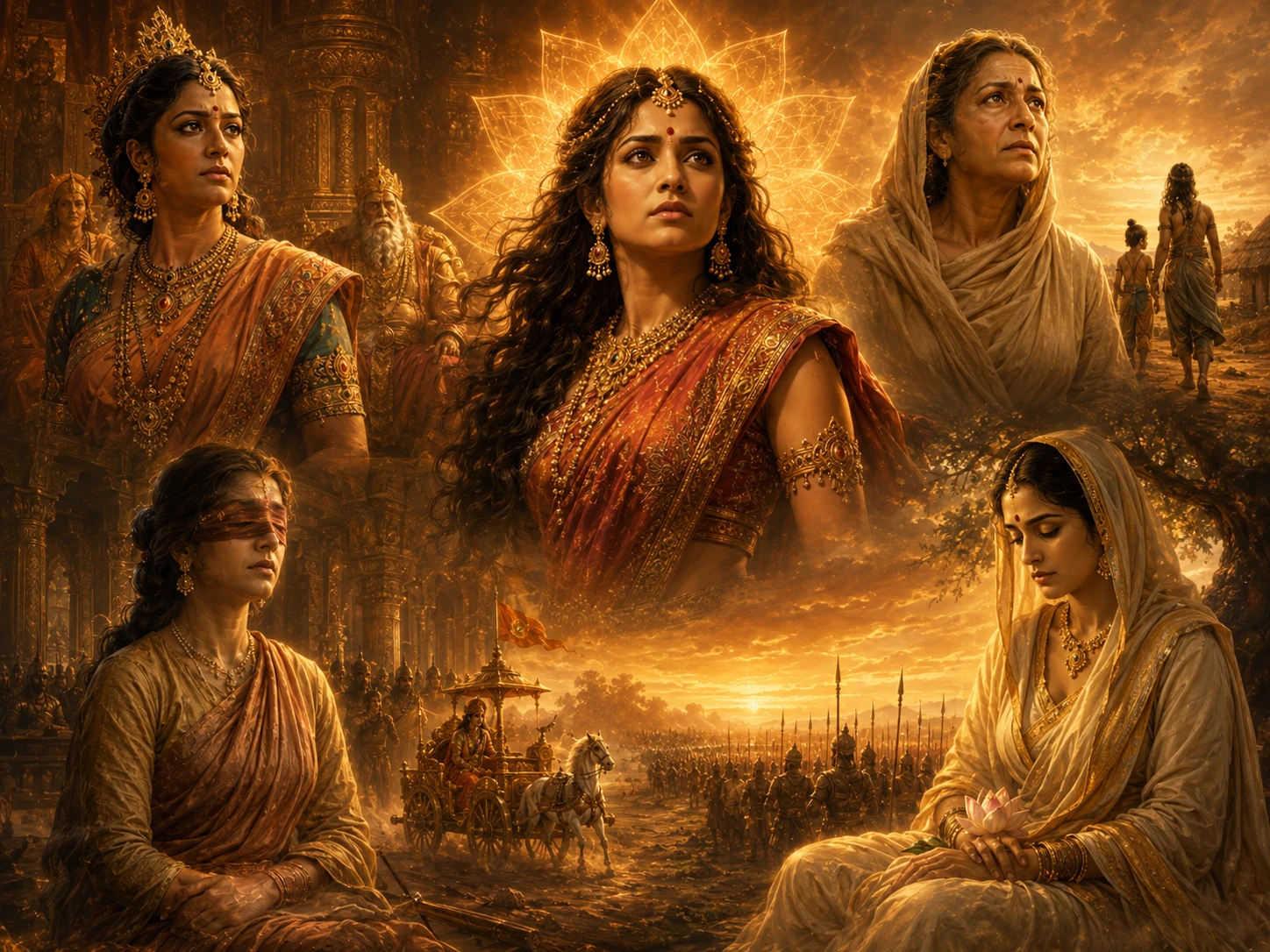
Sita and Draupadi -- The Two Women Who Triggered Two Great Wars
सीता और द्रौपदी -- वो दो स्त्रियाँ जिन्होंने दो महान युद्ध छेड़े
The standard telling goes like this: Sita was abducted, so Rama went to war. Draupadi was disrobed, so the Pandavas went to war. Two passive women, two reactive men, two wars caused by crimes against women.
This framing makes the women objects -- things that were done to. The abduction happened to Sita. The disrobing happened to Draupadi. They are the wounds, not the warriors. They are the triggers, not the architects.
But read the texts carefully -- not the Amar Chitra Katha version, not the TV serial version, the actual Valmiki and Vyasa -- and a radically different picture emerges.
Sita is not a passive victim waiting for rescue. She is a woman who chose to accompany Rama into exile when she could have stayed in the palace. She is the one who challenged Lakshmana's decision to stay behind when they heard Rama's cry (the golden deer episode). She survived months of psychological torture in Ravana's captivity without breaking, rejected Ravana's advances with absolute contempt, and when Rama asked her to prove her purity through Agni Pariksha after the war, she walked into the fire. The fire did not burn her. But the fact that she had to walk into it -- that is the moment the Ramayana stops being a simple rescue story and becomes a devastating critique of the systems it otherwise celebrates.
Draupadi is even more explicitly an agent, not a victim. Her question in the Kuru Sabha -- 'Did Yudhishthira have the right to stake me after he had already lost himself?' -- is not a cry for help. It is a legal argument. She is questioning the validity of the contract. She is doing, in a court of law, what no man in the room had the courage to do: challenging power with reason.
This article is the second in a three-part trilogy on women in the Hindu epics. The first (Women Power in Ancient India) established the breadth of female participation in Vedic and epic society. This piece goes deep into the two most prominent women of the two greatest epics -- not as cultural icons to be worshipped or political symbols to be deployed, but as characters whose choices drove the narratives they inhabit.
Both Sita and Draupadi are routinely misread. Sita is flattened into a symbol of wifely obedience by one camp and rejected as a patriarchal construction by another. Draupadi is celebrated as a feminist icon by one generation and reduced to a disrobing victim by popular culture. Both readings are shallow. The texts are deeper than their interpreters. What follows is an attempt to read both women as the primary sources actually present them -- as agents, strategists, and moral philosophers in their own right.
सभायां प्रश्नमेकं मे ब्रूत सर्वे सभासदः। आत्मानं वा पराजित्य ततो मां किं पराजयत्॥
sabhāyāṃ praśnam ekaṃ me brūta sarve sabhāsadaḥ | ātmānaṃ vā parājitya tato māṃ kiṃ parājayat ||
Answer me this one question, O all who sit in this assembly: having already lost himself, how could he then stake and lose me?
— Mahabharata, Sabha Parva (Draupadi's question in the Kuru court)
Sita -- The Woman Whose Choices Shaped the Ramayana
Strip away the divine framing for a moment -- set aside the question of avatars and incarnation -- and look at Sita's choices. Every critical plot turn in the Ramayana pivots on a decision Sita makes.
Choice 1: Going to the forest. Rama was exiled. He asked Sita to stay in the palace. She refused. Her argument: a wife's place is with her husband, not in comfort while he suffers. This is not submission -- she overrules his explicit instruction. The entire Aranya Kanda (forest book) exists because Sita chose to be there.
Choice 2: The Lakshman Rekha moment. When Rama chases the golden deer and cries out, Sita commands Lakshmana to go help him. Lakshmana resists, citing Rama's order to guard her. Sita accuses him of having ulterior motives -- a devastating charge that compels him to leave. This is the moment that enables the abduction. Sita is not a passive victim here. She makes a judgment call (that Rama is in danger) and acts on it forcefully. She was wrong about the danger -- but she was exercising agency, not waiting for events to happen to her.
Choice 3: Refusing Ravana. Across months of captivity in the Ashok Vatika, Ravana offers Sita queenship, wealth, and power. She refuses every time. The Sundara Kanda records her contemplating suicide rather than submission -- and then choosing to wait because she trusts Rama will come. Her survival is an act of will, not luck.
Choice 4: Walking into fire. After the war, Rama -- under the gaze of the entire army -- asks Sita to undergo Agni Pariksha. Her response is not tears or pleading. She asks the fire to be prepared and walks in. Agni himself rises and certifies her purity. This scene has been debated for centuries. What is undeniable is that Sita walks into the fire on her own terms. She does not ask for Rama's forgiveness. She asks fire -- the most incorruptible witness -- to testify on her behalf.
The Ramayana is not a war triggered by a helpless woman's abduction. It is a war triggered by a powerful woman's unjust captivity -- a woman who, at every stage, made choices that advanced or complicated the narrative. The abduction happened to her. Everything else she chose.
The Sundara Kanda reveals the full horror of Sita's captivity that popular retellings sanitize. In the Ashok Vatika, she is guarded by Rakshasis -- demonesses who are not merely wardens but psychological tormentors. Trijata is sympathetic, but the others deploy every tool of coercion: some threaten death, some mock her appearance, some offer false sympathy designed to make her doubt Rama's commitment, some describe graphic punishments to break her spirit. Through all of this, Sita maintains composure in their presence, allowing grief only in private moments. This is not passivity. This is a prisoner of war maintaining operational dignity under sustained psychological assault.
The moment that defines Sita's agency most clearly comes when Hanuman finds her. Having crossed the ocean, infiltrated Lanka, and located the princess, Hanuman offers to carry her back to Rama on his shoulders. She refuses. Her reason is precise: her rescue must come through Rama's own valour, through a war that publicly defeats Ravana, because only that level of visible justice can restore what was taken. She is not waiting to be rescued out of helplessness. She is choosing the method of her liberation. She understands that a secret escape would not undo the public humiliation of abduction. Only a public military victory would. This is strategic thinking, not passivity. Sita is directing the narrative of her own rescue.
For any young woman navigating the modern Indian workplace -- where harassment is often followed by institutional pressure to 'settle quietly' and 'move on for your own good' -- Sita's refusal to accept a quiet escape is profoundly relevant. She demands the public reckoning. She insists that the system that failed to protect her must be forced to acknowledge that failure.
And then comes the Agni Pariksha -- the fire ordeal that divides Sita's interpreters into warring camps. Here is what the Valmiki Ramayana actually describes: after defeating Ravana, Rama tells Sita in front of the assembled armies that he fought the war for his own honour, not for her. He says she is free to go wherever she pleases. Sita, devastated, orders Lakshmana to build a pyre and enters it voluntarily. Agni, the god of fire, rises from the flames carrying Sita unharmed and declares her purity to the entire assembly.
The standard devotional reading treats this as Rama testing Sita for the audience's benefit -- he always knew she was pure. The feminist critique reads it as patriarchal violence -- a husband demanding proof of fidelity from the woman he failed to protect. Both readings have merit. But neither captures what the text actually shows: Sita entering the fire is HER decision, not Rama's demand. She is the one who orders the pyre built. She is the one who chooses fire as the medium of proof. And when she emerges unharmed, it is not Rama who is vindicated -- it is the assembled world that is shamed for having doubted.
For a law student studying Evidence Law -- where the burden of proof falls on the accuser, not the accused -- the Agni Pariksha raises a foundational question: why should the survivor prove her purity when the system that failed to protect her faces no examination at all? This question is 3,000 years old and still unanswered in every HR department, every police station, and every courtroom in India.
Draupadi -- The Legal Mind That Exposed a System
Draupadi's question in the Kuru Sabha is not just emotionally powerful. It is legally precise. And the fact that nobody in the room -- not Bhishma, not Drona, not Vidura, not Dhritarashtra -- could answer it tells you everything about the moral bankruptcy of the system she was confronting.
The question operates on two levels. On the surface: if Yudhishthira had already staked and lost himself, he was a slave. A slave has no property. Therefore, he had no legal right to stake Draupadi. The bet was void. On a deeper level: can any man 'own' his wife as property to be wagered? Draupadi is questioning not just the specific bet but the entire framework that allows it.
Bhishma -- the patriarch, the conscience of the Kuru clan -- admits he cannot answer. He says, 'The course of Dharma is subtle.' This is not wisdom. This is a confession of failure. The greatest man in the room cannot answer a woman's straightforward legal question because the system he built and upheld has been weaponised against justice.
Draupadi's role does not end in the Sabha. Through the twelve years of exile and one year of hiding, she is the voice that keeps the flame of justice alive. When Yudhishthira considers forgiving the Kauravas, Draupadi's speech in the Vana Parva dismantles his arguments for peace:
She does not argue for revenge. She argues for consequence. She says, in essence: if you forgive men who dragged a menstruating queen by her hair in open court, you are not being virtuous -- you are teaching every future tyrant that there are no consequences for injustice. Forgiveness without justice is complicity.
The Mahabharata war did not happen because Draupadi was disrobed. It happened because no man in the most powerful court in the world could answer a woman's question about justice. The disrobing was the symptom. The disease was the silence of good men.
Draupadi's Vana Parva speech is not an emotional outburst. It is a systematically constructed argument. She invokes specific historical precedents -- kings who punished injustice, rulers who did not forgive unrepentant aggressors. She challenges Yudhishthira's definition of Kshatriya dharma point by point: if a warrior's duty is to protect the weak, how does passive forgiveness of those who assaulted his wife fulfil that duty? She argues, with devastating logic, that forgiveness extended to an unrepentant aggressor does not produce peace -- it produces emboldened aggression. The Kauravas will not reform because they are forgiven. They will attack again because they have learned that attack carries no consequences.
Her vow -- to leave her hair untied until it is washed with Dushasana's blood -- was not a private oath. It was a public, permanent, visible protest. Every day that Draupadi walked with unbound hair was a reminder to every Pandava, every ally, every witness that the Sabha's injustice remained unresolved. In Article 3 of this trilogy, we discussed Gandhari's blindfold -- a lifelong visual protest against an unjust marriage. Draupadi's unbound hair is the mirror image: a lifelong visual protest demanding justice for an assault the system refused to address. Both women weaponized appearance as moral statement.
The Structural Parallel -- Two Epics, One Pattern
Step back and see the pattern. Both women are abducted or assaulted because of a man's strategic failure -- Rama chasing the golden deer (an obvious trap) and Yudhishthira gambling his kingdom and family (an obvious setup). Both survive not through rescue but through inner fortitude. Both demand justice, not sympathy. And both are subjected to 'purity tests' by the very people and institutions that failed to protect them -- Sita faces the Agni Pariksha demanded by the husband whose decision to chase the deer enabled her abduction; Draupadi faces the court's silence after the husband whose decision to gamble enabled her assault.
The parallel is too precise to be accidental. Valmiki and Vyasa are making the same structural argument across two epics separated by cosmic ages: when patriarchal institutions fail women, those institutions then demand that women prove their purity to the failing institution. The fire-test is not a test of Sita's character. It is an indictment of the system that required it. The court's question 'was Draupadi legitimately staked?' is not a legal inquiry. It is a systemic failure dressed as procedure.
For a student of gender studies at JNU or a law student at NLSIU Bangalore studying constitutional protections for women, these two narratives are not ancient mythology. They are structural blueprints of how power deflects accountability. The pattern has not changed in 3,000 years. A woman is failed by the system. She survives. She demands justice. The system responds by questioning her conduct instead of its own.
Sita vs Draupadi -- Parallel Architecture of Two Catalysts
| Dimension | Sita | Draupadi |
|---|---|---|
| The crime against her | Abduction by Ravana | Public disrobing by Dushasana, ordered by Duryodhana |
| Her response | Absolute refusal to submit. Survived months of captivity through willpower alone. | Legal question that exposed the moral bankruptcy of the court. Then a vow that drove the war. |
| Her agency | Chose exile. Commanded Lakshmana. Rejected Ravana. Walked into fire on her own terms. | Challenged legality of the bet. Argued for consequence over forgiveness. Kept the flame of justice alive for 13 years. |
| What she demanded | To be believed. Her purity was self-evident -- the fire confirmed it. | To be answered. Her legal question was never answered -- the war was the answer. |
| The system's failure | Raj Dharma demanded proof of chastity from a queen who was the victim, not the perpetrator. | No elder in the court could answer a straightforward question about a woman's legal status. |
| Modern resonance | Every woman asked to 'prove' her innocence after assault. Every survivor who walks through fire and is still doubted. | Every whistleblower whose question is met with silence. Every legal challenge buried by institutional power. |
| What she represents | The cost of being morally perfect in a morally imperfect world. | The power of one question to bring down an empire built on silence. |
Neither woman 'started' a war. Both women exposed failures so fundamental that war became the only remaining mechanism for correction. The wars were not about them. The wars were about the systems that failed them.
Draupadi's unanswered question -- 'Having lost himself, how could he stake me?' -- has been analysed by Indian legal scholars as one of the earliest recorded arguments about personhood and property rights. The question essentially asks: does marriage make a wife the husband's property? And if yes, does the husband's loss of his own freedom (becoming a slave) automatically transfer the wife's freedom too? The Mahabharata does not answer this question. Neither Bhishma, Drona, Vidura, nor Dhritarashtra provides a verdict. The text deliberately leaves it open -- forcing every generation of readers to answer it for themselves. Indian Supreme Court judgments on marital rights, property, and consent in the 21st century are still, in essence, answering Draupadi's question from five thousand years ago.
Find Draupadi's Question in the Sabha Parva
The question no one could answer is asked in the Sabha Parva, the Mahabharata's second book -- the chapter that changed the course of the epic. The Mahabharata text is not yet on Eternal Raga; the overview article shows where it sits so you can find it in a full translation.
Tags
Eternal Raga · शाश्वत राग
Institutional voice — scholarly articles on Sanatan Dharma
Deepen Your Understanding
अपनी समझ और गहरी करें
scriptural exegesis
Women Power in Ancient India -- Scholars, Warriors, and Queens the Textbooks Erased
Gargi debated the greatest philosopher of her age and he could not defeat her. Maitreyi rejected a fortune for the pursuit of knowledge. Vishpala lost a leg in battle, got an iron prosthetic, and went back to fight. Kaikeyi drove Dasharatha's chariot in war and saved his life. These are not feminist reimaginings. These are the primary texts. And they tell a very different story from the one you were taught.
scriptural exegesis
The Forgotten Women -- Urmila, Madri, Gandhari and the Sacrifices Nobody Tells
Urmila slept for 14 years so Lakshmana could stay awake guarding Rama. Madri walked into her husband's funeral pyre carrying the guilt of his death. Gandhari blindfolded herself for life -- not in submission, but in the most devastating protest a wife has ever made. These women shaped the epics. The epics barely mention them.
scriptural exegesis
Draupadi in the Sabha -- The Trial That Started the War
A queen was dragged into a court full of kings, warriors, and elders. Not one stood up. She asked a single legal question that nobody could answer. Then she swore an oath that burned a civilization to the ground. Draupadi's Sabha episode is not a story about a helpless woman. It is the most devastating indictment of institutional silence in world literature.
scriptural exegesis
The Dice Game -- The Darkest Hour of the Mahabharata
A king who cannot say no to a challenge. An uncle whose dice are loaded with the bones of the dead. A court full of elders who watch injustice and say nothing. And a woman who asks one question that nobody in the room can answer: 'Did my husband lose himself first, or me?' The dice game in the Sabha Parva is not a plot device. It is the moral black hole at the centre of the Mahabharata. Everything before it is prologue. Everything after it is consequence. And the central horror is not what happens -- it is who lets it happen.
philosophy darshana
Rama vs Krishna -- Two Faces of Dharma, One Question for Your Life
Rama followed every rule and lost his wife. Krishna broke every rule and won the war. Both are Vishnu. Both upheld Dharma. So who was right? The answer might be the most important thing Hindu philosophy has to say to a world that thinks morality is simple.
scriptural exegesis
Agni Pariksha -- Sita's Fire Ordeal and the Interpretations That Divided India
A woman walks into fire to prove she is 'pure.' The man who asked her to do it is called God. For two thousand years, India has argued about what this scene means -- and the argument is far from over. Devotional reading, feminist critique, textual scholarship, and political appropriation all collide in the most contested episode of the Ramayana.
scriptural exegesis
Karna's Tragedy -- The Sun's Forgotten Son
Born with divine armor, abandoned at birth, raised by a charioteer, humiliated for his caste, cursed by his teacher, and killed while defenseless -- Karna's story is not the Mahabharata's subplot. It is the Mahabharata's conscience. Every system that failed him is a system that still fails people today.
Draupadi's unanswered question -- 'Having lost himself, how could he stake me?' -- has been analysed by Indian legal scholars as one of the earliest recorded arguments about personhood and property rights. The question e…
More in Scriptural Exegesis
Abhimanyu and the Chakravyuha -- The Boy Who Knew How to Enter but Not How to Leave
14 min read
Adbhuta Ramayana -- The Ramayana Where Sita Becomes Kali
9 min read
After Kurukshetra -- What Happened Next
14 min readThe same translation error that turned '33 Koti' into '33 crore' in Hinduism also happened in Buddhism. The Chinese translation of Buddhist texts rendered 'Sapta Koti Buddha' (7 Supreme Buddhas) as '7 Crore Buddhas.' The…
Deities AvatarsCommunity Reflections
🕉️
Be the first to share your reflection.