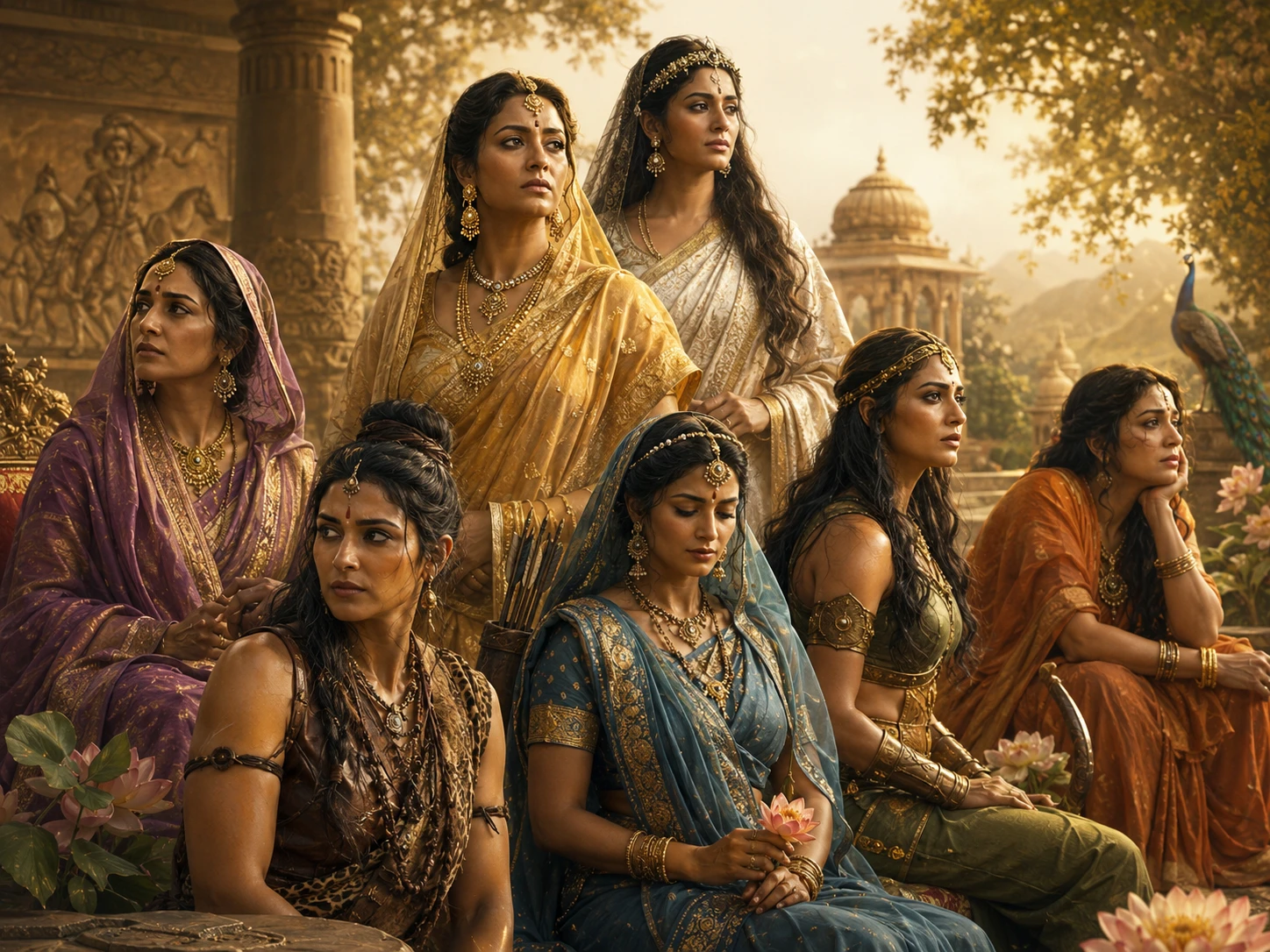
The Forgotten Women -- Urmila, Madri, Gandhari and the Sacrifices Nobody Tells
भुलाई गई स्त्रियाँ -- ऊर्मिला, माद्री, गान्धारी और वो त्याग जो कोई नहीं सुनाता
For every Sita that the Ramayana celebrates, there is an Urmila it forgets. For every Draupadi that the Mahabharata lionises, there is a Madri it buries in a footnote. For every Kunti whose strategy is remembered, there is a Gandhari whose protest is misread as submission.
These are the women who did not get the songs, the temples, the TV serials, or the Instagram quotes. They lived in the margins of two civilisation-defining epics, bearing sacrifices as enormous as the heroes' -- sometimes greater -- with almost no acknowledgment. Their stories survive in scattered shlokas, half-told episodes, and regional folk traditions that the mainstream retelling consistently overlooks.
This article -- Part 3 of our Women of the Epics trilogy -- gives them the space they were denied. Not as victims. Not as footnotes. As women whose choices, silences, and sacrifices shaped the very epics that forgot to name them.
This is the third article in a trilogy. The first (Women Power in Ancient India) surveyed the breadth of female authority in Vedic and epic texts. The second (Sita and Draupadi) went deep on the two most visible women. This piece turns to the ones the epics depend on but never fully see -- the women whose sacrifices, choices, and moral courage made the central narratives possible, yet who received neither glory nor grief from the storytelling tradition.
Every success story has an infrastructure of invisible labour. Every hero has someone who stayed behind. The Ramayana could not exist without Urmila. The Mahabharata could not reach its climax without Gandhari. The Pandava dynasty itself could not exist without Madri. These women are not footnotes. They are load-bearing structures whose removal would collapse the stories we celebrate.
यत्र नार्यस्तु पूज्यन्ते रमन्ते तत्र देवताः। यत्रैतास्तु न पूज्यन्ते सर्वास्तत्राफलाः क्रियाः॥
yatra nāryastu pūjyante ramante tatra devatāḥ | yatraitāstu na pūjyante sarvāstatrāphalāḥ kriyāḥ ||
Where women are honoured, the gods are pleased. Where they are dishonoured, all rituals and actions become fruitless.
— Manusmriti 3.56 (also quoted in Mahabharata, Anushasana Parva)
Urmila -- The Woman Who Slept So a Nation Could Be Saved
When Lakshmana decided to accompany Rama into exile, he left behind his wife Urmila in the palace at Ayodhya. For fourteen years, she lived alone -- not as a widow, not as a divorcee, but in a liminal state with no name. Her husband was alive but gone. He chose his brother over her. And the entire tradition celebrates this choice as the pinnacle of brotherhood without ever asking what it cost the woman who was left behind.
Some regional traditions (particularly in Awadhi and Maithili retellings) preserve a stunning detail the Valmiki text barely mentions: when Lakshmana requested the goddess of sleep, Nidra Devi, to help him stay awake for 14 years to guard Rama and Sita, Nidra agreed on one condition -- someone else must sleep in his place. Urmila took on that sleep. For fourteen years, she slept continuously in the palace so that her husband could remain vigilant in the forest.
This is not a minor detail. It reframes the entire exile. Lakshmana's legendary sleeplessness -- which enables him to guard Rama through every danger -- is possible only because Urmila absorbs the sleep he owes. His heroism is literally built on her sacrifice. Yet the Ramayana devotes thousands of shlokas to Lakshmana's devotion and barely a handful to Urmila's.
For every woman who has kept the home running while her husband deployed with the army, or worked double shifts while her partner pursued a degree, or raised children alone while her spouse built a career in another city -- Urmila's story is not ancient mythology. It is Tuesday.
Consider the emotional dimension the text implies but never fully explores. Urmila is Sita's sister -- both are daughters of King Janaka, both married Ikshvaku princes on the same day. When Sita was abducted by Ravana, Urmila -- asleep in the palace at Ayodhya -- would have learned of it only through messengers. She could do nothing. She was not even present for the grief. She slept through her sister's kidnapping, the war, the victory, and the return. She woke up to a world that had lived an entire epic without her.
In some Maithili folk traditions, Urmila is considered a greater sacrifice than Sita. The reasoning is heartbreakingly precise: Sita at least had Rama's presence during exile -- he was beside her in the forest, shared her hardships. Urmila had nothing. No husband, no companionship, no participation in the story. Her sacrifice produced no narrative. She gave fourteen years of her life and received not a single verse of acknowledgment in the original text.
Every NRI wife in suburban New Jersey who manages an entire household, children's education, and in-laws' expectations while her husband works 70-hour weeks at his tech job and receives all the family's acclaim -- she is living Urmila's pattern. Every mother in a tier-2 city who sacrificed her own career to run the home while her children cleared IIT and got celebrated, while she got a 'thanks Ma' at graduation -- she knows this story in her bones. The modern Urmilas are everywhere. We just do not have a word for their sacrifice.
Madri -- The Woman Who Carried the Guilt
Madri, the second wife of Pandu, is remembered for one thing: she was with Pandu when he died. The curse of sage Kindama decreed that Pandu would die the moment he approached a woman with desire. Madri, described as exceptionally beautiful, was with him when the curse activated. Pandu died. And Madri -- carrying the weight of having been, in her own perception, the instrument of her husband's death -- chose to immolate herself on his pyre.
Before she walked into the fire, she asked Kunti to raise her twin sons, Nakula and Sahadeva, alongside the other three Pandavas. Kunti agreed. And from that moment, Madri disappears from the Mahabharata. Her sons grow up as the 'lesser Pandavas' -- talented but perpetually in the shadow of Arjuna and Bhima. They are never given their own glory episodes. They are Madri's children, raised by Kunti, defined by their mother's absence.
The tradition never asks the harder question: did Madri have a choice? The curse was on Pandu, not on her. She did not seduce him -- the text implies he approached her. Yet she accepted the guilt. Her self-immolation was not a sati tradition (which developed much later) -- it was an individual act of a woman who could not bear to live with the perception that she caused her husband's death. Whether this was tragic nobility or internalised blame is a question the epic does not answer. But it is a question every reader should ask.
What makes Madri's story resonate in 2026 India is how uncomfortably it mirrors a pattern we still see. In any high-profile tragedy -- a corporate scandal, a political crisis, a family dispute over inheritance -- there is almost always one person who 'takes the fall,' whose departure from the scene is treated as resolution. Madri is that person. Her death closes the narrative complication of Pandu's curse. Her self-immolation resolves the awkward question of a wife who was present when the husband broke a fatal prohibition. The system moves on. The twins get raised by another woman. And nobody asks whether Madri had a choice that did not involve dying.
The mother in a middle-class Indian family who 'adjusts' every time -- who eats last, speaks last, sacrifices her ambitions to keep the household functional -- is performing a slower version of Madri's sati. She is not on a pyre. But she is burning nonetheless.
Gandhari -- The Blindfold That Was Not Submission
Gandhari is the most misread woman in the Mahabharata. Popular culture presents her blindfold as wifely devotion -- she covered her eyes because her husband was blind, choosing to share his disability. This is not wrong, but it is woefully incomplete.
Gandhari was a princess of Gandhara (modern Kandahar, Afghanistan). She was married to Dhritarashtra without being told he was blind. When she discovered the truth after the wedding, she had two options: accept the marriage and live normally, using her sight to guide both of them. Or tie a cloth over her eyes forever.
She chose the blindfold. And this choice was not devotion. It was protest.
By binding her eyes, Gandhari was saying: you married me to a blind man without my consent. You took my choice away. Now I will take my sight away -- and every single day for the rest of my life, you will see this blindfold and remember what you did. The blindfold is not a symbol of submission. It is a permanent, visible, undeniable accusation against the family that deceived her.
This reading is supported by Gandhari's character throughout the epic. She is not a passive, devoted wife. She is sharp, bitter, politically aware, and brutally honest. When Duryodhana comes to her for blessings before the war, she does not encourage him. She says, 'Where there is Dharma, there is victory' -- a clear signal that she knows her sons are on the wrong side. And in the final act of the war, when she discovers that all hundred of her sons are dead, she unleashes a curse on Krishna himself -- the only character in the Mahabharata with the moral authority and accumulated pain to curse God. Her curse -- that Krishna's own clan, the Yadavas, will destroy each other -- comes true.
Gandhari is not a victim. She is the most restrained fury in the epic -- a woman who held her rage behind a cloth for decades and released it only once, against the one person she held responsible.
Mandodari and Tara -- Wisdom the Heroes Did Not Deserve
Mandodari, Ravana's chief queen, repeatedly counselled him to return Sita and avoid war. The Valmiki Ramayana records her arguments as cogent, strategic, and heartfelt. She warned Ravana that his arrogance would destroy Lanka, their children, and their dynasty. He did not listen. After his death, she mourned him -- not as a demon's wife, but as the wife of a brilliant man who was destroyed by one fatal flaw.
Tara, wife of Vali in the Ramayana's Kishkindha Kanda, similarly warned Vali not to fight Sugriva a second time because Sugriva had secured a powerful ally (Rama). Vali dismissed her counsel. He died. Tara then turned to Rama himself and asked: 'If you are the upholder of Dharma, why did you kill my husband from behind a tree?' Rama's answer -- that Vali had wronged Sugriva and that Kshatriya dharma permitted this -- has been debated for millennia. Tara's question remains sharper than any answer given to it.
The backstory of her hundred sons reveals Gandhari's spiritual power. She was pregnant for two years -- a gestation so prolonged and painful that she struck her own womb in anguish, delivering not a child but a mass of flesh. It was Vyasa who intervened, dividing the mass into 101 pots filled with ghee -- from which emerged 100 sons and one daughter, Dushala, who is almost never mentioned in popular retellings. What is forgotten is that Gandhari earned the boon of 100 sons through her own severe tapas dedicated to Shiva -- she matched Kunti's divine boon with her own spiritual effort. Gandhari is not merely a passive vessel. She is a tapasvi whose spiritual capital rivals that of any Rishi in the epic.
Her final scene before the war is one of the most powerful images in the Mahabharata. When Duryodhana comes to her for blessing, Gandhari removes her blindfold for one brief moment and gazes upon her son's body. Her eyes, concentrated with decades of accumulated tapas from voluntary blindness, carry such power that Duryodhana's body turns to iron wherever her gaze falls. But because he is wearing a loincloth, his thighs remain unprotected. And this is precisely where Bhima's mace strikes the fatal blow in their climactic duel on the 18th day.
Gandhari's one moment of seeing -- after a lifetime of chosen blindness -- both protects and dooms her son. The symbolism is devastating. A mother's love, even when it summons supernatural power, cannot cover the parts her culture required her to look away from. The loincloth is not a garment. It is the blind spot that propriety creates.
In the Stri Parva -- the Book of Women, one of the most emotionally devastating sections of the Mahabharata -- Gandhari walks the battlefield after the 18-day war and names the bodies. She recognizes every son. She identifies every wound. She knows how each one died and who killed him. This is not the behaviour of a mother who was absent. This is a woman who tracked every moment of a war she chose not to see. Her blindfold was never ignorance. It was a filter -- she knew everything; she simply chose not to witness it directly.
When she finally curses Krishna -- holding him responsible for allowing the war when he had the power to prevent it -- she is not speaking from grief alone. She is making a legal argument: Krishna, as the supreme strategic mind, had both the ability and the duty to prevent this outcome. His choice to let the war happen, to strategize for the Pandavas while allowing the Kauravas to walk into destruction, makes him complicit. Gandhari's curse -- that Krishna's own clan, the Yadavas, will destroy each other -- is not a mother's anguish. It is cosmic jurisprudence.
The Forgotten Five -- What They Sacrificed, What They Got
| Woman | Her Sacrifice | What the Epic Gave Her | What She Deserved |
|---|---|---|---|
| Urmila (ऊर्मिला) | 14 years of solitary sleep so Lakshmana could stay awake. Raised alone in a palace with no husband, no recognition. | Barely a mention. A few shlokas across all 7 Kandas of the Ramayana. | Her own Kanda. Her sacrifice enabled Lakshmana's -- without her, the entire exile narrative collapses. |
| Madri (माद्री) | Self-immolation on Pandu's pyre, carrying guilt for his death that was not her fault. | A brief mention in Adi Parva. Disappears entirely after death. Sons treated as secondary Pandavas. | Recognition that the curse was Pandu's, not hers. Her death was the epic's first act of internalised blame. |
| Gandhari (गान्धारी) | Lifelong blindfold as protest against a marriage conducted through deception. Watched 100 sons die. | Reduced to 'blind devotion' in popular retellings. Her curse on Krishna treated as bitterness, not justice. | Recognition that her blindfold was the longest protest in literature, and her curse was the only accountability anyone in the epic ever faced. |
| Mandodari (मन्दोदरी) | Counselled Ravana repeatedly to return Sita. Ignored every time. Lost her husband, her kingdom, and her children to his arrogance. | A few verses of mourning. Then married off to Vibhishana (her husband's betrayer) in some traditions. | Credit as the wisest voice in Lanka. If Ravana had listened to her, there would be no Ramayana war. |
| Tara (तारा) | Warned Vali not to fight. Questioned Rama's ethics after Vali's death. Provided strategic counsel to Sugriva. | Brief mention. Overshadowed by Hanuman and Sugriva in the Kishkindha narrative. | Recognition that her question to Rama ('Why did you kill from hiding?') remains the most uncomfortable unanswered question in the Ramayana. |
This table does not include other overlooked women: Ahilya (cursed for her husband's enemy's crime), Shanta (Rama's sister, barely mentioned), Subhadra (Arjuna's wife, reduced to Krishna's sister), or Hidimbi (Bhima's wife, a Rakshasi who fought for the Pandavas and is all but erased from the main narrative). The pattern is consistent: women who served the plot were remembered. Women who complicated it were forgotten.
Gandhari's curse on Krishna is one of only two curses in the Mahabharata that actually come true exactly as spoken. After the war, she tells Krishna: 'Since you had the power to stop this war and chose not to, your own Yadava clan will destroy each other, and you yourself will die alone, in an inglorious manner, in the wilderness.' Thirty-six years later, exactly this happens -- the Yadavas kill each other in a drunken brawl at Prabhasa, and Krishna dies alone in a forest, struck by a hunter's arrow that hits his foot. The only other unfailing curse in the epic is Ashwatthama's -- and his target was an unborn child. Gandhari's hit God. The woman who spent a lifetime in self-imposed darkness had earned the moral authority to do what no warrior, no sage, and no king in the Mahabharata could: hold Krishna accountable.
Read the Sundara Kanda -- For Sita, but Also for Urmila
While you read Hanuman's search for Sita in Lanka, remember that somewhere in Ayodhya, Urmila is asleep -- carrying Lakshmana's exhaustion so he can carry Rama's mission.
Tags
Eternal Raga · शाश्वत राग
Institutional voice — scholarly articles on Sanatan Dharma
Deepen Your Understanding
अपनी समझ और गहरी करें
scriptural exegesis
Women Power in Ancient India -- Scholars, Warriors, and Queens the Textbooks Erased
Gargi debated the greatest philosopher of her age and he could not defeat her. Maitreyi rejected a fortune for the pursuit of knowledge. Vishpala lost a leg in battle, got an iron prosthetic, and went back to fight. Kaikeyi drove Dasharatha's chariot in war and saved his life. These are not feminist reimaginings. These are the primary texts. And they tell a very different story from the one you were taught.
scriptural exegesis
Sita and Draupadi -- The Two Women Who Triggered Two Great Wars
Every Indian knows that the Ramayana happened because Sita was abducted and the Mahabharata happened because Draupadi was disrobed. But here is the question nobody asks: were these women the cause of war, or the consequence of systems that had already failed? The answer reframes both epics.
scriptural exegesis
100 Kauravas -- The Forgotten Brothers of the Mahabharata
Everyone knows Duryodhana and Dushasana. But what about Vikarna, who stood up for Draupadi when no one else did? Or Yuyutsu, who defected to the Pandavas because his conscience demanded it? The Mahabharata names all 100 sons of Dhritarashtra -- warriors, strategists, and dissenters -- most of whom are killed across 18 days. Their story is not just a casualty list. It is the most devastating portrait of fratricidal war ever composed.
scriptural exegesis
Draupadi in the Sabha -- The Trial That Started the War
A queen was dragged into a court full of kings, warriors, and elders. Not one stood up. She asked a single legal question that nobody could answer. Then she swore an oath that burned a civilization to the ground. Draupadi's Sabha episode is not a story about a helpless woman. It is the most devastating indictment of institutional silence in world literature.
scriptural exegesis
Karna's Tragedy -- The Sun's Forgotten Son
Born with divine armor, abandoned at birth, raised by a charioteer, humiliated for his caste, cursed by his teacher, and killed while defenseless -- Karna's story is not the Mahabharata's subplot. It is the Mahabharata's conscience. Every system that failed him is a system that still fails people today.
philosophy darshana
Rama vs Krishna -- Two Faces of Dharma, One Question for Your Life
Rama followed every rule and lost his wife. Krishna broke every rule and won the war. Both are Vishnu. Both upheld Dharma. So who was right? The answer might be the most important thing Hindu philosophy has to say to a world that thinks morality is simple.
scriptural exegesis
Wives of Arjuna -- Four Women Who Shaped the War
Arjuna did not marry for romance. Each of his four marriages -- to Draupadi, Subhadra, Ulupi, and Chitrangada -- was a strategic alliance that brought the Pandavas military power, divine protection, or political legitimacy they could not have won on the battlefield. A Panchala princess, a Yadava sister, a Naga queen, and a Manipuri warrior-princess: four women from four different civilisations, each changing the course of the Mahabharata.
Gandhari's curse on Krishna is one of only two curses in the Mahabharata that actually come true exactly as spoken. After the war, she tells Krishna: 'Since you had the power to stop this war and chose not to, your own Y…
More in Scriptural Exegesis
Abhimanyu and the Chakravyuha -- The Boy Who Knew How to Enter but Not How to Leave
14 min read
Adbhuta Ramayana -- The Ramayana Where Sita Becomes Kali
9 min read
After Kurukshetra -- What Happened Next
14 min readThe same translation error that turned '33 Koti' into '33 crore' in Hinduism also happened in Buddhism. The Chinese translation of Buddhist texts rendered 'Sapta Koti Buddha' (7 Supreme Buddhas) as '7 Crore Buddhas.' The…
Deities AvatarsCommunity Reflections
🕉️
Be the first to share your reflection.