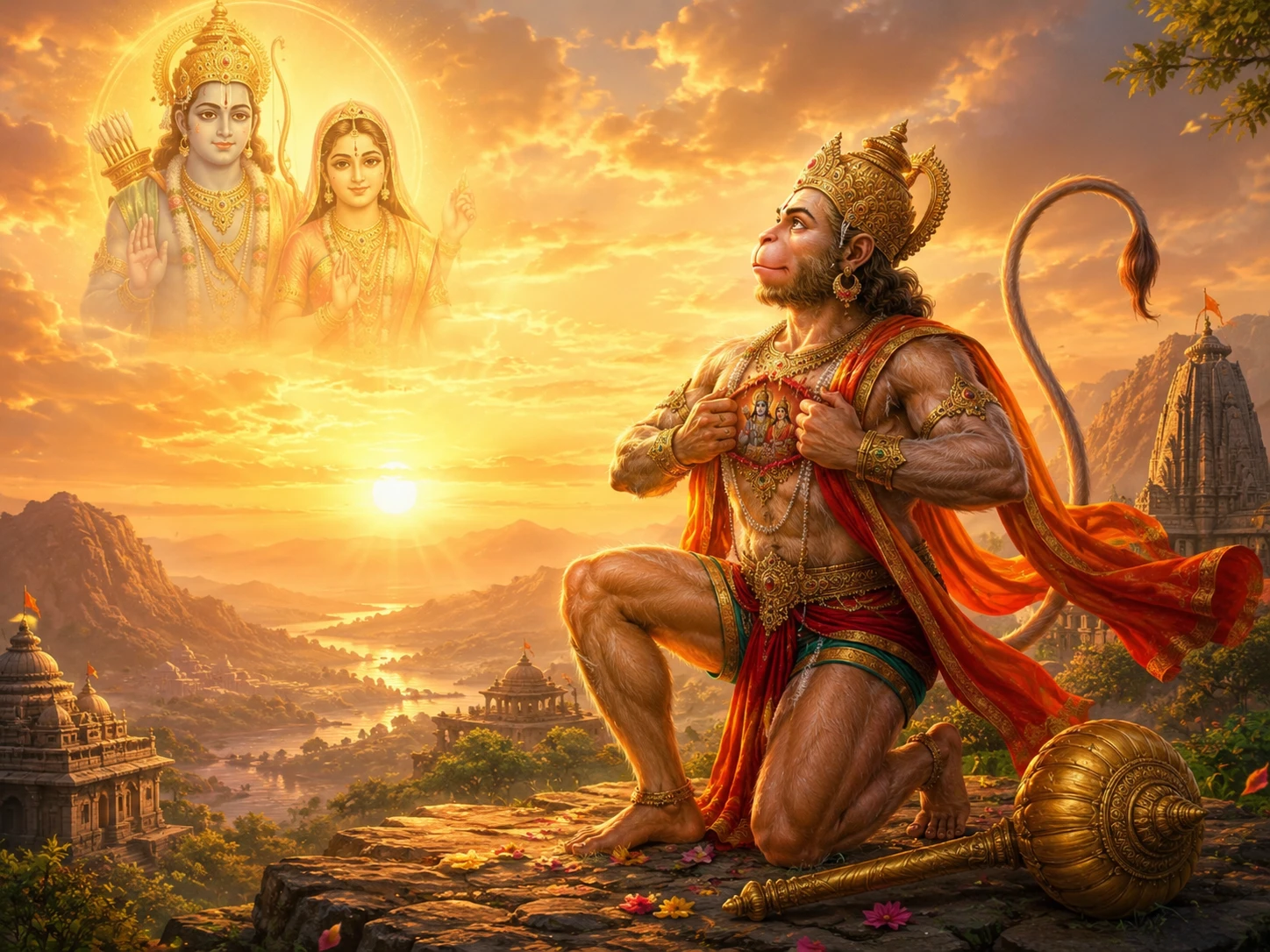
Hanuman -- The Perfect Devotee
हनुमान -- भक्ति की चरम सीमा
Every Tuesday and Saturday, across India, something extraordinary happens. The autorickshaw driver in Hyderabad ties a saffron flag to his rearview mirror. The NEET aspirant in Kota touches Hanuman's photo before opening her biology textbook. The Mumbai local commuter whispers 'Jai Bajrangbali' as the 8:47 Virar fast pulls into Dadar. The software engineer in Bengaluru visits the Ragigudda Anjaneya temple before his H-1B interview. None of these people are performing a ritual. They are accessing a relationship -- the oldest, most intimate, and most accessible devotional bond in Hinduism.
Hanuman is not merely popular. He is ubiquitous. More temples in India are dedicated to Hanuman than to any other single deity -- estimates range from 100,000 to over a million if roadside shrines and tree-trunk murtis are counted. His image guards village entrances, truck bumpers, gym walls, and WhatsApp display pictures. Wrestlers at the Tulsi Ghat akhada in Varanasi invoke Bajrangbali before every bout. Soldiers in the Indian Army's Madras Regiment carry Hanuman lockets. Cybersecurity professionals in Pune have named a threat-detection protocol after him (no, really).
Why? What is it about this particular figure that cuts across caste, class, region, language, age, and even religious boundaries (Hanuman shrines exist in some Jain and Buddhist traditions)?
The answer is not strength. India has plenty of strong deities. The answer is the quality of Hanuman's strength -- it is never self-serving. Every act of power Hanuman performs is in service of someone else. He leaps the ocean not for adventure but to find Sita. He burns Lanka not for revenge but as a message. He carries the Dronagiri mountain not to show off but to save Lakshmana's life. He tears open his chest not in madness but to reveal Rama and Sita living in his heart.
This is the architecture of perfect bhakti -- power without ego, capability without personal agenda, strength that exists only to serve.
Valmiki's Ramayana introduces Hanuman in the Kishkindha Kanda as a minister to the exiled monkey-king Sugriva. The first thing Rama notices about Hanuman is not his physical strength but his speech. In Kishkindha Kanda, Sarga 3, when Hanuman approaches Rama and Lakshmana disguised as a Brahmin mendicant, Rama tells Lakshmana that this person has clearly mastered the Vedas and grammar -- his speech is flawless, measured, and free of any fault. Valmiki is making a point: Hanuman's first superpower is not flying or shapeshifting. It is communication -- the ability to say the right thing at the right time with perfect clarity.
For the JEE aspirant struggling with English communication in placement interviews, this is a radical reframe. India's most celebrated warrior-devotee was first recognized for his eloquence. The career coach in Koramangala who tells students 'your technical skills get you in the door, your communication skills get you the job' is unknowingly channeling Valmiki's Hanuman.
अनिर्वेदः श्रियो मूलमनिर्वेदः परं सुखम्। अनिर्वेदो हि सततं सर्वार्थेषु प्रवर्तकः॥
anirvedaḥ śriyo mūlamanirvedaḥ paraṃ sukham | anirvedo hi satataṃ sarvārtheṣu pravartakaḥ ||
Perseverance is the root of prosperity. Perseverance is the highest happiness. Perseverance alone is the constant driver of all accomplishments.
— Valmiki Ramayana, Sundara Kanda, 12.10 (Hanuman's self-encouragement during Lanka search)
This verse is Hanuman talking to himself. He has entered Lanka, searched palace after palace, and cannot find Sita. Doubt creeps in. Fatigue weighs on him. And in that moment of near-despair, he does not pray to Rama. He does not invoke divine intervention. He coaches himself: anirveda -- do not give up. The root of all success is simply not quitting.
This is the verse every UPSC aspirant failing for the third time should have on their wall. It is the verse for the startup founder whose Series A just collapsed. It is the verse for the Class 12 student re-taking board exams after a breakdown. Hanuman -- the most powerful being in the Ramayana after Rama himself -- had to remind himself not to despair. If he needed that pep talk, so can you.
The Sundara Kanda, which is covered in detail in a separate article, is Hanuman's book. It is the only kanda named not after a place or event but after a quality -- sundara, meaning beautiful. Tradition holds that the beauty refers to Hanuman's devotion. In the entire kanda, Hanuman operates alone in enemy territory, making decisions without Rama's guidance. He decides how to enter Lanka, how to approach Sita, whether to fight or flee, and ultimately, whether to burn the city. Each decision reflects Rama's values without Rama's direct instruction -- the mark of a devotee who has so completely internalized his lord's dharma that he can act independently while remaining perfectly aligned.
This is what separates bhakti from obedience. A soldier follows orders. A devotee embodies the commander's intent even in situations the commander never anticipated. The Indian Army's concept of 'mission command' -- where field officers are expected to achieve objectives through independent judgment aligned with the overall mission -- is the military equivalent of Hanuman's Lanka operation.
Hanuman's devotion has five distinct registers in the texts, and understanding them prevents the common mistake of reducing him to a simple strongman-servant:
First, Dasya Bhakti (servant devotion) -- the most visible form. Hanuman serves Rama with total obedience. He carries messages, builds bridges, fights armies. This is the Hanuman of popular iconography -- the kneeling figure with folded hands.
Second, Sakhya Bhakti (friend devotion). In the Kishkindha Kanda, before the hierarchical relationship is established, Hanuman and Rama meet as equals. Hanuman's first instinct is diplomatic conversation, not prostration. The friendship is real before the service begins.
Third, Vatsalya Bhakti (parental-protective devotion). When Lakshmana is struck by Shakti and lies dying, Hanuman does not wait for orders. He flies to the Himalayas and tears out an entire mountain because he cannot waste time identifying a single herb. This is not servant behavior -- it is the fierce protectiveness of a parent who will break the world to save their child.
Fourth, Shanta Bhakti (peaceful devotion). The image of Hanuman sitting quietly, eyes closed, absorbed in Rama's name -- this is the Hanuman of the Hanuman Chalisa, the japa tradition, the meditative aspect that makes him accessible to anyone who simply wants to sit and remember God.
Fifth, Madhura Bhakti's inversion. Unlike the Gopis with Krishna, Hanuman's love for Rama contains zero romantic or erotic energy. It is the purest form of non-sexual intimacy -- a love so complete that it needs no physical expression. The image of Hanuman tearing open his chest to reveal Rama and Sita is the perfect visual metaphor: the beloved literally lives inside the devotee's body.
Tulsidas's Hanuman Chalisa (40 verses in Awadhi Hindi, 16th century) crystallized Hanuman's devotion into the most recited prayer in Hinduism. More Indians know the Hanuman Chalisa by heart than any other text -- including the national anthem. Its 40 chaupais cover Hanuman's birth, powers, exploits, and blessings with remarkable compression. The verse 'Bhoot Pisaach Nikat Nahi Aave / Mahavir Jab Naam Sunave' -- evil spirits dare not approach when Mahavir's name is heard -- is recited by millions every night before sleep, from Delhi to Detroit.
The Chalisa's genius is accessibility. You do not need a pandit, a temple, or even literacy to access Hanuman through it. A truck driver on NH-44 singing it through the Western Ghats at 3 AM is performing the same devotion as a Sanskrit scholar parsing its etymology. This radical accessibility is Hanuman's gift to Hinduism -- he makes bhakti democratic.
Five Registers of Hanuman's Bhakti
| Bhakti Type | Meaning | Hanuman Example | Modern Parallel |
|---|---|---|---|
| Dasya (Service) | Master-servant devotion | Carrying Rama's ring to Sita in Lanka | The CRPF jawan executing orders on the border without question |
| Sakhya (Friendship) | Equal-hearted companionship | Meeting Rama as a diplomat before pledging service | The co-founder who joins a startup because they believe in the person, not just the idea |
| Vatsalya (Protective care) | Parental fierce love | Uprooting Dronagiri mountain to save Lakshmana | The mother who fights the school system to get her child the right education |
| Shanta (Peaceful absorption) | Meditative devotion | Sitting in eternal Rama-nama japa | The morning jogger at Cubbon Park with Hanuman Chalisa on earbuds -- still mind, steady pace |
| Inverted Madhura | Non-erotic complete love | Tearing open chest to reveal Rama-Sita within | The platonic bond between an army buddy pair who would take a bullet for each other |
These categories draw from Narada Bhakti Sutra and the Bhagavata tradition's nine-fold bhakti classification. Hanuman uniquely embodies multiple registers simultaneously.
Hanuman's origin story itself carries layers. The standard Valmiki account is relatively simple: he is the son of Vayu (wind god) and Anjana. But the Shiva Purana and other texts add that he is an avatar of Shiva himself, born to serve Rama (Vishnu's avatar). This Shiva-Vishnu convergence in Hanuman is theologically significant. In a tradition where Shaiva and Vaishnava sects can be fiercely competitive, Hanuman is the bridge figure -- Shiva's energy in Vishnu's service. The philosophical implication is that the highest form of Shiva's power is expressed not through independent cosmic destruction but through devotional surrender to Vishnu's mission.
The childhood story of Hanuman mistaking the sun for a ripe fruit and leaping to eat it is found in later Puranic texts. Indra strikes him with his thunderbolt (Vajra), which gives him his name -- Hanu (jaw) + man -- the one with the broken jaw. Vayu, enraged at his son's injury, withdraws all air from the universe. The gods relent and shower the child with boons: Brahma grants immunity from his own weapon, Indra grants invulnerability to the vajra, Surya agrees to be his teacher. These boons essentially pre-load Hanuman with every power he will need for his future service to Rama.
But there is a catch -- a curse. The sages (or Indra, depending on the version) curse young Hanuman to forget his powers until someone reminds him of them. This is narratively brilliant. The most powerful being in the Ramayana does not know his own strength until the moment it is needed. Jambavan's famous reminder in the Kishkindha Kanda -- where the old bear-king tells Hanuman 'you can leap across the ocean; you have forgotten who you are' -- is one of the most motivational passages in world literature.
Every coaching center in Kota should have that scene on the wall. The student who cannot believe they can crack JEE? Someone needs to be their Jambavan.
Hanuman's role extends beyond the Ramayana. In the Mahabharata, he appears as the flag emblem on Arjuna's chariot -- Kapi Dhwaja. He also tests Bhima, his brother through Vayu, by blocking a forest path as an old monkey and asking Bhima to move his tail. Bhima, for all his strength, cannot. The lesson is Rama-bhakti: Hanuman's power in Treta Yuga surpasses even Bhima's raw Dvapara Yuga strength because it is fueled by devotion rather than ego.
In living Hinduism, Hanuman worship has specific cultural associations. Tuesday (Mangalvar) and Saturday (Shanivar) are his days. The connection to Shani (Saturn) comes from a legend where Hanuman freed Shani from Ravana's prison, and Shani in gratitude promised never to trouble Hanuman's devotees. This is why Hanuman is invoked as a shield against Shani Dosh (Saturn's malefic influence) in Jyotish astrology -- a practice so widespread that village Hanuman temples see their biggest crowds on Saturdays.
Sindoor (vermillion) offered to Hanuman traces to his seeing Sita apply sindoor to her parting. When he asked why, she said it was for Rama's long life. Hanuman promptly smeared his entire body in sindoor -- reasoning that if a small application gave Rama long life, full-body coverage should give him immortality. The story is theologically playful but structurally important: Hanuman takes every devotional act to its literal, maximum extreme. He does not do moderation.
This all-or-nothing quality is what makes Hanuman the patron deity of wrestlers, soldiers, bodybuilders, and anyone facing a physical or psychological challenge. The gyms of India -- from Kolhapur's kushti tradition to the CrossFit box in Gurgaon -- invoke Hanuman not for religious reasons but because his energy represents total commitment. The phrase 'Jai Bajrangbali' before lifting a heavy weight is not a prayer for divine intervention. It is an activation code -- a reminder that you are capable of more than you think, that your forgotten powers are waiting to be unlocked.
India's Mars Orbiter Mission (Mangalyaan) and Chandrayaan-3's lunar landing both involved pre-launch pujas by ISRO scientists. While no deity is officially invoked, the cultural connection is unmistakable -- Hanuman's leap across the ocean to reach Lanka is the original 'Indian space mission.' In 2023, when Chandrayaan-3's Pragyan rover successfully soft-landed near the Moon's south pole, social media flooded with Hanuman memes captioned 'First Indian to cross an impossible distance.' ISRO's unofficial mascot may well be Bajrangbali.
Chant Hanuman Chalisa with Eternal Raga
The Hanuman Chalisa is on Eternal Raga verse by verse, with its meaning. Recite it as your Tuesday or Saturday sadhana.
Eternal Raga · शाश्वत राग
Institutional voice — scholarly articles on Sanatan Dharma
Deepen Your Understanding
अपनी समझ और गहरी करें
deities avatars
Rama -- Ideal of Dharmic Living
Why does India still name its sons after a prince who chose exile over a throne? Rama's life is not a fairy tale -- it is a manual for dharmic decision-making under impossible pressure. From boardrooms to battlefields, his choices remain the hardest moral benchmark in civilization.
scriptural exegesis
Hanuman's Leap Across the Ocean
100 yojanas of open ocean. Three supernatural obstacles. Zero backup. Hanuman's leap to Lanka is not just mythology's greatest action sequence -- it is a masterclass in overcoming self-doubt, navigating temptation, and executing under impossible pressure.
scriptural exegesis
Why Sundara Kanda is the Most Revered
It is the only book of the Ramayana named after a quality, not a place. It is the only one where Rama is absent from the action. And it is the most recited, most parayana'd, most trusted text in living Hindu practice. Why does Sundara Kanda hold this unmatched position?
scriptural exegesis
7 Chiranjeevis -- The Immortals of Hindu Tradition
Seven beings who will not die until the end of this cosmic age. One is cursed to wander in agony. One rules the underworld. One compiled every scripture you have ever read. One is the most worshipped deity in India. The Chiranjeevis are not a mythology trivia list -- they are a map of how immortality works in Hindu thought, and why it is not always a blessing.
deities avatars
Who is Shiva?
He is the ash-smeared ascetic who is also the ideal husband. The destroyer of the universe who is called 'The Auspicious One.' The god of death who drank poison to save all life. He sits in meditation on a Himalayan peak, and simultaneously dances the cosmos into existence and annihilation. No deity in Hinduism contains more contradictions -- and no deity resolves them more completely. This is not a mythology explainer. This is an attempt to stand at the foot of the mountain and look up.
scriptural exegesis
Bhishma's Terrible Vow
A crown prince gave up the throne, love, marriage, and children -- forever -- so his father could marry a fisherwoman. That single vow made Bhishma immortal in name and set the entire Mahabharata into motion. Was it the noblest sacrifice in literature, or the most catastrophic?
India's Mars Orbiter Mission (Mangalyaan) and Chandrayaan-3's lunar landing both involved pre-launch pujas by ISRO scientists. While no deity is officially invoked, the cultural connection is unmistakable -- Hanuman's le…
More in Deities & Avatars
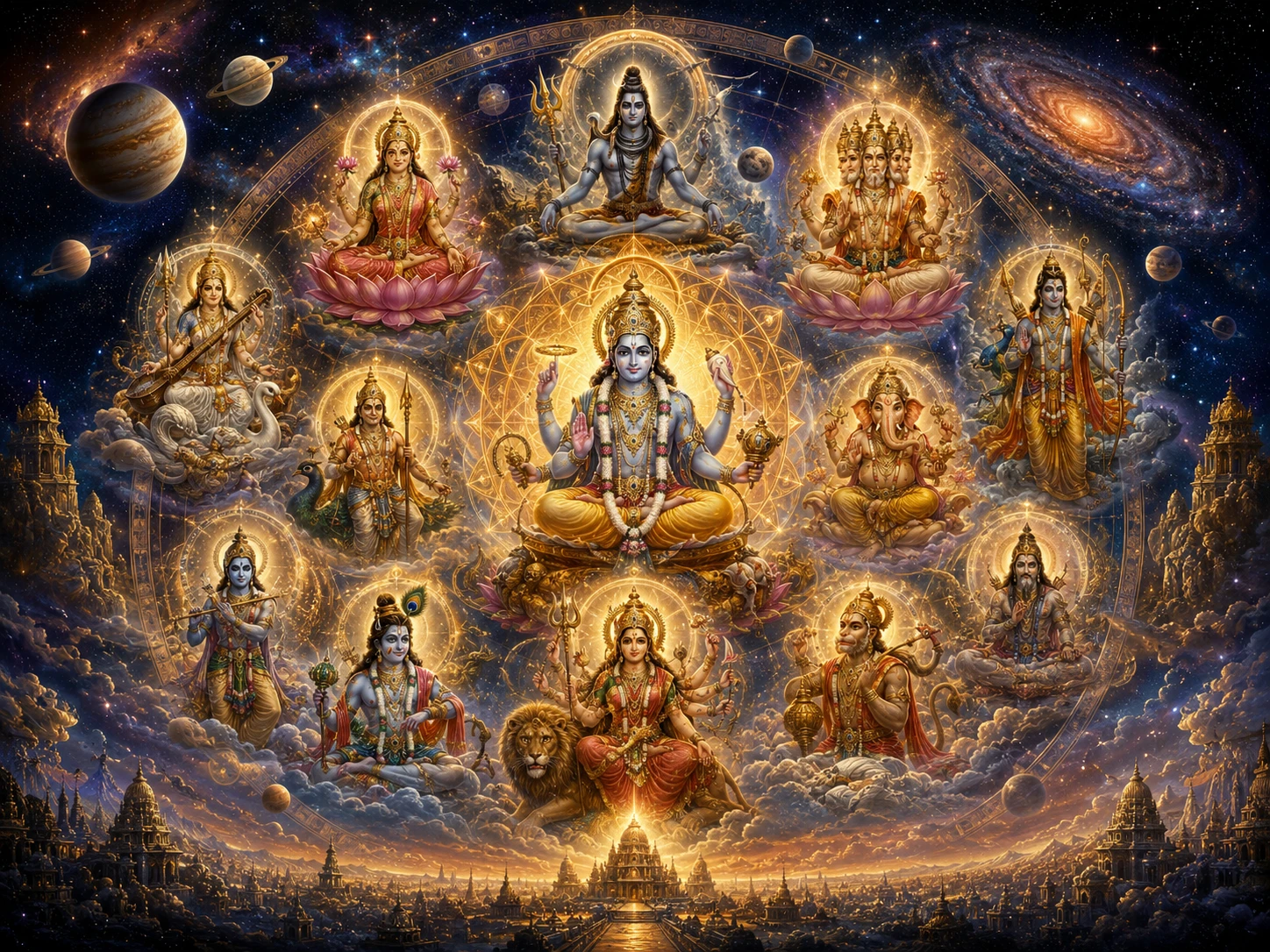
33 Koti Devata -- Why Hinduism Has 33 Types of Gods, Not 33 Crore
13 min read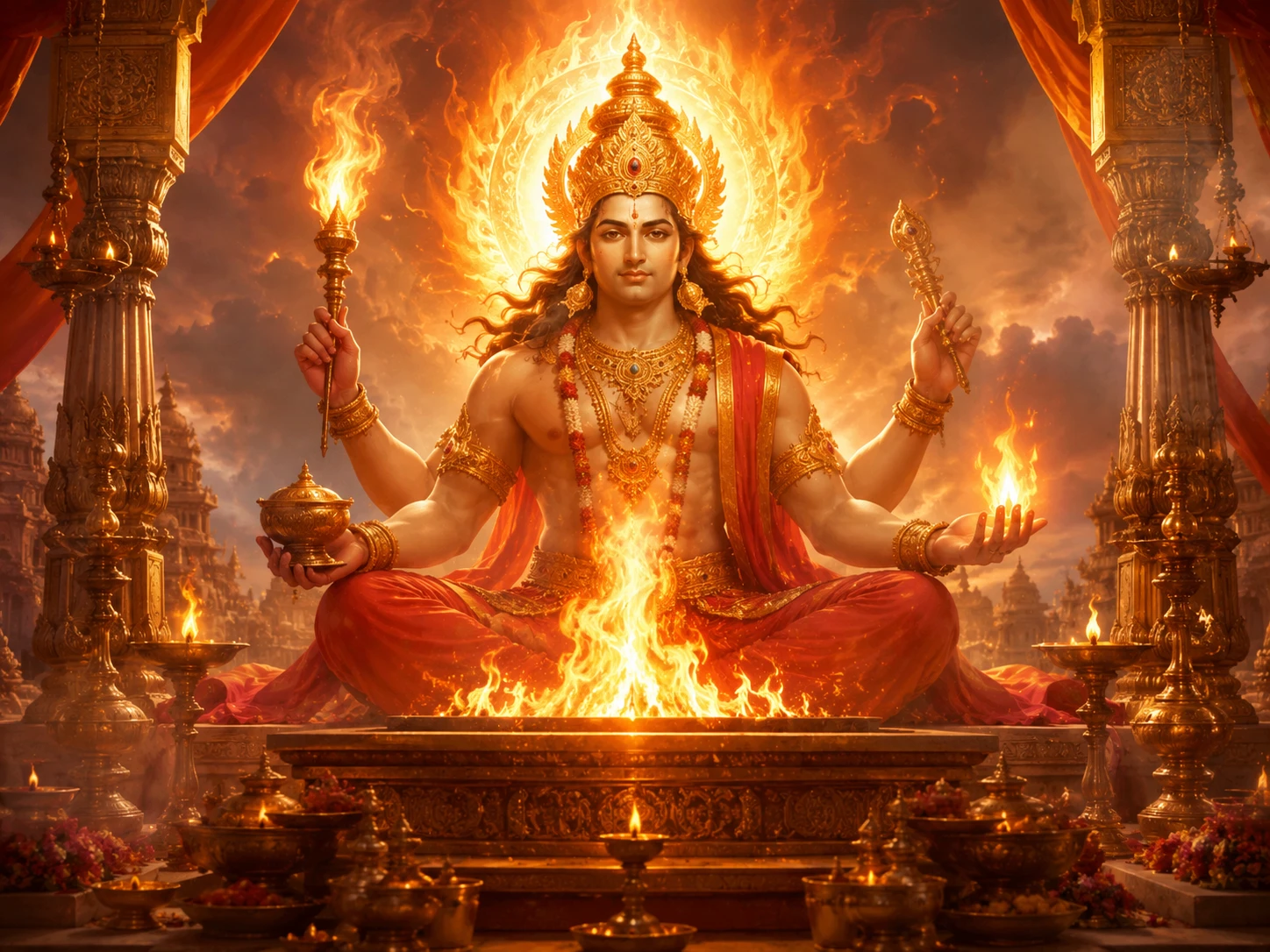
Agni -- The Fire God
19 min read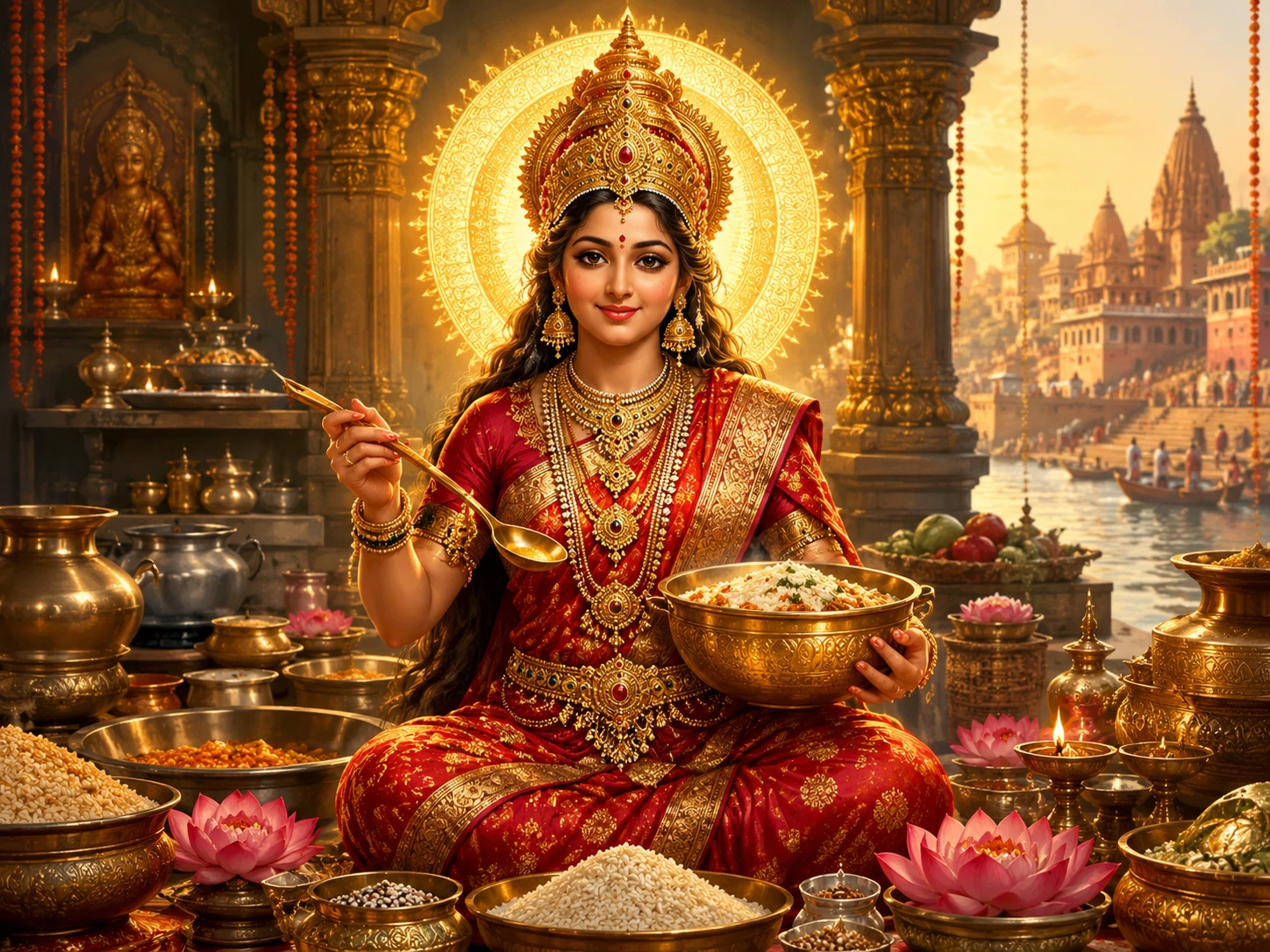
Annapurna -- Goddess of Food
19 min readThe same translation error that turned '33 Koti' into '33 crore' in Hinduism also happened in Buddhism. The Chinese translation of Buddhist texts rendered 'Sapta Koti Buddha' (7 Supreme Buddhas) as '7 Crore Buddhas.' The…
Deities AvatarsCommunity Reflections
🕉️
Be the first to share your reflection.