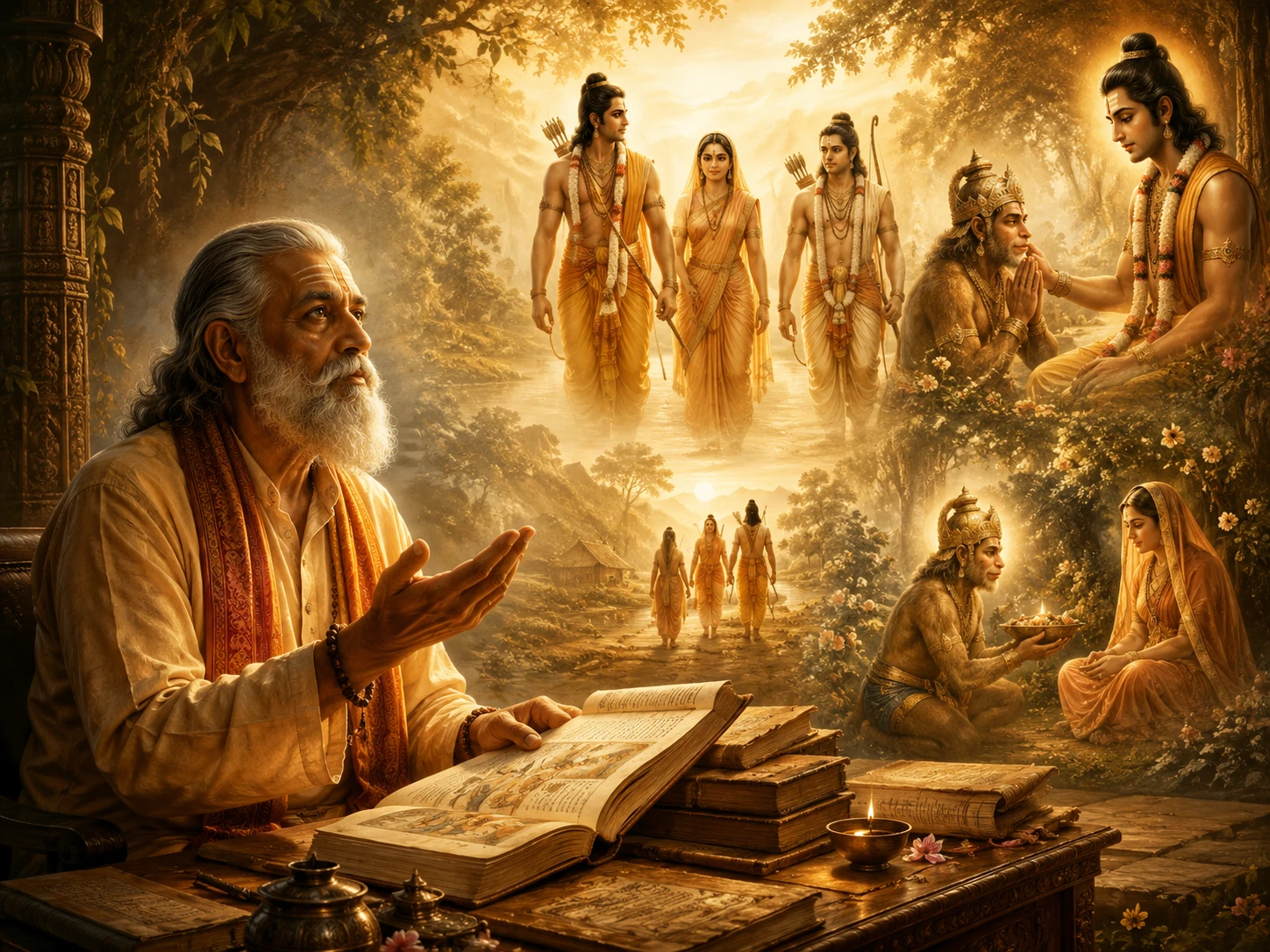
10 Life Lessons from the Ramayana That Still Work in 2026
रामायण के 10 जीवन-पाठ जो 2026 में भी उतने ही काम के हैं
The Ramayana is 24,000 verses long. Valmiki composed it in Sanskrit after a bird's death broke his heart open -- the first shloka of Indian literature was born from grief over a hunter killing a mating crane. That origin story sets the tone for everything that follows: this is not a fairy tale about a perfect prince. This is a text about how the world breaks people, and what they choose to do next.
Most Indians grow up with the Ramayana filtered through Ramanand Sagar's television serial or Amar Chitra Katha comics -- both deeply beloved, both necessarily simplified. The actual Valmiki Ramayana is darker, stranger, and far more morally complex. Rama weeps. Sita rages. Dasharatha dies of heartbreak. Ravana is a Vedic scholar who performs tapasya that shakes the throne of Indra. There are no simple heroes and simple villains here. There are people making choices under pressure -- choices that still echo in every IAS officer's transfer posting, every family business succession battle, every joint-family argument over property and honour.
What follows are ten lessons from the Valmiki Ramayana that have nothing to do with mythology quizzes and everything to do with living. They are drawn from specific episodes, specific characters, and specific verses. Some will be familiar. Others will surprise. All of them work -- not because they are ancient, but because the human situations they describe have not changed in the approximately seven thousand years since Valmiki watched that crane die.
रामो विग्रहवान् धर्मः साधुः सत्यपराक्रमः। राजा सर्वस्य लोकस्य देवानां मघवानिव॥
rāmo vigrahavān dharmaḥ sādhuḥ satyaparākramaḥ | rājā sarvasya lokasya devānāṃ maghavāniva ||
Rama is dharma embodied in human form. He is virtuous, his strength is truthfulness. He is king of all the worlds, as Indra is to the gods.
— Valmiki Ramayana, Aranya Kanda 3.37.13 (Maricha speaking to Ravana)
LESSON 1: DUTY IS NOT A FEELING -- IT IS A DECISION
When Dasharatha tells Rama he must go to the forest for fourteen years because of Kaikeyi's boon, Rama does not argue. He does not negotiate. He does not consult a lawyer. He folds his hands and prepares to leave. This is not blind obedience -- this is a man who understands that a king's word, once given, must be honoured, even if that king is broken-hearted and begging his own son to refuse.
The modern instinct is to call this weakness. Why did Rama not fight? Why did he not challenge an unjust order? But the text is making a subtler point. Rama does not obey because the order is just. He obeys because if the crown prince publicly defies the king's sworn word, every oath in the kingdom becomes worthless. Institutions survive on trust. When the most powerful person in the room honours a rule even when it costs him everything, the rule becomes real for everyone.
This is the lesson that hits hardest in modern India. Every UPSC aspirant in Old Rajinder Nagar studies governance. Rama actually demonstrates it. Duty is not what you do when it feels good. Duty is what you do when every cell in your body is screaming to do the opposite. An IIT placement season, a startup pivot, a family elder's unreasonable demand -- the Ramayana does not promise that doing the right thing will feel right. It promises that doing the right thing will hold the world together.
LESSON 2: LOYALTY WITHOUT POWER IS THE PUREST KIND
Bharata did not ask for the throne. He was away visiting his maternal grandfather when Kaikeyi engineered the exile. When he returns and discovers what happened, he does not celebrate. He rages at his mother. He publicly refuses the kingdom. He walks barefoot to Chitrakuta to beg Rama to return.
Rama refuses. So Bharata takes Rama's sandals, places them on the throne of Ayodhya, and governs as a regent -- not from the palace, but from a hut in Nandigram, wearing bark clothes, eating frugal meals, administering the kingdom in Rama's name for fourteen years.
Think about what this means in practical terms. Bharata had legitimate claim. The coronation was legal. Public opinion could have been managed. He had every incentive to simply accept the throne and move on. Instead, he chose to honour a brother who was not even present to know or thank him. This is loyalty without audience, without recognition, without reward -- the rarest form. In the corporate world, this would be the colleague who credits you in a presentation you never see. In a family, this is the sibling who protects your share of the inheritance when you are not in the room.
Bharata's fourteen years in Nandigram are arguably the most underrated subplot of the entire epic. Rama's exile gets the songs and the TV episodes. Bharata's exile -- self-imposed, thankless, invisible -- gets a footnote. The Ramayana is telling you something about what real sacrifice looks like: it does not come with a soundtrack.
LESSON 3: YOUR NETWORK IS YOUR NET WORTH -- BUILD IT BEFORE YOU NEED IT
Rama arrives in Kishkindha with nothing. He is an exiled prince without an army, without resources, without intelligence on his enemy's location. Within a few weeks, he has: (a) formed an alliance with Sugriva by killing Vali, (b) deployed the entire Vanara army across the four directions to search for Sita, (c) identified Hanuman as the one operative capable of crossing the ocean, and (d) received tactical defection from Vibhishana, Ravana's own brother.
None of this happened by accident. Rama's alliance strategy is a masterclass in relationship-building under adversity. He helps Sugriva first -- kills Vali, restores the kingdom -- before asking for anything in return. He earns Hanuman's devotion not through command but through genuine warmth. He accepts Vibhishana despite every advisor warning him it is a trap, because he judges character, not circumstance.
Every startup founder in Koramangala knows this lesson intuitively. You do not build your network when you need funding. You build it by being useful to people years before you need anything. The Ramayana goes further: Rama's alliances are not transactional. He genuinely cares about Sugriva's problem. He genuinely respects Hanuman's capabilities. He genuinely welcomes Vibhishana. The relationships are real, which is why they hold under the impossible stress of the Lanka war.
LESSON 4: RESILIENCE IS NOT THE ABSENCE OF SUFFERING -- IT IS THE REFUSAL TO BE DEFINED BY IT
Sita spends months as Ravana's captive in the Ashoka Vatika. She is threatened, cajoled, tempted, and psychologically pressured by Ravana and by the rakshasi guards. Ravana offers her the position of chief queen of Lanka -- one of the wealthiest, most powerful kingdoms in the world. She refuses. Every single day, she refuses.
The Valmiki Ramayana's Sita is not a passive victim. She is a woman who makes a deliberate choice to hold her ground when capitulation would have been easier and perhaps even rational. When Hanuman arrives and offers to carry her back on his shoulders, she refuses that too -- because being rescued like cargo would undermine Rama's duty to come himself and defeat Ravana. She thinks strategically even in captivity.
This lesson matters enormously for anyone going through a period of powerlessness -- a toxic workplace, a difficult marriage, an illness, a career setback. Sita does not pretend she is not suffering. She weeps. She is angry. She contemplates ending her life. But she does not surrender her identity or her agency. She waits not passively but deliberately, turning waiting itself into an act of resistance. Every JEE dropper taking a second attempt, every entrepreneur who has shut down a failed startup and is starting again -- Sita's Ashoka Vatika is your story too.
LESSON 5: TALENT WITHOUT HUMILITY IS RAVANA -- TALENT WITH HUMILITY IS HANUMAN
Ravana is not a fool. He is a devotee of Shiva who composed the Shiva Tandava Stotram. He is a master of the Vedas. He conquered Kubera, humbled Indra, and built Lanka into the most technologically advanced city in the epic universe. By every metric of 'success' -- wealth, knowledge, military power, cultural sophistication -- Ravana is the most accomplished character in the Ramayana.
And yet he loses. He loses because his talent exists inside a container of unchecked ego. He cannot hear counsel. When Vibhishana tells him to return Sita, he exiles his own brother. When Maricha warns him that Rama is dharma incarnate, he overrides the warning. When his wife Mandodari pleads, he ignores her. Ravana's downfall is not lack of ability. It is the belief that ability makes him exempt from consequence.
Contrast this with Hanuman. Hanuman has the power to leap across the ocean, to grow to the size of a mountain, to set Lanka on fire, to carry an entire peak of medicinal herbs through the sky. He could be the most arrogant being in the epic. Instead, he introduces himself as 'Rama's servant.' He reports back to the council before acting. He takes orders. He credits others. His power is enormous, but it is completely subordinated to something larger than himself.
Every college campus, every corporate floor, every Bollywood set has both archetypes: the brilliant person who cannot stop talking about how brilliant they are, and the quietly competent person who lets their work speak. The Ramayana does not say talent is bad. It says talent without humility is a weapon pointed at yourself.
10 Ramayana Lessons -- Character, Episode, and Modern Application
| Lesson | Key Character | Episode (Kanda) | Modern Application | पाठ (हिन्दी) |
|---|---|---|---|---|
| Duty is a decision, not a feeling | Rama | Exile acceptance (Ayodhya) | Honouring commitments even when it costs you | कर्तव्य भावना नहीं, निर्णय है |
| Loyalty without audience | Bharata | 14 years in Nandigram (Ayodhya) | Crediting absent colleagues, protecting family shares | बिना दर्शक की निष्ठा |
| Build your network before you need it | Rama + Sugriva | Kishkindha alliance (Kishkindha) | Startup alliances, pre-funding relationship building | ज़रूरत से पहले सम्बन्ध बनाओ |
| Resilience is deliberate resistance | Sita | Ashoka Vatika captivity (Sundara) | Surviving toxic workplaces, career setbacks, illness | सहनशीलता जानबूझकर प्रतिरोध है |
| Talent + humility vs talent + ego | Hanuman vs Ravana | Lanka mission / War (Sundara + Yuddha) | Brilliant but arrogant vs quietly competent | प्रतिभा + विनम्रता बनाम प्रतिभा + अहंकार |
| One bad advisor can destroy everything | Kaikeyi + Manthara | The two boons (Ayodhya) | Toxic mentors, office politics, family manipulation | एक बुरा सलाहकार सब तबाह कर सकता है |
| Defection for dharma is not betrayal | Vibhishana | Crossing to Rama (Yuddha) | Whistleblowing, leaving a corrupt organization | धर्म के लिए पक्ष बदलना विश्वासघात नहीं |
| Words have permanent consequences | Dasharatha | Boon to Kaikeyi / Shravan Kumar curse (Ayodhya) | Reckless promises, contract law, social media posts | शब्दों के स्थायी परिणाम होते हैं |
| A leader takes the hardest path | Rama | Agni Pariksha / Uttara Kanda (Yuddha) | Public accountability, the loneliness of leadership | नेता सबसे कठिन मार्ग चुनता है |
| Even exile can become an education | Rama + Sita + Lakshmana | Forest years (Aranya) | Gap years, layoffs, forced breaks as growth periods | वनवास भी शिक्षा बन सकता है |
Episodes mapped to Valmiki Ramayana's 7 Kandas. Some lessons span multiple Kandas. The Uttara Kanda is considered a later addition by many scholars but is included for completeness.
LESSON 6: ONE BAD ADVISOR CAN BURN DOWN AN EMPIRE
Kaikeyi is not originally a villain. She is one of Dasharatha's favourite queens. She fought alongside him in a battle against demons and saved his life by driving his chariot when the axle broke. He owed her two boons. She never used them.
Then Manthara arrived. Manthara is Kaikeyi's hunchbacked maidservant -- a woman who, in the Valmiki text, operates with the precision of a political strategist. She does not merely suggest that Kaikeyi use the boons. She constructs an entire narrative of fear: Rama on the throne will marginalise your son. You will be reduced to a servant in Kausalya's household. Your line will be erased. Every sentence is designed to activate Kaikeyi's deepest insecurity.
It works. Kaikeyi, who loved Rama as her own son, transforms overnight into the instrument of his exile. One conversation. One poisonous advisor. An entire dynasty shattered.
The modern parallel is everywhere. The colleague who poisons your relationship with your manager by reframing innocent actions as threats. The relative who turns a family gathering into a property dispute with a single whispered comment. The social media influencer who radicalises an audience not with facts but with fear. Manthara's technique is eternal: find the insecurity, amplify it, and let the target destroy themselves.
LESSON 7: SWITCHING SIDES FOR DHARMA IS NOT BETRAYAL
Vibhishana is Ravana's younger brother. He lives in Lanka. He is a rakshasa by birth. When he tells Ravana that keeping Sita is adharma and will destroy Lanka, Ravana calls him a traitor and throws him out. Vibhishana crosses the ocean and surrenders to Rama.
Rama's advisors are suspicious. Sugriva argues it could be a trap. But Rama accepts Vibhishana, saying that even if the man came to him with ill intent, once he has sought shelter, dharma demands protection. This is the principle of Sharanagati -- absolute refuge for anyone who surrenders.
Vibhishana's defection is perhaps the most morally complex moment in the epic. Is he a traitor? By Ravana's definition, yes. By dharma's definition, he is the only person in Lanka's court brave enough to speak truth to power. He sacrifices family, homeland, social identity, and security -- everything -- for a principle.
In today's world, this is the whistleblower who reports fraud at their own company. The junior doctor who flags malpractice in a government hospital. The IPS officer who files an FIR against a politically connected criminal. Vibhishana's story does not sugarcoat the cost. He loses his home. He is called a traitor by his own people. He gains dharmic standing, but the social price is permanent. The Ramayana is honest about this: doing the right thing when your entire community is doing the wrong thing is the loneliest decision a person can make.
यं पालयसि धर्मं त्वं धृत्या च नियमेन च। स वै राघवशार्दूल धर्मस्त्वामभिरक्षतु॥
yaṃ pālayasi dharmaṃ tvaṃ dhṛtyā ca niyamena ca | sa vai rāghavaśārdūla dharmastvāmabhirakṣatu ||
The dharma which you protect with courage and discipline -- may that very dharma protect you, O tiger of the Raghu dynasty.
— Valmiki Ramayana, Ayodhya Kanda 2.25.3 (Kausalya's blessing to Rama before exile)
LESSON 8: WORDS HAVE PERMANENT CONSEQUENCES
Dasharatha gave Kaikeyi two boons in a moment of gratitude after she saved his life in battle. He did not specify conditions or expiry dates. Years later, those words -- casual, generous, spoken in the afterglow of survival -- cost him his eldest son, his kingdom, and his life. He dies of grief after Rama leaves.
The deeper layer is the curse of Shravan Kumar's father. Years before the Kaikeyi episode, Dasharatha accidentally killed the young Shravan Kumar while hunting -- mistaking the sound of the boy filling a water pot for a deer drinking. Shravan's blind father, in his dying grief, cursed Dasharatha to die of separation from his own son, just as Shravan's father was dying of separation from his. The curse stuck. The boon completed it.
The lesson is almost brutally practical: words, once spoken, cannot be retrieved. A promise made in a WhatsApp voice note at 2 AM. A resignation letter sent in anger. A harsh comment to a child during exam season. The Ramayana understands that language is not just communication. Language is action. What you say becomes what happens.
LESSON 9: A LEADER TAKES THE HARDEST PATH
After the Lanka war, Rama asks Sita to undergo Agni Pariksha -- a trial by fire -- to publicly prove her purity. Then, in the Uttara Kanda, when a washerman questions Sita's virtue, Rama sends her to the forest even though he personally has no doubt about her. He chooses his duty as king over his love as husband.
These episodes are among the most debated in all of Hindu literature. Many scholars argue the Uttara Kanda is a later interpolation not written by Valmiki. Others defend Rama's actions as the impossible burden of public leadership -- a king cannot keep a queen whose legitimacy is publicly questioned, regardless of personal truth, because the institution of kingship itself would be undermined.
Whatever your interpretation, the lesson is clear: leadership at the highest level requires sacrifices that destroy you personally. The Prime Minister who sends soldiers to war. The CEO who lays off loyal employees to save a company. The parent who sends a child to a distant hostel for better education. Rama's tragedy is that being the ideal king and being a good husband are incompatible in the specific circumstances he faces. The Ramayana does not resolve this contradiction. It lets it stand -- because real life does not resolve it either.
LESSON 10: EVEN EXILE CAN BECOME AN EDUCATION
Rama's fourteen years in the forest are usually narrated as hardship. They are. But they are also the period in which Rama accumulates everything he needs to win the war that is coming. In the forests, he meets Agastya, who gives him divine weapons. He encounters Jatayu, whose sacrifice later provides critical intelligence. He stumbles upon Shabari, whose devotion teaches him that bhakti transcends caste and social hierarchy. He forms bonds with Guha the boatman, Sugriva the exiled king, and Hanuman the hidden genius.
None of this would have happened in the palace at Ayodhya. The exile, which was designed to destroy Rama, becomes the forge that makes him capable of defeating Ravana. Every forest encounter -- every rishi's ashram, every tribal alliance, every near-death experience with rakshasas -- adds a capability that shows up later in the war.
This pattern repeats endlessly in real life. The engineer who gets laid off and uses the gap year to build the app that becomes a unicorn. The NEET aspirant who fails the first attempt, takes a gap year, and cracks it the second time with a score 200 points higher. The cricketer who gets dropped from the team, works on a technical flaw, and returns stronger. The Ramayana's core structural insight is that exile -- whether imposed or chosen -- is not punishment. It is preparation. The question is not why did this happen to me, but what is this preparing me for.
The Valmiki Ramayana ends not with a happily-ever-after but with Sita entering the earth, Rama ruling Ayodhya in solitude, and eventually walking into the Sarayu river. The final tone is not triumph but acceptance. Dharma was upheld. The cost was everything personal. The world was kept together. That is what these ten lessons add up to: the Ramayana is not a fantasy about how life should be. It is a manual for how life actually is -- complicated, painful, occasionally beautiful, and always asking you to choose who you want to be when the easy option is right there in front of you.
Valmiki's Ramayana is 24,000 verses -- one verse for each letter of the Gayatri Mantra multiplied by a thousand. The 24 starting verses of each 1,000-verse group spell out the Gayatri Mantra when taken together, forming what scholars call the 'Gayatri Ramayana.' Additionally, the ISRO-named Chandrayaan missions owe their name to Chandra (moon), and India's first space rocket was named 'Rohini' -- the same name as one of Dasharatha's wives in the Ramayana. Indian science, governance, and military have been naming things after Ramayana characters for decades: DRDO's Agni and Akash missiles, the INS Vikrant (meaning 'brave,' a quality Rama exemplifies), and the Indian Army's 'Operation Vijay' all echo the epic's vocabulary.
Read the Ramayana on Eternal Raga
The Valmiki Ramayana is on Eternal Raga, all seven kandas, with Sanskrit and translation in English and Hindi. Begin with the Sundara Kanda for Hanuman's story or the Ayodhya Kanda for the exile.
Tags
Eternal Raga · शाश्वत राग
Institutional voice — scholarly articles on Sanatan Dharma
Deepen Your Understanding
अपनी समझ और गहरी करें
deities avatars
Rama -- Ideal of Dharmic Living
Why does India still name its sons after a prince who chose exile over a throne? Rama's life is not a fairy tale -- it is a manual for dharmic decision-making under impossible pressure. From boardrooms to battlefields, his choices remain the hardest moral benchmark in civilization.
philosophy darshana
Rama vs Krishna -- Two Faces of Dharma, One Question for Your Life
Rama followed every rule and lost his wife. Krishna broke every rule and won the war. Both are Vishnu. Both upheld Dharma. So who was right? The answer might be the most important thing Hindu philosophy has to say to a world that thinks morality is simple.
scriptural exegesis
Ramayana -- History or Myth? What the Evidence Actually Says
A 48-km limestone bridge between India and Sri Lanka that NASA satellites photographed. An exile route spanning 3,000 km that you can walk today -- every river, cave, and mountain matching Valmiki's descriptions. Astronomical events that planetarium software can verify. Five categories of evidence that turn a simple 'myth or fact?' into a far more interesting question.
scriptural exegesis
Ram and Sita -- The Complete Life Chronology
How old was Sita when Ram went into exile? Were they married for 12 years or just one? What does Valmiki Ramayana actually say -- and why do different manuscripts say different things? Social media is full of numbers thrown out of context. This article does what most don't: it lays out every verse, every manuscript variant, every scholarly reading, and lets you see the complete picture. From Chaitra Navami to the banks of Sarayu, this is the life chronology of Ram and Sita as the primary texts present it -- contradictions, critical editions, and all.
scriptural exegesis
Suryavanshi -- The Solar Dynasty from the First King to Rama
Rama was not the first king of Ayodhya. He was the 67th. Before him came Ikshvaku, who sneezed into existence from Manu's nostril. Then Harishchandra, who sold himself into slavery for truth. Then Sagara, whose 60,000 sons were burned to ash. Then Bhagiratha, who brought Ganga from heaven to redeem them. Then Raghu, who conquered the world. Then Dasharatha, who gave his life for a promise. This is the Solar Dynasty -- the longest unbroken royal lineage in any mythology on earth.
scriptural exegesis
Ramayana Warriors -- Rama's Alliance vs Lanka's Army
Two brothers, a bear king, an exile army of Vanaras, and one defector against the most fortified island-fortress in the world. The Lanka war was not a simple good-vs-evil showdown -- it was a war between two military systems, fought gate by gate, duel by duel. Here is every major warrior from both sides, mapped to their actual battle matchups from Valmiki's Yuddha Kanda.
scriptural exegesis
Sugriva's Search for Sita -- The Intelligence Network Hidden in the Ramayana
No phones, no satellites, no maps. Yet Sugriva found Sita across an entire continent. He did not send a random army -- he built a four-directional intelligence network with designated leaders, precise geographical routes, and a strict one-month deadline. Kishkindha Kanda, Sargas 40-43, reads less like an ancient epic and more like a military operations manual. The Ramayana was not just telling a story. It was teaching strategy.
Valmiki's Ramayana is 24,000 verses -- one verse for each letter of the Gayatri Mantra multiplied by a thousand. The 24 starting verses of each 1,000-verse group spell out the Gayatri Mantra when taken together, forming …
More in Scriptural Exegesis
Abhimanyu and the Chakravyuha -- The Boy Who Knew How to Enter but Not How to Leave
14 min read
Adbhuta Ramayana -- The Ramayana Where Sita Becomes Kali
9 min read
After Kurukshetra -- What Happened Next
14 min readThe same translation error that turned '33 Koti' into '33 crore' in Hinduism also happened in Buddhism. The Chinese translation of Buddhist texts rendered 'Sapta Koti Buddha' (7 Supreme Buddhas) as '7 Crore Buddhas.' The…
Deities AvatarsCommunity Reflections
🕉️
Be the first to share your reflection.