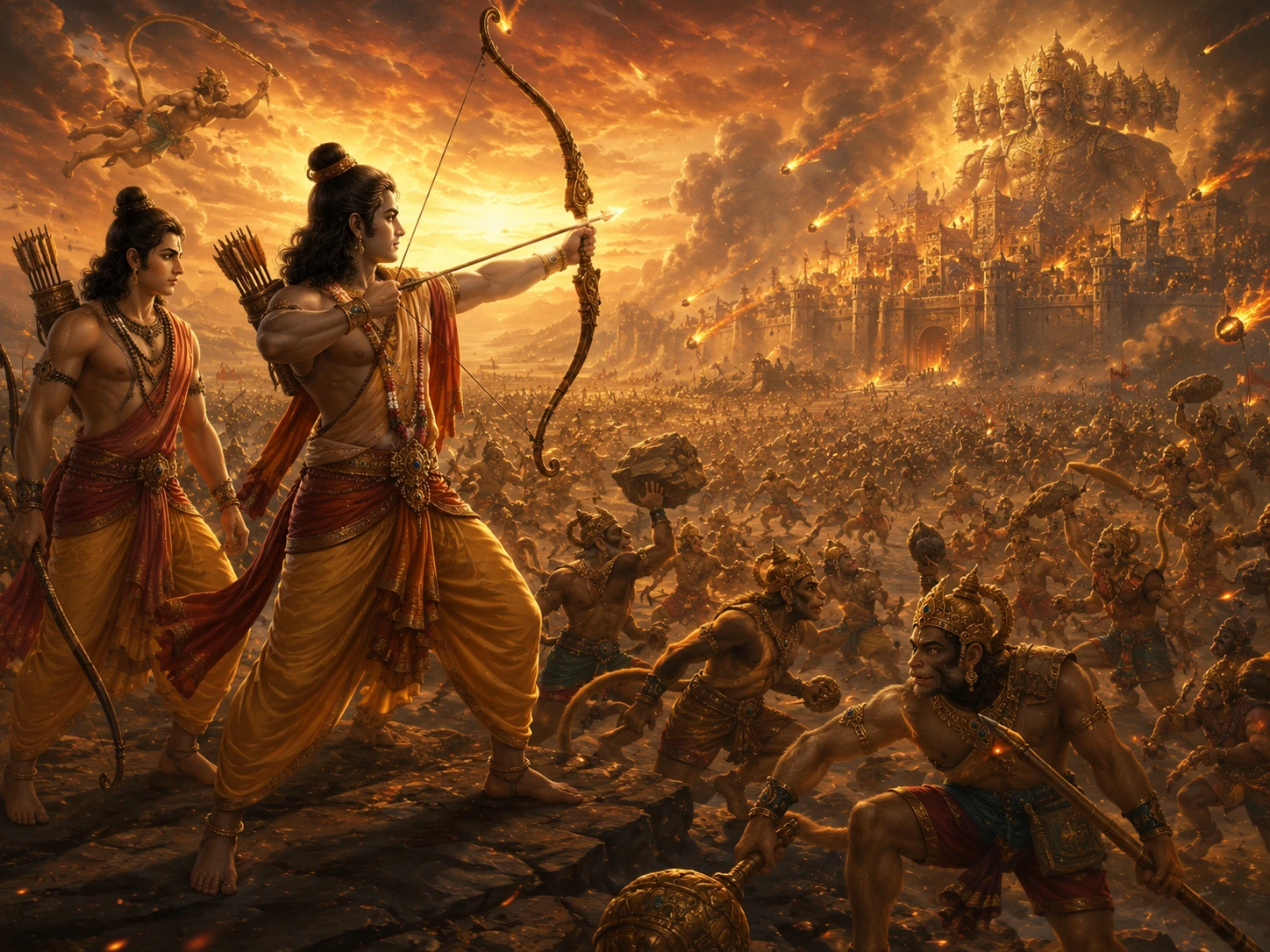
Ramayana Warriors -- Rama's Alliance vs Lanka's Army
रामायण योद्धा -- राम का गठबन्धन बनाम लंका की सेना
Instagram will rank Ramayana warriors from 1 to 18 with AI-generated art and zero textual citations. Valmiki did not rank. What Valmiki did -- across 129 sargas of the Yuddha Kanda -- was construct a military narrative of extraordinary precision: which commander held which gate, who fought whom in single combat, which weapon decided which duel, and who fell on which day of the war.
This article does not rank warriors. It maps both armies -- Rama's alliance and Lanka's forces -- using Valmiki Ramayana's Yuddha Kanda (with cross-references to Kishkindha Kanda for the Vanara mobilisation) as the primary source. Where Tulsidas's Ramcharitmanas or regional traditions add detail, those are noted separately.
The Lanka war was fought at four gates of the city. Valmiki's Yuddha Kanda Sarga 41 records the gate assignments explicitly. Rama and Lakshmana held the northern gate -- where Ravana himself was stationed. Nila, with Mainda and Dvivida, took the eastern gate. Angada, with Rishhabha, Gavaksha, Gaja, and Gavaya, held the southern gate. Hanuman, with Prajangha and Tarasa, guarded the western gate. Sugriva, with the main Vanara reserve, was stationed between the gates as a mobile force.
This was not a medieval European siege where one army bashes at a single wall. This was a four-front simultaneous assault on an island fortress surrounded by ocean, with the attackers having just built a bridge to get there. In modern Indian military terms, it was an amphibious operation followed by a multi-axis urban assault. MARCOS and the Indian Navy would recognise the operational design.
RAMA'S ALLIANCE -- THE COMMANDERS
The core leadership was astonishingly small for an army facing Lanka. Two human princes (Rama and Lakshmana), one defecting Rakshasa prince (Vibhishana), one Vanara king (Sugriva), one bear king (Jambavan), and a handful of Vanara generals. There was no cavalry, no chariots, no conventional weaponry on the Vanara side -- they fought with trees, boulders, nails, and teeth. Only Rama and Lakshmana carried conventional arms.
Rama -- Vishnu's seventh avatar, master of celestial astras. Fought and killed Prahasta (Ravana's commander-in-chief, Sarga 59), Kumbhakarna (Sarga 67), Mahodara, Mahaparshva, and ultimately Ravana himself (Sarga 108-110) using the Brahmastra given by Agastya.
Lakshmana -- incarnation of Shesha Naga. Killed Atikaya using the Brahmastra (Sarga 71), and in the climactic duel killed Indrajit/Meghanada (Sarga 90-91), widely considered Lanka's most dangerous warrior.
Hanuman -- son of Vayu. Killed Jambumali, Aksha (Ravana's son, in Sundara Kanda), Devantaka, and Akampana. Was the force that burned Lanka, carried the Sanjeevani mountain, and served as the primary shock-trooper throughout the war.
Angada -- son of Bali. Killed Narantaka with a single fist-blow to the chest (Sarga 69). Served as Rama's envoy to Ravana's court, where he planted his foot and challenged the entire Rakshasa assembly to move it.
Sugriva -- king of Kishkindha. Fought Ravana in single combat (a reckless act that Rama later reprimanded him for), defeated Kumbha, and killed Mahodara (Sarga 98) by severing his head in sword-and-shield combat.
Nila -- commander-in-chief of the Vanara army, son of Agni. Killed Nikumbha by running over him with Nikumbha's own chariot wheel (Sarga 42-43). Led the eastern gate assault and oversaw the bridge construction alongside Nala.
Nala -- the architect-engineer. Built the Rama Setu. Also fought as a warrior, defeating Pratapana in combat.
Jambavan -- king of the bears (Riksharaj). His most critical contribution was not combat but command psychology: when the Vanara army despaired at the ocean crossing, Jambavan identified Hanuman's dormant power and urged him to leap to Lanka. He also fought and was wounded by Indrajit's Brahmastra.
Vibhishana -- Ravana's brother, defected after being expelled for advising Ravana to return Sita. Provided critical intelligence: Lanka's defences, Ravana's weaknesses, the location of the Nikumbhila yajna where Indrajit drew his power. Without Vibhishana's intelligence, the Vanara army would have been fighting blind.
Sushena -- father of Bali's wife Tara, physician-warrior. Directed Hanuman to fetch the Sanjeevani herb when Lakshmana was struck down by Indrajit's Shakti weapon. Also fought at the western gate.
Dvivida and Mainda -- twin Vanara warriors. Dvivida struck down Ashaniprabha; Mainda subdued Vajramushti.
LANKA'S FORCES -- THE COMMANDERS
Ravana's military machine was qualitatively superior in every conventional dimension: chariots, elephants, divine weapons, sorcery, aerial combat capability (Indrajit could fight invisible from the sky), and fortified urban terrain. Lanka was described as a golden city with massive walls, moats, and four heavily guarded gates.
Ravana -- ten-headed king of Lanka, Vedic scholar, devotee of Shiva, master of divine weapons. Fought Sugriva, Lakshmana, and Rama in successive encounters. Killed by Rama with the Brahmastra in the final battle (Sarga 108-110). Valmiki describes him as a warrior of immense courage who went to battle knowing his doom, after Kumbhakarna and Indrajit had already fallen.
Indrajit (Meghanada) -- Ravana's eldest son, arguably the most dangerous warrior in the entire epic. Earned the name 'Indrajit' by defeating Indra himself. Possessed the Nagastra (serpent weapon) which bound Rama and Lakshmana in snake-coils (Sarga 45), the Brahmastra which felled the entire Vanara army, and the Shakti weapon that nearly killed Lakshmana. Could fight invisible using sorcery. Was finally killed by Lakshmana after Vibhishana revealed his power source -- the Nikumbhila yajna.
Kumbhakarna -- Ravana's brother, a warrior of colossal size. Despite being a Rakshasa, he was honest and wise, advising Ravana to return Sita before the war. Once awakened from his enchanted sleep, he devastated the Vanara army, defeating Sugriva in combat and eating hundreds of Vanaras. Rama had to sever his arms and then his head with multiple celestial arrows (Sarga 67).
Prahasta -- chief commander of Lanka's army, Ravana's maternal uncle. Led the first major sortie from Lanka. Killed by Nila according to some recensions, by Rama's arrows in others (Sarga 58-59 records the duel).
Atikaya -- son of Ravana and Dhanyamalini, massive in stature like his uncle Kumbhakarna. A Shiva devotee with Brahma's boon of a divine chariot and indestructible armour. Killed by Lakshmana using the Brahmastra (Sarga 71).
Narantaka -- son of Ravana, wielded a javelin compared to a meteor. Slaughtered numerous Vanaras before Angada stepped in and killed him with a fist-blow to the chest (Sarga 69).
Devantaka -- son of Ravana, wielded an iron spiked club. Killed by Hanuman with a thunderbolt-like blow to the skull.
Trishira -- three-headed Rakshasa. NOTE: Valmiki presents two characters with this name. One is a commander under Khara-Dushana in the Aranya Kanda, killed by Rama in the Dandakaranya forest. The other appears in the Lanka war. Many popular accounts conflate the two, but they are distinct in the text.
Mahodara and Mahaparshva -- two of Ravana's senior generals who fought alongside him in the final days. Sugriva killed Mahodara (Sarga 98); Mahaparshva fell to Rishabha.
Akampana -- Ravana's maternal uncle, served as intelligence officer and commander. He was the one who informed Ravana of Khara and Dushana's deaths and advised kidnapping Sita. Fought Hanuman in the Lanka war and was killed when Hanuman crushed him with an uprooted tree.
Kumbha and Nikumbha -- sons of Kumbhakarna. Kumbha was defeated by Sugriva; Nikumbha was killed by Hanuman.
Vajradamshtra -- a Rakshasa general. Killed by Angada in a prolonged duel involving swords, maces, and bare-knuckle fighting (Sarga 54).
परित्राणाय साधूनां विनाशाय च दुष्कृताम्। धर्मसंस्थापनार्थाय सम्भवामि युगे युगे॥
paritrāṇāya sādhūnāṃ vināśāya ca duṣkṛtām | dharmasaṃsthāpanārthāya sambhavāmi yuge yuge ||
For the protection of the righteous, for the destruction of the wicked, and for the establishment of dharma, I appear in every age.
— Bhagavad Gita 4.8 (the verse that describes the very purpose of Rama's avatar)
Key Battle Matchups -- Lanka War (Yuddha Kanda)
| Vanara/Rama Side | Lanka Side | Result | Sarga Ref. | वानर/राम पक्ष | लंका पक्ष | परिणाम | सर्ग सन्दर्भ |
|---|---|---|---|---|---|---|---|
| Rama | Ravana | Rama kills Ravana with Brahmastra | 108-110 | राम | रावण | राम ने ब्रह्मास्त्र से मारा | 108-110 |
| Lakshmana | Indrajit (Meghanada) | Lakshmana kills Indrajit after Nikumbhila intel | 90-91 | लक्ष्मण | इन्द्रजित (मेघनाद) | लक्ष्मण ने मारा -- निकुम्भिला खुफिया के बाद | 90-91 |
| Rama | Kumbhakarna | Rama severs arms then head with celestial arrows | 67 | राम | कुम्भकर्ण | राम ने दिव्य बाणों से बाहुएँ फिर सिर काटा | 67 |
| Nila / Rama | Prahasta | Killed in battle (recensions vary) | 58-59 | नील / राम | प्रहस्त | युद्ध में मारा गया (recensions भिन्न) | 58-59 |
| Lakshmana | Atikaya | Lakshmana uses Brahmastra | 71 | लक्ष्मण | अतिकाय | लक्ष्मण ने ब्रह्मास्त्र चलाया | 71 |
| Angada | Narantaka | Angada kills with a fist-blow to chest | 69 | अंगद | नरान्तक | अंगद ने छाती पर मुक्के से मारा | 69 |
| Hanuman | Devantaka | Hanuman crushes skull with fist | 69 | हनुमान | देवान्तक | हनुमान ने मुक्के से खोपड़ी कुचली | 69 |
| Hanuman | Akampana | Hanuman kills with uprooted tree | 55 | हनुमान | अकम्पन | हनुमान ने उखाड़े पेड़ से मारा | 55 |
| Sugriva | Mahodara | Sugriva severs head in sword combat | 98 | सुग्रीव | महोदर | सुग्रीव ने तलवार से सिर काटा | 98 |
| Angada | Vajradamshtra | Angada kills after prolonged melee | 54 | अंगद | वज्रदंष्ट्र | अंगद ने लम्बे melee के बाद मारा | 54 |
| Dvivida | Ashaniprabha | Dvivida strikes down with Sala tree | 42 | द्विविद | अशनिप्रभ | द्विविद ने साल वृक्ष से गिराया | 42 |
| Mainda | Vajramushti | Mainda subdues in combat | 42 | मैन्द | वज्रमुष्टि | मैन्द ने युद्ध में दबाया | 42 |
Sarga references are from Valmiki Ramayana's Yuddha Kanda (Baroda Critical Edition). Numbers may vary slightly in Gita Press or other recensions. This is not a complete list -- dozens of minor duels occur across the 129 sargas.
The Lanka war's four-gate siege (Yuddha Kanda Sarga 41) is studied in the Indian Army's College of Military Engineering in Pune as an early example of multi-axis urban assault planning. Nala's bridge-building feat -- constructing a causeway across the ocean using boulders and trees -- is referenced in Indian Navy training materials as the mythological precursor to military pontoon bridging. The Geological Survey of India has mapped the Adam's Bridge (Rama Setu) shoal chain between India and Sri Lanka, which closely follows the route described in the Ramayana. In 2017, Science Channel's 'What on Earth?' featured satellite images of the formation. The Indian Army's Gorkha Rifles regiment has Hanuman as its regimental emblem -- honouring the warrior who fought without conventional weapons and never retreated.
Read the Yuddha Kanda on Eternal Raga
Follow the war in Lanka sarga by sarga on Eternal Raga -- all 128 sargas of the Yuddha Kanda, with Sanskrit text and translation in English and Hindi.
Tags
Eternal Raga · शाश्वत राग
Institutional voice — scholarly articles on Sanatan Dharma
Deepen Your Understanding
अपनी समझ और गहरी करें
scriptural exegesis
Non-Human Races of the Epics -- Vanaras, Nagas, Yakshas & Beyond
Hindu mythology is not a two-player game between gods and humans. The epics describe at least eight distinct non-human civilisations -- forest-dwelling Vanaras with their own kingdoms and politics, serpentine Nagas with underground empires, shape-shifting Rakshasas with advanced technology, celestial Gandharvas who controlled music, and wealth-guarding Yakshas. This is the Mahabharata's multiverse -- and it was written millennia before Marvel.
scriptural exegesis
Ramayana -- History or Myth? What the Evidence Actually Says
A 48-km limestone bridge between India and Sri Lanka that NASA satellites photographed. An exile route spanning 3,000 km that you can walk today -- every river, cave, and mountain matching Valmiki's descriptions. Astronomical events that planetarium software can verify. Five categories of evidence that turn a simple 'myth or fact?' into a far more interesting question.
deities avatars
Hanuman -- The Perfect Devotee
He could lift mountains, leap oceans, and burn Lanka to the ground -- yet his greatest power was this: he never forgot whose work he was doing. Hanuman is not just a mythological hero. He is the operating system of selfless devotion that India still runs on.
scriptural exegesis
Ahalya Moksha -- The Woman Who Became Stone and the God Who Set Her Free
She was Brahma's most perfect creation. She was cursed for a crime that may not have been hers. She lay as stone -- or invisible, or in ashes, depending on which text you trust -- for thousands of years. Then a boy-prince's foot touched her, and she rose. Ahalya's story is Hinduism's oldest argument about consent, punishment, and grace.
scriptural exegesis
Agni Pariksha -- Sita's Fire Ordeal and the Interpretations That Divided India
A woman walks into fire to prove she is 'pure.' The man who asked her to do it is called God. For two thousand years, India has argued about what this scene means -- and the argument is far from over. Devotional reading, feminist critique, textual scholarship, and political appropriation all collide in the most contested episode of the Ramayana.
scriptural exegesis
Sugriva's Search for Sita -- The Intelligence Network Hidden in the Ramayana
No phones, no satellites, no maps. Yet Sugriva found Sita across an entire continent. He did not send a random army -- he built a four-directional intelligence network with designated leaders, precise geographical routes, and a strict one-month deadline. Kishkindha Kanda, Sargas 40-43, reads less like an ancient epic and more like a military operations manual. The Ramayana was not just telling a story. It was teaching strategy.
scriptural exegesis
7 Chiranjeevis -- The Immortals of Hindu Tradition
Seven beings who will not die until the end of this cosmic age. One is cursed to wander in agony. One rules the underworld. One compiled every scripture you have ever read. One is the most worshipped deity in India. The Chiranjeevis are not a mythology trivia list -- they are a map of how immortality works in Hindu thought, and why it is not always a blessing.
The Lanka war's four-gate siege (Yuddha Kanda Sarga 41) is studied in the Indian Army's College of Military Engineering in Pune as an early example of multi-axis urban assault planning. Nala's bridge-building feat -- con…
More in Scriptural Exegesis
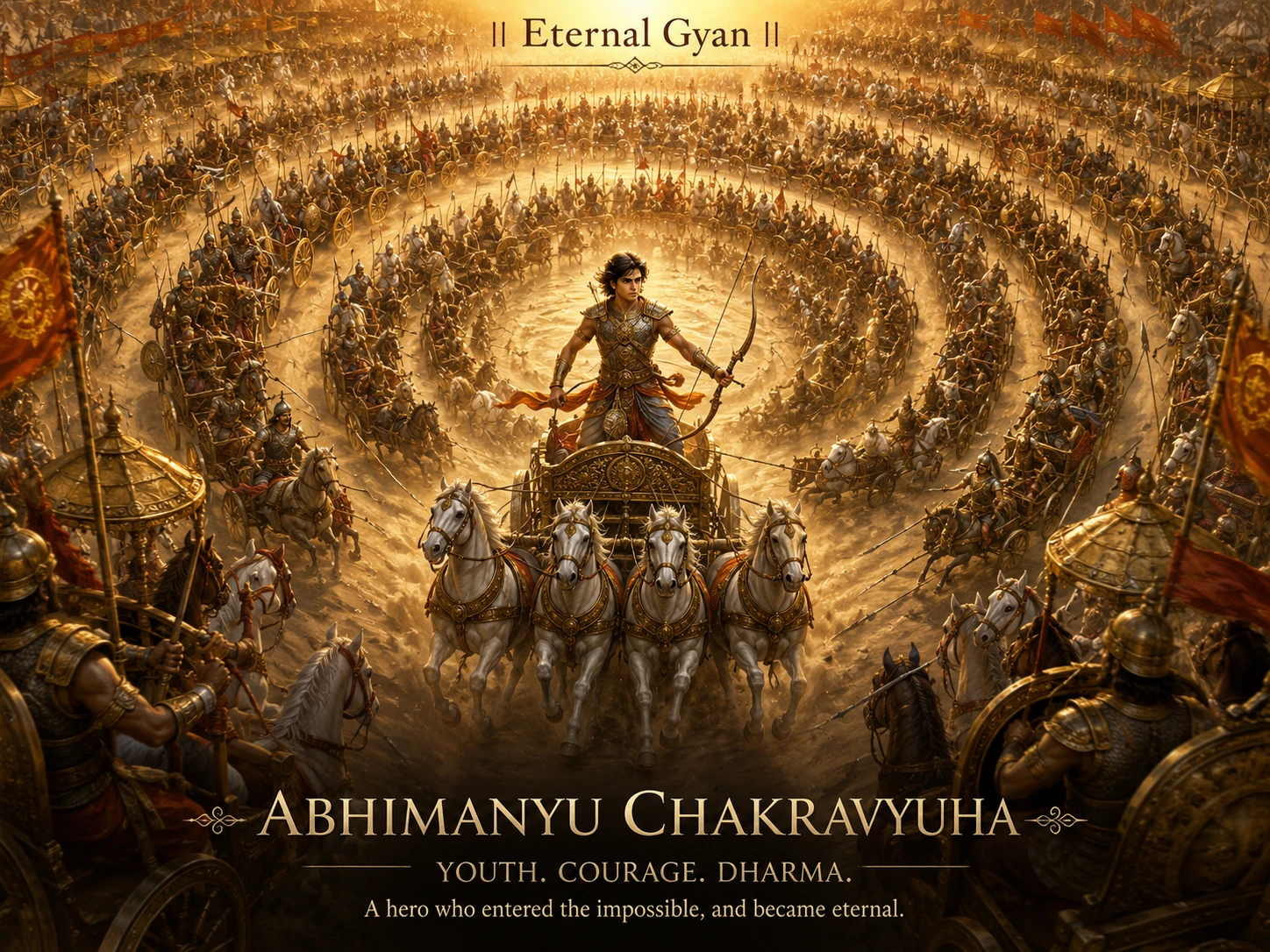
Abhimanyu and the Chakravyuha -- The Boy Who Knew How to Enter but Not How to Leave
14 min read
Adbhuta Ramayana -- The Ramayana Where Sita Becomes Kali
9 min read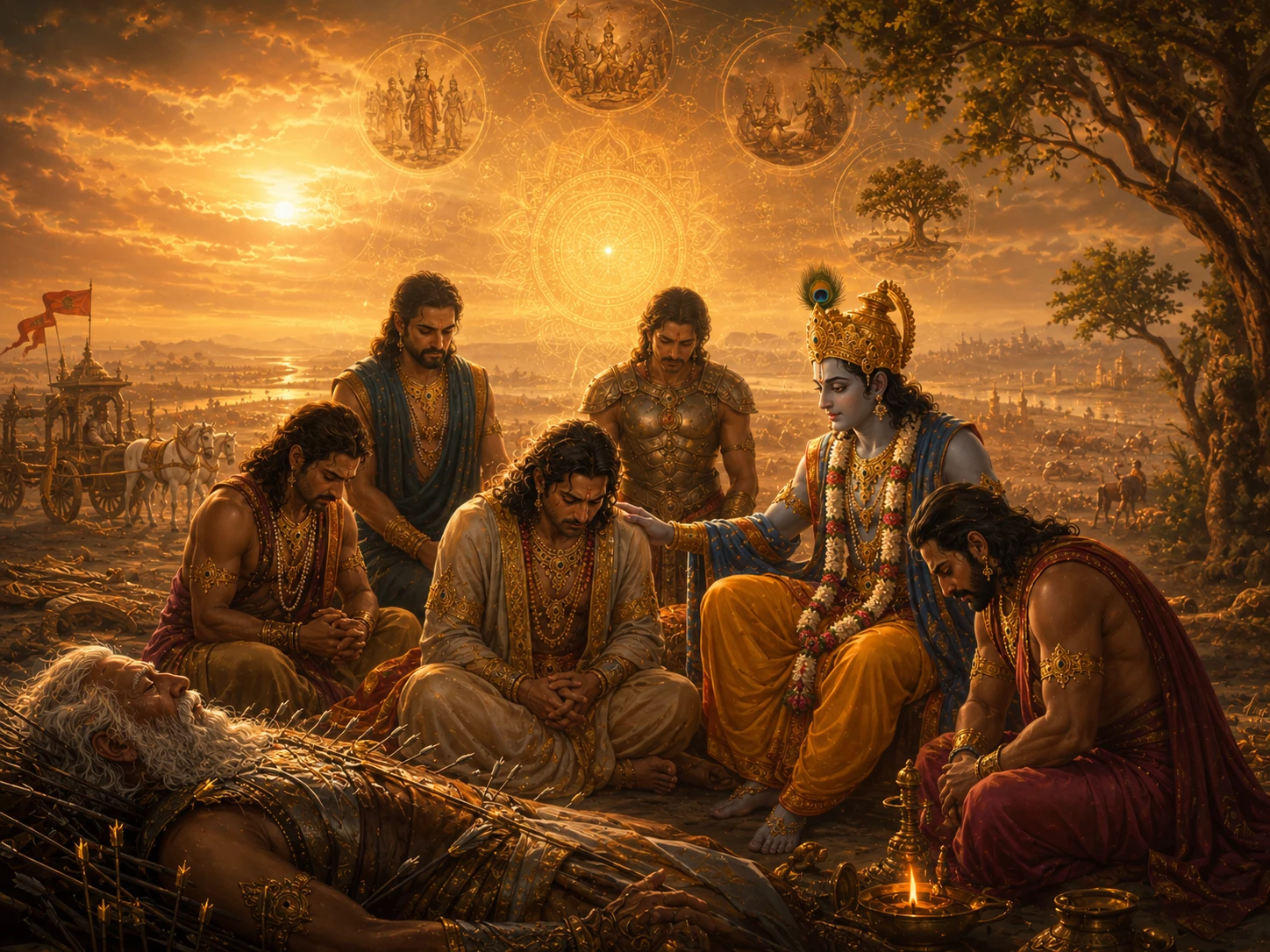
After Kurukshetra -- What Happened Next
14 min readThe same translation error that turned '33 Koti' into '33 crore' in Hinduism also happened in Buddhism. The Chinese translation of Buddhist texts rendered 'Sapta Koti Buddha' (7 Supreme Buddhas) as '7 Crore Buddhas.' The…
Deities AvatarsCommunity Reflections
🕉️
Be the first to share your reflection.