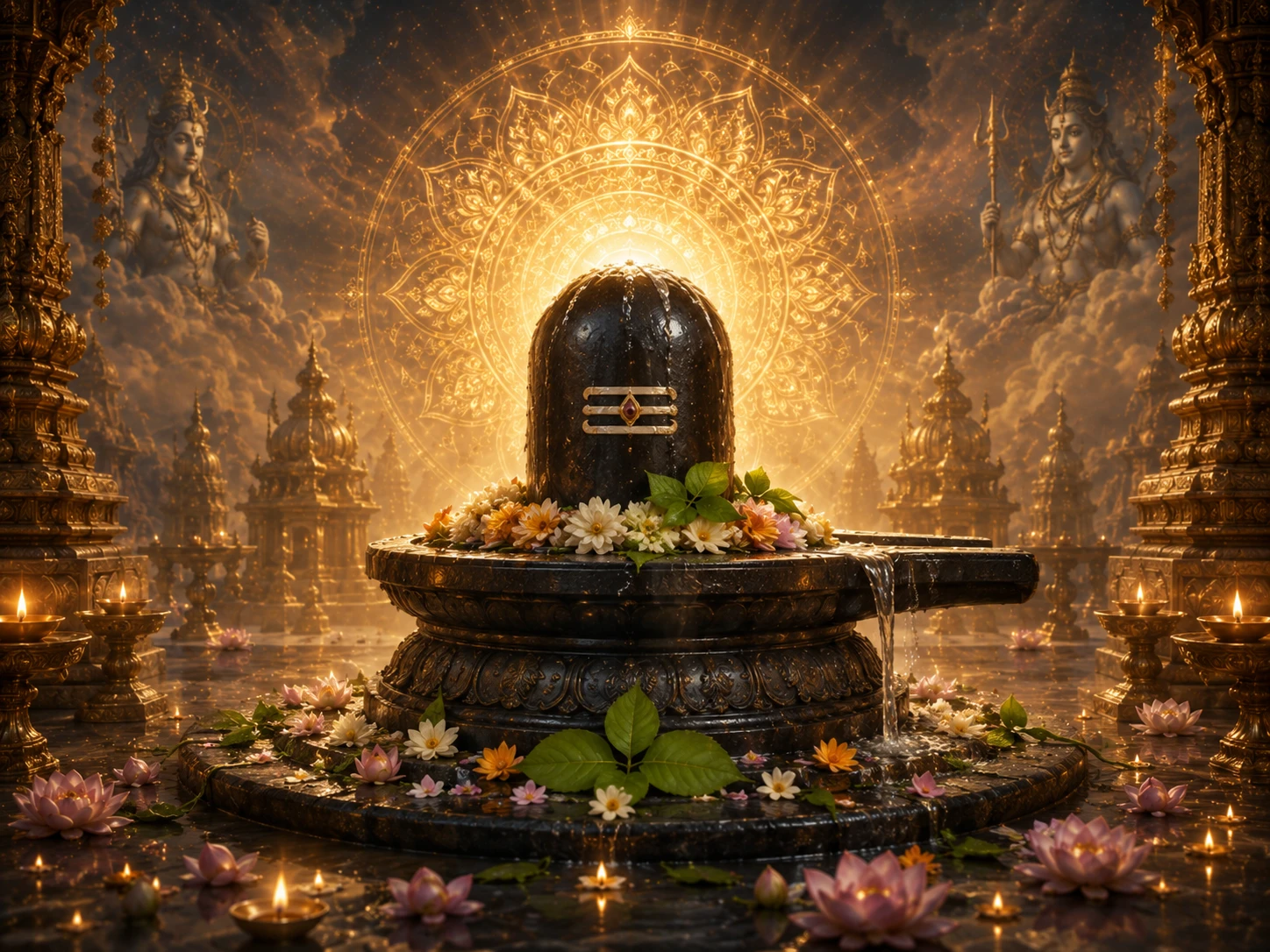
Shiva Linga -- Symbol, Form, and Misunderstanding
शिव लिंग -- प्रतीक, रूप और भ्रम निवारण
Open any Western textbook on Hinduism published before the 1990s, and you will find the Shiva Linga described as a 'phallic symbol.' This interpretation, cemented by colonial-era Indologists like Monier-Williams and missionaries seeking to portray Hinduism as a primitive fertility cult, has persisted for over two centuries. It is wrong. Not 'partially wrong' or 'one valid interpretation among many.' It is a mistranslation of the Sanskrit word 'linga' that no traditional Hindu text supports as the primary meaning.
The word 'linga' in Sanskrit means 'sign,' 'mark,' 'emblem,' or 'characteristic.' This is not obscure. It is the standard dictionary definition in every Sanskrit lexicon from Amarakosha to Monier-Williams' own dictionary. Panini, the father of Sanskrit grammar (4th century BCE), uses 'linga' to mean 'gender marker' -- the grammatical sign that identifies a noun as masculine, feminine, or neuter. The Nyaya school of logic uses 'linga' to mean 'evidence' or 'inferential sign' -- as in, 'where there is smoke (linga), there is fire.' The Samkhya school uses 'linga sharira' to mean 'subtle body' -- the non-physical substrate of consciousness.
In every one of these uses -- grammar, logic, philosophy, medicine -- 'linga' means 'sign' or 'mark.' The Shiva Linga is literally 'the sign of Shiva' -- the mark by which the formless, attributeless Supreme Reality makes itself knowable to human worship. It is an aniconic symbol: a form given to the formless so that the human mind, which needs a focus point, has somewhere to direct devotion.
The Shvetashvatara Upanishad makes this explicit. In describing the Supreme Being, it says Shiva has 'no linga' -- meaning He transcends all characteristics, all marks, all signs, including the sign of gender. The Linga Purana expands: 'Shiva is signless, without colour, taste, smell, beyond word or touch, without quality, motionless and changeless.' The Linga is not Shiva's body. It is the pointer to the reality that has no body.
न तस्य प्रतिमा अस्ति यस्य नाम महद्यशः। हिरण्यगर्भ इत्येष मा मा हिंसीदित्येषा यस्मान्न जात इत्येषः॥
na tasya pratimaa asti yasya naama mahadyashaH | hiraNyagarbha ityeSha maa maa hiMsiidityeShaa yasmaanna jaata ityeShaH ||
Of Him whose glory is great, there is no image (pratima). His name is 'Great Glory.' He is the Golden Embryo (Hiranyagarbha). 'May He not injure me' -- He from whom all is born.
— Shvetashvatara Upanishad, Adhyaya 4, Verse 19 -- foundational verse establishing that the Supreme has no form (pratima) and no characteristic mark (linga)
The Jyotirlinga: Column of Infinite Light
The Puranic origin story of the Linga is not sexual. It is cosmological. The Linga Purana and Shiva Purana narrate that once Brahma and Vishnu were debating who was supreme. Suddenly, a colossal pillar of fire (Jyotistambha) appeared between them, stretching infinitely upward and downward. Brahma took the form of a swan and flew upward to find its top. Vishnu took the form of a boar (Varaha) and dug downward to find its base. Neither could reach the end. The pillar had no beginning and no end. It was the Linga -- the 'sign' of Shiva, who is infinite reality itself.
Brahma lied, claiming he had found the top. Vishnu humbly admitted he could not find the base. Shiva emerged from the pillar of fire and cursed Brahma to have almost no temples (which is why Pushkar remains virtually the only Brahma temple in India) and blessed Vishnu for his honesty. This story is the foundational myth for Jyotirlinga worship -- the 12 sacred sites across India where Shiva is believed to have manifested as a self-luminous column of light.
Notice what the Linga is in this story: a pillar of infinite fire. Not a body part. Not a fertility symbol. An infinite column of light (jyoti) that no being -- not even the Creator and the Preserver -- can measure. The Linga is the unmeasurable, the uncircumscribable, the sign that reality exceeds every attempt to contain it.
Swami Vivekananda offered another historical layer. He proposed that the Shiva Linga evolved from the Yupa-Stambha -- the sacrificial post of Vedic fire rituals described in the Atharva Veda. The Yupa was the vertical pillar to which the sacrificial animal was tied, which was then idealized as the eternal Brahman. Over time, the Yupa-Stambha became the Shiva-Linga -- possibly with influence from Buddhist stupa architecture, which shares the dome-on-pedestal shape. Whether or not this historical hypothesis is correct, it reinforces the central point: the Linga's form is a pillar/column, not an anatomical representation.
The Three-Part Structure: Brahma, Vishnu, Shiva
The physical Shiva Linga you see in temples typically has three parts. The bottom section (Brahma Bhaga) is square and embedded in the pedestal -- it represents Brahma and creation. The middle section (Vishnu Bhaga) is octagonal -- it represents Vishnu and preservation. The top section (Shiva Bhaga or Pujya Bhaga) is cylindrical and is the visible portion that receives Abhisheka (ritual bathing) -- it represents Shiva and dissolution.
This three-part structure is described in the Linga Purana (Part 2, Chapter 47): 'Lord Brahma resides at the root, Lord Vishnu in the middle. The lord of all, Pashupati, in the form of Rudra, resides at the top.' The Linga is not a representation of Shiva alone. It is a representation of the entire cosmic process -- creation (square base, the most stable geometric form), preservation (octagonal transition), and dissolution (cylinder, the form closest to the formless circle).
The Yoni (the horizontal disc-shaped platform from which the Linga rises) represents Shakti -- Prakriti, the feminine creative energy. Together, Linga and Yoni symbolise the union of Purusha (consciousness) and Prakriti (nature) -- the Samkhya framework that underlies all of Hindu cosmology. This is not a sexual union depicted literally. It is the philosophical principle that consciousness and energy are inseparable, and that all of creation emerges from their interplay. The Mahabharata states: 'Know all that is male to be Ishana (Shiva), and all that is female to be Uma (Parvati); for this whole world, animate and inanimate, is pervaded by these two.'
Pancha Bhuta Lingas -- The Five Elemental Lingas of South India
| Element | Temple | Location | Linga Type | Unique Feature |
|---|---|---|---|---|
| Prithvi (Earth) | Ekambareswarar | Kanchipuram, Tamil Nadu | Earth/Sand Linga | Bathed in oil, not water, as water would dissolve it. Sita is said to have made a sand linga here. |
| Jala (Water) | Jambukeswarar / Thiruvanaikaval | Trichy, Tamil Nadu | Water Linga | Underground spring keeps the Garbhagriha perpetually flooded. Water seeps through the Linga. |
| Agni (Fire) | Arunachaleswarar | Tiruvannamalai, Tamil Nadu | Fire Linga | The hill Arunachala itself is the Linga. Deepam festival lights a massive flame atop the hill visible for kilometres. |
| Vayu (Air) | Srikalahasti | Srikalahasteeswara, Andhra Pradesh | Air Linga | Lamp inside the sanctum flickers continuously from unseen air currents. No external wind source identified. |
| Akasha (Space) | Chidambaram Nataraja | Chidambaram, Tamil Nadu | Space/Ether Linga | The 'Chidambara Rahasyam' -- the sanctum contains empty space (akasha) with a curtain. The formless is worshipped as formlessness itself. |
These five temples map the five elements onto five Lingas across Tamil Nadu and Andhra Pradesh. Together, they constitute a complete elemental pilgrimage circuit. The Chidambaram temple is the most philosophically radical: its 'Linga' is literally empty space behind a curtain -- the ultimate aniconic worship, where the sign (linga) points to the signless (alinga). You are worshipping nothing. And that nothing is everything.
The Colonial Distortion: How 'Sign' Became 'Phallus'
The phallic interpretation of the Shiva Linga entered Western scholarship primarily through 19th-century colonial Indologists. The earliest significant proponents were those operating within a Christian missionary framework that needed to demonstrate Hindu religion as 'primitive,' 'idolatrous,' and 'licentious' -- thereby justifying the colonial civilising mission. When these scholars encountered the Linga, they mapped it onto Greco-Roman phallic cults they were familiar with, ignoring the extensive Sanskrit textual evidence that defined Linga as 'sign.'
This is not to deny that some later Sanskrit texts (notably the 11th-century Narmamala by Kshemendra, a Kashmir text on satire and fiction) play with double meanings. Literature uses wordplay. But wordplay in a satirical text is not the same as theological definition. The Linga Purana, Shvetashvatara Upanishad, and Shaiva Agamas -- the actual doctrinal texts of Linga worship -- are unanimous: the Linga is the formless Brahman made graspable.
Dr. Nanditha Krishna, historian and director of the C.P. Ramaswami Aiyar Foundation, has documented extensively how the Linga evolved from the Harappan-era 'small tapered cone on a round base' to the elaborately carved Mukha-Lingas of the Gupta period and beyond -- always as an aniconic or semi-aniconic representation, never as an anatomical depiction. Panchamukha Lingas (five-faced Lingas with Shiva's faces carved on the cylinder) are found across India and Southeast Asia, including a famous one in the Pashupatinath Temple in Nepal. A column shaped like a body part does not get five divine faces carved onto it.
For any college student who encounters this distortion in a Western academic text, in a Reddit thread, or in a deliberately provocative social media post -- the response is simple: read the original Sanskrit. The texts are unambiguous. The Linga is a sign. The sign points to the infinite.
The Chidambaram Nataraja Temple in Tamil Nadu is the Akasha (Space/Ether) Linga among the Pancha Bhuta Lingas. Its innermost sanctum contains the 'Chidambara Rahasyam' -- literally, 'the secret of Chidambaram.' When the curtain is drawn back during worship, devotees see empty space decorated with golden bilva leaves. There is no idol, no stone, no physical Linga. The worship is of Akasha -- space itself. This is considered the highest philosophical statement in temple architecture anywhere in the world: the ultimate object of worship is the formless, and the Linga tradition, taken to its logical conclusion, worships the absence of form. The temple's architecture itself functions as the final Linga -- a built structure that frames nothingness as the highest sacred.
Self-manifested (Swayambhu) Lingas found in nature include the ice Linga at Amarnath Cave (Jammu & Kashmir), which forms naturally from dripping water that freezes into a stalagmite shape every year during Shravana; the Banalinga or Narmada Linga -- naturally rounded river stones from the Narmada river in Madhya Pradesh, polished by millennia of flowing water into smooth ellipsoidal shapes; and the rock formation at Kedarnath that is worshipped as a natural Linga. Even certain triangular mountain peaks are traditionally called Shiva Lingas. The fact that nature itself produces these forms -- from ice, water-polished stone, and mountain geology -- reinforces the tradition's own claim: the Linga is a cosmic form, not a human invention. It appears wherever the formless wishes to become visible.
Offer Abhisheka to Shiva
The Linga receives what you pour over it -- water, milk, honey, vibhuti -- and gives back nothing visible. That is the teaching: the formless absorbs your offering and transforms it invisibly. Offer water to a Shiva Linga at home or at a temple while chanting Om Namah Shivaya. Eternal Raga's article on abhisheka explains the full ritual.
Tags
Eternal Raga · शाश्वत राग
Institutional voice — scholarly articles on Sanatan Dharma
Deepen Your Understanding
अपनी समझ और गहरी करें
deities avatars
Who is Shiva?
He is the ash-smeared ascetic who is also the ideal husband. The destroyer of the universe who is called 'The Auspicious One.' The god of death who drank poison to save all life. He sits in meditation on a Himalayan peak, and simultaneously dances the cosmos into existence and annihilation. No deity in Hinduism contains more contradictions -- and no deity resolves them more completely. This is not a mythology explainer. This is an attempt to stand at the foot of the mountain and look up.
deities avatars
Nine Forms of Shiva -- The Many Faces of Mahadeva
He is the silent teacher under a banyan tree and the screaming destroyer on a battlefield. He is half-woman and half-man. He drank the poison that would have ended the universe and his throat turned blue. Nine scripturally-attested forms of Shiva -- from Nataraja to Rudra -- and why each one exists.
tantra mantra yantra
Om Namah Shivaya -- The Panchakshari Mantra
Five syllables. Three thousand years of continuous chanting. The most spoken mantra in Shaivism, extracted from the heart of the Vedas -- the eighth Anuvaka of the Sri Rudram in the Krishna Yajurveda. Na is earth. Ma is water. Shi is fire. Va is air. Ya is space. When you chant Om Namah Shivaya, you are not simply praying to a deity. You are vibrating the five elements that constitute your body, the universe, and the consciousness that witnesses both. This is how a mantra becomes a technology.
deities avatars
Ardhanarishvara -- The Half-Male, Half-Female Form of Shiva
Split exactly down the centre. Right half: matted hair, serpent, drum, trident, ash-smeared skin. Left half: silk, flowers, kohl-lined eye, curved breast, jewelled anklet. One body. Two genders. Zero contradiction. Ardhanarishvara is the most radical statement on gender in any world mythology -- 5,000 years before the modern conversation began. This is not inclusion as a concession. This is divine completeness as a first principle.
sacred symbols
Temple Architecture Symbolism -- Why Every Hindu Temple Is a Human Body, a Mountain, and the Universe
The dark womb-room at the centre. The tower rising above it like a spine. The gateway that frames the divine like an eye. A Hindu temple is not a building where you go to see God. It IS the body of God -- designed on a mandala grid, proportioned by sacred mathematics, and oriented to catch the first ray of the rising sun.
philosophy darshana
Purusha and Prakriti -- The Witness and the Dance
A lame man climbs onto the shoulders of a blind man. Together they navigate a forest neither could cross alone. This 1,700-year-old image from the Sankhya Karika is the most elegant description of consciousness and matter ever composed -- and it explains why you suffer, why you act, and how you can stop confusing yourself with your thoughts.
sacred symbols
Bindu -- The Point from which Creation Emerges
Look closely at the symbol ॐ. See the small dot above the curve? That is the Bindu, and in Hindu metaphysics it is not decoration. It is the point from which the universe began, and the point into which it will return. Meet the smallest mark in Hinduism that contains all of cosmology.
The Chidambaram Nataraja Temple in Tamil Nadu is the Akasha (Space/Ether) Linga among the Pancha Bhuta Lingas. Its innermost sanctum contains the 'Chidambara Rahasyam' -- literally, 'the secret of Chidambaram.' When the …
More in Sacred Symbols
Ashtamangala -- The Eight Auspicious Symbols of Hindu Tradition
13 min read
Bindu -- The Point from which Creation Emerges
12 min read
Gau -- Why the Cow Holds the Place She Does in Hindu Life
14 min readThe same translation error that turned '33 Koti' into '33 crore' in Hinduism also happened in Buddhism. The Chinese translation of Buddhist texts rendered 'Sapta Koti Buddha' (7 Supreme Buddhas) as '7 Crore Buddhas.' The…
Deities AvatarsCommunity Reflections
🕉️
Be the first to share your reflection.