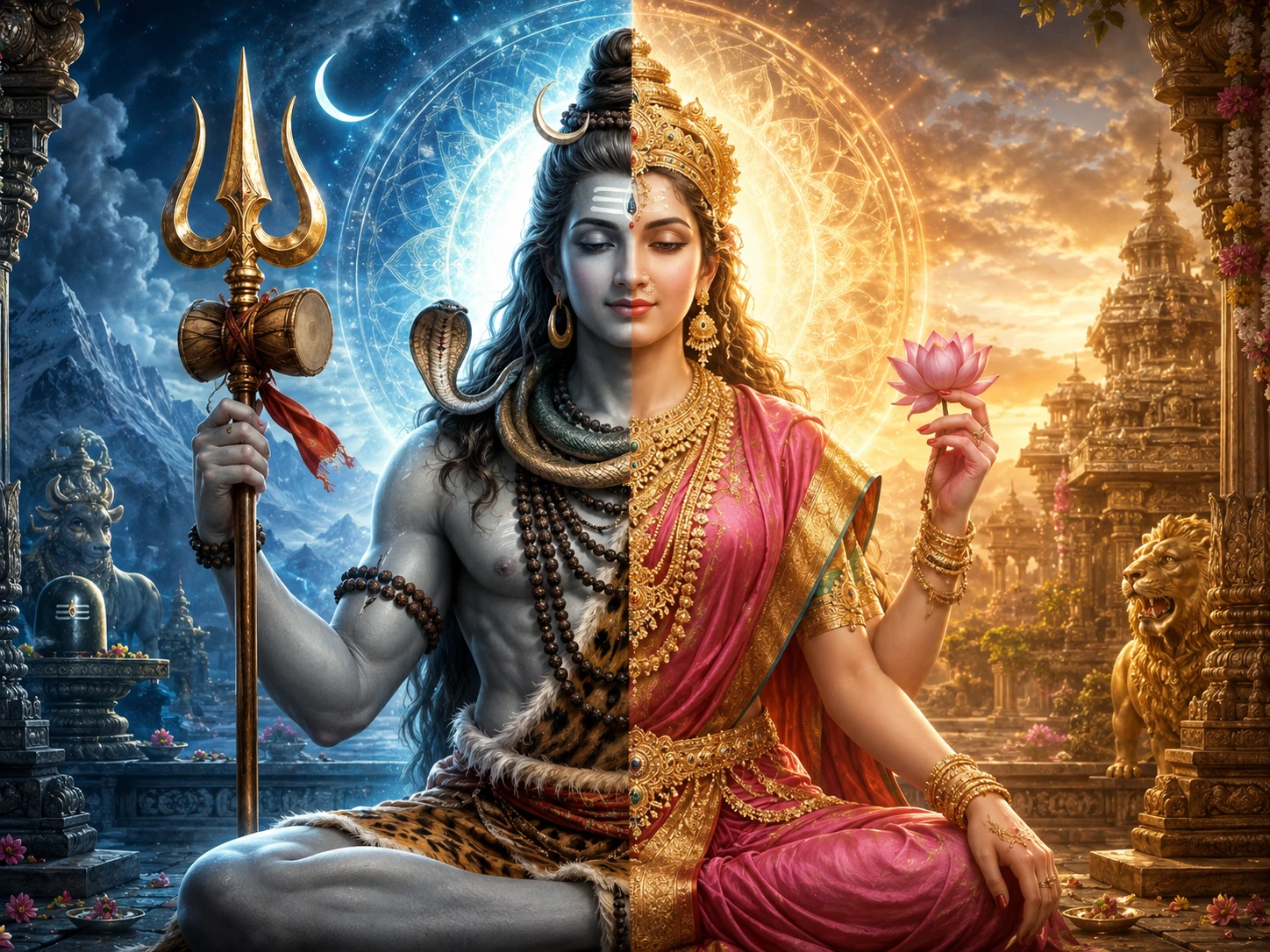
Ardhanarishvara -- The Half-Male, Half-Female Form of Shiva
अर्धनारीश्वर -- शिव का अर्ध-पुरुष, अर्ध-स्त्री रूप
The name breaks down cleanly: Ardha (half) + Nari (woman) + Ishvara (Lord). The Lord who is half woman. Not the Lord who tolerates a woman beside him. Not the Lord who has a female 'aspect.' The Lord who IS half woman. The feminine is not adjacent to the divine. It is constitutive of the divine. Remove Parvati, and Shiva is -- the tradition is explicit about this -- Shava. A corpse.
This is not a minor deity form tucked into a corner of Hindu theology. Ardhanarishvara appears in the Brihadaranyaka Upanishad (one of the oldest and most authoritative Upanishads, pre-500 BCE), the Shvetashvatara Upanishad, the Shiva Purana, the Linga Purana, the Skanda Purana, the Vishnu Purana, the Kurma Purana, and the Mahabharata. It is one of the 64 manifestations of Parashiva in Shaiva Siddhanta. Adi Shankaracharya composed a stotram dedicated to it. The Elephanta Caves near Mumbai, a UNESCO World Heritage Site, contain a 6th-century Ardhanarishvara sculpture considered among the finest stone carvings in the world.
The concept predates every modern conversation about gender, non-binary identity, or the social construction of masculinity and femininity -- by several thousand years. And it arrives at a conclusion that most contemporary discourse is still working toward: that the masculine and feminine are not opposites. They are two halves of one whole. The universe cannot exist if either half is missing. Creation itself requires their union.
स वा अयमात्मैव पुरा द्वैधापतत्। तत्पतिश्च पत्नी चाभवताम्॥
sa vaa ayam aatmaiva puraa dvaidhaapa tat | tat patishcha patnii chaabhava taam ||
This Self was indeed in the beginning one alone, in the form of a Person. Looking around, he saw nothing other than himself. He then split himself into two -- and from him arose husband and wife.
— Brihadaranyaka Upanishad, Adhyaya 1, Brahmana 4, Shloka 3 -- the oldest Upanishadic reference to the primordial androgynous being that prefigures Ardhanarishvara
Why Brahma's Creation Stalled -- The Shiva Purana Account
The Shiva Purana tells the foundational Puranic story. At the beginning of creation, Brahma created the Prajapatis -- all male. He instructed them to procreate. They could not. Creation stalled. A universe of masculine energy alone was sterile -- capable of thinking, planning, administering, but not of generating life.
Confused, Brahma meditated on Shiva. Shiva appeared -- not as the familiar ash-smeared ascetic, but as Ardhanarishvara. One body, split vertically: the right half Shiva, the left half Parvati. Brahma understood instantly. His creation had failed because it was incomplete. It had Purusha (consciousness, the witnessing principle) but no Prakriti (nature, the creative principle). It had the architect but not the builder. The observer but not the observed.
Brahma prayed to the female half, and from Parvati's body emerged all the female creative powers -- the Shaktis -- that made procreation, and therefore the continuation of creation, possible. In the Linga Purana's version, Ardhanarishvara Rudra is so intensely hot that merely emerging from Brahma's forehead burns Brahma himself. This detail is not decorative: it signifies that the union of masculine and feminine is not a gentle compromise. It is a nuclear fusion -- two forces combining to produce energy greater than either could generate alone.
The Skanda Purana gives perhaps the most intimate origin. Parvati asks Shiva to allow her to remain with him forever, 'embracing limb-to-limb.' Shiva grants this wish, and the two become one. This is not metaphysical abstraction. This is love that is so complete it refuses even the separation between two bodies.
Reading the Icon: What Each Detail Means
Ardhanarishvara is split vertically down the centre. The right half is Shiva. The left half is Parvati. This is not arbitrary. In yogic physiology, the right side of the body corresponds to Pingala Nadi (the solar, masculine energy channel) and the left to Ida Nadi (the lunar, feminine energy channel). The icon maps cosmic principles directly onto the nadis of the subtle body.
Shiva's right half: Matted hair (jata-mukuta) with a crescent moon. Tiger skin or elephant skin lower garment. Body smeared with ash (vibhuti). Serpent ornaments. The hand holds a trident (trishula) or makes the abhaya mudra (gesture of fearlessness). One earring: the male ear-ornament (kundala). Flat chest. This is the ascetic, the renouncer, the destroyer of illusion.
Parvati's left half: Smooth, well-combed hair adorned with flowers. Silk garment, often in red or gold. Body anointed with saffron paste (kumkum). Jewelled ornaments -- necklace, bangles, anklet. The hand holds a mirror or lotus or makes the varada mudra (gesture of granting wishes). One earring: the female ear-ornament (tatanka). Curved breast. This is the nurturer, the creator, the sustainer of life.
The contrast is deliberate and total. Ash versus saffron. Skulls versus flowers. Tiger skin versus silk. Renunciation versus engagement. And yet -- one body. The teaching: you do not get to choose one without the other. A person who is only discipline without compassion is cruel. A person who is only love without boundaries is formless. Completeness requires both.
The Nandi bull is shown near Shiva's foot. The lion (Parvati's vahana) is shown near hers. Two vehicles. One deity. Even the mode of transport is dual.
Ardhanarishvara -- The Two Halves Decoded
| Aspect | Shiva (Right Half) | Parvati (Left Half) | What the Contrast Teaches |
|---|---|---|---|
| Principle | Purusha -- consciousness, the witness | Prakriti -- nature, the creative force | Neither can exist alone. Awareness without energy is inert. Energy without awareness is blind. |
| Nadi | Pingala (Solar, right channel) | Ida (Lunar, left channel) | The goal of yoga is Sushumna -- the central channel where both merge. Ardhanarishvara IS Sushumna embodied. |
| Hair | Jata-mukuta (matted, wild, ascetic) | Smooth, adorned with flowers and ornaments | Wildness and refinement are not opposites but two modes of the same consciousness. |
| Body | Ash-smeared (vibhuti), flat chest | Saffron-anointed (kumkum), curved breast | Destruction (ash) and creation (fertility) share the same body. |
| Garment | Tiger/elephant skin (raw, unprocessed) | Silk (cultivated, refined) | The natural and the cultured are both divine. |
| Hand gesture | Abhaya mudra (do not fear) or holds trishula | Varada mudra (I grant wishes) or holds lotus/mirror | Protection and nourishment. 'I will defend you' and 'I will provide for you' -- both from one being. |
| Vahana | Nandi (bull -- dharma, patience, service) | Simha (lion -- power, sovereignty, independence) | Dharmic service and sovereign power are not in tension. They are two modes of divine transport. |
| Ear ornament | Kundala (male) | Tatanka (female) | Even the smallest detail -- a single earring -- carries the principle of duality-in-unity. |
The Ardhanarishvara icon is not decorative art. It is a philosophical diagram. Every line, ornament, gesture, and animal is a statement about the relationship between consciousness and energy, stillness and movement, renunciation and engagement. Indian temple sculpture at its highest is philosophy in stone.
The Bhringi Beetle: A Story About Incomplete Worship
One of the most famous sub-stories involves the sage Bhringi, a fanatical Shiva devotee who refused to acknowledge Parvati. When gods and sages visited Kailasa, Bhringi would circumambulate only Shiva, ignoring the Goddess entirely. Parvati, angered, cursed him: since he refused to acknowledge the feminine, he would lose all flesh and blood (associated with the feminine principle in Ayurveda -- Rakta Dhatu). Bhringi was reduced to a skeleton. He could not stand. Shiva gave him a third leg for support.
But Bhringi was persistent. When Shiva merged with Parvati as Ardhanarishvara -- specifically so that Bhringi would be forced to worship both -- the sage transformed himself into a beetle and drilled a hole through the deity's navel, separating the two halves so he could circumambulate only the male side.
Parvati, instead of being further angered, was amazed by his single-minded devotion. She blessed him. The story ends not with punishment but with recognition -- the Goddess herself honours devotion even when it excludes her.
This story is told in Shaiva Siddhanta and Tamil Nayanar literature as a teaching about several things at once: the futility of worshipping Shiva without Shakti (your body literally falls apart), the creative stubbornness of genuine devotion (Bhringi finds a way even when the rules change), and the grace of the Goddess who blesses even those who ignore her.
For any modern couple where one partner feels unseen -- for any workspace where feminine contributions are structurally devalued -- for any student taught that 'hard sciences' matter but arts don't -- the Bhringi story is a warning. Exclude one half and your creation collapses. Literally.
The Elephanta Caves (Gharapuri Island, Mumbai harbour), a UNESCO World Heritage Site dating to the 5th-6th century CE, contain one of the most celebrated Ardhanarishvara sculptures in the world. The figure is carved from basalt rock, stands over 5 metres tall, and displays an extraordinary combination of tenderness and power in a single image. Art historians consider it a masterpiece of Gupta-Chalukya era sculpture. What makes it remarkable is the subtlety of the transition at the centre line -- the sculptor did not draw a hard border between male and female. The halves flow into each other, suggesting that the division is conceptual, not physical. The figure invites the viewer to see unity, not separation. For any art or design student at NID, NIFT, or JJ School of Art -- or any IIT student who thinks 'the arts' don't matter -- one trip to Elephanta is worth a thousand lectures on the integration of technical precision and human emotion.
Despite Ardhanarishvara being one of the most widely depicted forms in Shiva temples across India, there are remarkably few temples actually dedicated to this form. The most prominent is the Sri Ardhanarishvara Temple at Tiruchengode, near Salem, Tamil Nadu. The main deity is 6 feet tall, wearing robes that are partly male and partly female. The temple is specifically visited by couples seeking harmony in marriage, people going through relationship difficulties, and those with Rahu-Ketu dosha. In the Thiruvannamalai Temple (also Tamil Nadu), the Skanda Purana records that Shiva gave his equal half to Parvati here, and during the annual Karthika Deepam festival, an Ardhanarishvara idol is brought out for public darshan for approximately 2 minutes -- lakhs of devotees and media witness this brief, annual appearance of the complete form.
Meditate on the Ardhanarishvara
Inhale through the right nostril (Pingala, Shiva). Exhale through the left (Ida, Shakti). When the breath merges in Sushumna, you are Ardhanarishvara for that moment. Begin the Nadi Shuddhi pranayama on Eternal Raga.
Tags
Eternal Raga · शाश्वत राग
Institutional voice — scholarly articles on Sanatan Dharma
Deepen Your Understanding
अपनी समझ और गहरी करें
deities avatars
Who is Shiva?
He is the ash-smeared ascetic who is also the ideal husband. The destroyer of the universe who is called 'The Auspicious One.' The god of death who drank poison to save all life. He sits in meditation on a Himalayan peak, and simultaneously dances the cosmos into existence and annihilation. No deity in Hinduism contains more contradictions -- and no deity resolves them more completely. This is not a mythology explainer. This is an attempt to stand at the foot of the mountain and look up.
deities avatars
Nine Forms of Shiva -- The Many Faces of Mahadeva
He is the silent teacher under a banyan tree and the screaming destroyer on a battlefield. He is half-woman and half-man. He drank the poison that would have ended the universe and his throat turned blue. Nine scripturally-attested forms of Shiva -- from Nataraja to Rudra -- and why each one exists.
sacred symbols
Shiva Linga -- Symbol, Form, and Misunderstanding
The most searched, most misunderstood, and most deliberately distorted symbol in Hinduism. The word 'Linga' means 'sign' or 'mark' in Sanskrit -- the same word Panini uses in grammar for 'gender marker' and the Nyaya school uses for 'evidence in logical inference.' The Shvetashvatara Upanishad says Shiva has no linga -- meaning He is beyond all characteristics, including gender. The Linga Purana says the Linga is the formless Brahman made graspable. Colonial-era mistranslation turned this into something else entirely. Here is what the texts actually say.
deities avatars
Devi Swaroopa -- Forms of the Goddess
She is Durga on the battlefield and Annapurna in the kitchen. She is Kali at the cremation ground and Lakshmi in the boardroom. She is Saraswati at the university and Parvati in the family. The Hindu Goddess is not one deity with accessories -- she is the entire spectrum of feminine power, from terrifying to tender, from cosmic to domestic. Understanding her forms is understanding the universe itself.
philosophy darshana
Purusha and Prakriti -- The Witness and the Dance
A lame man climbs onto the shoulders of a blind man. Together they navigate a forest neither could cross alone. This 1,700-year-old image from the Sankhya Karika is the most elegant description of consciousness and matter ever composed -- and it explains why you suffer, why you act, and how you can stop confusing yourself with your thoughts.
deities avatars
Nataraja -- The Cosmic Dancer
One foot crushes a dwarf. The other is raised in liberation. A ring of fire frames the dance. A drum beats creation into existence. An open palm says 'do not fear.' This is Nataraja -- Shiva as the Lord of Dance -- and it is the single most replicated Indian bronze in the history of art. The physicists at CERN chose it to stand outside the world's largest particle accelerator. The Chola bronzesmiths of Tamil Nadu perfected it a thousand years ago. And every time a subatomic particle appears and disappears, the cosmic dance continues.
scriptural exegesis
Women Power in Ancient India -- Scholars, Warriors, and Queens the Textbooks Erased
Gargi debated the greatest philosopher of her age and he could not defeat her. Maitreyi rejected a fortune for the pursuit of knowledge. Vishpala lost a leg in battle, got an iron prosthetic, and went back to fight. Kaikeyi drove Dasharatha's chariot in war and saved his life. These are not feminist reimaginings. These are the primary texts. And they tell a very different story from the one you were taught.
The Elephanta Caves (Gharapuri Island, Mumbai harbour), a UNESCO World Heritage Site dating to the 5th-6th century CE, contain one of the most celebrated Ardhanarishvara sculptures in the world. The figure is carved from…
More in Deities & Avatars
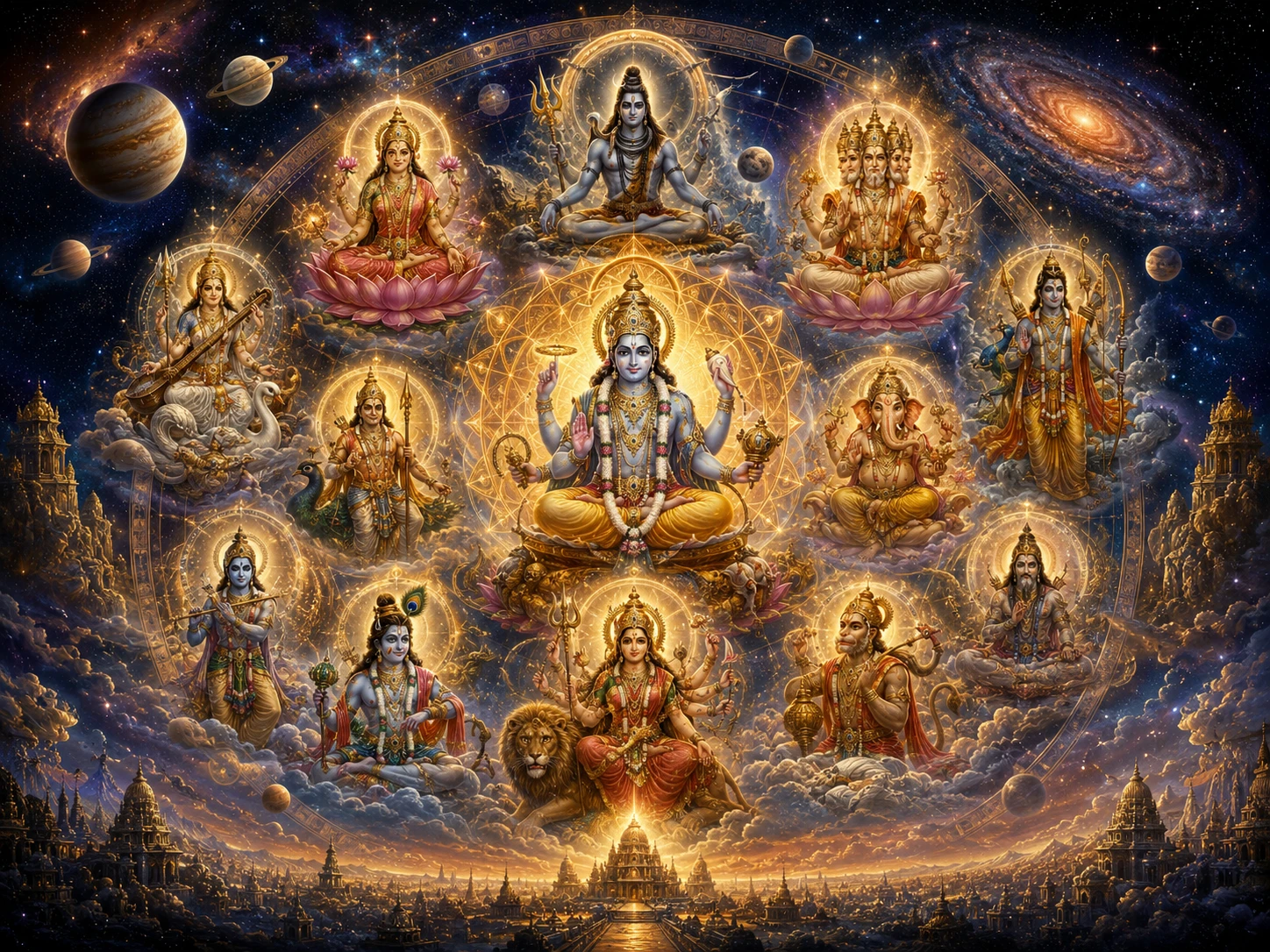
33 Koti Devata -- Why Hinduism Has 33 Types of Gods, Not 33 Crore
13 min read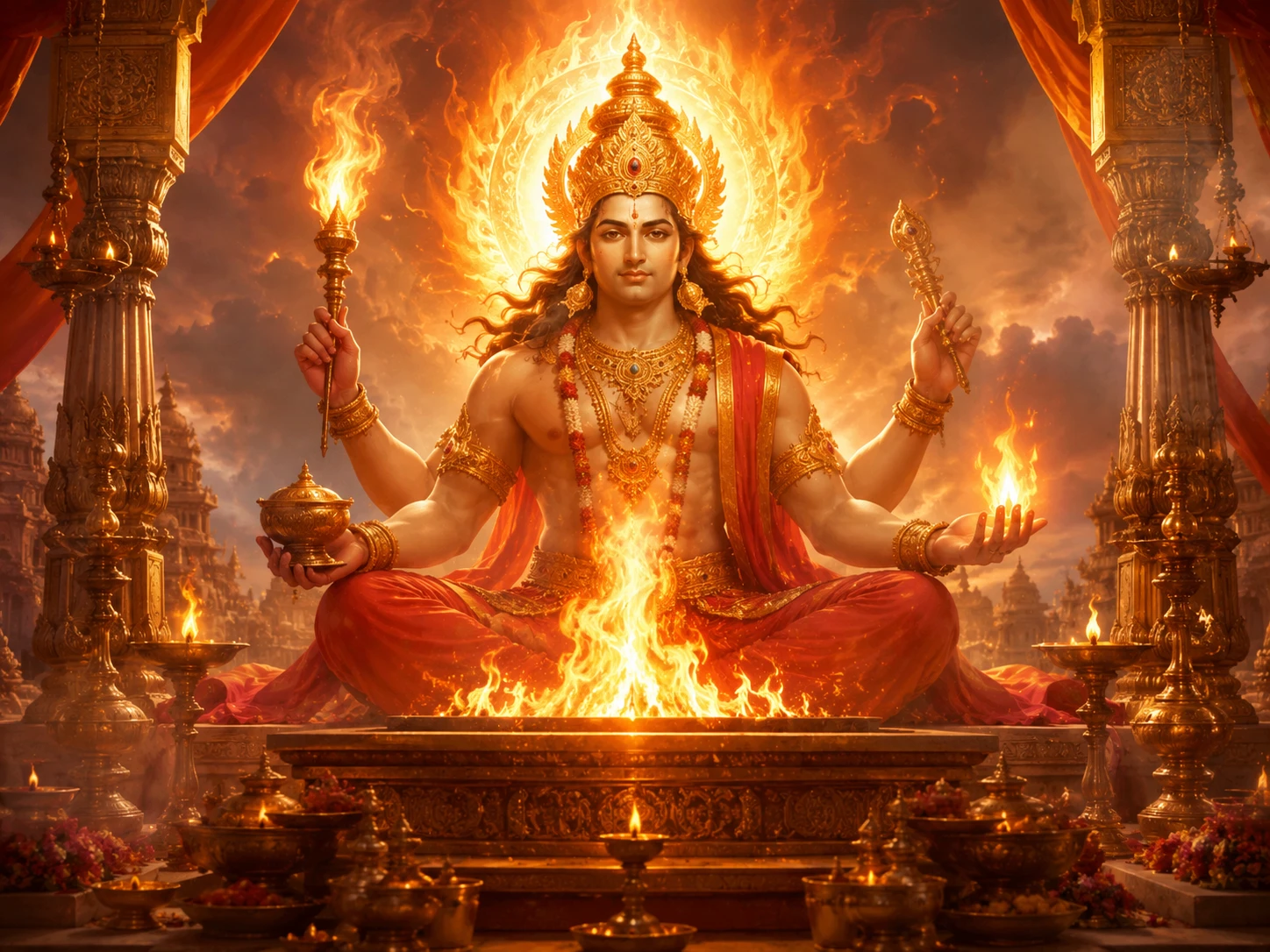
Agni -- The Fire God
19 min read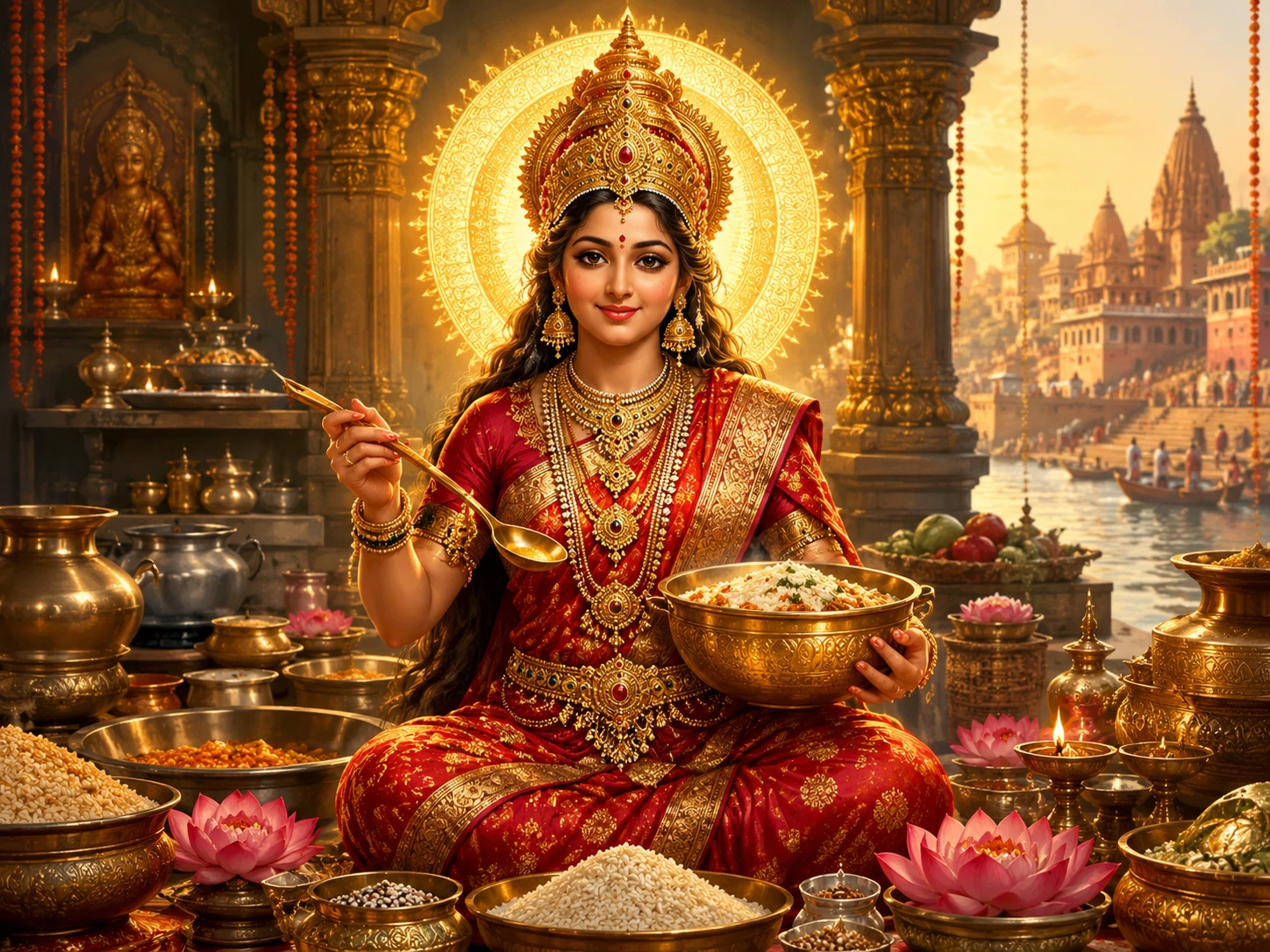
Annapurna -- Goddess of Food
19 min readThe same translation error that turned '33 Koti' into '33 crore' in Hinduism also happened in Buddhism. The Chinese translation of Buddhist texts rendered 'Sapta Koti Buddha' (7 Supreme Buddhas) as '7 Crore Buddhas.' The…
Deities AvatarsCommunity Reflections
🕉️
Be the first to share your reflection.