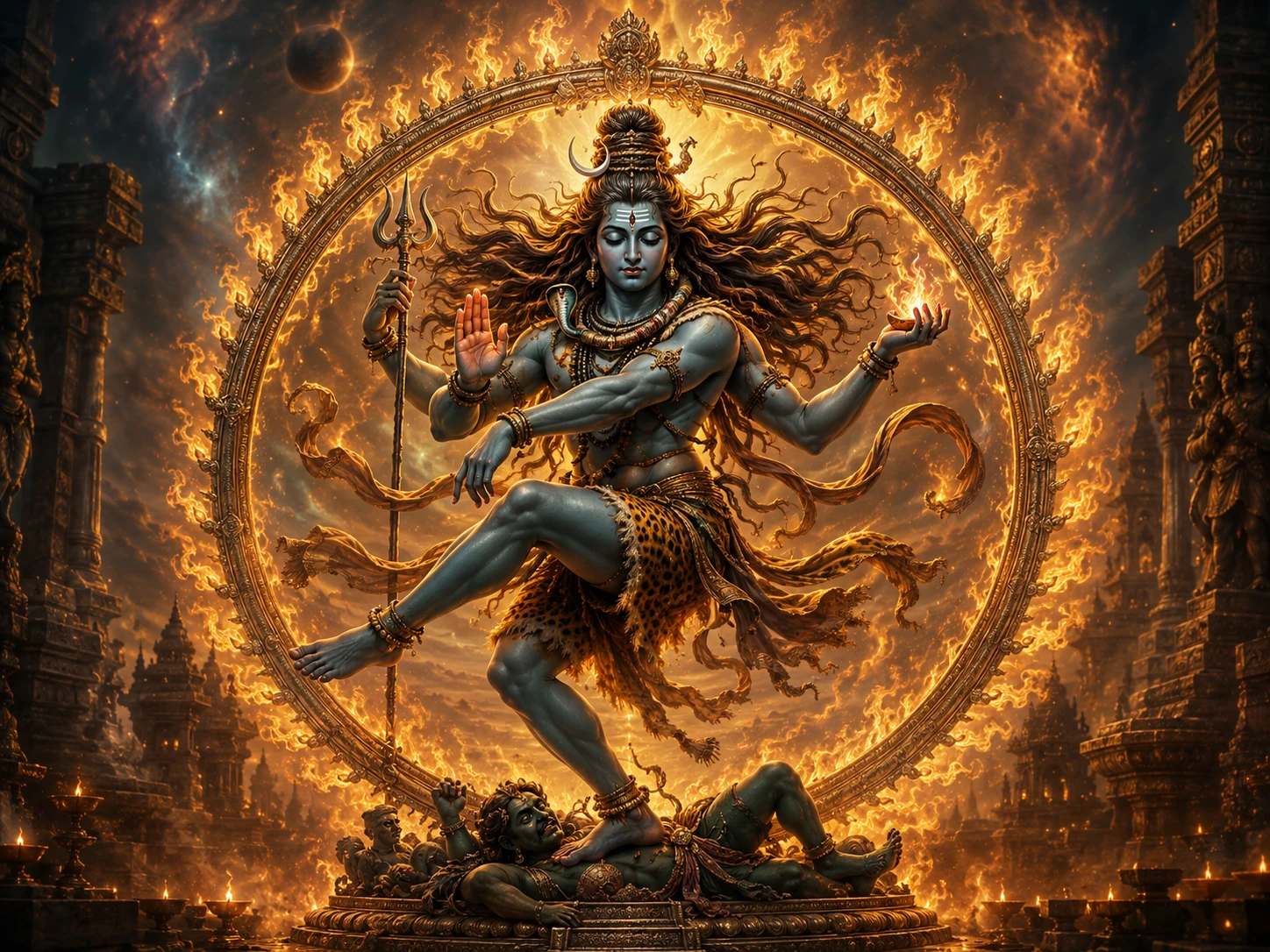
Nataraja -- The Cosmic Dancer
नटराज -- ब्रह्माण्डीय नर्तक
Nataraja -- Nata (dance) + Raja (king) -- is not merely Shiva dancing. It is Shiva as the mechanism of the universe itself, depicted in a single frozen frame. The Nataraja icon encodes the Pancha Kritya -- the five cosmic acts of Shiva (creation, preservation, dissolution, concealment, and grace) -- into the position of four arms, two legs, a ring of fire, and a crushed dwarf. No other religious icon in the world compresses this much cosmology into a single human-shaped image.
The form that we recognise today -- the Ananda Tandava ('dance of bliss') pose within a Prabhamandala (ring of fire) -- was perfected by the Chola dynasty bronzesmiths of Tamil Nadu between the 9th and 12th centuries CE. These bronzes, cast using the lost-wax (cire perdue) technique, are considered among the supreme achievements of Indian metallurgical art. The most famous is the Nataraja from the Brihadeshwara Temple at Thanjavur, now in the National Museum, New Delhi. Others are scattered across museums worldwide -- the Met in New York, the British Museum, the Rijksmuseum in Amsterdam -- and in every case, they are displayed as crown jewels of the collection.
But the concept is far older than the Cholas. The Nataraja dance is described in the Kurma Purana, the Shiva Purana, the Unmai Vilakkam of the Shaiva Siddhanta tradition, and in the hymns of the 63 Nayanar saints of Tamil Nadu (7th-8th century CE). Bharata Muni's Natya Shastra (circa 2nd century BCE) -- the foundational text of Indian performing arts -- opens with the statement that drama and dance were created by Brahma at Shiva's inspiration, and the 108 karanas (dance poses) of Bharatanatyam are traditionally attributed to Shiva's Tandava.
सृष्टिस्थितिविनाशानां तिरोभावानुग्रहस्य च। कर्ता योऽसौ पञ्चकृत्यो नटराज इतीर्यते॥
sR^iShTisthitivinaashaanaaM tirobhaavaanugrahasya cha | kartaa yo'sau pa~nchakR^ityo naTaraaja itiir yate ||
He who performs the five acts -- creation, preservation, destruction, concealment, and grace -- is called Nataraja, the King of Dance.
— Unmai Vilakkam (Shaiva Siddhanta text), summarising the Pancha Kritya doctrine encoded in the Nataraja icon
Decoding the Icon: Five Acts in One Image
Every element of the Nataraja has a precise symbolic function. Nothing is decorative.
The upper right hand holds a Damaru (drum). The drum's beat is Srishti -- creation. Sound is the first emanation of the universe. The 14 Maheshwara Sutras (the foundational phonemes from which Panini built Sanskrit grammar) are said to have emerged from the beats of Shiva's Damaru. Creation begins with vibration, with sound, with rhythm. Before there is matter, there is wave.
The upper left hand holds Agni (fire) or a flame. This is Samhara -- dissolution. The fire that dissolves all forms back to their essence. But notice: creation (drum) and destruction (fire) are held at the same height, by the same being, in the same dance. They are not sequential. They are simultaneous. Particles are being created and destroyed right now, at this moment, trillions of times per second inside your body.
The lower right hand is in Abhaya Mudra -- the gesture of 'do not fear.' This is Sthiti -- preservation, protection, reassurance. In the midst of creation and destruction, in the middle of the cosmic fire, one hand says: it is safe. You are held. This is the most human gesture in the icon -- a parent calming a child, a friend steadying a friend.
The lower left hand points downward toward the raised left foot. This gesture is called Gajahasta (elephant trunk hand) and represents Anugraha -- grace, liberation. It points toward the foot that is lifted off the ground -- the foot that is free. The message: liberation is where I am pointing. Follow.
The right foot presses down on Apasmara -- a small dwarf-demon who represents Avidya (ignorance), specifically the ignorance that forgets the cosmic dance is happening. Apasmara is not dead. He is suppressed. Ignorance cannot be killed permanently; it can only be continuously held down through awareness. The moment the dance stops, Apasmara rises. This is why the dance never stops.
The left foot is raised -- Anugraha, liberation. It is free of the earth. It is free of Apasmara. It represents the soul released from ignorance.
The Prabhamandala -- the ring of fire surrounding the dancer -- is the cosmos itself: Samsara, the cycle of birth and death, endlessly turning. Shiva dances within it, not outside it. He does not escape the fire. He IS the fire. And the dance.
The Five Acts of Nataraja -- Pancha Kritya Mapped to the Icon
| Cosmic Act | Sanskrit | Icon Element | What It Means | Modern Parallel |
|---|---|---|---|---|
| Creation | Srishti (सृष्टि) | Damaru (upper right hand) | Sound/vibration as the origin of all matter | Big Bang -- the universe began with energy, not substance. Sound before form. |
| Preservation | Sthiti (स्थिति) | Abhaya Mudra (lower right hand) | 'Do not fear' -- holding the world steady in the midst of change | The constants of physics -- gravity, speed of light -- that prevent chaos |
| Dissolution | Samhara (संहार) | Agni/flame (upper left hand) | Fire that dissolves form back to essence | Entropy -- all systems tend toward dissolution. Stars die. Cells die. The second law of thermodynamics. |
| Concealment | Tirodhana (तिरोधान) | Apasmara under right foot | Ignorance that veils reality; Maya that makes the game possible | The fact that you forget you are consciousness and believe you are only a body -- this forgetting is necessary for the game of life to proceed. |
| Grace | Anugraha (अनुग्रह) | Raised left foot + Gajahasta pointing to it | Liberation -- the foot free of earth, free of ignorance | The moment of insight, awakening, satori -- when the veil lifts and you see the dance for what it is. |
The genius of the Nataraja icon is that all five acts happen simultaneously, not sequentially. Creation and destruction are held at the same level. Preservation is offered in the middle of chaos. Concealment is underfoot. Grace is overhead. This is not a timeline. It is a snapshot of eternity.
CERN, Chidambaram, and the Physics of the Dance
In 2004, the Government of India gifted a 2-metre bronze Nataraja statue to CERN, the European Organisation for Nuclear Research in Geneva. It stands in front of the facility that houses the Large Hadron Collider -- the machine that discovered the Higgs Boson. The plaque quotes physicist Fritjof Capra from 'The Tao of Physics' (1975): 'Hundreds of years ago, Indian artists created visual images of dancing Shivas in a beautiful series of bronzes. In our time, physicists have used the most advanced technology to portray the patterns of the cosmic dance.'
The parallel is not decorative. At the subatomic level, particles are not static objects. They are events -- brief flickers of energy that appear, interact, and vanish in fractions of a second. The quantum field is a dance of continuous creation and annihilation. Electrons pop in and out of existence. Virtual particles materialise and dissolve. The vacuum of space is not empty -- it is a roiling dance of energy fluctuations. This is exactly what the Nataraja depicts: Srishti and Samhara, creation and dissolution, happening simultaneously, endlessly, everywhere.
The Chidambaram Nataraja Temple in Tamil Nadu -- one of the Pancha Bhuta Sthalas (the Akasha/Space linga) -- is the primary temple of Nataraja worship. The cosmic dance is depicted here in the Chit Sabha (Hall of Consciousness). The temple's architecture encodes several astronomical alignments: the roof of the Chit Sabha is supported by 64 beams (representing the 64 arts), decorated with 21,600 gold tiles (representing the number of breaths a human takes in 24 hours, according to yogic texts). The inner sanctum contains the Chidambara Rahasyam -- a curtain that, when drawn, reveals empty space adorned with golden bilva leaves. The ultimate object of worship at Chidambaram is not a form. It is Akasha -- space, consciousness, the void from which the dance emanates.
For any IIT, NIT, or IISER student studying quantum mechanics, wave-particle duality, or quantum field theory -- Nataraja is not a religious icon to be dismissed. It is a 1,000-year-old infographic of the same reality your equations describe. Different language. Same dance.
The Chola Nataraja bronzes (9th-12th century CE) were cast using the lost-wax technique -- a method in which a wax model is encased in clay, heated until the wax melts out, and then molten bronze is poured into the hollow. This allows extraordinary detail: individual strands of matted hair, the texture of the snake around Shiva's arm, the expression on Apasmara's crushed face. The technique requires the original wax model to be destroyed in the process -- which means every Chola Nataraja is unique. There is no mould. Each bronze is a one-time creation. The largest surviving Chola Nataraja, from the Brihadeshwara Temple at Thanjavur, is over 1.5 metres tall. In 2023, India successfully reclaimed several stolen Chola bronzes from foreign museums and private collections -- part of a growing movement to repatriate sacred art that was looted during the colonial period.
The word 'Apasmara' -- the dwarf crushed under Nataraja's foot -- literally means 'forgetfulness' or 'loss of memory' in Sanskrit. It is also the classical Ayurvedic term for epilepsy (a condition characterised by temporary loss of consciousness and memory). The theological choice is precise: the demon under Shiva's foot is not evil in the moral sense. He is the condition of forgetting -- forgetting that you are consciousness, forgetting that the dance is happening, forgetting that creation and dissolution are occurring inside your body at this very moment. Apasmara is not killed because ignorance cannot be permanently destroyed. It returns the moment awareness lapses. The Nataraja's eternal dance is therefore not a victory celebration. It is a continuous act of vigilance -- awareness holding ignorance down, breath by breath, moment by moment.
Recite the Shiva Tandava Stotram
Tradition says Ravana composed this in ecstasy after witnessing Shiva's cosmic dance. The rhythm of the stotram mirrors the Tandava itself -- accelerating, building, crashing like a wave. Recite it aloud; it is on Eternal Raga with its meaning.
Tags
Eternal Raga · शाश्वत राग
Institutional voice — scholarly articles on Sanatan Dharma
Deepen Your Understanding
अपनी समझ और गहरी करें
deities avatars
Who is Shiva?
He is the ash-smeared ascetic who is also the ideal husband. The destroyer of the universe who is called 'The Auspicious One.' The god of death who drank poison to save all life. He sits in meditation on a Himalayan peak, and simultaneously dances the cosmos into existence and annihilation. No deity in Hinduism contains more contradictions -- and no deity resolves them more completely. This is not a mythology explainer. This is an attempt to stand at the foot of the mountain and look up.
deities avatars
Nine Forms of Shiva -- The Many Faces of Mahadeva
He is the silent teacher under a banyan tree and the screaming destroyer on a battlefield. He is half-woman and half-man. He drank the poison that would have ended the universe and his throat turned blue. Nine scripturally-attested forms of Shiva -- from Nataraja to Rudra -- and why each one exists.
deities avatars
Ardhanarishvara -- The Half-Male, Half-Female Form of Shiva
Split exactly down the centre. Right half: matted hair, serpent, drum, trident, ash-smeared skin. Left half: silk, flowers, kohl-lined eye, curved breast, jewelled anklet. One body. Two genders. Zero contradiction. Ardhanarishvara is the most radical statement on gender in any world mythology -- 5,000 years before the modern conversation began. This is not inclusion as a concession. This is divine completeness as a first principle.
sacred symbols
Shiva Linga -- Symbol, Form, and Misunderstanding
The most searched, most misunderstood, and most deliberately distorted symbol in Hinduism. The word 'Linga' means 'sign' or 'mark' in Sanskrit -- the same word Panini uses in grammar for 'gender marker' and the Nyaya school uses for 'evidence in logical inference.' The Shvetashvatara Upanishad says Shiva has no linga -- meaning He is beyond all characteristics, including gender. The Linga Purana says the Linga is the formless Brahman made graspable. Colonial-era mistranslation turned this into something else entirely. Here is what the texts actually say.
tantra mantra yantra
Om Namah Shivaya -- The Panchakshari Mantra
Five syllables. Three thousand years of continuous chanting. The most spoken mantra in Shaivism, extracted from the heart of the Vedas -- the eighth Anuvaka of the Sri Rudram in the Krishna Yajurveda. Na is earth. Ma is water. Shi is fire. Va is air. Ya is space. When you chant Om Namah Shivaya, you are not simply praying to a deity. You are vibrating the five elements that constitute your body, the universe, and the consciousness that witnesses both. This is how a mantra becomes a technology.
vedic sciences
The Natyashastra -- Bharata's Fifth Veda of Drama, Dance and Rasa
An ancient handbook of theatre that covers everything from the shape of the stage to the movement of an eyebrow -- and gave India its central idea of art, rasa. What the Natyashastra is, its story of how drama was made from the four Vedas, and why every classical dance still traces itself to it.
sacred symbols
108 -- The Sacred Number That Links Your Mala to the Solar System
Why does a japa mala have exactly 108 beads? Why do temples list 108 names for every deity? The answer involves astronomy, anatomy, music, and mathematics -- and a coincidence so precise it still stuns astrophysicists: the distance from Earth to the Sun is approximately 108 times the Sun's diameter.
The Chola Nataraja bronzes (9th-12th century CE) were cast using the lost-wax technique -- a method in which a wax model is encased in clay, heated until the wax melts out, and then molten bronze is poured into the hollo…
More in Deities & Avatars
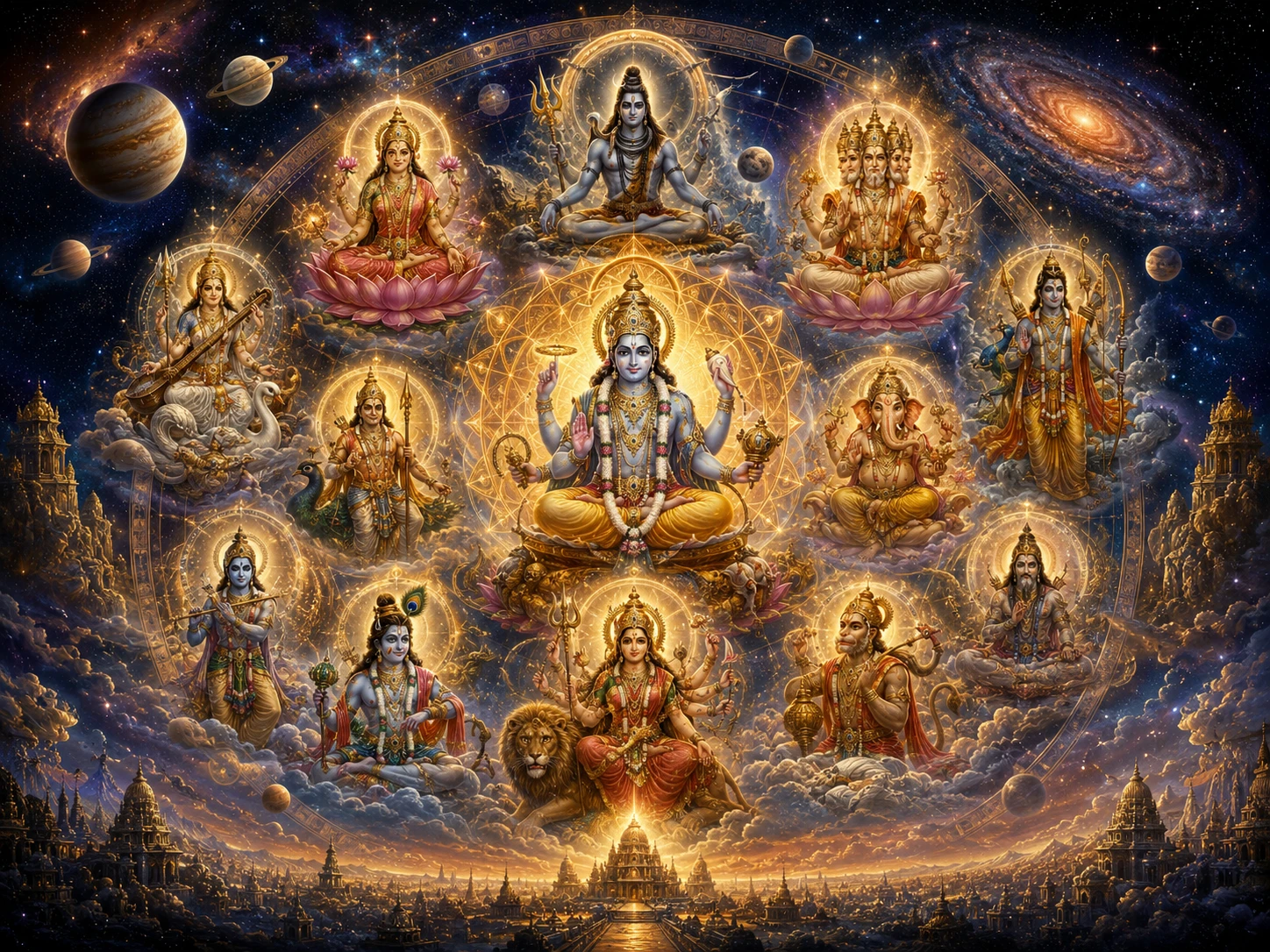
33 Koti Devata -- Why Hinduism Has 33 Types of Gods, Not 33 Crore
13 min read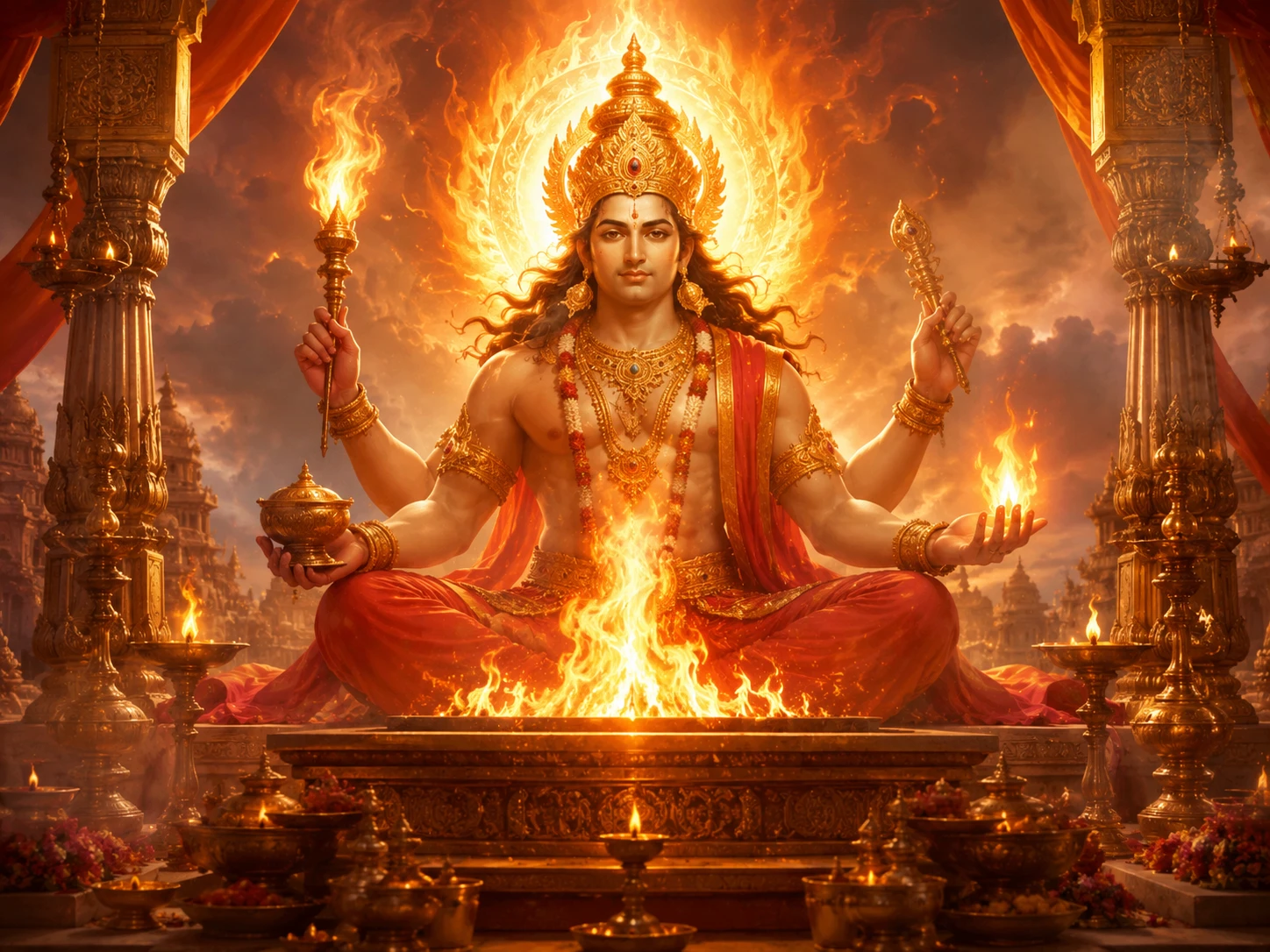
Agni -- The Fire God
19 min read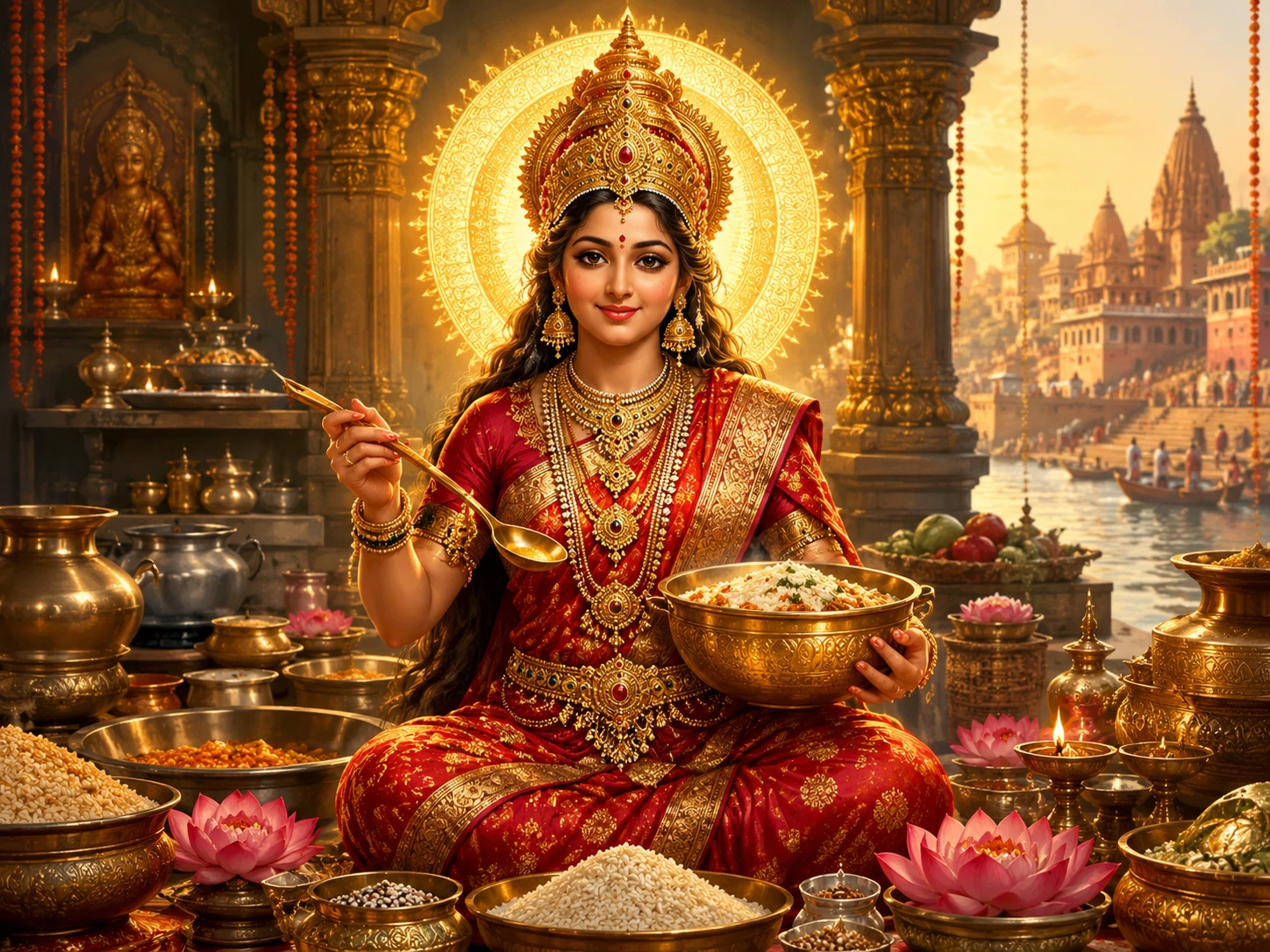
Annapurna -- Goddess of Food
19 min readThe same translation error that turned '33 Koti' into '33 crore' in Hinduism also happened in Buddhism. The Chinese translation of Buddhist texts rendered 'Sapta Koti Buddha' (7 Supreme Buddhas) as '7 Crore Buddhas.' The…
Deities AvatarsCommunity Reflections
🕉️
Be the first to share your reflection.