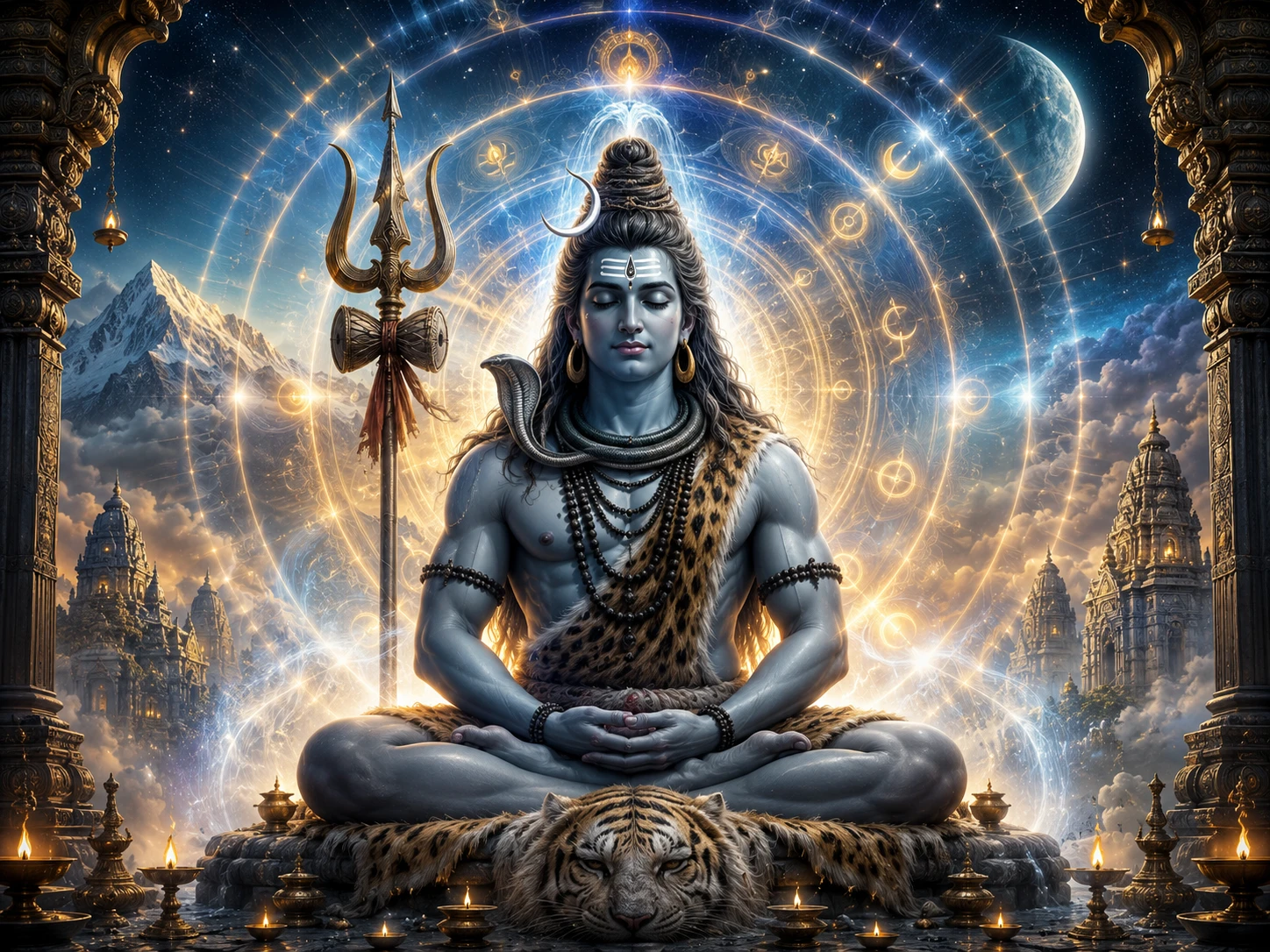
Om Namah Shivaya -- The Panchakshari Mantra
ॐ नमः शिवाय -- पंचाक्षरी मन्त्र
There are mantras that belong to a tradition. And there are mantras that are the tradition. Om Namah Shivaya is the second kind. It is the single most important mantra in Shaivism, the sonic distillation of the entire Sri Rudram hymn, and -- according to traditional commentators -- the 'heart of the Vedas' itself.
The mantra appears in the Krishna Yajurveda, specifically in the Taittiriya Samhita (TS 4.5.8.1), inside the eighth Anuvaka of the Namakam section of the Sri Rudram. The original Vedic form is 'Namah Shivaya cha Shivataraya cha' -- 'Salutations to Shiva, who is auspicious, and to Shivatara, who is more auspicious than that.' From this Vedic seed, the five-syllable mantra Na-Ma-Shi-Va-Ya was extracted as the concentrated essence.
The mantra also appears in the Shukla Yajurveda's Rudrashtadhyayi (5th chapter, verse 41), confirming its presence across both Yajurvedic recensions. This dual attestation is significant: it means the mantra is not a later devotional composition but a Shruti-level (revealed) sacred formula with the highest scriptural authority Hinduism recognises.
When millions of people across the world chant this mantra daily -- in Himalayan caves, in Varanasi ghats, in Chennai IT parks during lunch breaks, in New Jersey basements during weekend puja, in Bali temple ceremonies -- they are chanting a formula that has been in continuous liturgical use for at least 3,000 years. There are very few unbroken chains of human spiritual practice that are this old. The Gayatri Mantra is one. The Panchakshari is another. Both are Vedic. Both are alive.
नमः शिवाय च शिवतराय च
namaH shivaaya cha shivataraaya cha
Salutations to Shiva, who is auspicious, and to Shivatara, who is even more auspicious.
— Sri Rudram, Namakam, Anuvaka 8 (Taittiriya Samhita 4.5.8.1, Krishna Yajurveda) -- the Vedic origin of the Panchakshari Mantra
The Five Syllables and the Five Elements
The mantra is called Panchakshari -- 'five-syllabled' -- because its core is five syllables: Na, Ma, Shi, Va, Ya. When prefixed with Om, it becomes Shadakshari (six-syllabled). Traditional texts note an important distinction: the five-syllable form (without Om) is universally accessible -- the Shiva Purana states it may be chanted by all persons regardless of caste, gender, or initiation status. The six-syllable form (with Om) was traditionally reserved for dvijas (the twice-born who have undergone Upanayana). Modern practice has largely dissolved this distinction, and most spiritual teachers today encourage all sincere seekers to chant Om Namah Shivaya freely.
Each syllable maps to one of the Pancha Mahabhutas (five great elements) that constitute all physical reality:
Na -- Prithvi (Earth). The foundation. Stability, grounding, structure. The bones and muscles of your body. The ground you stand on.
Ma -- Jala (Water). Flow, purification, adaptability. The blood, lymph, and fluids of your body. The rivers and oceans.
Shi -- Agni (Fire). Transformation, clarity, illumination. The digestive fire (jatharagni), the metabolic heat. The sun.
Va -- Vayu (Air). Movement, breath, life-force. Prana itself. The wind, the atmosphere, the breath you are taking right now.
Ya -- Akasha (Ether/Space). Expansion, consciousness, the container within which everything exists. The space between atoms, between stars, between thoughts.
When you chant Na-Ma-Shi-Va-Ya, you are sequentially activating and purifying each element within your body. This is not metaphor. Ayurveda's Pancha Bhuta framework holds that every illness is ultimately an elemental imbalance. The Panchakshari, by vibrating all five elements in sequence, functions as a full-spectrum recalibration. This is why Japa of this mantra -- 108 repetitions with a Rudraksha mala -- is prescribed not merely as devotion but as a daily health-and-consciousness maintenance protocol.
The Panchakshari Decoded -- Five Syllables, Five Dimensions
| Syllable | Element (Bhuta) | Shiva's Face (Panchavaktra) | Cosmic Function | Body Region (Tirumantiram 941) |
|---|---|---|---|---|
| Na (न) | Prithvi (Earth) | Sadyojata (West) | Srishti (Creation) | Feet -- the foundation |
| Ma (म) | Jala (Water) | Vamadeva (North) | Sthiti (Preservation) | Navel -- the centre of nourishment |
| Shi (शि) | Agni (Fire) | Aghora (South) | Samhara (Dissolution) | Shoulders -- the seat of strength |
| Va (वा) | Vayu (Air) | Tatpurusha (East) | Tirodhana (Concealment) | Mouth -- the vehicle of expression |
| Ya (य) | Akasha (Space) | Ishana (Upward) | Anugraha (Grace) | Cranial centre -- the gateway to transcendence |
The Tirumantiram (verse 941), a Tamil Shaiva Siddhanta scripture by Tirumular, maps the five syllables directly onto Shiva's body: 'His feet are Na. His navel is Ma. His shoulders are Shi. His mouth is Va. His radiant cranial centre aloft is Ya. Thus is the five-lettered form of Shiva.' When you chant the Panchakshari, you are simultaneously chanting the five elements, the five cosmic functions, and the five regions of the Divine body.
The Shiva Panchakshara Stotram: Adi Shankaracharya's Masterpiece
In the 8th century CE, Adi Shankaracharya composed the Shiva Panchakshara Stotram -- a five-verse poem where each verse is built around one syllable of the mantra. The first verse begins 'Nagendraharaaya Trilochanaya' (salutations to the one who wears serpents as garlands, the three-eyed one) and ends 'Tasmai Na-karaya Namah Shivaya' -- Salutations to the syllable 'Na.' The second verse builds around 'Ma,' the third around 'Shi,' the fourth around 'Va,' and the fifth around 'Ya.' Each verse simultaneously describes Shiva's attributes and embeds the syllable as its sonic anchor.
This is not just poetry. It is a mnemonic architecture. Shankaracharya -- who was simultaneously a philosopher of the highest order (Advaita Vedanta), a composer of devotional hymns, and a monastic organiser who established the four Mathas that still operate today across India -- designed this stotram as a teaching tool. Each verse gives you a mental image (Shiva's serpent garland, Ganga-water, blue throat, damaru, third eye) to anchor the corresponding syllable. When a student in Kota or a professional in Gurugram chants this stotram, the five syllables are not abstract sounds. They are embodied, visual, felt.
The stotram is recited in millions of homes during Pradosha, every Shivaratri, and during daily Shiva puja. If you have been to a Shiva temple in South India, you have almost certainly heard it chanted. It is Shankaracharya's most popular standalone composition.
नागेन्द्रहाराय त्रिलोचनाय भस्माङ्गरागाय महेश्वराय। नित्याय शुद्धाय दिगम्बराय तस्मै नकाराय नमः शिवाय॥
naagendrahaaraaya trilocanaaya bhasmaangaraagaaya maheshvaraaya | nityaaya shuddhaaya digambaraaya tasmai nakaaraaya namaH shivaaya ||
Salutations to the one who wears the king of serpents as a garland, the three-eyed one, whose body is smeared with sacred ash, the Great Lord, the Eternal, the Pure, the one whose garment is the directions themselves -- salutations to that syllable 'Na,' salutations to Shiva.
— Shiva Panchakshara Stotram, Verse 1 (composed by Adi Shankaracharya, 8th century CE)
How to Practice: The Mechanics of Panchakshari Japa
The traditional practice is Japa -- repetitive chanting -- using a Rudraksha mala of 108 beads. The mantra is synchronised with breath: Om on the inhalation, Namah Shivaya on the exhalation. This creates a natural rhythmic cycle that progressively slows the breath, calms the nervous system, and draws attention inward.
Three levels of practice exist, each progressively deeper. Vachika Japa is chanting aloud -- the vibrations purify the external environment and the physical body. This is how kirtan works; this is what you hear at temple aarti. Upamshu Japa is whispered chanting where only the lips move -- the sound becomes internal, penetrating the subtle energy body. This is the most common mala meditation practice. Manasika Japa is silent, mental chanting -- the most powerful form, where the mantra becomes indistinguishable from thought itself. At the deepest level, this becomes Ajapa Japa -- the mantra chants itself without conscious effort, running continuously in the background of awareness like an operating system running beneath the applications of daily life.
The choice of 108 repetitions is not arbitrary. 108 maps to: 12 zodiac houses multiplied by 9 planets (Navagraha) in Jyotish. The 54 letters of the Sanskrit alphabet multiplied by 2 (Shiva and Shakti aspects of each). The distance between Earth and Sun being approximately 108 times the Sun's diameter. Whether astronomical coincidence or intentional calibration, 108 is the number at which the mantra cycle completes one full energetic circuit.
Best times for practice: Brahma Muhurta (approximately 4-5:30 AM), Sandhya (twilight transitions at dawn and dusk), Pradosha (the 13th tithi evenings sacred to Shiva), and of course Mahashivaratri -- the 'great night of Shiva' when millions chant through the entire night.
There is no restriction on who can chant. Man, woman, child, student, professional, any caste, any background. The Shiva Purana is explicit about this. The mantra asks only for sincerity. For a NEET aspirant who needs 10 minutes of mental reset between study sessions, or a working mother in Thane who needs grounding during the 7:15 local, or an NRI in Dallas who wants to maintain a connection to something deeper than the next sprint review -- 108 rounds of Om Namah Shivaya takes approximately 12-15 minutes. That is less than one Instagram scroll.
The Sri Rudram, from which the Panchakshari is extracted, contains the word 'Namah' (salutations) approximately 300 times in its Namakam section. This is why the section is called 'Namakam' -- it is literally a 300-fold salutation to Shiva in every conceivable form: as the lord of thieves, the lord of forests, the lord of armies, the lord of sleepers, the lord of wakers, the lord of potters, the lord of dogs, the lord of everything. The Namakam does not limit Shiva to 'high' or 'spiritual' forms. It finds him in every single category of existence -- including the socially marginalised and the conventionally impure. This is radical theology. It says: there is nowhere Shiva is not. The Panchakshari is the distilled essence of this 300-fold recognition.
Modern neuroscience research on mantra meditation has found that repetitive chanting activates the vagus nerve (the longest cranial nerve, connecting brain to gut), reduces cortisol levels (stress hormone), and increases alpha-wave activity in the brain (associated with relaxed, focused attention). A 2017 study published in the International Journal of Yoga found that 20 minutes of mantra chanting produced measurable decreases in anxiety and blood pressure. While these studies do not prove the specific claims of Shaiva theology, they confirm what practitioners have reported for millennia: that rhythmic repetition of sacred syllables produces measurable physiological and psychological effects. The ancient rishis did not have EEG machines. They had 3,000 years of observational data from meditators. Both methods arrived at the same conclusion: the mantra works.
Begin Your Panchakshari Japa
108 repetitions. One rudraksha mala. Om on the in-breath, Namah Shivaya on the out-breath. Keep the same time each day and let the beads keep count. The mantra's page on Eternal Raga gives its meaning and how to chant it. Start today -- the mantra has waited millennia for you.
Tags
Eternal Raga · शाश्वत राग
Institutional voice — scholarly articles on Sanatan Dharma
Deepen Your Understanding
अपनी समझ और गहरी करें
deities avatars
Who is Shiva?
He is the ash-smeared ascetic who is also the ideal husband. The destroyer of the universe who is called 'The Auspicious One.' The god of death who drank poison to save all life. He sits in meditation on a Himalayan peak, and simultaneously dances the cosmos into existence and annihilation. No deity in Hinduism contains more contradictions -- and no deity resolves them more completely. This is not a mythology explainer. This is an attempt to stand at the foot of the mountain and look up.
deities avatars
Nine Forms of Shiva -- The Many Faces of Mahadeva
He is the silent teacher under a banyan tree and the screaming destroyer on a battlefield. He is half-woman and half-man. He drank the poison that would have ended the universe and his throat turned blue. Nine scripturally-attested forms of Shiva -- from Nataraja to Rudra -- and why each one exists.
tantra mantra yantra
Mahamrityunjaya Mantra -- Conquering Death
A 16-year-old boy clings to a Shiva Linga as the god of death throws a noose around his neck. Shiva emerges from the Linga, kicks Yama in the chest, and declares the boy immortal. That boy is Markandeya. That mantra is the Mahamrityunjaya. It appears in the Rig Veda, the Yajur Veda, and the Atharva Veda -- the only healing mantra attested in three of the four Vedas. It is chanted in ICU corridors, before surgeries, at bedsides, and in cremation grounds. This is not a mantra about avoiding death. It is a mantra about not being afraid of it.
tantra mantra yantra
The Science of Mantra -- How Sacred Sound Rewires Consciousness
A mantra is not a prayer. It is not a wish. It is a precision instrument of consciousness -- a vibrational key engineered in Sanskrit thousands of years ago to unlock specific states of mind. Modern neuroscience is only now catching up.
tantra mantra yantra
What Makes a Mantra -- The Anatomy of Sacred Sound
Not every Sanskrit word is a mantra. Not every chant carries power. A mantra is an engineered formula with six mandatory components -- rishi, devata, chhanda, beej, shakti, and viniyoga. Miss any one and the circuit is incomplete. Here is the blueprint.
tantra mantra yantra
The Gayatri Mantra -- 24 Syllables That Illuminate the Mind
The most chanted verse in human history is not a prayer for wealth, power, or protection. It is a prayer for light -- for the divine radiance to illuminate the intellect. 24 syllables from Rig Veda 3.62.10, attributed to Rishi Vishwamitra, have shaped Indian civilisation for over three thousand years.
sacred symbols
Shiva Linga -- Symbol, Form, and Misunderstanding
The most searched, most misunderstood, and most deliberately distorted symbol in Hinduism. The word 'Linga' means 'sign' or 'mark' in Sanskrit -- the same word Panini uses in grammar for 'gender marker' and the Nyaya school uses for 'evidence in logical inference.' The Shvetashvatara Upanishad says Shiva has no linga -- meaning He is beyond all characteristics, including gender. The Linga Purana says the Linga is the formless Brahman made graspable. Colonial-era mistranslation turned this into something else entirely. Here is what the texts actually say.
The Sri Rudram, from which the Panchakshari is extracted, contains the word 'Namah' (salutations) approximately 300 times in its Namakam section. This is why the section is called 'Namakam' -- it is literally a 300-fold …
More in Tantra, Mantra & Yantra
Agama vs Tantra vs Veda -- Three Streams of Hindu Practice
14 min read
Agni Dhyana -- What Meditation on Fire Is Actually Grounded In
8 min read
Ashta Siddhi -- The Eight Yogic Powers and How Hanuman Embodies Them
13 min readThe same translation error that turned '33 Koti' into '33 crore' in Hinduism also happened in Buddhism. The Chinese translation of Buddhist texts rendered 'Sapta Koti Buddha' (7 Supreme Buddhas) as '7 Crore Buddhas.' The…
Deities AvatarsCommunity Reflections
🕉️
Be the first to share your reflection.
Watch on YouTube
 Om Namah Shivaya — chant & recitation
Related across Eternal Raga