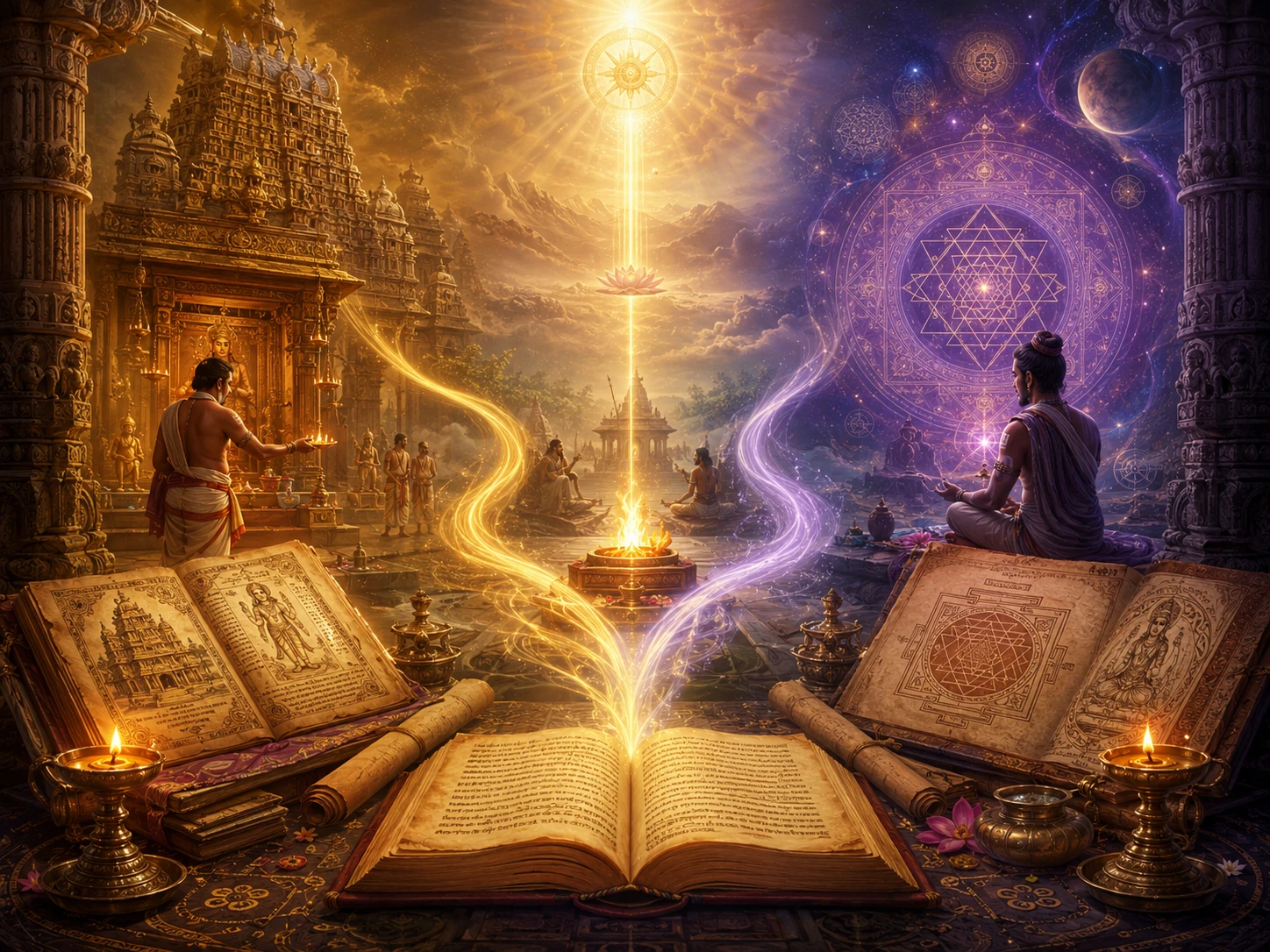
Agama vs Tantra vs Veda -- Three Streams of Hindu Practice
आगम बनाम तंत्र बनाम वेद -- हिन्दू साधना की तीन धाराएँ
Here is a question that will stump most Hindus, including many who consider themselves devout: what is the difference between Agama, Tantra, and Veda?
You have heard all three words. You might even use them in conversation. But ask most people -- even UPSC aspirants studying Indian Culture for the GS-1 paper, even the temple trustee who visits Tirumala every month, even the yoga instructor who trained in Rishikesh -- to explain the distinction, and you will get a blank stare or a vague wave of the hand.
This is not because the distinction is trivial. It is because these three streams have woven together so tightly over two millennia that separating them feels like trying to unweave a three-ply rope into individual threads. Your daily practice as a Hindu almost certainly draws from all three simultaneously -- and that is by design, not by accident.
When you light a diya and recite a Vedic mantra at home, you are performing a Vaidika act. When the temple priest consecrates a murti using elaborate rules for deity installation, proportions, and daily service, he follows the Agama. When your mother wears a Kavach yantra around her neck or chants a Beej mantra given to her by her guru at initiation, she is in the Tantric stream. All three coexist in one household, often in one puja.
Understanding how they relate -- where they overlap, where they differ, and why it matters -- is essential for anyone who wants to go beyond surface-level Hinduism and grasp the architecture of the tradition itself. Think of it as understanding the difference between the Indian Constitution, the Indian Penal Code, and case law. All are 'the law,' but they serve different functions and originate from different processes. Similarly, Veda, Agama, and Tantra are all 'scripture,' but they are different kinds of scripture doing different kinds of work.
Veda -- The Foundation of Knowledge
The Vedas are the oldest stratum. They are Shruti -- literally 'that which was heard' -- revelations received by rishis in states of deep meditation and transmitted orally for centuries before being committed to writing. The four Vedas (Rig, Yajur, Sama, Atharva) are divided into four sections each: Samhita (hymns), Brahmana (ritual commentary), Aranyaka (forest treatises), and Upanishad (philosophical culmination).
The Vedic religion, in its original form, was centred on fire sacrifice (Yajna). There were no temples, no murtis, no deity installation. The gods were invoked through the sacred fire, the offering was poured into the flames, and the smoke carried the offering upward. This is the Shrauta tradition -- the 'heard' tradition of elaborate multi-day fire rituals requiring multiple priests, precise chanting, and detailed astronomical timing.
The Vedic contribution to Hinduism is foundational: the mantras. The Gayatri Mantra is Vedic. The Rudram and Chamakam chanted at every Shiva temple are from the Yajur Veda. The Purusha Sukta recited at temple consecrations is from the Rig Veda. The Upanishadic concepts of Brahman, Atman, Maya, Karma, and Moksha form the philosophical scaffolding on which all later Hindu thought is built.
But here is the critical point: the Vedas do not tell you how to build a temple, how to install a deity, what proportions the sanctum should have, what rituals to perform daily for the murti, or how to consecrate a yantra. These are not Vedic concerns. They are Agamic concerns. And this is where the next stream enters.
आगतं पञ्चवक्त्रात्तु गतं च गिरिजाननम्। मतं च वासुदेवस्य तस्मादागम उच्यते॥
āgataṃ pañca-vaktrāt tu gataṃ ca girijānanam | mataṃ ca vāsudevasya tasmād āgama ucyate ||
That which came (aa-gata) from the five faces of Shiva, which went (gata) to the face of Girija (Parvati), and which has the approval (mata) of Vasudeva (Vishnu) -- that is called Agama.
— Paramasamhita (quoted in multiple Agamic texts)
Agama -- The Architecture of Worship
The Agamas are the vast body of texts that govern the practical infrastructure of Hindu worship -- temple construction, deity installation, daily rituals, festival calendars, and the entire liturgical life of the tradition. If the Vedas provide the philosophy and the mantras, the Agamas provide the operating manual.
The word Agama itself encodes its pedigree. As the Paramasamhita explains, it is knowledge that came (aa-gata) from Shiva, was transmitted to Parvati, and is endorsed by Vishnu. The dialogical format is characteristic: most Agamas are structured as conversations between Shiva and Parvati (or between Vishnu and Lakshmi), with one teaching and the other asking questions. When Shiva teaches Parvati, the text is called Agama; when Parvati teaches Shiva, it is called Nigama. This distinction, though seemingly formal, reflects a philosophical point: knowledge flows in both directions between consciousness (Shiva) and energy (Shakti).
The Agamas are divided into three main families based on the presiding deity: Shaiva Agamas (28 principal texts like Kamika, Karana, Suprabhedha), Vaishnava Agamas or Pancharatra Samhitas (over 200 texts like Sattvata Samhita, Jayakhya, Paushkara), and Shakta Agamas or Tantras (64 texts according to tradition).
Every major temple in India operates on Agamic rules. When you visit Tirupati and see the specific sequence of rituals performed for Lord Venkateswara -- the morning Suprabhatam, the Thomala seva, the Abhishekam -- every step follows Vaikhanasa Agama, one of the two main Vaishnava ritual systems (the other being Pancharatra). When you visit the Shiva temples of Tamil Nadu -- Chidambaram, Nataraja, the great chain from Rameswaram to Kanchipuram -- they follow Kamika Agama or other Shaiva Agamic texts.
The Agamic texts are astonishingly detailed. They specify the exact proportions of a temple tower (Vimana), the dimensions of the sanctum relative to the main hall, the materials for the deity (stone, metal, gem, wood), the mantras for each step of consecration, the daily schedule of worship (typically five to six services), the ingredients for each offering, the qualifications of the priest, and even the musical instruments to be played at each hour. This is engineering-grade documentation -- the ancient equivalent of an ISO standard for sacred architecture.
Tantra -- The Technology of Transformation
The word Tantra derives from the root 'tan' (to expand) and 'tra' (to protect or liberate). A Tantra is a system that expands consciousness while protecting the practitioner. As the Kamika Agama says: that which spreads great knowledge concerning Tattva and Mantra, and which saves -- that is called Tantra.
Tantra overlaps significantly with Agama -- in fact, the terms are sometimes used interchangeably. The Shakta Agamas are commonly called Tantras; the Shaiva Agamas are sometimes called Tantras; the Vaishnava Agamas are usually called Samhitas but have Tantric elements. The confusion is not accidental -- these traditions flowed into each other over centuries.
However, there is a meaningful distinction. While Agama focuses on the external architecture of worship (temple, murti, ritual sequence), Tantra focuses on the internal architecture of the practitioner (chakras, nadis, kundalini, mantra activation, yantra meditation). Agama tells you how to build the temple; Tantra tells you how to become the temple.
The Tantric tradition introduces several key technologies not found in the Vedic corpus: Kundalini awakening through the chakra system, Mantra Diksha (initiation into a specific mantra by a guru, with precise rules about who can receive which mantra), Yantra worship (meditation on geometric diagrams encoding divine energy), Nyasa (installation of mantras in specific parts of the body), and the elaborate system of Beej Mantras (seed syllables like Om, Shreem, Hreem, Kleem) that compress cosmic forces into single sounds.
The Tantric worldview is also distinctive in its radical inclusivity. Where Vedic ritual was originally restricted by caste and gender (only Brahmin males could perform Shrauta rituals), Tantra explicitly opens its doors to all. The Kularnava Tantra, a foundational Kaula text, states that in the Kula tradition, distinctions of caste and gender dissolve before the guru's initiation. This democratization of spiritual access is one of Tantra's most profound contributions to Hinduism.
Every Bollywood song that mentions 'Tantra-Mantra' as if it means black magic is perpetuating a colonial-era distortion. British Orientalists encountered Tantric texts, found their sexual symbolism and ritual transgression deeply uncomfortable, and classified the entire corpus as 'degenerate.' This prejudice seeped into Indian self-perception. Today, when a JEE student in Kota hears 'Tantra' and thinks of horror movies and midnight graveyards, it is a direct legacy of this colonial misunderstanding. The reality is that Tantra is the engine running most mainstream Hindu worship -- and reclaiming it is an act of intellectual honesty.
Veda vs Agama vs Tantra -- The Three Streams Compared
| Dimension | Veda (वेद) | Agama (आगम) | Tantra (तंत्र) |
|---|---|---|---|
| Meaning of term | Vid -- to know. Knowledge itself. | Aa-gata -- that which has come (from Shiva to Parvati to Vishnu). | Tan + Tra -- to expand + to protect/liberate. |
| Type of revelation | Shruti -- heard by rishis in meditation. Apaurusheya (authorless). | Revealed by Shiva/Vishnu in dialogue with consort. Has divine author. | Revealed in dialogue format. Emphasis on guru-shishya transmission. |
| Primary focus | Cosmological knowledge, philosophy, mantras, and fire sacrifice. | Temple construction, deity installation, daily worship protocol. | Internal sadhana -- chakras, kundalini, mantra diksha, yantra. |
| Central practice | Yajna (fire ritual), Svadhyaya (Vedic study), Upanishadic inquiry. | Puja (deity worship), Utsava (festivals), Prana Pratishtha (consecration). | Mantra japa, Yantra meditation, Kundalini yoga, Nyasa. |
| Accessibility | Historically restricted -- Brahmins only for Shrauta rituals. | Open to all who enter the temple; priest must be qualified. | Explicitly universal -- open to all castes and genders after diksha. |
| Key texts | Rig, Yajur, Sama, Atharva Veda; Upanishads. | 28 Shaiva Agamas; 200+ Pancharatra Samhitas; 64 Shakta Tantras. | Kularnava Tantra, Tantraloka, Vijnana Bhairava, Mahanirvana Tantra. |
| Temple role | Provides mantras chanted during rituals. | Provides the complete operational blueprint for the temple. | Provides the inner practice system for advanced sadhana. |
| Geographic strength | Pan-Indian; strongest in Vedic heartland (UP, Bihar, Maharashtra). | South India (Shaiva & Vaishnava Agamas dominate temple worship). | Bengal, Assam, Kashmir, Kerala; also pan-Indian through kirtan/mantra. |
| Modern misconception | Often equated with only mantras or outdated rituals. | Unknown to most Hindus despite governing their temples. | Confused with black magic or sexual practices. |
| Relationship to each other | Foundation and authority accepted by all. | Claims Vedic basis; operationalizes Vedic principles in temple form. | Claims Vedic basis; internalizes Vedic principles in body-based practice. |
Both Agama and Tantra claim Vedic authority. The Kularnava Tantra (2.85) states: 'Know the Kula Shastra to be Vedic in essence' (vedatmakam shastram viddhi kaulatmakam priye). They are not rivals but three perspectives on one truth.
How They Work Together -- The Puja Room Example
Walk into any Hindu home puja room and you will see the three streams converging in one square metre of sacred space.
The murti or photo of the deity is Agamic -- its iconography (number of hands, posture, vahana, attributes) follows Agamic specifications called Dhyana Shlokas. The manner of daily worship -- lighting the diya, offering flowers, performing aarti in a clockwise direction, ringing the bell -- follows Agamic protocol transmitted through family tradition.
The mantras chanted during this puja are predominantly Vedic. The Gayatri Mantra, the Shanti Mantra (Om Sahana Vavatu), the Purush Sukta at special occasions -- all Vedic. Even the act of reciting 'Om' before any prayer is a Vedic practice.
And the kavach worn around the mother's neck, the Hanuman Chalisa she recites daily (a Tantric stotra in structure even if popular culture does not label it so), the specific Beej Mantra she received from her guru, the small yantra plate tucked behind the murti -- these are Tantric elements, seamlessly integrated.
The three streams do not compete in practice. They compose. Just as a good dal needs three elements -- the base pulse, the tempering (tadka), and the salt -- Hindu home worship needs the Vedic mantras (base), the Agamic ritual form (tempering), and the Tantric personal sadhana (salt that makes it uniquely yours). Remove any one and the meal is incomplete.
This integration is not a modern innovation. It has been the living practice for over a thousand years. The great Acharyas understood this. Shankaracharya, champion of Vedanta, established the Shanmata system of worship with Tantric elements. Ramanuja, champion of Vishishtadvaita, systematised Pancharatra Agamic worship at Srirangam. Abhinavagupta, champion of Kashmir Shaivism, synthesised Vedic philosophy with Tantric practice in his Tantraloka. Each great teacher drew from all three streams because each stream addresses a different dimension of the spiritual life.
The Agamic Infrastructure You Never Noticed
Here is a thought experiment for anyone who has visited a Hindu temple anywhere in India.
You entered through a Gopuram (tower gateway). You walked through a Prakara (circumambulatory corridor). You saw the Dwajastambha (flag pillar) and Bali-pitha (offering platform). You reached the Ardha-mandapa, then the Maha-mandapa, then finally the Garbhagriha where the murti resides. The deity faced east. The proportions of each section followed specific ratios.
None of this is Vedic. All of it is Agamic.
The Vedas describe a world of open-air fire altars, not enclosed stone sanctums. The entire physical infrastructure of the Hindu temple -- its ground plan (Vastu-purusha mandala), its vertical proportions, its deity placement, its directional orientation, the rules for what happens in which mandapa -- comes from the Agamas. Without the Agamas, Hinduism would have no temples.
This is why the Agamas are arguably the most practically important scriptures in Hinduism, yet the least known to ordinary devotees. Ask the average temple-going Hindu in Bangalore or Nashik what Agama governs their temple, and they will not know. They do not need to know, in the same way you do not need to know the building code to live in a house. But for anyone studying Hindu civilisation seriously -- whether for academic, devotional, or architectural purposes -- the Agamas are indispensable.
The archaeological implications are significant too. When historians study the great temples of Hampi, Khajuraho, Konark, or Thanjavur, they are reading Agamic architecture in stone. The Silpa Shastra texts that guided the sculptors, the Vastu texts that guided the architects, and the Agamic texts that guided the priests form an integrated knowledge system. The IIT or NIT architecture student who visits Hampi on a college trip is walking through an Agamic textbook without knowing it.
The Nigama-Agama Dialogue -- When Parvati Teaches Shiva
One of the most overlooked features of the Agamic tradition is the Nigama -- the reverse flow of teaching where Parvati instructs Shiva rather than the other way around. This is not a minor footnote. It encodes a radical philosophical commitment: Shakti is not merely the student or consort but the co-teacher, the active intelligence through whom knowledge becomes embodied.
The implication is profound. In the Nigamic texts, Devi asks the questions that Shiva cannot ask himself -- questions about the practical application of knowledge, about the needs of embodied beings, about how cosmic truth translates into lived experience. Shiva holds the abstract principle; Shakti holds the operational intelligence. Knowledge is not complete until it has been questioned, tested, and grounded in practice.
This dialogical structure has no parallel in other scriptural traditions. The Vedas are monological -- received by rishis, not debated between deities. The Bible, Quran, and Torah are revelations from God to human prophets. But the Agamas and Tantras model knowledge as a conversation between equals -- Consciousness and Energy, Purusha and Prakriti, the Formless and the Formed.
For the modern reader, especially the young professional navigating the Indian corporate world or the startup founder trying to build something meaningful, this structure carries a practical lesson. Knowledge that stays theoretical is sterile. The Veda provides the theory. The Agama turns it into architecture and ritual. The Tantra turns it into personal experience. Just as a McKinsey strategy deck is useless until someone implements it on the factory floor, Vedic knowledge is incomplete until the Agamic and Tantric traditions operationalize it in temple and body.
The MBA student at ISB Hyderabad or IIM Ahmedabad would recognise this as the difference between case study learning (Veda), standard operating procedure (Agama), and on-the-job execution (Tantra). All three are essential. None alone is sufficient.
This is also why the guru-shishya parampara remains central across all three streams. The Veda requires a teacher to transmit the correct pronunciation and meaning of mantras. The Agama requires a trained priest to execute rituals with precision. The Tantra requires an initiated guru to transmit the Beej Mantra and oversee the sadhak's progress through the internal practices. In each case, the living teacher is the bridge between scriptural knowledge and lived transformation. No app, no YouTube video, no PDF can substitute for this transmission -- though platforms like Eternal Raga can introduce the framework and inspire the seeker to find their guide.
The Kamika Agama, the foundational Shaiva Agamic text, runs to over 12,000 verses and covers everything from temple architecture to deity sculpture proportions to the chemistry of ritual offerings. An IIT Madras research project has been digitising Agamic manuscripts preserved in Tamil Nadu's Saiva Siddhanta monasteries (adheenam), many written on palm leaves that are slowly deteriorating. The IGNCA (Indira Gandhi National Centre for the Arts) has also catalogued Agamic manuscripts across South India. Yet despite this, no complete critical edition of all 28 Shaiva Agamas exists in any single language -- a gap equivalent to not having a complete English Bible despite Christianity being 2,000 years old.
Why This Matters Today -- Reclaiming the Full Tradition
Understanding the Veda-Agama-Tantra triad is not academic trivia. It is essential for anyone who wants to engage with Hinduism as a living civilisation rather than a museum exhibit.
For the temple administration: knowing which Agama your temple follows allows you to ensure rituals are performed correctly, to resolve disputes about procedure, and to make informed decisions about renovation and expansion.
For the yoga practitioner: knowing that your practice of asana, pranayama, and meditation has Tantric roots -- not purely Vedic ones -- frees you from the false binary of 'authentic Vedic yoga' versus 'corrupted Tantric yoga.' Both are authentic. They serve different purposes.
For the UPSC aspirant: the Art and Culture section regularly asks about temple architecture, iconography, and scriptural classifications. Understanding the Agamic basis of temple design instantly clarifies questions about Dravida vs Nagara styles, about the significance of the Gopuram, about the difference between Agamic and Vedic rituals.
For the NRI explaining Hinduism to non-Hindu friends: instead of the vague 'Hinduism has many scriptures,' you can explain with precision. The Vedas are the knowledge base. The Agamas are the operations manual. The Tantras are the advanced practice guide. Together, they form a complete system -- philosophy plus practice plus personal transformation.
And for any Hindu who has felt confused by the sheer scale and seeming contradictions of the tradition: understanding these three streams resolves much of the confusion. Hindu practices do not contradict each other. They come from different streams, address different needs, and work together like the instruments of an orchestra. The confusion arises only when you do not know which stream a practice belongs to.
As the Kularnava Tantra states: Veda, Shastra, and Agama speak of the same means of Bhoga (experience) and Moksha (liberation). The streams are different. The ocean is one.
Experience All Three Streams -- Begin with Vedic Mantra Japa
Start with the most accessible meeting point: chant the Gayatri mantra (Vedic) 108 times on a mala (the counted repetition the Tantras systematised), seated before a deity image or yantra (Agamic focus). In this one act, all three streams flow together. The Gayatri's page on Eternal Raga gives its meaning and how to chant it.
Eternal Raga · शाश्वत राग
Institutional voice — scholarly articles on Sanatan Dharma
Deepen Your Understanding
अपनी समझ और गहरी करें
tantra mantra yantra
Tantra, Mantra and Yantra -- The Three Pillars of Spiritual Practice
Tantra is the loom, Mantra is the thread, Yantra is the pattern. Together they form the complete technology of spiritual transformation that India gifted to the world -- and they are far more profound than popular culture imagines.
tantra mantra yantra
Diksha -- Why Initiation Matters and What It Actually Means
The Kularnava Tantra is unambiguous: there is no liberation without Diksha, no Diksha without a Guru, and no Guru without a Parampara. In an age where mantras are available on YouTube and spiritual apps offer 'instant enlightenment,' understanding why initiation is non-negotiable separates the seeker from the tourist.
tantra mantra yantra
The Gayatri Mantra -- 24 Syllables That Illuminate the Mind
The most chanted verse in human history is not a prayer for wealth, power, or protection. It is a prayer for light -- for the divine radiance to illuminate the intellect. 24 syllables from Rig Veda 3.62.10, attributed to Rishi Vishwamitra, have shaped Indian civilisation for over three thousand years.
tantra mantra yantra
Sri Yantra -- The Supreme Geometry of Creation
Nine interlocking triangles. 43 smaller triangles. A single point from which the entire universe unfolds. The Sri Yantra is the most complex and revered sacred diagram in Hinduism -- and modern mathematicians have found that constructing it requires solving simultaneous equations that Western mathematics did not formalise until the 18th century. This is not decoration. This is the visual body of the Goddess.
tantra mantra yantra
Kundalini -- The Serpent Power That Sleeps at Your Spine's Base
A coiled serpent sleeps at the base of your spine. When awakened through yoga, mantra, or guru's grace, she rises through seven energy centres, dissolving every limitation of body and mind, until she merges with pure consciousness at the crown of your head. This is not New Age fantasy. This is the central psycho-spiritual technology of Tantric Hinduism -- mapped in Sanskrit texts over 1,500 years ago and now studied by neuroscientists at institutions from Harvard to NIMHANS Bangalore.
tantra mantra yantra
The Sahasranama Tradition -- Why God Needs a Thousand Names
On a bed of arrows, dying but not yet dead, Bhishma reveals to Yudhishthira the thousand names of Vishnu -- and changes Hindu devotional practice forever. The Sahasranama is not a list. It is a map of infinity compressed into 107 Sanskrit verses, chanted by millions every morning from Srirangam to Silicon Valley.
tantra mantra yantra
The Science of Mantra -- How Sacred Sound Rewires Consciousness
A mantra is not a prayer. It is not a wish. It is a precision instrument of consciousness -- a vibrational key engineered in Sanskrit thousands of years ago to unlock specific states of mind. Modern neuroscience is only now catching up.
The Kamika Agama, the foundational Shaiva Agamic text, runs to over 12,000 verses and covers everything from temple architecture to deity sculpture proportions to the chemistry of ritual offerings. An IIT Madras research…
More in Tantra, Mantra & Yantra

Agni Dhyana -- What Meditation on Fire Is Actually Grounded In
8 min read
Ashta Siddhi -- The Eight Yogic Powers and How Hanuman Embodies Them
13 min read
Bandhas and Mudras -- Locks and Seals as a Working System
11 min readThe same translation error that turned '33 Koti' into '33 crore' in Hinduism also happened in Buddhism. The Chinese translation of Buddhist texts rendered 'Sapta Koti Buddha' (7 Supreme Buddhas) as '7 Crore Buddhas.' The…
Deities AvatarsCommunity Reflections
🕉️
Be the first to share your reflection.