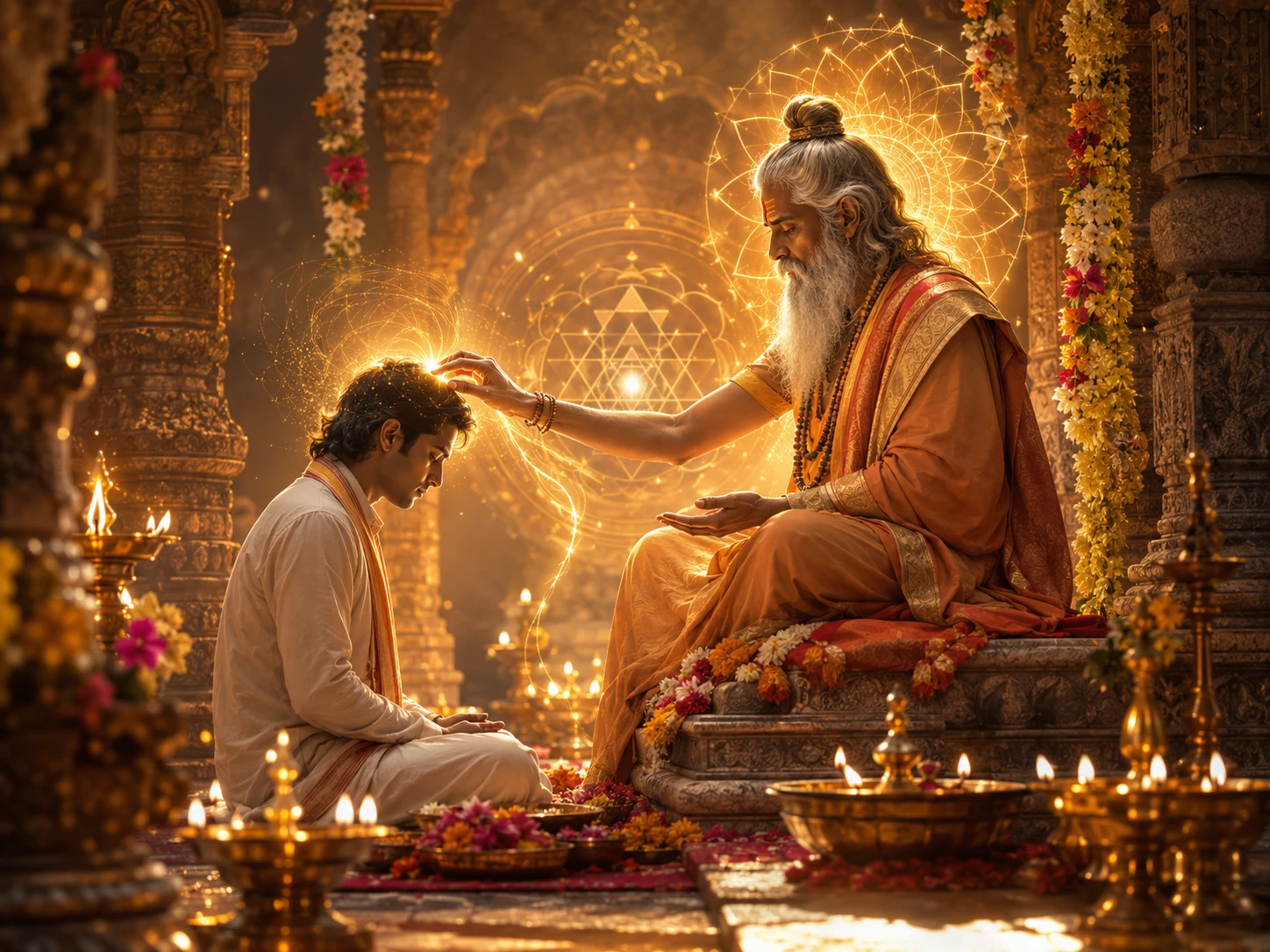
Diksha -- Why Initiation Matters and What It Actually Means
दीक्षा -- दीक्षा क्यों आवश्यक है और इसका वास्तविक अर्थ क्या है
You can download a mantra from the internet in three seconds. You can watch a YouTube tutorial on Kundalini meditation. You can buy a Rudraksha mala on Amazon and a yantra on Flipkart. You can read translations of the Kularnava Tantra on your Kindle. All of these are available, accessible, and free or nearly free.
So why does every serious spiritual tradition in India -- Shaiva, Shakta, Vaishnava, Nath, Buddhist, Jain -- insist that the mantra must come from the mouth of a living Guru? Why does the Kularnava Tantra, one of the most authoritative Kaula texts, state categorically: 'Na diksha vina moksha' -- there is no liberation without Diksha?
The answer cuts to the heart of what Diksha actually is. It is not the delivery of information. It is the transmission of Shakti.
Think of it this way. You can read every book on swimming. You can watch Olympic swimmers frame by frame. You can memorise the biomechanics of every stroke. But until you get in the water -- until an instructor puts their hand under your back and guides your body through the motion -- you cannot swim. The information was always available. The transmission required contact.
Diksha is spiritual contact. It is the moment when the accumulated tapas, siddhi, and Shakti of an entire lineage -- flowing from Guru to Guru across centuries -- enters the disciple through the medium of a living teacher. The mantra is the vehicle. But the power that charges the mantra comes from the Parampara.
This is why the same mantra -- say, Om Namah Shivaya -- has different potency when chanted casually versus when received through Diksha. The syllables are identical. The vibration is not. After Diksha, the mantra is said to be 'Chaitanya' -- alive, conscious, activated. Before Diksha, it is 'Jada' -- inert, a collection of sounds without the spark that ignites transformation.
The distinction matters enormously in a culture that increasingly treats spiritual practice as content consumption. The seeker who collects mantras from books and apps without Diksha is like the engineering student who watches MIT OpenCourseWare lectures but never does a lab experiment. The theory is absorbed. The transformation is not.
दीयते ज्ञानमैश्वर्यं क्षीयते पाशबन्धनम्। इति दीक्षेति सा प्रोक्ता देशिकैस्तत्त्वकोविदैः॥
dīyate jñānam aiśvaryaṃ kṣīyate pāśa-bandhanam | iti dīkṣeti sā proktā deśikais tattva-kovidaiḥ ||
That process which bestows divine knowledge (jnana) and sovereignty (aishvarya), and which destroys the bondage of fetters (pasha) -- that is called Diksha by the spiritual teachers who know the Truth.
— Vishnu Yamala Tantra (quoted in multiple Agamic texts)
The Etymology of Diksha -- Giving and Destroying
The word Diksha carries its own theology in its syllables. It derives from two Sanskrit roots: 'da' (to give) and 'kshi' (to destroy). Alternatively, from the verb root 'diksh' meaning to consecrate.
This dual etymology is not accidental. Diksha is simultaneously a giving and a destroying. The Guru gives (da) the disciple transcendental knowledge (Divya Jnana). And simultaneously, Diksha destroys (kshi) the accumulated sins, the seed of ignorance, and the fetters (pasha) that bind the soul to the cycle of birth and death.
The Vishnu Yamala Tantra captures this precisely: 'That process which bestows divine knowledge and destroys sin, the seed of sin and ignorance, is called Diksha by the spiritual teachers who have seen the Truth.' This is not a metaphor. The Tantric tradition understands Diksha as an energetic event -- a precise operation on the subtle body of the disciple.
During Diksha, according to the Sharadatilaka Tantra (Chapters 3-5), the Guru performs an internal yogic act: he draws the Chaitanya (conscious energy) of the disciple into himself, purifies it through his own tapas and mantra siddhi, and then returns it to the disciple -- now cleansed, activated, and aligned with the Parampara's Shakti. This is not a symbolic ceremony. In the Tantric understanding, it is a surgical intervention on the architecture of the disciple's karma.
This is why Diksha traditionally requires preparation. The disciple observes dietary restrictions, sexual abstinence, and mental purification for a prescribed period before the ceremony. The body and mind must be receptive vessels. Just as a surgeon does not operate on an unprepared patient, a Guru does not initiate an unprepared disciple. The preparation is not punishment or gatekeeping -- it is calibration.
Five Types of Diksha -- From Touch to Thought
The Tantric tradition classifies Diksha into five primary types, each operating through a different faculty of the Guru. This is not a theoretical taxonomy -- each type corresponds to the spiritual capacity of both the Guru and the disciple.
Samaya Diksha (Ritual Initiation) is the most common form. The Guru conducts a formal ceremony -- typically involving a sacred fire (homa), mantra recitation, and the placing of the hand on the disciple's head. The disciple receives the Ishta Mantra (personal deity mantra) and accepts the rules of the Sampradaya (tradition). This is the standard initiation in most Hindu monastic orders -- ISKCON, Ramakrishna Mission, Shankaracharya Mathas, and countless lineages across India. The JEE student who takes Diksha from a family guru in Rishikesh before heading to Kota for coaching is typically receiving Samaya Diksha.
Sparsha Diksha (Touch Initiation) is transmission through physical contact. The Guru places the right hand on the disciple's head, or touches the Ajna Chakra (point between the eyebrows), or embraces the disciple. The Shakti flows through touch. The most famous historical example: Sri Ramakrishna touching Swami Vivekananda's chest, sending him into a state of cosmic consciousness. Anandamayi Ma was known to frequently bestow Sparsha Diksha.
Vag Diksha (Word Initiation) is transmission through the spoken mantra. The Guru whispers the mantra into the disciple's right ear -- the Mantra entering through the ear canal and lodging directly in consciousness. This is the most intimate of the ritual forms; the Guru's breath carrying the Shakti of the lineage into the disciple's body.
Drik Diksha (Gaze Initiation) is transmission through the Guru's eyes. A single look from a Siddha Guru can awaken the dormant Kundalini. This requires extraordinary spiritual attainment in the Guru and receptivity in the disciple. Shirdi Sai Baba and Neem Karoli Baba are often described as Gurus who initiated through gaze.
Sambhavi Diksha (Supreme Initiation) combines all faculties -- gaze, word, touch, and mental intention. Some traditions describe it as initiation through mere proximity or thought. It is the rarest form, requiring a Guru of the highest attainment. In the Nath tradition, it is said that Matsyendranath initiated Gorakshanath through Sambhavi Diksha, transmitting the entire science of Hatha Yoga in a single moment of absolute connection.
Five Types of Diksha -- The Transmission Spectrum
| Diksha Type | दीक्षा प्रकार | Medium of Transmission | Key Historical Example | Requirement |
|---|---|---|---|---|
| Samaya Diksha | समय दीक्षा | Formal ceremony -- fire, mantra, hand on head | Standard initiation in ISKCON, Ramakrishna Mission, Shankaracharya Mathas | Qualified Guru + ritual preparation by disciple |
| Sparsha Diksha | स्पर्श दीक्षा | Physical touch -- hand, embrace, or finger on Ajna | Sri Ramakrishna touching Vivekananda; Anandamayi Ma | Guru with accumulated Shakti; receptive disciple |
| Vag Diksha | वाग् दीक्षा | Whispered mantra directly into disciple's ear | Traditional Guru Mantra transmission in most lineages | Correct mantra selection for disciple's temperament |
| Drik Diksha | दृक् दीक्षा | Guru's charged gaze awakening disciple's Kundalini | Shirdi Sai Baba; Neem Karoli Baba; Bhagavan Nityananda | Siddha-level Guru; exceptionally prepared disciple |
| Sambhavi Diksha | शाम्भवी दीक्षा | Combined gaze + word + touch + mental intention, or mere proximity | Matsyendranath initiating Gorakshanath (Nath tradition) | Guru of highest attainment; rarest form of Diksha |
The five types are not ranked by superiority but by the Guru's mode of transmission and the disciple's capacity to receive. A Samaya Diksha from a true Siddha Guru may be more powerful than a Drik Diksha from a lesser teacher. The lineage and the Guru's own attainment matter more than the method.
Shaktipat -- The Descent of Grace
At the core of every Diksha -- regardless of type -- is Shaktipat: the descent of divine power from the Guru into the disciple. The word literally means 'the falling (pat) of Shakti.' It is the moment when the dormant spiritual energy within the disciple is activated by the Guru's grace.
Shaktipat is not something the Guru manufactures. It is something the Guru channels. The Guru's body, purified through years of sadhana, becomes a conduit for the Shakti of the lineage. The energy does not originate in the Guru's personal power -- it originates in the Parampara and ultimately in Shiva or Shakti themselves. The Guru is a transformer, stepping down cosmic voltage to a level the disciple's system can handle.
The experience of Shaktipat varies dramatically. Some disciples report physical heat, trembling, or spontaneous movements (kriyas). Some experience visions or hear inner sounds. Some feel nothing at the time but notice profound changes in the days and weeks following. The Tantric texts warn against judging the validity of Diksha by the intensity of immediate experience -- some of the deepest transmissions are felt not as fireworks but as a quiet, irreversible shift in the baseline of consciousness.
The Kashmir Shaiva tradition describes three intensities of Shaktipat: Tivra (intense), Madhya (moderate), and Manda (gentle). Tivra Shaktipat can produce immediate liberation. Madhya produces intense longing for the Divine and rapid spiritual progress. Manda awakens a gradual unfolding over years of practice. Most disciples receive Manda Shaktipat -- and this is not a lesser gift. A seed planted gently grows into a tree that outlasts the storm.
In the modern context, Shaktipat has become a loaded term. Some self-styled gurus claim to offer 'mass Shaktipat' at weekend workshops for a fee. Discernment is essential. Authentic Shaktipat requires an authentic Guru rooted in an authentic Parampara. The Kularnava Tantra provides extensive guidelines for recognising a true Guru versus a false one -- and the primary marker is not charisma or fame but the Guru's own conduct, renunciation, and lineage.
The Guru-Shishya Bond -- Beyond the Transaction
The modern commodification of spirituality has reduced Diksha in popular imagination to a transactional event: you go to a guru, receive a mantra, pay a dakshina, and leave. This is a catastrophic misunderstanding.
Diksha is not a transaction. It is the beginning of a relationship that the tradition considers more binding than marriage, more consequential than birth, and more permanent than death. The Guru-Shishya bond is described in the Kularnava Tantra as the relationship through which liberation itself becomes possible. Without Guru, no Diksha. Without Diksha, no Moksha. Without Moksha, the endless turning of the wheel.
The Guru's responsibility does not end at the Diksha ceremony. A true Guru monitors the disciple's progress, adjusts the practice, addresses obstacles, and -- in the Tantric framework -- takes on a portion of the disciple's karma. This is not metaphor. The tradition holds that when a Guru initiates a disciple, they accept karmic responsibility for that soul's liberation. This is why authentic Gurus are often reluctant to give Diksha freely -- they understand the weight of what they are assuming.
The disciple's responsibility is equally profound. After Diksha, the mantra received must be practised with regularity and kept secret. The Guru's instructions must be followed. The discipline of the Sampradaya must be maintained. This is not blind obedience -- it is the recognition that transformation requires structure, and the Guru provides the structure that the disciple's untrained mind cannot provide for itself.
For the young Indian navigating the tension between modernity and tradition, between LinkedIn and lineage, between a Pune apartment and a Himalayan ashram -- the Guru-Shishya relationship offers something no app or algorithm can: personalised spiritual guidance from a living being who has walked the path and reached the destination. In a world of infinite content and zero transmission, Diksha remains the irreplaceable act of connection.
Diksha Across Hindu Sampradayas -- Shaiva, Vaishnava, and Shakta
Every major Hindu Sampradaya has its own Diksha framework, and understanding these differences illuminates the diversity within what outsiders often see as a monolithic tradition.
In the Shaiva Siddhanta tradition dominant in Tamil Nadu and parts of Karnataka, Diksha follows a three-tiered structure: Samaya Diksha (entry-level, making one a Samayin -- a member of the community), Vishesha Diksha (special initiation granting access to specific mantras and practices), and Nirvana Diksha (the highest, administered at the point of death to ensure liberation). The 28 Shaiva Agamas govern these rituals with extraordinary precision. The priest (Shivacharya) who conducts the temple worship at Chidambaram or Thanjavur must himself have received all three levels of Diksha.
The Vaishnava traditions split into two major streams. The Sri Vaishnava tradition (followers of Ramanuja) practises Pancha Samskara -- a five-fold initiation that includes Tapa (branding the shoulders with the heated symbols of Shankha and Chakra), Pundra (application of the Urdhva Pundra or V-shaped Nama tilak on twelve body parts), Nama (receiving a new spiritual name), Mantra (receiving the Ashtakshara and Dvaya mantras), and Yaga (learning the mode of daily worship). At Tirupati, Srirangam, and every Sri Vaishnava temple, the Diksha-qualified Vaishnavas (Samashrayana-holders) form the core worshipping community.
The Gaudiya Vaishnava tradition (Chaitanya Mahaprabhu's lineage, including ISKCON) practises Harinama Diksha as the first initiation -- receiving the Hare Krishna Mahamantra and the vow to chant 16 rounds daily. A second initiation (Brahmanical Diksha) follows, granting the Gayatri Mantra and Brahman thread. The ISKCON process is perhaps the most globally standardised Diksha system in contemporary Hinduism.
The Shakta tradition's Diksha is the most elaborate. The Kularnava Tantra, Sharadatilaka, and Prapanchasara describe multi-day ceremonies involving Homa, Nyasa, Purascharana (preliminary mantra repetition), and the gradual transmission of increasingly powerful Beej Mantras. Sri Vidya Diksha -- initiation into the worship of Lalita Tripurasundari through the Sri Yantra -- is a Krama Diksha (step-wise), where the disciple progresses through stages over years: first the Bala Trayakshari Mantra (three syllables), then the Panchadashi (fifteen syllables), and finally the Mahashodashi (sixteen syllables). A serious Sri Vidya practitioner may take twelve years to receive the full spectrum of initiation.
What unites all these traditions is the non-negotiable principle: the mantra must come from a living Guru in an unbroken chain of transmission. Whether the mantra is the Panchakshari of the Shaivas, the Ashtakshari of the Vaishnavas, or the Panchadashi of the Shaktas, the power of the syllable is activated only when it passes through the living breath of a teacher who received it from their teacher, who received it from theirs, stretching back to the divine source itself.
Finding a Guru in the Modern Age -- Discernment and Red Flags
The Kularnava Tantra devotes extensive passages to the qualities of a true Guru and the dangers of a false one. In an age of spiritual influencers with Instagram followings larger than some cities, these warnings are more relevant than ever.
A true Guru, according to the Tantric texts, has these markers: established in a legitimate Parampara (lineage) that can be traced back to an acknowledged Acharya or Siddha; personally accomplished in sadhana (not merely learned in scripture); demonstrably ethical in conduct (not exploiting disciples financially, sexually, or emotionally); willing to turn away the unready rather than accumulate followers; and transparent about the demands of the path.
The red flags are equally clear: a guru who promises instant results, who charges exorbitant fees for initiation, who demands absolute obedience without accountability, who isolates disciples from family and friends, who claims exclusive access to truth, or who displays ostentatious wealth while preaching renunciation. The tradition is explicit: such a person is not a Guru but a Guru-drohee -- a betrayer of the Guru principle.
The practical challenge for the young Indian professional -- say, a 28-year-old product manager in Hyderabad or a data scientist in Gurugram -- is that the options feel binary: either commit to a traditional Sampradaya that demands significant lifestyle changes, or consume spiritual content casually without any formal commitment. But there is a middle path.
Begin with satsang. Attend lectures, kirtans, or retreats offered by established traditions -- the Ramakrishna Mission, the Chinmaya Mission, the Sringeri Sharada Peetham, Arsha Vidya Gurukulam, the Sivananda network, local Nath or Varkari traditions. Listen. Observe. Ask questions. A genuine tradition welcomes inquiry; a cult discourages it. Over time -- and the texts explicitly say this takes time, often years -- the right Guru-Shishya relationship will crystallise naturally.
The tradition also acknowledges what it calls 'Ishta Niyati' -- the divine appointment. The Guru who is right for you, the Parampara that matches your temperament, will find you when you are ready. Your job is not to hunt for a Guru like you search for a job on LinkedIn. Your job is to prepare the vessel -- through ethical living, regular sadhana with open mantras, study of scripture, and genuine longing for the Truth. When the vessel is ready, the water appears.
As the Kularnava Tantra beautifully states: 'As the heat of fire burning within a tree is not perceived though it exists, so Shiva present everywhere is not perceived, but is perceived only through the Guru.' The Guru makes the invisible visible. But only when the disciple's eyes are ready to see.
The tradition of Diksha predates even the Tantric texts. The Rig Veda's Aitareya Brahmana and the Yajur Veda's Shatapatha Brahmana both contain references to Diksha as a preparatory consecration for Vedic sacrifices. The word appears in the context of the Soma Yajna, where the Yajamana (sacrificer) undergoes Diksha -- a period of fasting, abstinence, and ritual purification -- before he is deemed fit to handle the sacred Soma. The Tantric tradition expanded this concept from preparation for a single ritual to preparation for an entire lifetime of spiritual practice. Meanwhile, the Ramakrishna Mission's modern Diksha process requires candidates to read four specific books about the tradition before being considered for initiation -- combining ancient requirements of preparation with contemporary literary engagement.
Prepare for Diksha -- Begin with Open Mantras
While diksha mantras require a guru, several powerful mantras are open to all without initiation: Om, the Gayatri, the Mahamrityunjaya, Om Namah Shivaya and Om Namo Narayanaya. Choose one and build a daily practice on a mala. All five are in the mantra meditation library on Eternal Raga, with their meaning. When the practice deepens and the longing for a guru arises, that longing itself is the sign that you are ready.
Tags
Eternal Raga · शाश्वत राग
Institutional voice — scholarly articles on Sanatan Dharma
Deepen Your Understanding
अपनी समझ और गहरी करें
tantra mantra yantra
Tantra, Mantra and Yantra -- The Three Pillars of Spiritual Practice
Tantra is the loom, Mantra is the thread, Yantra is the pattern. Together they form the complete technology of spiritual transformation that India gifted to the world -- and they are far more profound than popular culture imagines.
tantra mantra yantra
Japa -- Vachika, Upamshu, Manasika and the Art of Sacred Repetition
Krishna declares in the Gita: 'Among sacrifices, I am Japa.' Not the fire ritual, not the horse sacrifice, not the Soma offering -- but the silent repetition of a sacred name. Three levels of chanting, one mala of 108 beads, and a practice you can do on the Delhi Metro without anyone knowing.
tantra mantra yantra
What Makes a Mantra -- The Anatomy of Sacred Sound
Not every Sanskrit word is a mantra. Not every chant carries power. A mantra is an engineered formula with six mandatory components -- rishi, devata, chhanda, beej, shakti, and viniyoga. Miss any one and the circuit is incomplete. Here is the blueprint.
tantra mantra yantra
Kundalini -- The Serpent Power That Sleeps at Your Spine's Base
A coiled serpent sleeps at the base of your spine. When awakened through yoga, mantra, or guru's grace, she rises through seven energy centres, dissolving every limitation of body and mind, until she merges with pure consciousness at the crown of your head. This is not New Age fantasy. This is the central psycho-spiritual technology of Tantric Hinduism -- mapped in Sanskrit texts over 1,500 years ago and now studied by neuroscientists at institutions from Harvard to NIMHANS Bangalore.
tantra mantra yantra
The Gayatri Mantra -- 24 Syllables That Illuminate the Mind
The most chanted verse in human history is not a prayer for wealth, power, or protection. It is a prayer for light -- for the divine radiance to illuminate the intellect. 24 syllables from Rig Veda 3.62.10, attributed to Rishi Vishwamitra, have shaped Indian civilisation for over three thousand years.
tantra mantra yantra
Beeja Mantras of Major Deities -- The Seed Syllables That Contain Universes
Om is not just a sound. It is the compression of the entire Vedic cosmology into a single syllable. Shreem contains Lakshmi's abundance. Hreem holds Devi's creative power. Kleem carries Krishna's attraction. Aim encodes Saraswati's wisdom. Each Beej Mantra is a cosmic zip file -- one syllable containing the complete energy signature of a deity.
tantra mantra yantra
Agama vs Tantra vs Veda -- Three Streams of Hindu Practice
When a priest performs abhishek at Somnath, he follows Shaiva Agama. When your grandmother chants Lalita Sahasranama, she uses Shakta Tantra. When a pandit recites Rudram at a yagna, he invokes the Veda. These are not rival systems -- they are three rivers flowing into one ocean. Most Hindus practise all three without knowing the difference.
The tradition of Diksha predates even the Tantric texts. The Rig Veda's Aitareya Brahmana and the Yajur Veda's Shatapatha Brahmana both contain references to Diksha as a preparatory consecration for Vedic sacrifices. The…
More in Tantra, Mantra & Yantra
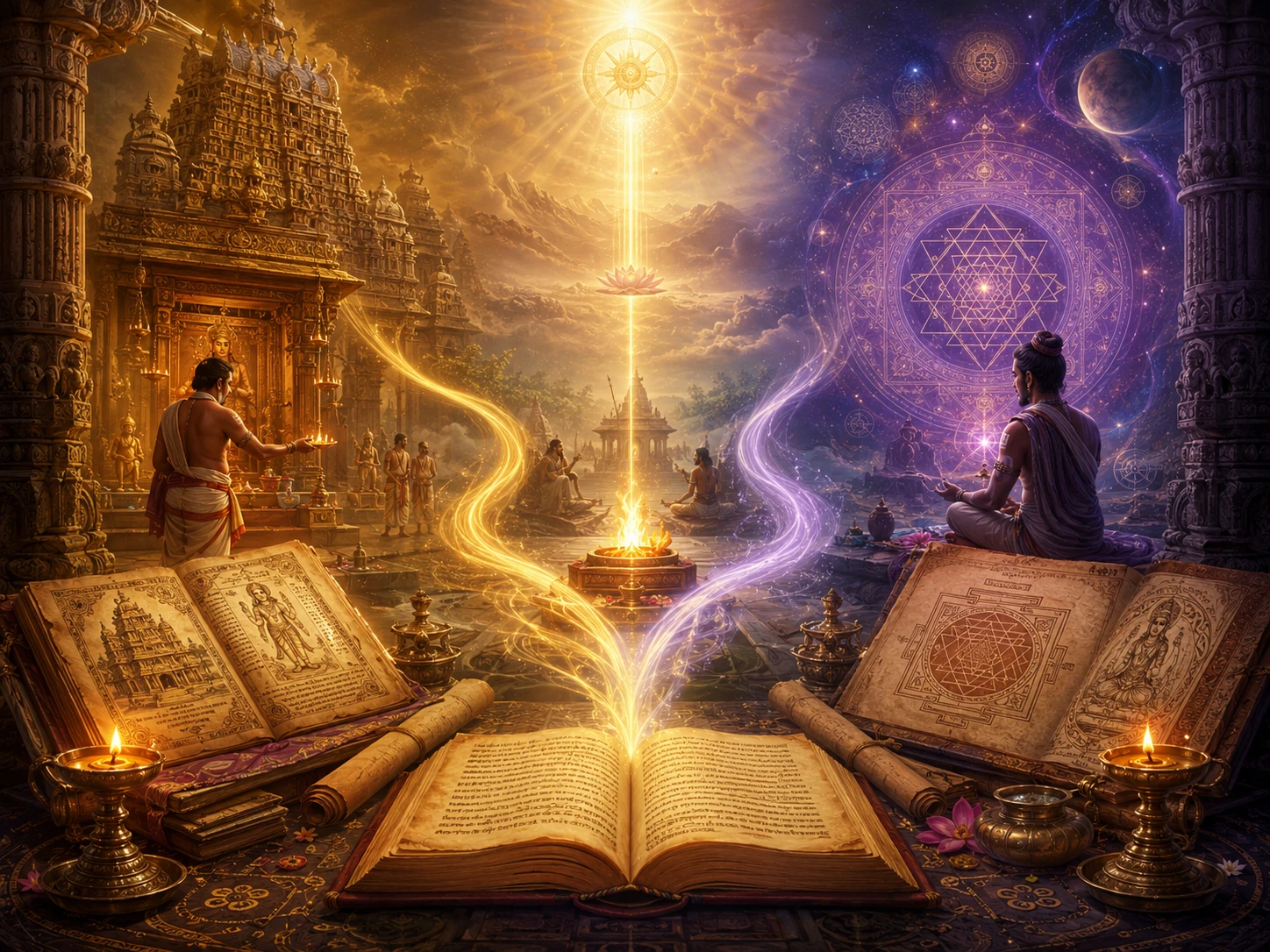
Agama vs Tantra vs Veda -- Three Streams of Hindu Practice
14 min read
Agni Dhyana -- What Meditation on Fire Is Actually Grounded In
8 min read
Ashta Siddhi -- The Eight Yogic Powers and How Hanuman Embodies Them
13 min readThe same translation error that turned '33 Koti' into '33 crore' in Hinduism also happened in Buddhism. The Chinese translation of Buddhist texts rendered 'Sapta Koti Buddha' (7 Supreme Buddhas) as '7 Crore Buddhas.' The…
Deities AvatarsCommunity Reflections
🕉️
Be the first to share your reflection.