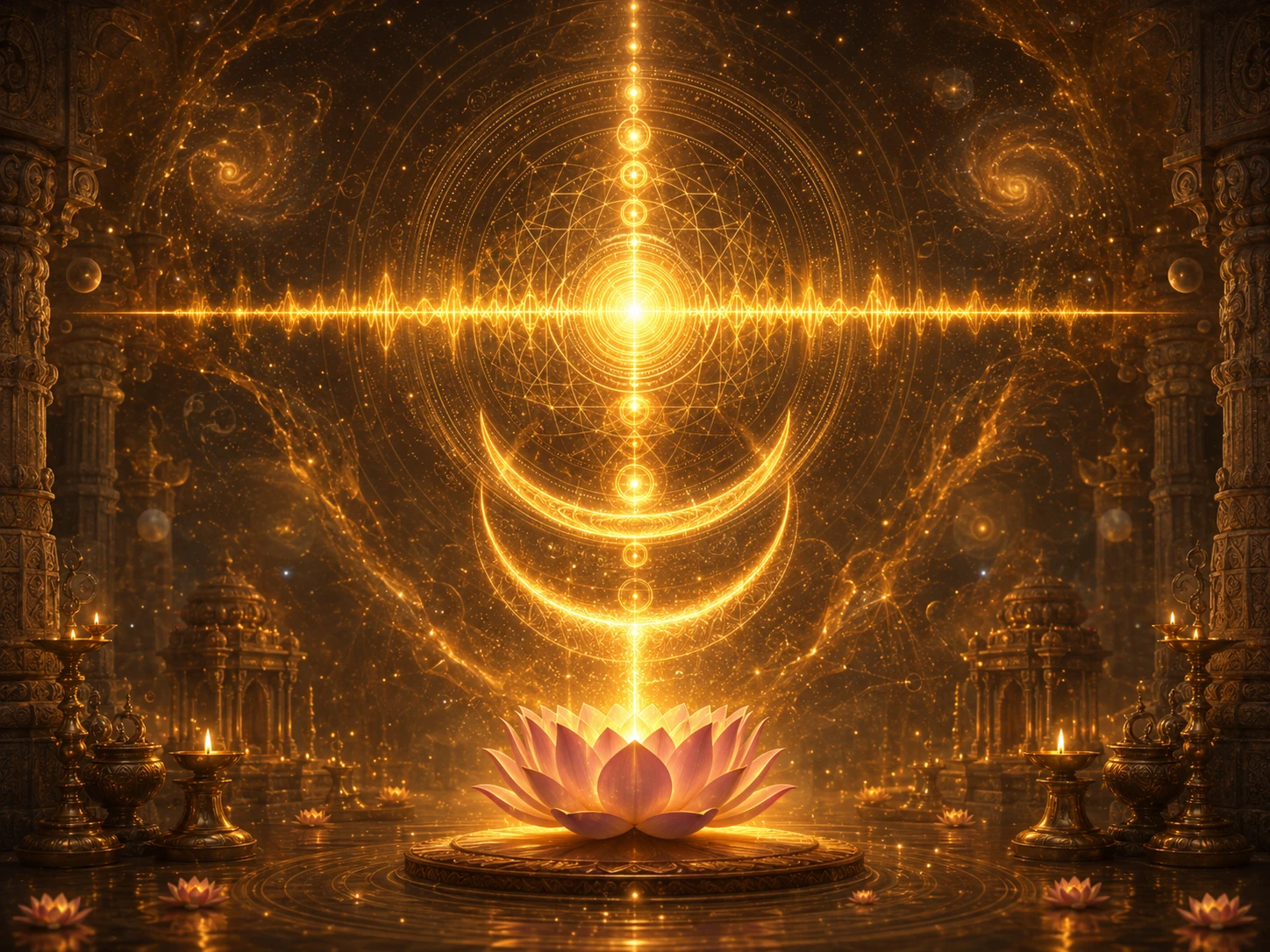
Bindu, Nada, Kala -- Manifestation
बिन्दु, नाद, कला -- अभिव्यक्ति
Modern physics says the universe began from a singularity, a point of infinite density before the Big Bang, from which time, space and matter unfolded. The Shakta tantric tradition, codified in Kashmir around the 11th century but reaching back much further, says the same thing in different vocabulary. Brahman is not a crowded house of gods. Brahman is a single, silent, featureless reality, and from that reality everything emerges. The tradition names three stages of that emergence. Bindu is the first stage -- a condensed point, still undifferentiated, but already a point. Nada is the second stage -- the first vibration that arises within the bindu, a hum that is not yet sound and not yet silence. Kala is the third stage -- the first differentiation, the division that makes two from one, and from two everything else that follows. These three terms carry the weight of the entire Shakta cosmology. They are not metaphors. They are a precise philosophical account of how One becomes Many, and how a trained practitioner can walk the sequence backward.
The foundational text on this threefold structure is the Kamakala Vilasa of Punyananda Natha, composed probably in the 12th or 13th century and preserved through the Hadi lineage of Sri Vidya. Kamakala Vilasa literally means The Playful Manifestation of Kamakala, and Kamakala is the compound term that points to the three-in-one reality of bindu plus nada plus the third component that completes the trio. Punyananda lays out in short verses that Kamakala is the supreme triangle formed by the three principles. Bindu in this framework is the Parabindu, the Supreme Point, identified with Shiva as pure consciousness. From the Parabindu arises the first subtle vibration, Nada. From the friction of Bindu and Nada emerges Bija, the seed that contains all future differentiation. These three together constitute the triangle that is the Sri Chakra's innermost form, and that is why the innermost triangle of the Sri Yantra is sometimes called the Kamakala triangle. The entire outer expansion of the yantra -- the hexagram, the lotuses, the square -- is the further unfolding of this primary triangle into visible geometric form.
तस्य प्रस्फुरितो बिन्दुर्नादसंज्ञो विभुः प्रभुः। नादबिन्दुमयी भूत्वा ततः कलेति संस्थिता॥
tasya prasphurito bindurnādasaṃjño vibhuḥ prabhuḥ | nādabindumayī bhūtvā tataḥ kaleti saṃsthitā ||
From that supreme source arises the pulsating Bindu, the all-pervading lord, known also as Nada. Becoming the composite of Nada and Bindu together, Shakti then abides as Kala, the first differentiation.
— Paraphrase of Kamakala Vilasa, verses 2-6, attributed to Punyananda Natha, 12th-13th century Sri Vidya tradition
To grasp Bindu, consider what happens before the first moment of any experience. You wake up in the morning. There is a fraction of a second where you exist but no specific thought has yet arisen. No memory of yesterday. No plan for today. No sense of who you are in any detailed sense. You simply are. That state, if it could be frozen and examined, is the closest ordinary experience to what the tantric texts call the Bindu state. The word bindu normally translates as drop, but in tantric usage it means point -- a point of existence that carries everything that will follow but has not yet unfolded any of it. The Parabindu is this point taken as absolute, the primordial condensation of all possibility. Mathematicians speak of a singularity as a point where the known laws break down. Tantric texts speak of the Parabindu as the point from which all laws emerge. In meditation, advanced upasakas are said to touch this state not as metaphor but as direct experience. The language of description fails at that point because description itself requires the differentiation that the Parabindu precedes.
Nada is the second stage and is often called the first movement, the first spanda, within what was still. Tantric texts are careful here. Nada is not yet sound in the ordinary sense. You cannot hear it with the ear. It is vibration before vibration becomes acoustic. The closest analogy in physics is the standing-wave potential of a tense string before the string is plucked. The wave is already present as a tendency even though no audible tone is yet produced. Nada is this tendency taken as an independent cosmic principle. In Kashmir Shaivism, this same idea is called spanda, the pulsation of consciousness. Nada is spanda in its Shakta register. When a meditator sits in deep stillness, the first thing she notices before any thought arises is a subtle humming at the back of awareness. Yoga texts call this anahata nada, the unstruck sound, the sound that no external cause produces. The ear-ringing quality that meditators often report after long practice is not physiological noise; it is the Anahata Nada becoming audible as the practitioner's attention refines. Nada Yoga is a full discipline built around learning to hear this progressively finer layer of inner sound until the upasaka can track it back to its source in the Bindu.
The Three Stages Compared
| Stage | Nature | Tantric Principle | Ordinary Analogy | Upasana Entry |
|---|---|---|---|---|
| Bindu | Undifferentiated point | Shiva, pure consciousness, Prakasha | The moment of waking before any thought arises | Deep samadhi, mantra dissolution |
| Nada | First vibration, unstruck sound | Spanda, the pulsation that is both Shiva and Shakti | Standing wave before a string is plucked | Anahata nada listening, pranayama subtle observation |
| Kala | First differentiation, division into many | Shakti, Vimarsha, the power of making distinctions | The first distinct thought of the day | Mantra japa, yantra visualisation, ritual distinction |
In Kashmir Shaivism the triad is sometimes given as Iccha, Jnana, Kriya -- will, knowledge, action -- mapped respectively to Bindu, Nada, Kala. Sri Vidya texts preserve the bindu-nada-kala terminology as primary.
Kala is the third stage and the most accessible to ordinary consciousness because it is where we actually live. Kala means part, division, or aspect. Everything we experience as distinct -- this object, that object, this thought, that thought -- is already Kala. The word is used in Sanskrit for any small division, including the sixteen phases of the moon (the Shodasha Kala), the sixty-four arts of civilisation (the Chatuh-shashti Kala), and the specific ritual divisions within a puja. At the cosmic level, the first Kala is the primordial division of the undifferentiated into two, from which all further multiplicity unfolds. The Kamakala Vilasa describes this moment as the emergence of the red bindu (Shakti) and the white bindu (Shiva) from the single Mahabindu. Once Shiva and Shakti stand as two, even notionally, the rest of the universe can fold out -- thirty-six tattvas in the Kashmir Shaivism enumeration, or twenty-five in the older Sankhya tradition. Kala is where creation actually starts moving. Bindu is origin. Nada is the stirring. Kala is the first visible step of the stirring becoming something specific. A 2026 startup metaphor might help. Bindu is the founder's silent vision before she has articulated it even to herself. Nada is the inner sense that something needs to be built, the pre-verbal urgency. Kala is the first time she says the word to her co-founder and they both feel the room change.
The cosmogonic picture in Shakta texts starts with Parabindu at the peak, moves through Nada, reaches the first Kala, and from there unfolds into the full tattva hierarchy. Kashmir Shaivism codifies this as thirty-six tattvas, starting with Paramashiva at one end and ending with prithvi, the earth element, at the other. Each tattva is a specific degree of forgetting, where consciousness loses progressively more of its original transparency until, at the level of prithvi, it finds itself as inert matter that appears to have no consciousness at all. This is maya working through kala. But the entire sequence is reversible. The practitioner who learns to meditate on the earth element can walk back to water, fire, air, space, manas, buddhi, ahamkara, prakriti, purusha, and further back until she touches kala, then nada, then bindu, and finally Parashiva. The tantric path is this reverse walk. The upasaka who reports having dissolved into Bindu for a few seconds in deep meditation is not making a mystical boast. She is describing a specific station on a cartographically known track. Every serious Shakta Guru has walked this track under a predecessor's supervision, or is considered not yet a Guru.
The Bindu-Nada-Kala framework maps onto mantra practice with surprising precision. Every mantra, when analysed phonetically, has three layers. The audible sound that the mouth produces is Vaikhari, the outermost level. Below that lies the silent inner articulation that happens before the mouth moves, called Madhyama. Below Madhyama lies Pashyanti, the flash of meaning that has not yet taken linguistic shape. Below Pashyanti lies Para Vak, the supreme speech that is identical with the Parabindu. A mantra recited only at Vaikhari level is like playing a guitar by pushing the strings without plucking them -- technically correct posture, no music. A mantra recited with Madhyama engaged is like playing the guitar with correct finger pressure and plucking. A mantra recited with Pashyanti alive is like a musician who has stopped noticing her own playing because the music and she are one. A mantra recited with Para Vak active is the silent source from which even the musician arises. Every serious sadhana trains the upasaka to move her mantra from Vaikhari down through all four layers. The move from Madhyama to Pashyanti is roughly the move from Nada to Bindu. The move from Pashyanti to Para Vak is the final collapse.
Practical meditation on Bindu-Nada-Kala is not restricted to advanced Sri Vidya upasakas. A simpler version is accessible to any serious practitioner who has developed basic concentration. Sit in stillness for ten minutes in an ordinary meditation posture. Begin by noticing the Kala level -- the specific thoughts, sensations, and images passing through awareness. Notice them as many, distinct, multiple. Without trying to stop them, draw attention underneath them to the Nada level. This is subtler. You are looking for the background hum of awareness itself, the space in which thoughts appear. The first time a meditator makes this shift cleanly, it can be startling. The thoughts are still happening but are no longer the foreground. Stay with the Nada for several minutes. Then attempt the third shift. Look for what the Nada itself is vibrating within. The Bindu is not a louder thing or a different thing; it is the silent ground of even the subtle vibration. Most beginners cannot touch Bindu cleanly. That is fine. Even recognising Nada once is an enormous step. With practice over months, Bindu becomes accessible in brief, irreducible flashes. These flashes rearrange the practitioner's relationship to her own mind permanently.
Modern neuroscience has found some unexpected resonances with this classical scheme. A 2014 study from NIMHANS Bangalore using fMRI on long-term meditators found that practitioners trained in mantra japa show progressively reduced activity in the default mode network (the brain's chatter layer) as they move from audible recitation to silent mental recitation to pure awareness of the mantra without rehearsing its sounds. The study's authors did not use Sanskrit terminology. But what they documented maps cleanly onto the Vaikhari-Madhyama-Pashyanti progression described in the tantric texts, and the terminal state they recorded in the most advanced subjects is indistinguishable from what upasakas describe as touching Bindu. The neuroscience does not prove the metaphysics. It shows that trained meditators reliably produce a sequence of measurable brain states that matches what the tradition has been describing in non-neuroscientific language for over a thousand years. This is the direction in which credible Hindu-scientific dialogue actually happens -- not in triumphant claims that ancient Indians knew fMRI, but in the quieter observation that introspective descriptions developed by careful practitioners can be externally validated when the tools become available.
The Bindu-Nada-Kala framework shows up architecturally in the Sri Chakra itself. The central bindu of the yantra is Bindu, unambiguously. The nine interlocking triangles that surround the bindu carry Nada, the vibratory layer. The outer lotuses and the Bhupura are Kala, the differentiated layer where the single reality has fanned out into many. This is why traditional Sri Chakra worship always moves from outside inward in samhara krama. The practitioner is literally walking backward through the three stages -- she begins at Kala in the Bhupura, moves through Nada in the inner triangles, and finally reaches Bindu at the centre. The ritual is a cosmogony-in-reverse. At the bindu, the upasaka offers not flowers but her own ego, which is the last Kala she carries, and in ideal practice the ego dissolves at the centre, leaving only the original source which was never really separate from the upasaka in the first place. This is the full theological point of all Shakta upasana. You were never far from the Bindu. You only misidentified yourself as a Kala. The path of sadhana is not toward a destination. It is the gradual letting go of a mistaken self-identification.
The Bindu-Nada-Kala lineage extends outward in interesting ways. In Nada Yoga, the pure-sound discipline descending from the Hatha tradition, the three become four stages of heard inner sound: the ocean-roar, the bell-chime, the flute-like tone, and finally the formless vibration that is indistinguishable from silence. These four stages map Kala to Nada to Bindu in progressively finer resolution. In musical theory, the Indian raga system treats every note as a Kala, the Shruti relationships between notes as Nada, and the Sa, the tonic root, as the Bindu of that particular raga. A trained Hindustani vocalist who returns again and again to Sa after exploring the raga's full range is performing a daily Bindu meditation whether or not she thinks of it in those terms. A 2026 classical musician trained at Bhatkhande Music Institute in Lucknow or at the ITC Sangeet Research Academy in Kolkata is carrying an oral tradition whose theoretical roots sit exactly in the tantric framework. The framework also shows up in Kathak footwork, in temple architecture where the garbhagriha is the Bindu and the outer structures radiate outward as Nada and Kala, and in the Vedic chant tradition where the recitation of the Udatta-Anudatta-Svarita accents encodes a Bindu-Nada-Kala structure at the level of each syllable. What looks like three specialised Shakta terms is, on closer examination, a framework that quietly runs through much of Hindu expressive culture.
A final observation about the Bindu-Nada-Kala framework concerns time. Kala in Sanskrit is both the word for differentiation and the word for time. This is not coincidence. The first differentiation, according to the tantric reading, is the differentiation of the timeless Bindu into the first moment that has before and after. Time is Kala in its temporal sense. The Shakta goddess Kali derives her name from the same root. She is the Goddess of Kala -- of time and of differentiation both. To worship Kali is to make peace with the fact that one lives inside Kala, inside time, inside differentiation, inside death. To go behind Kali is to move backward through Nada to Bindu, to the state before time begins. This is what the Upanishads call the timeless state, the state before the day-and-night cycle started. A sincere upasaka who has meditated on Kali for years eventually realises that Kali is not asking to be worshipped from outside. She is inviting the upasaka back through herself, back through differentiation, back through vibration, back to the silent source where neither Goddess nor upasaka exists as separate. The bindu-nada-kala framework is the intellectual map of this invitation. The sadhana is what converts the map into actual travel. Every sincere upasaka who has stayed with this framework for a decade reports the same slow realisation -- the map, the traveller, and the destination were never three different things.
One common confusion deserves clarification. The word kala appears in several distinct Sanskrit technical usages, and a reader new to the vocabulary can easily conflate them. Kala with short a means part, division, or time -- this is the kala we have been discussing, the third term in the Bindu-Nada-Kala triad. Kalaa with long final a means art -- as in the sixty-four classical arts of Indian civilisation, including music, dance, cooking, perfumery, and so on. These two are related etymologically (each art is a specific division of skilled human attention) but are not the same word grammatically. Then there is Kaala with long first a, which means time as cosmic duration, and which also gives the name of the god Kaala and the goddess Kaali in a gendered pair. Shakta commentary tradition sometimes plays on all three resonances at once -- kala as differentiation, kalaa as artistry, and Kaali as the goddess of temporal differentiation -- because the underlying philosophical point is that division and time and artistic expression are all the same fundamental activity of Shakti stepping down from undifferentiated Bindu into differentiated existence. A serious student of Sri Vidya spends some early weeks just disentangling which kala is being used in which verse, and by the end realises that the tradition deliberately overlaps them to make the philosophical point visible in the very vocabulary.
The Indian Statistical Institute in Kolkata, in collaboration with the ITC Sangeet Research Academy, conducted a multi-year study beginning in 2011 on the acoustic microstructure of classical raga performance. The researchers found that master vocalists returning to Sa after elaborate raga improvisation produce a specific spectral signature in the final tonic note that is measurably different from the same Sa sung by learners. The signature involves a fuller harmonic stack and a characteristic phase coherence that researchers described as a reset to the fundamental. When the team consulted the Dagar tradition vocalists associated with the academy, they learned that the senior ustads of the gharana describe this final Sa in exactly Bindu terminology, passed down orally from the 18th-century Behram Khan. The research paper did not use the word Bindu, but its acoustic findings and the oral tradition's language describe the same phenomenon. What was thought to be a purely metaphysical tantric idea about returning to the undifferentiated source turns out to have a precise acoustic counterpart in living Hindustani classical music.
Try the Three-Stage Descent
Try a twelve-minute descent. Begin at kala, noticing the plurality of ordinary thoughts; settle into nada, resting in the background hum of awareness; and finally attempt bindu, the silent point under even the subtlest vibration. Do not expect to reach bindu in early attempts; touching nada clearly, even once, is a significant breakthrough. Over weeks of daily practice the map becomes familiar and the descent smoother. The Fading of a Sound dharana on Eternal Raga is good preparation for the nada stage.
Tags
Eternal Raga · शाश्वत राग
Institutional voice — scholarly articles on Sanatan Dharma
Deepen Your Understanding
अपनी समझ और गहरी करें
tantra mantra yantra
Sri Yantra -- The Supreme Geometry of Creation
Nine interlocking triangles. 43 smaller triangles. A single point from which the entire universe unfolds. The Sri Yantra is the most complex and revered sacred diagram in Hinduism -- and modern mathematicians have found that constructing it requires solving simultaneous equations that Western mathematics did not formalise until the 18th century. This is not decoration. This is the visual body of the Goddess.
tantra mantra yantra
Sri Vidya -- The Supreme Worship System
Sri Vidya is the most guarded, most intricate worship system inside Hinduism. It worships the Divine Mother Lalita Tripura Sundari through a fifteen-syllable mantra, the Sri Chakra yantra, and an initiation line that reaches back through Adi Shankaracharya to the Rig Veda. Miss the diksha and nothing works. Receive it, and the entire cosmos reorganizes itself inside you.
tantra mantra yantra
Nada Yoga -- The Yoga of Sacred Sound
The Hatha Yoga Pradipika declares that of all paths to samadhi, meditation on Nada -- the inner sound -- is supreme. In a world drowning in noise-cancelling earbuds and Spotify playlists, the oldest yoga of sound asks you to listen to the one frequency that needs no device.
tantra mantra yantra
Kundalini -- The Serpent Power That Sleeps at Your Spine's Base
A coiled serpent sleeps at the base of your spine. When awakened through yoga, mantra, or guru's grace, she rises through seven energy centres, dissolving every limitation of body and mind, until she merges with pure consciousness at the crown of your head. This is not New Age fantasy. This is the central psycho-spiritual technology of Tantric Hinduism -- mapped in Sanskrit texts over 1,500 years ago and now studied by neuroscientists at institutions from Harvard to NIMHANS Bangalore.
tantra mantra yantra
Matrika Shakti -- The Sacred Alphabet as Cosmic Blueprint
The Sanskrit alphabet is not a human invention. It is a cosmological map -- each letter a compressed Shakti, each vowel a tattva, the whole Varnamala a sonic replica of the universe unfolding from pure consciousness to gross matter. When Shiva's damaru sounded fourteen times, it did not produce grammar. It produced reality.
tantra mantra yantra
The Science of Mantra -- How Sacred Sound Rewires Consciousness
A mantra is not a prayer. It is not a wish. It is a precision instrument of consciousness -- a vibrational key engineered in Sanskrit thousands of years ago to unlock specific states of mind. Modern neuroscience is only now catching up.
tantra mantra yantra
Yantra Components -- Bindu, Triangle, Lotus, Bhupura
Every Hindu yantra, from the simple Ganesh Yantra to the intricate Sri Chakra, is built from the same short list of geometric components. A bindu. Triangles pointing up or down. Hexagrams. Lotuses of four, eight, sixteen or more petals. An outer square with four gates. Learn this vocabulary, and every yantra becomes readable. Mistake the grammar, and the yantra is only a pretty drawing.
The Indian Statistical Institute in Kolkata, in collaboration with the ITC Sangeet Research Academy, conducted a multi-year study beginning in 2011 on the acoustic microstructure of classical raga performance. The resear…
More in Tantra, Mantra & Yantra
Agama vs Tantra vs Veda -- Three Streams of Hindu Practice
14 min read
Agni Dhyana -- What Meditation on Fire Is Actually Grounded In
8 min read
Ashta Siddhi -- The Eight Yogic Powers and How Hanuman Embodies Them
13 min readThe same translation error that turned '33 Koti' into '33 crore' in Hinduism also happened in Buddhism. The Chinese translation of Buddhist texts rendered 'Sapta Koti Buddha' (7 Supreme Buddhas) as '7 Crore Buddhas.' The…
Deities AvatarsCommunity Reflections
🕉️
Be the first to share your reflection.