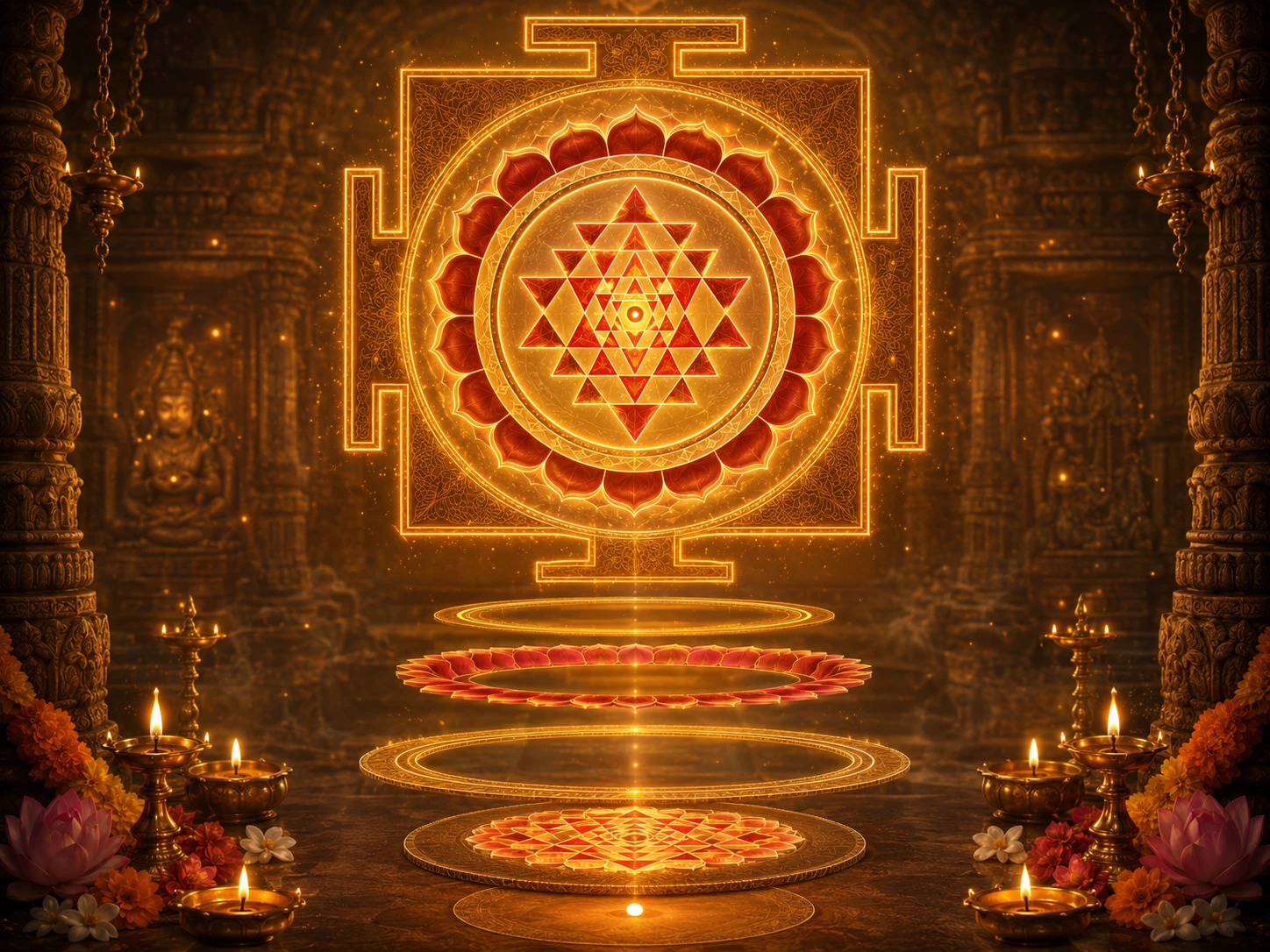
Yantra Components -- Bindu, Triangle, Lotus, Bhupura
यन्त्र घटक -- बिन्दु, त्रिकोण, कमल, भूपुर
If you visit a large Hindu temple for the first time, you notice the art. The carvings, the murals, the bronzes. You rarely notice the yantras unless someone points them out. Yet every major temple has them, often etched on the foundation stones, inscribed on copper plates hidden in the garbhagriha, or woven into the floor patterns of the sanctum. Yantras are the architectural logic beneath the visible iconography. They look like geometric drawings to the untrained eye. To someone who has learned the grammar, they are readable sentences, each component carrying specific meaning, and the complete yantra making a specific statement about a specific deity. This article is about that grammar. Once you know it, any yantra you encounter from then on -- in a temple, a book, a friend's puja altar, a print on someone's office wall -- becomes legible. You can tell what deity it is for. You can tell whether it is correctly drawn. You can tell what siddhi it is designed for. Without the grammar, all yantras look vaguely similar and mysterious. With the grammar, they are as distinct as different Hindi sentences made from the same alphabet.
The smallest component of any yantra is the bindu. A single point. Geometrically it has position but no dimension. Symbolically it carries the largest possible meaning -- the undifferentiated source from which the entire cosmos unfolds. Every Shakta yantra places its bindu at the exact centre. The bindu is the Goddess herself in her most condensed form, before manifestation begins. In Sri Vidya commentaries, Bhaskararaya identifies the bindu with the Parabindu, the supreme point, from which the first vibration Nada emerges, and from Nada the first differentiation into Bindu-Nada-Kala. The entire unfolding of a yantra outward from this central dot is a cosmogony -- a visual telling of how the One becomes the Many without ceasing to be One. When the upasaka worships a yantra in samhara krama, moving inward, the final offering is always at the bindu. When she worships in srishti krama, moving outward, the first offering is always at the bindu. Either way, the bindu is the fulcrum. A yantra drawn without a clearly defined central point is structurally incomplete. This is why traditional yantra artists first fix the bindu on the paper or plate, then construct everything else around it using specific string-and-compass measurements.
बिन्दुर्नादस्तथा बीजं त्रिविधा भगवन्मयी। बिन्दुर्नादमयी शक्तिः बीजं चक्रेश्वरी स्मृता॥
bindurnādastathā bījaṃ trividhā bhagavanmayī | bindurnādamayī śaktiḥ bījaṃ cakreśvarī smṛtā ||
Bindu, Nada and Bija -- these three are of the nature of the Lord. Shakti is made of Bindu and Nada together; the seed-syllable is remembered as the Chakreshwari, the Mistress of the Circle.
— Kamakala Vilasa of Punyananda Natha, attested in the Vamakeshwara Tantra tradition and cited in Bhaskararaya's Setubandha
After the bindu comes the triangle, the first closed shape in the unfolding. Triangles in yantra are never decorative. Their orientation encodes the entire Shiva-Shakti dichotomy. An upward-pointing triangle represents Shiva, the static masculine principle, the axis of consciousness that remains unmoved while existence pulses around it. It is also called the agni trikona, the fire triangle, because flame naturally rises upward. A downward-pointing triangle represents Shakti, the dynamic feminine principle, the descending movement through which consciousness becomes form. It is also called the jala trikona, the water triangle, because water naturally falls downward. A Kali yantra, we saw, is made entirely of downward triangles, because Kali is pure Shakti descent. A Shiva yantra would, by the same logic, emphasise upward triangles. The Sri Chakra famously combines four upward and five downward triangles -- four Shiva-triangles, five Shakti-triangles -- interpenetrating so that neither dominates, which is the geometric expression of the Sri Vidya theology that Shiva and Shakti are finally one. When you encounter any yantra, count the triangles first, note their directions, and you have already read half its meaning.
The next level of complexity is the combination of two triangles into a hexagram, the shatkona. One upward and one downward triangle overlap, producing six outer points and a hexagonal centre. The shatkona is the most famous yantra component because it appears in Solomon's Seal in Judaism, in the Star of David, and in medieval alchemy diagrams across Europe. Its Indian pedigree is independent and older. The shatkona encodes balanced union -- Shiva and Shakti in equilibrium, neither ascending nor descending, holding each other in stable coexistence. A pure shatkona yantra is rare; more often the shatkona appears as part of a larger composition. In the Vishnu Yantra it sits at the centre. In the Tara yantra it surrounds the central bindu. In the Sri Chakra the innermost triangle is almost a shatkona but is pulled slightly into asymmetry. When you see a shatkona in a yantra, the practice associated with it will be balanced, steady, integrative -- not fierce Kali work, not ecstatic Chinnamasta work, but grounded Vishnu or Lakshmi-Narayana practice. Shatkona yantras are often prescribed for marital harmony, for business partnerships, and for any situation requiring two parties to coexist productively without one dominating the other.
The Building Blocks of Any Yantra
| Component | Sanskrit Name | Meaning | Typical Placement | Example Yantras |
|---|---|---|---|---|
| Central point | Bindu | Undifferentiated source of creation | Exact centre | Every yantra without exception |
| Upward triangle | Urdhva trikona / Agni trikona | Shiva; consciousness; ascending principle | Around bindu or woven in | Shiva yantra; 4 upward in Sri Chakra |
| Downward triangle | Adho trikona / Jala trikona | Shakti; manifestation; descending principle | Around bindu or woven in | Kali yantra; 5 downward in Sri Chakra |
| Hexagram | Shatkona | Balanced Shiva-Shakti union | Middle layer | Vishnu yantra; Tara yantra |
| 4-petal lotus | Chatur-dala padma | Four-directional completeness; earth | Outer or inner ring | Ganesha yantra; some Bhairava yantras |
| 8-petal lotus | Ashta-dala padma | Eight Vak-devatas; directions plus between | Usually outer ring | Kali yantra; Kamala yantra; Sri Chakra outer |
| 16-petal lotus | Shodasha-dala padma | Sixteen kala of the moon; 16 Nityas | Outer to inner transition | Sri Chakra second enclosure |
| Outer square | Bhupura | Material world; four gates to directions | Outermost boundary | Every complete yantra |
| Four gates | Dvara | Entry points from the four quarters | Middle of each Bhupura side | All Bhupura-based yantras |
Other less common components include the outer pentagon (used in certain Bhadrakali yantras), twelve-petal lotus (used in Anahata chakra meditation diagrams), and the thousand-petal lotus (reserved for Sahasrara visualisations and rarely drawn on physical yantras).
Lotus petals are the next major component, and the number of petals carries precise meaning. An eight-petal lotus represents the eight directions plus the four cardinal and four ordinal divisions of space. It also maps to the eight Matrikas, the eight Vak-devatas of the Panchadasi tradition, and the eight days from new moon to half moon in the lunar fortnight. A sixteen-petal lotus doubles this to carry the sixteen Nityas, the sixteen phases of the moon -- fifteen for the days of the fortnight plus one for the goddess of the unchanging full state. A four-petal lotus represents the four directions at their simplest, and appears in yantras dedicated to elemental powers. A twelve-petal lotus appears in the Anahata chakra representation but rarely on physical yantras. A hundred-petal or thousand-petal lotus is almost always visualised rather than drawn, because the geometric precision required for these counts on a finite plate is impractical. When you see petals on a yantra, counting them carefully matters. Twenty-four petals would signal a different deity than twenty-two. The number is never decorative. A yantra print that casually uses twelve or thirty petals where the tradition specifies eight or sixteen is incorrect and should not be used for serious worship.
The outermost component is the Bhupura, literally the earth-city. It is the square boundary that encloses every complete yantra. The Bhupura represents the material world, the solid domain within which the yantra manifests its energies for the upasaka. The four sides of the square face the four cardinal directions -- east, south, west, north -- and each side has a gate at its middle, the dvara. These four gates are entry points for consciousness moving inward or outward. In the dissolution order of Navavarana Puja, the upasaka begins by entering through the eastern dvara, then circumambulates inward. In the creation order, she emerges outward through the same gates. The gates are often guarded by specific protective deities. The eastern gate is traditionally associated with Indra. The southern gate with Yama. The western gate with Varuna. The northern gate with Kubera. These four lokapalas, the world-guardians, are invoked before entering the inner yantra. A yantra drawn without a Bhupura is considered unfinished for ritual use. A yantra drawn with a Bhupura but without clear dvaras is also incomplete. The square itself is not a container in the Western sense of enclosure. It is a threshold -- the place where the material world and the yantra's sacred geometry meet and negotiate.
Proportions between components follow rules that are rarely stated publicly but always followed by serious yantra artists. The diameter of the central bindu is never arbitrary; it is set as a specific fraction of the innermost triangle's side. The innermost triangle's side in turn determines the diameter of the surrounding lotus, and that lotus determines the size of the next lotus or triangle ring, and so on outward. The final Bhupura side is roughly triple the innermost triangle's side in a Sri Chakra, and proportionately for other yantras. These proportions are not aesthetic choices. They are ratio requirements that make the yantra energetically coherent according to tradition. A yantra drawn on a random sheet of paper with freehand proportions may look correct but is treated as decorative only. A yantra drawn to correct proportions on copper, silver, or gold, with specific mantras recited during each line of the drawing, is called an Uttama yantra and commands serious ritual use. The difference between a Bazaar yantra and a Peetham yantra is exactly this proportional fidelity. The Bazaar plate, stamped by machine, may have the right iconography but wrong ratios. The Peetham plate, drawn by a qualified artisan under the supervision of a Guru, has both. An advanced upasaka will refuse to worship on a Bazaar plate even if the iconography looks identical.
The question of yantra materials deserves brief attention. Tradition prescribes different materials for different goddesses and different purposes. Copper is the standard working material for daily upasana yantras. It is considered responsive, durable, and affordable. Silver carries a higher frequency and is preferred for Lakshmi and other prosperity-oriented deities. Gold is reserved for Shri Vidya and major Shakta deities in premium installations, and is rarely used in household practice. Bhojpatra (birch bark) is used for temporary yantras drawn by specific mantras during purascharana, often burned at the end of the ritual to release the accumulated energy. Silk cloth is used for yantras carried on the body as kavach. Crystal is an unusual material preferred for certain meditation-oriented yantras because the transparency matches the consciousness-transparency the upasaka cultivates. Stone yantras engraved on temple foundations are the most permanent. Each material has documented effects on the temperature and duration of energy retained in the yantra. A copper yantra receives morning puja and holds its charge through the day with a single reactivation at noon. A paper yantra loses its charge within hours and must be redrawn or reactivated frequently. A gold yantra holds its charge for months and sometimes years. The material is part of the practice, not a casual choice.
A common modern confusion is between a yantra and a mandala. The two look similar to outsiders and are sometimes used interchangeably in popular media, but tradition distinguishes them precisely. A yantra is a deity-specific diagram whose geometry encodes the deity's mantra and whose function is to receive worship and channel consciousness. A mandala is a broader term for any sacred diagram, often including large ceremonial Tibetan-style sand diagrams, cosmological depictions of the universe, or elaborate protective enclosures drawn during extended rituals. Most mandalas are temporary; yantras are permanent. Mandalas often have representational content -- painted deities, colour-coded protective figures, naturalistic scenes of celestial domains -- while yantras are almost entirely geometric, with any figurative content restricted to the Bhupura gates or to external icons placed alongside the yantra. A Tibetan Vajrayana sand mandala is not a yantra, though both belong to the broader tantric family of sacred diagrams. The Kalachakra mandala is not a yantra. The Sri Chakra is both a yantra and, in certain Sri Vidya contexts, the basis of mandala construction for extended multi-day pujas. A 2026 reader who has seen yantras and mandalas conflated on Instagram spiritual accounts is dealing with conceptual slop, not tradition.
The practical test for reading a yantra requires three steps. First, locate the central bindu. If you cannot find a clear point at the geometric centre, the yantra is incomplete. Second, count the triangles and note their orientations. Mostly downward triangles mean Shakti-dominant -- Kali, Durga, Chamunda. Mostly upward triangles mean Shiva-dominant -- Shiva Lingam yantras, certain Skanda yantras. Balanced up and down, as in shatkona or Sri Chakra, means integrated Shakta-Vaishnava or Advaitic frameworks. Third, count the lotus petals and note the Bhupura gates. Eight-petal with four gates is the standard complete frame. Sixteen-petal is a more elaborate frame, often for major goddesses. No petals but only triangles and Bhupura indicates a specialised yantra, often for quick efficacy rather than sustained upasana. This three-step read allows you to walk into any temple, see a yantra engraved on a stone at the entrance, and know in thirty seconds which family of deity it serves. A Koramangala startup founder who has learned this grammar can walk into a Mylapore temple in Chennai, examine the yantra at the foundation, and correctly guess Kali, Kamakshi, or Meenakshi before looking at any signage. The grammar is learnable. The rewards of learning it are immediate and cumulative.
A note on contemporary misuse. Scroll Instagram in 2026 and you will find yantras painted on T-shirts, yoga mats, tattoos, coffee mugs, and mandala colouring books, marketed as decoration or aesthetic appreciation of Indian heritage. This is not religiously harmful in most cases -- a correctly drawn Sri Chakra on a yoga mat is not worse than a correctly drawn one framed on a wall. But two specific patterns are problematic. First, freely altered yantras where the artist has added petals, removed triangles, or rearranged the geometry for visual appeal. These are no longer the yantras they claim to be. They are decorative drawings using yantra iconography. Calling an altered pattern a Sri Chakra is like calling a randomly written sequence of Devanagari characters a Vedic hymn. Second, yantras drawn on body locations that tradition considers inauspicious -- below the waist, on the feet, on consumable items like food packaging. These offend without intent. A Bagalamukhi yantra tattooed on the lower back, marketed as a fashion choice, is understood within the tradition to produce unpredictable effects. The conservative approach for a 2026 consumer is to use yantras only in their traditional forms, drawn by qualified artisans, placed where the tradition specifies. Aesthetic appreciation of the geometry through printed books, framed art and academic study is entirely welcome. The issue is not aesthetics. The issue is the material-plus-placement-plus-form triad that tradition carefully regulates.
A subtle but important component that deserves separate treatment is the directional apparatus within the Bhupura. The four sides of the square are not interchangeable. Each carries its own cosmological load. The eastern side faces the rising sun and is associated with Surya, beginnings, knowledge, and the Brahmin varna in classical Vedic thought. The southern side faces Yama, endings, justice, and the Kshatriya varna. The western side faces Varuna, the waters, the setting sun, and the Vaishya varna. The northern side faces Kubera, wealth, the Himalayan polar star, and the Shudra varna in the Vedic scheme. A yantra is always oriented with the eastern gate placed so that the upasaka faces east while worshipping. Installing a yantra with north-gate forward, or rotating its orientation to fit furniture, disrupts the directional flow that the yantra's design assumes. Temples are built with this rule absolute. Home pujas follow it with minor adjustment. The four Vastu directions are not superstition; they are the physical coordinates the yantra's construction maps itself to. An upasaka who has meditated on a correctly oriented yantra for years and then attempts the same practice with the yantra rotated ninety degrees will report a distinct internal wrongness. The awareness has learned the directional geometry. Moving the plate changes the computation.
One final component that deserves attention is what tradition calls the yantra's akshara body -- the Sanskrit letters inscribed between or within the geometric components. A Sri Chakra, when drawn in full detail, carries the fifty Matrika letters distributed along the petals of the two lotuses. A Bagalamukhi yantra carries the beeja Hlim inscribed in its central triangle. A Ganesh yantra carries Gam at the core. These letters are not captions. They are acoustic encodings that name each energy point that the geometry localises. When the upasaka recites the mantra, she is pronouncing the sound that the inscribed letter represents, converting the visible into the audible, and the visible-plus-audible into a unified sensory event that the nervous system processes differently from either alone. Beginners often wonder whether they should write the letters themselves when drawing a yantra for personal practice. The tradition says no for initial practice. The geometric skeleton can be drawn by a learner. The letter inscription is a Guru-supervised step, because each letter must be written at a specific moment during the construction ritual, with the matching beeja recited while the stroke is being made. A yantra with incorrectly inscribed letters is worse than one without letters at all. The clean geometric form is neutral. Letters written in the wrong position or at the wrong time create a confused acoustic signature the yantra then radiates.
The Indian Institute of Science in Bangalore, in a 2017 mathematical analysis of Sri Chakra geometry led by Professor Radhika S. Rao, confirmed that the proportions specified in classical texts produce a stable triangle-intersection pattern only when a specific equation involving the ratio of the innermost triangle's apex angle to the enclosing circle's radius is satisfied. Deviating from this ratio by even 0.3 degrees causes the 43 smaller triangles to fail to close properly, which is visible to trained artisans but not to casual viewers. The team further demonstrated that this same ratio appears in the Fibonacci-based growth patterns of certain botanical structures, and in the harmonics of the sitar's main resonant string. Whether the ancient designers of the Sri Chakra understood the full mathematical structure or arrived at it empirically through generations of iteration is an open scholarly question. What is not in question is that the proportions stated in the 11th-century Vamakeshwara Tantra match the proportions that modern geometry independently validates.
Practise Reading Yantras
Start with yantras you can find in print -- the Sri Yantra, a Ganesha yantra, a Navagraha yantra. For each, identify the bindu, each triangle and its direction, each lotus and its petal count, and the bhupura with its four gates. Work through ten yantras using the three-step read described in this article; by the tenth you will be able to place an unfamiliar yantra's deity family within thirty seconds. This is the prerequisite for any yantra meditation you take up later. Eternal Raga does not yet have a yantra library; its Steady Gaze dharana is a good companion once you can read what you are looking at.
Tags
Eternal Raga · शाश्वत राग
Institutional voice — scholarly articles on Sanatan Dharma
Deepen Your Understanding
अपनी समझ और गहरी करें
tantra mantra yantra
Sri Yantra -- The Supreme Geometry of Creation
Nine interlocking triangles. 43 smaller triangles. A single point from which the entire universe unfolds. The Sri Yantra is the most complex and revered sacred diagram in Hinduism -- and modern mathematicians have found that constructing it requires solving simultaneous equations that Western mathematics did not formalise until the 18th century. This is not decoration. This is the visual body of the Goddess.
tantra mantra yantra
Sri Vidya -- The Supreme Worship System
Sri Vidya is the most guarded, most intricate worship system inside Hinduism. It worships the Divine Mother Lalita Tripura Sundari through a fifteen-syllable mantra, the Sri Chakra yantra, and an initiation line that reaches back through Adi Shankaracharya to the Rig Veda. Miss the diksha and nothing works. Receive it, and the entire cosmos reorganizes itself inside you.
tantra mantra yantra
10 Mahavidya Yantras
Ten goddesses. Ten geometries. Ten frequencies of awakening. The Das Mahavidya yantras are the most advanced tools in Shakta tantra, each a precision-engineered diagram mapped to a specific goddess, a specific siddhi, and a specific emotional landscape. Kali is not Kamala. Chinnamasta is not Bhuvaneshwari. The yantras make the difference visible.
tantra mantra yantra
Navavarana Puja -- Sri Chakra Worship
Navavarana Puja is the crown ritual of Sri Vidya. Nine concentric enclosures of the Sri Chakra, each housing a circle of yoginis, each offering a distinct siddhi, are worshipped one by one. The full ritual moves either from outside inward, dissolving the world into the Goddess, or from the centre outward, bringing Her out to fill the world. A seasoned upasaka finishes in three hours. The structure itself holds a full cosmology.
tantra mantra yantra
Yantra Meditation Guide -- How to Meditate with Sacred Geometry
A yantra is not a decoration. It is an optical mantra -- a geometric diagram engineered to restructure visual perception and, through it, consciousness itself. This guide teaches you how to meditate with yantras, from beginner trataka to advanced Sri Yantra navigation.
tantra mantra yantra
Bindu, Nada, Kala -- Manifestation
Three Sanskrit terms carry the entire Shakta cosmology of how Brahman becomes universe. Bindu is the condensed point before all creation. Nada is the first vibration, the primordial sound that is not yet sound. Kala is the first differentiation, the division that makes many from one. Every Sri Yantra, every mantra, every breath a trained upasaka takes passes through these three stages in reverse, collapsing back from kala through nada to bindu.
tantra mantra yantra
Matrika Shakti -- The Sacred Alphabet as Cosmic Blueprint
The Sanskrit alphabet is not a human invention. It is a cosmological map -- each letter a compressed Shakti, each vowel a tattva, the whole Varnamala a sonic replica of the universe unfolding from pure consciousness to gross matter. When Shiva's damaru sounded fourteen times, it did not produce grammar. It produced reality.
The Indian Institute of Science in Bangalore, in a 2017 mathematical analysis of Sri Chakra geometry led by Professor Radhika S. Rao, confirmed that the proportions specified in classical texts produce a stable triangle-…
More in Tantra, Mantra & Yantra
Agama vs Tantra vs Veda -- Three Streams of Hindu Practice
14 min read
Agni Dhyana -- What Meditation on Fire Is Actually Grounded In
8 min read
Ashta Siddhi -- The Eight Yogic Powers and How Hanuman Embodies Them
13 min readThe same translation error that turned '33 Koti' into '33 crore' in Hinduism also happened in Buddhism. The Chinese translation of Buddhist texts rendered 'Sapta Koti Buddha' (7 Supreme Buddhas) as '7 Crore Buddhas.' The…
Deities AvatarsCommunity Reflections
🕉️
Be the first to share your reflection.