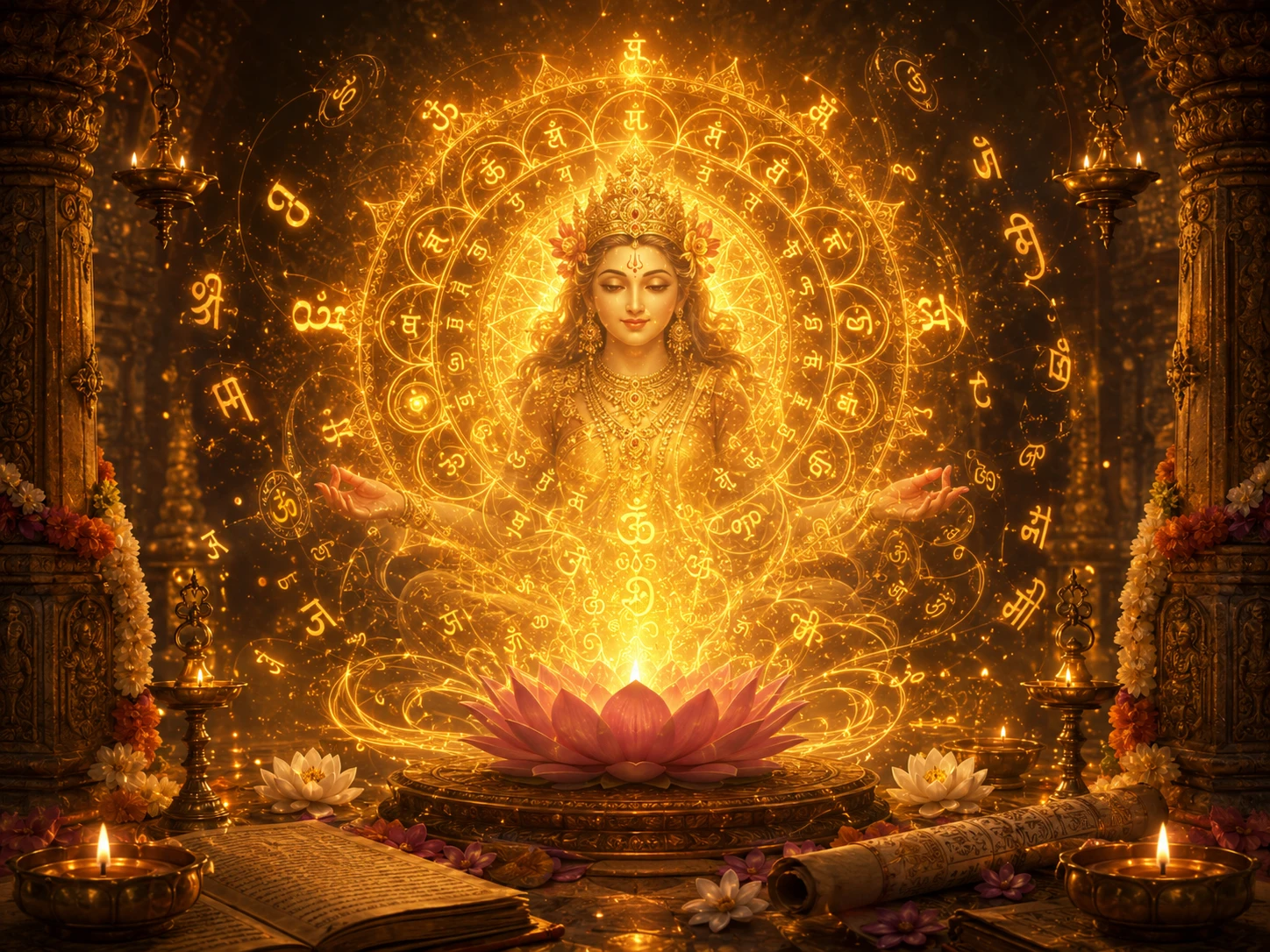
Matrika Shakti -- The Sacred Alphabet as Cosmic Blueprint
मातृका शक्ति -- वर्णमाला में छिपा ब्रह्माण्ड का नक्शा
Open any school textbook in India and the Sanskrit alphabet begins with a simple chart: the vowels from 'a' to 'ah', the consonants from 'ka' to 'ha', arranged in neat rows by tongue position. Every CBSE student has memorised it. Every Hindi-medium kid in a government school in Lucknow or Bhopal has recited it. It looks like an ordinary phonetic table -- the kind of thing linguists would design by studying where the tongue touches the palate.
It is not ordinary. Not even close.
In the Tantric traditions of India -- particularly the non-dual Kashmir Shaivism that flourished in the Kashmir Valley between the 9th and 12th centuries CE -- the Sanskrit alphabet is not a human invention for organising speech sounds. It is a cosmological map. Each letter is a compressed packet of divine Shakti. Each vowel corresponds to a stage in the unfolding of consciousness from the Absolute to the material world. The entire Varnamala -- literally 'garland of letters' -- is a sonic replica of the universe itself, encoded in fifty syllables.
This tradition is called Matrika -- the 'Little Mothers'. The letters are not symbols that represent reality. They are the mothers that give birth to reality. When you chant a Sanskrit syllable, you are not describing something. You are activating the exact cosmic force that syllable embodies.
This is not metaphor. This is the operating system.
यतो वा इमानि भूतानि जायन्ते। येन जातानि जीवन्ति। यत् प्रयन्त्यभिसंविशन्ति।
yato vā imāni bhūtāni jāyante | yena jātāni jīvanti | yat prayanty abhisaṃviśanti |
That from which all these beings are born, by which once born they live, and into which they enter upon departing -- seek to know That. That is Brahman.
— Taittiriya Upanishad, 3.1.1
When the Damaru Sounded Fourteen Times
The origin story of the Sanskrit alphabet is not a story about writing. It is a story about cosmic percussion.
According to tradition, at the conclusion of his Tandava -- the cosmic dance of creation and dissolution -- Shiva sounded his damaru fourteen times. From those fourteen beats emerged fourteen sequences of phonemes, each ending with a marker consonant. These are the Maheshwara Sutras, also known as the Shiva Sutras of grammar (distinct from the philosophical Shiva Sutras of Vasugupta that form the basis of Kashmir Shaivism).
The verse that records this event is among the most celebrated in the Sanskrit grammatical tradition:
Nrittaavasaane nataraajaraajo nanaada dhakkaam navapanchavaaram | Uddhartukaamah sanakadisiddhan etad vimarше shivasutrajaalaam ||
'At the end of his cosmic dance, Shiva, the Lord of Dance, sounded his damaru fourteen times. Wishing to uplift the sages beginning with Sanaka, he revealed this web of Shiva Sutras.'
The sage Panini -- whom modern linguists consider the father of formal grammar, centuries before Chomsky -- heard these fourteen sounds and from them constructed the Ashtadhyayi, roughly four thousand rules that codify every aspect of Sanskrit morphology, syntax, and phonetics. The fourteen Maheshwara Sutras organise all the phonemes of Sanskrit into groups that can be referenced using abbreviations called pratyahara. The pratyahara 'aC' covers all vowels. The pratyahara 'haL' covers all consonants. From just fourteen compact strings, Panini generated an entire computational grammar -- what Stanford linguist Paul Kiparsky has called 'the most complete generative grammar of any language yet written.'
But here is what the school textbook does not tell you: the Tantric traditions did not see Panini as simply a linguist. They saw him as a receiver. The sounds that emerged from Shiva's damaru were not arbitrary. They were the sonic architecture of reality itself. The damaru did not produce an alphabet. It produced the vibrational DNA of the cosmos. Panini merely wrote down what Shiva revealed.
For a JEE aspirant in Kota memorising formulas at 2 AM, this might sound like mythology. But consider this: the Maheshwara Sutras accomplish something that no other phonetic system in the ancient world even attempted. They compress the entirety of Sanskrit phonology into fourteen strings so tightly optimised that computer scientists have studied them as examples of optimal data compression. The articulatory organisation -- grouping phonemes by tongue position, voicing, and aspiration -- anticipated modern phonetics by over two thousand years. Whether you call the source divine or human, the engineering is extraordinary.
Anuttara -- The Letter 'A' and the Architecture of Reality
Now we enter the deepest layer of the Matrika tradition -- the one that the Instagram reel about Kashmir Shaivism barely scratches.
In the Trika system of Kashmir Shaivism, the universe is composed of thirty-six tattvas -- categories of reality that range from the purest transcendental consciousness down to the grossest material elements. This is not the same as the twenty-five tattvas of Samkhya philosophy. Kashmir Shaivism adds eleven more at the top, covering the stages by which Shiva's pure consciousness progressively limits itself to become the individual experiencing subject trapped in a material body.
The revolutionary claim of Matrika cosmology is this: these thirty-six tattvas are not merely described by the Sanskrit letters. They are embodied in them. Each letter of the alphabet is the Shakti -- the active power -- of a specific tattva. The Varnamala is not a phonetic chart that happens to match a philosophical system. The phonetic chart IS the philosophical system, expressed in sound.
Here is how the mapping works, moving from the purest to the grossest:
The vowel 'a' (अ) corresponds to Anuttara -- the Supreme, Parama Shiva, that which has nothing above it. The word 'anuttara' itself means 'unsurpassable'. In Kashmir Shaivism, this is the thirty-seventh principle -- or more precisely, the transcendental principle that can never be brought into any categorical scheme. If we say there are thirty-six tattvas, Anuttara is the thirty-seventh. If we bring it into the count, then it becomes the first tattva, but the count shifts to thirty-seven. It is always above. This is why the letter 'a' begins the alphabet -- not by arbitrary convention, but because pure consciousness is the starting point of all manifestation.
From Anuttara, the unfolding proceeds:
'a' (अ) again for Shiva Tattva -- pure I-consciousness (Cit). The letter 'a' does double duty because Shiva and the Absolute are not truly separate; Shiva Tattva is the Absolute in its first stir of self-awareness.
'aa' (आ) for Shakti Tattva -- Ananda-Shakti, the power of self-revelation. The long vowel is the first expansion, the first breath of bliss.
'i' (इ) and 'ii' (ई) for Sadashiva -- Iccha-Shakti, the will power. The experience here is 'I am this' with emphasis on 'I'. The universe begins to shimmer as an object of divine will.
'u' (उ) and 'uu' (ऊ) for Ishvara -- Jnana-Shakti, the knowledge power. Here the experience shifts to 'This is I' -- the universe becomes an object of divine knowledge.
'e' (ए) and 'ai' (ऐ) for Shuddha Vidya -- Kriya-Shakti, the action power. The balance point where 'I' and 'this' are held in perfect equilibrium.
'o' (ओ) and 'au' (औ) for Maya -- the principle of limitation that begins to veil pure consciousness.
Beyond Maya, the consonants begin -- 'ka' onwards -- corresponding to the Kancukas (five limiting sheaths), then Purusha (the individual soul, 'ka' to 'na'), Prakriti (primordial nature, 'ta' to 'na'), and finally the Sthula Bhutas (gross elements, 'ta' to 'ksha').
The entire alphabet, from 'a' to 'ksha', is a complete journey from infinite consciousness to a grain of earth. And the journey back -- from 'ksha' to 'a' -- is the path of spiritual liberation.
अकारो वै परः शिवः। आ इति शक्तिः स्मृता। एतेभ्यो वर्णभेदयः सर्वं जगदुन्मज्जते॥
akāro vai paraḥ śivaḥ | ā iti śaktiḥ smṛtā | etebhyo varṇabhedayaḥ sarvaṃ jagad unmajjate ||
The letter 'a' is verily the Supreme Shiva. The letter 'aa' is remembered as Shakti. From these letters and their differentiations, the entire universe arises.
— Malinivijayottara Tantra, Adhyaya 6 (6.6-6.8 paraphrased)
Kali's Garland -- Fifty Letters, Fifty Skulls, Fifty Shaktis
The Trika mapping of letters to tattvas is the most philosophically rigorous version of Matrika cosmology. But it is not the only one. Across the broader Shakta traditions -- the goddess-centred traditions that span from Bengal to Kerala -- a parallel and equally powerful framework exists: the identification of the fifty Sanskrit letters with the fifty skulls in Kali's garland, and with the fifty-one Shakti Peethas scattered across the subcontinent.
In Shakta iconography, Kali wears a garland of fifty freshly severed heads (mundamala). This is not arbitrary gore. Each head represents one of the fifty letters of the Sanskrit alphabet (including the special letters 'ksha' and the Anusvara/Visarga). The garland encodes the complete Matrika -- the entirety of creative speech -- draped around the neck of the goddess who represents the ultimate power of dissolution and recreation.
The implication is staggering. When Kali destroys, she destroys the universe of name and form -- which is to say, the universe of speech, of Matrika itself. And when she creates, she does so by re-activating the letters, re-sounding the cosmic alphabet. Creation is articulation. Destruction is silence. And both hang around her neck as a single garland.
The fifty-one Shakti Peethas -- sacred sites across the subcontinent where parts of Sati's body are said to have fallen -- are also traditionally mapped to the fifty letters. Each Peetha has a presiding Shakti and a Bhairava, and each is associated with a specific syllable of the Matrika. When pilgrims travel the Shakti Peetha circuit -- from Kalighat in Kolkata to Kamakhya in Assam to Hinglaj in Balochistan -- they are, in a sense, walking the alphabet. They are tracing the Varnamala on the body of the earth.
For the NRI family in New Jersey who visits the Kalighat temple on every India trip, or the Bengali grandmother in Salt Lake City who recites the Chandi Path every Navratri -- the Matrika tradition is not abstract philosophy. It is woven into the geography of devotion, the texture of pilgrimage, the very body of the Goddess.
Matrika on the Yantra -- Letters as Sacred Architecture
If the Trika system maps letters to philosophical categories and the Shakta tradition maps them to geography, the Yantra tradition maps them to geometry.
In the construction of sacred yantras -- the geometric diagrams used as aids for meditation and worship -- Sanskrit letters are not decorative additions. They are structural elements. The Sri Yantra, the most celebrated of all yantras, has petals and enclosures upon which specific letters of the Matrika are inscribed. The Matrika Nyasa -- the ritual of placing Sanskrit letters on the body during worship -- is a direct application of this principle. When a practitioner touches their forehead and whispers 'Om Am' or touches their heart and whispers 'Om Hrim', they are not performing an empty gesture. They are installing the corresponding Matrika-Shakti at that location in their subtle body.
The Tantraloka of Abhinavagupta -- the magnum opus of Kashmir Shaivism, running to over five thousand verses across thirty-seven chapters -- devotes extensive sections to explaining how the Matrika operates within ritual, meditation, and the awakening of Kundalini. Abhinavagupta describes how the fifty letters of the alphabet are distributed across the six chakras of the subtle body, from Muladhara (the base, containing the Earth element and its corresponding consonants) to Ajna (the command centre between the eyebrows, containing the vowel 'ha' and 'ksha').
This means that the chakra system and the Matrika system are not two separate things. They are two views of the same reality. When a yoga practitioner in a Bandra studio in Mumbai 'opens' their heart chakra through meditation, the Tantric tradition would say they are simultaneously activating the Matrika-Shaktis seated in the Anahata -- the letters 'ka' through 'tha' in the traditional mapping. Sound, geometry, body, and cosmos are all one system.
The Paratrishika Vivarana -- Abhinavagupta's commentary on the final section of the Rudrayamala Tantra -- makes this unity explicit. Abhinavagupta argues that all letters are Shaktis, that their combination is the universe, and that the awareness of this identity is liberation itself. He writes that language and grammar reflect consciousness -- not metaphorically, but structurally. The rules of sandhi (phonetic combination) in Sanskrit mirror the rules by which tattvas combine to produce manifest reality.
Three Streams of Matrika Cosmology
| Tradition | What Letters Map To | Key Text | Core Principle | Living Practice Today |
|---|---|---|---|---|
| Kashmir Shaivism (Trika) | 36 Tattvas -- from Anuttara/Shiva down to Prithvi. Vowels = pure tattvas, consonants = impure/mixed tattvas. | Malinivijayottara Tantra, Tantraloka, Paratrishika Vivarana | Letters ARE the Shaktis of the tattvas. Sound and ontology are identical. | Shaiva meditation traditions in Kashmir, academic Trika studies at Lucknow and Varanasi universities |
| Shakta Tradition | 50 letters = 50 skulls on Kali's mundamala = 51 Shakti Peethas across the subcontinent | Devi Mahatmyam, Lalita Sahasranama, Shakta Upanishads | The Goddess wears the alphabet as a garland. Creation is speech; dissolution is silence. | Shakti Peetha pilgrimages, Navratri Chandi Path, Kali puja in Bengal |
| Paninian Grammar (Vyakarana) | All Sanskrit phonemes organised into 14 Maheshwara Sutras from Shiva's damaru | Ashtadhyayi of Panini, Nandikesvara's Kashika | The sounds of the damaru are the seeds of all language. Grammar is a revealed science. | Sanskrit pathshalas, CBSE/ICSE Sanskrit curriculum, NLP research using Paninian frameworks |
These three are not competing traditions. They are three lenses on the same reality. The Trika sees the alphabet as metaphysics, the Shakta as theology, and the Vyakarana as linguistics. All three agree: Sanskrit letters are not arbitrary signs. They are the DNA of the cosmos.
Purvamalini and Uttaramalini -- The Two Orders of the Alphabet
One of the most fascinating and least discussed aspects of the Matrika tradition is that Kashmir Shaivism actually recognises two distinct orderings of the Sanskrit alphabet, each with its own cosmological significance.
The first is the Purvamalini -- the 'prior garland' -- which is the standard phonetic order that every student learns: a, aa, i, ii, u, uu, ri, lri, e, ai, o, au, am, ah, ka, kha, ga, gha... and so on. This is the order based on articulatory phonetics -- where in the mouth each sound is produced, moving systematically from the throat to the lips. In the Tantric tradition, this order is also called Matrika or Siddhi, and it represents the orderly, sequential unfolding of the universe.
The second is the Uttaramalini -- the 'later garland' -- a completely different arrangement in which the vowels and consonants are mixed together in a non-phonetic sequence that begins with 'na' and ends with 'pha'. This is the Malini proper -- the order from which the Malinivijayottara Tantra gets its very name. The Malini is not arbitrary. It is a mystical scrambling of the phonetic order that represents the way divine consciousness actually manifests -- not in neat sequential steps, but in a simultaneous, interpenetrating eruption of all categories at once.
The Purvamalini is the teaching order -- how the tradition explains reality to students, step by step. The Uttaramalini is the experiential order -- how reality actually unfolds for the awakened consciousness, where Shiva and Shakti, subject and object, vowel and consonant are not separate streams but a single flood.
For a software developer in Whitefield, Bengaluru, familiar with the difference between sorted and shuffled arrays, this might resonate: the Purvamalini is the sorted array -- useful for instruction and reference. The Uttaramalini is the hash map -- optimised for actual retrieval, where related elements are stored together regardless of their sequential position.
Jayaratha, in his commentary on Abhinavagupta's Tantraloka, explains that the Malinivijayottara Tantra is considered the supreme Tantra precisely because of Malini -- the Uttaramalini arrangement occupies a pre-eminent position among all schools of Shaiva Tantrism. The text uses the Uttaramalini for its mystic practices, just as the Svacchanda Tantra uses the Purvamalini for its own.
Why This Matters Now -- Matrika and Modern India
The Matrika tradition is not a museum piece. It is a living technology with implications that modern India is only beginning to rediscover.
In computational linguistics, Panini's grammar -- built on the Maheshwara Sutras -- has been studied as a precursor to formal language theory. Researchers at IIT Kanpur and Stanford have explored how Paninian rules operate like a programming language, with the pratyahara system functioning as a remarkably efficient indexing mechanism. The government of India's National Education Policy 2020 explicitly emphasises Sanskrit as a knowledge system, not merely a classical language.
In the wellness and yoga industry -- now a global phenomenon worth billions -- the Matrika tradition is the intellectual backbone of mantra practice. Every time someone in a yoga class in Indiranagar or Brooklyn chants 'Om', they are invoking the Matrika principle: that specific sounds produce specific effects on consciousness, not because of belief, but because of the ontological identity between sound and reality.
In the cultural space, the Matrika tradition resolves a question that confuses many young Indians educated in English-medium schools: why do Hindus treat scripts and sounds as sacred? Why does a grandmother in Mylapore refuse to place a book on the floor? Why does a pandit in Kashi wash his hands before touching a Sanskrit manuscript? The answer is Matrika. If letters are not mere symbols but actual forces -- mothers that birth reality -- then the page that holds them is genuinely sacred. The reverence is not superstition. It is applied metaphysics.
For the UPSC aspirant in Old Rajinder Nagar studying Indian philosophy for the General Studies paper, the Matrika system offers a clean answer to the 'What is the relationship between language and reality in Indian thought?' question that examiners love. For the IIT student who cannot understand why their grandmother insists on the exact pronunciation of a mantra, the Matrika tradition explains: if the letter IS the Shakti, then mispronunciation is not a social error. It is an ontological one. You are not saying the wrong word. You are activating the wrong force.
And for anyone who has ever felt that Sanskrit sounds different from other languages -- that it carries a weight, a resonance, a vibration that transcends meaning -- the Matrika tradition says: you are right. You are not imagining it. The tradition has been saying this for over a thousand years.
Panini's Ashtadhyayi, built on the fourteen Maheshwara Sutras, generates approximately 3,959 grammatical rules from just fourteen compact phoneme strings. Computer scientists have noted that the pratyahara system -- where two boundary letters encode an entire set of phonemes between them -- is structurally identical to modern data compression techniques like run-length encoding. Paul Kiparsky of Stanford has called Panini's grammar 'the most complete generative grammar of any language yet written', predating Chomsky's formal language theory by over two millennia. In 2022, a Cambridge researcher demonstrated that a problem in Sanskrit grammar left unsolved for 2,500 years could be resolved using Panini's own rule-priority algorithm -- proving that the system's internal logic was even more powerful than scholars had realised.
The Matrika and You -- A Closing Meditation
The next time you open your mouth and say 'a' -- the first sound a human infant makes, the first letter of the Sanskrit alphabet, the first vibration of Shiva's self-awareness -- consider what the Matrika tradition is telling you.
You are not making a sound. You are participating in the original act of creation. The letter 'a' is Anuttara -- the Unsurpassable, the Supreme. Every time it is uttered, anywhere in the world, in any language (because 'a' is universal), the Matrika tradition says that pure consciousness is momentarily expressing itself through you.
The entire alphabet is inside you. The fifty letters are seated in your chakras. The vowels are in your crown and throat. The consonants are distributed from your heart to your base. Your body is a living yantra, inscribed with the Matrika by the fact of your existence.
For the college student in Pune overwhelmed by semester exams, for the working professional in Gurgaon stuck in a 6 PM traffic jam on the expressway, for the grandmother in Trichy doing her evening Sandhya -- the Matrika tradition offers a radical reframe. You are not a small person in a big universe. You are the universe, encoded in fifty letters, temporarily walking around in a human body.
The Sanskrit alphabet is not a chart on a classroom wall. It is you.
Experience Matrika Through Japa
Begin with the simplest matrika practice: sit quietly, close your eyes, and chant each vowel of the Sanskrit alphabet slowly -- a, aa, i, ii, u, uu -- feeling the vibration move from the throat towards the crown. Go once through the whole varnamala, then rest in the silence. The beej syllables in Eternal Raga's mantra meditation library are built from these same sounds.
Tags
Eternal Raga · शाश्वत राग
Institutional voice — scholarly articles on Sanatan Dharma
Deepen Your Understanding
अपनी समझ और गहरी करें
philosophy darshana
Kashmir Shaivism -- The Philosophy of Divine Recognition
What if liberation is not about gaining something new but recognising what you already are? Kashmir Shaivism says you are already Shiva -- infinite, free, blissful consciousness. You have simply forgotten. The entire universe is Shiva's dance of self-concealment and self-recognition. Your job is to remember.
tantra mantra yantra
Tantra, Mantra and Yantra -- The Three Pillars of Spiritual Practice
Tantra is the loom, Mantra is the thread, Yantra is the pattern. Together they form the complete technology of spiritual transformation that India gifted to the world -- and they are far more profound than popular culture imagines.
tantra mantra yantra
Om Namah Shivaya -- The Panchakshari Mantra
Five syllables. Three thousand years of continuous chanting. The most spoken mantra in Shaivism, extracted from the heart of the Vedas -- the eighth Anuvaka of the Sri Rudram in the Krishna Yajurveda. Na is earth. Ma is water. Shi is fire. Va is air. Ya is space. When you chant Om Namah Shivaya, you are not simply praying to a deity. You are vibrating the five elements that constitute your body, the universe, and the consciousness that witnesses both. This is how a mantra becomes a technology.
sacred symbols
Sri Chakra -- The Sacred Geometry That Takes a Lifetime to Draw Perfectly
Nine interlocking triangles. Four pointing upward (Shiva). Five pointing downward (Shakti). Their intersection creates 43 smaller triangles that map the entire journey of consciousness from the material to the divine. The Sri Yantra is the most complex sacred geometric figure in any world tradition -- and mathematicians still argue about whether it can be drawn with perfect precision.
tantra mantra yantra
Tantraloka of Abhinavagupta
Around 1000 CE in Kashmir, a polymath named Abhinavagupta composed the most ambitious tantric text in Hindu history. The Tantraloka is 5800 verses across 37 chapters, synthesising every Shaiva tantric tradition available to the 10th century into a single non-dual philosophy. It remains the definitive statement of Kashmir Shaivism and one of the most challenging texts in all of Indian thought. Understanding it requires learning how to read Kashmir at all.
scriptural exegesis
Pitha Nirnaya -- The Text That Tried to Map Where the Goddess Fell
After Sati's body came apart over the subcontinent, someone had to write it all down: which piece fell where, which goddess now lives there, which form of Shiva guards her. The Pitha Nirnaya is that gazetteer. But ask how many Shakti Peethas exist and you get four different answers from four different texts -- 4, 18, 51, 108 -- and none of them is wrong.
tantra mantra yantra
The Seven Chakras -- Energy Centres That Map Your Inner Universe
You have seven power stations running along your spine. Each governs a specific domain of human experience -- from survival instinct to sexual energy to willpower to love to expression to intuition to cosmic consciousness. The chakra system is not mystical poetry. It is the most detailed map of human psychology ever embedded in a spiritual framework -- and modern neuroscience is only now catching up to what Tantric yogis described 1,500 years ago.
Panini's Ashtadhyayi, built on the fourteen Maheshwara Sutras, generates approximately 3,959 grammatical rules from just fourteen compact phoneme strings. Computer scientists have noted that the pratyahara system -- wher…
More in Tantra, Mantra & Yantra
Agama vs Tantra vs Veda -- Three Streams of Hindu Practice
14 min read
Agni Dhyana -- What Meditation on Fire Is Actually Grounded In
8 min read
Ashta Siddhi -- The Eight Yogic Powers and How Hanuman Embodies Them
13 min readThe same translation error that turned '33 Koti' into '33 crore' in Hinduism also happened in Buddhism. The Chinese translation of Buddhist texts rendered 'Sapta Koti Buddha' (7 Supreme Buddhas) as '7 Crore Buddhas.' The…
Deities AvatarsCommunity Reflections
🕉️
Be the first to share your reflection.