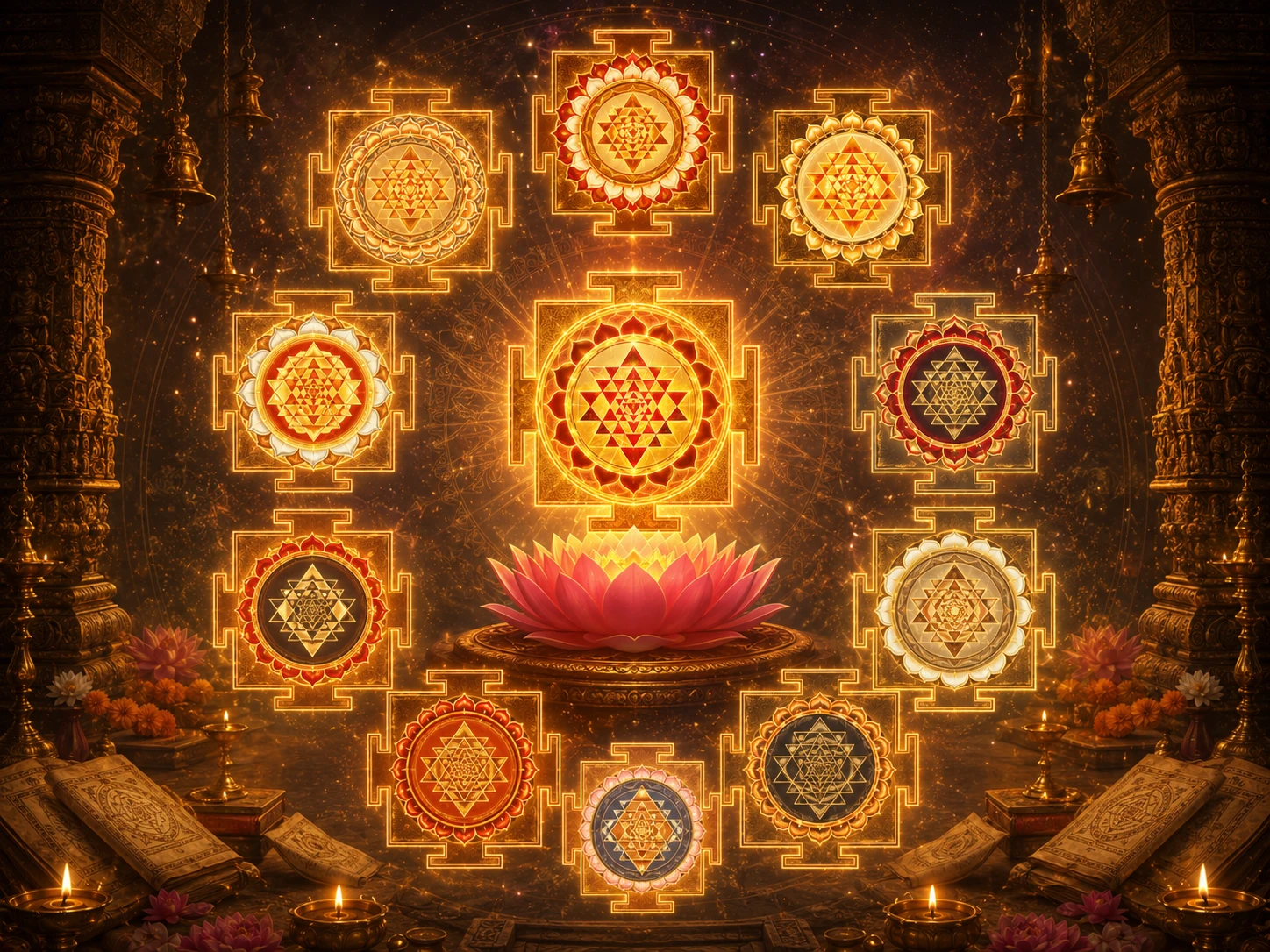
10 Mahavidya Yantras
दश महाविद्या यन्त्र
The Das Mahavidyas are the ten great wisdom goddesses of Shakta tantra. Each one is a complete cosmology on her own. Kali holds time and liberation. Tara holds the sound before sound. Tripura Sundari holds beauty as non-dual awareness. Bhuvaneshwari holds space. Bhairavi holds the fierce warmth of tapas. Chinnamasta holds the severed head and the courage to see through ego completely. Dhumavati holds the widow's emptiness that paradoxically grants siddhi. Bagalamukhi holds the yellow frequency of speech that stops an opponent mid-attack. Matangi holds the outcaste wisdom that refuses purity codes. Kamala holds abundance as Lakshmi in her tantric register. A Shakta upasaka is taught these ten as aspects of a single Adi Shakti, each aspect accessible through a specific mantra, a specific meditation, and a specific yantra. The yantras are the visual frequencies. Just as a violin string produces a different note at different lengths, the Goddess produces different qualities of consciousness through different geometries. A Mahavidya yantra is not a decoration. It is a tunable instrument that the upasaka plays with her attention, her mantra japa, and her physical ritual offerings.
The tantric principle underneath all ten yantras is identical. A specific Goddess has a specific geometric pattern that resonates with Her mantra. When the upasaka places the physical yantra before her, meditates on its pattern, and recites the matching mantra, three synchronised streams of attention begin -- visual, acoustic, and conceptual -- all directed to the same Goddess. The mind, normally scattered across many stimuli, is unified by this simultaneous convergence. The traditional explanation is that the yantra is the Goddess's body in geometric form, the mantra is Her body in acoustic form, and the deity image is Her body in anthropomorphic form. Worshipping any one is worshipping Her. Worshipping all three synchronously is worshipping Her completely. Every Mahavidya worship follows this template. What differs from Goddess to Goddess is the specific design of each component and the internal state the worship is designed to produce. Kali worship cultivates fearlessness before death. Bhuvaneshwari worship cultivates spaciousness that dissolves claustrophobia. Dhumavati worship cultivates detachment from every form of superficial reward. Each yantra is keyed to its specific interior outcome.
क्रीं काल्यै नमः। ह्रीं बगलामुखि सर्वदुष्टानां वाचं मुखं पदं स्तम्भय जिह्वां कीलय बुद्धिं विनाशय ह्रीं ॐ स्वाहा॥
krīṃ kālyai namaḥ | hrīṃ bagalāmukhi sarvaduṣṭānāṃ vācaṃ mukhaṃ padaṃ stambhaya jihvāṃ kīlaya buddhiṃ vināśaya hrīṃ oṃ svāhā ||
Salutations to Kali, whose seed is Krim. O Bagalamukhi, paralyse the speech, mouth, feet of all evil-doers; nail down their tongues; destroy their intellect. Hrim Om Svaha.
— Kali Beeja Mantra and Bagalamukhi Moola Mantra, preserved in Shaktisangama Tantra and Todala Tantra traditions
The Kali yantra is the first and oldest of the ten. Its geometry is the cleanest statement of Shakta philosophy in visual form. At the centre sits a red bindu, the drop from which all manifestation emerges. Around the bindu, five downward-pointing triangles interpenetrate, forming the pancha-yoni, the five wombs of creation. Around the triangles lies an eight-petal lotus. Outside the lotus lies an outer square with four gates pointing to the cardinal directions. The entire figure is often drawn on a black background with red and white lines, or red on white for domestic use. The five inverted triangles are essential. They carry the Shakti vector, the downward-moving feminine principle that makes creation possible. A Kali yantra with triangles pointing upward is iconographically incorrect. The Kali mantra Krim, given with the seed to the left ear by the Guru, is repeated while the eyes remain steady on the central bindu. Traditional counts prescribe 1.25 lakh repetitions for purascharana, completed over 41 days or in intensive three-day retreats during Kali Chaudas or Diwali amavasya. The reported result at purascharana completion is not worldly wealth but a specific internal consistency -- the upasaka stops flinching at situations that previously produced fear.
The Tara yantra follows immediately after Kali in importance, but carries a different tonality. Where Kali is nocturnal, raw, and terminal, Tara is liminal, protective, and maritime. The name Tara means She Who Ferries Across -- specifically across the ocean of rebirth. Her yantra typically shows a downward triangle containing a hexagram (shatkona), surrounded by an eight-petal lotus and the Bhupura. The hexagram is the key difference from the Kali yantra. Two interpenetrating triangles, one downward (Shakti) and one upward (Shiva), represent balanced cosmic polarity, the kind needed when crossing dangerous waters. Tara's primary mantra uses the seed Hrim or the compound Om Hrim Strim Hum Phat. The tradition associates Tara with the Himalayan Nila Tara form, worshipped at Tarapith in Birbhum, West Bengal, where the poet-sant Bamakhepa performed his most intense sadhana in the 19th century. A modern upasaka travelling from Kolkata to Tarapith, even without intention to become a Sadhu, reports a measurable shift in perception after spending three nights on the cremation ground of Tarapith. The yantra is what allows urban practitioners to access a thinned-down version of this frequency without physical pilgrimage.
The Ten Mahavidya Yantras at a Glance
| Mahavidya | Yantra Core Geometry | Primary Beeja | Distinctive Siddhi | Temple Seat |
|---|---|---|---|---|
| Kali | 5 inverted triangles + 8-petal lotus + Bhupura | Krim (क्रीं) | Fearlessness; liberation from ego | Kalighat, Kolkata; Dakshineswar |
| Tara | Shatkona inside downward triangle + lotus + Bhupura | Trim / Strim | Protection; crossing of dangerous thresholds | Tarapith, Birbhum |
| Tripura Sundari | Full Sri Chakra (9 interlocking triangles) | Panchadasi (15 syllables) | Non-dual realisation; beauty as consciousness | Kamakshi, Kanchipuram |
| Bhuvaneshwari | Upward triangle with Bhupura and lotus | Hrim (ह्रीं) | Expansiveness; mastery over space | Jhargram; some Assam temples |
| Bhairavi | Shatkona with central bindu, red colour | Hasaim Hasakarim Hasaim | Fierce discipline; tapas that completes | |
| Chhinnamasta | Inverted triangle with severed head image | Srim Hrim Klim Aim Vajra-vairochaniye Hum Hum Phat | Severance of ego-identification; sexual sublimation | |
| Dhumavati | Dusky upward triangle, often with crow motif | Dhum Dhum Dhumavati Svaha | Detachment; acceptance of emptiness | |
| Bagalamukhi | Yellow square with central yellow triangle | Hlim (ह्लीं) | Stopping of enemy speech and action; victory in debate | |
| Matangi | Downward triangle with green hues, outcaste motifs | Om Hrim Klim Hum Matangyai Phat Svaha | Arts, speech, unorthodox wisdom | |
| Kamala | 8-petal lotus with central bindu | Srim (श्रीं) | Abundance, auspiciousness, tantric Lakshmi | Kamalatmika shrines; Vaishno Devi (in Lakshmi aspect) |
These yantra geometries, beejas and siddhis are drawn from Todala Tantra, Mundamala Tantra and Shaktisangama Tantra. Regional traditions may vary slightly in lotus petal counts or beeja pronunciations.
Bhuvaneshwari is often called the most accessible of the Mahavidyas for householder practice. Her yantra is simple -- an upward-pointing triangle inside an eight-petal lotus inside a Bhupura -- and her temperament is that of the cosmic mother who holds space itself. The name Bhuvaneshwari means She Who Is The Lady Of Bhuvana, the inhabited worlds. Her seed is Hrim, sometimes called the Maya bija because it simultaneously contains all the other seeds in compressed form. In the Lalita Sahasranama and other Shakta texts, Hrim is treated as the acoustic signature of the entire Shakta cosmos. Bhuvaneshwari worship is recommended for those who feel cramped -- professionally, emotionally, spatially. An upasaka in a small Mumbai apartment, an IIT-JEE student in a shared Kota hostel room, a young woman in a joint family navigating low psychological space -- Bhuvaneshwari's yantra and mantra open that inner aperture. The external conditions may not change, but the sense of suffocation loosens. Several contemporary Kanchi and Sringeri teachers give Hrim japa as the first mantra to students with anxiety, because Bhuvaneshwari carries this spaciousness quality more cleanly than any other Mahavidya.
Bagalamukhi is the Mahavidya of stambhana -- paralysis of the opponent through sound. Her yantra is unmistakable. Unlike the other Mahavidyas whose yantras are drawn in red and white on neutral backgrounds, Bagalamukhi yantra is yellow. Bright turmeric yellow. A yellow square encloses a yellow triangle, which encloses a central yellow bindu. Flowers offered to her are yellow marigold. The cloth on the altar is yellow silk. Even the clothes worn by the upasaka during Bagalamukhi purascharana are yellow. This chromatic consistency is not ornamental. Yellow is the colour of the Manipura chakra in classical yoga, the solar plexus, the seat of personal power and the power of speech. Bagalamukhi is invoked specifically to halt an opponent mid-action. Court cases are the classical Indian scenario for Bagalamukhi worship. A 2026 UPSC candidate facing an unfair interview board, a startup founder facing a hostile takeover, a journalist being sued by a politician -- these are the situations where Bagalamukhi upasakas report their yantra practice has pulled them through. Her main temple is at Nalkheda in Madhya Pradesh, where the yantra is engraved on the foundation stone of the shrine. The Datia temple in Bundelkhand is another major seat. A serious Bagalamukhi sadhana requires strict dietary discipline and extensive Guru oversight, because the mantra is known to produce rapid external results that can destabilise untested practitioners.
Chinnamasta's yantra is probably the most startling of the ten in its imagery. The geometric core is a downward triangle with a bindu, standard enough. But the icon that accompanies the yantra shows the Goddess herself holding her own severed head, blood from her neck feeding three streams -- one into her own mouth, two into the mouths of her two attendants. Western observers often read this as horror imagery. The tantric reading is different and worth stating precisely. Chinnamasta represents the moment of radical self-cognition, when the upasaka sees through the ego so completely that the ego is beheaded without ceremony, without drama, without loss. The severed head still smiles. The body still stands. The blood still feeds devotees. The teaching is that what we call the self is not dependent on the head we protect so fiercely. Chinnamasta sadhana is not recommended for beginners. A Kanchi preceptor will usually redirect an enthusiastic aspirant who asks for Chinnamasta mantra to Bhuvaneshwari or Kamala first. The yantra is worshipped in Hinglaj in Balochistan (now in Pakistan) and in the lesser-known Chinnamasta temple at Rajrappa in Jharkhand, where the temple itself sits at the confluence of two rivers, Bhairavi and Damodar, mirroring the dual blood streams of the iconography.
Dhumavati is the widow goddess, the Mahavidya who appears as an old woman in white, riding a crow, holding a winnowing basket. Her yantra is dusky -- often drawn on grey or ash-coloured paper with dark red lines -- with a single upward triangle in the centre. Dhumavati represents what no other major Hindu goddess represents: the presence that remains when everything has gone. She is widowhood, poverty, famine, loss, old age, emptiness. Yet she is a Mahavidya, which means she grants a specific wisdom that only arrives when every other support has been removed. Traditional practice reserves Dhumavati for sannyasins, for widows who voluntarily accept their condition as sadhana, and for elderly upasakas approaching the end of life with open hands. She is not worshipped by young people seeking prosperity, which would be contradictory. However, there is a specific and important exception. In the Shakta canon, Dhumavati is invoked by those who face specific forms of unavoidable loss -- a sudden bereavement, a business failure that cannot be reversed, the loss of reputation -- to help the sufferer pass through without bitterness. A 2026 corporate executive in Gurgaon who has been laid off after fifteen years and cannot find equivalent work might, under a qualified teacher, receive Dhumavati mantra for one specific purpose -- to metabolise the loss cleanly rather than carry it as resentment. The yantra at the altar during this period makes what could be pure defeat into a doorway.
Matangi and Kamala complete the ten, forming a contrasting pair at the end of the sequence. Matangi is the outcaste goddess, sometimes called the tantric Saraswati, worshipped in forms that specifically reject the purity-impurity codes of mainstream brahmanism. Her yantra uses green colouring and downward triangles. Her worship includes offerings that would be considered ritually impure in standard temple practice -- leftover food, food touched by mouths. The theological point is that She is untouched by purity distinctions because She is the source of those distinctions. Matangi is the patron of artists, especially musicians, speech-workers and those whose livelihood requires words. Many classical dancers at the Kalakshetra lineage in Chennai quietly worship Matangi before performances. Kamala, by contrast, is the bright final Mahavidya, also called Shree, also called the tantric Lakshmi. Her yantra is the familiar eight-petal lotus with a central bindu, closely related to the Sri Yantra but simpler. Kamala grants abundance in its Shakta register -- not the worldly-transactional wealth that simple Lakshmi worship may invoke, but the deeper auspiciousness that comes when the upasaka has seen through the other nine Mahavidyas and earned the capacity to hold abundance without being ruled by it. She is the goddess to approach last, not first. A Shakta lineage tradition is to rotate through a weekly cycle of all ten, with Kamala reserved for Sundays or for special auspicious days like Akshaya Tritiya.
A critical point about Mahavidya yantra practice is that these are not shortcuts for non-initiated users. Each of the ten mantras carries specific energetic signatures that, without preparation, can destabilise the practitioner's nervous system. Kali Krim recited carelessly in large numbers has been documented by teachers to produce unwanted agitation, sleeplessness and irrational outbursts in under-prepared aspirants. Bagalamukhi Hlim can produce pronounced arrogance, because the mantra works on the power of speech and untested practitioners mistake the resulting confidence for personal mastery. Chinnamasta mantras are strictly restricted. Dhumavati is not given to the young. Every experienced Shakta Guru vets aspirants through a preparatory phase of simpler practices -- Ganapati, Bala Tripura Sundari, a basic Durga mantra -- before considering any Mahavidya initiation. The yantras described in this article are for orientation. Possessing a copper Mahavidya yantra at home without initiation is not harmful on its own, but using it with inappropriate mantras is. A well-worn rule across Shakta mathas is that the yantra may be bought, the mantra must be earned. Two-thousand-rupee copper plates from Amazon do not change this. Neither do mass-produced energised yantras sold in Paharganj or online astrology marketplaces.
In practical modern Indian life, Mahavidya yantras show up in specific and often surprising places. The Kalighat temple in Kolkata has had continuous Kali yantra worship since at least the 17th century; its priests still follow the yantra-specific ritual sequences. The Ugratara temple in Guwahati, Assam, features Tara yantra worship aligned with the Kamakhya Shakta peetha. Tarapith in Birbhum, West Bengal, houses one of the most intense Tara yantra establishments, where Bamakhepa in the late 19th century and Kali Khyapa in the 20th century performed legendary sadhanas. The Jwalamukhi temple in Himachal, while primarily a flame shrine, keeps a working Bhuvaneshwari yantra in its sanctum. Dhumavati has her own temple at Varanasi's Dhoopchandi area. Matangi is worshipped along with other Mahavidyas at Kamakhya. Bagalamukhi's Datia temple in Bundelkhand has documented political associations -- Madhya Pradesh and Uttar Pradesh politicians, advocates preparing for high court cases, and occasionally senior bureaucrats facing inquiries have been observed performing purascharana there before critical engagements. These associations are neither publicised nor denied. They are simply part of how Mahavidya sadhana quietly intersects with modern Indian public life.
From a strictly philosophical angle, the Das Mahavidya system teaches that divine consciousness takes ten distinct shapes because ordinary human consciousness takes ten distinct tangles. The mind that fears death meets Kali. The mind that cannot cross a threshold meets Tara. The mind that cannot find beauty meets Tripura Sundari. The mind that is cramped meets Bhuvaneshwari. The mind that lacks discipline meets Bhairavi. The mind that clings to ego meets Chinnamasta. The mind that cannot accept loss meets Dhumavati. The mind that is overwhelmed by opposition meets Bagalamukhi. The mind that refuses its own creative voice meets Matangi. The mind that fears abundance meets Kamala. This ten-fold diagnostic is the deep structure. A proper Shakta Guru does not assign the same Mahavidya to every student. He reads the student's predominant psychic tangle and prescribes the matching Mahavidya. One aspirant leaves with Kali initiation. Another leaves with Bhuvaneshwari. A third is told to wait and do Bala Tripura Sundari for two years first. The yantra each eventually receives is the key to that specific untangling. This is why the Mahavidya system is medicine rather than menu. You do not choose from the ten. The ten show you what you already are, and then the one who recognises you most fully steps forward as your particular teacher.
The Bhairavi yantra deserves its own attention since it is often skipped in popular listings of the ten. Bhairavi is the fierce goddess of tapas, the heat that burns through spiritual complacency. Her yantra centres on a downward-pointing triangle inside a shatkona, outside which sits a bindu-shaped centre of fire. The colour scheme is red throughout, often with deep orange accents. Her worship is traditionally performed during the third watch of the night, between midnight and three in the morning, when the world is silent and the upasaka's own tapas can be observed without distraction. Bhairavi sadhana is for practitioners who have already begun spiritual work and found that their discipline keeps collapsing. A 2026 aspirant who has tried three different meditation practices over two years, kept each for a few weeks, then drifted away -- this is a candidate for whom a Guru might prescribe Bhairavi after initial preparatory practices. The Goddess does not grant discipline from outside. She burns away the internal rot that dissolves discipline. What remains is a residue clean enough that practice now stays. The main Bhairavi temple in India is at Shakti Peethas scattered from Kanyakumari to Kashmir, with the Bhairavi shrine at Kamakhya in Guwahati being the most important pilgrimage destination. An upasaka who completes a Bhairavi purascharana at Kamakhya during the Ambubachi festival (the June monsoon festival celebrating the Goddess's menstruation) reports an order-of-magnitude increase in what his daily practice can sustain afterward.
The Indian Army's Northern Command, operating from Udhampur, has a small temple on its headquarters premises featuring an Ashta Matrika shrine that includes a Bagalamukhi yantra. This is not secret; it is visible to visitors with permission. The association between Bagalamukhi sadhana and military contexts is ancient -- the Goddess who paralyses the opponent's action is a natural invocation for warriors before combat. The 1999 Kargil conflict saw several Indian Army officers, particularly from units that recruit heavily from Madhya Pradesh and Bundelkhand, make pilgrimages to the Bagalamukhi temples at Datia and Nalkheda before deployment. Colonel-level officers later acknowledged this in regimental records without embarrassment. Modern Indian military culture carries an undiscussed but active thread of Shakta observance, particularly Bagalamukhi for tactical contexts and Durga for unit protection, woven through a professional force that is otherwise rigorously secular in its training.
Choose Your First Mahavidya Carefully
Without initiation, you should not perform any Mahavidya mantra purascharana. What you can do is sit quietly with a single Mahavidya yantra image, recite her public stotra (not her secret mantra), and observe what shifts. Eternal Raga's mantra library has ashtakams and kavachas for the Mahavidyas -- the Dakshina Kali Ashtakam, Tara Ashtakam, Matangi Ashtakam, Bagalamukhi Ashtakam and others -- with Sanskrit and translation. Starting with this public devotional material lets you sense which Mahavidya speaks to you before you consider seeking diksha.
Tags
Eternal Raga · शाश्वत राग
Institutional voice — scholarly articles on Sanatan Dharma
Deepen Your Understanding
अपनी समझ और गहरी करें
tantra mantra yantra
Dasha Mahavidya -- Ten Wisdom Goddesses Who Map the Entire Universe
One holds her own severed head. Another is an ugly old widow. A third paralyses enemies by seizing their tongues. The Dasha Mahavidya are not comfortable goddesses. They are the ten dimensions of reality that most religions are too afraid to acknowledge -- from transcendent beauty to terrifying destruction, from cosmic abundance to abject poverty. Together, they form the most complete map of feminine divinity ever conceived.
tantra mantra yantra
Sri Vidya -- The Supreme Worship System
Sri Vidya is the most guarded, most intricate worship system inside Hinduism. It worships the Divine Mother Lalita Tripura Sundari through a fifteen-syllable mantra, the Sri Chakra yantra, and an initiation line that reaches back through Adi Shankaracharya to the Rig Veda. Miss the diksha and nothing works. Receive it, and the entire cosmos reorganizes itself inside you.
tantra mantra yantra
Sri Yantra -- The Supreme Geometry of Creation
Nine interlocking triangles. 43 smaller triangles. A single point from which the entire universe unfolds. The Sri Yantra is the most complex and revered sacred diagram in Hinduism -- and modern mathematicians have found that constructing it requires solving simultaneous equations that Western mathematics did not formalise until the 18th century. This is not decoration. This is the visual body of the Goddess.
tantra mantra yantra
Yantra Components -- Bindu, Triangle, Lotus, Bhupura
Every Hindu yantra, from the simple Ganesh Yantra to the intricate Sri Chakra, is built from the same short list of geometric components. A bindu. Triangles pointing up or down. Hexagrams. Lotuses of four, eight, sixteen or more petals. An outer square with four gates. Learn this vocabulary, and every yantra becomes readable. Mistake the grammar, and the yantra is only a pretty drawing.
tantra mantra yantra
Beeja Mantras of Major Deities -- The Seed Syllables That Contain Universes
Om is not just a sound. It is the compression of the entire Vedic cosmology into a single syllable. Shreem contains Lakshmi's abundance. Hreem holds Devi's creative power. Kleem carries Krishna's attraction. Aim encodes Saraswati's wisdom. Each Beej Mantra is a cosmic zip file -- one syllable containing the complete energy signature of a deity.
tantra mantra yantra
Navavarana Puja -- Sri Chakra Worship
Navavarana Puja is the crown ritual of Sri Vidya. Nine concentric enclosures of the Sri Chakra, each housing a circle of yoginis, each offering a distinct siddhi, are worshipped one by one. The full ritual moves either from outside inward, dissolving the world into the Goddess, or from the centre outward, bringing Her out to fill the world. A seasoned upasaka finishes in three hours. The structure itself holds a full cosmology.
tantra mantra yantra
Matrika Shakti -- The Sacred Alphabet as Cosmic Blueprint
The Sanskrit alphabet is not a human invention. It is a cosmological map -- each letter a compressed Shakti, each vowel a tattva, the whole Varnamala a sonic replica of the universe unfolding from pure consciousness to gross matter. When Shiva's damaru sounded fourteen times, it did not produce grammar. It produced reality.
The Indian Army's Northern Command, operating from Udhampur, has a small temple on its headquarters premises featuring an Ashta Matrika shrine that includes a Bagalamukhi yantra. This is not secret; it is visible to visi…
More in Tantra, Mantra & Yantra
Agama vs Tantra vs Veda -- Three Streams of Hindu Practice
14 min read
Agni Dhyana -- What Meditation on Fire Is Actually Grounded In
8 min read
Ashta Siddhi -- The Eight Yogic Powers and How Hanuman Embodies Them
13 min readThe same translation error that turned '33 Koti' into '33 crore' in Hinduism also happened in Buddhism. The Chinese translation of Buddhist texts rendered 'Sapta Koti Buddha' (7 Supreme Buddhas) as '7 Crore Buddhas.' The…
Deities AvatarsCommunity Reflections
🕉️
Be the first to share your reflection.