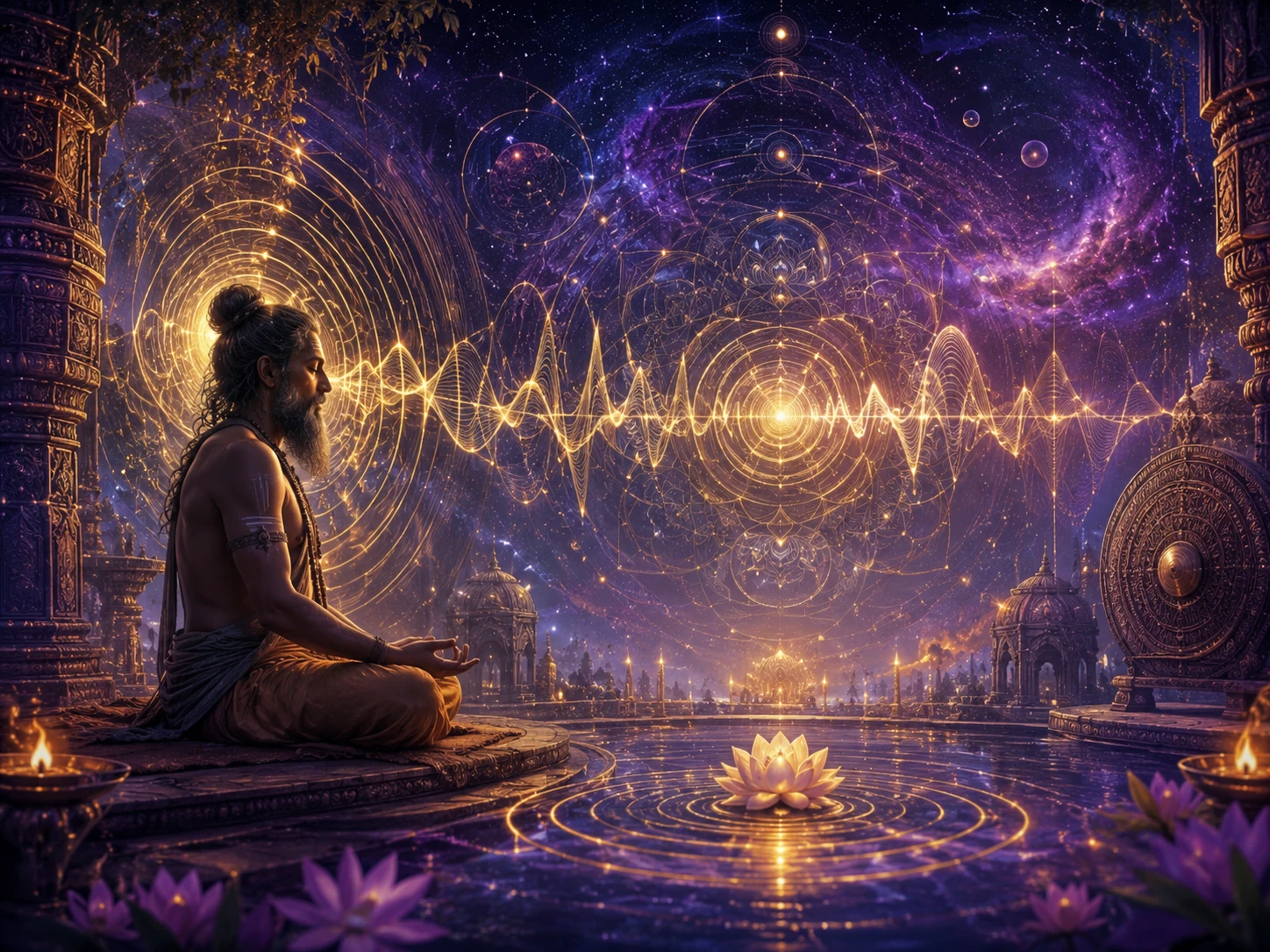
Nada Yoga -- The Yoga of Sacred Sound
नाद योग -- पवित्र ध्वनि का योग
Put on your earbuds. Turn on noise cancellation. Now sit in silence for sixty seconds.
What do you hear? Not the traffic outside. Not the WhatsApp notification you are waiting for. Not the playlist queued up on your phone. What do you hear when every external sound is stripped away?
If you listen closely -- and this is not metaphor but physiological fact -- you will hear a faint, high-pitched tone. A hum. A ringing. Most people dismiss it as tinnitus or background noise. The yogis of the Natha tradition, writing over a thousand years ago, heard the same tone and built an entire path to liberation around it.
They called it Anahata Nada -- the unstruck sound. And the discipline they created to explore it is Nada Yoga, the Yoga of Sacred Sound.
Nada Yoga is not about chanting a mantra, though chanting can be a doorway into it. It is not about listening to bhajans, though devotional music activates the same neural pathways. Nada Yoga is the practice of turning the ear of awareness inward until you hear the sound that has no external source -- the vibration that precedes and underlies all other vibrations. The Hatha Yoga Pradipika, the 15th-century masterwork by Svatmarama, devotes nearly the entire fourth chapter to this practice. After describing asanas, pranayama, mudras, and bandhas in the first three chapters, Svatmarama reserves his highest teaching for Nada. He calls it the fastest route to Raja Yoga.
In a country where Indian classical music was designed as a spiritual practice, where the seven notes of the saptak correspond to the seven chakras, where the morning raga Bhairav is named after a form of Shiva, Nada Yoga is not obscure mysticism. It is the theoretical foundation of the deepest art form India ever produced.
श्रीआदिनाथेन सपादकोटि- लयप्रकाराः कथिता जयन्ति। नादानुसन्धानकमेकमेव मन्यामहे मुख्यतमं लयानाम्॥
śrī-ādināthena sa-pāda-koṭi- laya-prakārāḥ kathitā jayanti | nādānusandhānam ekam eva manyāmahe mukhyatamaṃ layānām ||
Adinatha (Shiva) propounded one-and-a-quarter crore methods of laya (absorption). Of all those methods, we consider Nadanusandhana -- the practice of inner sound -- to be the foremost.
— Hatha Yoga Pradipika 4.66 (Svatmarama)
Two Kinds of Sound -- Ahata and Anahata
Nada Yoga begins with a fundamental classification that changes how you understand every sound you have ever heard. All sound in the universe falls into two categories: Ahata and Anahata.
Ahata Nada is struck sound -- sound produced when two objects collide, when a string is plucked, when vocal cords vibrate against air. Every sound you hear through your ears is Ahata. The tabla player's taal, the train horn at the railway crossing, the call of the azaan from the mosque next to the temple in any Indian bazaar, the notification ping from Zomato -- all Ahata. This is the sound physics measures in Hertz, the sound that requires a medium to travel through, the sound that begins and ends.
Anahata Nada is unstruck sound -- sound that arises without any physical collision. It has no beginning and no end. It requires no medium. It is not produced; it simply is. The Anahata is the sound that yogis describe as the primordial vibration underlying all of existence -- what the Vedas call Nada Brahman, the sound-form of the Absolute.
Here is where it gets interesting for the NEET student studying biophysics or the IIT aspirant fascinated by wave mechanics: Anahata Nada is not a poetic metaphor. Contemporary neuroscience has documented that meditators in deep states produce measurable changes in auditory cortex activation even in the absence of external stimuli. The brain generates its own sonic experience. The ancient yogis mapped this internal soundscape with extraordinary precision, describing ten distinct stages of inner sound -- from the roar of the ocean to the buzzing of bees to the tinkling of bells to a final, seamless tone that dissolves the boundary between listener and listened.
The modern parallel is striking. When neuroscientists at Johns Hopkins study monks in deep meditation using fMRI, they find that the default mode network -- the part of the brain responsible for the constant chatter of ego -- goes quiet. What replaces it? A state the yogis would recognize instantly: the mind absorbed in Nada.
The Ten Stages of Inner Nada
The Hatha Yoga Pradipika and the Nada Bindu Upanishad describe a remarkable progression of inner sounds that the practitioner encounters as the practice deepens. These ten stages are not arbitrary -- they form a consistent map reported across centuries by meditators working independently in different traditions.
The progression moves from gross to subtle: first, the sound of the ocean (like holding a conch shell to the ear). Then the rumble of thunder-clouds. Then the ringing of bells. Then the blast of a conch. Then the resonance of a stringed instrument like the veena. Then the clapping of hands. Then the sound of a flute. Then the deep beat of a drum. Then the buzzing of bees. And finally, a fine, continuous, all-pervading tone that the texts liken to the resonance of a bell fading into infinity.
Each stage requires more refined attention. The early stages are relatively accessible -- anyone who has sat in true silence for twenty minutes may recognize the ocean-like roar or the bell tones. The later stages demand sustained practice, stillness, and what the text calls Ekagrata -- one-pointed concentration. The final tone is described as the Pranava itself -- the innermost vibration of Om, stripped of all gross frequency, pure consciousness manifesting as sound.
The UPSC aspirant studying Indian philosophy for the General Studies paper will recognise this framework as Laya Yoga -- the yoga of dissolution. The mind, absorbed progressively in subtler sounds, dissolves its own agitation until only awareness remains. Svatmarama uses five vivid metaphors for this process: the mind caught by Nada is like a bee drunk on honey (it forgets to fly), like an elephant goaded into obedience, like a deer frozen by a hunter's lamp, like a cobra charmed by the snake-charmer's been, like a horse steadied by a bolt on the stable door.
नासनं सिद्धसदृशं न कुम्भकः केवलोपमः। न खेचरीसमा मुद्रा न नादसदृशो लयः॥
nāsanaṃ siddha-sadṛśaṃ na kumbhakaḥ kevalopamḥ | na khecarī-samā mudrā na nāda-sadṛśo layaḥ ||
There is no asana equal to Siddhasana, no kumbhaka equal to Kevala, no mudra equal to Khechari, and no laya (absorption) equal to Nada.
— Hatha Yoga Pradipika 4.45 (Svatmarama, some editions 1.45)
The Four Stages of Nadanusandhana
The Hatha Yoga Pradipika describes the complete journey of Nada practice in four stages that parallel the classical stages of yogic attainment.
Arambha Avastha (The Beginning) marks the first breakthrough. The practitioner, seated in Siddhasana or Muktasana with Shanmukhi Mudra (closing the ears, eyes, nose, and mouth with the fingers), turns attention to the sounds arising in the right ear -- or more precisely, the 'true ear,' the inner ear of the heart. The Brahma Granthi (the knot at the Muladhara chakra that binds consciousness to the physical body) begins to loosen. The practitioner experiences joy and hears tinkling sounds like ornaments -- the Anahata Nada in its initial, delicate form.
Ghata Avastha (The Vessel) deepens the practice. Prana and Apana unite in the Sushumna, entering the heart centre. The Vishnu Granthi (the knot at Anahata chakra) is pierced. Here the body may feel completely blissful, and sounds like drums and kettledrums arise.
Parichaya Avastha (Acquaintance) is the advanced stage. The Rudra Granthi at the Ajna chakra is pierced. Sounds of mridanga and the buzzing of the great bee (Mahabhringanaada) are heard. Prana reaches the space between the eyebrows.
Nishpatti Avastha (Consummation) is the final stage. The mind dissolves entirely into Nada. The practitioner hears the sound of the flute and veena and attains Raja Yoga. The individual self (jivatma) merges with the cosmic self (paramatma). This is not philosophical speculation; it is the experiential culmination described with clinical precision by Svatmarama.
Think of it like the stages of a startup reaching product-market fit. Arambha is the MVP launch -- you have something, but it is rough. Ghata is seed funding -- commitment deepens. Parichaya is growth stage -- things accelerate. Nishpatti is the IPO -- complete arrival. Except here, the product is consciousness, the market is infinity, and the fit is permanent.
Nada Brahman -- Sound as the Source of Creation
The philosophical foundation of Nada Yoga is the doctrine of Nada Brahman -- the idea that the ultimate reality is not inert substance but living vibration. This is not a fringe Tantric concept; it is woven into the very architecture of the Vedas.
The Rig Veda's Nasadiya Sukta (10.129) speaks of a primordial stirring before creation. The Sama Veda -- the Veda of melody -- is structured entirely as song, because the rishis understood that truth is not merely spoken but sung into existence. The Taittiriya Upanishad traces the descent of reality from Brahman through Akasha (space), and the first quality of Akasha is Shabda -- sound. Space and sound arise together. Before there is form, before there is light, there is vibration.
The Shaiva tradition elaborates this further through the doctrine of Spanda -- the divine pulsation. Kashmir Shaivism teaches that consciousness (Shiva) is not static but eternally vibrating, and this vibration (Spanda) is the source of all manifestation. Abhinavagupta's Tantraloka treats Nada as the bridge between the Unmanifest (Para) and the Manifest (Vaikhari) -- the four levels of speech (Para, Pashyanti, Madhyama, Vaikhari) are essentially four levels of Nada becoming progressively gross until it emerges as audible human speech.
This maps surprisingly well onto modern physics. String theory proposes that at the most fundamental level, matter is not particles but vibrating strings of energy. The frequency of vibration determines what 'particle' manifests -- just as the frequency of Nada, in Tantric metaphysics, determines what reality manifests. An IIT physicist might not call it Nada Brahman, but the structural parallel is hard to ignore: the universe, at its deepest level, is made of vibration.
Nada Yoga and Indian Classical Music
To understand Nada Yoga in its living form, look at the concert stage.
Indian classical music -- both Hindustani and Carnatic -- was not designed as entertainment. It was engineered as Nada Sadhana. The raga system is a Nada Yoga technology. Each raga is a specific arrangement of ascending and descending notes designed to evoke a particular bhava (emotional-spiritual state) at a particular time of day. Raga Bhairav at dawn evokes Shiva's austere stillness. Raga Yaman at twilight evokes the luminous peace of homecoming. The ragas are not arbitrary; they correspond to the movement of prana through the nadis at different hours.
The tanpura -- the four-stringed drone instrument that provides the continuous backdrop to every classical performance -- is the musician's portal to Anahata Nada. The tanpura does not play melody. It produces a shimmering field of overtones -- layer upon layer of harmonic frequencies arising from four simple strings. A skilled listener can hear dozens of notes that nobody is playing. These emergent overtones are the musician's gateway to the unstruck sound.
This is why the riyaz (daily practice) of a serious classical musician looks identical to yogic sadhana. Pandit Jasraj spoke of his morning riyaz as meditation. Ustad Bismillah Khan played shehnai at the Ganga ghat in Varanasi every dawn as an offering, not a performance. Kishori Amonkar described her quest to find the note between the notes -- the shruti, the microtonal space where Anahata lives. M.S. Subbulakshmi's rendering of Bhaja Govindam was not vocal technique; it was a living transmission of Nada.
The next time you open YouTube and search for a classical alap, recognise what you are hearing. That slow, unhurried exploration of a raga's opening notes, without rhythm, without accompaniment, is Nada Yoga performed in real time.
Ahata Nada vs Anahata Nada -- The Two Domains of Sound
| Dimension | Ahata Nada (Struck Sound) | Anahata Nada (Unstruck Sound) |
|---|---|---|
| Origin | Produced by collision of two objects or vibration of a medium | Arises spontaneously without physical cause |
| Medium required | Yes -- air, water, or solid needed for propagation | No -- independent of any physical medium |
| Duration | Has beginning and end; decays over time | Eternal and continuous; no decay |
| Perception | Heard through physical ears (external auditory system) | Heard through inner ear of awareness (heart chakra) |
| Examples | Speech, tabla, veena, birdsong, traffic, notification sounds | Inner hum in deep meditation, Pranava (Om), Nada Brahman |
| Practice role | Starting point -- chanting, kirtan, raga, mantra recitation | Destination -- what remains when all external sound ceases |
| Textual source | Natya Shastra, Sangita Ratnakara | Hatha Yoga Pradipika (Ch. 4), Nada Bindu Upanishad |
| Modern parallel | Acoustic physics, sound engineering, Hertz measurement | Brainwave entrainment, auditory cortex self-activation in meditation |
In Nada Yoga, Ahata sound is the ladder; Anahata sound is the destination. Mastery of external listening (through music, mantra, or nature sounds) trains the awareness to perceive the subtler internal sound.
How to Begin Nada Yoga -- A Practical Guide
The beauty of Nada Yoga is its accessibility. Unlike complex pranayama techniques that require a guru's supervision, or advanced asanas that need years of physical preparation, Nada meditation can begin tonight.
Step one is environment. Choose the quietest room available. Late night (after 10 PM) or pre-dawn (Brahma Muhurta, 4:00-5:30 AM) is ideal because ambient noise drops dramatically. If you live in a noisy Indian city -- and let us be honest, most of us do, whether it is the auto-rickshaws on a Pune road or the construction site outside a Noida flat -- use simple foam earplugs to reduce external stimulation.
Step two is posture. Sit comfortably -- Padmasana, Siddhasana, or even on a chair with feet flat on the ground. The spine must be erect but not stiff. Close the eyes.
Step three is Shanmukhi Mudra (also called Yoni Mudra). Press the thumbs gently against the ear flaps (tragus) to seal the ears. Rest the index fingers lightly on the closed eyelids. Place the middle fingers alongside the nostrils (not pressing). Ring fingers rest above the upper lip, little fingers below the lower lip. This seals the sensory gates.
Step four is listening. With ears sealed, breathe naturally and listen. At first you will hear your own pulse, your breathing, and perhaps a general hum. Do not judge or label these sounds. Simply observe. Over sessions -- perhaps the third attempt, perhaps the tenth -- you will begin to hear a finer sound beneath the physiological noise. It may present as a high-pitched ringing, a shimmering tone, or a distant bell.
Step five is following. When you hear the subtler sound, pour your attention into it like water filling a vessel. Do not try to amplify it. Simply attend. The sound itself becomes the meditation object. The mind, which normally bounces between thoughts like a cricket ball in a gully match, finds a resting place in the sound.
Start with ten minutes. Build to twenty. The Hatha Yoga Pradipika promises that consistent practice yields results within months -- and centuries of meditators confirm this.
NASA's recordings of planetary emissions convert electromagnetic radiation into audible sound. When you listen to these 'sounds of the planets,' the eerie hum of Jupiter or Saturn's rings sounds remarkably similar to what the Nada Bindu Upanishad describes as the higher stages of inner Nada. The ancient rishis were mapping an interior cosmos that modern space science is now hearing from the exterior. Meanwhile, neuroscience research at institutions including Harvard and Max Planck Institute has shown that Tibetan singing bowls and Indian tanpura drones induce measurable theta-wave states in the brain -- the same brainwave patterns associated with deep meditation and creative insight.
Nada Yoga in the Living Tradition -- Temples, Bhajans, and the Conch at Dawn
Nada Yoga is not locked in a text. It is alive every time a temple bell rings.
Consider the architecture of a major South Indian temple -- say, Meenakshi Amman in Madurai or Brihadeshwara in Thanjavur. The garbhagriha (sanctum) is designed as a resonance chamber. When the priest rings the bell and chants the mantra, the sound waves reflect off the stone walls in specific patterns, creating standing waves that intensify certain frequencies. The devotee standing in the mandapa does not merely hear a bell -- they are bathed in a precisely engineered sound field. This is acoustic Nada Yoga built into stone.
The conch shell blown at dawn and dusk in every Hindu household and temple is another Nada instrument. The spiralling chamber of the Shankha naturally amplifies certain harmonics while filtering others, producing a tone that traditional texts say purifies the atmosphere and aligns the listener's prana. The Mahabharata's opening of the Kurukshetra war with the blowing of five Pandava conch shells is not merely dramatic staging -- it is the activation of Nada Shakti before battle.
And then there is kirtan -- the communal singing practice that has spread from Vrindavan and Mayapur to London and Los Angeles. Kirtan is Ahata Nada used as a vehicle to approach Anahata. As the voices merge, as individual identity dissolves into the collective sound, as the tempo builds and the names of the Divine repeat and repeat, something shifts. The chattering mind goes quiet. The group enters a shared state of Nada absorption. This is why kirtan is described in the Bhagavata Purana as the easiest and most natural form of sadhana for the Kali Yuga. It requires no initiation, no complex technique, no special qualification. Just a voice and willingness to listen.
The NRI in New Jersey who attends a Saturday evening kirtan at the local ISKCON temple, the college student in Rishikesh who hears the Ganga aarti echo off the hills, the grandmother in Chennai who falls asleep listening to Suprabhatam on her phone -- all are practising Nada Yoga, whether they know the Sanskrit terminology or not.
Begin Your Nada Yoga Journey -- Mantra Japa with the Inner Ear
Chant Om 108 times on a mala. As you chant, listen not to your own voice but to the silence between each Om; that silence is the doorway to anahata nada. A tanpura drone, played or recorded, makes a good ahata foundation. The Fading of a Sound dharana on Eternal Raga takes the same listening further.
Tags
Eternal Raga · शाश्वत राग
Institutional voice — scholarly articles on Sanatan Dharma
Deepen Your Understanding
अपनी समझ और गहरी करें
tantra mantra yantra
The Science of Mantra -- How Sacred Sound Rewires Consciousness
A mantra is not a prayer. It is not a wish. It is a precision instrument of consciousness -- a vibrational key engineered in Sanskrit thousands of years ago to unlock specific states of mind. Modern neuroscience is only now catching up.
sacred symbols
Om -- The Primordial Sound That Contains the Universe
Every temple bell, every mantra, every meditation session begins and ends with Om. But what exactly IS Om? The Mandukya Upanishad claims this single syllable contains all of reality -- past, present, future, and whatever lies beyond time itself. Twelve verses. One sound. The entire map of consciousness.
tantra mantra yantra
The Seven Chakras -- Energy Centres That Map Your Inner Universe
You have seven power stations running along your spine. Each governs a specific domain of human experience -- from survival instinct to sexual energy to willpower to love to expression to intuition to cosmic consciousness. The chakra system is not mystical poetry. It is the most detailed map of human psychology ever embedded in a spiritual framework -- and modern neuroscience is only now catching up to what Tantric yogis described 1,500 years ago.
tantra mantra yantra
Tantra, Mantra and Yantra -- The Three Pillars of Spiritual Practice
Tantra is the loom, Mantra is the thread, Yantra is the pattern. Together they form the complete technology of spiritual transformation that India gifted to the world -- and they are far more profound than popular culture imagines.
tantra mantra yantra
Kundalini -- The Serpent Power That Sleeps at Your Spine's Base
A coiled serpent sleeps at the base of your spine. When awakened through yoga, mantra, or guru's grace, she rises through seven energy centres, dissolving every limitation of body and mind, until she merges with pure consciousness at the crown of your head. This is not New Age fantasy. This is the central psycho-spiritual technology of Tantric Hinduism -- mapped in Sanskrit texts over 1,500 years ago and now studied by neuroscientists at institutions from Harvard to NIMHANS Bangalore.
tantra mantra yantra
Japa -- Vachika, Upamshu, Manasika and the Art of Sacred Repetition
Krishna declares in the Gita: 'Among sacrifices, I am Japa.' Not the fire ritual, not the horse sacrifice, not the Soma offering -- but the silent repetition of a sacred name. Three levels of chanting, one mala of 108 beads, and a practice you can do on the Delhi Metro without anyone knowing.
tantra mantra yantra
Yantra Meditation Guide -- How to Meditate with Sacred Geometry
A yantra is not a decoration. It is an optical mantra -- a geometric diagram engineered to restructure visual perception and, through it, consciousness itself. This guide teaches you how to meditate with yantras, from beginner trataka to advanced Sri Yantra navigation.
NASA's recordings of planetary emissions convert electromagnetic radiation into audible sound. When you listen to these 'sounds of the planets,' the eerie hum of Jupiter or Saturn's rings sounds remarkably similar to wha…
More in Tantra, Mantra & Yantra

Agama vs Tantra vs Veda -- Three Streams of Hindu Practice
14 min read
Agni Dhyana -- What Meditation on Fire Is Actually Grounded In
8 min read
Ashta Siddhi -- The Eight Yogic Powers and How Hanuman Embodies Them
13 min readThe same translation error that turned '33 Koti' into '33 crore' in Hinduism also happened in Buddhism. The Chinese translation of Buddhist texts rendered 'Sapta Koti Buddha' (7 Supreme Buddhas) as '7 Crore Buddhas.' The…
Deities AvatarsCommunity Reflections
🕉️
Be the first to share your reflection.