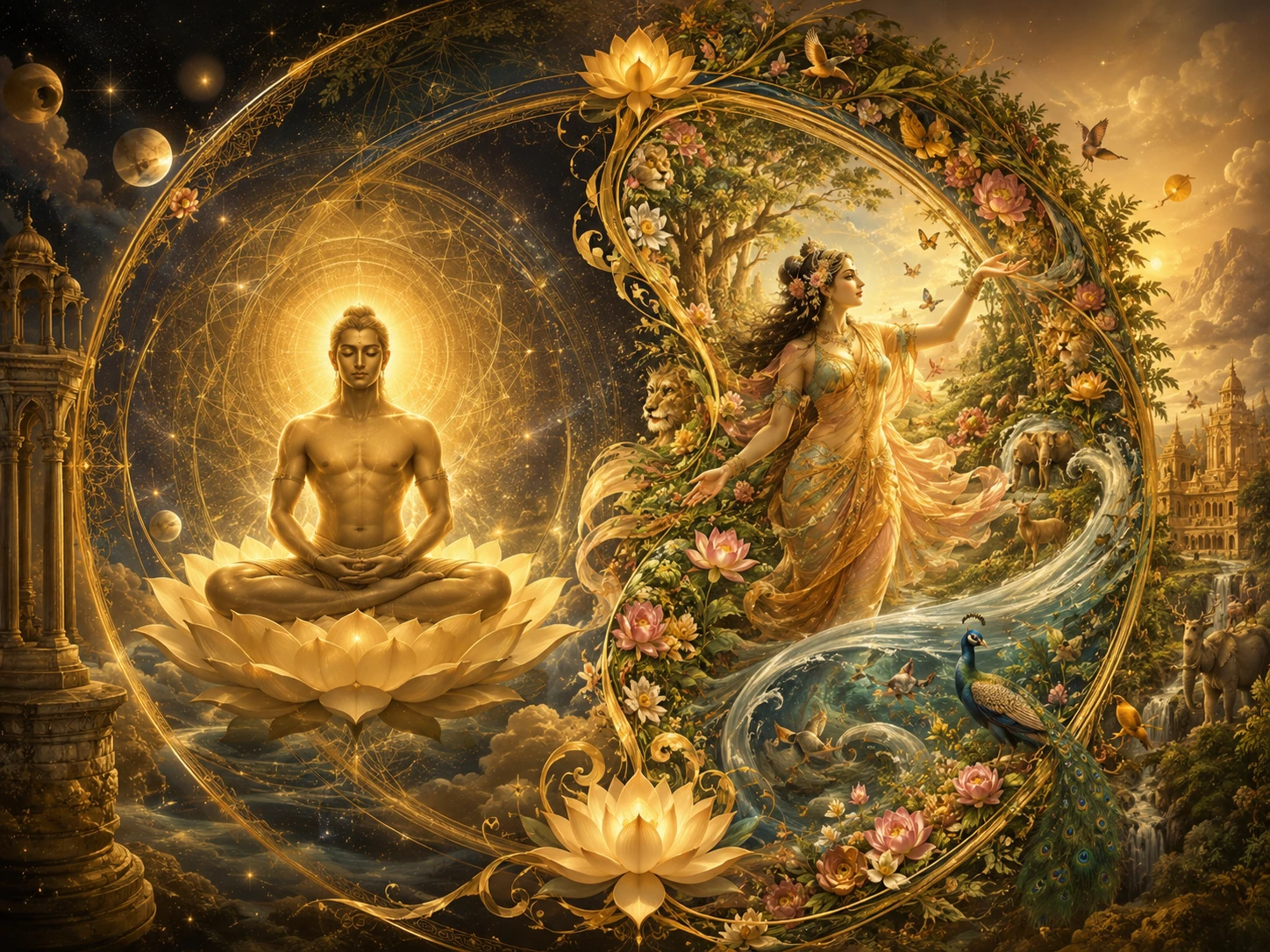
Purusha and Prakriti -- The Witness and the Dance
पुरुष और प्रकृति -- साक्षी और नृत्य
Close your eyes for ten seconds. Notice your thoughts. Maybe a grocery list. Maybe a melody. Maybe anxiety about tomorrow's deadline. Now notice that there is something watching those thoughts. The thoughts change -- the watcher does not. The thoughts are noisy -- the watcher is silent. The thoughts are many -- the watcher is one.
That distinction -- between the stream of experience and the awareness that observes it -- is the foundational insight of Samkhya, the oldest systematic philosophy in India. Samkhya calls the watcher Purusha (pure consciousness) and the stream Prakriti (nature, matter, everything that moves, changes, and evolves). These two are irreducibly different. They cannot be collapsed into one. And yet, the entire universe exists because they come together.
This is not mystical hand-waving. Samkhya is the most analytical, most rigorously logical of all Hindu philosophical systems. It does not begin with God. It does not begin with faith. It begins with suffering -- specifically, the three types of suffering (duhkha-traya) that every human experiences -- and asks: what is the root cause, and how do we end it? The answer it arrives at is precise: suffering arises because Purusha (consciousness) mistakenly identifies itself with Prakriti (matter). You think you are your body, your thoughts, your job title, your Instagram follower count. You are not. You are the one watching all of these. And the moment you truly understand that, suffering begins to dissolve.
Samkhya was systematised by the sage Kapila, traditionally considered its founder, though no surviving text is directly attributed to him. The definitive text we have is the Sankhya Karika of Ishvarakrishna, composed around the 4th century CE -- a marvel of philosophical compression, packing the entire system into just 72 verses. From this small text, an entire civilisation's understanding of mind, matter, and liberation flows.
पुरुषस्य दर्शनार्थं कैवल्यार्थं तथा प्रधानस्य। पङ्ग्वन्धवदुभयोरपि संयोगस्तत्कृतः सर्गः॥
puruṣasya darśanārthaṃ kaivalyārthaṃ tathā pradhānasya | paṅgvandhavadubhayorapi saṃyogastatkṛtaḥ sargaḥ ||
For the purpose of Purusha's seeing and for the liberation of Prakriti -- like the union of a lame man and a blind man -- from the conjunction of both, creation arises.
— Sankhya Karika, Verse 21 (Ishvarakrishna)
The blind-and-lame parable is one of the most brilliant philosophical images in world literature, and it deserves unpacking.
Prakriti is the blind man. She has legs -- she can act, move, create, destroy, evolve. She is the source of everything material: the five elements, the sense organs, the mind (manas), the intellect (buddhi), the ego (ahamkara), the five subtle elements (tanmatras). She is the dancer, the actress, the engine of the entire phenomenal world. But she is blind -- she has no consciousness, no awareness, no capacity to witness her own activity. She acts but does not know she is acting.
Purusha is the lame man. He can see everything with perfect clarity. He is pure consciousness -- eternal, unchanging, inactive. He witnesses but does not move. He illuminates but does not participate. He is the light in the cinema hall that makes the movie visible but is not part of the movie.
Neither can cross the forest alone. The blind man (Prakriti) walks in circles without direction. The lame man (Purusha) sees the path but cannot take a single step. When the lame man climbs onto the blind man's shoulders, they move and see together. The blind man's legs plus the lame man's eyes equal a functional being navigating reality.
This is you. Right now. Every conscious experience you have is Purusha riding on Prakriti's shoulders. Your eyes are Prakriti. The seeing is Purusha. Your brain processes information -- that is Prakriti. The awareness of that information -- that is Purusha. When you sit in a lecture hall in IIT Bombay or a coaching centre in Kota and understand a concept, both are operating simultaneously: Prakriti (brain, nerves, sensory organs) processes; Purusha (consciousness) illuminates.
The problem -- the cause of all suffering, according to Samkhya -- is that the lame man forgets he is the lame man. He starts thinking he is the legs. He identifies with the walking instead of the seeing. He confuses himself with the body, the mind, the emotions, the social roles. He forgets he was always the witness and gets lost in the spectacle. Samkhya's entire project is to reverse this confusion -- not by stopping the dance, but by reminding the witness that he is the witness.
Samkhya's map of reality is built on 25 Tattvas -- 25 fundamental categories that account for everything that exists. It begins with Prakriti, the unmanifest root of all matter, and ends with Purusha, pure consciousness.
From Prakriti, when she is disturbed from her equilibrium, the first evolute is Mahat (also called Buddhi) -- the cosmic intellect, the capacity for discernment. From Mahat arises Ahamkara -- the ego-principle, the sense of 'I am'. From Ahamkara, the evolution branches in three directions depending on which Guna is dominant.
When Sattva dominates Ahamkara, the five Jnana Indriyas (organs of knowledge: hearing, touch, sight, taste, smell) and Manas (mind as coordinator) emerge. When Rajas fuels the process, the five Karma Indriyas (organs of action: speech, grasping, locomotion, excretion, reproduction) emerge. When Tamas dominates, the five Tanmatras (subtle elements: sound, touch, form, taste, smell) emerge, and from these the five Mahabhutas (gross elements: space, air, fire, water, earth).
Count them: 1 Prakriti + 1 Mahat + 1 Ahamkara + 5 Jnana Indriyas + 5 Karma Indriyas + 1 Manas + 5 Tanmatras + 5 Mahabhutas = 24 categories of Prakriti. Add the 25th -- Purusha, pure consciousness -- and you have the complete Samkhya map.
This is not a creation myth. It is an analytical decomposition of experience. It asks: what are the minimum categories needed to explain everything a conscious being experiences? And it arrives at 25 -- a remarkably compact number for a system that covers physics, psychology, epistemology, and soteriology in one framework.
The UPSC aspirant memorising these 25 Tattvas for the Indian Philosophy optional paper is learning one of the most sophisticated ontologies ever produced. The IIT student who dismisses Hindu philosophy as 'just mythology' has never encountered Samkhya's precision. This is not storytelling. This is systematic analysis of reality that predates Western empiricism by at least a thousand years.
The 25 Tattvas are not merely an enumeration exercise. They represent a radical claim: that everything you have ever experienced, from the taste of your morning chai to the grief at a funeral, from the sensation of Mumbai rain on your face to the abstract understanding of a mathematical theorem, can be traced back to combinations of these 25 categories and nothing else.
Consider what happens when you bite into a gulab jamun at a Diwali gathering. The sweetness on your tongue is Rasa Tanmatra (subtle element of taste) activating through your Rasana (tongue, a Jnana Indriya), processed by Manas (mind as coordinator), evaluated by Buddhi (intellect -- 'this is good'), claimed by Ahamkara (ego -- 'I am enjoying this'), and illuminated by Purusha (consciousness -- the fact that there is an experiencer at all). Remove any one of these, and the experience collapses. Remove the tongue and there is no taste. Remove the mind and there is no registration. Remove consciousness and there is no one to whom the experience happens.
This analytical precision is what distinguishes Samkhya from both Western materialism and Eastern mysticism. Western materialism says consciousness is merely a product of matter -- an emergent property of sufficiently complex neural networks. Samkhya says no: consciousness is irreducible. You cannot get awareness from non-awareness by adding complexity, just as you cannot get wetness from sand by piling more sand. Eastern mysticism, on the other hand, often declares matter to be illusion (Maya) and only consciousness to be real. Samkhya refuses this too: matter is as real as consciousness, as eternal as consciousness, and as fundamental. Both are required. Neither is derivative.
This philosophical position has a surprisingly modern resonance. The 'panpsychism' debate in contemporary philosophy of mind -- the idea that consciousness might be a fundamental feature of the universe rather than an emergent property of brains -- echoes Samkhya's insistence that Purusha is irreducible. Integrated Information Theory (IIT), proposed by neuroscientist Giulio Tononi, posits that consciousness is a fundamental property associated with certain information structures -- a framework that, while different in mechanism, shares Samkhya's intuition that consciousness cannot be fully explained by physics alone.
For the JEE or NEET aspirant studying biology in Kota, this has practical implications. When you study the human nervous system, you are studying Prakriti's machinery in extraordinary detail -- neurons, synapses, neurotransmitters, the visual cortex, the prefrontal cortex. This is magnificent work. But Samkhya would add: you are also the one studying. And that 'you' -- the awareness behind the study -- is not located in any neuron. It is Purusha, and it is the one thing in your experience that science cannot put under a microscope, because it is the one doing the looking.
Purusha vs Prakriti -- The Fundamental Duality
| Attribute | Purusha (Consciousness) | Prakriti (Nature / Matter) |
|---|---|---|
| Nature | Sentient (chetana) -- pure awareness | Insentient (jada) -- no awareness of its own |
| Activity | Completely inactive (akarta) -- witnesses only | Constantly active -- source of all change and evolution |
| Number | Multiple -- each being has its own Purusha (Samkhya is pluralistic) | One -- single unmanifest root from which all matter evolves |
| Composition | Without Gunas (nirguna) -- beyond Sattva, Rajas, Tamas | Made of three Gunas in equilibrium when unmanifest |
| Change | Unchanging (kutastha) -- eternal and immutable | Ever-changing -- evolves from unmanifest to manifest |
| Role in experience | The seer (drashta) -- the light by which experience is known | The seen (drishya) -- everything that can be experienced |
| Parable analogy | The lame man -- can see but cannot walk | The blind man -- can walk but cannot see |
| Cinema analogy | The light in the projector that makes the movie visible | The film reel, screen, actors, story, emotions |
| Liberation | Already free -- only needs to recognise it was never bound | Withdraws once Purusha recognises it -- like a dancer who stops when the audience leaves |
Samkhya's dualism is unique in Indian philosophy: it posits consciousness and matter as equally real and equally eternal. Neither is an illusion. Neither is derived from the other. Advaita Vedanta later challenged this by arguing both collapse into a single Brahman.
One of the most beautiful images in the Sankhya Karika comes in verse 59, where Prakriti is compared to a dancer (nartaki) who performs on stage for the Purusha-audience. Once the Purusha has truly seen the performance -- once consciousness has fully understood the nature of matter -- the dancer stops. Not because she is forced to, but because the purpose of the dance is complete. The audience has seen everything there was to see. The show is over.
This is Samkhya's model of liberation (Kaivalya). It is not about destroying the world, escaping from life, or reaching some heavenly realm. It is about complete seeing. When Purusha fully recognises that it is not Prakriti -- that the thoughts, emotions, body, and social identity are Prakriti's performance, not Purusha's essence -- the misidentification dissolves. And when misidentification dissolves, suffering ends. Not because the world stops, but because you stop confusing yourself with the world.
Prakriti does not cease to exist. The material world continues. Other Purushas are still watching, still entangled, still mistaking themselves for their bodies and bank accounts. But for the liberated Purusha, the dance has ended. Consciousness rests in itself -- alone, complete, content. This is Kaivalya, 'aloneness' -- not loneliness, but the supreme independence of consciousness that no longer needs external experience to feel real.
For a young person navigating the relentless comparison culture of Instagram, the rat race of placements at an engineering college in Hyderabad, or the family pressure of a middle-class home in Patna -- Samkhya's message is not 'reject all this'. It is: 'know who you are within all this'. You can code, study, compete, love, fail, and succeed -- but if you know that you are the watcher and not the watched, the weight of every experience becomes lighter. You stop taking failures personally because you realise the failure happened to Prakriti's performance, not to you. You stop craving success as validation because Purusha was never invalidated in the first place.
रङ्गस्य दर्शयित्वा निवर्तते नर्तकी यथा नृत्यात्। पुरुषस्य तथात्मानं प्रकाश्य विनिवर्तते प्रकृतिः॥
raṅgasya darśayitvā nivartate nartakī yathā nṛtyāt | puruṣasya tathātmānaṃ prakāśya vinivartate prakṛtiḥ ||
Just as a dancer, having displayed herself to the audience, retires from the dance -- so too Prakriti, having revealed herself to Purusha, withdraws.
— Sankhya Karika, Verse 59 (Ishvarakrishna)
Samkhya's influence on other systems is immense. The Yoga Sutras of Patanjali adopt Samkhya's ontology almost entirely -- the 25 Tattvas, the Purusha-Prakriti distinction, the Guna theory -- and add a practical methodology of concentration and meditation to achieve the discriminative knowledge Samkhya describes. You cannot understand Yoga philosophy without understanding Samkhya first. They are traditionally called paired systems (samana-tantra): Samkhya provides the map, Yoga provides the vehicle.
The Bhagavad Gita draws heavily from Samkhya. Chapter 13's Kshetra-Kshetrajna (Field and Knower of the Field) is essentially Prakriti-Purusha in Gita vocabulary. Chapter 2's reference to Samkhya-Buddhi (the intellect of Samkhya) is Krishna telling Arjuna that this is the philosophical lens through which to understand his situation. The entire framework of the three Gunas -- which the Gita applies in Chapters 14, 17, and 18 -- is a Samkhya inheritance.
Even Advaita Vedanta, which ultimately rejects Samkhya's strict dualism, borrows extensively from its terminology and analytical method. When Shankaracharya speaks of the five sheaths (Panchakosha), the three bodies (Sthula, Sukshma, Karana Sharira), or the witness consciousness (Sakshi Chaitanya), he is working within a conceptual architecture that Samkhya built first.
In modern science, the closest parallel to the Purusha-Prakriti distinction is the 'hard problem of consciousness' -- the puzzle articulated by philosopher David Chalmers in 1995: why does physical processing in the brain give rise to subjective experience at all? Neuroscience can map every neural pathway (Prakriti's machinery), but it cannot explain why there is an experiencer (Purusha's mystery). Samkhya would not be surprised by this problem. It would say the problem exists precisely because consciousness and matter are fundamentally different. You will never find consciousness by dissecting matter, because consciousness was never matter to begin with.
There is a practical dimension to Purusha-Prakriti that most philosophy textbooks miss, and it has to do with identity.
Every crisis of identity -- every 'Who am I really?' that strikes in the shower at age 25, every midlife unravelling at 42, every retirement emptiness at 60 -- is, in Samkhya's framework, a case of misidentification. You built your sense of self on Prakritic categories: 'I am an engineer', 'I am a mother', 'I am a Sharma from Jaipur', 'I am someone who earns 25 LPA'. When any of these is threatened -- a layoff, a divorce, children leaving home, a health diagnosis -- the identity collapses, and you feel like you are dying. But Samkhya says: it is not you that is collapsing. It is the costume. The actor behind the costume was never threatened.
The startup founder in Koramangala whose company fails and who spirals into depression is experiencing Prakritic identity collapse. The job title, the team, the investor deck, the WeWork address -- these were Prakriti's props. When the show closes, the props are cleared. If the founder had known they were Purusha all along -- the witness behind the venture, not the venture itself -- the failure would hurt, but it would not destroy. There is a difference between 'my company failed' and 'I failed'. Samkhya draws a hard line between these two sentences.
The NEET student in Hyderabad who does not clear the exam and feels their entire worth has been negated -- Prakritic identification. The score is Prakriti (a number produced by a brain-body system responding to questions). The devastation comes from Purusha believing it IS the score. When a young person in India takes their life over exam results -- and this happens with horrifying frequency in Kota, in Hyderabad, in Chennai -- the deepest philosophical tragedy is that they were never the score. They were the awareness that looked at the score and felt pain. That awareness is indestructible. It was there before the exam and would have been there after. No scorecard in the universe can touch Purusha.
This is not abstract consolation. This is the most practical insight Samkhya offers: you are not your resume, your rank, your salary, your relationship status, your social media metrics, or your family's expectations. You are the consciousness that witnesses all of these. And that consciousness cannot be promoted, demoted, hired, fired, praised, or insulted -- because it was never in the game. It was always in the audience.
Samkhya is technically atheistic -- or more precisely, non-theistic. It does not deny God; it simply finds God unnecessary for its system. The 25 Tattvas account for everything without needing a creator deity. This makes Samkhya unique among the six orthodox Hindu schools (Shad Darshana), and it generated centuries of debate. The Yoga Sutras later added Ishvara (God) as a 'special Purusha' -- a practical concession that Samkhya's own logic did not require. When a UPSC candidate encounters the question 'Is Samkhya atheistic?' in the Indian Philosophy optional, the correct answer is: Samkhya is nirīśvara (without God as a cause) but not nāstika (not denying the Vedas). It is the sharpest example of Indian philosophy's ability to be deeply spiritual without being theistic.
The Witness Meditation -- Sakshi Dhyana
Sit quietly and observe your thoughts without engaging. Do not push them away. Do not follow them. Simply watch them arise and dissolve, like clouds passing across a sky that remains unchanged. You are the sky. The clouds are Prakriti. This is the experiential core of Samkhya's liberation. The 'Beneath the Weather' dharana on Eternal Raga is a related practice.
Tags
Eternal Raga · शाश्वत राग
Institutional voice — scholarly articles on Sanatan Dharma
Deepen Your Understanding
अपनी समझ और गहरी करें
philosophy darshana
Sattva, Rajas, Tamas -- The Three Gunas That Run Your Life
Every mood you have ever felt, every decision you have ever made, every Netflix binge and every 4 AM study session -- Hindu philosophy says it all comes down to three forces. Sattva illuminates, Rajas agitates, Tamas numbs. The Bhagavad Gita's Chapter 14 is essentially a 2,000-year-old personality framework that modern psychology is only now catching up to.
philosophy darshana
Sankhya -- The Oldest Philosophy of Creation
Before the Bhagavad Gita. Before Patanjali. Before Shankaracharya. There was Sankhya -- a philosophy that explained everything from cosmic creation to human suffering without invoking God. Founded by Kapila, compressed into 72 devastating verses by Ishvarakrishna, and quietly embedded in every other Indian philosophical system that came after it.
philosophy darshana
Yoga Darshana -- Patanjali's Science of the Mind
Before yoga became a global fitness trend worth $80 billion, it was India's most rigorous system of psychology. Patanjali's 196 sutras are not about touching your toes -- they are about rewiring your mind. Here is the philosophy the world forgot when it turned yoga into exercise.
philosophy darshana
Atman and Brahman -- The Self and the Absolute
The Upanishads make a claim so radical that 3,000 years have not dulled its edge: the individual self (Atman) and the ultimate reality of the universe (Brahman) are not two different things. They are one. Every school of Hindu philosophy is essentially an argument about what this identity means.
philosophy darshana
Panchakosha -- The Five Sheaths That Hide Your True Self
You are not your body. You are not your breath. You are not your thoughts. You are not even your bliss. The Taittiriya Upanishad says you are wrapped in five sheaths -- like a sword inside a scabbard -- and the real you is hidden at the centre, untouched by any of them. Peel off all five and what remains is Atman.
philosophy darshana
Antahkarana -- Manas, Buddhi, Chitta, Ahamkara
Your mind is not one thing. It is a factory with four departments -- a sensory processor (Manas), a decision-maker (Buddhi), a memory bank (Chitta), and an ego that claims credit for everything (Ahamkara). Hindu philosophy mapped these 1,200 years before cognitive science, and the map is still more elegant than anything a neuroscience lab has produced.
philosophy darshana
Kashmir Shaivism -- The Philosophy of Divine Recognition
What if liberation is not about gaining something new but recognising what you already are? Kashmir Shaivism says you are already Shiva -- infinite, free, blissful consciousness. You have simply forgotten. The entire universe is Shiva's dance of self-concealment and self-recognition. Your job is to remember.
Samkhya is technically atheistic -- or more precisely, non-theistic. It does not deny God; it simply finds God unnecessary for its system. The 25 Tattvas account for everything without needing a creator deity. This makes…
More in Philosophy & Darshana
The 14 Lokas -- Hindu Cosmology as a Map of Consciousness
14 min read
Achintya Bhedabheda -- Chaitanya's Theology of Inconceivable Difference-and-Unity
13 min read
Adhyasa -- Superimposition and the Foundational Error of the Self
13 min readThe same translation error that turned '33 Koti' into '33 crore' in Hinduism also happened in Buddhism. The Chinese translation of Buddhist texts rendered 'Sapta Koti Buddha' (7 Supreme Buddhas) as '7 Crore Buddhas.' The…
Deities AvatarsCommunity Reflections
🕉️
Be the first to share your reflection.