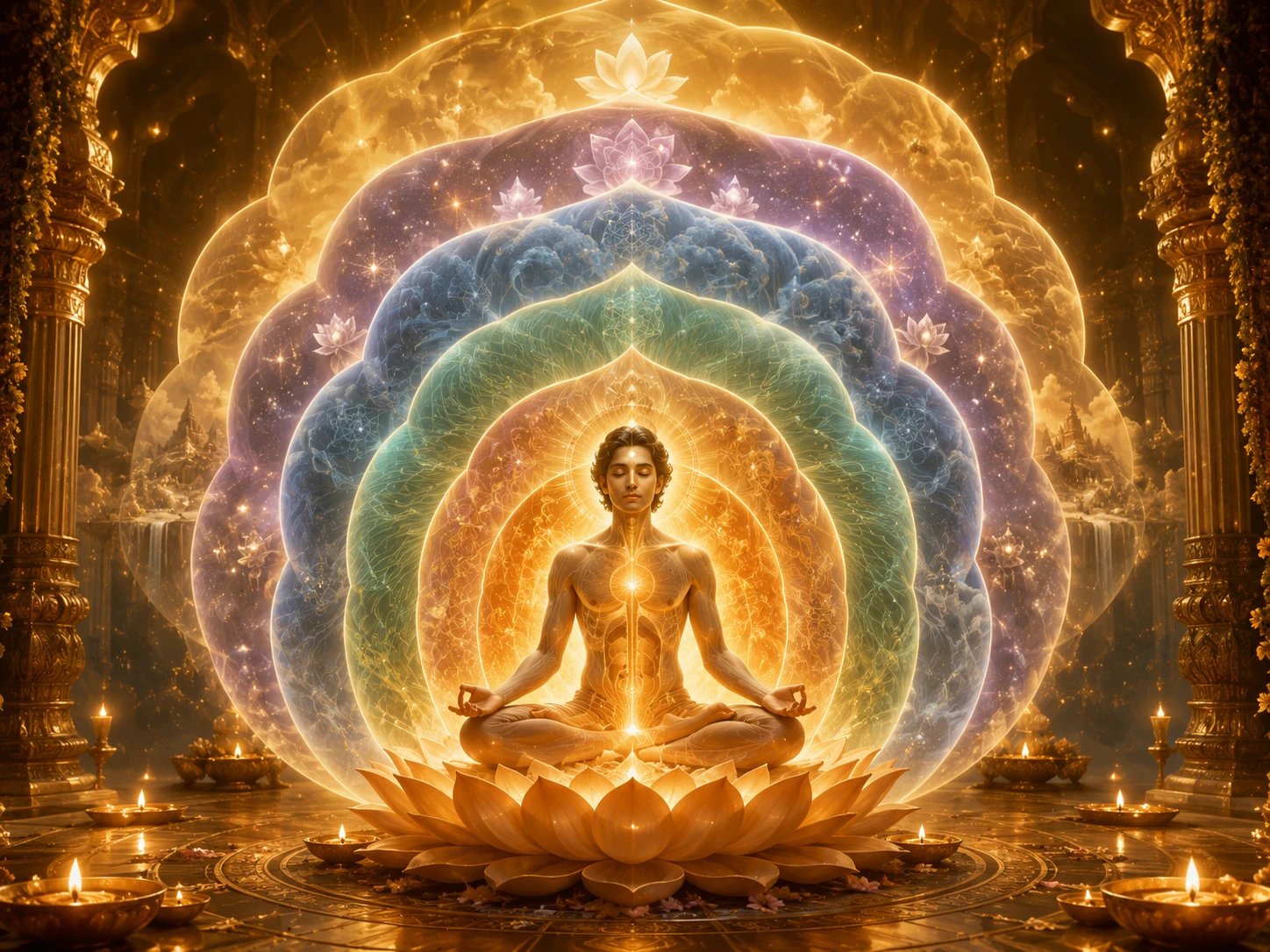
Panchakosha -- The Five Sheaths That Hide Your True Self
पञ्चकोश -- पाँच आवरण जो तुम्हारे असली स्वरूप को छुपाते हैं
Think of a Russian Matryoshka doll -- the kind you find in tourist shops from Moscow to Manali. You open the outermost figure and inside is a smaller one. Open that and there is a smaller one still. And again. And again. Until you reach the smallest, solid figure at the centre that cannot be opened -- because it is not a container. It is the thing itself.
The Taittiriya Upanishad -- one of the oldest and most profound of the principal Upanishads, embedded in the Yajur Veda -- uses exactly this architecture to describe the human being. You are not one thing. You are five nested layers, each subtler than the last, each hiding the next, each mistakable for the real you. These five layers are the Pancha Koshas -- the five sheaths.
The outermost sheath is made of food. The next is made of breath. Then mind. Then intellect. The innermost is made of bliss. And behind all five, untouched and unchanging, is Atman -- the true Self, which is identical to Brahman.
This is not metaphor. The Taittiriya Upanishad's Ananda Valli (Chapter 2) presents this as a systematic teaching delivered by the sage Varuna to his son Bhrigu. Bhrigu is told to investigate Brahman through tapas (deep contemplation). He begins by thinking food is Brahman -- because everything is born from food, lives by food, and returns to food. Varuna sends him back to meditate further. He returns thinking prana (breath, life force) is Brahman. Sent back again. Mind. Sent back. Intellect. Sent back. Finally, Bhrigu arrives at Ananda (bliss) and recognises it as the deepest accessible layer -- though even bliss is a sheath, not the final reality.
This pedagogical structure is extraordinary. It does not give the answer. It makes the student discover the answer through progressive deepening. It is the Socratic method, 2,600 years before Socrates, set not in an Athenian agora but in a Vedic forest ashram.
सत्यं ज्ञानमनन्तं ब्रह्म। यो वेद निहितं गुहायां परमे व्योमन्। सोऽश्नुते सर्वान् कामान् सह ब्रह्मणा विपश्चितेति॥
satyaṃ jñānamanantaṃ brahma | yo veda nihitaṃ guhāyāṃ parame vyoman | so'śnute sarvān kāmān saha brahmaṇā vipaściteti ||
Brahman is Truth, Knowledge, and Infinity. He who knows It as hidden in the cave of the heart, in the highest space -- he attains all desires together with the omniscient Brahman.
— Taittiriya Upanishad, Ananda Valli, 2.1.1
Let us walk through each kosha as the Upanishad presents it, and then translate it into the lived reality of 21st century India.
Annamaya Kosha -- the food sheath. Anna means food. This is your physical body, born from food, sustained by food, and returning to food upon death. It is the outermost layer, the one you see in the mirror every morning. The Upanishad's point is not that the body is unimportant -- it is that the body is not you. Your body was a two-kilogram infant. Now it is perhaps a seventy-kilogram adult. Every atom has been replaced multiple times. The body you had seven years ago literally does not exist anymore, yet 'you' persisted through the replacement. The body is a vehicle, not the driver.
For the NEET aspirant studying anatomy in a Hyderabad coaching centre, Annamaya Kosha is the subject of the entire syllabus -- bones, muscles, organs, systems. Modern medicine operates almost entirely at this level. When your grandmother in Varanasi says 'shareer toh maya hai' (the body is illusion), she is speaking Kosha theory in folk language -- inelegantly perhaps, but directionally correct.
Pranamaya Kosha -- the vital breath sheath. Prana here is not just breathing (though breathing is its most visible manifestation). It is the entire network of life energies that keep the body functioning -- the five Pranas (Prana, Apana, Samana, Udana, Vyana) plus the five organs of action (speech, hands, feet, excretion, reproduction). When you are asleep, you are not consciously aware, but Pranamaya Kosha keeps operating -- your heart beats, your lungs expand, your metabolism continues. It is the autopilot that runs while the pilot is unconscious.
The yoga teacher in Rishikesh who teaches pranayama is working directly on this kosha. The Ayurvedic doctor in Kerala who diagnoses your Vata-Pitta-Kapha constitution is mapping Pranamaya Kosha's patterns. When you feel 'low energy' after a heavy meal or 'buzzing with energy' after a morning run, you are sensing fluctuations in Pranamaya Kosha.
Manomaya Kosha -- the mind sheath. Manas here means the sensory-processing mind -- the faculty that receives input from the five senses, generates thoughts, desires, doubts, and emotional reactions. This is the layer most people identify as 'themselves'. When you say 'I am angry' or 'I want pizza' or 'I am confused about my career', you are speaking from Manomaya Kosha. But the Upanishad's radical claim is that this too is a sheath, not the self. You can observe your anger -- which means you are not the anger. You can watch your desires arise and subside -- which means you are not the desires. The observer is deeper than Manomaya.
The psychologist at NIMHANS in Bangalore, the counsellor at a Kota coaching institute, the therapist on Practo or BetterHelp -- they all work at this level. CBT, mindfulness-based stress reduction, and dialectical behaviour therapy are all technologies for managing Manomaya Kosha. They are useful, even transformative. But from the Upanishadic perspective, they address the sheath, not the Self.
Vijnanamaya Kosha -- the intellect sheath. Vijnana means discriminative knowledge, the capacity to analyse, judge, decide, and distinguish truth from falsehood. This is the faculty that says 'this argument is valid' or 'this business plan is flawed' or 'this relationship is unhealthy'. It is subtler and more powerful than Manas. While Manas doubts and oscillates, Buddhi (the core of Vijnanamaya) decides. The IIT professor who designs algorithms, the Supreme Court judge who writes a landmark verdict, the UPSC topper who synthesises facts across seventeen subjects -- all are operating at peak Vijnanamaya.
But even this is not you. The intellect changes -- your understanding at 15 is different from your understanding at 35. The intellect makes errors. The intellect can be sharp in one domain and dull in another. And crucially, you can observe your own intellectual process -- you can notice 'I am overthinking this' or 'my analysis is biased'. That noticing comes from somewhere deeper.
Anandamaya Kosha -- the bliss sheath. This is the subtlest and most deceptive of the five, because bliss feels like the end of the journey. In deep sleep, when mind and intellect are inactive, you experience a profound rest that you recognise upon waking: 'I slept well.' That 'sleeping well' is Anandamaya Kosha -- a state of contentment untouched by external circumstance. In deep meditation, when thoughts settle and a quiet joy arises from nowhere, that too is Anandamaya. The meditator at an Art of Living retreat in Bangalore, the sadhaka at a Vipassana centre in Igatpuri, the devotee lost in kirtan at Vrindavan -- all are touching Anandamaya Kosha.
But even bliss is a sheath. It comes and goes. Deep sleep ends. Meditation sessions conclude. The bliss experienced in Anandamaya Kosha is still an experience -- and an experience requires an experiencer. That experiencer -- the one who knows bliss but is not bliss, who knows deep sleep but does not sleep, who remains aware through all five sheaths without being any of them -- is Atman.
The Five Koshas -- A Complete Map
| Kosha | Meaning | Corresponds To | Active In | Common Misidentification | How to Work With It |
|---|---|---|---|---|---|
| Annamaya | Made of food | Sthula Sharira (gross body) | Waking state | 'I am fat', 'I am old', 'I am ugly' | Yoga asana, nutrition, physical exercise |
| Pranamaya | Made of breath/energy | Part of Sukshma Sharira (subtle body) | Waking + Dream | 'I am tired', 'I am energised', 'I am hungry' | Pranayama, breathwork, Ayurvedic balancing |
| Manomaya | Made of mind | Part of Sukshma Sharira | Waking + Dream | 'I am anxious', 'I am happy', 'I am confused' | Meditation, CBT, mindfulness, japa |
| Vijnanamaya | Made of intellect | Part of Sukshma Sharira | Waking + Dream | 'I am smart', 'I am the decision-maker', 'I know best' | Self-inquiry (Atma Vichara), Viveka practice, study of Vedanta |
| Anandamaya | Made of bliss | Karana Sharira (causal body) | Deep sleep | 'I am at peace', 'This meditative bliss is the goal' | Deep meditation, Yoga Nidra, surrender (Ishvara Pranidhana) |
The five koshas map onto the three bodies (Sharira Traya): Annamaya = Gross Body; Pranamaya + Manomaya + Vijnanamaya = Subtle Body; Anandamaya = Causal Body. Atman is beyond all three bodies and all five sheaths.
The Panchakosha model's power lies in its practical applicability across multiple domains of modern life.
In healthcare, it explains why treating only the body (Annamaya) often fails for chronic conditions. A patient with persistent back pain may have an Annamaya issue (herniated disc), but the pain persists because Manomaya (stress, anxiety) and Pranamaya (shallow breathing, poor posture) are also involved. The integrative medicine approach that combines physical therapy, breathing exercises, counselling, and meditation is, whether it knows it or not, treating across multiple koshas. The Apollo hospital system in India increasingly incorporates yoga and pranayama alongside surgery -- a Panchakosha approach by another name.
In education, it explains why rote learning (operating at Manomaya -- memorisation) produces students who pass exams but cannot think independently. True education should engage Vijnanamaya -- the discriminative intellect that can analyse, synthesise, and create. The IIT system's emphasis on problem-solving over memorisation is essentially a shift from Manomaya to Vijnanamaya pedagogy. The NEP 2020's focus on critical thinking attempts the same shift at scale.
In corporate life, it explains burnout. The startup founder in Koramangala who works sixteen-hour days is depleting Pranamaya (energy) and Manomaya (mental bandwidth) simultaneously while ignoring Anandamaya (deep rest and meaning). When they crash -- and they do, with depressing regularity -- it is because three koshas were neglected while one (Vijnanamaya, strategic intellect) was overworked. The corporate wellness programme that offers only gym memberships addresses Annamaya. The one that adds meditation addresses Manomaya. The one that adds purpose and meaning workshops begins to touch Anandamaya. Only the full-stack approach works.
In spiritual practice, the Panchakosha model is a diagnostic tool. If you meditate but still feel anxious, your Manomaya Kosha needs attention -- perhaps through japa or pranayama before sitting. If you do pranayama but feel physically stiff, Annamaya needs asana. If you have intellectual clarity but feel purposeless, Anandamaya needs devotion or surrender practice. The model tells you where you are stuck and what to do about it.
The Panchakosha model has been adopted by the Indian government's AYUSH Ministry as the theoretical framework for integrating yoga into public healthcare. The Ministry's protocol documents explicitly reference the five koshas when designing yoga interventions for conditions like diabetes, hypertension, and depression. S-VYASA University in Bangalore (Swami Vivekananda Yoga Anusandhana Samsthana) has published peer-reviewed research mapping yoga practices to specific koshas -- pranayama for Pranamaya, meditation for Manomaya, Yoga Nidra for Anandamaya. The five-kosha model has also entered Western psychology through Ken Wilber's Integral Theory and through the trauma therapy community, where practitioners distinguish between 'body trauma' (Annamaya), 'nervous system dysregulation' (Pranamaya), and 'cognitive distortion' (Manomaya) -- Vedantic terminology by another name.
Journey Through the Koshas
Lie down and move your awareness slowly through each kosha: the body's sensations (annamaya), the breath (pranamaya), passing thoughts (manomaya), the witness that notices them (vijnanamaya), and the stillness beneath (anandamaya). This is the principle behind yoga nidra. The Meditate section has pranayama and dharana practices to build on.
Tags
Eternal Raga · शाश्वत राग
Institutional voice — scholarly articles on Sanatan Dharma
Deepen Your Understanding
अपनी समझ और गहरी करें
philosophy darshana
Antahkarana -- Manas, Buddhi, Chitta, Ahamkara
Your mind is not one thing. It is a factory with four departments -- a sensory processor (Manas), a decision-maker (Buddhi), a memory bank (Chitta), and an ego that claims credit for everything (Ahamkara). Hindu philosophy mapped these 1,200 years before cognitive science, and the map is still more elegant than anything a neuroscience lab has produced.
philosophy darshana
Neti Neti -- The Method of Negation That Reveals Everything
What is Brahman? Not the body. Not the mind. Not the intellect. Not the ego. Not the universe. Not even the gods. The Brihadaranyaka Upanishad's 'Neti Neti' is the most radical answer ever given to the most fundamental question -- an answer that works by refusing to answer, stripping away everything false until only truth remains.
philosophy darshana
Sattva, Rajas, Tamas -- The Three Gunas That Run Your Life
Every mood you have ever felt, every decision you have ever made, every Netflix binge and every 4 AM study session -- Hindu philosophy says it all comes down to three forces. Sattva illuminates, Rajas agitates, Tamas numbs. The Bhagavad Gita's Chapter 14 is essentially a 2,000-year-old personality framework that modern psychology is only now catching up to.
philosophy darshana
Atman and Brahman -- The Self and the Absolute
The Upanishads make a claim so radical that 3,000 years have not dulled its edge: the individual self (Atman) and the ultimate reality of the universe (Brahman) are not two different things. They are one. Every school of Hindu philosophy is essentially an argument about what this identity means.
scriptural exegesis
Taittiriya Upanishad -- Panchakosha, the Five Sheaths, and Why Bliss Is Brahman
A son goes to his father and asks: 'Teach me Brahman.' The father says: 'Go and meditate.' The son comes back five times, each time with a deeper answer -- food, breath, mind, knowledge, bliss. Each answer is more subtle than the last. Each peels away a sheath of identity until nothing is left but pure joy. This is the Taittiriya Upanishad -- the text that gave Indian philosophy the Panchakosha (Five Sheaths) model, the convocation address that every university chancellor wishes they could deliver, and the single most important declaration in Vedantic thought: Anando Brahmeti -- Bliss is Brahman.
philosophy darshana
Maya -- The Cosmic Illusion That Runs the Universe
You walk down a dark path and see a snake. Your heart pounds, your body freezes. Then someone brings a lamp. It was a rope. The snake was never there. Hindu philosophy says the entire universe works exactly like this -- and the lamp is called knowledge. Welcome to Maya, the most counterintuitive and most liberating idea in Indian thought.
philosophy darshana
Yoga Darshana -- Patanjali's Science of the Mind
Before yoga became a global fitness trend worth $80 billion, it was India's most rigorous system of psychology. Patanjali's 196 sutras are not about touching your toes -- they are about rewiring your mind. Here is the philosophy the world forgot when it turned yoga into exercise.
The Panchakosha model has been adopted by the Indian government's AYUSH Ministry as the theoretical framework for integrating yoga into public healthcare. The Ministry's protocol documents explicitly reference the five k…
More in Philosophy & Darshana
The 14 Lokas -- Hindu Cosmology as a Map of Consciousness
14 min read
Achintya Bhedabheda -- Chaitanya's Theology of Inconceivable Difference-and-Unity
13 min read
Adhyasa -- Superimposition and the Foundational Error of the Self
13 min readThe same translation error that turned '33 Koti' into '33 crore' in Hinduism also happened in Buddhism. The Chinese translation of Buddhist texts rendered 'Sapta Koti Buddha' (7 Supreme Buddhas) as '7 Crore Buddhas.' The…
Deities AvatarsCommunity Reflections
🕉️
Be the first to share your reflection.