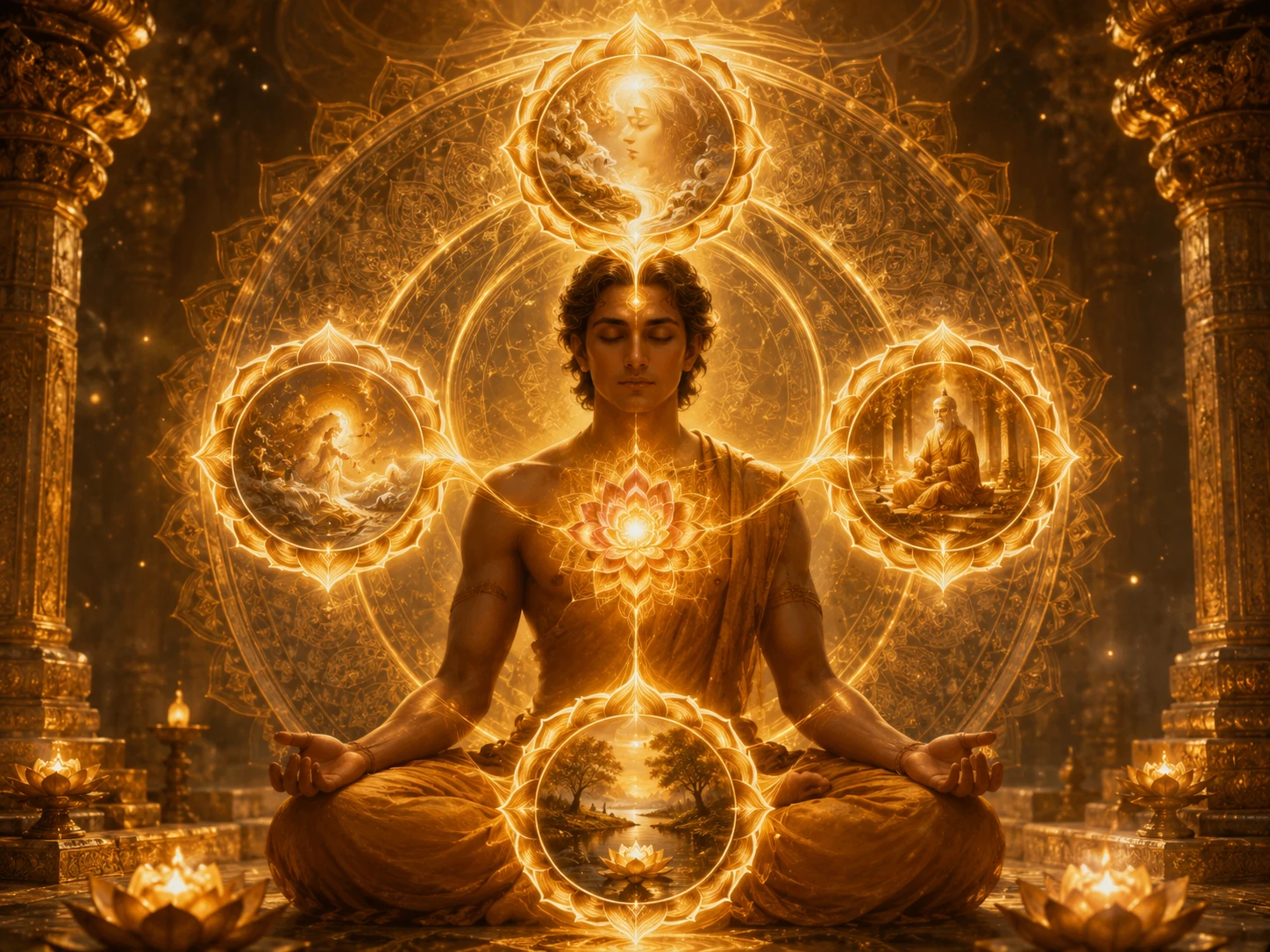
Antahkarana -- Manas, Buddhi, Chitta, Ahamkara
अन्तःकरण -- मनस्, बुद्धि, चित्त, अहंकार
You are walking down MG Road in Bangalore. A car horn blares. Your ears register the sound. Your eyes notice a red Maruti Suzuki swerving toward you. Something in you processes the sensory data -- that is Manas. Something in you instantly decides 'jump back' -- that is Buddhi. Something in you recalls that your cousin was hit by a car on this same road last year -- that is Chitta. And something in you, in the aftermath, thinks 'I nearly died, I must be more careful, this happened to ME' -- that is Ahamkara.
Four functions. One mind. Four names for the same organ operating in four modes. This is the Antahkarana -- literally 'the inner instrument' -- and it is Hindu philosophy's most precise map of the psychological apparatus.
The English word 'mind' is hopelessly vague. It collapses thinking, feeling, remembering, deciding, and self-referencing into a single term. Vedantic philosophy refuses this collapse. It insists that the mind has distinct functional modes that can be observed, trained, and ultimately transcended separately. Shankaracharya explains this in the Vivekachudamani (verses 93-96): the one Antahkarana is called by four different names according to the function it performs at any given moment. When it doubts and oscillates between options, it is Manas. When it decides and determines, it is Buddhi. When it remembers and stores impressions, it is Chitta. When it identifies with itself and says 'I', it is Ahamkara.
This is not just taxonomy for its own sake. The four-fold distinction has practical consequences. If you know which function is malfunctioning, you know what to fix. The Kota student who cannot concentrate is having a Manas problem -- sensory input is overwhelming Buddhi's capacity to process. The corporate executive who keeps making the same bad hiring decision has a Chitta problem -- past samskaras (impressions) are overriding current Buddhi. The social media influencer who cannot separate their self-worth from their follower count has an Ahamkara problem -- the ego has fused with a metric. Different problems, different solutions, same inner instrument.
मनोबुद्ध्यहङ्कार चित्तानि नाहं न च श्रोत्रजिह्वे न च घ्राणनेत्रे। न च व्योम भूमिर्न तेजो न वायुः चिदानन्दरूपः शिवोऽहम् शिवोऽहम्॥
manobuddhyahaṅkāra cittāni nāhaṃ na ca śrotrajihve na ca ghrāṇanetre | na ca vyoma bhūmirna tejo na vāyuḥ cidānandarūpaḥ śivo'ham śivo'ham ||
I am not the mind, not the intellect, not the ego, not the memory. I am not the ears, not the tongue, not the nose, not the eyes. I am not space, not earth, not fire, not air. I am of the nature of consciousness-bliss. I am Shiva, I am Shiva.
— Nirvana Shatakam, Verse 1 (Shankaracharya)
Let us examine each function in depth, because the precision of the Vedantic model is its greatest strength.
Manas -- the sensory mind, the import-export department. Manas is the function that interfaces with the external world through the ten Indriyas (five organs of knowledge, five organs of action). It receives raw sensory data -- sounds, sights, textures, tastes, smells -- and presents them to Buddhi for processing. Manas is also the seat of Sankalpa-Vikalpa: the oscillation between resolution and doubt, between 'should I?' and 'should I not?' When you stand in a restaurant scanning the menu, unable to choose between butter chicken and paneer tikka, that is Manas doing what it does -- presenting options without deciding. Manas cannot decide. It can only present.
The modern equivalent is your phone's notification system. Every ping, every alert, every social media update is Manas importing data. When your phone buzzes during a meeting, Manas says 'something happened'. It does not say 'this is important' or 'ignore it'. That evaluation is Buddhi's job. The epidemic of distraction that plagues the modern Indian -- the student who checks Instagram every three minutes, the professional who cannot finish an email without Alt-Tabbing to Slack -- is fundamentally a Manas problem: the import system is running unchecked because Buddhi has abdicated its supervisory role.
Buddhi -- the intellect, the decision-maker, the CEO. Buddhi determines, discriminates, and decides. When Manas presents the menu, Buddhi chooses. When Manas reports a suspicious shape in the dark, Buddhi says 'rope' or 'snake'. When you weigh a job offer -- salary versus location versus growth versus work-life balance -- that multidimensional analysis is Buddhi at work.
Buddhi has a hierarchy within itself. At its lowest function, it makes practical decisions (this brand of dal is cheaper). At its highest, it performs Viveka -- the discrimination between the real and the unreal, between Atman and Anatman, between the permanent and the impermanent. The entire project of Vedantic self-inquiry depends on a sharpened Buddhi. This is why every traditional guru emphasises Satsanga (association with the wise) and Swadhyaya (self-study) -- because these sharpen Buddhi the way a whetstone sharpens a blade.
Chitta -- memory, the subconscious storehouse. Chitta stores every impression (Samskara) you have ever absorbed. Every experience, every emotion, every sensory input that passed through Manas and was processed by Buddhi leaves a trace in Chitta. These traces do not just sit there passively. They influence future perceptions, decisions, and emotional reactions. The reason you flinch when a dog barks loudly is because Chitta stores the Samskara of being chased by a stray in childhood. The reason you feel inexplicably warm toward someone who wears jasmine is because Chitta stores the Samskara of your grandmother's gajra.
In modern terms, Chitta is the operating system's background processes -- running constantly, consuming resources, shaping the user experience without the user's conscious knowledge. Patanjali's Yoga Sutras open with 'Yogas Chitta Vritti Nirodhah' -- yoga is the cessation of the fluctuations of Chitta. This is because Chitta's stored impressions are what generate the endless chatter, the involuntary memories, the automatic emotional responses that keep you identified with the mind instead of recognising yourself as the witness.
Ahamkara -- the ego, the 'I-maker'. This is not ego in the Freudian sense (the mediator between id and superego) nor ego in the common sense (arrogance). Ahamkara is the function that appropriates experience and claims ownership. When Manas sees, Buddhi decides, and Chitta stores -- Ahamkara says 'I saw, I decided, I remember.' It converts impersonal processes into personal identity. Without Ahamkara, there would be seeing but no seer, thinking but no thinker, experiencing but no experiencer-identity.
The problem, according to Vedanta, is not that Ahamkara exists -- it is necessary for functioning in the world. The problem is that Ahamkara misidentifies. It says 'I am this body' (fusing with Annamaya Kosha). It says 'I am this emotion' (fusing with Manomaya). It says 'I am this job title' (fusing with a social construct). It says 'I am this JEE rank' (fusing with a number). Each fusion creates bondage. Each de-fusion is a step toward liberation. The entire Neti Neti practice is, in Antahkarana terms, the systematic de-fusion of Ahamkara from every object it has claimed as itself.
The Four Functions of Antahkarana
| Function | Sanskrit | Role | Operates Like | When It Malfunctions | Modern Parallel |
|---|---|---|---|---|---|
| Sensory Mind | Manas | Imports sensory data, oscillates between options (Sankalpa-Vikalpa) | Phone notification system -- always importing, never deciding | Distraction, inability to focus, sensory overload | ADHD symptoms, doomscrolling, notification addiction |
| Intellect | Buddhi | Discriminates, decides, determines truth from falsehood | The CEO -- reviews data from all departments and makes the call | Poor decisions, inability to commit, analysis paralysis | Decision fatigue, cognitive biases studied by Kahneman |
| Memory / Subconscious | Chitta | Stores all impressions (Samskaras), drives habits and automatic reactions | Hard drive + background processes -- always running, shaping behaviour | Trauma responses, addictive loops, unconscious bias | Implicit memory, Freud's unconscious, PTSD triggers |
| Ego / I-maker | Ahamkara | Claims ownership of experience, creates sense of individual identity | The branding department -- puts 'I' and 'mine' on everything | Identity fusion, narcissism, existential crisis when identity is threatened | Self-concept in psychology, imposter syndrome, identity politics |
All four functions are aspects of the same inner instrument, not four separate entities. They work together every moment. The Yoga Sutras address mainly Chitta. The Gita addresses mainly Buddhi. The Upanishads address mainly Ahamkara. A complete practice engages all four.
The Antahkarana model maps onto modern cognitive science with remarkable precision, and in some respects surpasses it.
Daniel Kahneman's dual-process theory -- System 1 (fast, automatic, intuitive) and System 2 (slow, deliberate, analytical) -- is essentially a two-fold model of what Vedanta mapped as a four-fold system. System 1 corresponds roughly to Manas + Chitta (automatic sensory processing plus stored patterns). System 2 corresponds to Buddhi (deliberate analysis and decision). Kahneman's model has no separate category for the ego-function -- the 'I' that claims authorship of decisions. Vedanta does, and it considers this function (Ahamkara) to be the root of all psychological suffering. If Kahneman had included an Ahamkara category, his model would have predicted not just cognitive biases but identity-based biases -- the tribal thinking, the defensive reasoning, the inability to change your mind because your sense of self is fused with your position. Which is, of course, exactly what we observe in political discourse, social media arguments, and board room conflicts across India and the world.
The Antahkarana model also explains meditation's mechanism more precisely than most neuroscience accounts. When you sit for meditation and try to focus on the breath, what happens? Manas keeps importing sensory data (sounds outside, bodily sensations). Chitta keeps surfacing old memories and future worries. Ahamkara keeps narrating ('I am meditating well' or 'I am bad at this'). Buddhi, if properly trained, observes all three and gently redirects attention to the breath. This is exactly what happens in every meditation session at every Vipassana centre, every Art of Living workshop, and every early-morning sadhana at an ashram in Rishikesh. The Antahkarana model does not just describe what the mind does. It tells you which part is doing what, so you know where to apply your effort.
For the young Indian navigating a psychologically complex world -- the startup founder managing stress and ambition simultaneously, the first-generation college student carrying family expectations as Chitta-weight, the NRI parent whose Ahamkara oscillates between two cultures -- the Antahkarana model is not philosophy to be studied. It is a user manual for the instrument you use every waking moment.
Shankaracharya's Nirvana Shatakam -- the six-verse hymn whose opening line declares 'Mano Buddhi Ahankara Chittani Naham' (I am not the mind, intellect, ego, or memory) -- is said to have been composed spontaneously by the eight-year-old Shankara when his future guru Govindapada asked him 'Who are you?' Instead of giving his name, caste, or village, the boy replied with six verses systematically negating every possible identification -- body, mind, Indriyas, elements, Gunas, social roles -- until only Chidananda (consciousness-bliss) remained. Whether the story is historical or hagiographic, the Nirvana Shatakam is today chanted daily in Advaita ashrams across India and has become one of the most recognisable Sanskrit chants on YouTube, Spotify, and the Eternal Raga app. It is, in effect, a complete Antahkarana de-identification exercise compressed into a three-minute kirtan.
Chant the Nirvana Shatakam
Shankara's Nirvana Shatakam is the antahkarana meditation in verse. Each stanza sets aside a layer of false identification -- mind, body, senses, elements, roles -- until only consciousness and bliss remain. Read it slowly, one verse a day; it is on Eternal Raga with its meaning.
Tags
Eternal Raga · शाश्वत राग
Institutional voice — scholarly articles on Sanatan Dharma
Deepen Your Understanding
अपनी समझ और गहरी करें
philosophy darshana
Panchakosha -- The Five Sheaths That Hide Your True Self
You are not your body. You are not your breath. You are not your thoughts. You are not even your bliss. The Taittiriya Upanishad says you are wrapped in five sheaths -- like a sword inside a scabbard -- and the real you is hidden at the centre, untouched by any of them. Peel off all five and what remains is Atman.
philosophy darshana
Neti Neti -- The Method of Negation That Reveals Everything
What is Brahman? Not the body. Not the mind. Not the intellect. Not the ego. Not the universe. Not even the gods. The Brihadaranyaka Upanishad's 'Neti Neti' is the most radical answer ever given to the most fundamental question -- an answer that works by refusing to answer, stripping away everything false until only truth remains.
philosophy darshana
Sattva, Rajas, Tamas -- The Three Gunas That Run Your Life
Every mood you have ever felt, every decision you have ever made, every Netflix binge and every 4 AM study session -- Hindu philosophy says it all comes down to three forces. Sattva illuminates, Rajas agitates, Tamas numbs. The Bhagavad Gita's Chapter 14 is essentially a 2,000-year-old personality framework that modern psychology is only now catching up to.
philosophy darshana
Yoga Darshana -- Patanjali's Science of the Mind
Before yoga became a global fitness trend worth $80 billion, it was India's most rigorous system of psychology. Patanjali's 196 sutras are not about touching your toes -- they are about rewiring your mind. Here is the philosophy the world forgot when it turned yoga into exercise.
philosophy darshana
Purusha and Prakriti -- The Witness and the Dance
A lame man climbs onto the shoulders of a blind man. Together they navigate a forest neither could cross alone. This 1,700-year-old image from the Sankhya Karika is the most elegant description of consciousness and matter ever composed -- and it explains why you suffer, why you act, and how you can stop confusing yourself with your thoughts.
philosophy darshana
Maya -- The Cosmic Illusion That Runs the Universe
You walk down a dark path and see a snake. Your heart pounds, your body freezes. Then someone brings a lamp. It was a rope. The snake was never there. Hindu philosophy says the entire universe works exactly like this -- and the lamp is called knowledge. Welcome to Maya, the most counterintuitive and most liberating idea in Indian thought.
philosophy darshana
Sankhya -- The Oldest Philosophy of Creation
Before the Bhagavad Gita. Before Patanjali. Before Shankaracharya. There was Sankhya -- a philosophy that explained everything from cosmic creation to human suffering without invoking God. Founded by Kapila, compressed into 72 devastating verses by Ishvarakrishna, and quietly embedded in every other Indian philosophical system that came after it.
Shankaracharya's Nirvana Shatakam -- the six-verse hymn whose opening line declares 'Mano Buddhi Ahankara Chittani Naham' (I am not the mind, intellect, ego, or memory) -- is said to have been composed spontaneously by t…
More in Philosophy & Darshana
The 14 Lokas -- Hindu Cosmology as a Map of Consciousness
14 min read
Achintya Bhedabheda -- Chaitanya's Theology of Inconceivable Difference-and-Unity
13 min read
Adhyasa -- Superimposition and the Foundational Error of the Self
13 min readThe same translation error that turned '33 Koti' into '33 crore' in Hinduism also happened in Buddhism. The Chinese translation of Buddhist texts rendered 'Sapta Koti Buddha' (7 Supreme Buddhas) as '7 Crore Buddhas.' The…
Deities AvatarsCommunity Reflections
🕉️
Be the first to share your reflection.