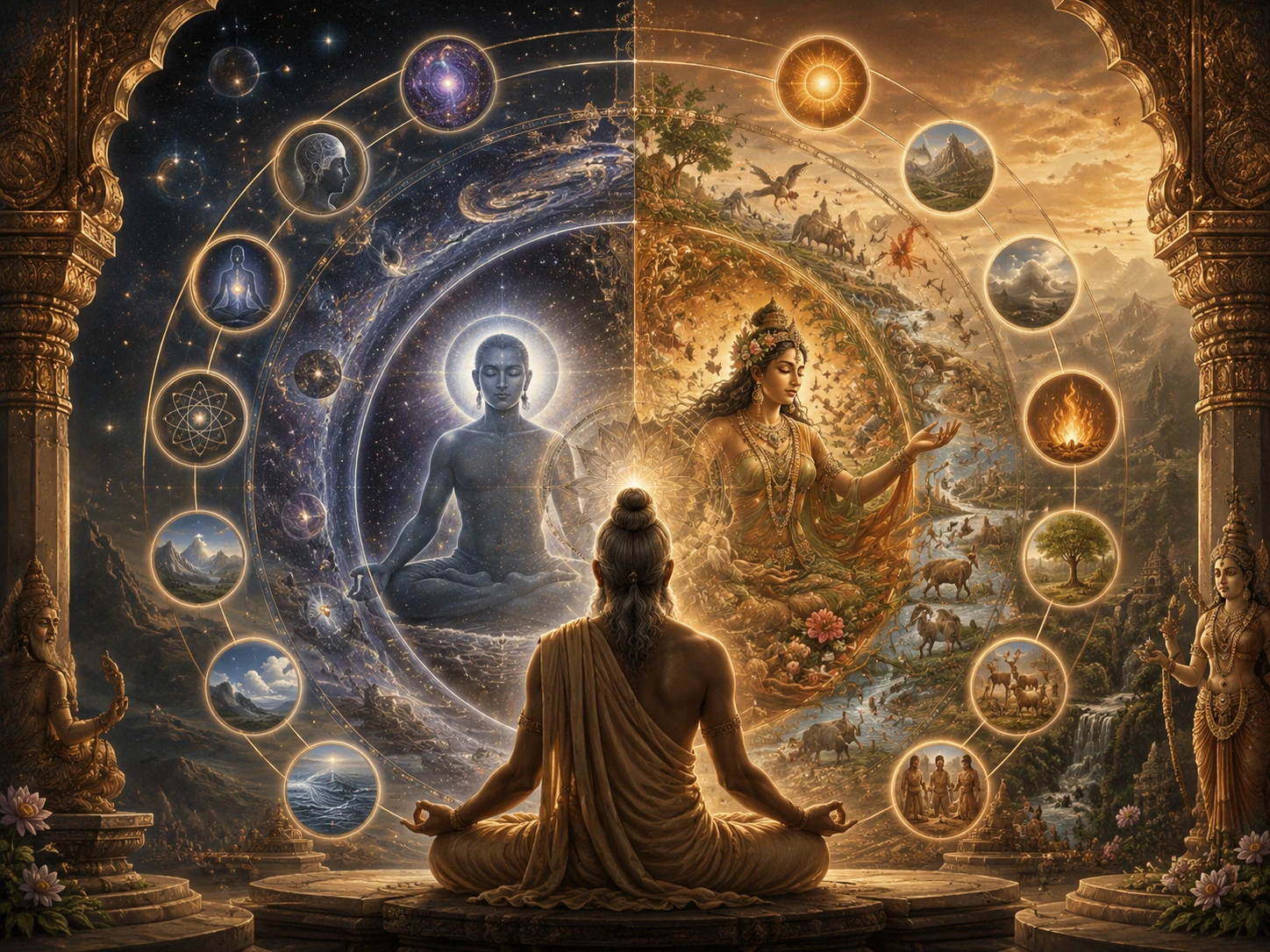
Sankhya -- The Oldest Philosophy of Creation
सांख्य -- सृष्टि का प्राचीनतम दर्शन
Every philosophy begins with a problem. For Sankhya, the problem is suffering.
Not poetic suffering. Not existential angst. Three precise, categorised types of suffering that between them account for every form of human misery. Adhyatmika -- suffering that originates within yourself, whether physical (a migraine, a torn ligament) or mental (anxiety, grief, envy). Adhibhautika -- suffering caused by other beings, from the colleague who undermines you to the mosquito that keeps you awake. Adhidaivika -- suffering caused by cosmic or natural forces beyond anyone's control, the earthquake that levels your city, the flood that swallows your harvest, the pandemic that rewrites the planet.
The very first verse of the Sankhya Karika opens with this: from the affliction of the three-fold suffering arises the desire to know its cause and cure. This is not a spiritual invitation. It is a clinical statement. Samkhya begins where medicine begins -- with diagnosis -- and builds an entire philosophy as the prescription.
What makes Sankhya remarkable is not just its antiquity (it may be the oldest systematic philosophy in the world, predating both Greek and Chinese philosophical traditions in its early forms) but its method. Sankhya does not ask you to believe. It asks you to count. The word 'Sankhya' itself means 'enumeration' or 'number'. The system proceeds by careful, logical analysis -- distinguishing, categorising, and classifying every element of experience until no residue remains unexplained. It arrives at exactly 25 fundamental categories (Tattvas) that, according to its claim, account for everything that exists and everything that can be experienced. Nothing more is needed. Nothing less will do.
दुःखत्रयाभिघाताज्जिज्ञासा तदभिघातके हेतौ। दृष्टे साऽपार्था चेन्नैकान्तात्यन्ततोऽभावात्॥
duḥkhatrayābhighātājjijñāsā tadabhighātake hetau | dṛṣṭe sā'pārthā cennaikāntātyantato'bhāvāt ||
From the torment of the three-fold suffering arises the desire to know the means of its removal. If you say that visible remedies suffice, no -- for they are neither certain nor permanent.
— Sankhya Karika, Verse 1 (Ishvarakrishna)
The opening verse's second half is as important as its first. It anticipates the obvious objection: why do we need philosophy at all? We have medicine for bodily pain, police for threats from others, and engineering for natural disasters. These are the 'visible remedies' (drishta). Sankhya's reply is devastating in its precision: these remedies are neither ekanta (certain -- they do not always work) nor atyanta (permanent -- they do not last). You cure one disease and another appears. You lock your door against one thief and another finds a window. You build a dam against one flood and the next one is bigger.
This is not pessimism. It is an empirical observation about the nature of material solutions. Every external fix has a shelf life. The AC breaks down. The insurance policy has exclusions. The promotion brings new stress. Sankhya's claim is that a different kind of knowledge -- discriminative knowledge (viveka-jnana) that distinguishes consciousness (Purusha) from matter (Prakriti) -- can end suffering at its root, not by changing external circumstances but by changing the fundamental confusion about who is suffering and what suffering is.
The historical context matters here. Sankhya emerged in a world of intense philosophical competition. The Vedic ritualist tradition (Purva Mimamsa) argued that the solution to suffering was correct performance of rituals. The materialist Charvakas argued that since only matter exists, the solution is to maximise pleasure. The early Buddhists argued that the self is an illusion and suffering ends when the illusion is seen through. The Jains argued for extreme asceticism as the path to liberating the soul from karmic matter. Sankhya carved its own path: suffering has a precise cause (the confusion of Purusha with Prakriti), a precise mechanism (the evolution of Prakriti through the three Gunas), and a precise cure (the discriminative knowledge that untangles the two). No ritual needed. No god needed. No self-torture needed. Just clear seeing.
Sage Kapila is traditionally credited as the founder of Sankhya. The Bhagavata Purana identifies Kapila as an incarnation of Vishnu who taught Sankhya to his mother Devahuti -- an origin story that neatly resolves the awkward fact of an orthodox Hindu school being non-theistic by making its founder divine. The Mahabharata's Shanti Parva references Kapila extensively. The Svetasvatara Upanishad mentions him. But no surviving text is directly attributed to Kapila himself.
What we have is the Sankhya Karika of Ishvarakrishna, composed around the 4th century CE, which is the definitive surviving text of the school. It was so influential that it was translated into Chinese by Paramartha in the 6th century -- making it one of the earliest Indian philosophical texts to travel to East Asia. Gaudapada (the teacher of Shankaracharya's teacher Govindapada) wrote one of the most important commentaries on it. Vachaspati Mishra, the polymath commentator who wrote across every school of Hindu philosophy, produced the Tattvakaumudi on the Sankhya Karika -- considered the clearest exposition of the system.
The Sankhya Karika is 72 verses in Arya metre -- a musical, rhythmic pattern that makes the verses memorisable. This was deliberate. In an oral tradition, philosophical systems had to be compressed into forms that could be chanted, transmitted, and preserved without writing. The entire Sankhya system -- its ontology, epistemology, ethics, and soteriology -- fits in a text shorter than most WhatsApp group chats. That compression is itself a philosophical achievement.
For the UPSC aspirant preparing Indian Philosophy as an optional subject, Sankhya is essential. It appears in questions about the Shad Darshana, about the Gita's philosophical framework, about Yoga's theoretical basis, and about the history of Indian materialism and dualism. Understanding Sankhya well unlocks at least four other systems: Yoga (which shares its ontology), the Gita (which uses its vocabulary), Advaita Vedanta (which borrows and then transcends it), and Ayurveda (which uses its Guna theory as its physiological basis).
The architecture of Sankhya's 25 Tattvas is not a random list. It is a logical cascade -- each category necessarily giving rise to the next, like a tree branching from its seed.
At the root is Prakriti -- unmanifest, uncaused, eternal. She is the equilibrium of three Gunas (Sattva, Rajas, Tamas) in perfect balance. When this balance is disturbed by the mere presence of Purusha (consciousness), evolution begins.
First to emerge is Mahat, also called Buddhi -- the cosmic intellect, the faculty of discrimination and determination. This is not your personal intellect but the principle of intellect itself, the capacity that allows reality to be known. In modern terms, if the universe is a vast computation, Mahat is the emergence of the capacity to process information at all.
From Mahat arises Ahamkara -- the ego-principle. This is not pride or vanity in the ordinary sense. It is the primordial sense of 'I' -- the point at which undifferentiated awareness becomes localised, personalised, and directional. It is the moment the universal becomes individual. Every identity crisis you have ever experienced, from your first day at college to your last appraisal meeting in a Gurugram office tower, is a drama playing out within the field of Ahamkara.
Ahamkara then branches in three directions. Under the influence of Sattva, it produces the five organs of knowledge (Jnana Indriyas: hearing, touch, sight, taste, smell) and the coordinating mind (Manas). Under Rajas, it produces the five organs of action (Karma Indriyas: speech, grasping, locomotion, excretion, reproduction). Under Tamas, it produces the five subtle elements (Tanmatras: sound, touch, form, taste, smell as pure potentials), and from these arise the five gross elements (Mahabhutas: space, air, fire, water, earth).
The total: 1 (Prakriti) + 1 (Mahat) + 1 (Ahamkara) + 11 (5 Jnana + 5 Karma + 1 Manas) + 5 (Tanmatras) + 5 (Mahabhutas) = 24. Add Purusha as the 25th, and the enumeration is complete.
This is not mythology dressed as philosophy. It is systematic ontology -- a complete theory of categories that accounts for every type of entity in the universe. The Indian Institute of Science in Bangalore investigates matter (Mahabhutas). The National Institute of Mental Health and Neurosciences (NIMHANS) investigates mind (Manas, Buddhi, Ahamkara). The consciousness researchers at IIT Kanpur's cognitive science lab investigate Purusha. Sankhya had the entire map 1,700 years before these institutions existed.
Sankhya vs Other Darshanas -- How the Six Systems Compare
| Feature | Sankhya | Yoga | Nyaya | Vaisheshika | Mimamsa | Vedanta |
|---|---|---|---|---|---|---|
| Core question | What causes suffering and how to end it? | How to still the mind and achieve Kaivalya? | How do we know what is true? | What are the atoms of reality? | How to correctly perform Vedic rituals? | What is the nature of Brahman? |
| Key text | Sankhya Karika (Ishvarakrishna) | Yoga Sutras (Patanjali) | Nyaya Sutras (Gautama) | Vaisheshika Sutras (Kanada) | Mimamsa Sutras (Jaimini) | Brahma Sutras (Badarayana) |
| Position on God | Nirishvara (God not needed) | Accepts Ishvara as a special Purusha | Accepts God as creator | God as efficient cause | God not central; ritual is | Brahman is supreme reality |
| Metaphysics | Dualist: Purusha + Prakriti | Dualist (adopted from Sankhya) | Pluralist: many substances | Atomist: 9 substances | Realist: world is real | Varies: Non-dual, Qualified, Dual |
| Path to liberation | Viveka-jnana (discriminative knowledge) | Samadhi through 8 limbs | Correct logical reasoning | Knowledge of atomic categories | Correct ritual performance | Jnana, Bhakti, or Karma Yoga |
| Relationship with Sankhya | The source | Shares ontology; adds practice | Different framework; respects Sankhya | Complementary physics | Different goals; minimal overlap | Borrows and transcends Sankhya |
Sankhya and Yoga are traditionally paired (samana-tantra). Nyaya and Vaisheshika are paired. Mimamsa and Vedanta are paired. Together these six constitute the Shad Darshana -- the six orthodox philosophical schools of Hinduism.
Sankhya's epistemology -- its theory of valid knowledge -- is characteristically lean. It accepts only three Pramanas (means of valid knowledge): Pratyaksha (direct perception), Anumana (inference), and Shabda (reliable verbal testimony, particularly scriptural). Compare this to Nyaya, which accepts four (adding Upamana, or analogy), or Advaita Vedanta, which accepts six. Sankhya's minimalism is deliberate. It wants the smallest possible toolkit that gets the job done.
The three Pramanas map onto how we actually learn. Pratyaksha: you see fire and feel heat. Anumana: you see smoke on a distant hill and infer fire. Shabda: a trustworthy person (or text) tells you there is fire on the hill. Sankhya argues that everything we need to know about reality can be established through these three channels and no others.
But the most important knowledge Sankhya seeks -- the knowledge that Purusha is distinct from Prakriti -- cannot come from Pratyaksha alone, because Purusha is not a sense-object. You cannot see consciousness the way you see a table. Anumana helps: from the fact that there is experience, you infer an experiencer. But final clarity comes from Shabda -- the testimony of the Karika itself, the teaching of a guru, the accumulated wisdom of the tradition. This is not blind faith. It is trust in testimony that has been verified by generations of practitioners, the same way you trust a textbook on physics not because you have personally verified every experiment but because a tradition of reliable knowers stands behind it.
This epistemological framework has contemporary relevance for anyone navigating India's information-saturated landscape. The WhatsApp forward claiming miraculous health benefits of turmeric fails all three Pramanas: no controlled perception, no valid inference, no reliable testimony. The peer-reviewed paper from AIIMS meets all three. Sankhya's epistemology is, in effect, a 1,700-year-old fake news filter.
Sankhya's model of liberation is refreshingly non-dramatic. There is no cosmic event. No descent of grace. No sudden thunderclap of awakening (though later Bhakti traditions would add these dimensions). In Sankhya, liberation happens the moment Purusha fully recognises that it is not Prakriti. That is all.
The Karika uses two unforgettable images for this. In verse 59, Prakriti is compared to a dancer (nartaki) who performs for the audience (Purusha). Once the performance is fully seen and understood, the dancer withdraws. She does not need to be forced off stage. The show simply ends because its purpose is complete. In verse 65, the liberated Purusha is compared to a spectator (prekshakavat) who watches Prakriti with complete clarity -- clean, pure, uninvolved. The word 'svaccha' (transparent, clean) is used for Purusha's nature after liberation.
What does this look like in lived experience? According to Sankhya, the liberated person still has a body, still eats, still interacts with the world. The subtle body (lingasharira) continues until the momentum of past karma is exhausted -- like a potter's wheel that keeps spinning after the potter removes his hand. But the confusion is over. The liberated Purusha no longer says 'I am happy' or 'I am sad'. It recognises that happiness and sadness are Prakriti's movements, and it -- consciousness -- is the unmoving witness.
This is not escapism. The IITian who understands Sankhya does not drop out of placements. The doctor at AIIMS does not stop treating patients. The cricketer does not stop playing. But the inner relationship to these activities changes fundamentally. You act without being entangled. You experience without being consumed. You live without being confused about what is living and what is watching the living happen.
Sankhya does not promise bliss. It promises clarity. And in a civilisation that produced the concept of Maya (cosmic illusion), clarity may be the most radical promise of all.
Sankhya's influence extends far beyond Hindu philosophy. The Buddhist Abhidharma tradition's detailed enumeration of dharmas (categories of existence) bears striking structural similarity to Sankhya's Tattva system -- leading scholars like Erich Frauwallner to argue that early Buddhism was significantly influenced by proto-Sankhya thought. The Jain concept of Jiva (soul) and Ajiva (non-soul) parallels Purusha-Prakriti. Even in modern India, Sankhya's Guna theory underpins the entire Ayurvedic medical system -- your Prakriti-type (Vata, Pitta, Kapha) at any Ayurvedic clinic in Kerala is diagnosed using categories that trace directly back to Samkhya's three Gunas. The next time you take a Prakriti quiz on an Ayurvedic wellness app, you are using a 1,700-year-old philosophical framework.
Practise Viveka -- Discriminative Meditation
Sit quietly and practise the core Sankhya exercise: distinguish what changes from what does not. Thoughts change -- awareness does not. Emotions change -- the witness does not. Body changes -- consciousness does not. This is Viveka, the heart of Sankhya's liberation.
Tags
Eternal Raga · शाश्वत राग
Institutional voice — scholarly articles on Sanatan Dharma
Deepen Your Understanding
अपनी समझ और गहरी करें
philosophy darshana
Purusha and Prakriti -- The Witness and the Dance
A lame man climbs onto the shoulders of a blind man. Together they navigate a forest neither could cross alone. This 1,700-year-old image from the Sankhya Karika is the most elegant description of consciousness and matter ever composed -- and it explains why you suffer, why you act, and how you can stop confusing yourself with your thoughts.
philosophy darshana
Sattva, Rajas, Tamas -- The Three Gunas That Run Your Life
Every mood you have ever felt, every decision you have ever made, every Netflix binge and every 4 AM study session -- Hindu philosophy says it all comes down to three forces. Sattva illuminates, Rajas agitates, Tamas numbs. The Bhagavad Gita's Chapter 14 is essentially a 2,000-year-old personality framework that modern psychology is only now catching up to.
philosophy darshana
Yoga Darshana -- Patanjali's Science of the Mind
Before yoga became a global fitness trend worth $80 billion, it was India's most rigorous system of psychology. Patanjali's 196 sutras are not about touching your toes -- they are about rewiring your mind. Here is the philosophy the world forgot when it turned yoga into exercise.
philosophy darshana
Atman and Brahman -- The Self and the Absolute
The Upanishads make a claim so radical that 3,000 years have not dulled its edge: the individual self (Atman) and the ultimate reality of the universe (Brahman) are not two different things. They are one. Every school of Hindu philosophy is essentially an argument about what this identity means.
philosophy darshana
Dvaita vs Advaita -- The Greatest Debate in Hindu Philosophy
Are you and God the same being, temporarily confused? Or are you and God eternally different, connected by love but never identical? This question split Hindu philosophy into rival schools, produced centuries of razor-sharp debate, and still determines whether you pray saying 'I am Brahman' or 'I am Brahman's servant'. The answer depends on which genius you believe -- Shankaracharya or Madhvacharya.
philosophy darshana
Panchakosha -- The Five Sheaths That Hide Your True Self
You are not your body. You are not your breath. You are not your thoughts. You are not even your bliss. The Taittiriya Upanishad says you are wrapped in five sheaths -- like a sword inside a scabbard -- and the real you is hidden at the centre, untouched by any of them. Peel off all five and what remains is Atman.
philosophy darshana
Antahkarana -- Manas, Buddhi, Chitta, Ahamkara
Your mind is not one thing. It is a factory with four departments -- a sensory processor (Manas), a decision-maker (Buddhi), a memory bank (Chitta), and an ego that claims credit for everything (Ahamkara). Hindu philosophy mapped these 1,200 years before cognitive science, and the map is still more elegant than anything a neuroscience lab has produced.
Sankhya's influence extends far beyond Hindu philosophy. The Buddhist Abhidharma tradition's detailed enumeration of dharmas (categories of existence) bears striking structural similarity to Sankhya's Tattva system -- le…
More in Philosophy & Darshana
The 14 Lokas -- Hindu Cosmology as a Map of Consciousness
14 min read
Achintya Bhedabheda -- Chaitanya's Theology of Inconceivable Difference-and-Unity
13 min read
Adhyasa -- Superimposition and the Foundational Error of the Self
13 min readThe same translation error that turned '33 Koti' into '33 crore' in Hinduism also happened in Buddhism. The Chinese translation of Buddhist texts rendered 'Sapta Koti Buddha' (7 Supreme Buddhas) as '7 Crore Buddhas.' The…
Deities AvatarsCommunity Reflections
🕉️
Be the first to share your reflection.