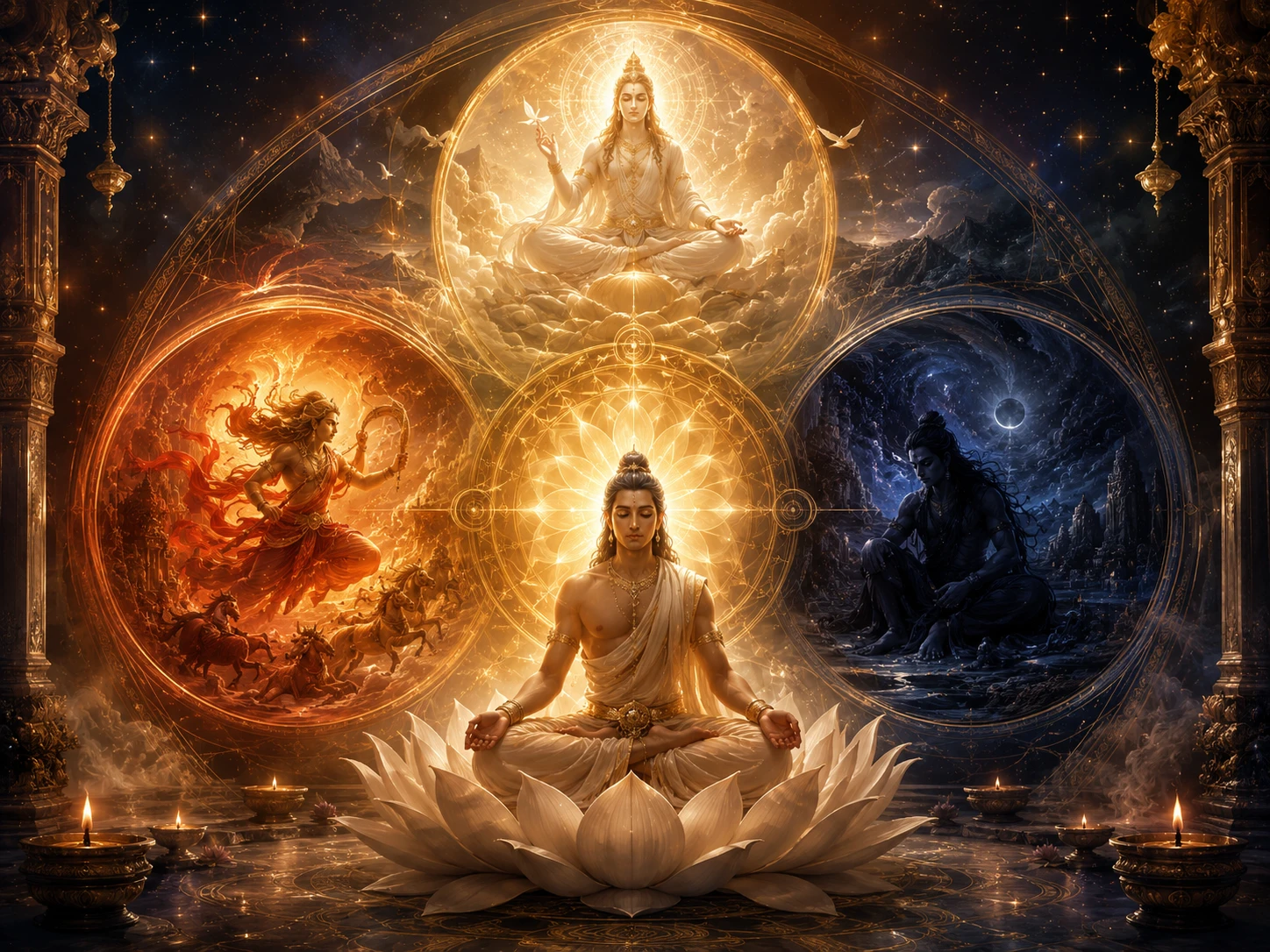
Sattva, Rajas, Tamas -- The Three Gunas That Run Your Life
सत्त्व, रजस्, तमस् -- तीन गुण जो तुम्हारी ज़िन्दगी चलाते हैं
You wake up at 5 AM, mind clear, body light, the world feels crisp and full of possibility. You meditate without effort. You study without distraction. Ideas arrive fully formed. That is Sattva.
Two days later, you are pacing your room at midnight, heart racing, three tabs open on your laptop, replying to WhatsApp groups you should have muted, planning a business you will abandon by Thursday. You are restless, ambitious, irritable, and convinced you are being productive. That is Rajas.
Another day, you cannot get off the couch. You have watched seven episodes of something you do not even like. Your alarm went off three times and you hit snooze each time. The JEE textbook is on the table where you left it four days ago. You know you should move but something heavy and shapeless keeps you pinned. That is Tamas.
Hindu philosophy did not discover these states. Every human being who has ever lived has cycled through them. What Hindu philosophy did -- specifically the Samkhya school, and later the Bhagavad Gita -- was name them, systematize them, explain their mechanics, and offer a path beyond them. The three Gunas are not a spiritual metaphor. They are an operational model of the mind -- arguably the oldest psychological framework in human civilisation, predating Freud's id-ego-superego by at least two millennia.
सत्त्वं रजस्तम इति गुणाः प्रकृतिसम्भवाः। निबध्नन्ति महाबाहो देहे देहिनमव्ययम्॥
sattvaṃ rajastama iti guṇāḥ prakṛtisambhavāḥ | nibadhnanti mahābāho dehe dehinamavyayam ||
Sattva, Rajas, and Tamas -- these three Gunas born of Prakriti bind the imperishable soul to the body, O mighty-armed Arjuna.
— Bhagavad Gita, Chapter 14, Verse 5
The word 'Guna' in Sanskrit literally means 'rope' or 'strand'. Picture three ropes -- one white, one red, one black -- braided together into a single cord. That cord is your personality, your tendencies, your moment-to-moment experience of being alive. The proportion of each strand changes constantly. You are not permanently Sattvic or permanently Tamasic. You shift between them -- sometimes within a single hour.
This is the first radical insight of Guna theory: personality is not fixed. It is a dynamic ratio. The Bhagavad Gita explicitly states this in verse 14.10 -- sometimes Sattva predominates by suppressing Rajas and Tamas, sometimes Rajas overpowers the other two, sometimes Tamas smothers both. The interplay is constant, like weather systems colliding over a landscape.
The second radical insight: all three Gunas bind you. Not just Tamas, not just Rajas -- even Sattva is a chain. The Gita is unambiguous about this. Verse 14.6 says Sattva binds through attachment to happiness and knowledge. The IAS officer who cannot stop acquiring degrees, the meditator who becomes addicted to the bliss state, the scholar who hoards knowledge like currency -- they are all Sattvically bound. The golden chain is still a chain.
This is where Guna theory parts ways with simplistic self-help. Modern wellness culture would tell you to just be more positive, more calm, more balanced -- essentially, be more Sattvic. The Gita says: go beyond all three. Become Gunatita -- the one who has transcended the Gunas entirely. That is Chapter 14's ultimate teaching, and it is a destination most people do not even know exists.
Let us examine each Guna in detail, because the Bhagavad Gita does not treat them as abstract categories. It gives precise, observable symptoms for each -- almost like a diagnostic manual.
Sattva is characterised by clarity, lightness, luminosity, and a natural inclination toward knowledge and happiness. When Sattva dominates, you think clearly, act ethically without effort, feel a quiet contentment that does not depend on external circumstances. The Gita says 'all the gates of the body are illumined by knowledge' when Sattva prevails (14.11). Think of your best study sessions at the library -- not the frantic ones before an exam, but the ones where you sat down and the material simply made sense. That focused, luminous clarity is Sattva at work.
But Sattva has a trap. It binds through sukha-sanga (attachment to pleasure) and jnana-sanga (attachment to knowledge). The UPSC aspirant in Old Rajinder Nagar who has been 'preparing' for seven years and cannot stop because the identity of being a serious aspirant has become more important than actually clearing the exam -- that is Sattvic bondage. The yoga teacher in Rishikesh who has built an entire persona around being peaceful and now cannot allow themselves a moment of honest anger -- Sattvic bondage. The coder at a Bangalore startup who reads documentation for pleasure and judges colleagues who do not -- Sattvic bondage wearing the mask of excellence.
Rajas is characterised by desire, restlessness, attachment, and compulsive activity. When Rajas dominates, greed and worldly ambition flare up. You cannot sit still. Every notification demands response. Every conversation becomes a negotiation. The Gita lists the symptoms precisely: lobha (greed), pravritti (hyperactivity), arambha (compulsive starting of new projects), ashama (inability to rest), and spriha (craving) -- all in verse 14.12.
The Rajasic person is the startup founder who pitches a new idea every month but ships nothing. The Instagram influencer refreshing analytics at 2 AM. The engineering student juggling five clubs, two internships, and a YouTube channel, running on caffeine and cortisol, calling it hustle. The Kota coaching student who does not study to learn but to beat -- the rank is everything, the knowledge is incidental. Rajas looks like ambition. It feels like purpose. But underneath it is an engine that cannot be turned off, fuelled not by vision but by anxiety disguised as drive.
Tamas is characterised by darkness, delusion, heaviness, negligence, and sleep. When Tamas prevails, confusion and inertia set in. You know what you should do but cannot bring yourself to do it. The Gita's words are sharp: aprakasha (absence of light), apravritti (inactivity), pramada (negligence), moha (delusion) -- verse 14.13. Tamas is not rest. Rest is Sattvic. Tamas is the inability to act even when you want to. It is the Sunday that stretches from morning to midnight with nothing accomplished and a vague sense of guilt hanging over everything.
The college student who has not attended class in three weeks and is now too ashamed to show up -- Tamas. The middle-aged professional in a Gurugram apartment who has been meaning to exercise for two years -- Tamas. The NRI family that knows they should teach their children Hindi but it is easier to let it slide -- Tamas in cultural form. Tamas is not evil. It is gravity. And like gravity, it requires deliberate effort to overcome.
सत्त्वं सुखे सञ्जयति रजः कर्मणि भारत। ज्ञानमावृत्य तु तमः प्रमादे सञ्जयत्युत॥
sattvaṃ sukhe sañjayati rajaḥ karmaṇi bhārata | jñānamāvṛtya tu tamaḥ pramāde sañjayatyuta ||
Sattva binds one to happiness, Rajas binds to action, O Bharata. And Tamas, veiling knowledge, binds one to negligence and heedlessness.
— Bhagavad Gita, Chapter 14, Verse 9
The Three Gunas -- A Diagnostic Chart
| Aspect | Sattva (Harmony) | Rajas (Activity) | Tamas (Inertia) |
|---|---|---|---|
| Core quality | Clarity, lightness, illumination | Desire, restlessness, compulsive action | Darkness, heaviness, delusion |
| Binds through | Attachment to happiness and knowledge (BG 14.6) | Attachment to action and its fruits (BG 14.7) | Negligence, sleep, and heedlessness (BG 14.8) |
| When dominant, you feel | Clear, calm, compassionate, focused | Driven, agitated, ambitious, unable to rest | Confused, lethargic, avoidant, numb |
| Colour in tradition | White (shukla) | Red (rakta) | Black (krishna) |
| Time of day | Brahma Muhurta and early morning | Midday and afternoon | Late night and pre-dawn darkness |
| Food association | Fresh, light, nourishing -- fruits, milk, ghee | Spicy, sour, salty -- stimulating foods | Stale, overprocessed, reheated, fermented |
| After death (BG 14.14-15) | Higher realms of the wise | Reborn among those driven by action | Born into confusion and lower states |
| Modern Indian parallel | The IIT professor who teaches for love of subject | The startup founder chasing the next funding round | The employee on autopilot, counting days to weekend |
| Trap to watch for | Spiritual pride, knowledge hoarding, self-righteousness | Burnout, anxiety, mistaking motion for progress | Procrastination spirals, depression, avoidance loops |
All three Gunas are present in every person at all times. The ratio changes constantly. The goal is not to eliminate Rajas and Tamas but to transcend all three -- becoming Gunatita (BG 14.22-25).
The Bhagavad Gita does not stop at diagnosis. Chapters 17 and 18 extend Guna theory into every domain of life -- food, worship, charity, knowledge, action, and even happiness itself. This makes the Guna framework astonishingly comprehensive. It is not just about your mental state. It is about what you eat (17.8-10), how you give (17.20-22), what kind of knowledge you seek (18.20-22), how you act (18.23-25), and what you consider happiness (18.36-39).
Consider food. Sattvic food is fresh, nourishing, and promotes clarity -- think of the simple dal-chawal-ghee that your grandmother swears by. Rajasic food is overly spicy, sour, and stimulating -- the Maggi with extra masala at midnight in your hostel room. Tamasic food is stale, overprocessed, and lifeless -- the three-day-old pizza reheated in a microwave at a Pune IT park.
Consider charity. Sattvic dana is given at the right place, right time, to a worthy recipient, with no expectation of return. Rajasic dana is given grudgingly, or with expectation of recognition -- the corporate CSR event with more photographers than beneficiaries. Tamasic dana is given at the wrong place, to the wrong person, with contempt -- tossing a coin at someone while looking the other way.
The genius of this framework is that it does not moralize. It observes. It says: here are three tendencies. They are always operating. Learn to see which one is driving you right now. That seeing itself is the beginning of freedom.
Modern psychology has arrived at remarkably similar frameworks. The Positive Psychology movement talks about states of 'flow' (Sattvic), 'stress arousal' (Rajasic), and 'learned helplessness' (Tamasic). Cognitive Behavioral Therapy identifies thought patterns that map almost exactly onto the three Gunas -- clear thinking versus catastrophizing versus avoidance. The Circadian Rhythm research shows that Sattvic states naturally peak in early morning, Rajasic states dominate afternoon, and Tamasic states take over late night -- exactly as described in Ayurvedic texts that divide the day into Guna-dominant periods.
The difference is that modern psychology treats these as separate discoveries. The Guna framework unifies them into a single, elegant model -- and then adds a dimension that modern psychology does not have: the possibility of transcendence.
The Mahabharata offers perhaps the most vivid dramatisation of the three Gunas in action through its principal characters. Yudhishthira is the Sattvic ideal -- truthful to a fault, committed to dharma even when it costs him his kingdom, his wife, and his freedom. His refusal to lie even when a single untruth could win the Kurukshetra war outright is Sattva taken to its logical extreme. But notice the trap: his adherence to truth becomes rigidity, his dharmic certainty becomes a form of pride, and his 'Sattvic' gambling session (he believed he was honouring a Kshatriya duty) leads to the most catastrophic event in the epic. Sattva, unchecked, created the conditions for the dice game.
Duryodhana is Rajas incarnate. His ambition is limitless. His restlessness is constant. He cannot tolerate Yudhishthira's prosperity even for a moment. The golden throne of Hastinapura is not enough -- he needs to know that no one else sits on any throne. Every strategic move he makes is driven by lobha (greed) and matsarya (envy). He is the founder who cannot celebrate a competitor's success, the MBA student who tracks classmates' LinkedIn profiles obsessively, the cricketer who sledges not to win but because silence feels like losing. Duryodhana is the most talented Rajasic personality in Indian literature -- and his story is the most complete illustration of where unchecked Rajas leads.
Kumbhakarna, Ravana's brother in the Ramayana, is Tamas made flesh. His defining characteristic is sleep -- not ordinary sleep, but cosmic-level hibernation for six months at a stretch. When awakened to fight Rama's army, he is confused, disoriented, and fights not out of conviction but out of loyalty to a brother he knows is wrong. He tells Ravana to his face that abducting Sita was adharma, yet picks up his mace and walks to the battlefield anyway. That is the Tamasic tragedy: knowing the right path but being too heavy, too inert, too bound by existing momentum to change course.
In everyday India, these three characters map onto recognisable archetypes. The IAS officer who follows procedure with such devotion that a drought-stricken village waits three months for a file to move -- Sattvic rigidity. The Shark Tank India contestant who has pivoted seven times in two years and calls each pivot 'strategy' -- Rajasic restlessness. The government department where files gather dust and tea is served at precise intervals regardless of whether work happens -- Tamasic institutional inertia. The Gunas are not just personal. They operate at the level of families, organisations, cities, and civilisations.
The Gunatita -- the person who has transcended the three Gunas -- is described in verses 14.22-25 of the Gita, and the portrait is striking in its ordinariness. Arjuna asks Krishna: how does one recognise such a person? What are their signs? How do they behave?
Krishna's answer is not about supernatural powers or visible auras. The Gunatita does not hate illumination when it comes, does not hate activity when it arises, does not hate delusion when it appears. They do not crave any of these states when they are absent. They sit like a witness, unmoved, established in the Self. They treat a lump of earth, a stone, and gold alike. They are equal toward the pleasant and the unpleasant, the praise and the blame, the honour and the dishonour. They treat friend and enemy alike. They have abandoned all undertakings motivated by desire.
This is not indifference. This is equanimity -- and the distinction matters enormously. The indifferent person does not care. The equanimous person cares deeply but is not destabilised by outcomes. Think of MS Dhoni in a World Cup final -- fully engaged, fully present, but the scoreboard does not own his nervous system. That is the closest modern Indian analogy to the Gunatita state. Dhoni does not stop playing. He stops being played by the game.
And how does one reach this state? Krishna's answer in 14.26 is breathtaking in its simplicity: through unswerving Bhakti Yoga -- unwavering devotion. Not through analysis alone, not through renunciation alone, not through action alone -- but through love directed at the divine with absolute consistency. The intellectual system of the Gunas resolves, ultimately, in the heart.
The Guna framework maps remarkably onto modern psychological models. Martin Seligman's PERMA model of well-being (Positive emotion, Engagement, Relationships, Meaning, Accomplishment) describes essentially Sattvic flourishing. Mihaly Csikszentmihalyi's concept of 'Flow' -- the state of optimal experience -- matches Sattva's illuminated clarity almost exactly. Meanwhile, the burnout epidemic documented in WHO's 2019 classification echoes the Rajasic trap of compulsive action, and the 'languishing' state described by Adam Grant during the pandemic mirrors Tamas with uncanny precision. The Gita had a unified theory for what modern psychology discovered in fragments across different decades and different researchers.
If you take one practical thing from the Guna framework, let it be this: awareness of your current Guna state is the first step to changing it.
When you catch yourself in Tamas -- sluggish, avoidant, numbed -- do not try to leap straight to Sattva. That almost never works. Instead, introduce Rajas first. Move your body. Go for a walk. Make a phone call. Start with small action, any action. Rajas is the bridge out of Tamas.
When you catch yourself in Rajas -- frantic, scattered, unable to stop -- do not add more activity. Introduce Sattva deliberately. Sit still for five minutes. Read something with depth instead of scrolling. Cook a simple meal instead of ordering in. Sattva settles Rajas the way a clear sky settles a storm.
And when you find yourself in Sattva -- clear, calm, luminous -- enjoy it, but do not grasp it. The moment you try to hold onto it, you have converted it into Rajasic craving for a Sattvic state, and you have lost the very thing you were trying to keep.
The Gita's ultimate message is not about optimising your Guna mix. It is about recognising that you are not the Gunas at all. You are the Purusha watching the Gunas play. You are the audience, not the actors. When that recognition stabilises, the ropes that bind you begin to loosen -- not because you cut them, but because you realise they were never attached to the real you in the first place.
Observe Your Gunas -- A Guided Meditation
Sit quietly and observe which Guna is dominant in you right now. Are you clear and calm (Sattva)? Restless and driven (Rajas)? Heavy and avoidant (Tamas)? This simple practice of Guna-awareness, repeated daily, is the beginning of the Gunatita path described in Gita Chapter 14.
Tags
Eternal Raga · शाश्वत राग
Institutional voice — scholarly articles on Sanatan Dharma
Deepen Your Understanding
अपनी समझ और गहरी करें
philosophy darshana
Purusha and Prakriti -- The Witness and the Dance
A lame man climbs onto the shoulders of a blind man. Together they navigate a forest neither could cross alone. This 1,700-year-old image from the Sankhya Karika is the most elegant description of consciousness and matter ever composed -- and it explains why you suffer, why you act, and how you can stop confusing yourself with your thoughts.
philosophy darshana
Sankhya -- The Oldest Philosophy of Creation
Before the Bhagavad Gita. Before Patanjali. Before Shankaracharya. There was Sankhya -- a philosophy that explained everything from cosmic creation to human suffering without invoking God. Founded by Kapila, compressed into 72 devastating verses by Ishvarakrishna, and quietly embedded in every other Indian philosophical system that came after it.
scriptural exegesis
Gita Chapter 14 -- Three Gunas -- The Operating System You Never Knew You Were Running
Everything you think, feel, and do is running on one of three modes: Sattva (clarity), Rajas (restless drive), or Tamas (inertia). You did not choose them. They chose you -- through your food, your sleep cycle, the people you spend time with, and the habits you have compounded over lifetimes. Chapter 14 of the Gita is the most precise psychological framework in ancient literature. It explains why you feel inspired at 5 AM and sluggish at 3 PM, why some people are driven by ambition and others by apathy, and -- most importantly -- how to transcend all three.
philosophy darshana
Maya -- The Cosmic Illusion That Runs the Universe
You walk down a dark path and see a snake. Your heart pounds, your body freezes. Then someone brings a lamp. It was a rope. The snake was never there. Hindu philosophy says the entire universe works exactly like this -- and the lamp is called knowledge. Welcome to Maya, the most counterintuitive and most liberating idea in Indian thought.
philosophy darshana
Yoga Darshana -- Patanjali's Science of the Mind
Before yoga became a global fitness trend worth $80 billion, it was India's most rigorous system of psychology. Patanjali's 196 sutras are not about touching your toes -- they are about rewiring your mind. Here is the philosophy the world forgot when it turned yoga into exercise.
philosophy darshana
Panchakosha -- The Five Sheaths That Hide Your True Self
You are not your body. You are not your breath. You are not your thoughts. You are not even your bliss. The Taittiriya Upanishad says you are wrapped in five sheaths -- like a sword inside a scabbard -- and the real you is hidden at the centre, untouched by any of them. Peel off all five and what remains is Atman.
philosophy darshana
Moksha -- What Liberation Really Means
It is not heaven. It is not an afterlife reward. It is not escaping the world. Moksha -- the ultimate goal of Hindu life -- is the recognition that you were never bound in the first place. But each school defines it differently: for Advaita it is knowledge, for Dvaita it is eternal love, for Yoga it is aloneness. Same word, radically different destinations.
The Guna framework maps remarkably onto modern psychological models. Martin Seligman's PERMA model of well-being (Positive emotion, Engagement, Relationships, Meaning, Accomplishment) describes essentially Sattvic flouri…
More in Philosophy & Darshana
The 14 Lokas -- Hindu Cosmology as a Map of Consciousness
14 min read
Achintya Bhedabheda -- Chaitanya's Theology of Inconceivable Difference-and-Unity
13 min read
Adhyasa -- Superimposition and the Foundational Error of the Self
13 min readThe same translation error that turned '33 Koti' into '33 crore' in Hinduism also happened in Buddhism. The Chinese translation of Buddhist texts rendered 'Sapta Koti Buddha' (7 Supreme Buddhas) as '7 Crore Buddhas.' The…
Deities AvatarsCommunity Reflections
🕉️
Be the first to share your reflection.